Non Meat Ingredients Market Overview
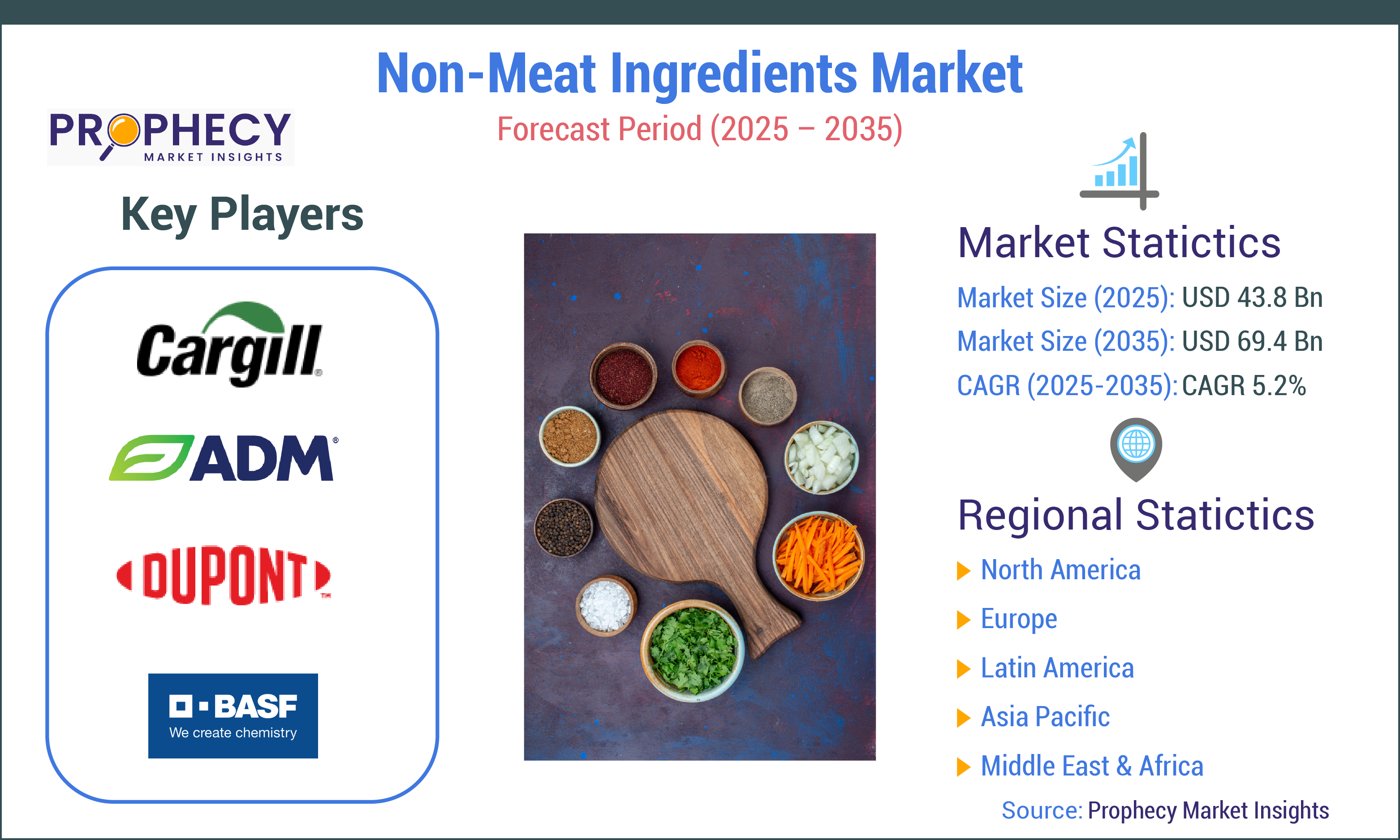
- By 2035, the non-meat ingredients market size is contemplated to enlarge at a valuation of USD 69.4 Billion.
- In 2024, the non-meat ingredients market valuation was USD 42.0 Billion.
- Non-Meat Ingredients Market is developing at a CAGR of 5.2%.
Non-meat ingredients refer to a wide range of substances used in food production-especially processed meats and plant-based options-which do not originate from animal meat. These include binders, filler, flavor, colorants, preservatives, emulsifiers, plant-based proteins, and dietary fiber. Their primary purpose is to enhance the texture, taste, appearance, nutritional value and shelf life of meat and non-meat food products. One of the major benefits of non-meat ingredients is his contribution to health and well-being, as they often have low levels of saturated fat and cholesterol and are rich in fiber and plant proteins. They also support permanent food production by reducing environmental impact, such as greenhouse gas emissions and land use.
Non-meat ingredients market is a growing due to consumer demand for healthy and more durable food options. Awareness about health risks associated with excessive meat consumption-for heart disease, obesity, and high cholesterol-growing, consumers are rapidly turning to plant-based and functional ingredients that provide better nutrition profiles. This change is supported by the global movement towards environmental stability, with more people select products that have low carbon footprints and have low environmental effects.
The future of non-meat ingredient market is shaped by many emerging trends that reflect changing consumer preferences and technological progresses. A major trend is a growing demand for clean-labeled and natural ingredients, as consumers seek rapid transparency and avoid artificial additives in their food. Additionally, stability remains a strong impact, which uses upcycled materials, insect proteins and algae as environmentally friendly options. Integration of AI and smart food technology in product development is also expected to accelerate innovation in this place. As a result, non-meat material market is ready for significant changes, which align with global push towards healthy, moral, and environmentally responsible food habits.
Recession Risk & Tariff Analysis:
- Non-meat ingredient markets with remarkable challenges from the market economic recession and tariff-related trade issues that can affect its development trajectory. During the recession, consumers reduce the expenditure on premiums or special food products, which can slow down the demand for high-cost non-meat ingredients such as novel plant proteins and fermentation-rich components.
- Food manufacturers can also return to innovation and improvement efforts to manage cost, potentially affect market expansion.
Impact of Generative AI on Non-Meat Ingredients Market:
- The emergence of generative AI is ready to significantly affect the non-meat ingredient market by accelerating innovation and optimizing product growth processes. Generative AI equipment can rapidly analyze huge datasets-from consumer preferences and nutritional profiles to molecular structures of ingredients-scientists to increase novels with more accuracy and speed to increase novels, non-meat proteins, taste combinations, and texture.
- This technique also facilitates simulation of component interactions, reducing the time and cost of testing-and-trunk use in developing meat options and functional additives.
Non Meat Ingredients Market Drivers & Restraints
Key Drivers:
Growing Vegan and Vegetarian Populations Driving Demand for Non-Meat Ingredients Market
The growing vegetarian and vegetarian population are significantly increasing the growth of the non-metal material market, as consumers are rapidly looking for plant-based, clean and durable food options. This change in dietary preferences has increased the demand for non-meat components such as soy protein, pea protein, starch, fiber, and natural flavor enhancing the taste, texture and nutritional profiles of meat. Food manufacturers are investing heavy in meat analogs and hybrid products to fulfill this extended consumer base, promoting market expansion.
- For instance, according to the data published by The Vegan Society, approximately 25.8 million people globally tried veganism in January 2025. 81% of consumers had tried plant-based milk, 48% had tried other dairy alternatives, 44% had tried vegan meat alternatives and 25% had tried a vegan egg replacement.
Restraints:
High Cost and Consumer Skepticism can Disturb Market Growth
One of the major restrictions facing non-meat ingredient market is the relatively high cost of special ingredients compared to traditional meat products. Novel proteins such as fermentation-rituals mycoproteins or accurate-integrated dairy options often require sophisticated technology and complex production processes, which increase their price. This value can make the final products less affordable for sensitive consumers, widely limit adoption, especially in developing markets.
- Counterbalance Statement: Progress in technology and scale economies is continuously reducing production costs, making these components more accessible. At the same time, increasing consumer education about the health and environmental benefits of non-metal components is helping to create confidence and acceptance.
Opportunities & Trends:
Innovation and Conscious Consumption Lead the Way to Future
Increasing demand for durable and morally citrus products, with labs, recycled metals, and environmentally friendly packaging, with environmentally friendly packaging among environmentally conscious buyers. Digital transformation is another major driver, as e-commerce platforms are equipped with reality try-on, AI personalities, and virtual consultations increase customers and reach the market globally. Capitalization and optimization continue to receive traction, which gives consumers to be normal, manufactured-to-order pieces, which are designed through new technologies such as tribal AI and 3D printing.
Non Meat Ingredients Market Segmentations & Regional Insights
Product, source, ingredients types, form, application, end-user, and region are the divisions of the non-meat ingredients market.
By Product:
Fresh meat products, processed and cured meat products, marinated and seasoned meat products, ready-to-eat products, frozen meat products, and others are product type on which market is segmented. The processed and cured meat is the first dominant product in non-meat ingredients market share. The reason for this is that processed meat-alternative sausage, daily meat, bacon, and corrected products-usually rely on various non-meat ingredients such as binders, fillers, preservation, taste enhancing and psychiatry to improve texture, taste, shelf life and overall product quality.
Ready to eat products are second dominant in non-meat ingredient market. The growing consumer demand for convenient, nutritious, and healthy food options is increasing this segment, making it an important area for non-meat component use after processed and fixed meat products.
By Source:
On the account of source, the market is categorized into chemical substances, plants, and animals. The Plant-based source is the first dominant in the non-meat ingredients market. This dominance is inspired by the widespread use of plant-ritual proteins (such as soy, peas, wheat gluten), fiber, starch, and natural tastes, which are preferred for their nutritional benefits, stability, and versatility in enhancing meat alternatives and increasing processed meat products.
Chemical substances is the second dominant source in non-meat ingredient market size. These include preservatives (such as sodium nitrite), antioxidants, emulsifiers and pH stabilizers that are artificially produced or chemically modified. They play an important role in enhancing the shelf life, safety and stability of meat and meat-optional products.
By Ingredient Types:
The market is divided into binders, fillers, extenders, flavoring agents, coloring agents, and others by ingredient types. Binders are the first dominant Ingredients in non-meat ingredient market. Binders are necessary to maintain the texture, composition and moisture retention of both processed meats and plant-based meat options. Common binder products such as soy protein, wheat gluten, and starch help to improve stability and cutting quality, making them important in high -volume applications such as sausage, patties, and meat analogs.
Flavoring Agents are second dominant ingredient types in non-meat ingredient market share. Flavoring agents are used widely to enhance the taste and aroma of processed meats, plant-based meat options and ready-to-Eat products. As the consumer demand for meat analogs increases, flavoring agents-two are rapidly important in imitation of natural and synthetic-meat's charming, umami-rich taste.
By Form:
Dry/powder, liquid, and paste/gel are form on which market is divided. Dry/powder is the first dominant form in non-meat ingredient market. Due to its versatility, stability, and extended shelf life. This form is widely preferred in both traditional meat processing and growing plant-based segment, as it allows for easy combination, equal distribution, and coherent functionality in a wide variety of applications.
Liquid is the second dominant form in non-meat ingredient market share. Due to their effectiveness in enhancing taste, moisture, and texture in meat and plant-based yogas. Usually used for liquid smoke, marinade, oil, taste extract, and emulsifiers, liquid forms are favored in marinates, experienced and ready-to-Eat products where uniform distribution and quick absorption are required.
By Application:
Extending meat, binding and emulsifying, texture improvement, improving nutritional value, and others are application of the market. Binding and emulsifying is the first dominant application in non-meat ingredient market share. Due to the structural integrity of meat and meat-optional products, due to its important role in maintaining the texture and moisture retention. Ingredients such as soy protein, carrageenan, starch, and gums are widely used to tie components together and create a similar product stability.
Extending Meat is the second dominant application in non-meat ingredient market growth. Due to need to reduce production costs, improve yield, and increase product stability without renouncing quality. Non-meat materials such as soy flour, textured vegetable protein (TVP), grains, and fiber are usually used to partially replace the meat content while maintaining a uniform texture and appearance.
By End User:
By end user, the market is divided into meat processors, food manufacturers, foodservice industry, and others. Meat processors are first dominant end user in non-meat ingredient market share. Due to their heavy dependence on functional ingredients to increase product quality, shelf life and processing efficiency. These companies use a wide range of non-meat ingredients-including binders, emulsifiers, extenders, flavoring agents, and color-who are processed, fine and ready-to-eat meat products to produce consumer expectations for taste, appearance, and stability.
Food Manufacturer is second dominant end user in non-meat ingredient market size. Due to plant-based meat options, frozen food, snacks, and their extended role in the production of ready-to-Eat foods. These companies use non-meat ingredients such as innovative, shelf-stable and taste enhancing, binders, extenders, and nutritional adders to develop innovative, shelf-stable, and convenient food products.
Regional Insights:
Geographically, the non-meat ingredients market is studied across North America, Europe, Asia Pacific, Latin America, and the Middle East & Africa.
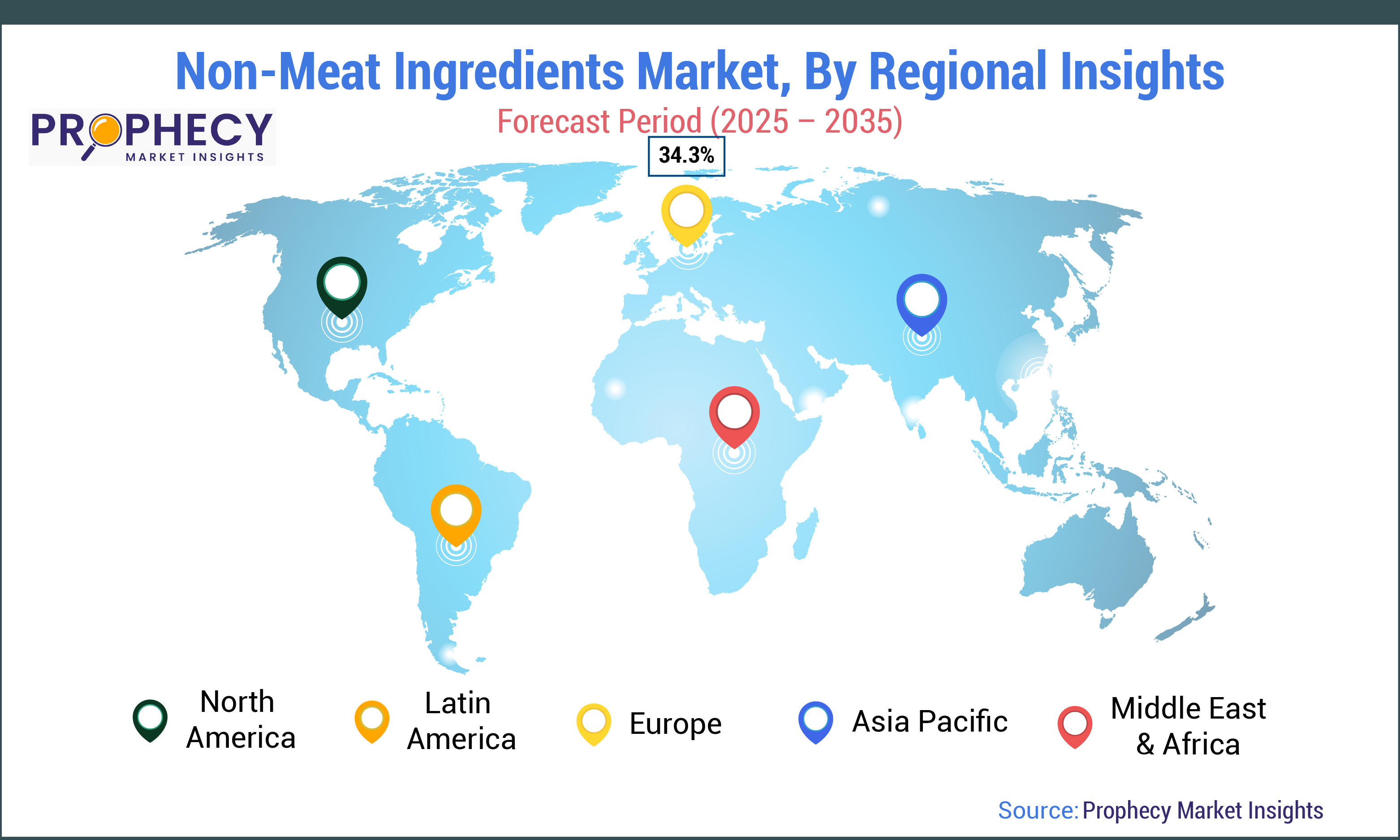
Europe: This is a significant and rapidly growing area in the non-meat ingredient market share, operated by strong consumer demand for durable, clean, and plant-based food products. European consumers are rapidly adopting flexitarian, vegetarian, and vegetarian diet, which is being encouraged to improve products with non-meat materials such as plant proteins, natural taste agents, binders, and preservatives. Countries such as Germany, Netherlands, and UK lead to this trend, which has a high concentration of innovation and product launch in meat options and functional processed foods.
- Germany Non-Meat Ingredients Market Insights:
Germany is currently Europe's most advanced and largest market for non-meat ingredients, with a strong ingredient manufacturing base, widespread consumer acceptance, and supportive retail ecosystems. Growth is fueled by robust production volumes, clear innovation pipelines, and strategic price alignment in supermarkets.
North America: This region holds an important stake in the non-meat ingredients market, which is powered by advanced food processing infrastructure, high consumer awareness and strong demand for clean labels, functional and plant-based products. The region, especially the United States, has seen an increase in health-conscious and flexitarian consumers, promoting the use of non-meat materials in both processed meat and meat-optional products.
- U.S. Non-Meat Ingredients Market Insights:
The American non-meat ingredients market is going to grow strong and rapidly, which is inspired by health awareness, stability, and innovation. Plant protein-especially with soya and pea-dominate, with emerging subtle-and insect-based protein obtaining traction. Despite the challenges of cost and price sensitivity, strong R&D, diverse product channels, and high-profile components are in market positions for continuous growth.
Asia Pacific: This is the fastest growing region in the non-meat ingredients market. Supported by strong government initiative and diverse consumer demand in China, India and ANZ, leading charge with soy-based and emerging pea proteins. The region is ready to redefine global plant-based and meat-vegetable component trends through 2030 and further.
- China Non-Meat Ingredients Market Insights:
China leads the Asia-Pacific in both the pace and speed of development in non-metal components. With strong government support, growing consumer openness, abundant sleeping and pea production, and rapid expansion startup ecosystem, the country is developing in a global innovation center for rapid alternative proteins. The challenges around the cost and local taste adaptation persist, but strategic partnership and local product designs are helping them address them.
Non-Meat Ingredients Market Report Scope:
|
Attribute |
Details |
|
Market Size 2025 |
USD 43.8 Billion |
|
Projected Market Size 2035 |
USD 69.4 Billion |
|
CAGR Growth Rate |
5.2% (2025-2035) |
|
Base year for estimation |
2024 |
|
Forecast period |
2025 – 2035 |
|
Market representation |
Revenue in USD Billion & CAGR from 2025 to 2035 |
|
Regional scope |
North America - U.S. and Canada Europe – Germany, U.K., France, Russia, Italy, Spain, Netherlands, and Rest of Europe Asia Pacific – China, India, Japan, Australia, Indonesia, Malaysia, South Korea, and Rest of Asia-Pacific Latin America - Brazil, Mexico, Argentina, and Rest of Latin America Middle East & Africa – GCC, Israel, South Africa, and Rest of Middle East & Africa |
|
Report coverage |
Revenue forecast, company share, competitive landscape, growth factors, and trends |
Segmentation:
By Product:
- Fresh Meat
- Processed and Cured Meat
- Marinated and Seasoned Meat
- Ready-to-Eat
- Frozen Meat
- Others
By Source:
- Chemical Substances
- Plants
- Animals
By Ingredient Type:
- Binders
- Fillers
- Extenders
- Flavoring Agents
- Coloring Agents
- Others
By Form:
- Dry/Powder
- Liquid
- Paste/Gel
By Application:
- Extending Meat
- Binding and Emulsifying
- Texture Improvement
- Improving Nutritional Value
- Others
By End User:
- Meat Processors
- Food Manufacturers
- Foodservice Industry
- Others
By Region:
- North America
- U.S.
- Canada
- Europe
- Germany
- U.K.
- France
- Russia
- Italy
- Spain
- Netherlands
- Rest of Europe
- Asia Pacific
- China
- India
- Japan
- Australia
- Indonesia
- Malaysia
- South Korea
- Rest of Asia Pacific
- Latin America
- Brazil
- Mexico
- Argentina
- Rest of Latin America
- Middle East & Africa
- GCC
- Israel
- South Africa
- Rest of Middle East & Africa
Non Meat Ingredients Market Competitive Landscape & Key Players
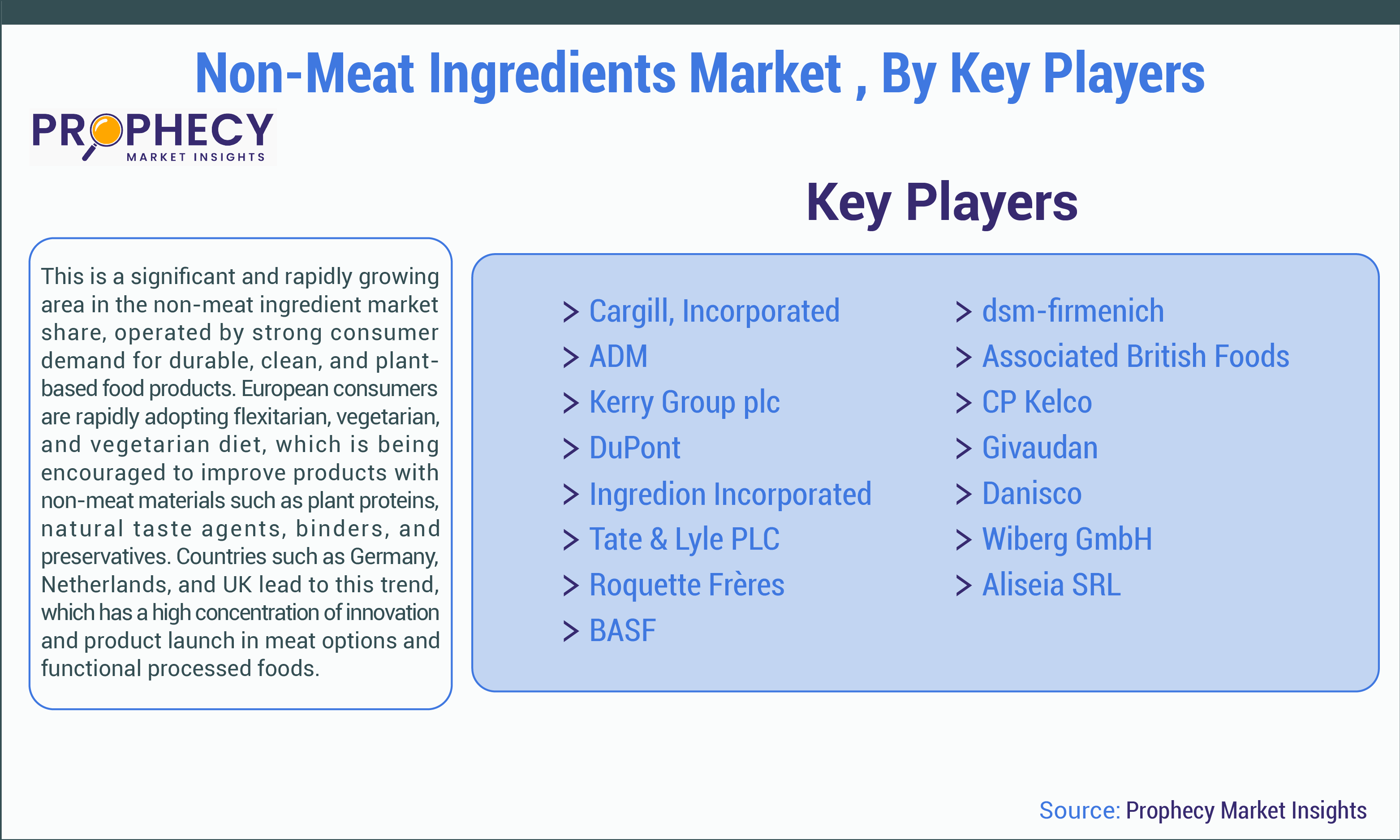
Non-meat content is a dynamic and competitive landscape in the market, inspired by growing global demand for plant-based, functional, and clean food solutions. Leading players such as Kerry Group plc, Cargill, Incorporated, Tate & Lyle, Dsm-firmenich, and ADM dominate the market with diverse portfolio of binders, flavorings, extenders, and plant-based proteins. These companies are investing heavy in R&D to develop multi-functional and durable materials that increase the texture, taste, and nutritional value. Competitive strategies include product innovation, stability initiative, merger and acquisition and regional adaptation.
Non-Meat Ingredients Market Companies:
- Cargill, Incorporated
- ADM
- Kerry Group plc
- DuPont
- Ingredion Incorporated
- Tate & Lyle PLC
- Roquette Frères
- BASF
- dsm-firmenich
- Associated British Foods
- CP Kelco
- Givaudan
- Danisco
- Wiberg GmbH
- Aliseia SRL
View an Additional List of Companies in the Non-Meat Ingredients Market
Non Meat Ingredients Market Recent News
- In April 2025, THIS has announced the launch of a brand-new line based on nutritious, plant-based ingredients. The UK-based vegan meat brand is known for its alternatives to sausages, burgers, and nuggets, but its new products come amid growing demand for more “natural” plant-based options. The Super Superfoods range features two products, Super Block and Marinated Pieces, both made with whole-food ingredients.
- In September 2024, Nosh.bio, a B2B foodtech startup specialising in fermented fungi-based ingredients, has announced a groundbreaking commercial partnership with the zur Mühlen Group (ZMG), one of Europe’s largest sausage producers. This collaboration allows the partners to launch Koji Chunks, a new category of clean-label products. Zur Mühlen Group is part of the Tönnies Group, a leader in the European meat production sector, and will leverage its extensive retailer network to introduce Koji Chunks to the market, starting in Germany.
Analyst View:
Non-meat ingredient market is designed for a strong growth of the market, supported by developing consumer preferences towards healthy, durable, and more moral food options. Analysts believe that the market is not only benefiting from plant-based and increased meat-optional consumption, but also from innovations in food processing technologies and clean label yogas. There is a clear change between manufacturers towards natural, multi-functional ingredients that can repeat the taste, texture, and nutritional profile of traditional meat products without compromising the quality.
More Related Reports
Meat Substitute Market
Meat Market
Meat Ingredients Market
Clean Meat Market
Meat Processing Equipment Market
Non Meat Ingredients Market Company Profile
|
Company Name |
Tate & Lyle |
|
Headquarter |
London |
|
CEO |
Nick Hampton |
|
Employee Count |
4,971 Employees |
Non Meat Ingredients Market Highlights
FAQs
Non-meat ingredients market size was valued at USD 43.8 Billion in 2025 and is expected to reach USD 69.4 Billion by 2035 growing at a CAGR of 5.2%.
Product, source, ingredients types, form, application, end user, and region are the segmentation for the target market.
North America, Asia Pacific, Europe, Latin America, and the Middle East & Africa. North America is expected to dominate the market.
The key players operating the non-meat ingredients market include Cargill, Incorporated, ADM, Kerry Group plc, DuPont, Ingredion Incorporated, Tate & Lyle PLC, Roquette Frères, BASF, Dsm-firmenich, Associated British Foods, CP Kelco, Givaudan, Danisco, Wiberg GmbH, and Aliseia SRL.