Global Meat Substitute Market By Overview
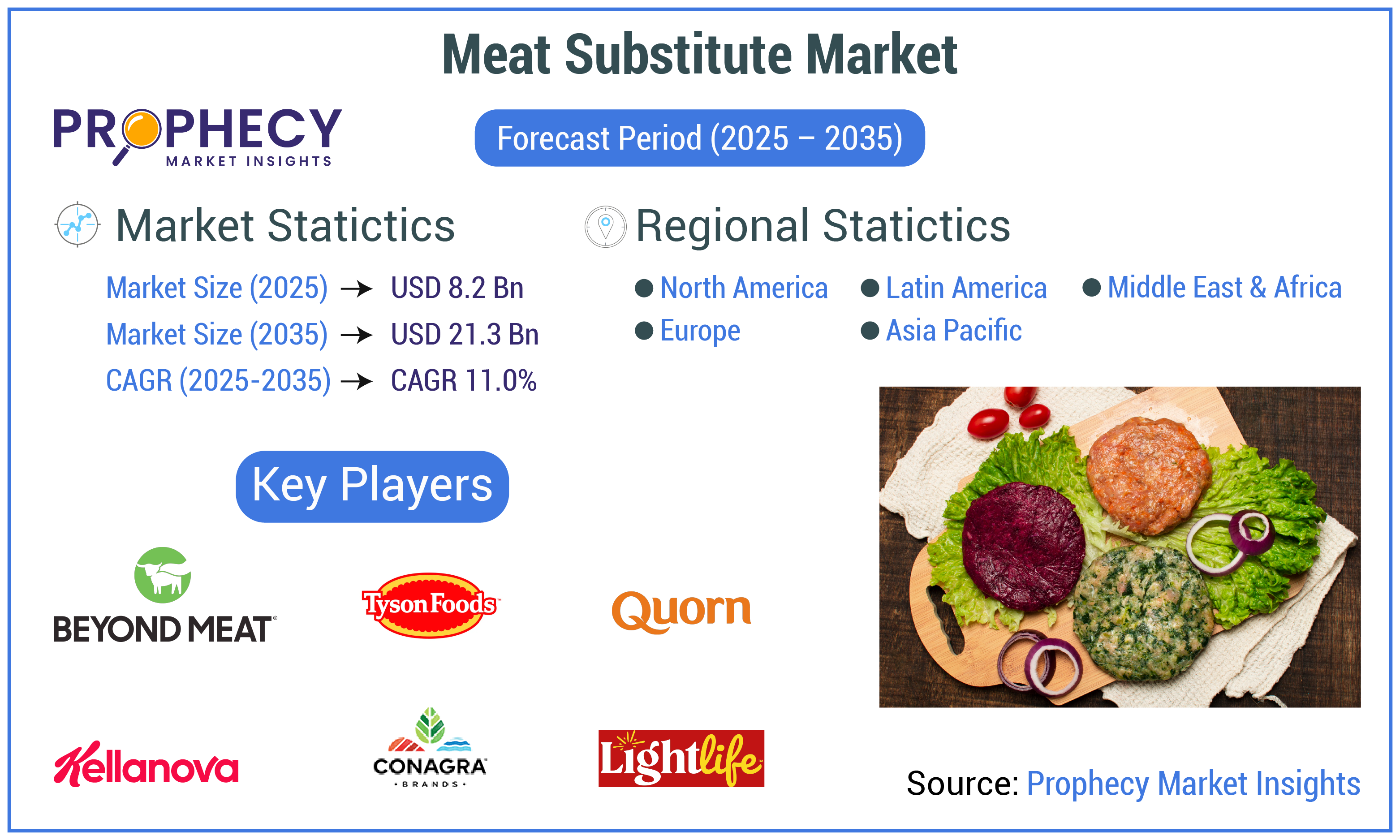
- Meat substitute market size is predicted to progress at a rate of USD 21.3 Billion, by 2035.
- The valuation of the market was accounted for USD 7.5 Billion in 2024.
- Meat substitute market is mounting at a CAGR 11.0%.
A meat substitute is a food product designed to replicate the taste, texture, appearance, and nutritional value of real meat, without using any animal-derived ingredients. These substitutes are developed for vegetarians, vegans, and people seeking to reduce their meat consumption for health, environmental, or ethical reasons. Meat substitutes are made from plant-based ingredients such as soy protein, wheat gluten, legumes, pulses, and even fungi. Meat substitutes aim to provide a similar level of protein, iron, and other essential nutrients as traditional meat.
Rising disposable income, growing health & wellness trends, in which consumers are increasingly prioritizing health, and environmental impact of livestock farming, is shifting global preference towards meat substitute, resulting to propel meat substitute market growth. Growing awareness about ethical, animal welfare considerations, rise in flexitarians, and rapidly growing vegan population is expected to pitch meat substitute market growth. Technological innovations in more realistic textures, flavors, and supportive government policies, regulations, promoting plant-based diets, is estimated to impel meat substitute market growth.
Expansion in emerging markets due to both traditional vegetarian diets and modern health awareness, growing focus on product innovation, diversification, and partnering with global chains to gain mass exposure, increase sales channels, is projected to boost meat substitute market growth. Retailers are launching their own plant-based brands, expanding shelf space for meat substitutes in retails, increasing demand for clean-label, organic meat substitutes, and increasing investment, fueling R&D, marketing, and global expansion, is propelling meat substitute market growth.
Recession Risk and Tarriff Analysis on Meat Substitute Market:
- During economic recessions, consumers often shift toward lower-cost food options. Many meat substitutes have higher price than conventional meat, especially in premium plant-based or lab-grown products. Budget-conscious consumers might choose for traditional protein sources such as eggs, legumes, or affordable meats, which could temporarily hinder the market's growth during financial downturns.
- Tariffs and trade barriers can impact the cost of importing key raw materials or finished meat substitute products, especially in regions dependent on global supply chains. Countries with protective agricultural policies may impose duties to favor local producers, potentially raising prices for consumers and limiting international market expansion.
Impact of Generative AI on Meat Substitute Market:
- AI model helps to analyses different plant proteins, binders, and flavor compounds interaction, which enables food scientists to design meat alternatives with better taste, texture, and nutritional profiles.
- AI algorithms can predict successful ingredient combinations, dramatically reducing development time and cost. AI tools can analyze social media, acquire patterns, and reviews to understand shifting preferences and emerging trends.
Global Meat Substitute Market By Drivers & Restraints
Key Drivers:
Rising Disposable Income can Stimulate Market Augmentation
As consumer income increases, the ability to spend on higher-quality, health-oriented, and environmentally sustainable food options increases. Traditionally, plant-based meat alternatives have higher price compared to conventional meat due to higher production costs and advanced processing techniques. With more income at their disposal, consumers, especially in urban and middle-class segments are increasingly choosing products that align with their lifestyle values, such as health, wellness, animal welfare, and environmental sustainability. In developing regions rising income levels are driving changes in dietary patterns. Consumers are shifting from basic, chief foods to more diverse and protein-rich diets, which opens the door for alternative protein products such as soy, pea, or mycoprotein-based meat substitutes. Higher income levels support growth in premium and specialty plant-based categories, such as organic, non-GMO, and clean-label meat alternatives, resulting to boost meat substitute market growth.
- For instance, according to article published in February 2024, this article states that, the demand for on-the-go snack is continuously expanding, due to busy lifestyle, and the need for quick, easy solution. Fruit and vegetable snacks consumed by 60% globally. As the growing health awareness, increasing interest in snacks that cater to specific dietary needs, such as gluten-free, keto, vegan, or high-protein options. 7/10 children take snacks at least once a day or more, this is higher rate in North America and Asia.
Restraints:
Market Hindered by High Production Costs
Meat substitute has the high production costs compared to traditional meat. These costs shoot from the use of specialized raw materials such as plant proteins, advanced processing technologies, and research-intensive development processes to replicate the taste and texture of meat. The newer technologies such as cell-based or cultured meat require expensive facilities and equipment, which further drive-up costs. As a result, many plant-based meat products are priced higher than conventional meat, which limits target market growth.
- Counterbalance Statements: Innovations in alternative protein extraction and processing methods, with improvements in ingredient sourcing, are making it more cost-effective to produce meat substitutes. The rising consumer willingness to pay a premium for sustainable and ethical products supports the market’s growth.
Opportunities & Trends:
Rapid Adoption of Plant-based Food will Create Significant Opportunities
As more consumers become health-conscious and environmentally aware, there is a growing shift towards vegetarian, vegan, and flexitarian diets, which expanding the demand for tasty, nutritious, and convenient plant-based meat alternatives. Advances in food technology and innovation, such as the development of new protein sources and improved taste, texture, are attracting traditional plant-based consumers and meat eaters looking for healthier or more sustainable options. The greater availability of these products in mainstream supermarkets, restaurants, and fast-food chains is making plant-based foods more accessible to a wider audience. Supportive government policies promoting sustainability, with rising incomes and urbanization in emerging markets boost market expansion. Thus, the growing adoption of plant-based foods is significantly driving meat substitute market share.
- For instance, according to article published by Euromonitor is privately owned & trademarked, in March 2023, this article states that, there were 30% of consumers are aimed to reduce animal products consumption products. The plant-based innovation targeted at dairy, meats, and become wide-ranging across Western Europe. About 18% of consumers choosing a dairy-free diet. Of those consumers following a flexitarian/plant-based diet, 42% of global consumers are focused to reduce their impact on the environment. Advances in production methods have allowed diversification in recent years.
Global Meat Substitute Market By Segmentations & Regional Insights
The meat substitute market is segmented into product, type, form, category, source, distribution channel, and region.
By Product:
Based on product, the market is divided into tofu, tempeh, textured vegetable protein, seitan, Quorn, and others. The textured vegetable protein holds the major meat substitute market share, due to its cost-effectiveness, high protein content, and wide applicability in processed food products such as patties, nuggets, and meatless sausages. It is made mainly from soy flour, and has a meat-like texture after hydrated, making it a popular choice for manufacturers aiming to replicate traditional meat products on a large scale, is booming the segment’s expansion in meat substitute market size.
The second leading product segment is tofu, a traditional soy-based food that has seen growing global demand, particularly among health-conscious and vegetarian consumers. Tofu is valued for its nutritional benefits, including being rich in plant-based protein, calcium, and iron. It is also widely accepted due to its mild flavor, culinary flexibility, and easily absorbing the flavors of various dishes, is predicted to enhance segment growth in meat substitute market share.
By Type:
Concentrates, isolates and textured are categorized by type in the market. Texture proteins is most dominating segment in the market. Textured proteins are valued for their ability to mimic the fibrous texture of meat, making them ideal for creating meat-like products such as burgers, sausages, and nuggets. This offer a chewy, meat-like bite and are commonly made from soy or pea protein, which makes them highly popular among manufacturers and consumers seeking realistic plant-based alternatives, is anticipated to fuel segment’s development in meat substitute market size.
The isolates is second leading segment. Isolates are highly refined forms of protein with a high protein content and minimal fat or carbohydrates. This are widely used in meat substitutes to improve nutritional quality, texture, and binding properties. Isolates provide a smooth, consistent protein base that enhances the overall product quality, especially in processed meat alternatives such as patties and deli slices, is projected to boost meat substitute market share in given segment.
By Form:
The target market is divided into solid and liquid by form. The solid is superior segment in the market. Solid meat substitutes include products such as tofu blocks, tempeh, textured vegetable protein chunks, plant-based burgers, sausages, and nuggets. These products are more widely consumed due to this are closely resemble traditional meat in texture and use, making them popular among consumers seeking direct meat replacements, is assessed to boost segment’s extension in meat substitute market size.
By Category:
On the basis of category, the market is segmented into, frozen, refrigerated, and shelf table. The frozen is most leading segment in meat substitute market share. Frozen meat substitutes, such as plant-based burgers, nuggets, sausages, and other ready-to-cook items, have gained widespread popularity due to their convenience, longer shelf life, and ability to preserve taste and texture better than fresh alternatives. Consumers appreciate frozen products for easy storage and quick preparation, which has driven strong demand in retail and foodservice sectors, is estimated to impel meat substitute market growth.
By Source:
By source, meat substitute market is divided into, soy protein, and wheat protein, pea protein, and others. The meat substitute market share is dominated by soy protein due to its high protein quality, affordability, and use in meat alternatives such as tofu, tempeh, and textured vegetable protein. It offers excellent functional properties such as good texture and binding ability, making it a preferred choice for many manufacturers globally, resulting to boost segment’s development in meat substitute market size.
By Distribution Channel:
Under distribution channel, the market is categorized into hypermarkets & supermarkets, convenience stores, online retails, and others. Hypermarkets & supermarkets are the leading distribution channel for meat substitute globally. These outlets offer a wide variety of snack brands, bulk purchasing options, and frequent in-store promotions. Their large footprint, especially in urban and suburban areas, makes them the preferred choice for consumers looking for variety and value, is estimated to impel meat substitute market share in given segment.
Regional Insights:
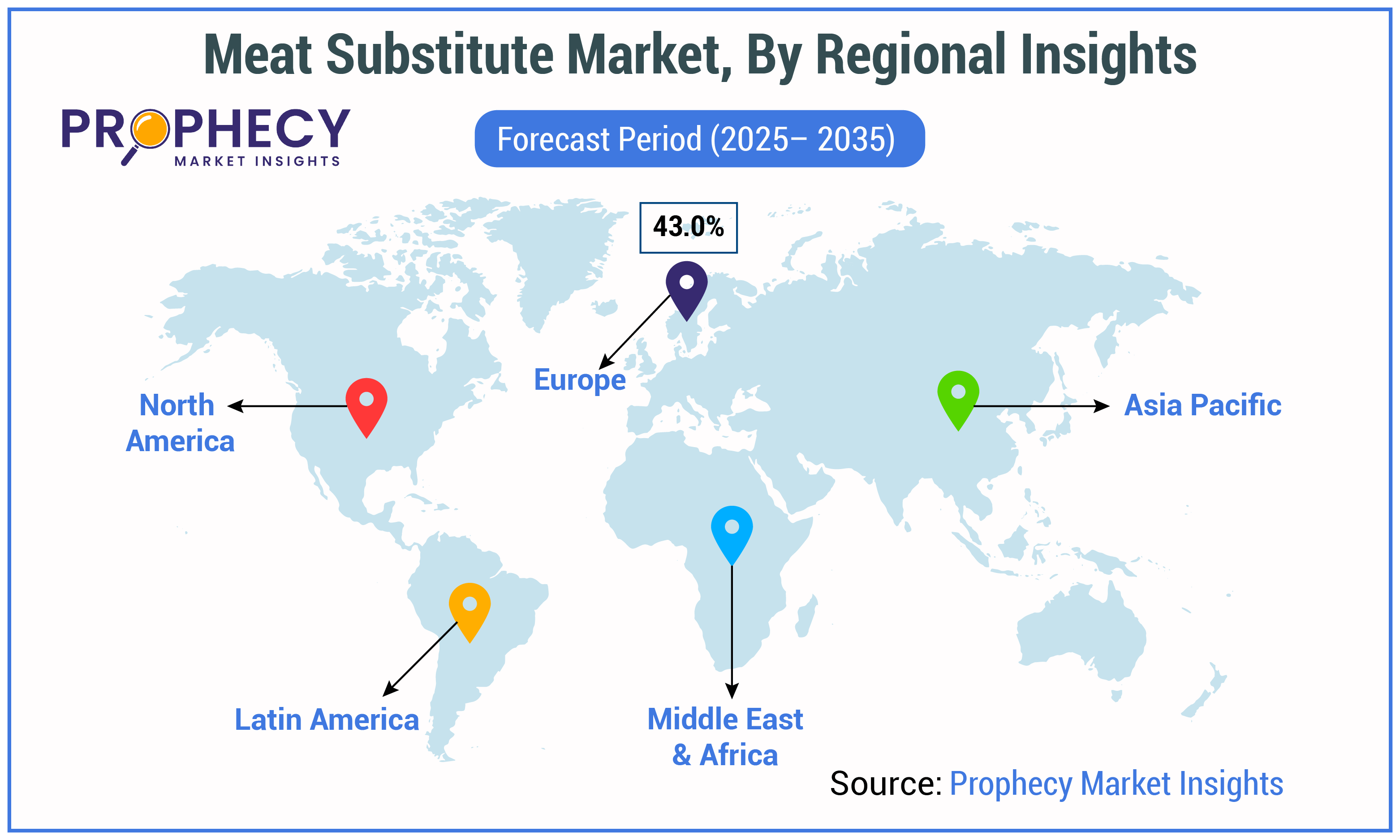
Geographically, the market is studied across North America, Europe, Asia Pacific, Latin America, and the Middle East & Africa.
Europe: This region is the dominant player in the market holding a 37.4% of global market share. This leadership is driven by strong consumer awareness about health and environmental issues, widespread vegetarian and vegan populations, supportive government policies, and well-developed retail and foodservice infrastructure, contributing to propel segment’s expansion in meat substitute market size.
- U.K. Meat Substitute Market Insights:
U.K. is the leading country in the Europe for target market. The U.K. has a strong vegan and vegetarian population, progressive food policies, and significant investments in plant-based startups. Consumer awareness around sustainability and animal welfare further boosts demand here, resulting to fuel meat substitute market share.
North America: This region is the second dominating market. It has high consumer demand for innovative plant-based products, significant investments by major companies, and increasing adoption of flexitarian diets. The U.S. and Canada are key markets, with presence of major companies shifting the plant-based trend, is expected to drive meat substitute market share.
- U.S. Meat Substitute Market Insights:
The U.S. is the largest and most dominant country in the North America market. It leads in innovation, consumer adoption, and market size, with major brands. The U.S. has a large base of health-conscious and environmentally aware consumers driving demand for plant-based meat alternatives, resulting to drive meat substitute market growth.
Asia Pacific: This region is emerging as a fast-growing and increasingly important market in the meat substitute. This growth is driven by a combination of rising health consciousness, increasing environmental awareness, and a growing middle class with higher disposable income. Traditional plant-based diets in parts of Asia provide a strong cultural foundation for acceptance, in which younger consumers are embracing innovative meat alternatives inspired by Western trends, is anticipated to propel meat substitute market share.
- China Meat Substitute Market Insights:
China is the dominating country in the Asia-Pacific region. With its massive population and growing middle class, China is seeing increasing interest in plant-based proteins as health and environmental concerns rise. China’s sheer scale and rapid modernization make it a key player in the region’s meat substitute market growth.
Meat Substitute Market Report Scope:
|
Attribute |
Details |
|
Market Size 2025 |
USD 8.2 Billion |
|
Projected Market Size 2035 |
USD 21.3 Billion |
|
CAGR Growth Rate |
11.0% (2025-2035) |
|
Base year for estimation |
2024 |
|
Forecast period |
2025 – 2035 |
|
Market representation |
Revenue in USD Billion & CAGR from 2025 to 2035 |
|
Regional scope |
North America - U.S. and Canada Europe – Germany, U.K., France, Russia, Italy, Spain, Netherlands, and Rest of Europe Asia Pacific – China, India, Japan, Australia, Indonesia, Malaysia, South Korea, and Rest of Asia-Pacific Latin America - Brazil, Mexico, Argentina, and Rest of Latin America Middle East & Africa – GCC, Israel, South Africa, and Rest of Middle East & Africa |
|
Report coverage |
Revenue forecast, company share, competitive landscape, growth factors, and trends |
Segmentation:
By Product:
- Tofu
- Tempeh
- Textured Vegetable Protein
- Seitan
- Quorn
- Others
By Type:
- Concentrates
- Isolates
- Textured
By Form:
- Solid
- Liquid
By Category:
- Frozen
- Refrigerated
- Shelf Table
By Source:
- Soy Protein
- Wheat Protein
- Pea Protein
- Others
By Distribution Channel:
- Hypermarkets & Supermarkets
- Convenience Stores
- Online Retails
- Others
By Region:
- North America
- U.S.
- Canada
- Europe
- Germany
- U.K.
- France
- Russia
- Italy
- Spain
- Netherlands
- Rest of Europe
- Asia Pacific
- China
- India
- Japan
- Australia
- Indonesia
- Malaysia
- South Korea
- Rest of Asia Pacific
- Latin America
- Brazil
- Mexico
- Argentina
- Rest of Latin America
- Middle East & Africa
- GCC
- Israel
- South Africa
- Rest of Middle East & Africa
Global Meat Substitute Market By Competitive Landscape & Key Players
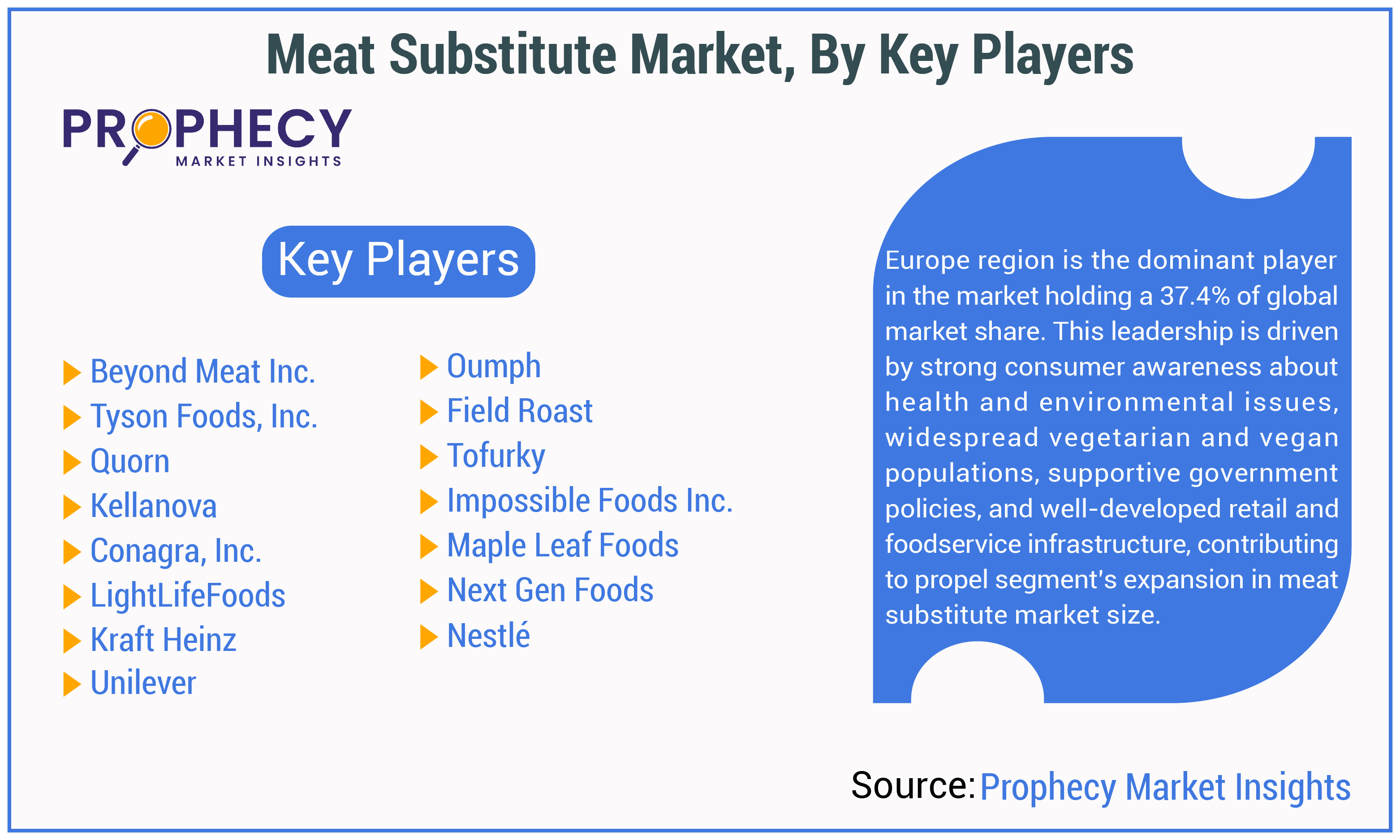
The main key players operating in the meat substitute market are, Beyond Meat Inc., Mondel?z International, Kellanova, and others. These companies are constantly innovating, expanding their product portfolios, and optimizing production processes to meet the evolving demands of consumers, through their collaboration or partnerships. Companies are investing in research and development (R&D) to introduce innovative Sourceed products, resulting to propel meat substitute market growth.
Meat Substitute Market Companies:
- Beyond Meat Inc.
- Tyson Foods, Inc.
- Quorn
- Kellanova
- Conagra, Inc.
- LightLifeFoods
- Kraft Heinz
- Unilever
- Oumph!
- Field Roast
- Tofurky
- Impossible Foods Inc.
- Maple Leaf Foods
- Next Gen Foods
- Nestlé
View an Additional List of Companies in the Meat Substitute Market
Global Meat Substitute Market By Recent News
- In May 2025, Swedish foodtech startup Millow opened its first commercial-scale factory at a former LEGO production hall in Gothenburg. This facility used patented dry fermentation process in which mycelium, a rootlike structure of fungus, that feed on oats in a bioreactor. The rapidly growing meat alternative that can replace beef mince, doner kebab, and others. The Millow aimed to produce 500Kg of mycoprotein per day, and gives alternative meat sector.
- In April 2025, THIS launched brand new line based nutritious, plant-based ingredients. The U.K. based vegan meat brand new product aimed to meet growing demand for more natural plant-based options. The Super Superfoods range featured with two products, Super Block and Marinated Pieces, both made with whole-food ingredients. THIS vegan meat products were available in supermarkets, and this focused-on alternatives that were considered as ultra-processed.
- In February 2025, Plant-based steak purveyors Juicy Marbles launched its Meaty meal lamb meat alternative. This was known as innovative vegan meat products ush as Whole Cut Loin, and Thick Cut Filet, which both contain 20g protein per portion. The vegan meat was remarked as very similar taste and structure to a real steak.
- In January 2025, Project Eaden, a Berlin-based startup deploying fiber spinning and computing technology created Ultra-realistic meat alternatives, raised USD 15.6 million Series A round. This funding aimed to support R&D work to develop additional products such as bacon, pork loins and beef steaks, which did not face regulatory hurdled to get is goods to market.
Analyst View:
The meat substitute market driven by rising number of health-conscious, flexitarian, vegan, vegetarian consumers, and increasing awareness of the environmental impact of livestock farming. Continuous R&D in plant-based, cell-based technologies, retail, foodservice penetration, rising disposable income, and growing demand for plant-based food, is expected to pitch meat substitute market growth.
More Related Reports
Meat Market
Meat Ingredients Market
Non-Meat Ingredients Market
Clean Meat Market
Meat Processing Equipment Market
Global Meat Substitute Market By Company Profile
|
Company Name |
Nestlé |
|
Headquarter |
Vevey, Switzerland |
|
CEO |
Laurent Freixe |
|
Employee Count |
277,000 Employees |
Global Meat Substitute Market By Highlights
FAQs
Meat substitute market size was valued at USD 8.2 Billion in 2025 and is expected to reach USD 21.3 Billion by 2035 growing at a CAGR of 11.0%.
Product, type, form, category, source, distribution channel, and region are the segmentation for the target market.
North America, Asia Pacific, Europe, Latin America, and the Middle East & Africa. Europe is expected to dominate the market.
The key players operating in the meat substitute market include Beyond Meat Inc., Tyson Foods, Inc., Quorn, Kellanova, Conagra, Inc., LightLifeFoods, Kraft Heinz, Unilever, Oumph, Field Roast, Tofurky, Impossible Foods Inc., Maple Leaf Foods, Next Gen Foods, and Nestlé