Global GridScale Battery Storage Technologies Overview
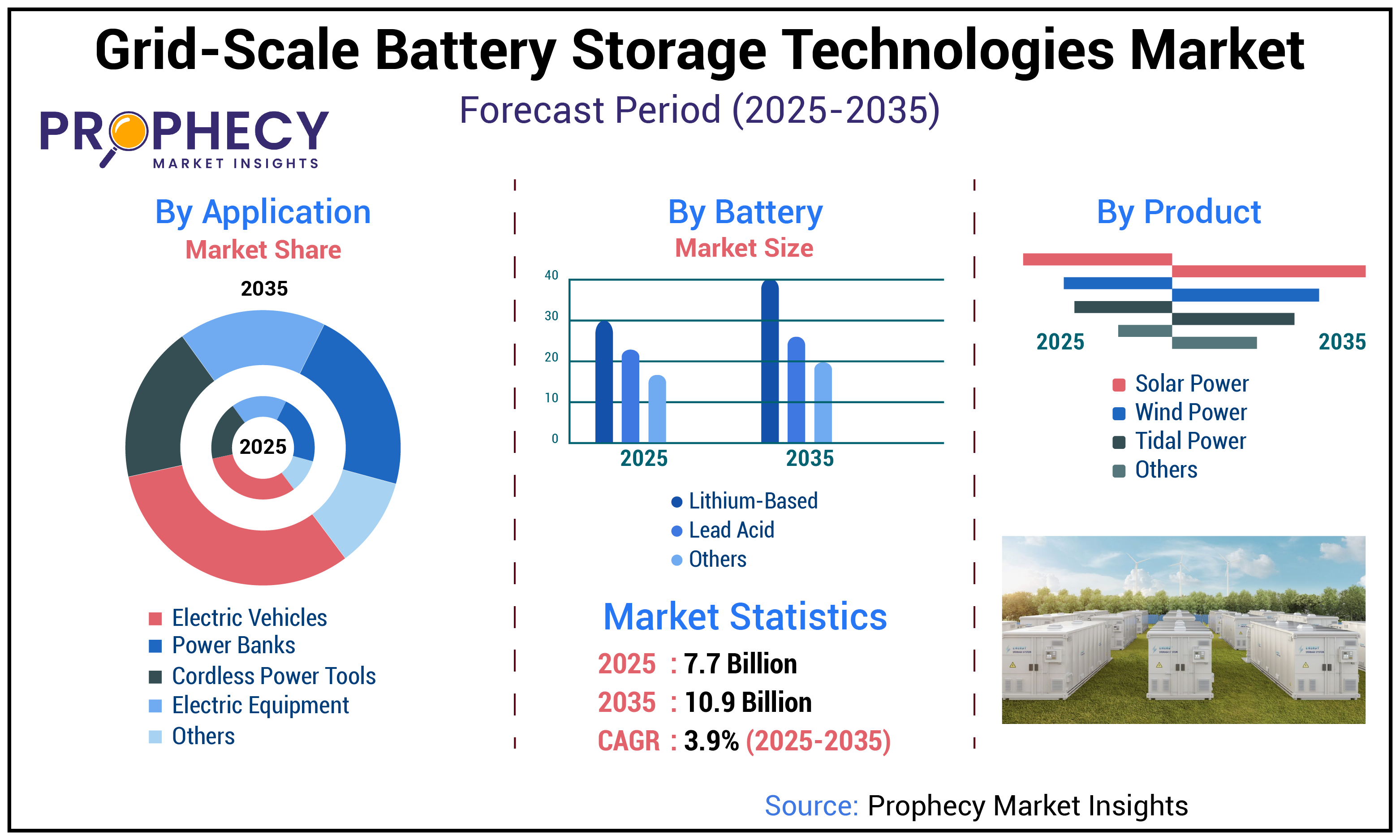
- Grid-Scale battery storage technologies market size is expected to develop at a rate of USD 10.9 Billion, by 2035.
- In 2024, the market valuation was USD 7.2 Billion.
- Grid-Scale battery storage technologies market is expanding at a CAGR 3.9%.
Grid-scale battery storage refers to the technology that uses large-scale battery systems to store electricity from the grid or renewable sources for later use. These systems, also known as Battery Energy Storage Systems (BESS), help balance the electrical grid by storing excess energy during low demand and releasing it during peak demand. It offers several advantages, for enhancing grid stability, integrating renewable energy, and improving energy system resilience. These systems can store energy during low demand periods and release it during peak hours, providing crucial backup power during outages and reducing reliance on fossil fuels.
The rising urbanization and industrialization, the rising adoption of renewable energy sources such as, solar and wind necessitates storage solutions to ensure a consistent and reliable power supply, favorable government policies, such as mandates for renewable energy and carbon reduction goals, are also fueling the demand for grid-scale battery storage, and the increasing energy demand are factors contributing in driving the grid-scale battery storage technologies market growth.
The market’s expansion is also stimulated by significant advancements in battery technology, especially in lithium-ion batteries, which have led to lower production costs and improved performance. Innovations in materials and manufacturing processes are further driving down prices, making grid-scale battery storage more economically viable. Moreover, battery storage can help improve the stability and reliability of the electricity grid by providing fast frequency response, peak load shaving, and backup power during outages.
Recession Risk and Tariff Analysis:
- The grid-scale battery storage technologies market is resilient in the face of global economic uncertainty, thanks to supportive policies, falling battery prices, and the need to incorporate renewable energy sources. Technological developments and the growing need for grid dependability are driving the sector's expansion, despite the high upfront costs and ongoing supply chain difficulties.
- In the grid-scale battery storage technologies market, tariff analysis looks at how import taxes and trade regulations affect the price of technology. While advantageous policies encourage investment and competition, high tariffs on battery components, such as lithium cells, can increase project costs. Pricing strategy, supply chain planning, and international market access all depend on an understanding of these tariffs.
Impact of Generative AI on Grid-Scale Battery Storage Technologies Market:
- Grid-scale battery storage technologies is changing as a result of generative AI's improvements in sustainability, dependability, and efficiency. It optimizes the cycles of battery charging and discharging by enabling predictive analytics for energy demand and renewable generation. As a result, the grid becomes more stable and depends less on fossil fuels.
- Innovations powered by AI speed up the development of battery technology while reducing prices and deployment timelines. The industry is anticipated to expand dramatically due to AI's contribution to operational optimization and the integration of renewable energy sources.
Global GridScale Battery Storage Technologies Drivers & Restraints
Key Drivers:
Rapid Urbanization is Stimulating the Market Augmentation
The grid-scale battery storage technologies market growth is due to rapid urbanization. Strong energy infrastructure is required as the demand for dependable electricity rises with the size of metropolitan populations. This is addressed by grid-scale batteries, which integrate renewable energy sources, stabilize the power supply, and manage peak loads—all of which are critical in highly populated places. Regions such as Asia Pacific, experiencing swift urban development, are witnessing increased investments in battery storage solutions to meet escalating energy needs and support sustainable urban growth.
- For instance, according to the data published by World Bank Group, in order to fulfill the World Bank's purpose of eradicating poverty and promoting shared prosperity on a habitable world, more livable cities must be built. Currently, 4.4 billion people, or more than half of the world's population, reside in urban areas. This trend is predicted to continue, with nearly seven out of ten people living in cities by 2050, when the urban population is predicted to more than quadruple.
Restraints:
The Limited Lifespan of Grid-Scale Battery Storage Technologies is Limiting the Market Expansion
Grid-scale battery storage technology' short lifespan and gradual deterioration are two of its main drawbacks. Batteries lose efficiency with repeated cycles of charging and discharging, which lowers its dependability and storage capacity. The stability of long-term energy storage systems is impacted by this performance decline, which calls for periodic maintenance or replacements. Furthermore, as batteries contain hazardous elements, recycling and disposing of it presents environmental issues that strain waste management systems and raise questions about ecological effect and sustainability.
- Counterbalance Statements: Research should concentrate on creating cutting-edge materials with longer cycle lives and greater robustness in order to combat battery deterioration. AI-powered predictive maintenance can prolong battery life and maximize utilization. Furthermore, the environmental dangers connected with battery end-of-life can be reduced by using eco-friendly disposal techniques and a strong recycling infrastructure.
Opportunities & Trends:
Integration of Advanced Storage Technologies is Unlocking Growth Opportunities for the Impending Years
The grid-scale battery storage technologies market is expected to develop rapidly due to the advent of sophisticated storage technologies such as pumped-storage hydropower (PSH). Large-scale, long-duration energy storage capabilities provided by PSH improve grid stability and make it easier to integrate sporadic renewable energy sources such as solar and wind. PSH speeds up the implementation of various energy storage options to meet future energy demands by enabling more effective energy management and load balancing in conjunction with battery storage systems.
- For instance, according to the facts published by IEA, pumped-storage hydropower is the most widely used storage technology and it has significant additional potential in several regions. Batteries are the most scalable type of grid-scale storage and the market has seen strong growth in recent years. Other storage technologies include compressed air and gravity storage, but it plays a comparatively small role in current power systems. Additionally, hydrogen which is detailed separately is an emerging technology that has potential for the seasonal storage of renewable energy.
Global GridScale Battery Storage Technologies Segmentations & Regional Insights
The grid-scale battery storage technologies market is segmented into product type, application, and region.
By Product Type:
On the basis of product type, the market is trifurcated into tidal power, wind power, and solar power. The solar power segment is attributed to rule over the grid-scale battery storage technologies market share. This is due to the versatility and scalability of battery technology, especially lithium-ion, which is suitable for diverse applications, including storing energy from variable renewable sources such as wind and solar.
The wind power segment is the second dominating product type in the grid-scale battery storage technologies market. This is due to the fact that wind energy, such as solar power, is intermittent and relies on battery storage to ensure a reliable and consistent power supply to the grid.
By Battery Type:
Contingent to battery type, the market is divided into lead acid, lithium-based, and others. The lithium-based segment is the dominating battery type, in the grid-scale battery storage technologies market share. This is due to its high energy density, long lifespan, and declining costs. These factors make them well-suited for various applications, including electric vehicles and large-scale energy storage systems.
The lead acid segment is the second dominating battery type, in the grid-scale battery storage technologies market. This is due to its established presence, cost-effectiveness, and reliability. While lithium-ion batteries dominate, lead-acid batteries offer a more budget-friendly option for utilities aiming to enhance grid stability and resilience.
By Application:
Dependent on application, the market is sub-segmented into electric vehicles, power banks, cordless power tools, electric equipment, and others. The electric vehicles segment is expected to dominate the grid-scale battery storage technologies market share. This is due to the massive deployment of EVs and the increasing need for grid-scale storage to support renewable energy integration and grid stability.
The power banks segment is the second leading application in the grid-scale battery storage technologies market. This is due to a combination of factors, cost-effectiveness, rapid deployment, and multiple applications.
By End-User:
Appertaining from end-user, the market is classified into utilities and grid operators, independent power producers, commercial and industrial customers, and others. The independent power producers segment is the leading end-user, in the grid-scale battery storage technologies market share. This is due to the increasing deployment of renewable energy sources like solar and wind, where IPPs play a significant role in energy generation and often integrate battery storage to manage intermittency and improve grid stability.
The utilities and grid operators segment is the second leading end-user, in the grid-scale battery storage technologies market. This is due to its role in maintaining grid stability, integrating renewable energy, and managing peak demand.
Regional Insights:
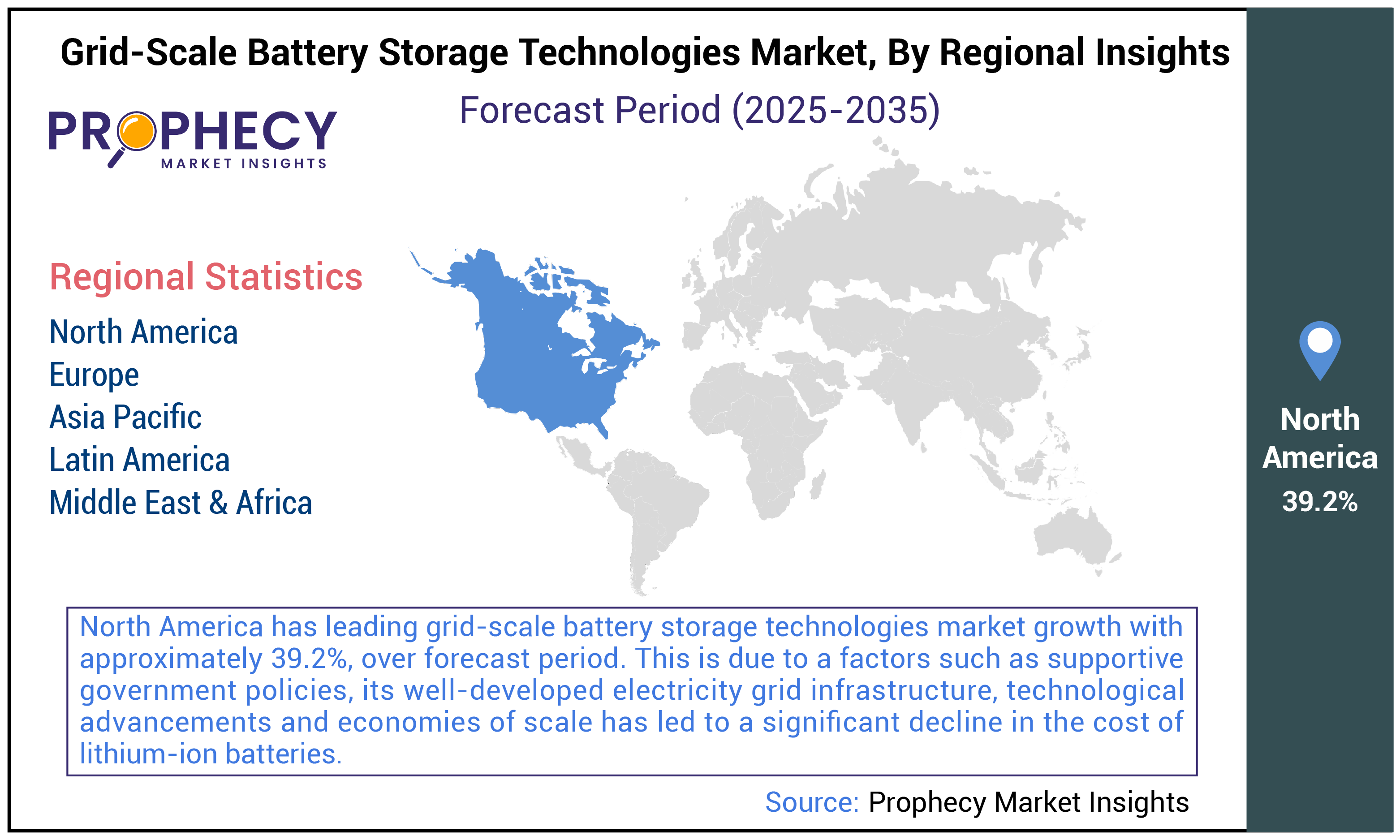
Geographically, the market is studied across North America, Europe, Asia Pacific, Latin America, and the Middle East & Africa.
North America: This is the region which has the leading grid-scale battery storage technologies market share by approximately 39.2%, in the recent years. This is due to a combination of factors, such as, supportive government policies, such as the Inflation Reduction Act in the US, provide tax incentives and subsidies for energy storage projects, its well-developed electricity grid infrastructure which enables the integration of renewable sources such as solar and wind, and technological advancements and economies of scale have led to a significant decline in the cost of lithium-ion batteries. Additionally, utilities are investing in grid modernization to enhance reliability and flexibility, driving the need for grid-scale battery systems to manage grid fluctuations and intermittency, thus driving its market expansion.
- U.S. Grid-Scale Battery Storage Technologies Market Insights:
The grid-scale battery storage technologies market in the U.S. is the most superior market, in the recent years. This is due to robust renewable energy infrastructure, supportive government policies (such as the Inflation Reduction Act), and declining battery costs. Furthermore, the U.S. is actively investing in grid modernization and energy security, with California and Texas being key regions for deployment. California and Texas are leading the way in large-scale battery storage deployments, driven by its high renewable energy penetration and supportive policies.
Asia Pacific: This is the region which has the grid-scale battery storage technologies, growing with the fastest growth rate, during the forecast period, in the recent years. This is due to a combination of factors, such as this region’s significant surge in renewable energy generation, particularly solar and wind power, rapid urbanization and industrialization and population growth in many Asia Pacific countries lead to a consistently high demand for electricity, favorable government policies, including tax breaks for renewable energy, incentives for energy storage, and regulations promoting energy efficiency, the declining battery costs, and the electrification of remote areas.
- China Grid-Scale Battery Storage Technologies Market Insights:
The grid-scale battery storage technologies market in China is growing with the highest CAGR, during the forecast period, in the recent years. This dominance is driven by several factors, including strong government support, investments in research and development, and robust manufacturing capabilities. China's commitment to renewable energy integration and grid modernization, coupled with the development of sodium-ion battery technology, has led to numerous large-scale energy storage projects. Moreover, the development of sodium-ion batteries in China is seen as a way to reduce reliance on lithium and other critical materials, further bolstering the country's position in the market.
Europe: This is the region which is experiencing significant grid-scale battery storage technologies market growth, in the recent years. This is due to a confluence of factors, including ambitious climate goals, a growing reliance on renewable energy sources, and supportive regulatory frameworks. The European Union's commitment to carbon neutrality by 2050, coupled with policies promoting energy efficiency and sustainability, has spurred investments in energy storage technologies. Lithium-ion batteries, with its high energy density and efficiency, dominate the European BESS market, further contributing to the region's strong position in the grid-scale battery storage sector.
- U.K. Grid-Scale Battery Storage Technologies Market Insights:
The grid-scale battery storage technologies market in the U.K. is experiencing considerate amount of growth, in the recent years. This is due to its ambitious energy transition projects and a supportive regulatory framework that incentivizes the deployment of renewable energy sources, including co-located storage facilities. Moreover, this country is heavily investing in renewable energy and storage solutions, with initiatives such as the European Commission's Net Zero Industry Act and proposed reforms for Electricity Market Design.
|
Attribute |
Details |
|
Market Size 2025 |
USD 7.7 Billion |
|
Projected Market Size 2035 |
USD 10.9 Billion |
|
CAGR Growth Rate |
3.9% (2025-2035) |
|
Base year for estimation |
2024 |
|
Forecast period |
2025 – 2035 |
|
Market representation |
Revenue in USD Billion & CAGR from 2025 to 2035 |
|
Regional scope |
North America - U.S. and Canada Europe – Germany, U.K., France, Russia, Italy, Spain, Netherlands, and Rest of Europe Asia Pacific – China, India, Japan, Australia, Indonesia, Malaysia, South Korea, and Rest of Asia-Pacific Latin America - Brazil, Mexico, Argentina, and Rest of Latin America Middle East & Africa – GCC, Israel, South Africa, and Rest of Middle East & Africa |
|
Report coverage |
Revenue forecast, company share, competitive landscape, growth factors, and trends |
Segmentation:
By Product Type:
- Tidal Power
- Wind Power
- Solar Power
By Battery Type:
- Lead Acid
- Lithium-Based
- Others
By Application:
- Electric Vehicles
- Power Banks
- Cordless Power Tools
- Electric Equipment
- Others
By End-User:
- Utilities and Grid Operators
- Independent Power Producers
- Commercial and Industrial Customers
- Others
By Region:
- North America
- U.S.
- Canada
- Europe
- Germany
- U.K.
- France
- Russia
- Italy
- Spain
- Netherlands
- Rest of Europe
- Asia Pacific
- China
- India
- Japan
- Australia
- Indonesia
- Malaysia
- South Korea
- Rest of Asia Pacific
- Latin America
- Brazil
- Mexico
- Argentina
- Rest of Latin America
- Middle East & Africa
- GCC
- Israel
- South Africa
- Rest of Middle East & Africa
Global GridScale Battery Storage Technologies Competitive Landscape & Key Players
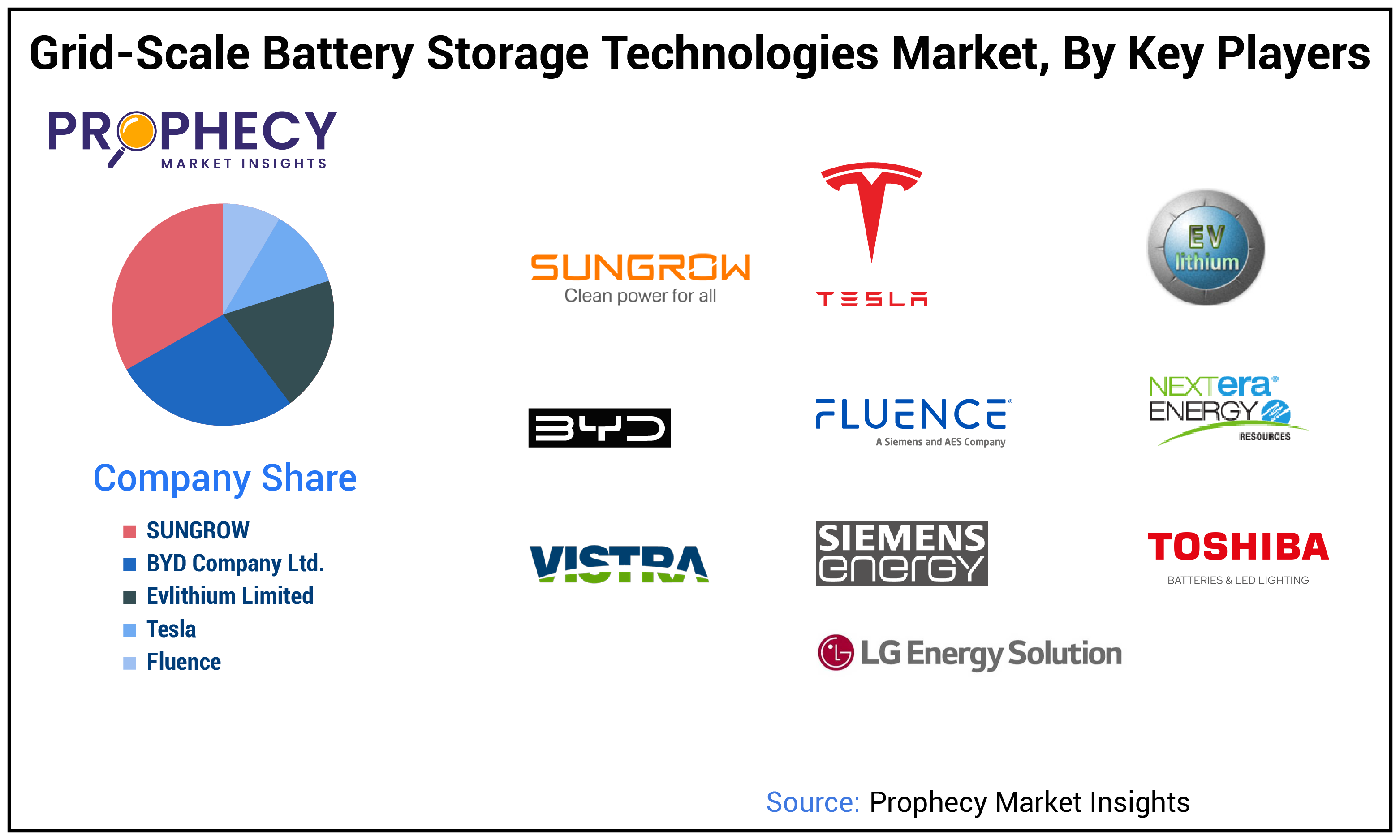
The key players operating in the market include, SUNGROW, BYD Company Ltd., Evlithium Limited, and others. These key players are focusing on several key strategies, including renewable energy integration, grid modernization, expanding microgrids, and technological advancements to reduce costs and improve performance. These strategies aim to enhance grid stability, reduce emissions, and optimize energy usage, for driving grid-scale battery storage technologies market growth.
Grid-Scale Battery Storage Technologies Market Companies:
- SUNGROW
- BYD Company Ltd.
- Evlithium Limited
- Tesla
- Fluence
- NextEra Energy Resources, LLC
- Vistra Corp.
- LG Energy Solution
- SAMSUNG SDI CO., LTD.
- Panasonic Life Solutions India Pvt. Ltd.
- TOSHIBA CORPORATION
- sonnen
- Siemens Energy
- Neoen
- Zenob Energy Limited
View an Additional List of Companies in the Grid-Scale Battery Storage Technologies Market
Global GridScale Battery Storage Technologies Recent News
- In April 2025, Saudi Arabia was moving more quickly to achieve its strategic objectives for renewable energy. With a total investment of more than 6.73 billion Saudi Riyals and a projected capacity of 2.5GW/10GWh, the Saudi Electricity Company (SEC), overseen by the Ministry of Energy, announced the start of the second phase of its battery energy storage system (BESS) project.
- In February 2025, the largest grid-scale energy storage project contracts in the world, with a capacity of 12.5GWh at the time, were successfully signed by BYD Energy Storage and Saudi Electricity Company. Together with the 2.6GWh project that was already completed, the entire collaboration now totals an astounding 15.1GWh of projects. This agreement represents a significant and important advancement in its cooperation in the field of renewable energy, giving Saudi Arabia's renewable energy sector significant impetus and helping to achieve the country's Vision 2030 objectives.
- In April 2024, the world leader in energy management and automation digital transformation, Schneider Electric, recently unveiled its newest Battery Energy Storage System (BESS), which is built to be a part of an architecture that is both adaptable and scalable. A completely integrated microgrid solution powered by Schneider Electric's controls, optimization, electrical distribution, and renowned digital and field services is built on top of BESS.
- In July 2023, In Tagawa-gun, Fukuoka Prefecture, NTT Anode Energy Corporation, Kyushu Electric Power Company, Inc. (Kyuden), and Mitsubishi Corporation MC announced the formal start of operations of a 1.4 MW / 4.2 MWh grid-scale battery storage system. By reducing solar power curtailment, this technology seeks to advance renewable energy as a significant power source.
- In August 2021, The Moss Landing Energy Storage Facility's Phase II construction was just finished by Vistra. Power is presently being stored by the battery system and released to the California grid as needed. The plant is currently the largest of its sort in the world, with a total capacity of 400 megawatts/1,600 megawatt-hours with the 100-megawatt extension.
Analyst View:
The grid-scale battery storage technologies market is growing due to a number of factors, including growing urbanization and industrialization, the increasing use of renewable energy sources such as solar and wind, which require storage solutions to guarantee a steady and dependable power supply, favorable government policies, and rising energy demand. Significant developments in battery technology, particularly in lithium-ion batteries, which have reduced production costs and enhanced performance, are also driving the market's growth. Price reductions brought about by advancements in manufacturing techniques and materials are also increasing the economic viability of grid-scale battery storage.
More Related Reports
Battery Energy Storage Market
Grid Connected Battery Energy Storage Market
Renewable Energy Storage Market
Battery Storage Inverter Market
Mobile Energy Storage System Market
Global GridScale Battery Storage Technologies Company Profile
|
Company Name |
SUNGROW |
|
Headquarter |
Hefei, China |
|
CEO |
Mr. Cao Renxian |
|
Employee Count (2024) |
13,697 Employees |
Global GridScale Battery Storage Technologies Highlights
FAQs
Grid-scale battery storage technologies market size was valued at USD 7.7 Billion in 2025 and is expected to reach USD 10.9 Billion by 2035 growing at a CAGR of 3.9%.
Product type, battery type, application, end-user, and region are the segmentation for the grid-scale battery storage technologies market.
North America, Asia Pacific, Europe, Latin America, and the Middle East & Africa. North America is expected to dominate the market.
The key players operating in the grid-scale battery storage technologies market include SUNGROW, BYD Company Ltd., Evlithium Limited, SAMSUNG SDI CO., LTD., Tesla, Fluence, NextEra Energy Resources, LLC, Vistra Corp., LG Energy Solution, Panasonic Life Solutions India Pvt. Ltd., TOSHIBA CORPORATION, sonnen, Siemens Energy, Neoen, and Zenob? Energy Limited