Renewable Energy Storage Market Overview
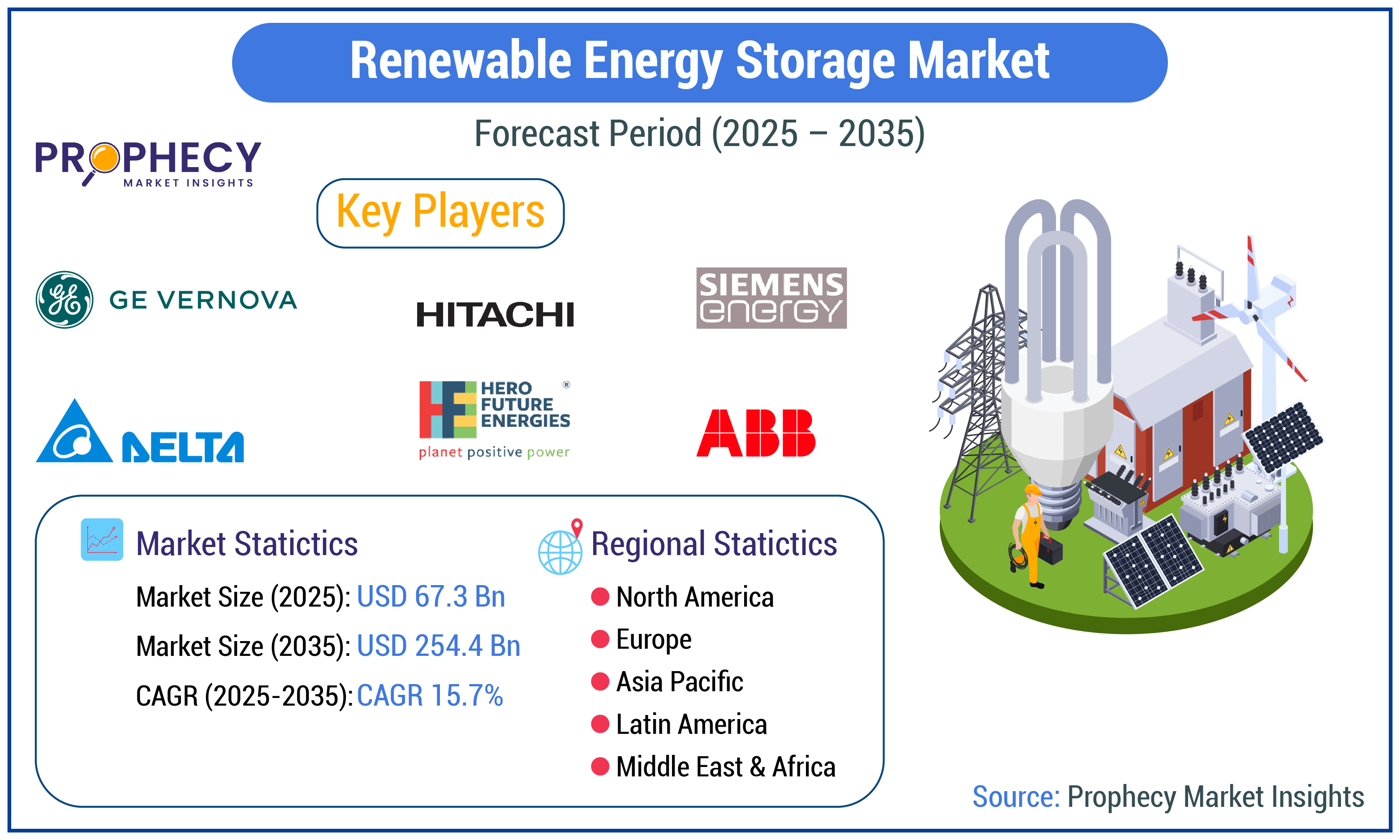
- The Renewable Energy Storage Market size is expected to expand at a rate of USD 254.4 Billion, by 2035.
- In 2024, the Renewable Energy Storage Market valuation was USD 59.6 Billion.
- The Renewable Energy Storage Market is growing at a CAGR 15.7%.
Renewable energy storage is the process of storing and capturing energy that is generated through renewable sources such as hydropower and solar. Energy storage systems improvise grid stability and integration of clean energy into the renewable energy power infrastructure that helps in storing the energy used to store excess power generated during peak production. Renewable energy storage enhances the reliability of renewable power systems and ensures the constant energy supply.
Government incentives and declining costs of battery technologies such as lithium ion are driving market expansion of renewable energy storage. Global transition towards clean energy, growing adoption of solar and wind power and supportive policies are major growth factors for renewable energy storage. Electric vehicle integration and advancements in energy management solutions are inviting new opportunities for storage deployment further leveraging the market share for renewable energy storage market on the global scale.
The renewable energy storage market is anticipating significant growth with current trends in technological advancement and rising need for clean energy solutions. Lithium iron phosphate (LFP) batteries are gaining popularity is a notable trend as they have longer lifespan and cost-effectiveness making a crucial change in battery market. Market is witnessing the emergence of innovative business models such as Energy Storage as a Service (ESaaS) for energy management.
Key Takeaways:
- According to the article published by ENERCON, Renewable electricity grew 50% year-on-year from 2022 to 2023, with the contribution of renewables to global energy creation set to increase from 29% of the total energy mix to 42% by 2028.
Recession Risk & Tariff Analysis:
- Renewable energy storage is facing significant challenges from recession risk and tariff uncertainties especially in U.S. Renewable energy projects are experiencing decline in funding and investments due to economic downturns. Lithium-ion batteries and solar panels have imposed tariffs reaching up to 145% raising the costs of energy storage systems.
- The higher cost has disrupted the renewable energy storage supply chains and deterred foreign investments especially in the Asia-Pacific region that has large scale energy storage material production. Slowdown in deployment of renewable energy storage solutions is due to compound effect of economic and policy challenges that is affecting the pace of energy transition on global scale.
Impact of Generative AI on Renewable Energy Storage Market:
- Generative AI helps enhancing the forecast period, system design and optimization in the renewable energy storage market acting as a transformative tool. Generative AI can help allowing for better planning and utilization of storage resources by enabling more accurate predictions of renewable energy generation and consumption patterns that can help the renewable industrial corporations and commercial entities to predict and plan according to given stance in operations ahead.
- Functions performative includes simulating complex grid scenarios, optimize battery dispatch strategies and improve energy management systems through integrating the generative AI driven models. Next generation storage technologies can be designed by generative AI supporting scalability and resilience of renewable energy infrastructure.
Renewable Energy Storage Market Drivers & Restraints
Key Drivers:
Global Renewable Shift Fuels Rising Demand for Energy Storage Solutions
Global shift towards renewable sources such as solar and wind is driving the growing demand for energy storage systems globally. To balance supply and demand these storage solutions are essential by storing the excess energy that has been generated during high production period and delivering it when consumption rises and generation decreases.
- For instance, a report published by IEA stated, electricity production from renewable sources rose 4.6% year-on-year to 340.7 TWh in March 2024. This growth was driven by increases in solar (+16.7% y-o-y) and hydro (+5.7% y-o-y) power, led by OECD Europe’s 7.9% overall increase, despite a 1.4% drop in wind power generation.
The Adoption of Grid Stability boost Renewable Energy Storage Systems
For variability and intermittency of renewable energy sources such as solar and wind, the energy storage systems play an important role for these components. During high generation the excess energy is stored while during the demand is high and generation is low the release of energy is carried out with systems that provide vital ancillary services making the Grid Stability and Reliability a major growth factor for its implementation across various regions.
Restraints:
High Initial Costs Limit Energy Storage Adoption in Residential and Small Commercial Sectors
Lithium-ion batteries have high initial cost that disrupt the renewable energy storage adoption among residential users and small commercial businesses. Installation and expenses related to batteries and inverters force consumers for substantial upfront investment that can be costly. Accessibility can be limited to energy storage solutions for large section of market due to given financial disadvantage.
- Counterbalance Statements: Reducing industrial runoff and improving water quality management are two sustainable ways to solve environmental issues affecting seaweed cultivation. Relocating farms and creating heat-resistant seaweed strains are two examples of climate change adaptation strategies that can help reduce the effects of warming oceans. Ecological balance is supported by sustainable farming methods such as rotational farming and polyculture systems.
Opportunities & Trends:
Accelerating Battery Innovations and Energy Storage as a Service Fuel Market Growth
The renewable energy storage market is witnessing several key trends and opportunities driving significant market growth. Advancements in battery technologies are integrated to enhance grid stability and support the sources such as solar and wind energy. Large scale investments in energy storage are rapidly growing with U.S. projected to add over 31 GW of new storage capacity in 2025. Growing Energy Storage as a Service (ESaaS) models are essential for cost-effective and flexible solutions for businesses to manage energy consumption and lower peak demand charges on renewable energy storage. Cross-border renewable energy projects are carried out in Asia-Pacific region exemplified by Laos’ MW monsoon wind project supplying Vietnam. Given renewable energy developments underscore rapidly evolving renewable energy storage landscape that opens numerous opportunities to stakeholders and investors on global scale.
Renewable Energy Storage Market Segmentations & Regional Insights
Renewable energy storage market is segmented into source, technology, application, and region.
By Source:
Based on source the renewable energy storage market is divided into Wind, Hydropower, Solar and others. Solar energy stands dominant with rapid global expansion of solar power installations and high compatibility of solar energy. Due to declining cost of photovoltaic (PV) systems the solar energy segment source is largely preferred in storage solutions making it dominant segment in renewable energy storage market.
Wind energy is the fastest growing segment in renewable energy storage market as there is large-scale deployment of onshore and offshore wind farms, especially in regions that have favorable wind conditions. Wind power storage has become essential to balance supply and demand, integrating efficient energy storage systems.
By Technology:
Pumped Hydroelectric Storage, Battery Energy Storage, Flywheel Energy Storage, Compressed Air Energy Storage, Thermal Energy Storage, and Hydrogen Energy Storage are given sub-segments of technology. Pumped hydroelectric storage is the dominant technology segment renewable energy storage market share as it is long-standing use and large-scale energy capacity that is crucial for grid-level storage applications. Pumped hydroelectric storage attributes for majority of global energy storage capacity for excess energy storage.
Battery energy storage holds the second dominant position as lithium-ion batteries have decreasing cost and its commercial, and utility-scale applications. Battery systems offer high efficiency and well-suited storing energy from intermittent sources. Battery energy storage continues to gain traction as the need for decentralized and flexible energy storage solutions increases.
By Application:
Residential, Commercial and Industrial are applications of the Renewable Energy Storage Market. The industrial segment is the dominant segment in renewable energy storage market share due to consistent and high energy demands of industrial operations and large-scale storage solutions for maintaining productivity and lower grid power dependency. Corporate commitments to decarbonization and government initiatives further drive the adoption of energy storage in industrial segment.
Commercial segment is fastest growing segment in the renewable energy storage as the commercial facilities are increasingly adopting the renewable energy storage systems to enhance energy reliability and support sustainability initiatives. Reducing energy cost and energy independence are major factors for commercial segment to integrate the renewable energy storage on large scale.
Regional Insights:
Geographically, the renewable energy storage market is studied across North America, Europe, Asia Pacific, Latin America, and the Middle East & Africa.
Asia Pacific: This region dominates the renewable energy market commanding nearly 38.0% of the market share in 2024. Rapid industrialization, substantial funding in renewable energy infrastructure and robust government policies in countries such as China, Japan, India and South Korea are major contributing factors for the growth of renewable energy storage in the region.
- China Renewable Energy Storage Market Insights:
China is leading the renewable energy storage market with adding over GW of energy storage capacity in 2023 that is more than 260% increase compared to previous year due to innovations and development in aggressive renewable energy targets and lithium-ion battery technology with regions focus on advanced storage solutions and integrating renewable energy sources.
North America: This region holds the second dominant position in renewable energy storage market size with substantial investments in clean energy infrastructure and solar and wind power deployment expansion across the United States and Canada. North America is focusing on advanced energy storage solutions and grid modernization.
- U.S. Renewable Energy Storage Market Insights:
In U.S. there are significant battery energy storage installations with initiatives such as Inflation Reduction Act that supports the renewable energy storage sector. In 2024 alone, the U.S. added nearly 9.2 GW of new battery storage capacity, pushing the nation's cumulative capacity to 26.3 GW, reflecting rapid growth in renewable energy integration.
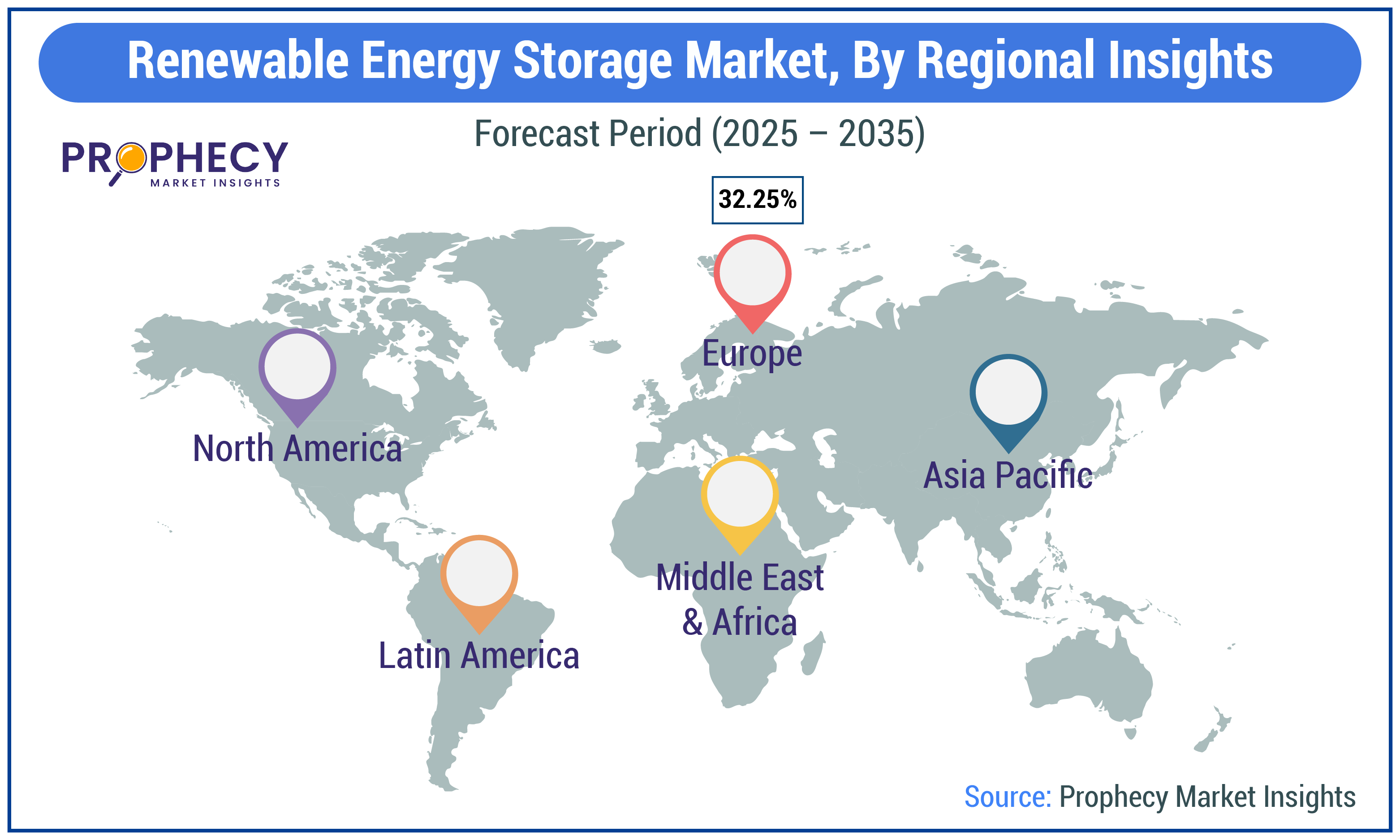
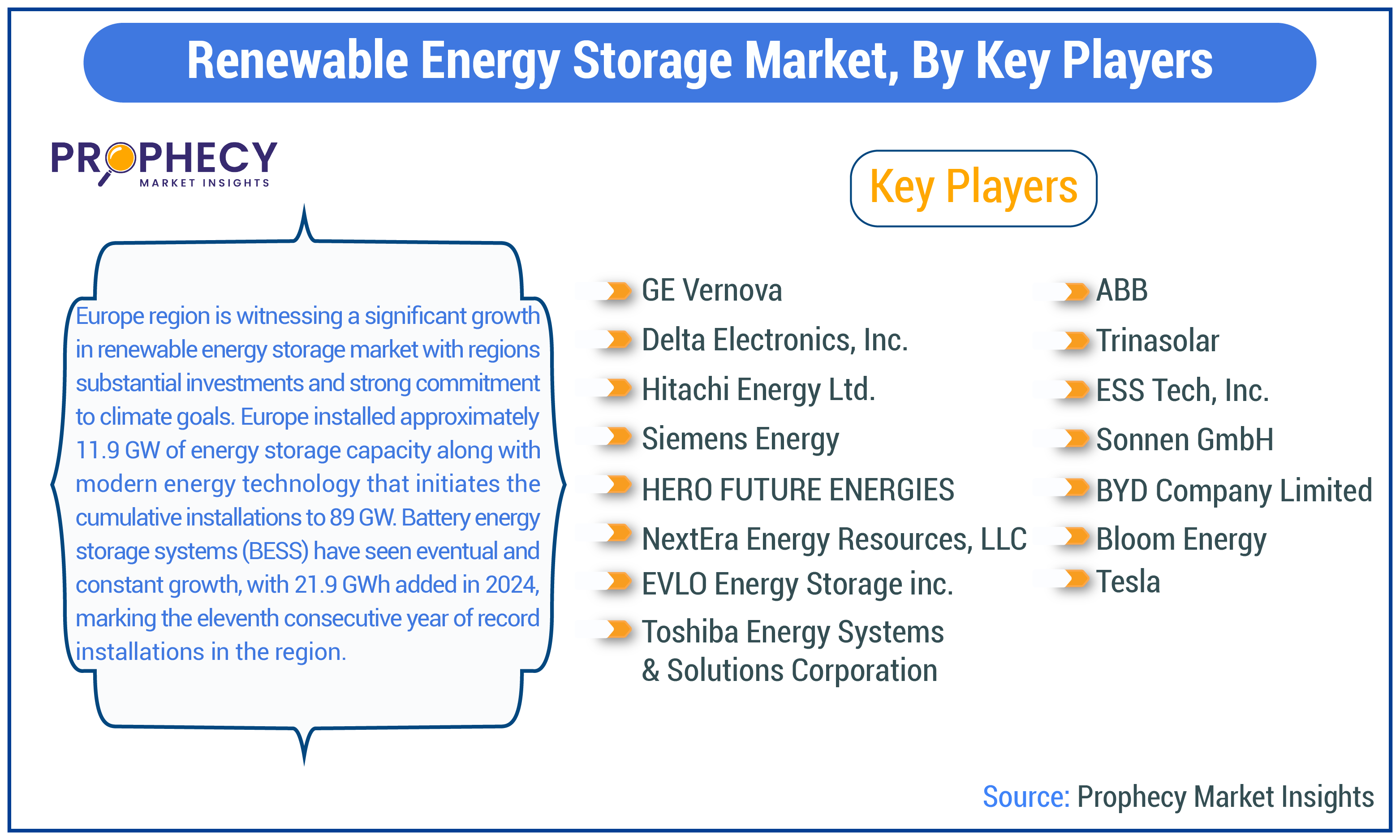
Europe: This region is witnessing a significant growth in renewable energy storage market with regions substantial investments and strong commitment to climate goals. Europe installed approximately 11.9 GW of energy storage capacity along with modern energy technology that initiates the cumulative installations to 89 GW. Battery energy storage systems (BESS) have seen eventual and constant growth, with 21.9 GWh added in 2024, marking the eleventh consecutive year of record installations in the region.
- Germany Renewable Energy Storage Market Insights:
Germany leads the global renewable energy storage market supported by robust renewable energy frameworks and proactive sustainable energy policies in the region. Germany accounted for 25.6 % market share in the European market in 2024. Country has well established power grid infrastructure and high investments in renewable energy storage making it leading player in the region.
Renewable Energy Storage Market Report Scope:
|
Attribute |
Details |
|
Market Size 2025 |
USD 67.3 Billion |
|
Projected Market Size 2035 |
USD 254.4 Billion |
|
CAGR Growth Rate |
15.7% (2025-2035) |
|
Base year for estimation |
2024 |
|
Forecast period |
2025 – 2035 |
|
Market representation |
Revenue in USD Billion & CAGR from 2025 to 2035 |
|
Regional scope |
North America - U.S. and Canada Europe – Germany, U.K., France, Russia, Italy, Spain, Netherlands, and Rest of Europe Asia Pacific – China, India, Japan, Australia, Indonesia, Malaysia, South Korea, and Rest of Asia-Pacific Latin America - Brazil, Mexico, Argentina, and Rest of Latin America Middle East & Africa – GCC, Israel, South Africa, and Rest of Middle East & Africa |
|
Report coverage |
Revenue forecast, company share, competitive landscape, growth factors, and trends |
Segmentation:
By Source:
- Wind
- Hydropower
- Solar
- Others
By Technology:
- Pumped Hydroelectric Storage
- Battery Energy Storage
- Flywheel Energy Storage
- Compressed Air Energy Storage
- Thermal Energy Storage
- Hydrogen Energy Storage
By Application:
- Residential
- Commercial
- Industrial
By Region:
- North America
- U.S.
- Canada
- Europe
- Germany
- U.K.
- France
- Russia
- Italy
- Spain
- Netherlands
- Rest of Europe
- Asia Pacific
- China
- India
- Japan
- Australia
- Indonesia
- Malaysia
- South Korea
- Rest of Asia Pacific
- Latin America
- Brazil
- Mexico
- Argentina
- Rest of Latin America
- Middle East & Africa
- GCC
- Israel
- South Africa
- Rest of Middle East & Africa
Renewable Energy Storage Market Competitive Landscape & Key Players
The key players operating in the renewable energy storage market include, GE Vernova, DELTA ELECTRONICS, INC., ABB, and other. Key players are increasingly investing in renewable energy storage to support transition to clean energy and enhancement of grid reliability. Reducing carbon emissions and capitalizing on the growing demand for sustainable energy solutions are major goals for the given organizations.
Renewable Energy Storage Market Companies:
- GE Vernova
- Delta Electronics, Inc.
- Hitachi Energy Ltd.
- Siemens Energy
- Toshiba Energy Systems & Solutions Corporation
- Trinasolar
- NextEra Energy Resources, LLC
- EVLO Energy Storage inc.
- ABB
- HERO FUTURE ENERGIES
- ESS Tech, Inc.
- Sonnen GmbH
- BYD Company Limited
- Bloom Energy
- Tesla
View an Additional List of Companies in the Renewable Energy Storage Market
Renewable Energy Storage Market Recent News
- In May 2025, a new Battery Energy Storage Systems-as-a-Service (BESSaaS) was introduced by ABB which is a flexible, zero-capital-expenditure solution designed to accelerate the shift to clean, resilient, and affordable energy. Financial and operational disruption is eliminated enabling companies to deploy battery storage without upfront investment with given service models.
- In May 2025, three new products at Intersolar Europe: the Risen Stack Modular Energy Storage System, the Luvit Micro Inverter, and the Gurap String Inverter were launched by Risen Energy liable for residential, commercial and industrial (C&I), and large-scale ground-mounted solar applications, reinforcing the company's focus on providing integrated solar storage solutions further expanding the product in multiple regions.
- In March 2025, the next-generation PowerTitan 2.0 energy storage system was announced by Sungrow which is an advanced system is designed to accelerate the renewable transition by offering enhanced energy storage capabilities, supporting the integration of renewable energy sources into the grid outsourcing the energy spectrum in the advanced systems.
Analyst View:
Renewable energy storage market having a significant growth in the forecast period along with the technological advancement and escalating demand for grid stability. A shift towards lithium iron phosphate (LFP) batteries is the ongoing trend having properties such as cost-effectiveness and longer lifespan driving more market growth. Global agenda for decarbonization intensifies and thus energy storage is poised to become an integral component of modern energy infrastructure driving long term market growth.
More Related Reports
Renewable Methanol Market
Energy-Based Aesthetic Devices Market
Ambient Energy Harvester Market
Renewable Methanol Market
Renewable Naphtha Market
Renewable Energy Storage Market Company Profile
|
Company Name |
GE Vernova |
|
Headquarter |
Massachusetts, U.S. |
|
CEO |
Scott Strazik |
|
Employee Count (2024) |
75,000 Employees |
Renewable Energy Storage Market Highlights
FAQs
Renewable energy storage market size was valued at USD 67.3 Billion in 2025 and is expected to reach USD 254.4 Billion by 2035 growing at a CAGR of 15.7%.
Renewable energy storage is segmented into source, Technology, application and region are the segmentation for the target market.
North America, Asia Pacific, Europe, Latin America, and the Middle East & Africa. North America is expected to dominate the market.
The key players operating the renewable energy storage market include GE Vernova, DELTA ELECTRONICS, INC., Hitachi Energy Ltd., Siemens Energy, Toshiba Energy Systems & Solutions Corporation, TRINASOLAR, NextEra Energy Resources, LLC, EVLO Energy Storage inc., ABB, HERO FUTURE ENERGIES, ESS Tech, Inc., Sonnen GmbH, BYD Company Limited, Bloom Energy, and TESLA.