Global Renewable Energy Market Overview
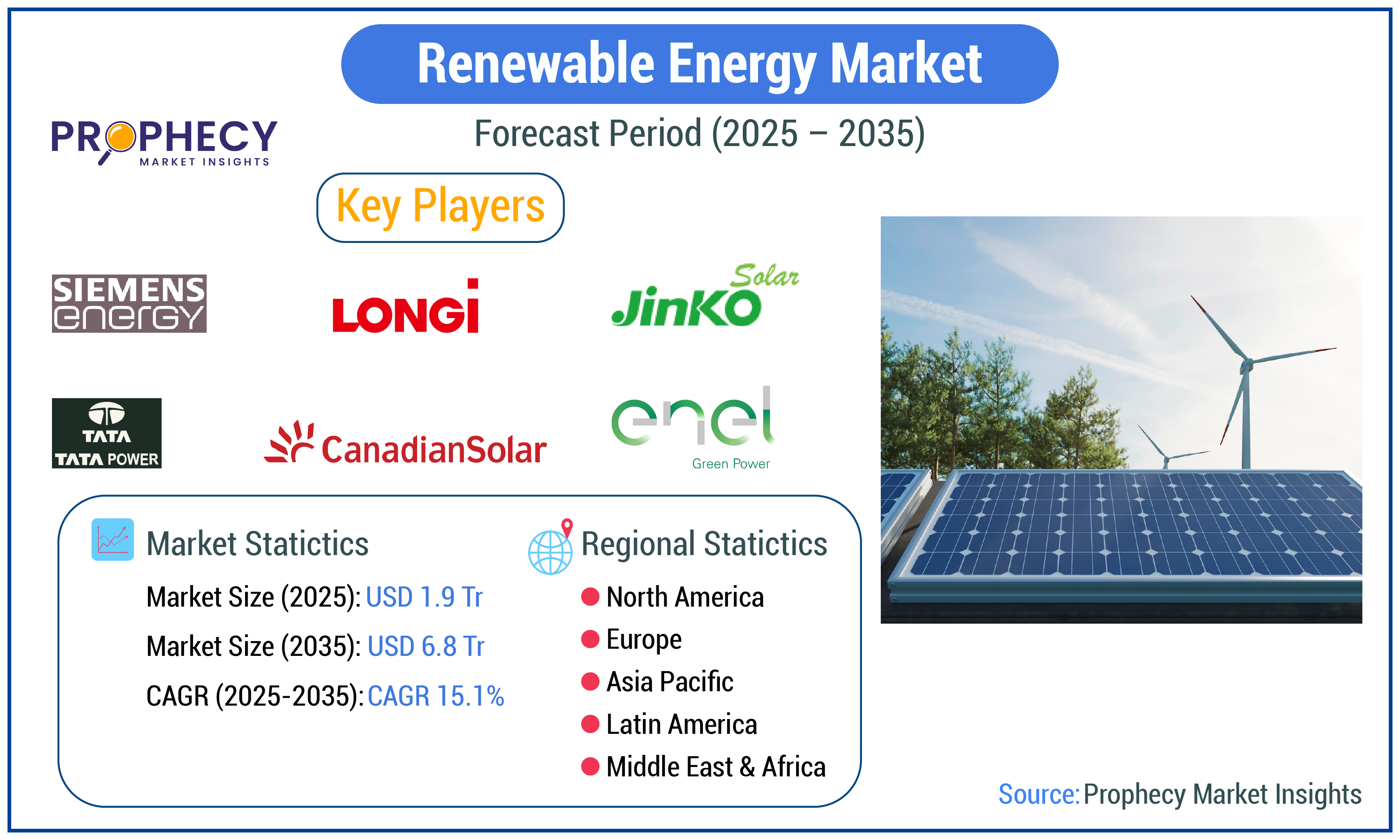
- By 2035, renewable energy market size is contemplated to enlarge at a valuation of USD 6.8 Trillion.
- In 2024, the renewable energy market valuation was USD 1.7 Trillion.
- Renewable energy market is developing at a CAGR of 15.1%.
Renewable energy is energy obtained from traditional energy sources such as sunlight, the wind, flowing water, and geothermal energy, which are abundantly available and provide a replaceable source of energy. Unlike fossil energy sources which are limited, renewable energy is sustainable and can lessen the greenhouse gas emissions and environmental impact that ever-increasing energy use has. Renewable energy is a global effort in work for clean, reliable, and sustainable energy systems.
The renewable energy market is continually expanding due to growing environmental concerns, dwindling fossil fuel reserves, and supportive policies from governments, among other reasons. Technological innovation, scale economies, decreasing production costs, and continued energy demand are all factors that are also contributing to the acceleration of renewable energy consumption. In fact, global climate initiatives, corporate sustainability commitments and growing leisure energy will make renewable investments in the future infrastructure in various sectors and geographical regions.
If we see continued innovation, digital integration, and storage potential with renewables, the future market potential with renewable energy is positive. Continued change to low-carbon economies globally, as well as the acceleration of electrification in transport policies and manufacturing sectors, will provide continued fuel as part of sustainable development and for the long-term protection and security of energy globally.
Recession Risk & Tariff Analysis:
- Economic downturns can lead to deferred investments, canceled projects, and reduced budgets and government priorities around renewable energy. However, established long-term policy commitments and global climate goals usually maintain minimum levels of demand and stability in the sector.
- Tariffs imposed on imported renewable energy materials such as wind turbines and solar panels can increase project costs and have the potential to decrease profitability and speed of deployment. Trade disputes and protectionist policies may also disrupt supply chains. Conversely, these same tariffs can catalyze local manufacturing, enable a growing local industry if support by appropriate regulatory and financial incentives.
Impact of Generative AI on Renewable Energy Market:
- Generative AI improves the scientific modeling of weather patterns, energy demand, and grid behavior and produces more accurate renewables forecasting. This can improve planning for production, storage, and distribution, minimizing waste and maximizing efficiency, supporting the cost-effective integration of renewable energy sources into an energy mix.
- Renewable technologies such as those for solar cells, wind turbines, and storage are rapidly designed and prototyped with the help of generative AI. For example, a new area of technology development could be shortened in its time scales using generative AI with respect to performance scenario simulation and material innovation. Generative AI will be able to assist in fast-tracking the technology breakthroughs and make them competitive and scalable in the sector of renewable energy.
Global Renewable Energy Market Drivers & Restraints
Key Drivers:
Government Policies and Climate Commitments is Driving Growth
Government support, via favorable policies, subsidies, and climate action strategies, is one of the most significant factors driving the growth of the renewable energy market. Governments around the globe are implementing expertise and regulations such as renewable portfolio standards; tax incentives and carbon reduction targets.
These regulations address issues by encouraging investment, increasing the speed of a renewable deployment, and provide long-term stability for renewable projects in the public/private sector.
Moreover, international obligations like the Paris Accord require countries to be increasing their share of renewable energy in each nation's energy portfolio, which creates the opportunity for sectors to grow together related to renewable solutions and facilitated rapid market growth based on new innovations across regions.
- For instance, according to the International Energy Agency (IEA), global renewable capacity additions will reach an unprecedented high of 440 GW in 2024 driven by supportive government policies - China, the U.S. and EU, which show strong climate commitments and incentives for the market.
Restraints:
Intermittency and Grid Integration Challenges to Repel Market Growth:
Major constraints in the renewable energy market include intermittency of solar and wind resources based on weather and finite nature of solar and wind energy that leads to unreliable energy and puts strain on existing grid system infrastructure. If large levels of variable deposition renewable energy sources were to be deployed onto older or not modernized established grids, smart grids, energy storage systems, and balancing technologies would be needed and would require significant upfront capital investment.
Without upgrading infrastructure and without real-time energy management systems functionality to enable renewable energy uptake from technical and operational considerations will ultimately restrict wider uptake of renewables.
- Counterbalance Statements: Advances in energy storage, AI based grid management and demand-response technologies can fundamentally address many of the challenged related to intermittency. Countries who are investing in modernized grids and flexible energy systems are successfully integrating larger shares of renewables while successfully maintaining grid performance and reliability. This shows while intermittency could pose challenges, those challenges are manageable as part of an overall transition pathway.
Opportunities & Trends:
Rise of Decentralized Renewable Energy with Storage Integration Driving Opportunities
Emerging markets in most jurisdictions are experiencing a major shift in the renewable energy market toward decentralized energy systems, including local grids and rooftop installations. This is changing the landscape of the renewable energy market across the globe. With the accompanying advancements in energy storage technologies, such as lithium-ion batteries and flow batteries, the capacity to reliably access off-grid power on the strengthened reliability of the existing grid continues to enhance energy security and encourages clean energy adoption in underserved population.
Global Renewable Energy Market Segmentations & Regional Insights
Type technology, application, end-user and region are the divisions of the renewable energy market.
By Type:
Based on the type, the renewable energy market is divided into solar energy, wind energy, hydropower, biomass energy, geothermal energy, ocean energy. Solar energy has the greatest renewable energy market share as it is the most available resource, the installation costs have been declining rapidly, and there are strong government incentives. The global rise of solar energy with installation in the commercial, utility, and residential sectors has been driven by innovation in photovoltaic cells, rapid installation costs, and improvements in solar infrastructure, particularly in sunnier locations throughout the globe.
Wind energy is the second-largest share of the renewable market that has grown quickly as a result of large-scale installations, particularly in Europe, China and the United States. The rise of offshore wind farms, increases in turbine efficiency, and increased turbine capacity have also added to wind energy generation to make it a more competitive and scalable alternative to traditional energy resources.
By Technology:
Based on Technology, the market is segmented into photovoltaic (pv) systems, concentrated solar power (csp), onshore/offshore wind technology, hydroelectric turbines, geothermal heat pumps. Photovoltaic (PV) systems are the dominating renewable energy market share due to the simple installation, falling prices, and flexibility for many uses. Their usage is widespread in residential, commercial, and utility-scale projects. PV systems capture sunlight and convert it to electricity, a key technology as the world transitions from fossil fuels to renewable energy sources.
Onshore/Offshore wind technology ranks second. Precursors to onshore and offshore wind technology include benefits of scale, energy output and government support. Onshore wind turbines are an economical way to produce electric energy, whereas offshore wind projects benefit from greater quantity and more reliable winds. Technological improvements to turbine designs have improved generation efficiency and development has raised the profile of wind energy and made it an essential pillar of renewable energy capacity.
By Application:
Based on application, the market is segmented into electricity generation, heating and cooling, off-grid energy access. Electricity generation dominates the renewable energy market share. Increasing electricity generation by renewable sources is the major option for meeting the surging global electricity requirement in considering the urgent need to decarbonize the whole energy sector. With the support of policies, capital flows, and technology, renewable electricity sources such as solar, hydro, and wind have all contributed toward the global displacement of fossil fuel in the power generation process.
Heating and cooling systems are the second-largest application, primarily in households and industries. Solar thermal systems, biomass boiler systems, and geothermal ground source heat pumps are slowly taking root due to advances in energy efficiency standards and sustainability. This application area has potential for sustainable temperature control and less or no reliance on conventional heating fuels.
By End-user:
Residential, commercial, industrial, utility-scale power providers, agriculture & rural applications are end-user of the renewable energy market. Utility-scale power producers are the dominant players in the renewable energy market size by virtue of their ability to produce and deliver high quantities of energy. While utility-scale projects involve both government and private funding, these projects are designed to deliver large amounts of solar, wind, and hydro energy to national and local grids, which ultimately provides a necessary component for achieving overall energy transition outcomes.
Industrial is the second largest segment as more manufacturers adopt renewable energy to reduce operating expenses and reach their sustainability goals. Industries have been developing on-site solar and biomass systems to secure lower emissions, and adhere to global environmental regulations, which drives strong growth from this end-user segment.
Regional Insights:
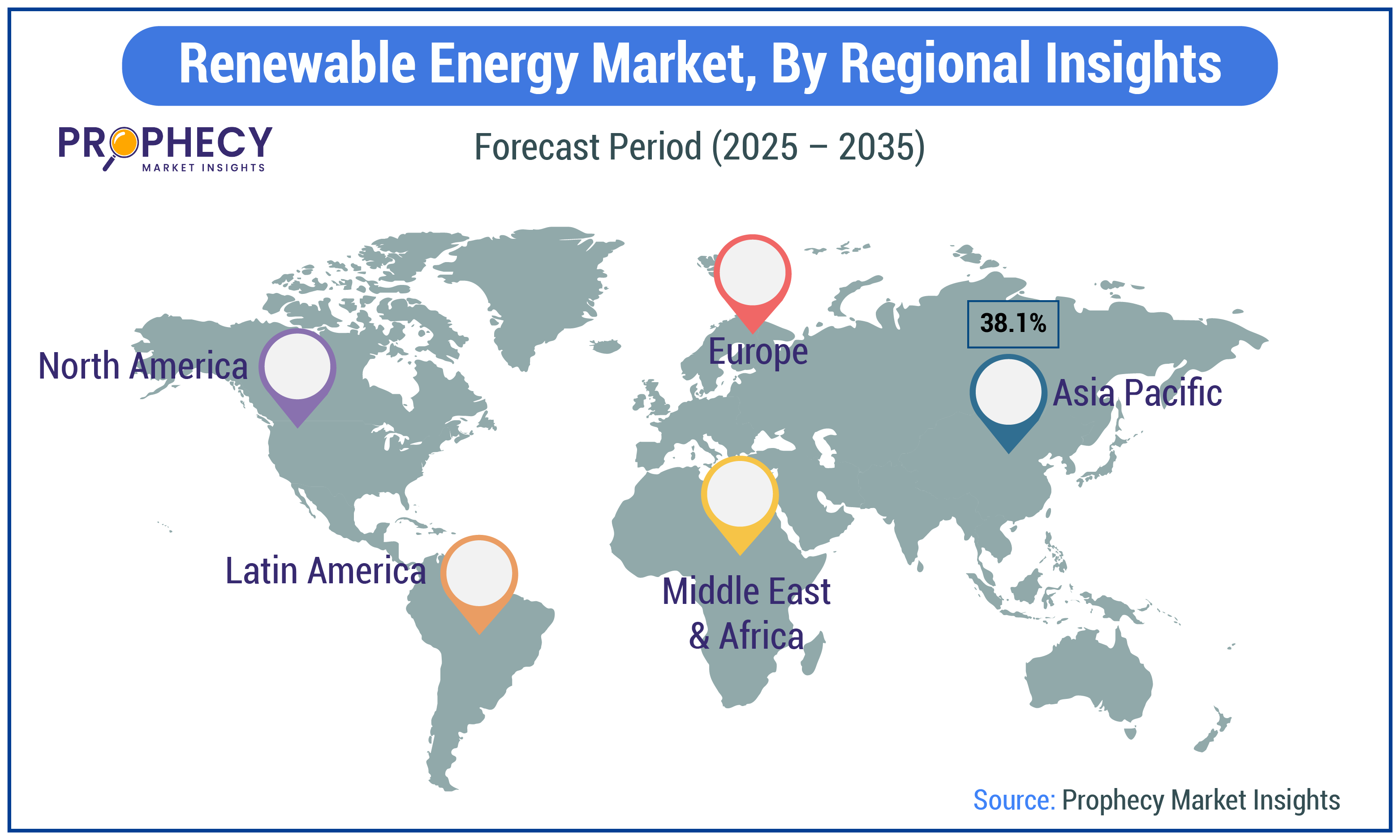
Geographically, the renewable energy market is studied across North America, Europe, Asia Pacific, Latin America, and the Middle East & Africa.
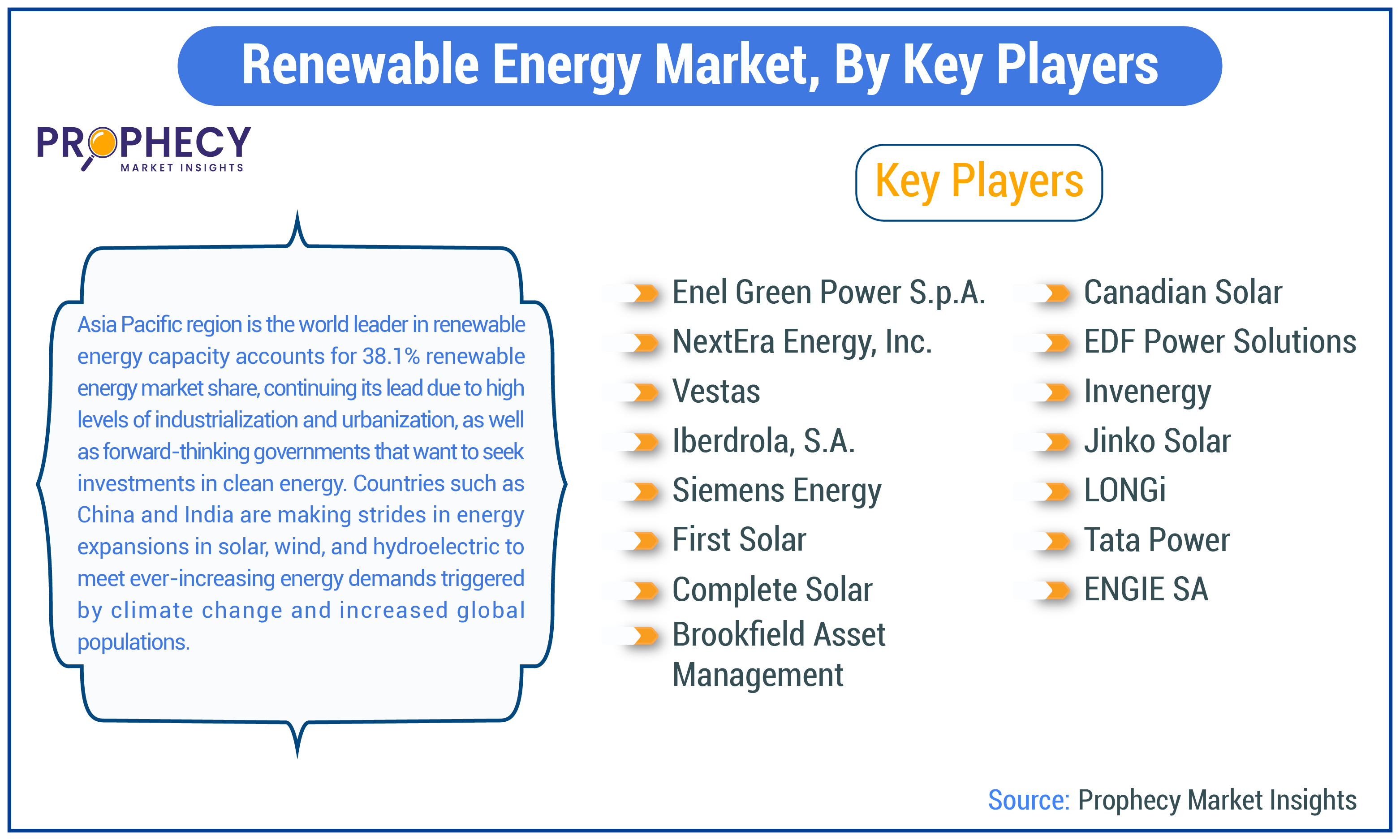
Asia Pacific: This region is the world leader in renewable energy capacity accounts for 38.1% renewable energy market share, continuing its lead due to high levels of industrialization and urbanization, as well as forward-thinking governments that want to seek investments in clean energy. Countries such as China and India are making strides in energy expansions in solar, wind, and hydroelectric to meet ever-increasing energy demands triggered by climate change and increased global populations.
- China Renewable Energy Market Insights:
China leads the Asia Pacific renewable energy market and is the world leader in renewable energy capacity, for both solar and wind. Huge investments, favorable policy, and domestic manufacturing capacity has enabled China to build out renewable infrastructure quickly. From President Xi's commitment to achieving carbon neutrality by 2060, the energy transition will continue to accelerate and increase the adoption and integration of clean energy technologies.
Europe: The second-largest share of the renewable energy market is hold by Europe region. This is fueled by proactive regulatory frameworks, greenhouse gas emission targets, and technological innovation that has increased demand for renewable energy. Nations such as Germany, the UK, and Denmark have built systems that rely primarily on wind and solar power with the support of government policies, energy storage infrastructure, investment in smart grids and fully engaged decision-making with energy companies.
- Germany Renewable Energy Market Insights:
Germany is Europe's leader in renewable energy according to its Energiewende policy. It has invested large sums in wind and solar power, and alleviated some of its dependency on fossil fuels. With government funding, public acceptance, and innovation, Germany will continue to lead the transition of green energy technology.
North America: This region is third largest in target market growth. Solar, wind, and hydroelectric are driving advances in renewable energy deployment. Even with a mature energy infrastructure, the U.S. and Canada's renewable energy market is growing through government and private corporate incentives, targets, and technology improvements.
- U.S. Renewable Energy Market Insights:
The U.S. is the top investment market for renewable energy in North America, with an active expansion of the wind, solar, and hydro sectors. Growing from incentives at the federal and state levels in terms of renewable portfolio standards, along with big corporate investments in renewable energy. Technological innovations and the execution of massive-scale utility power projects give the U.S. the edge worldwide for clean energy adoption and deployment.
Renewable Energy Market Report Scope:
|
Attribute |
Details |
|
Market Size 2025 |
USD 1.9 Trillion |
|
Projected Market Size 2035 |
USD 6.8 Trillion |
|
CAGR Growth Rate |
15.1% (2025-2035) |
|
Base year for estimation |
2024 |
|
Forecast period |
2025 – 2035 |
|
Market representation |
Revenue in USD Trillion & CAGR from 2025 to 2035 |
|
Regional scope |
North America - U.S. and Canada Europe – Germany, U.K., France, Russia, Italy, Spain, Netherlands, and Rest of Europe Asia Pacific – China, India, Japan, Australia, Indonesia, Malaysia, South Korea, and Rest of Asia-Pacific Latin America - Brazil, Mexico, Argentina, and Rest of Latin America Middle East & Africa – GCC, Israel, South Africa, and Rest of Middle East & Africa |
|
Report coverage |
Revenue forecast, company share, competitive landscape, growth factors, and trends |
Segmentation:
By Type:
- Solar Energy
- Wind Energy
- Hydropower
- Biomass Energy
- Geothermal Energy
- Ocean Energy
By Technology:
- Photovoltaic (PV) Systems
- Concentrated Solar Power (CSP)
- Onshore/Offshore Wind Technology
- Hydroelectric Turbines
- Geothermal Heat Pumps
By Application:
- Electricity Generation
- Heating and Cooling
- Off-grid Energy Access
By End-user:
- Residential
- Commercial
- Industrial
- Utility-Scale Power Providers
- Agriculture & Rural Applications
By Region
- North America
- U.S.
- Canada
- Europe
- Germany
- U.K.
- France
- Russia
- Italy
- Spain
- Netherlands
- Rest of Europe
- Asia Pacific
- China
- India
- Japan
- Australia
- Indonesia
- Malaysia
- South Korea
- Rest of Asia Pacific
- Latin America
- Brazil
- Mexico
- Argentina
- Rest of Latin America
- Middle East & Africa
- GCC
- Israel
- South Africa
- Rest of Middle East & Africa
Global Renewable Energy Market Competitive Landscape & Key Players
The prominent players operating in the market include, Enel Green Power S.p.A., NextEra Energy, Inc., Vestas, Iberdrola, S.A., Siemens Energy, First Solar, Brookfield Asset Management, and others. Companies in the fiercely competitive renewable energy sector prioritize technological advancement, international growth, and strategic alliances. Players range from multinational energy behemoths to niche solar or wind companies. Project pipelines, cost effectiveness, vertical integration, and a strong regional presence particularly in developing and highly sought-after markets are the main drivers of competitive advantages.
Renewable Energy Market Companies:
- Enel Green Power S.p.A.
- NextEra Energy, Inc.
- Vestas
- Iberdrola, S.A.
- Siemens Energy
- First Solar
- Brookfield Asset Management
- Complete Solar
- Canadian Solar
- EDF Power Solutions
- Invenergy
- Jinko Solar
- LONGi
- Tata Power
- ENGIE SA
View an Additional List of Companies in the Renewable Energy Market
Global Renewable Energy Market Recent News
- In July 2025, the world's leading energy storage company, Jinko ESS today announced the deployment of an 860kWh energy storage system for the San Carlo Homes for the Aged Facility in Victoria, in connection with Melbourne-based Renewable Energy specialists Acacia Energy, with implementation pathway provided by Highline Group.
- In January 2025, Invenergy, a clean energy solution developer, owner, and operator that is privately owned and is the largest in its sector, recently closed on a $1.1 billion debt financing facility for three solar projects in Ohio, Indiana, and Tennessee. The debt financing consists of a Construction/Bridge Loan Facility and a Letter of Credit Facility.
Analyst View:
The renewable energy industry is expanding rapidly. Three notable trends driving this growth are climate change, government support, and innovation. Decentralized energy systems are on the rise, AI will be utilized to manage the smart grids of the future, and solar and wind power technology is progressing quickly. Emerging markets will provide significant opportunities due to energy demand and untapped resources. Intermittency, high capital investment, and integration into grids will continue to challenge as well. Nevertheless, with a global commitment to future sustainability and energy transition the outlook for renewable energy is positive in the future and years to come.
More Related Reports
Renewable Drones Market
Renewable Energy Storage Market
Renewable Methanol Market
North America Renewable Energy Storage Market
Renewable Naphtha Market
Global Renewable Energy Market Company Profile
|
Company Name |
Enel Green Power S.p.A. |
|
Headquarter |
Rome, Italy |
|
CEO |
Salvatore Bernabei |
|
Employee Count |
9000 Employees |
Global Renewable Energy Market Highlights
FAQs
Renewable energy market size was valued at USD 1.9 Trillion in 2025 and is expected to reach USD 6.8 Trillion by 2035 growing at a CAGR of 15.1%.
Type, Technology, Application, End-user, and region are the segmentation for the target market.
North America, Asia Pacific, Europe, Latin America, and the Middle East & Africa. Acia-Pacific is expected to dominate the market.
The prominent players operating in the market include, Enel Green Power S.p.A., NextEra Energy, Inc., Vestas, Iberdrola, S.A., Siemens Energy, First Solar, Brookfield Asset Management, Complete Solar, Canadian Solar, EDF Power Solutions, Invenergy, Jinko Solar., LONGi, Tata Power, and ENGIE SA.