Global Battery Storage Inverter Market Overview
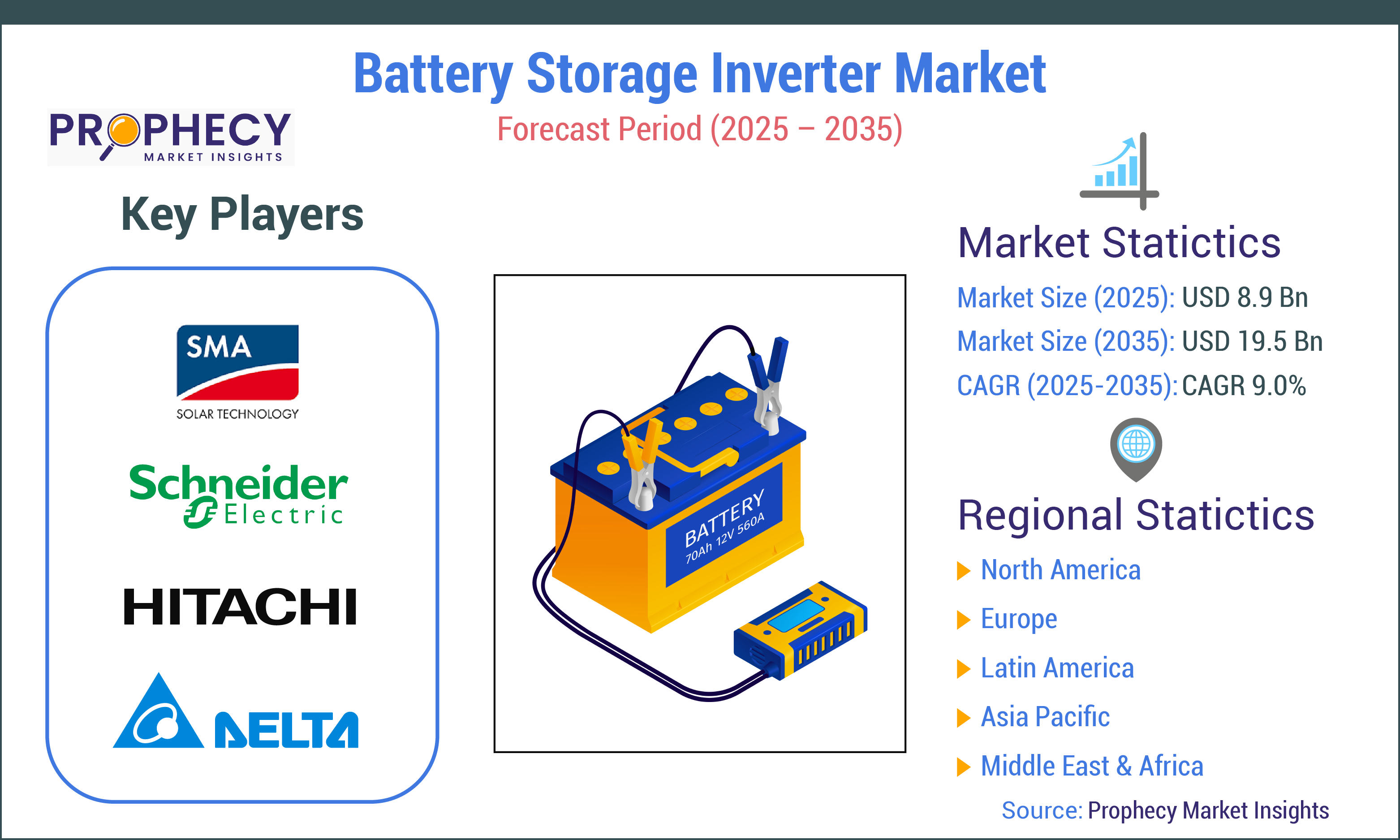
- Battery storage inverter market size is anticipated to develop at a rate of USD 19.5 Billion, by 2035.
- The valuation of the market was accounted for USD 8.3 Billion in 2024.
- Battery storage inverter market is expanding at a CAGR 9%.
A battery storage inverter is a specialized electrical device that plays a critical role in energy storage systems particularly that use batteries to store electricity from renewable sources such as solar or wind. Its primary function is to convert the direct current (DC) electricity stored in batteries into alternating current (AC) electricity, which used in homes, businesses, and electrical grids use. Many battery storage inverters integrated with energy management systems that help regulate charging and discharging schedules, protect battery life, and maximize efficiency. Battery storage inverters are often bi-directional, this is vital for smart energy management, which allows users to store cheap energy during off-peak hours.
Rapid urbanization, industrialization is driving the need for reliable energy storage solutions, integration with smart grids, IoT to enable real-time data analysis, and surging adoption of renewable energy sources, is anticipated to drive battery storage inverter market growth. Rising demand for energy independence, due to rising electricity costs, improvement in inverter efficiency, battery chemistry, and growing needs for grid stabilization, decentralization, is estimated to compel battery storage inverter market growth.
Expansion in emerging economic, and government investment in electricity grids, can create future opportunities for battery storage market growth. Rise of electric vehicles, growing commercial & industrial sector adoption, and advancement in hybrid inverter solutions, is expected to pitch battery storage inverter market growth.
Recession Risk and Tarriff Analysis on Battery Storage Inverter Market:
- A global or regional economic recession could impact the battery storage inverter market by reducing investments in renewable energy projects and infrastructure upgrades. During downturns, both consumers and businesses tend to delay high-cost purchases such as solar-plus-storage systems. Government funding for clean energy may also squeeze, affecting utility-scale projects and slowing market momentum temporarily.
- Tariffs on imported components, especially from major manufacturing hubs, can significantly impact production costs and pricing in the inverter market. Trade tensions and protectionist policies may lead to higher import duties on electronics or battery technologies, disrupting supply chains and increasing end-user prices.
Impact of Generative AI on Battery Storage Inverter Market:
- Using AI-driven models, manufacturers and energy engineers can simulate complex grid interactions, forecast energy demand, and optimize inverter configurations in various scenarios. This reduces design time, cost, and error, especially in large-scale utility and commercial storage projects.
- AI can analyze massive datasets from smart inverters and battery management systems to predict equipment failures before it can occur, which enables predictive maintenance and extending system lifespan. AI helps utilities and operators develop intelligent energy dispatch strategies, especially for balancing renewable inputs with grid demand.
Global Battery Storage Inverter Market Drivers & Restraints
Key Drivers:
Rapid Industrialization Is Projected to Boost Market Growth
As industries expand, their energy consumption rises sharply, leading to increased demand for reliable, efficient, and sustainable power solutions. Many industrial facilities are integrating renewable energy sources such as solar and wind to reduce operational costs and meet environmental regulations, creating a strong need for battery storage systems with inverters that can efficiently manage energy flow and ensure uninterrupted power supply. Battery storage inverter enables industries to store excess renewable energy, optimize energy usage during peak demand, which can be unreliable or expensive in rapidly developing regions. Industrial sectors are adopting energy storage solutions to improve power quality, reduce carbon footprints, and enhance operational resilience against grid outages or fluctuations, is anticipated to drive energy storage inverter market growth.
Restraints:
Market Hindered by High Initial Investment Costs
Battery storage inverters, especially integrated with renewable energy systems and advanced control technologies, can be expensive. The high upfront costs for residential, commercial, and utility-scale systems may discourage adoption, particularly in developing economies or cost-sensitive sectors, resulting to limits target market growth.
- Counterbalance Statements: Falling prices of lithium-ion batteries, economies of scale in inverter manufacturing, supportive government subsidies, tax credits, and financing schemes are lowering the total system cost. In many regions, long-term energy savings and demand charge reductions defend the investment, which improves return on investment (ROI).
Opportunities & Trends:
Increasing Government Investment in Electricity Grids Surge Market Growth
As countries shift toward cleaner energy sources such as solar and wind, the existing power infrastructure faces challenges in managing variable power supply, grid stability, and demand response. Governments across regions especially in Asia-Pacific, North America, and Europe are allocating significant funding to smart grid projects, grid digitization, and energy storage integration.
Battery storage inverters play a critical role in these initiatives by enabling efficient energy conversion, by managing two-way power flows, and ensures seamless integration of distributed energy resources into the grid. Investments aimed at enhancing grid resilience, reducing transmission losses, and supporting peak load management create strong demand for advanced battery inverters that can handle complex grid requirements. Thus, growing government investment focus on electric grid modernization, resulting to boost battery storage inverter market growth.
- For instance, investment in electricity grids increased by 8% in 2022, with advanced and emerging economics are supporting to investment and enables electrification of buildings, industry, and transport. The European Union action plan predicted to invest USD 633 billion in the electricity grid by the end of 2030. In which USD 434 billion is aim to invest for the distribution grid, including USD 184 billion for digitalization. China’s State Grid Corporation invested of USD?77 billion in transmission in 2023, with the total nationwide investment was USD 442 billion, Japan invested USD 155.5 Billion in 2022, to encourage new power grid technologies, energy-efficient homes and other carbon footprint-reduction technologies.
Global Battery Storage Inverter Market Segmentations & Regional Insights
The battery storage inverter market is segmented into type, end-user, and region.
By Type:
Based on type, the market is divided into single phase electric power, and three phase electric power. Three-phase inverters dominate the market, particularly in commercial, industrial, and utility-scale applications. This are preferred due to their higher power handling capacity, greater efficiency, and better voltage stability, making them ideal for large-scale energy storage systems that support renewable integration into the grid, is projected to boost segment’s development in battery storage inverter market size.
Single phase electric power is second superior segment in the market, as it is common in residential and small-scale installations. The rise in home solar-plus-storage systems, as residential solar adoption increases, the demand for compact and efficient single-phase inverters, is assessed to compel battery storage inverter market share.
By End-User:
Under end-user, the market is categorized into residential, commercial & industrial, utility scale and others. The utility-scale segment holds the largest share of the market. This dominance is due to the rapid deployment of large-scale renewable energy projects, particularly solar and wind farms that require massive energy storage systems to manage grid stability, peak shaving, and renewable intermittency. These systems rely heavily on three-phase, high-capacity inverters and are supported by strong government incentives, is expected to pitch growth of segment in battery storage inverter market share.
The commercial & industrial segment is the second-leading market. Companies are increasingly adopting battery storage inverters to reduce electricity bills, manage peak load charges, and ensure uninterrupted operations during outages. Growth in this segment is driven by the demand for energy resilience, cost savings, and sustainability compliance, especially in urban and industrial zones, resulting to propel segment’s expansion in battery storage inverter market size.
Regional Insights:
Geographically, the market is studied across North America, Europe, Asia Pacific, Latin America, and the Middle East & Africa.
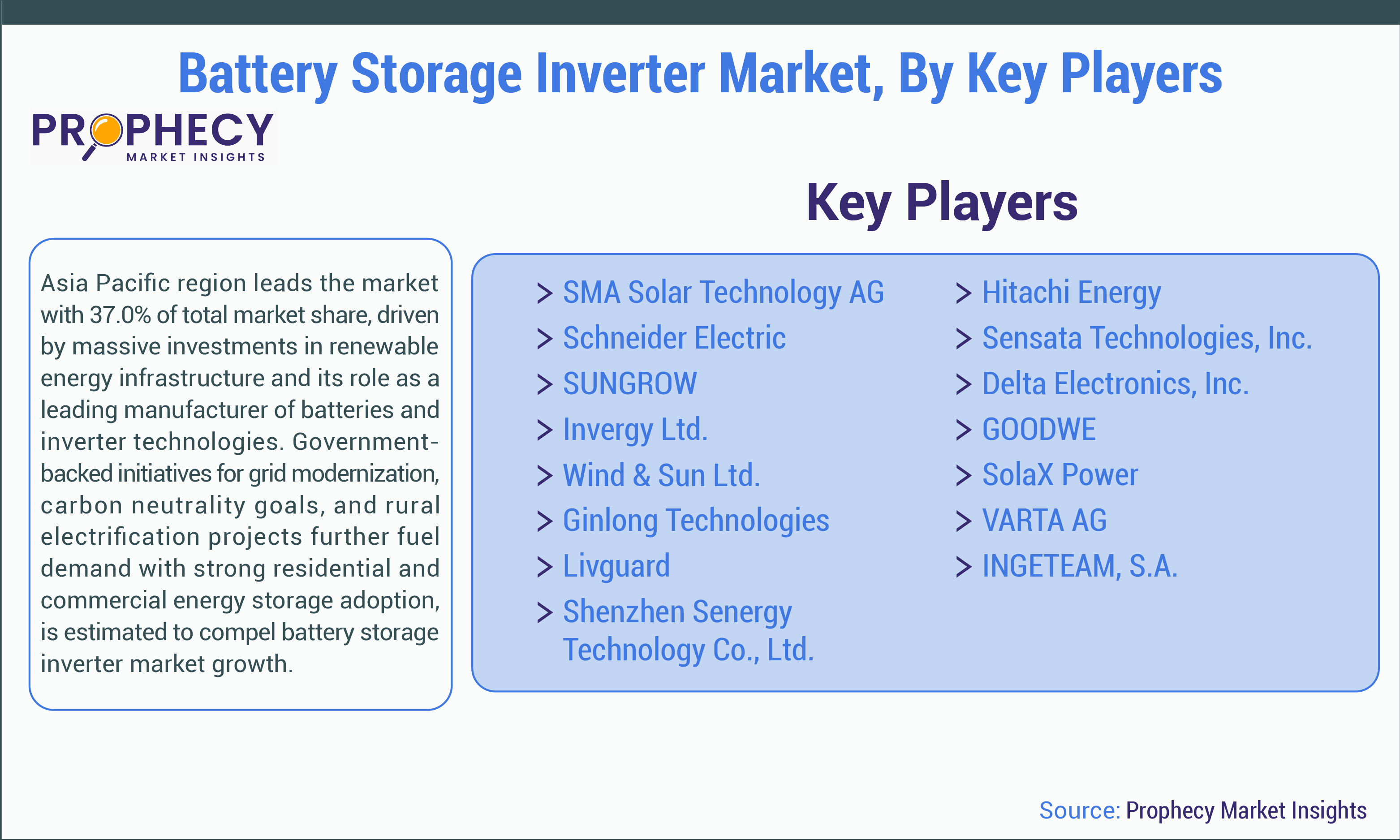
Asia Pacific: This region leads the market with 37.0% of total market share, driven by massive investments in renewable energy infrastructure and its role as a leading manufacturer of batteries and inverter technologies. Government-backed initiatives for grid modernization, carbon neutrality goals, and rural electrification projects further fuel demand with strong residential and commercial energy storage adoption, is estimated to compel battery storage inverter market growth.
- China Battery Storage Inverter Market Insights:
China is the dominating country in the Asia Pacific region for the target market. Massive investments in renewable energy projects, particularly solar and wind, which create a huge demand for energy storage solutions to manage intermittency. China is also a global manufacturing hub for batteries and inverters, enabling cost-effective production and rapid technological advancement, is anticipated to drive battery storage market growth.
North America: this region holds the second largest share of the market, driven by rapid growth in residential solar-plus-storage systems, commercial energy storage adoption, and utility-scale battery projects supported by federal tax credits and state-level clean energy mandates. The rise of smart grids, electric vehicles, and peak demand challenges continues to accelerate demand for battery storage inverter, resulting to propel battery storage inverter market size.
- U.S. Battery Storage Inverter Market Insights:
The U.S. is the dominant country in North America for the market. The growth is fueled by favorable government incentives. There is strong adoption of residential solar-plus-storage systems, with utility-scale projects that require large-capacity inverters. The country’s focus on grid modernization and the increasing integration of electric vehicles, contributing to boost battery storage inverter market size.
Europe: This is a significant and fast-growing region in the market, driven by the continent's strong commitment to decarbonization, renewable energy integration, and grid modernization. Countries are leading the charge with widespread adoption of residential solar-plus-storage systems and growing investments in utility-scale battery projects. The rise in electric vehicles and smart energy solutions is increasing demand for advanced inverter technologies across the region, is anticipated to drive battery storage inverter market share.
- Germany Battery Storage Inverter Market Insights:
Germany is the leading country in Europe for battery storage inverter. Germany has high adoption rates of residential solar and energy storage, supported by government subsidies and favorable regulations. Increasing investments in smart grid technology and large-scale energy storage, is projected to boost battery storage inverter market share.

Battery Storage Inverter Market Report Scope:
|
Attribute |
Details |
|
Market Size 2025 |
USD 8.9 Billion |
|
Projected Market Size 2035 |
USD 19.5 Billion |
|
CAGR Growth Rate |
9% (2025-2035) |
|
Base year for estimation |
2024 |
|
Forecast period |
2025 – 2035 |
|
Market representation |
Revenue in USD Billion & CAGR from 2025 to 2035 |
|
Regional scope |
North America - U.S. and Canada Europe – Germany, U.K., France, Russia, Italy, Spain, Netherlands, and Rest of Europe Asia Pacific – China, India, Japan, Australia, Indonesia, Malaysia, South Korea, and Rest of Asia-Pacific Latin America - Brazil, Mexico, Argentina, and Rest of Latin America Middle East & Africa – GCC, Israel, South Africa, and Rest of Middle East & Africa |
|
Report coverage |
Revenue forecast, company share, competitive landscape, growth factors, and trends |
Segmentation:
By Type:
- Single Phase Electric Power
- Three Phase Electric Power
By End-User:
- Residential
- Commercial & Industrial
- Utility Scale
- Others
By Region:
- North America
- U.S.
- Canada
- Europe
- Germany
- U.K.
- France
- Russia
- Italy
- Spain
- Netherlands
- Rest of Europe
- Asia Pacific
- China
- India
- Japan
- Australia
- Indonesia
- Malaysia
- South Korea
- Rest of Asia Pacific
- Latin America
- Brazil
- Mexico
- Argentina
- Rest of Latin America
- Middle East & Africa
- GCC
- Israel
- South Africa
- Rest of Middle East & Africa
Global Battery Storage Inverter Market Competitive Landscape & Key Players
The main key players operating in the battery storage inverter market are, SMA Solar Technology AG, Schneider Electric, SUNGROW, and others. These companies are constantly innovating, expanding their product portfolios, and optimizing production processes to meet the evolving demands of consumers, through their collaboration or partnerships. Companies are investing in introduce innovative electric storage products, resulting to propel battery storage inverter market growth.
Battery Storage Inverter Market Companies:
- SMA Solar Technology AG
- Schneider Electric
- SUNGROW
- Invergy Ltd.
- Wind & Sun Ltd.
- Shenzhen Senergy Technology Co., Ltd.
- Ginlong Technologies
- Livguard
- Hitachi Energy
- Sensata Technologies, Inc.
- Delta Electronics, Inc.
- GOODWE
- SolaX Power
- VARTA AG
- INGETEAM, S.A.
View an Additional List of Companies in the Battery Storage Inverter Market
Global Battery Storage Inverter Market Recent News
- In March 2025, BYD Energy Storage, introduced a new BYD Battery-Box LV5.0+ at booth B214 at Solar & Storage Live Africa in Johannesburg. This residential energy storage system was used with BYD Energy Storage’s own Power-Box inverters. BYD Energy Storage’s new Power-Box hybrid inverters as a complete solution offered by BYD Energy Storage. The LV5.0+ was used with low-voltage inverters from many established inverter providers.
- In February 2025, Austrian solar energy firm Fronius launched Fronius Reserva. The Reserva was Fronius’s battery inverter and used solar system, for a range between 6.3 and 15.8kWh. The new battery storage system was matched to the two hybrid inverters Fronius GEN24 Plus and Fronius Verto Plus was integrated into an existing photovoltaic system.
- In November 2024, Solis, a pioneer in PV inverter technology, introduced its latest solution for energy storage, know as S6-EH3P (8-15)K02-NV-YD-L, the ow-voltage, three-phase hybrid inverter designed for residential and small commercial application. The rising global demand for scalable, accessible and cost-effective energy solutions, the new S6-EH3P(8-15)K02-NV-YD-L product aimed to offer low-voltage that aligns with growing industry trend to provide highly efficient and affordable solution.
- In September 2024, Sungrow, the global leading PV inverter and energy storage system provider announced agreement with MSR Green Energy SDN BHD (MSR-GE) to advance 100MW/400MWh Battery Energy Storage System (BESS) project in Sabah, Malaysia. This project was expected to play crucial role in region’s transition to renewable energy and sustainable development.
- In September 2024, SolarEdge Technologies, Inc., unveiled its next-generation single-phase solar + storage at RE+. The new residential offering was integrated a scalable battery and a new solar inverter up to 11.5kW to provide highly flexible whole home backup to fit in various types of home across the U.S.
Analyst View:
The battery storage inverter market driven by rapid urbanization, industrialization and rising demand for effective energy storage system. Rise of electric vehicles, growing commercial & industrial sector adoption, increasing government investment in electricity grid, and advancement in hybrid inverter solutions, is predictable to pitch battery storage inverter market growth.
More Related Reports
Lithium Ion battery Market
Automotive Battery Market
Zinc Battery Market
Li-ion Battery Recycling Market
UAV Battery Market
Global Battery Storage Inverter Market Company Profile
|
Company Name |
SUNGROW |
|
Headquarter |
Hefei, Anhui, China |
|
CEO |
Cao Renxian |
|
Employee Count |
13,697 Employees |
Global Battery Storage Inverter Market Highlights
FAQs
Battery storage inverter market size was valued at USD 8.9 Billion in 2025 and is expected to reach USD 19.5 Billion by 2035 growing at a CAGR of 9%.
Type, end-user, and region are the segmentation for the target market.
North America, Asia Pacific, Europe, Latin America, and the Middle East & Africa. Asia Pacific is expected to dominate the market.
The key players operating in the battery storage inverter market include SMA Solar Technology AG, Schneider Electric, SUNGROW, Invergy Ltd., Wind & Sun Ltd., Shenzhen Senergy Technology Co., Ltd., Ginlong Technologies, Livguard, Hitachi Energy, Sensata Technologies, Inc., Delta Electronics, Inc., GOODWE, SolaX Power, VARTA AG, and INGETEAM, S.A.