North America Virtual Power Plant Market Overview
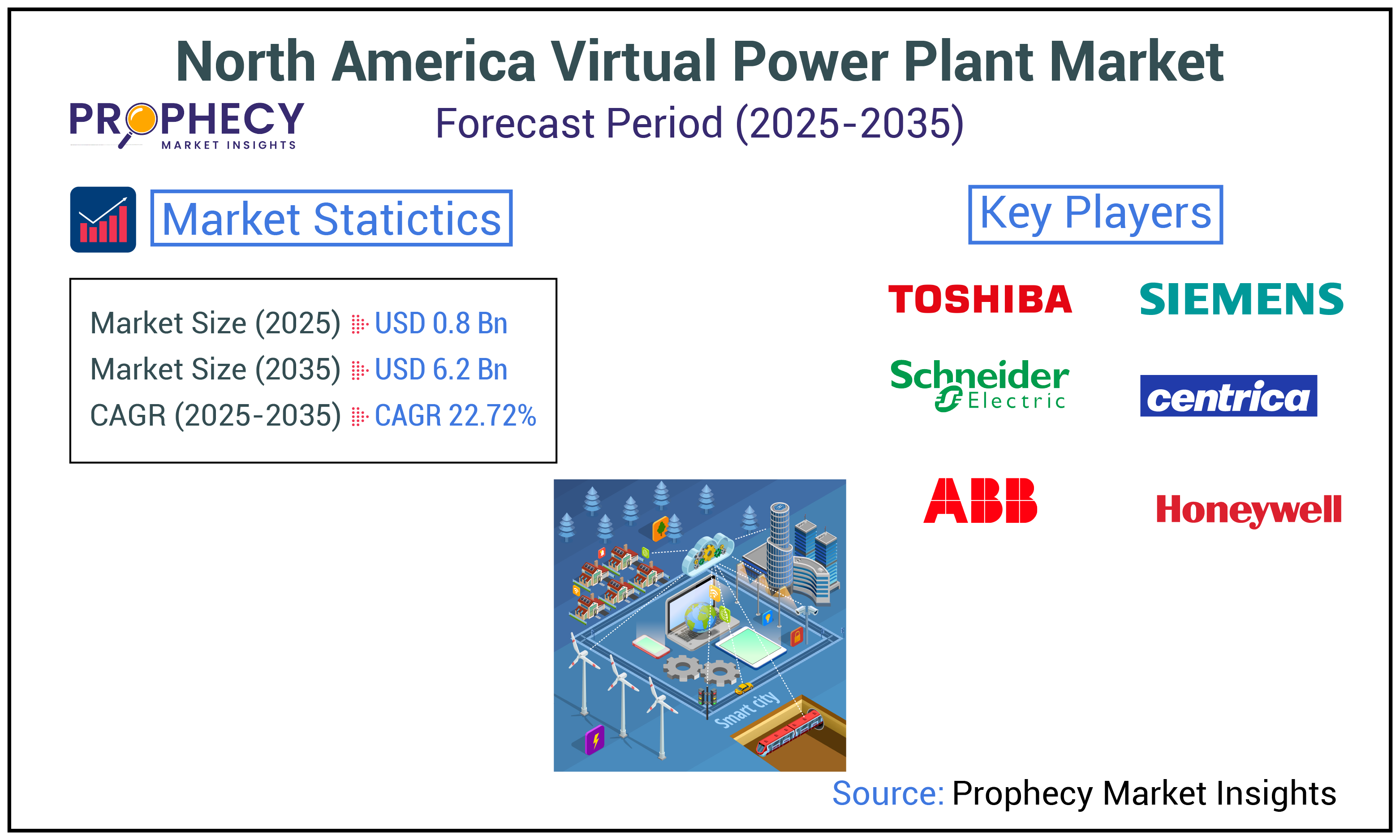
- By 2035, the North America virtual power plant market size is contemplated to enlarge at a valuation of USD 6.2 Billion.
- In 2025, the North America virtual power plant market valuation was USD 0.8 Billion.
- North America virtual power plant market is developing at a CAGR of 22.72%.
A Virtual Power Plant (VPP) is a collection of distributed energy generation units, for example, photovoltaic panels, wind turbines, battery storage systems, and flexible power consumers, which are linked and managed centrally by sophisticated software. This platform provides seamless energy delivery, load balancing in real time, and electricity trading at the best rates automatically, thus making the use of a standard power station not necessary.
North America virtual power plant market size is booming with renewable energy sources growth, which is mainly attributed to the increased use of renewable energy sources in the region, the strong desire for the modernization of the grid, and the various government initiatives that are very supportive of clean energy as well as energy efficiency. Utilities and industries find VPP technologies as a solution to cater to the rising needs which stem from increased electricity consumption, frequent disturbances in the grid, and energy management better than before.
The upcoming virtual power plant market will be influenced by the more profound integration of green energy, battery storage, and the adoption of such technologies as AI, IoT, and blockchain. These developments bring the possibility of instant energy management, peer-to-peer trading, and higher grid adaptability. Moreover, VPPs are spreading to such new territories as vehicle-to-grid (V2G) and hydrogen storage, both of which are benefitting from a robust regulatory environment and an increasing need for reliable, decentralized energy systems.
Recession Risk & Tariff Analysis:
- North America virtual power plant market has to deal with is the increasing tariffs on the imported components such as batteries and solar equipment. Since these components are becoming more expensive, the prices of projects are going to increase, which will also lead to a delay in the deployment of the virtual power plant.
- North America virtual power plant market uncertainty situation is further aggravated by the economic situation and investor sentiment, and together these factors pose the risk of recession and might lead to a slowdown in the clean energy sector.
Impact of Generative AI on North America Virtual Power Plant Market:
- Generative Al is indeed helping the North America virtual power plant market to grow. It allows for more accurate energy predictions, quick adjustments to the grid, and the automatic operation of local energy resources. This saves energy, cuts down on expenses, and allows for cleaner energy to be used more easily in the power grid.
North America Virtual Power Plant Market Drivers & Restraints
Key Drivers:
The Market is driven by Rising Adoption of Renewable Energy
The increasing use of clean energy in the U.S. and Canada is the major reason for the popularity of VPPs, as numerous homes, businesses, and electric utilities are combining solar panels, wind turbines, and other renewable energy technologies with the existing electricity grid.
The move toward distributed resources creates a large market for intelligent networks that can handle the intermittent nature of supply and demand, which virtual power plants are providing effectively. As governments focus on carbon reduction and energy self-reliance, the share of renewable energy continues to increase, making VPPs necessary to manage and utilize these decentralized, fluctuating sources in time.
- For Instance, according to the data published by Deloitte, by the end of 2024, the US Energy Information Administration (EIA) expects wind capacity to rise to 153.8 GW, up by 6.5 GW from a year earlier. Meanwhile, it expects solar to rise by a record-breaking 38.4 GW to 128.2 GW, and battery storage to rise by a record-breaking 14.9 GW to 30.9 GW.
Restraints:
The Market Growth is disturbed by Data Privacy & Cybersecurity Risks
Data privacy and security are a significant concern in the North America Virtual Power Plant market. VPPs need to share data in real-time between the distributed energy resources, control systems, and utilities, and this interconnectedness is what makes them susceptible to cyber-attacks, data breaches, or even getting access without permission. Such situations can affect the proper functioning of the grid and even the user's privacy.
- Counterbalance Statements: In order to alleviate these dangers, VPP operators are embracing security measures such as encrypted communication, several layers of authentication, artificial intelligence-based threat detection, and adherence to cybersecurity norms such as NIST and ISO/IEC 27001. Constant inspections and associations with security companies also lead to greater stability and reliability in the system.
Opportunities & Trends:
Demand for Grid Decentralization will be a Game-Changer Solution for the Market in Future
Decentralization of the power grid is a major turning point that is driving the North America Virtual Power Plant market to change rapidly. DERs (distributed energy resources) such as rooftop solar, batteries, EVs, and smart thermostats are spreading quickly, and this is the reason why conventional centralized power systems are having difficulties in handling their changeability and being able to grow.
VPPs solve this problem by combining and managing these distributed resources as a single, adaptable energy network that provides grid balancing, demand response, and peer-to-peer energy trading. This decentralized model improves the system's reliability, decreases transmission losses, and enables real-time decision making thus, power systems become more intelligent, environmentally friendly, and capable of adjusting to the changing energy needs.
North America Virtual Power Plant Market Segmentations & Regional Insights
Component, source, technology, application, end user, and country are the divisions of the North America virtual power plant market.
By Component:
Hardware, software, and services are component on which North America virtual power plant market is segmented. With its critical intelligence layer that aggregates distributed energy resources (DERs), delivers real-time data, performs predictive analytics, and orchestrates automated energy dispatch powered by cloud-based, AI-driven platforms the software component has the largest North America Virtual Power Plant (VPP) market share.
Rising demand for system integration, consultancy, continuing maintenance, and managed services particularly as utilities and businesses increasingly favor energy-as-a-service and turnkey VPP deployments has made the services component the second-largest market.
By Source:
Based on the source, the North America virtual power plant market is divided into renewable energy sources, conventional energy sources, and hybrid energy sources. Renewable energy sources, particularly solar electricity, have the most market share in the North America Virtual Electricity Plant market. Due to the extensive use of rooftop and utility-scale solar as well as the declining cost of solar technology, the solar sector alone accounted for over 45% of the VPP market in 2023. This makes solar the most readily integrated and scalable source for decentralized VPP networks.
The second-largest is the fast-expanding hybrid energy sources market, which is mostly made up of solar-plus-storage setups. These hybrid systems improve dispatchability, dependability, and grid flexibility by combining battery storage with renewable energy sources.
By Technology:
Demand response, distributed generation, mixed asset, energy storage systems integration, and others are technology of the North America virtual power plant market. With about 47–48% of revenue in 2023 and 2024, the Demand Response category commands the greatest market share in the North America Virtual Power Plant market. It is in the lead due to utilities greatly appreciate its adaptability in reducing peak demand, distributing grid loads, and providing cost savings through financial rewards for customer involvement.
The second most common packaging type is distributed generation, which are mostly used for mouthwashes and rinses. The ease of bigger, resealable containers for at-home use and growing customer interest in Conventional Energy Sources oral hygiene products are the main factors driving their rising popularity.
By Application:
On the application, North America virtual power plant market is categorized into peak load management, energy trading, grid balancing, remote monitoring and forecasting, and others. Peak load management is the largest application category in the North America virtual power plant market share across as it may save costs by eliminating costly peaker plants, increase grid stability during high-stress periods, and reduce peak power demand.
The second-largest use is Grid Balancing, which maintains a real-time balance between the supply and demand for power by utilizing both supply-side and demand-side flexibility inside VPPs.
By End User:
Industrial sector, commercial sector, residential sector, utilities and power retailers, and others are end user of the North America virtual power plant market. With around 40–60% of VPP revenue as of 2019–2023, the residential sector has the biggest North America virtual power plant market share. The extensive use of smart appliances, electric cars, home energy storage, and rooftop solar is what is causing this domination.
The industrial and commercial sector, which combined generate between 35 and 40% of market sales, is the second most significant end-user group. Through energy optimization and distributed generation techniques, VPPs help commercial and industrial establishments control peak demand, save energy expenditures, and achieve sustainability goals.
By Country:
By country, the market is divided into U.S., and Canada. The U.S. is by far the leading nation in the Virtual Power Plant (VPP) market in North America. Due to aggressive investments in grid modernization, proactive regulatory frameworks, and widespread adoption of distributed energy resources (DERs) such as solar, storage, and EV integration, it is expected to dominate both the North American and global markets through 2030. In 2023, it accounted for the largest share of regional VPP revenues.
North America Virtual Power Plant Market Report Scope:
|
Attribute |
Details |
|
Market Size 2025 |
USD 0.8 Billion |
|
Projected Market Size 2035 |
USD 6.2 Billion |
|
CAGR Growth Rate |
22.72% (2025-2035) |
|
Base year for estimation |
2024 |
|
Forecast period |
2025 – 2035 |
|
Market representation |
Revenue in USD Billion & CAGR from 2025 to 2035 |
|
Regional scope |
North America - U.S. and Canada |
|
Report coverage |
Revenue forecast, company share, competitive landscape, growth factors, and trends |
Segmentation:
By Component:
- Hardware
- Smart Meters
- Remote Terminal Units
- Others
- Software
- Cloud-based
- Cloud-based
- Services
- Consulting
- Integration & Deployment
- Others
By Source:
- Renewable Energy Sources
- Conventional Energy Sources
- Hybrid Energy Sources
By Technology:
- Demand Response
- Distributed Generation
- Mixed Asset
- Energy Storage Systems Integration
- Others
By Application:
- Peak Load Management
- Energy Trading
- Grid Balancing
- Remote Monitoring and Forecasting
- Others
By End User:
- Industrial Sector
- Commercial Sector
- Residential Sector
- Utilities and Power Retailers
- Others
By Country:
- U.S.
- Canada
North America Virtual Power Plant Market Competitive Landscape & Key Players
In order to provide flexible, intelligent energy solutions, virtual power plant businesses in North America develop by collaborating with utilities, using AI/IoT, increasing solar-plus-storage, and taking advantage of clean energy subsidies. The key players operating in the North America Virtual Power Plant Market include, Tesla, Schneider Electric, ENPHASE ENERGY, Stem, Inc., Siemens, and others.
North America Virtual Power Plant Market Companies:
- Tesla
- Schneider Electric
- Sunrun
- Amway Corp.
- Stem, Inc.
- Siemens
- ABB
- Enel X
- Enphase Energy
- Honeywell International Inc.
- Toshiba Energy Systems & Solutions Corporation
- Centrica plc
- ev.energy
- BC Hydro
- sonnen, Inc.
North America Virtual Power Plant Market Recent News
- In May 2025, as part of its Power Smart portfolio, BC Hydro is spearheading a novel new Peak Saver project that will turn residences in two towns in British Columbia into virtual power plants, providing consumers with continuous power while enhancing the electrical grid's flexibility. A developing concept that helps satisfy increasing energy demands by optimizing consumers' energy resources is the virtual power plant. Through the integration of many small-scale energy sources, such as smart thermostats, controlled electric car charging, and household batteries, these virtual power plants can assist in better balancing the demands on the electrical grid.
- In September 2024, ev.energy, the top worldwide software solution supplier for integrating electric vehicles (EVs) into virtual power plants (VPPs), is the best Distributed Energy Resource Management System (DERMS) for EV specialists. The honor highlights ev.energy's critical contribution to the worldwide transition to renewable energy, electric vehicles, and grid modernization.
Analyst View:
The North America virtual power plants (VPPs) market is expanding quickly due to the need for updated, effective grid infrastructure, the rising use of renewable energy, and encouraging government efforts. Through sophisticated software for real-time energy management and trading, VPPs incorporate distributed energy sources such as solar, wind, batteries, and flexible loads. The industry is also being propelled by the integration of blockchain, IoT, and AI technologies, as well as new applications in hydrogen storage and vehicle-to-grid that provide decentralized energy stability and increased grid flexibility.
More Related Reports
Virtual Power Plant Market
Virtual Extensible LAN Market
Mobile Virtual Network Operator Market
Virtual Critical Care Solutions Market
Asia Pacific Virtual Power Plant Market
North America Virtual Power Plant Market Company Profile
|
Company Name |
Tesla |
|
Headquarter |
Austin, Texas, U.S. |
|
CEO |
Elon Musk |
|
Employee Count |
125,665 Employees |
FAQs
North America virtual power plant market size was valued at USD 0.8 Billion in 2025 and is expected to reach USD 6.2 Billion by 2035 growing at a CAGR of 22.72%.
Component, source, technology, application, end user, and country are the segmentation for the North America Virtual Power Plant Market.
The market is segmented into U.S. and Canada. U.S. is expected to dominate the market.
The key players operating the North America virtual power plant market include Tesla, Schneider Electric, Sunrun, Amway Corp., Stem, Inc., Siemens, ABB, Enel X, Enphase Energy, Honeywell International Inc., Toshiba Energy Systems & Solutions Corporation, Centrica plc, ev.energy, BC Hydro, and sonnen, Inc.