Asia Pacific Virtual Power Plant Market Overview
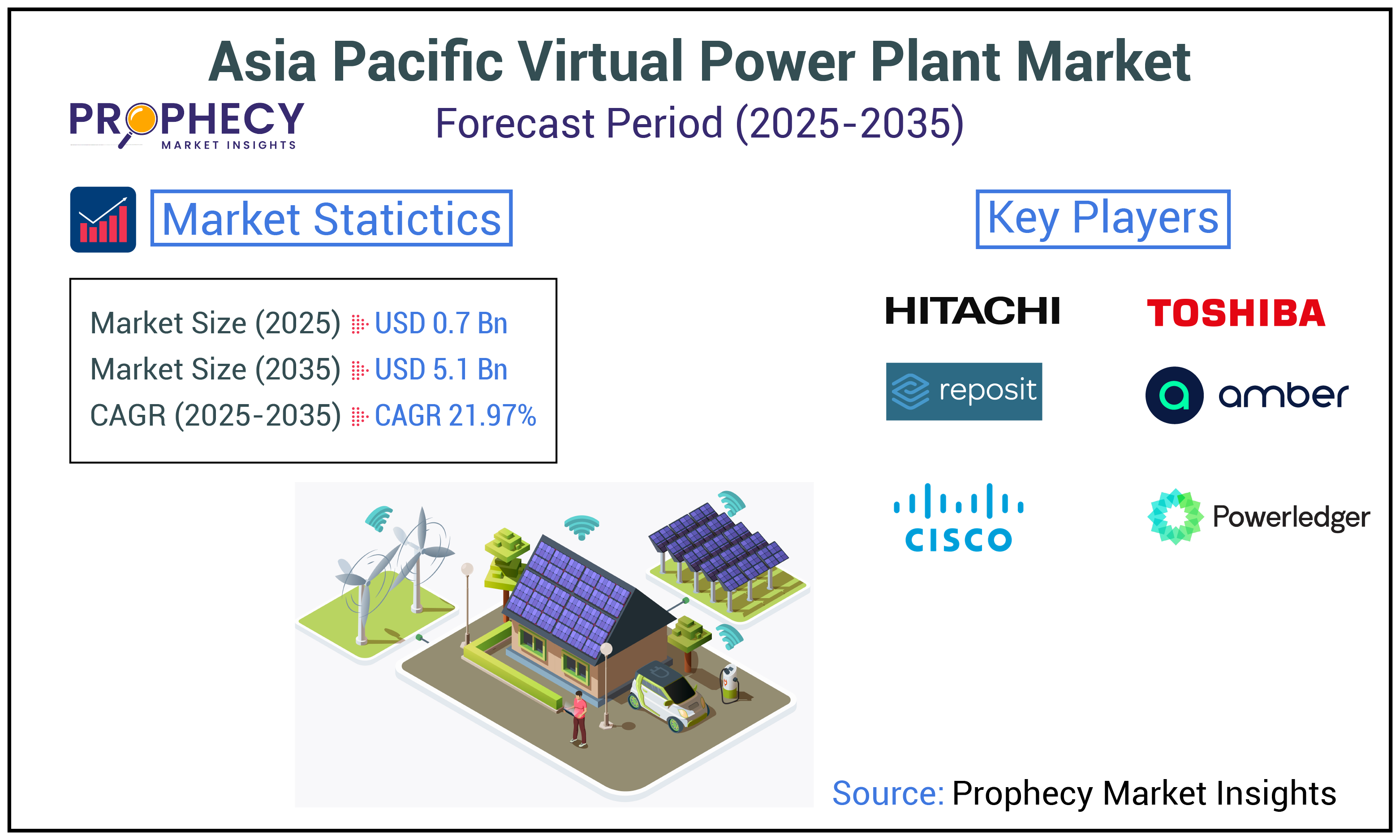
- By 2035, the Asia Pacific virtual power plant market size is contemplated to enlarge at a valuation of USD 5.1 Billion.
- In 2025, the Asia Pacific virtual power plant market valuation was USD 0.7 Billion.
- Asia Pacific virtual power plant market is developing at a CAGR of 21.97%
A Virtual Power Plant (VPP) operates through a cloud-based system which connects distributed energy assets including solar panels batteries and wind turbines to function as one unified power generation facility. Virtual Power Plants coordinate multiple distributed energy resources to balance electrical supply and demand through stored energy dispatch. Utilities together with grid operators can decrease their dependence on fossil fuels and strengthen their energy resilience through their Virtual Power Plant operations.
The Asia Pacific virtual power plant (VPP) market is witnessing significant growth due to the rising integration of renewable energy sources, increasing demand for grid reliability, and ongoing advancements in digital technologies. The quick expansion of cities along with the requirement to handle distributed energy resources effectively leads to increasing VPP implementation across the area. Market expansion results from the combination of favorable government policies together with energy transition objectives and smart grid infrastructure investments. Virtual power plants experience rapid 10% annual growth worldwide through 2030 due to increasing electricity grids and investments into distributed energy resources and energy storage and demand response systems.
The Asia?Pacific VPP market experiences rapid changes due to multiple connecting developments. The increasing adoption of distributed energy resources (DERs) including rooftop solar PV batteries and electric vehicle integration transforms energy systems to allow VPPs to execute flexible demand response and grid services with higher efficiency. The software platform together with smart management layer receive increased attention because advanced AI together with machine learning and IoT-enabled energy management systems enable both real-time forecasting and automatic control and resource distribution for extensive DER fleets.
Key Information:
- For instance, in June 2025, In India the Central Electricity Regulatory Commission (CERC) published draft guidelines about Virtual Power Purchase Agreements. The draft guidelines aim to establish standardized financial agreements between major energy users who back renewable energy producers and acquire Renewable Energy Certificates (RECs) through third-party exchanges.
Recession Risk & Tariff Analysis:
- Asia-Pacific virtual power plant market experiences possible obstacles because of general economic uncertainty and the threat of regional or worldwide recession. A market downturn could cause lower capital investment into renewable infrastructure which would postpone smart grid upgrades while hindering energy storage system deployment which are fundamental to VPP expansion.
- The economic viability of virtual power plants depends heavily on the current structure of tariffs in operation. Various regional countries maintain utility tariff systems which lack the ability to properly incentivize flexible power usage and demand response and behind-the-meter generation.
Impact of Generative AI on Asia Pacific Virtual Power Plant Market:
- Generative AI starts to transform Asia-Pacific virtual power plants (VPPs) through its ability to improve immediate decisions and prediction accuracy and network optimization. Generative AI employs deep learning techniques to analyze complex patterns that enable better simulation of power demand along with renewable generation patterns and system contingencies compared to conventional models.
- The ability to dynamically balance distributed energy resources through generative AI enables operators to predict load shifts while automating dispatch operations in complex grid environments. Virtual simulations powered by generative AI enable VPP design alongside regulatory compliance modeling and customer behavior forecasting which leads to enhanced operational efficiency and scalability.
Asia Pacific Virtual Power Plant Market Drivers & Restraints
Key Drivers:
Virtual Power Plants Gain Momentum as Asia-Pacific Accelerates Renewable Energy Integration
The Asia-Pacific area experiences growth in solar and wind renewable energy projects which need VPPs for managing their irregular patterns and proper grid integration. The expanding industry receives additional backing through government support programs as well as decarbonization objectives and changing energy regulations which promote decreased dependency on fossil fuels. VPPs become essential for grid stability as they gather and manage distributed energy resources that increase in number.
- For Instance, in July 2025, New South Wales has raised its incentive amount to AUD 1,500 from AUD 800 for household and small business battery installations that participate in Virtual Power Plants (VPPs). The improved subsidy will drive higher VPP enrollment rates which will maintain stable demand patterns while advancing the 82% renewable energy target for 2030.
Restraints:
Regulatory Fragmentation Poses Challenge to Virtual Power Plant Deployment in Asia-Pacific
The process of creating and running VPPs becomes complex because of different unclear rules that exist throughout various Asian Pacific nations. The diverse regulatory frameworks create a time-consuming and costly process which might slow down the development of new markets. The lack of uniformity in regulations creates difficulties for international energy commerce and prevents the development of standardized VPP technologies. The complete realization of VPP potential depends on unified policy frameworks together with standardized technical standards implemented throughout the region.
- Counterbalance Statements: Several countries within Asia-Pacific demonstrate progress toward establishing transparent regulations and beneficial policies which support virtual power plants (VPPs). Government-funded initiatives together with pilot testing programs along with regional partnerships work to minimize compliance obstacles while motivating private sector involvement. The ongoing initiatives throughout the region create better conditions for Virtual Power Plant expansion.
- For instance, New virtual tolling agreements facilitated by contracts including Akaysha Energy in Australia together with fresh multi-party legal frameworks for Laos?Vietnam?Thailand solar exports demonstrate how complex financing solutions enable clean energy infrastructure expansion.
Opportunities & Trends:
Digital Technologies Drive Efficiency and Scalability of Virtual Power Plants in Asia-Pacific
The combination of technologies enables VPP operators to forecast energy requirements and react quickly to grid changes while optimizing resource distribution. Machine learning algorithms boost the precision of forecasting both power generation patterns and consumption patterns. The maturing digital infrastructure creates a substantial increase in both the scalability and responsiveness of VPP networks throughout the Asia-Pacific region.
The digital transformation process brings cost reductions and system reliability enhancements through automated processes and predictive maintenance techniques. The implementation of this system both enhances grid resilience and facilitates the shift to decentralized sustainable energy systems.
Asia Pacific Virtual Power Plant Market Segmentations & Regional Insights
Component, source, technology, application, end user, and country are the divisions of the Asia Pacific virtual power plant market.
By Component:
Hardware, software, and services, are component on which Asia Pacific virtual power plant market is segmented. The software segment leads the Asia-Pacific virtual power plant market share as it manages and optimizes distributed energy resources (DERs) through coordination. Software platforms provide real-time data analytics and predictive forecasting alongside automated decision-making capabilities.
The hardware segment represents the second major component in the Asia-Pacific virtual power plant market share due to distributed energy resources including smart meters and solar inverters and battery storage systems and communication devices are being increasingly deployed. These physical assets form the basic layer of VPP infrastructure, which enables connection and data flow between energy sources and control systems.
By Source:
Renewable energy sources, conventional energy sources, and hybrid energy sources are segmentations of virtual power plant market by source. Renewable energy sources represent the leading segment in the Asia-Pacific virtual power plant market share as the region moves towards clean energy and decarbonization objectives. The rapid deployment of solar and wind power across China India Japan and Australia generates an essential need for VPPs to handle their variable nature and maximize their grid integration.
The virtual power plant market in Asia-Pacific considers hybrid energy sources as its second leading segment because operators use both renewable and traditional energy assets to improve reliability and grid stability. Hybrid virtual power plants enhance their flexibility for handling variable power supply and demand peaks through the combination of solar energy, wind generation and gas-fired power plants with storage systems.
By Technology:
The market is segmented into demand response, distributed generation, mixed asset, energy storage systems integration, and others in the technology segment. Demand response stands as the leading technology segment in the Asia-Pacific virtual power plant market share owing to it executes essential supply-demand equilibrium functions in real time. Virtual power plants utilize demand response to modify their energy consumption patterns because this system motivates consumers to decrease or relocate their electricity usage throughout peak demand times.
The virtual power plant market across Asia-Pacific finds its second largest technology segment in distributed generation because of the fast growth of rooftop solar together with small wind turbines and other distributed renewable power resources. Distributed generation allows VPPs to collect power from decentralized assets, improve energy security and reduce transfer losses.
By Application:
Based on the application, the Asia Pacific virtual power plant market is divided into peak load management, energy trading, grid balancing, remote monitoring and forecasting, and others. The primary application segment in the Asia-Pacific virtual power plant market size consists of peak load management due to utilities and grid operators need effective solutions to manage increasing electricity demand and prevent infrastructure overload.
The grid balancing segment stands as the second leading application in the Asia-Pacific virtual power plant market growth due to the rising integration of intermittent renewable energy sources such as solar and wind. VPPs execute the vital function of keeping supply and demand balanced in real-time by controlling distributed energy resources which ensures equilibrium between power generation and consumption.
By End User:
Industrial sector, commercial sector, residential sector, utilities and power retailers and others are end-use of the Asia Pacific virtual power plant market. Utilities and power retailers in the Asia-Pacific virtual power plant market growth lead as the main end-users as they actively lead grid modernization and energy transition projects. VPPs function as platforms to control distributed energy resources across large areas to improve grid stability while decreasing dependance on traditional fossil-fuel-based power generation.
The industrial sector represents the second primary user group within the Asia-Pacific virtual power plant market due to its substantial and fluctuating power requirements together with increasing demands for cost reduction and energy stability. Industries are increasingly using VPP solutions to integrate renewable generation on site, manage top loads and participate in demand programs.
By Country:
The Asia-Pacific virtual power plant market shows Australia as its front-runner with Japan, China and South Korea following closely behind. The Australian market leads due to of its widespread rooftop solar adoption combined with sophisticated energy storage projects and government programs that facilitate distributed energy resource (DER) integration.
Asia Pacific Virtual Power Plant Market Report Scope:
|
Attribute |
Details |
|
Market Size 2025 |
USD 0.7 Billion |
|
Projected Market Size 2035 |
USD 5.1 Billion |
|
CAGR Growth Rate |
21.97% (2025-2035) |
|
Base year for estimation |
2025 |
|
Forecast period |
2025 – 2035 |
|
Market representation |
Revenue in USD Billion & CAGR from 2025 to 2035 |
|
Regional scope |
Asia Pacific - China, India, Japan, Australia, Indonesia, Malaysia, South Korea, and Rest of Asia Pacific |
|
Report coverage |
Revenue forecast, company share, competitive landscape, growth factors, and trends |
Segmentation:
By Component:
- Hardware
- Smart Meters
- Remote Terminal Units
- Others
- Software
- Cloud-based
- On-premise
- Services
- Consulting
- Integration & Deployment
- Others
By Source:
- Renewable Energy Sources
- Conventional Energy Sources
- Hybrid Energy Sources
By Technology:
- Demand Response
- Distributed Generation
- Mixed Asset
- Energy Storage Systems Integration
- Others
By Application:
- Peak Load Management
- Energy Trading
- Grid Balancing
- Remote Monitoring and Forecasting
- Others
By End Use:
- Industrial Sector
- Commercial Sector
- Residential Sector
- Utilities and Power Retailers
- Others
By Country:
- China
- India
- Japan
- Australia
- Indonesia
- Malaysia
- South Korea
- Rest of Asia Pacific
Asia Pacific Virtual Power Plant Market Competitive Landscape & Key Players
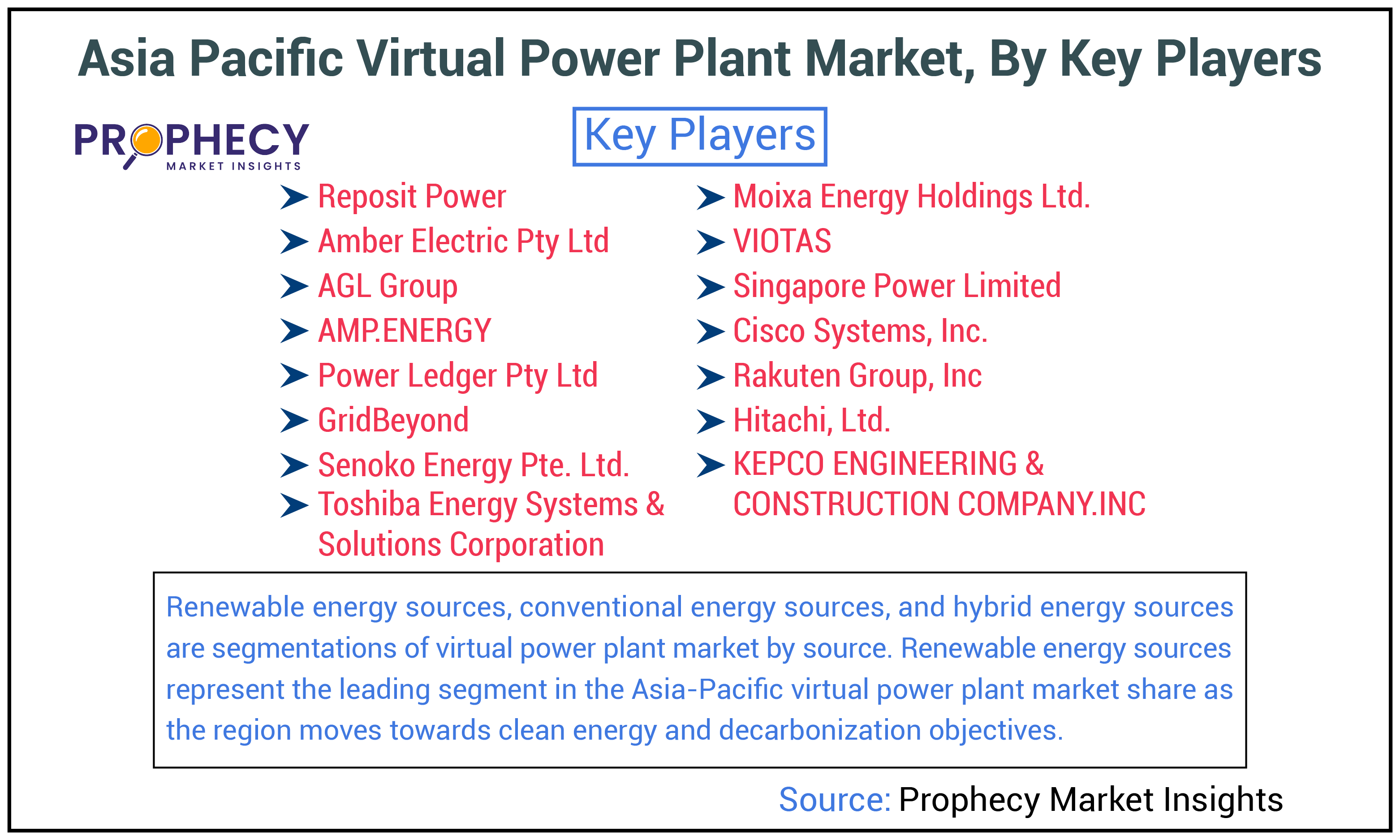
The Asia-Pacific virtual power plant market contains a competitive mixture of regional energy providers together with international technology corporations as well as new startups that specialize in grid optimization. Market leaders dedicate their resources to establish partnerships and conduct pilot programs and develop digital platforms for expanding their market presence.
Asia Pacific Virtual Power Plant Market Companies:
- Toshiba Energy Systems & Solutions Corporation
- Reposit Power
- KEPCO ENGINEERING & CONSTRUCTION COMPANY.INC
- Amber Electric Pty Ltd
- AGL Group
- AMP.ENERGY
- Power Ledger Pty Ltd
- GridBeyond
- Senoko Energy Pte. Ltd.
- Moixa Energy Holdings Ltd.
- VIOTAS
- Singapore Power Limited
- Cisco Systems, Inc.
- Rakuten Group, Inc
- Hitachi, Ltd.
Asia Pacific Virtual Power Plant Market Recent News
- In June 2025, Rakuten Group, Inc continues to expand its Virtual Power Plant (VPP) operations throughout Japan by distributing zero-cost energy storage batteries to business customers through partnerships with Fuyo General Lease and Global Engineering. The remote management system will control these installations to maintain power supply stability throughout the varied business sectors of the country.
- In June 2025, Vena Energy has entered into a 20-year-old virtual power purchase agreement with Ly Corporation for 72MW Maniwa Solar Project in Okayama Prefecture. Completed for completion by 2026, it is Japan's largest VPPA with a unit, and delivers clean energy that is sold on Japan Electric Power Exchange to support local decarbonization goals.
Analyst View:
the Asia-Pacific region's virtual power plant (VPP) market as one of the world's most rapidly evolving energy markets, driven by the region's rapid shift to decentralized, clean energy systems. Growth is driven by the evolution of distributed energy resources, supportive regulatory policies for clean energy goals, and rising investments in digital grid infrastructure.
More Related Reports
Virtual Power Plant Market
Virtual Extensible LAN Market
Mobile Virtual Network Operator Market
Virtual Critical Care Solutions Market
Virtual Hospitals Market
Asia Pacific Virtual Power Plant Market Company Profile
|
Company Name |
Toshiba Energy Systems & Solutions Corporation |
|
Headquarter |
Kanagawa, Japan |
|
CEO |
Takao Konishi |
|
Employee Count |
5000 Employees |
FAQs
Asia Pacific virtual power plant market size was valued at USD 0.7 Billion in 2025 and is expected to reach USD 5.1 Billion by 2035 growing at a CAGR of 21.97%.
Component, source, technology, application, end user, and country are the segmentation for the target market.
The market is segmented into China, India, Japan, Australia, Indonesia, Malaysia, South Korea, and Rest of Asia Pacific. Australia is expected to dominate the market.
The key players operating the Asia Pacific virtual power plant market include Toshiba Energy Systems & Solutions Corporation, Reposit Power, KEPCO ENGINEERING & CONSTRUCTION COMPANY.INC, Amber Electric Pty Ltd, AGL Group, AMP.ENERGY, Power Ledger Pty Ltd, GridBeyond, Senoko Energy Pte. Ltd., Moixa Energy Holdings Ltd., VIOTAS., Singapore Power Limited, Cisco Systems, Inc., CP Kelco U.S.,Inc., and Hitachi, Ltd.