Japan Virtual Power Plant Market Overview
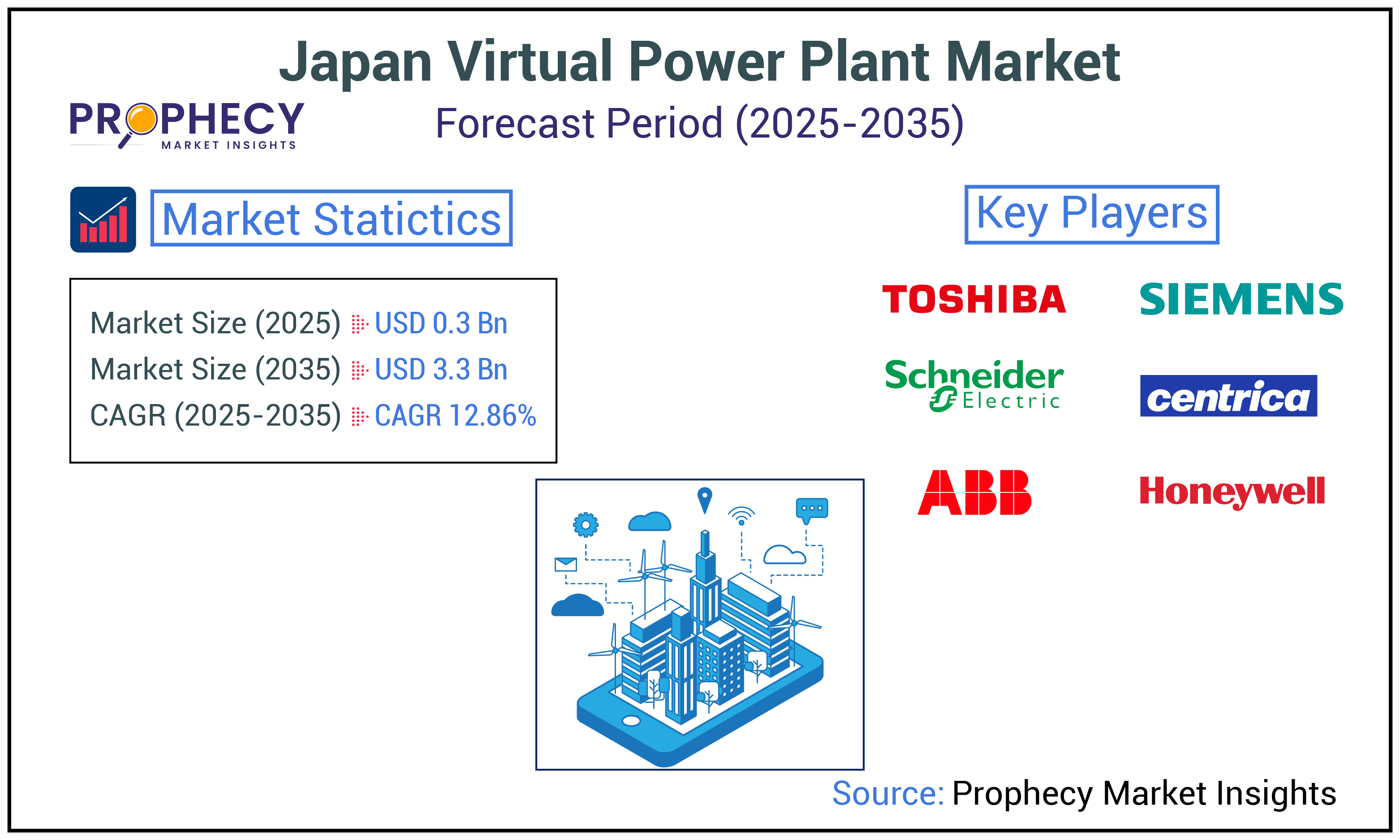
- By 2035, the Japan virtual power plant market size is contemplated to enlarge at a valuation of USD 3.3 Billion.
- In 2025, the Japan virtual power plant market valuation was USD 0.3 Billion.
- Japan virtual power plant market is developing at a CAGR of 12.86%
A virtual power plant (VPP) operates through a cloud-based system which connects distributed energy assets including solar panels batteries and wind turbines to function as one unified power generation facility. Virtual Power Plants coordinate multiple distributed energy resources to balance electrical supply and demand through stored energy dispatch. Utilities together with grid operators can decrease their dependence on fossil fuels and strengthen their energy resilience through their Virtual Power Plant operations.
The virtual power plant (VPP) market in Japan is growing at a fast pace, driven by the interplay of several factors. The dominant driver is the extensive use of distributed renewable generation, particularly solar and wind, which leads to fluctuating demand and supply on the grid and necessitates the use of VPPs for real-time balancing. Besides, government support has been instrumental in promoting the development of distributed energy resources (DER) through measures such as feed-in tariffs, demand-response capacity markets, and pilot funding.
The VPP scene in Japan is changing quickly due to the combination of policies, technologies, and business interests. One effect is grid flexibility is being improved by the large increase in battery energy storage system (BESS) installations these range from industrial-size long-duration systems to residential lithium-ion and flow batteries. Big projects are already happening.
For instance, Sumitomo aims to increase BESS from 9 MW in 2023 to 500 MW in 2031. TotalEnergies/Saft is also getting ready for a 1 GWh system in Fukushima that will be the base for grid stability and load balancing.
Key Information:
- For instance, Japan has changed its climate goals in February 2025. The country aims to have half of its energy come from renewables by 2040 and make greater GHG reductions during 2035-40. The change has encouraged measures to be taken at the policy level, money being spent by utilities on the grid, and collaborations involving the public-private sectors in the areas of wind, hydrogen, ammonia, and storage.
Recession Risk & Tariff Analysis:
- Japan virtual power plant market growth is expected to develop over time though it faces some challenges concerning the global economy. If there is a recession, it will mostly cause less money to be spent on building by companies and electric utilities, hence the progress of energy resources that are distributed, energy storage, and grid modernization that are the main elements of the VPP structure will be put on hold.
- Industries and businesses are the sectors that have the most significant impact on demand response and load aggregation. These sectors can reduce their participation significantly if the energy costs are cut or the production declines due to an economic recession. Furthermore, the attitude of investors and the availability of funds for renewable energy and smart grid projects may be negatively influenced by the recession, thus affecting the implementation of large-scale VPP projects.
Impact of Generative AI on Japan Virtual Power Plant Market:
- Generative Artificial Intelligence is gradually becoming a major factor to be reckoned with in the Virtual Power Plant (VPP) system in Japan, boosting the capabilities of operational intelligence, forecasting, and decision support. In particular, companies such as Grid Solutions that concentrate on energy aggregation are implementing software powered by machine learning technology for the purpose of making estimations regarding energy demand and market prices for short periods of time, which, in turn, are crucial instruments in the management of VPP as well as in the trading process.
- Moreover, market is witnessing how JERA’s innovative Digital Power Plant concept links the generative AI, the digital twins and prodigious enterprise metaverse, known as “Enterprise Knowledge Adviser” to comprehend historical mishaps, provide current-time resolutions and allow remote team-work, among engineering groups, located anywhere in the world, to carry out virtual co-working.
Japan Virtual Power Plant Market Drivers & Restraints
Key Drivers:
Japan Boosts VPP Growth with DER Incentives and Smart Grid Policies
Japan's Strategic Energy Plan is a key factor that not only encourages smart communities but also DERs including the VPP through the various subsidies and financial incentives provided. These laws help to improve the robustness of the grid, lower carbon emissions, and facilitate the energy transition of Japan. The program designed such that grid participants are enabled to use solar, storage, and demand response devices has become the encouragement of the VPP collaborations in residential and industrial sectors.
- For Instance, Japan's cabinet gave its formal approval to the Seventh Strategic Energy Plan on February 18, 2025, which marked a major step forward in the country's clean energy ambitions. The plan outlines a target of 40–50% renewables in the electricity mix by fiscal year 2040, with a 20% contribution from nuclear energy, thus paving the way for a large-scale solar-plus-storage installation along with VPP engagement.
Restraints:
Japan’s Aging Grid Spurs Urgent Upgrades Ahead of VPP Expansion
Traditional systems are usually built in such a way that they do not possess digital communication functionalities or real-time responsiveness which are essential for dynamic load balancing and DER integration. Hence, these systems if not updated, may lead to such problems as data delays, limited coalitions between systems, and poor security which may be an obstacle to VPP scalability. These projects will definitely require a considerable amount of money to be spent on smart grid technologies, advanced metering infrastructure as well as secure communication protocols if they are to fully embrace the VPP ecosystem.
- Counterbalance Statements: Despite that, Japan is energetically dealing with the shortcomings of its infrastructure by making tactical investments in the smart grid technology, implementing the advanced metering systems throughout the country, and launching public-private partnerships that target the improvement of the grid's flexibility, thus, being able to a more efficient and sustainable energy network which supports VPP.
Opportunities & Trends:
Japan’s VPP Market Emerges as Key Growth Engine for Clean?Energy Grid and DER Innovation
The virtual power plant (VPP) market in Japan offers considerable opportunities as the country moves faster with its renewable energy transition. Among VPP technologies, battery energy storage systems (BESS) have been leading market with around 90% of the total installed capacity. The residential BESS sector is highly competitive and faces grid saturation due to the large number of homes with installed photovoltaic (PV) systems and batteries in Japan. But in the commercial and industrial sector, nationwide regional demand response services (R-DRS) are expanding.
Japan Virtual Power Plant Market Segmentations & Regional Insights
Component, source, technology, application, and end user are the divisions of the Japan virtual power plant market.
By Component:
Hardware, software, and services, are component on which Japan virtual power plant market is segmented. The software segment holds a dominant position in the Japan virtual power plant market share since it handles the distributed energy resources (DERs) management and optimization by the coordination process. Additionally, software platforms deliver real-time data analytics and predictive forecasting as well as the automation of decision making.
The hardware segment is the second largest contributor to the Japan virtual power plant market, the main reasons being the widespread deployment of distributed energy resources such as smart meters, solar inverters, battery storage systems, and communication devices. These tangible assets constitute the fundamental layer of the VPP network, which facilitates the exchange of data between energy sources and control systems.
By Source:
Renewable energy sources, conventional energy sources, and hybrid energy sources are segmentations of virtual power plant market by source. Renewable energy sources represent the leading segment in the Japan virtual power plant market share as the region moves towards clean energy and decarbonization objectives. The rapid deployment of solar and wind power across China India Japan and Australia generates an essential need for VPPs to handle their variable nature and maximize their grid integration.
The virtual power plant market is segmented by source into renewable energy sources, conventional energy sources, and hybrid energy sources. The renewable energy segment is the leading segment of the Japan virtual power plant market as the region moves towards clean energy and decarbonization objectives. The fast deployment of solar and wind power across China, India, Japan, and Australia creates a vital need for VPPs to manage their variability and thus maximize their integration with the grid.
By Technology:
The virtual power plant market in Japan is divided according to various technologies such as demand response, distributed generation, mixed asset, energy storage systems integration, and others. Among these segments, demand response represents the leading technology segment in Japan virtual power plant market share. This is largely as it performs necessary supply-demand equilibrium operations in real time. Demand response is implemented by virtual power plants to change their energy usage patterns as this system encourages consumers to reduce or shift their electricity usage during peak demand
Japan's market for virtual power plants after the largest technology segment for distributed generation is the second due to the rapid growth of rooftop solar, wind turbines for small and other distributed renewable energy sources. Distributed generation allows VPPs to take energy from decentralized sources, increase energy security and reduce energy losses during transmission.
By Application:
The virtual power plant market in Japan has been segmented by application into peak load management, energy trading, grid balancing, remote monitoring and forecasting, and others. Among these, the peak load management segment holds the largest share of the Japan virtual power plant market due to the growing demand for energy and the need for smart infrastructure solutions by utilities and grid operators to avoid the overloading of the network.
The grid balancing segment market in Japan holds the position of the second most significant application for virtual power plants (VPP) owing to the increasing integration of renewable energy sources. The VPPs perform the crucial role of balancing supply and demand in real-time by managing distributed energy resources which, in turn, guarantees balance between power generation and consumption.
By End User:
Industrial sector, commercial sector, residential sector, utilities, and power retailers, among other are end-use of the Japan virtual power plant market. Utilities and power retailers in the Japan virtual power plant market growth mainly lead the end-users as they actively lead grid modernization and energy transition projects. VPPs act as control platforms for distributed energy resources over large areas to enhance grid stability while reducing reliance on traditional fossil-fuel-based power generation.
The industrial sector is the second largest user group in the Japan virtual power plant market, after the residential sector. The sizable and variable power needs of this sector as well as the rising requirements for energy stability and cost savings are primarily the reasons for this enormous interest. To begin with, workers are employing VPP solutions to facilitate the energy generation from the installed renewable sources on site. Besides, they are running peak consumption program, and coupled demand through participation in demand programs.
Japan Virtual Power Plant Market Report Scope:
|
Attribute |
Details |
|
Market Size 2025 |
USD 0.3 Billion |
|
Projected Market Size 2035 |
USD 3.3 Billion |
|
CAGR Growth Rate |
12.86% (2025-2035) |
|
Base year for estimation |
2025 |
|
Forecast period |
2025 – 2035 |
|
Market representation |
Revenue in USD Billion & CAGR from 2025 to 2035 |
|
Report coverage |
Revenue forecast, company share, competitive landscape, growth factors, and trends |
Segmentation:
By Component:
- Hardware
- Smart Meters
- Remote Terminal Units
- Intelligent Electronic Devices
- Others
- Software
- Cloud-based
- On-premise
- Services
- Consulting
- Integration & Deployment
- Others
By Source:
- Renewable Energy Sources
- Conventional Energy Sources
- Hybrid Energy Sources
By Technology:
- Demand Response
- Distributed Generation
- Mixed Asset
- Energy Storage Systems Integration
- Others
By Application:
- Peak Load Management
- Energy Trading
- Grid Balancing
- Remote Monitoring and Forecasting
- Others
By End Use:
- Industrial Sector
- Commercial Sector
- Residential Sector
- Utilities and Power Retailers
- Others
Japan Virtual Power Plant Market Competitive Landscape & Key Players
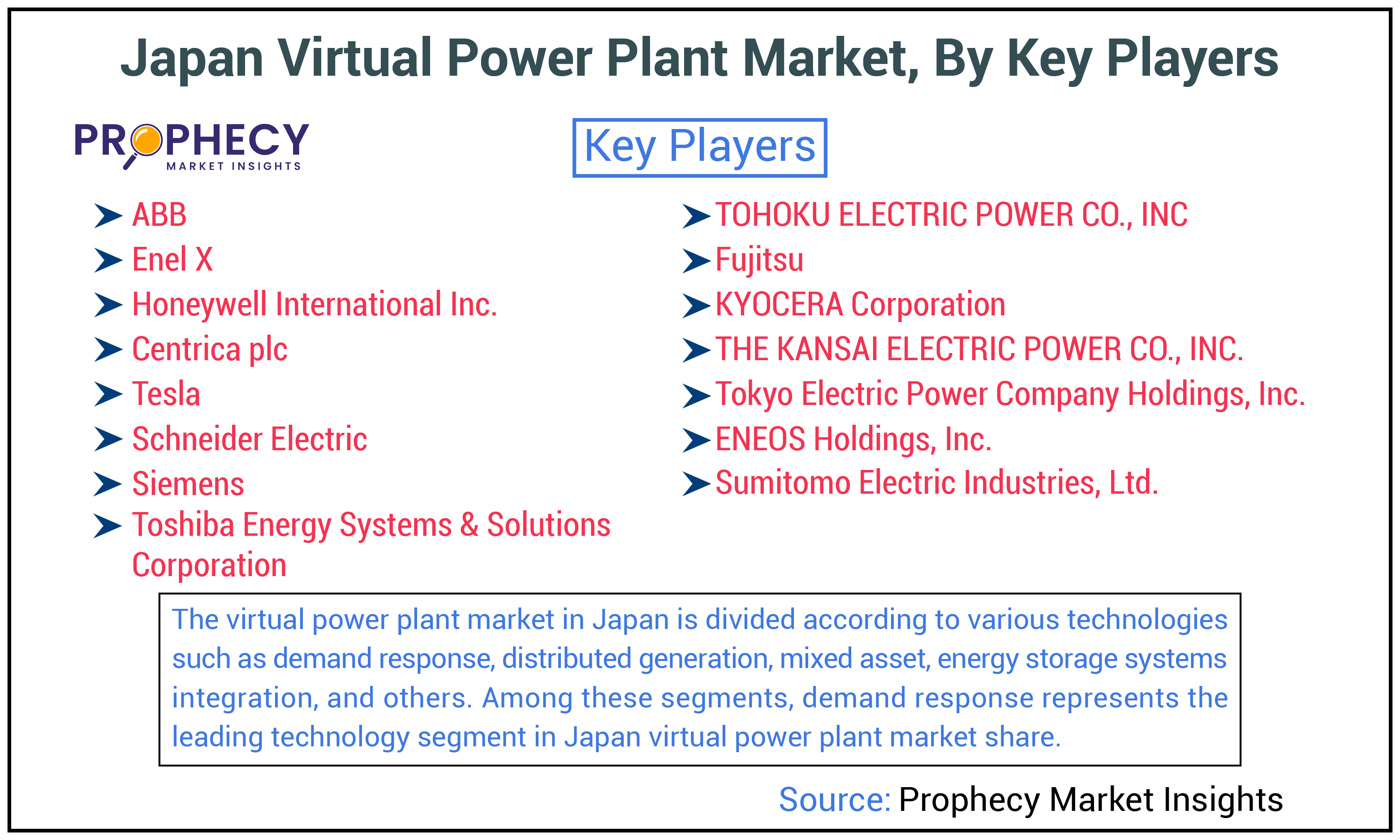
The Japan virtual power plant market contains a competitive mixture of regional energy providers together with international technology corporations as well as new startups that specialize in grid optimization. Corporations dedicate their resources to establish partnerships and conduct pilot programs and develop digital platforms for expanding their market presence.
Japan Virtual Power Plant Market Companies:
- ABB
- Enel X
- Honeywell International Inc.
- Toshiba Energy Systems & Solutions Corporation
- Centrica plc
- Tesla
- Schneider Electric
- Siemens
- TOHOKU ELECTRIC POWER CO., INC
- Fujitsu
- KYOCERA Corporation
- THE KANSAI ELECTRIC POWER CO., INC.
- Tokyo Electric Power Company Holdings, Inc.
- ENEOS Holdings, Inc.
- Sumitomo Electric Industries, Ltd.
Japan Virtual Power Plant Market Recent News
- In June 2025, Tesla plans to grow its virtual power plant business throughout Japan, giving businesses free storage batteries that can be remotely managed to assist balance supply and demand for electricity. In 2021, Tesla opened a virtual power plant (VPP) in the Okinawan prefecture's Miyakojima city. In partnership with Fuyo General Lease, a leasing firm, and Global Engineering, an energy company located in Fukuoka in which Fuyo has invested, it will grow the business.
Analyst View:
The market for virtual power plants (VPPs) in Japan is growing quickly due to the increase of distributed renewable energy sources such as wind and solar, which need real-time balancing to keep the grid stable. These resources are connected and coordinated via cloud-based VPPs, which provide effective energy dispatch and less dependency on fossil fuels. The adoption of DER has been pushed by strong government backing in the form of feed-in tariffs, demand-response markets, and pilot projects. Battery energy storage systems (BESS) are also becoming more and more popular in Japan, where big firms such as Sumitomo and TotalEnergies/Saft are investing in extensive projects to improve grid resilience and flexibility.
More Related Reports
Virtual Power Plant Market
Virtual Extensible LAN Market
Mobile Virtual Network Operator Market
Virtual Critical Care Solutions Market
Asia Pacific Virtual Power Plant Market
Japan Virtual Power Plant Market Company Profile
|
Company Name |
Tokyo Electric Power Company Holdings, Inc. |
|
Headquarter |
Uchisaiwaicho, Chiyoda, Tokyo |
|
CEO |
Tomoaki Kobayakawa |
|
Employee Count |
38,183 Employees |
FAQs
Japan virtual power plant market size was valued at USD 0.3 Billion in 2025 and is expected to reach USD 3.3 Billion by 2035 growing at a CAGR of 12.86%.
Component, source, technology, application, end user, and country are the segmentation for the Japan virtual power plant market.
The key players operating the Japan Virtual Power Plant Market include ABB, Enel X, Honeywell International Inc., Toshiba Energy Systems & Solutions Corporation, Centrica plc, Tesla, Schneider Electric, Siemens, TOHOKU ELECTRIC POWER CO., INC, Fujitsu, KYOCERA Corporation, THE KANSAI ELECTRIC POWER CO., INC., Tokyo Electric Power Company Holdings, Inc., ENEOS Holdings, Inc., and Sumitomo Electric Industries, Ltd.