Japan Blue Ammonia Market Overview
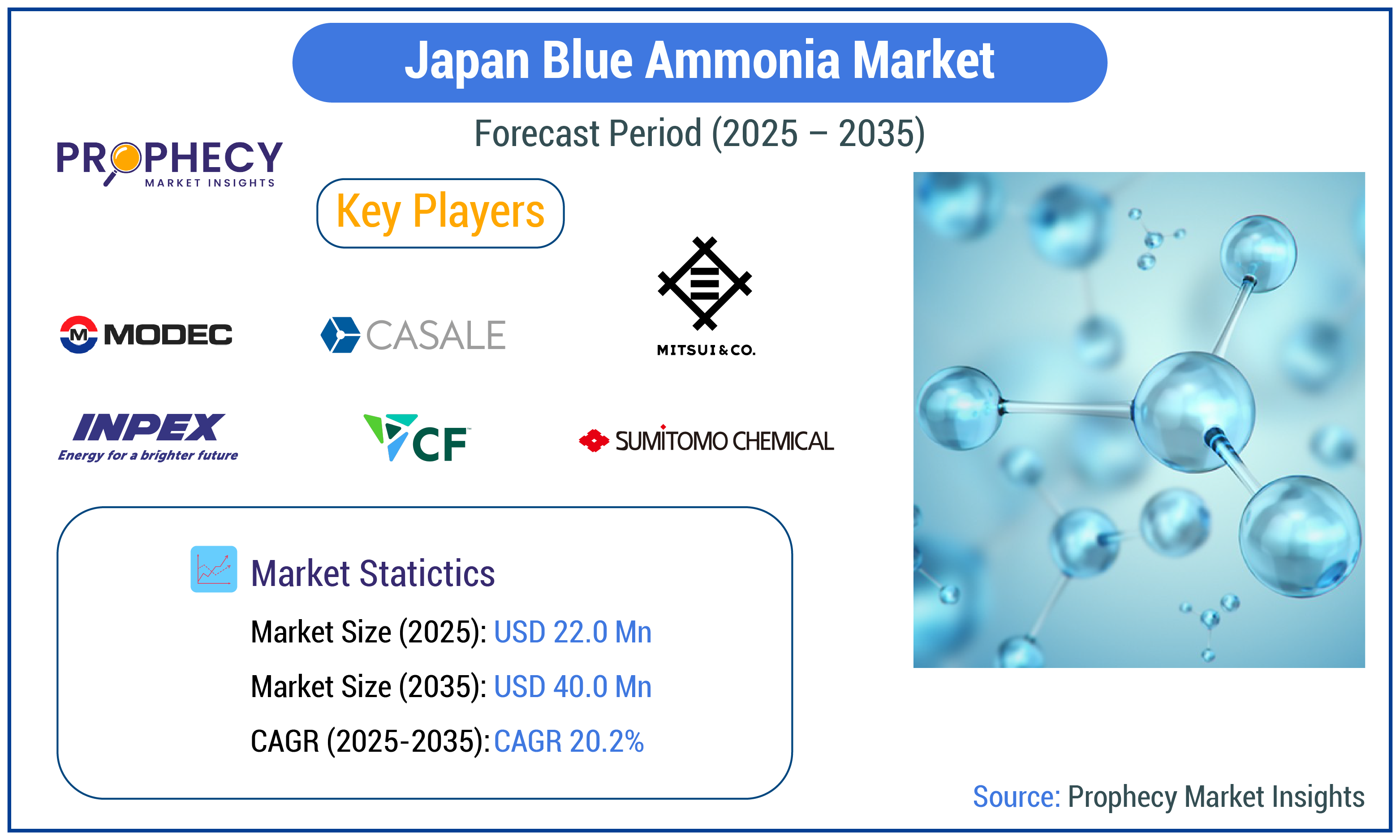
- By 2035, the Japan blue ammonia market size is contemplated to enlarge at a valuation of USD 40.0 Million.
- In 2025, the Japan blue ammonia market valuation was USD 22.0 Million.
- Japan blue ammonia market is developing at a CAGR of 20.2%.
In contrast to gray ammonia, blue ammonia is traditional ammonia for which the by-product CO2 has been caught and stored, minimizing its influence on the climate. In recent years, several fertilizer manufacturers have started these kinds of initiatives. Blue ammonia is a contentious substance that requires industrial guidelines. For instance, permanently pumping CO2 into the ground is more ecologically friendly than using it for increased oil recovery. Airborne nitrogen and natural gas-derived hydrogen are combined to create blue ammonia. Blue ammonia manufacture also necessitates the capture and storage of the CO2 produced during the hydrogen separation from natural gas (reforming), even though ammonia synthesis using natural gas is a well-established process.
Japan's deliberate movement toward hydrogen and ammonia as renewable energy carriers, its commitment to reach carbon neutral by 2050, and the substantial financial backing provided by funding and regulations are the primary drivers encouraging the Japan blue ammonia market expansion. The manufacturing of blue ammonia from natural gas in combination with carbon capture and storage (CCS) is an attractive option for decarbonizing power generation given that it acts as a low-carbon replacement for conventional fuels, particularly when cofiring with coal. Growth in the market is additionally facilitated by infrastructure investments and testing initiatives by energy powerful competitors including JERA and IHI, as well as Japan's partnerships with Middle Eastern and Southeast Asian countries to assure a long-term supply of blue ammonia.
Japan blue ammonia market is expected to grow significantly as a consequence of considerable industrial expenses, ambitious clean energy goals, and substantial government backing. Blue ammonia is necessary for the nation's goal of purchasing 3 million tons of clean ammonia yearly by 2030 and 30 million tons by 2050. Prominent firms notably JERA are developing international partnerships and committing substantial expenditures, reaching ¥5 trillion (~US$32 billion) by 2035, to build facilities, obtain fuel from developments notably ExxonMobil's, and convert coal-fired power stations to utilize ammonia. Japan is positioned as a key participant in the global blue ammonia transition as a result of these initiatives.
Recession Risk and Tariff Analysis:
- Trade tensions and escalating economic worries could lead to complications for Japan's blue ammonia market. The trust of investors could decrease if the economy shrinks in early 2025 and hyperinflation undermines spending by consumers. Nevertheless, expected U.S. taxes on chemical imports could increase the selling price of Japanese feedstocks or ammonia imports, which might impede the building of infrastructure and disrupt the supply chains.
- Despite this Japan continues to be committed to boosting the utilization of blue ammonia, except there exists substantial government backing or favorable agreements regarding trade, these economic and commercial challenges may slow growth.
Impact of Generative AI on Japan Blue Ammonia Market:
- Japan blue ammonia market has been projected to be adversely affected by generative AI in the following two primary manners: by educating the requirement for power and by boosting the effectiveness of technology. As AI turns into increasingly prevalent, especially within data centers, Japan's power needs are anticipated to rise substantially boosting the requirement for low-carbon fuels notably blue ammonia.
- At the exact same time, artificial intelligence (AI) could accelerate up ammonia production developments by using predictive analytics to improve infrastructure planning and optimize catalyst design. By virtue of its dual function, generative AI is positioned to both stimulate demand and spur innovation in Japan blue ammonia market.
Japan Blue Ammonia Market Drivers & Restraints
Key Drivers:
Japan's Engagement to Zero Carbon Development Will Encourage Industry Development
As the country seeks for scalable, low-carbon energy alternatives to reduce emissions from its manufacturing and electrical power industries, Japan's determination to become carbon neutral by 2050 is an essential driver propelling the Japan blue ammonia market growth. Specifically in thermal power manufacturing, blue ammonia which can be produced from gas extracted from the ground combined carbon capture and storage (CCS) offers an economically profitable and environmentally conscious replacement for coal. This is in accordance with Japan's strategy to incrementally transition out fossil fuels without completely reconstructing the country's infrastructure. Japan's commitment of establishing blue ammonia an essential part of its emissions-free operation renewable energy portfolio can be seen in government actions including importation roadmaps and subsidies, in addition to helping hands for co-firing technology. These measures will accelerate market expansion through public-private cooperation.
- For Instance, according to the data published by the Government of Japan, Japan aims to reduce its greenhouse gas emissions by 46? by 2030, and will continue strenuous efforts in its challenge to meet the lofty goal of cutting its emission by 50?. Japan has already achieved a reduction of approximately 20%, Japan’s reduction is on track. Japan will implement its growth-oriented carbon pricing concept based on the GX Promotion Act.
Restrains:
A Shortage of Domestic CCS Infrastructure has Hampered the Market's Competitiveness
Expanding up blue ammonia production is severely constrained by Japan's underdeveloped domestic carbon capture and storage (CCS) infrastructure, as CCS must be established for absorbing the CO? generated throughout the hydrogen production procedure. Additionally, there are presently limited massive operations CCS installations within Japan, insufficient mineral deposits storage possibilities that are considered acceptable, and laws and regulations that interfere with the execution. It makes it harder for producers to produce blue ammonia domestically and makes it more dependent on imports.
- Counterbalance Statements: Japan is dealing with this threshold from sponsoring CCS pilot projects, researching offshore preservation substitutes (such in depleted oil and gas areas), and establishing relationships with regional partners includes Australia and Indonesia to transport and store CO? crossing international borders. To further develop Japan's CCS the potential while promoting a more autonomous blue ammonia market, it additionally becomes imperative that it strengthen legislative structures along with offering encouragement for private sector development.
Opportunities & Trends:
Technological Advancements Can Indicate Future Potential Markets
By improving efficiency in manufacturing while lowering expenditures, advances in technology are the primary future development powering the blue ammonia market in Japan. Ammonia manufacturing facilities is growing more profitable and environmentally friendly through breakthroughs notably inadequate, low-pressure conditions prevail synthesizing devices by organizations including Tsubame BHB and next-generation iron-based catalysts developed through Japanese academics. In the meantime, domestic pilot projects include INPEX's CCUS program have paved the door for massive amounts deployment, while upgraded technologies for carbon capture including BASF-JGC's HiPACT system have decreased CO? collection expenses by over 30 percent. These technological advances encourage Japan's long-term renewable energy aspirations through boosting blue ammonia's stability and economic viability.
Japan Blue Ammonia Market Segmentations & Regional Insights
Technology purity, application, end-user industry are the divisions of the Japan blue ammonia market.
By Technology:
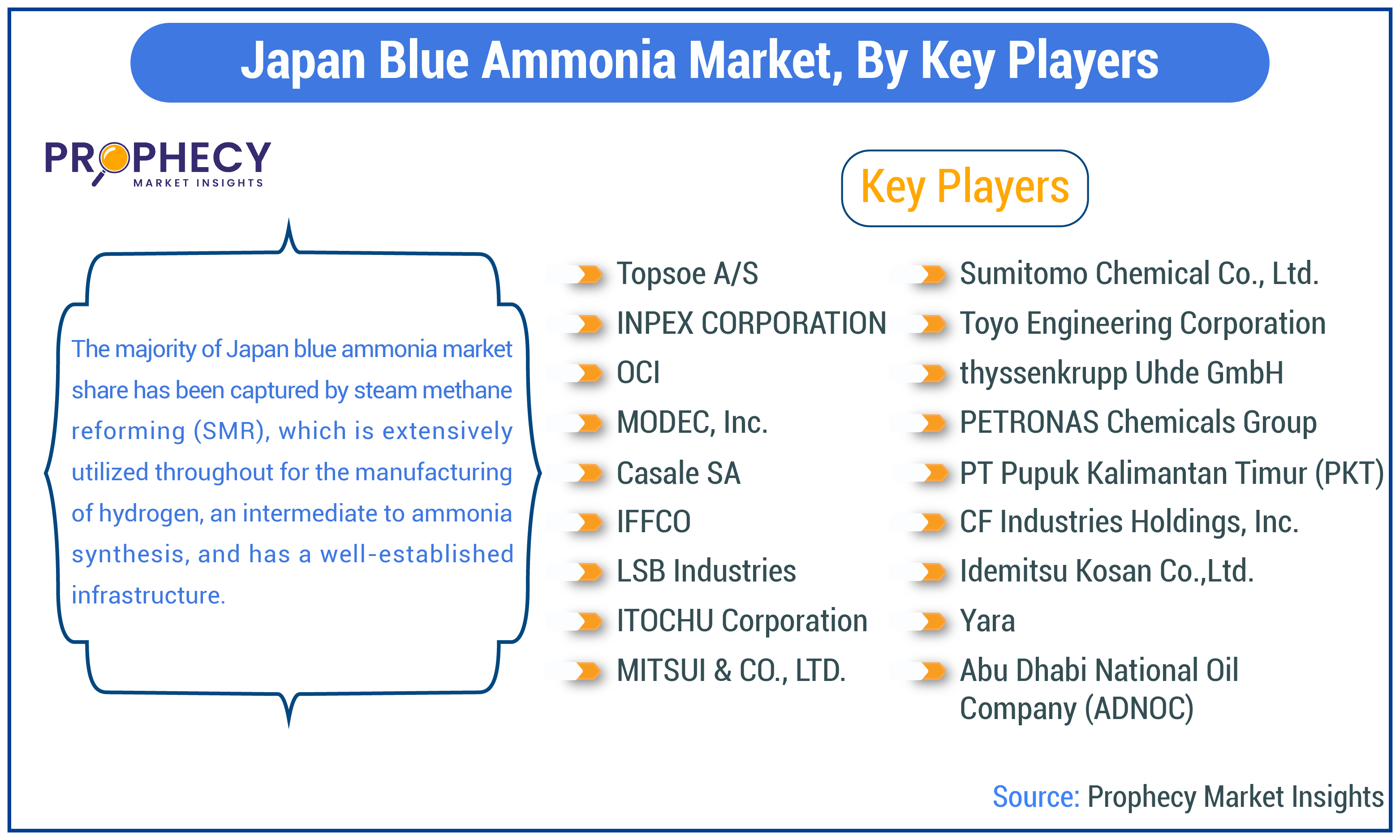
Steam methane reforming, autothermal reforming, and gas partial oxidation are technology including in the Japan blue ammonia market. The majority of Japan blue ammonia market share has been captured by steam methane reforming (SMR), which is extensively utilized throughout for the manufacturing of hydrogen, an intermediate to ammonia synthesis, and has a well-established infrastructure.
The subsequent fastest-growing technology is autothermal reforming (ATR), which has been gaining popularity due to the fact it provides more hydrogen and integrates better with CCS, allowing for greater carbon reductions than SMR.
By Purity:
99.99% Purity, 99.9% Purity, and 99% Purity are purity for which market is categorized. Additionally, to its suitability for essential uses consisting of clean fuel in power generation, simultaneous combustion in temperature plants, and as a hydrogen carrier for energy transport areas in which exceptional purity requirements are essential for guaranteeing combustion effectiveness while avoiding machinery deterioration, 99.99% purity encompasses the biggest share of the marketplace in Japan's blue ammonia market.
Considering an appropriate compromise among price and performance, the 99.9% purity sector is second in prominence. It is primarily employed in manufacturing processes such as chemicals and fertilizers where somewhat decreased purity is permissible.
By Application:
Power generation, transportation, industrial feedstock, and others are application of the Japan blue ammonia market. Japan's dedication to reduce carbon emissions from its electrical energy sector primarily cofiring blue ammonia in conventional coal-fired power plants has put power generation at the highest level of the Japan blue ammonia market growth.
Considering blue ammonia may be exploited as a lower-carbon replacement in mainstream enterprises including fertilizer and chemical manufacture, industrial feedstock is the second-highest number prevalent application.
By End-User Industry:
Japan blue ammonia market is categorized into agriculture, utilities, oil & gas, and logistics, on the account of end-user industry. The utilities sector prevails in the Japanese blue ammonia market share for the reason to the nation's relentless attempts to reduce carbon emissions from electrical power generation by employing ammonia co-firing in coal-fired facilities.
The second-busiest end consumer is agriculture that employs blue ammonia as an environmentally friendly replacement for traditional chemical fertilizers based on ammonia, consequently decreasing the carbon footprint associated with food production.
Japan Blue Ammonia Market Report Scope:
|
Attribute |
Details |
|
Market Size 2025 |
USD 22.0 Million |
|
Projected Market Size 2035 |
USD 40.0 Million |
|
CAGR Growth Rate |
20.2% (2025-2035) |
|
Base year for estimation |
2024 |
|
Forecast period |
2025 – 2035 |
|
Market representation |
Revenue in USD Million & CAGR from 2025 to 2035 |
|
Report coverage |
Revenue forecast, company share, competitive landscape, growth factors, and trends |
Segmentation:
By Technology:
- Steam Methane Reforming
- Autothermal Reforming
- Gas Partial Oxidation
By Purity:
- 99.99% Purity
- 99.9% Purity
- 99% Purity
By Application:
- Power Generation
- Transportation
- Industrial Feedstock
- Others
By End-User Industry:
- Agriculture
- Utilities
- Oil & Gas
- Logistics
Japan Blue Ammonia Market Competitive Landscape & Key Players
Establishing for a long time globalization supply commitments that guarantee consistent environmentally friendly ammonia imported goods, putting money into sophisticated manufacturing processes and CCS incorporation to minimize expenditures and carbon dioxide emissions, and organizing with incentives from the government under the Green Transformation (GX) policy constitute significant tactics for expansion for Japan's blue ammonia manufacturers. The key players operating in the Japan blue ammonia market include MITSUI & CO., LTD., Sumitomo Chemical Co., Ltd., Toyo Engineering Corporation, IFFCO, and others.
Japan Blue Ammonia Market Companies:
- Topsoe A/S
- INPEX CORPORATION
- OCI
- MODEC, Inc.
- Casale SA
- thyssenkrupp Uhde GmbH
- Idemitsu Kosan Co.,Ltd.
- ITOCHU Corporation
- MITSUI & CO., LTD.
- Sumitomo Chemical Co., Ltd.
- Toyo Engineering Corporation
- IFFCO
- PETRONAS Chemicals Group?
- PT Pupuk Kalimantan Timur (PKT)
- Yara
- CF Industries Holdings, Inc.
- Abu Dhabi National Oil Company (ADNOC)
- LSB Industries
Japan Blue Ammonia Market Recent News
- In June 2025, based in Niigata prefecture, Japanese oil giant Inpex has begun commissioning work on the nation's first blue hydrogen and ammonia pilot. Beginning in the fall of this year, the project is anticipated to generate around 700 tonnes of blue hydrogen annually, with CO2 being recovered and stored in depleted reservoirs in the adjacent Higashi-Kashiwazaki gas field.
Analyst View:
Japan's ambition to being carbon neutral by 2050, its move to clean energy carriers including hydrogen and ammonia, and the country's robust government backing through financing and legislation are all contributing to the country's quickly growing blue ammonia sector. Blue ammonia, which is produced by mixing nitrogen with natural gas-derived hydrogen and using carbon capture and storage (CCS) to absorb the generated CO?, provides a low-carbon substitute for conventional fuels, especially when used in conjunction with coal to generate electricity. Prominent firms particularly JERA and IHI are making significant investments in large-scale demonstration projects, multinational supply relationships (such with ExxonMobil), and infrastructure. Japan's critical position in the global blue ammonia transition is highlighted by its aim to import 3 million tons of clean ammonia annually by 2030 and 30 million tons by 2050.
More Related Reports
U.S Ammonia Market
Bluetooth Speaker Market
Bluetooth Beacons Market
Asia Pacific Blue Ammonia Market
Ammonia Market
Japan Blue Ammonia Market Company Profile
|
Company Name |
Sumitomo Chemical Co., Ltd. |
|
Headquarter |
Tokyo, Japan |
|
CEO |
Nobuaki Mito |
|
Employee Count |
32,161 Employees |
FAQs
Japan blue ammonia market size was valued at USD 22.0 Million in 2025 and is expected to reach USD 40.0 Million by 2035 growing at a CAGR of 20.2%.
Technology, purity, application, end-user industry, and country are the segmentation for the target market.
The key players operating the Japan blue ammonia market include Topsoe A/S, INPEX CORPORATION, OCI, MODEC, Inc., Casale SA, thyssenkrupp Uhde GmbH, Idemitsu Kosan Co.,Ltd., ITOCHU Corporation, MITSUI & CO., LTD., Sumitomo Chemical Co., Ltd., Toyo Engineering Corporation, IFFCO, PETRONAS Chemicals Group, PT Pupuk Kalimantan Timur (PKT), Yara, CF Industries Holdings, Inc., Abu Dhabi National Oil Company (ADNOC), and LSB Industries.