Asia Pacific Blue Ammonia Market Overview
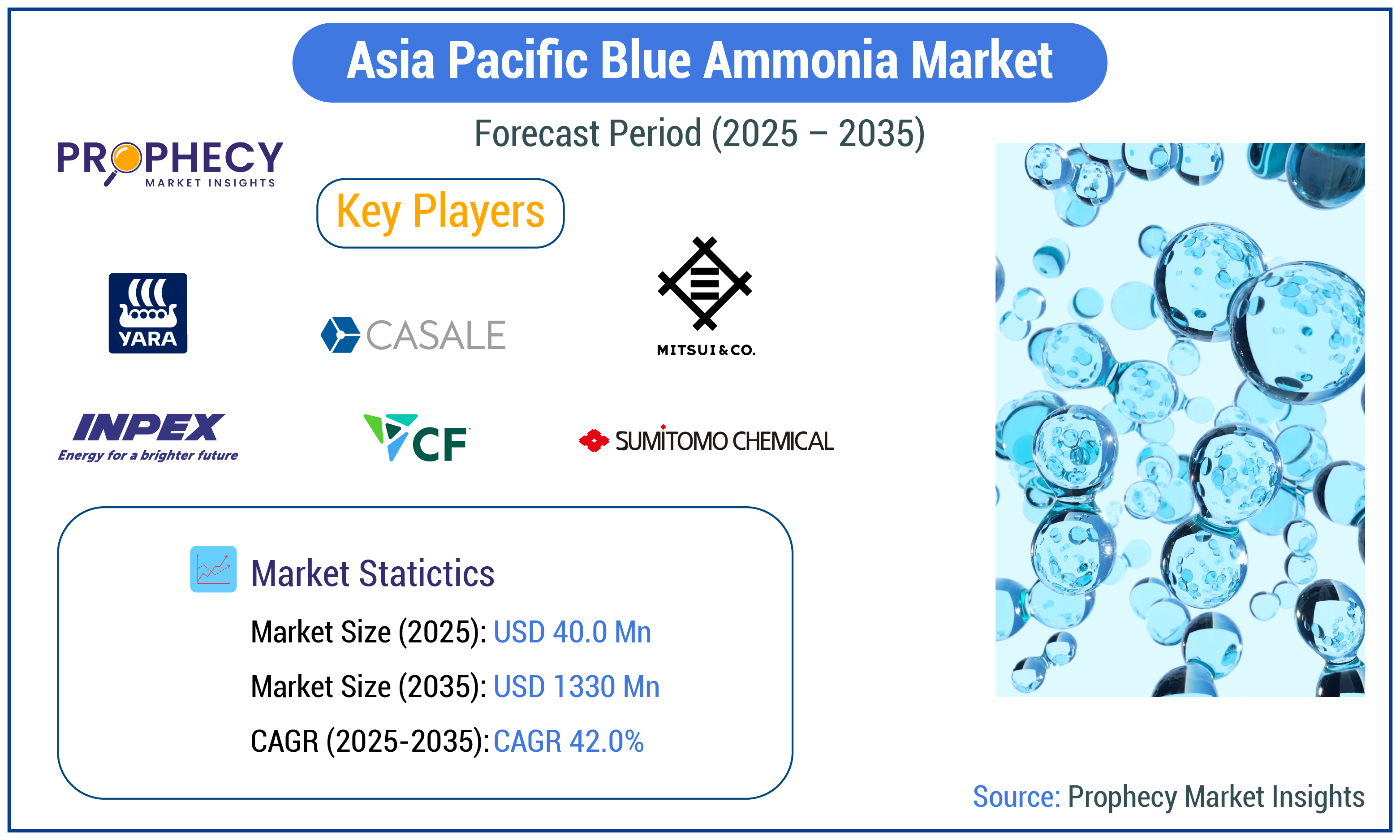
- By 2035, the Asia Pacific blue ammonia market size is contemplated to enlarge at a valuation of USD 1330 Million.
- In 2025, the Asia Pacific blue ammonia market valuation was USD 40.0 Million.
- Asia Pacific blue ammonia market is developing at a CAGR of 42.0%.
When hydrogen from natural gas is used to manufacture blue ammonia, the carbon dioxide (CO?) emissions that are produced are absorbed and stored using carbon capture and storage (CCS) technology. Comparing this technique to conventional ammonia, the carbon footprint is greatly reduced. Among the main benefits of blue ammonia are its potential as a low-carbon fuel for shipping and power generation, its application as a hydrogen carrier for clean energy transportation, and its contribution to the reduction of emissions in the chemical and fertilizer manufacturing sectors.
Strong government policies supporting low-carbon solutions, such as carbon pricing, CCUS subsidies, and hydrogen/ammonia strategies in China, India, Japan, and South Korea, as well as the region's enormous ammonia demand, mainly from fertilizers and industrial uses, are driving the Asia Pacific blue ammonia market acceleration. The industry is expanding due to a number of factors, including a strategic push to improve energy security and decarbonization, a plentiful supply of natural gas feedstock, and significant investment in CCUS infrastructure (including cross-border CO? storage projects including Australia hosting storage for South Korea and Japan).
Regional hydrogen policies in nations including Japan, South Korea, and Australia, which are investing in CCS-powered ammonia import and export hubs, are expected to propel the Asia Pacific blue ammonia market to strong development. Traditional ammonia use is being supported by industrial growth and agricultural need, but the use of blue ammonia is being accelerated by low-carbon programs and cross-border CO? storage projects, such as Australia's supply to Japan and Korea. Efficiency will be improved by technological advancements such as the move toward autothermal reforming and integration with renewable gas infrastructure. Blue ammonia is positioned as a scalable, transitional option in the energy transition, but the long-term trend indicates a gradual shift to green ammonia as renewable capacity increases and carbon laws tighten.
Recession Risk and Tariff Analysis:
- Potential recessions and rising tariffs pose moderate threats to the Asia Pacific blue ammonia market, especially in light of trade tensions and U.S. import taxes on regional exports. These elements have the potential to lower demand from important industries including chemicals and fertilizer, alter supply chains, and raise production costs.
- Rollouts of blue ammonia projects could be delayed if key nations notably China, India, and Japan experience slower economic growth. Overall, long-term prospects are still bright, but uncertainty surrounding trade and the economy may have an impact on short-term growth.
Impact of Generative AI on Asia Pacific Blue Ammonia Market:
- Through real-time process optimization, predictive maintenance, and sophisticated modeling, generative AI is increasing efficiency and having a beneficial effect on the Asia Pacific blue ammonia industry. These technologies improve plant reliability, lower emissions, and lower operating costs.
- However, unless combined with better energy sources, the growing energy demand from AI infrastructure may put a strain on regional power networks, perhaps negating some environmental benefits. All things considered, artificial intelligence presents both new energy management issues and substantial operational benefits.
Asia Pacific Blue Ammonia Market Drivers & Restraints
Key Drivers:
Rising Industrialization to Propel Growth of the Market
Growing industries, especially in chemicals, fertilizers, power, and heavy manufacturing, require cleaner energy and raw materials to meet production needs and stricter environmental regulations. This is one of the main factors driving the Asia Pacific blue ammonia market growth. There is growing demand to lower carbon emissions while preserving energy security as nations in Southeast Asia, China, and India increase their industrial output.
Particularly in energy-intensive industries including steel, cement, and chemicals, blue ammonia presents an alluring option for decarbonizing industrial processes due to its low carbon footprint made possible by carbon capture and storage (CCS). Blue ammonia is a key element in Asia Pacific's industrial and energy transformation since it is consistent with both international climate pledges and national decarbonization targets.
- For Instance, according to the data published by Britannica, Since World War II, Asia has had tremendous industrial expansion, starting with Japan's ascent to prominence in manufacturing and continuing with the swift development of nations including South Korea, Taiwan, and Malaysia. Light manufacturing and labor-intensive industries are still crucial in less developed countries, even if heavy industries consisting of steel, aluminum, and engineering have thrived in big economies that include China, India, and Japan.
Restrains:
The Market Growth is Disturbs by Energy Security Concerns
Asia Pacific's high reliance on natural gas as a feedstock much of which is imported and vulnerable to supply outages, geopolitical unrest, and fluctuations in global prices raises energy security issues for the Asia Pacific blue ammonia market here. The reliable and economical production of blue ammonia is at risk due to this dependence, particularly for nations with sizable domestic gas reserves.
- Counterbalance Statements: Countries are investing in domestic gas exploration, obtaining long-term LNG contracts, and creating regional energy collaborations in order to diversify their energy sources and allay these worries. Building robust carbon capture and storage (CCS) infrastructure and incorporating renewable energy into hydrogen production paths can also help achieve decarbonization objectives by lowering reliance on imports and improving long-term energy security.
Opportunities & Trends:
Future Market Opportunities can be Revealed by the Growing Demand for Low-Carbon Fuels
As governments and large energy companies shift to sustainable alternatives in heavy industry, power production, and maritime transportation, the growing demand for low-carbon fuels in Asia Pacific is driving the blue ammonia market. In order to comply with the IMO's more stringent emissions regulations for maritime shipping, ports throughout the area, including those in Singapore and Japan, are also constructing ammonia bunkering facilities. Blue ammonia is emerging as a strategic, transitional clean fuel that satisfies environmental and legal requirements while promoting sustainable industrial growth, according to these joint efforts.
Asia Pacific Blue Ammonia Market Segmentations & Regional Insights
Technology purity, application, end-user industry, and country are the divisions of the Asia Pacific blue ammonia market.
By Technology:
Steam methane reforming, autothermal reforming, and gas partial oxidation are technology including in the Asia Pacific Blue Ammonia Market. With more than 60–65% of production, Steam Methane Reforming (SMR) has a substantial Asia Pacific blue ammonia market share. SMR is the preferred technique for large-scale hydrogen (and hence ammonia) generation with integrated carbon capture due to its established infrastructure, cost effectiveness, and technological maturity.
The second-largest technique is Autothermal Reforming (ATR), which is still smaller but has gained a lot of traction owing to its improved energy integration and higher CO2 capture efficiency. This makes it especially attractive for newer, low-carbon projects that are aimed at stricter emissions management.
By Purity:
99.99% Purity, 99.9% Purity, and 99% Purity are purity for which market is categorized. The 99.99% purity segment has the largest Asia Pacific blue ammonia market share due to it satisfies strict requirements for chemical, power-generation, and industrial applications that require minimal impurities, balancing cost-effectiveness and performance.
Although slightly less pure, the second-largest sector, 99% purity, is still an affordable choice for wider industrial applications where ultra-high purity is less important, supporting competitive price and meeting high-volume demand.
By Application:
Power generation, transportation, industrial feedstock, and others are application of the Asia Pacific blue ammonia market. Since many regional economies depend on ammonia for fertilizers, polymers, pharmaceuticals, and other chemical processes where decarbonization goals are urgent, industrial feedstock has the greatest Asia Pacific blue ammonia market share.
Power generation is the second-largest application, and due to emissions objectives and energy transition plans, there is growing interest in cofiring ammonia in thermal plants and replacing coal-fired capacity, particularly in nations including China and Japan.
By End-User Industry:
The Asia Pacific blue ammonia market is categorized into agriculture, utilities, oil & gas, and logistics, on the account of end-user industry. The major end-user industry is agriculture, which is motivated by its crucial role in the production of fertilizer. Ammonia is still the principal source of nitrogen in farming and accounts for around 60% of regional demand.
As nations including China, India, and Japan actively investigate ammonia co-firing to decarbonize thermal power plants and promote grid resilience under clean-energy transitions, utilities that is, power generation and industrial heating represent the second-largest industry.
Asia Pacific Blue Ammonia Market Report Scope:
|
Attribute |
Details |
|
Market Size 2025 |
USD 40.0 Million |
|
Projected Market Size 2035 |
USD 1330 Million |
|
CAGR Growth Rate |
42.0% (2025-2035) |
|
Base year for estimation |
2024 |
|
Forecast period |
2025 – 2035 |
|
Market representation |
Revenue in USD Million & CAGR from 2025 to 2035 |
|
Regional scope |
Asia Pacific - China, India, Japan, Australia, Indonesia, Malaysia, South Korea, and Rest of Asia Pacific |
|
Report coverage |
Revenue forecast, company share, competitive landscape, growth factors, and trends |
Segmentation:
By Technology:
- Steam Methane Reforming
- Autothermal Reforming
- Gas Partial Oxidation
By Purity:
- 99.99% Purity
- 99.9% Purity
- 99% Purity
By Application:
- Power Generation
- Transportation
- Industrial Feedstock
- Others
By End-User Industry:
- Agriculture
- Utilities
- Oil & Gas
- Logistics
By Country:
- China
- India
- Japan
- Australia
- Indonesia
- Malaysia
- South Korea
- Rest of Asia-Pacific
Asia Pacific Blue Ammonia Market Competitive Landscape & Key Players
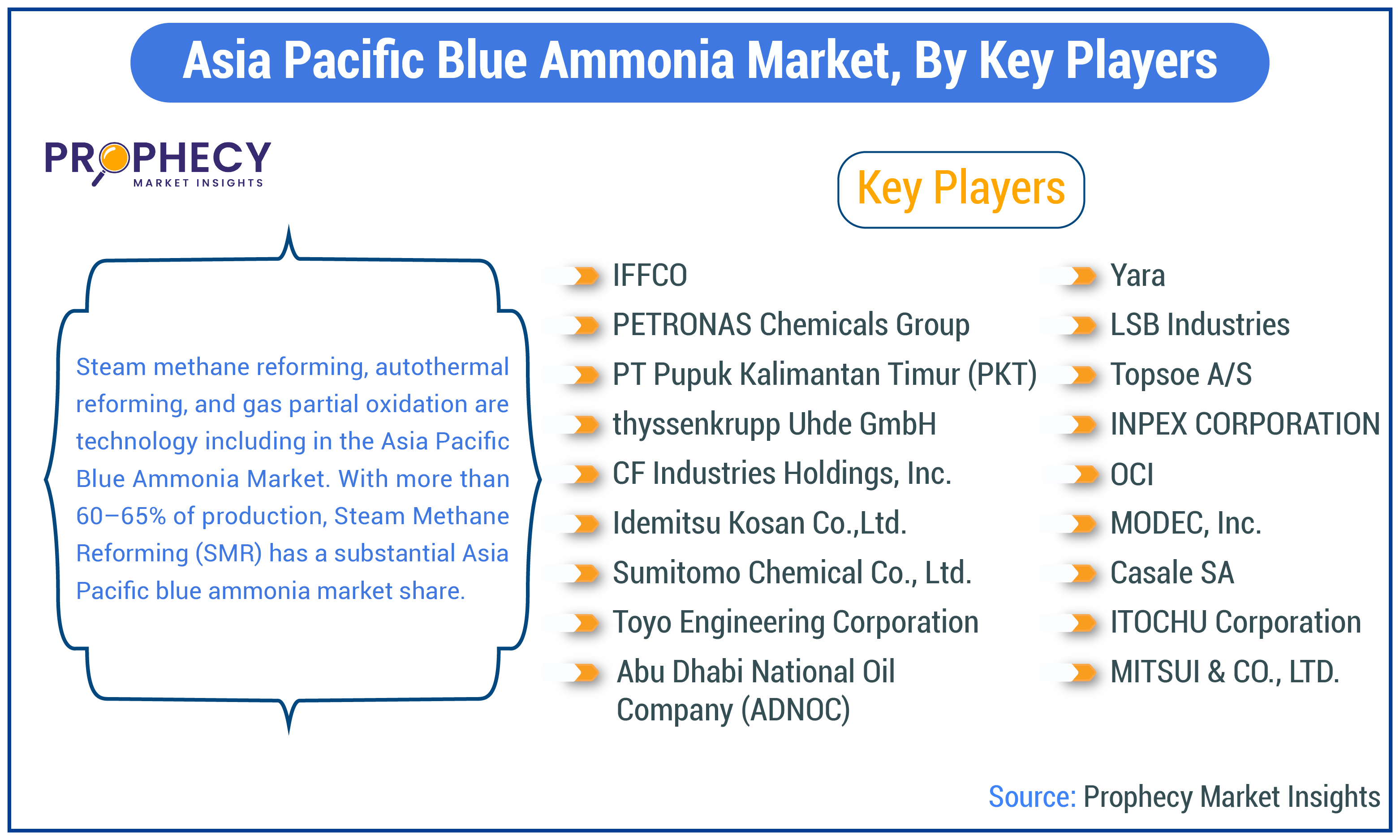
The key players operating in the Asia Pacific blue ammonia market include, IFFCO, PETRONAS Chemicals Group,PT Pupuk Kalimantan Timur (PKT), Abu Dhabi National Oil Company (ADNOC), and others Expanding low-carbon manufacturing processes, emphasizing on major construction projects, and making advantage of new advances in technology in carbon capture and storage constitute a few of the development tactics implemented by Asia-Pacific blue ammonia business enterprises.
Asia Pacific Blue Ammonia Market Companies:
- IFFCO
- PETRONAS Chemicals Group?
- PT Pupuk Kalimantan Timur (PKT)
- Yara
- CF Industries Holdings, Inc.
- Abu Dhabi National Oil Company (ADNOC)
- LSB Industries
- Topsoe A/S
- INPEX CORPORATION
- OCI
- MODEC, Inc.
- Casale SA
- thyssenkrupp Uhde GmbH
- Idemitsu Kosan Co.,Ltd.
- ITOCHU Corporation
- MITSUI & CO., LTD.
- Sumitomo Chemical Co., Ltd.
- Toyo Engineering Corporation
Asia Pacific Blue Ammonia Market Recent News
- In January 2025, The American Bureau of Shipping (ABS) has granted MODEC, Inc. and Toyo Engineering Corporation an Approval in Principle (AiP) for a blue ammonia floating production storage and offloading (also known as the "Blue Ammonia FPSO") that will generate ammonia from the gas provided by the nearby Oil & Gas FPSO.
- In August 2024, seven blue ammonia projects have been developed by Pupuk Indonesia throughout its facilities in Aceh, east Kalimantan, south Sumatra, and east Java. With a total production capacity of 7 million tons per year, the company is now the biggest producer of grey ammonia in Asia. It is made from natural gas without the use of CCS. With the use of CCS, it will transform its current grey plants into blue ammonia facilities, with the goal of producing 4.3 million tons of blue ammonia annually by 2045.
- In April 2023, Idemitsu Kosan Co., Ltd. declared that it and Korea Electric Power Corporation have inked a Memorandum of Understanding (MOU) in order to work together on the establishment of a blue/carbon-free ammonia supply chain in Korea and Japan. The two businesses will work together to conduct research on the supply of blue/carbon-free ammonia to each nation, as well as its procurement and maritime transportation.
Analyst View:
Compared to normal ammonia, blue ammonia drastically lowers the carbon footprint since it is made from hydrogen derived from natural gas with carbon emissions absorbed by CCS technology. Strong government regulations, a high ammonia demand for industry and fertilizers, a plentiful supply of natural gas, and significant expenditures in CCUS infrastructure are all factors propelling Asia Pacific blue ammonia market expansion. To help achieve low-carbon targets, nations including Australia, South Korea, and Japan are creating cross-border CO? storage projects and ammonia centers based on CCS. Although a long-term transition to green ammonia is expected as renewable energy capacity grows, technological developments notably autothermal reforming and integration with renewables are increasing efficiency and presenting blue ammonia as a crucial transitional fuel.
More Related Reports
U.S Ammonia Market
Bluetooth Speaker Market
Bluetooth Beacons Market
North America Ammonia Market
Ammonia Market
Asia Pacific Blue Ammonia Market Company Profile
|
Company Name |
MITSUI & CO., LTD. |
|
Headquarter |
Tokyo, Japan |
|
CEO |
Kenichi Hori |
|
Employee Count |
42,000 Employees |
FAQs
Asia Pacific blue ammonia market size was valued at USD 40.0 Million in 2025 and is expected to reach USD 1330 Million by 2035 growing at a CAGR of 42.0%.
Technology, purity, application, end-user industry, and country are the segmentation for the target market.
The market is segmented by countries China, India, Japan, Australia, Indonesia, Malaysia, South Korea, and Rest of Asia Pacific. Japan is expected to dominate the Market.
The key players operating the Asia Pacific blue ammonia market include IFFCO, PETRONAS Chemicals Group PT Pupuk Kalimantan Timur (PKT), Yara, CF Industries Holdings, Inc., Abu Dhabi National Oil Company (ADNOC), LSB Industries, Topsoe A/S, INPEX CORPORATION, OCI, MODEC, Inc., Casale SA, thyssenkrupp Uhde GmbH, Idemitsu Kosan Co.,Ltd., ITOCHU Corporation, MITSUI & CO., LTD., Sumitomo Chemical Co., Ltd., and Toyo Engineering Corporation.