Blue Ammonia Market Overview
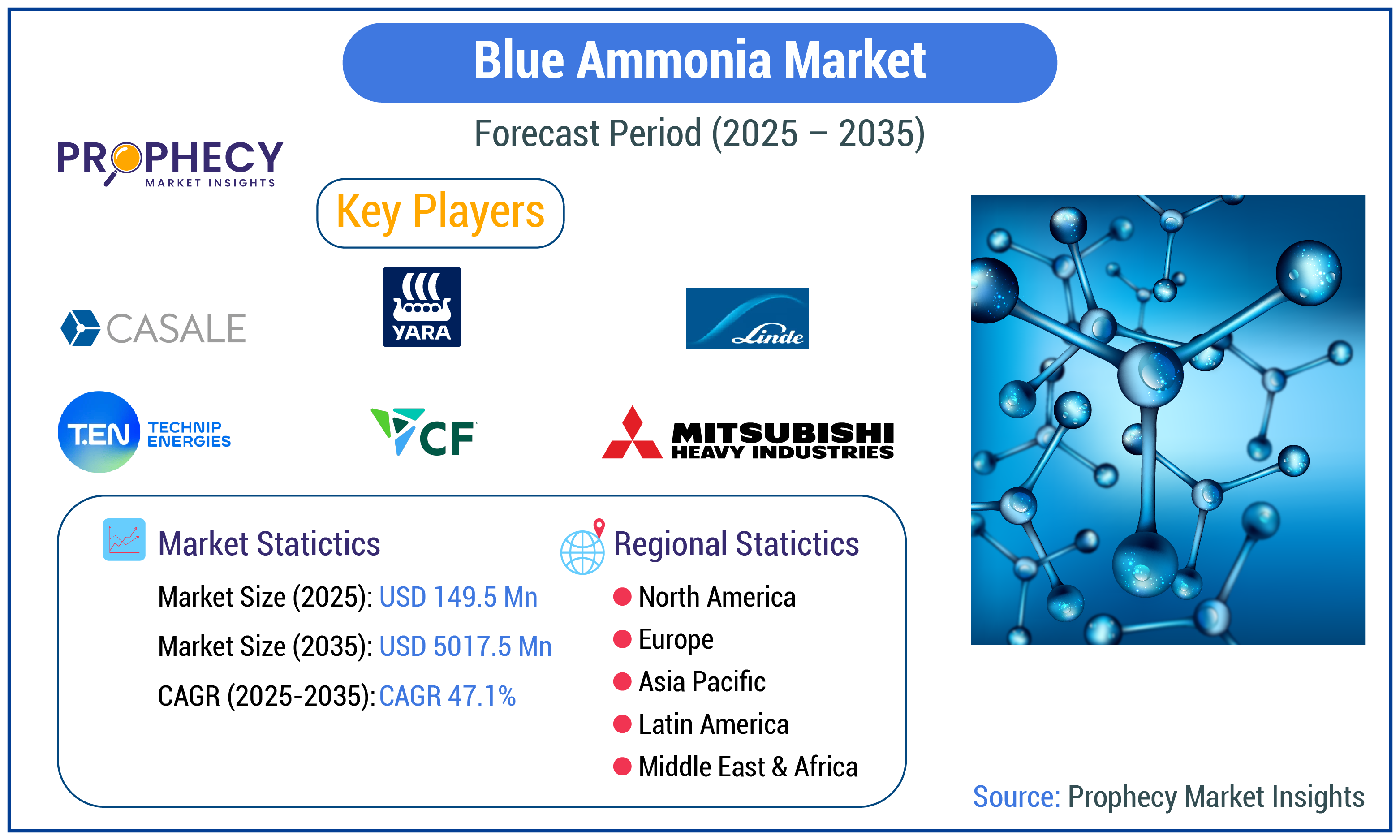
- By 2035, the blue ammonia market size is contemplated to enlarge at a valuation of USD 5017.5 Million.
- In 2024, the blue ammonia market valuation was USD 108 Million.
- Blue ammonia market is developing at a CAGR of 47.1%.
Ammonia that is produced using natural gas, where the carbon emissions generated during production is known as blue ammonia that is captured and stored through CCS technology which acts as low-carbon alternative ammonia. Major use includes low-carbon fuel for power generation and as a hydrogen carrier for energy transport. Blue ammonia is also utilized in fertilizers and chemical manufacturing supporting the global decarbonization efforts.
Blue ammonia market is experiencing significant growth with growing decarbonization goals, global agenda for clean energy alternatives and combination of regulatory support. Carbon capture and storage (CCS) advancements are making blue ammonia more scalable and cost-effective driving its adoption on large scale. With climate policies implemented by governments and carbon reduction targets focusing on low-carbon fuels such as blue ammonia in industries such as power generation, heavy industry, and maritime transport, the blue ammonia adoption is further accelerating at rapid pace.
Blue ammonia is witnessing rapid evolution with several key trends shaping the global ammonia market with growing demand for low-carbon ammonia and major government supportive policies. Blue ammonia is becoming increasingly popular for decarbonizing industries including transportation, fertilizers, and power production. Energy producers, governments and engineering firms are collaborating to build blue ammonia value chains. Recent deals include CF Industries partnering with JERA and Mitsui for a USD 4.0 Million ATR-based facility in Louisiana, and Sabic’s feedstock approvals in Saudi Arabia.
Recession Risk & Tariff Analysis:
- Blue ammonia market faces notable challenges with recession risk and tariff uncertainties potentially slowing down international trade and investment. Lower capital spending and reduced energy demand are major consequences for economic downturns which can hinder large-scale blue ammonia projects.
- Countries may impose restrictive trade policies and tariffs to protect hydrogen and ammonia industries disrupting global supply chain development. Such risk collectively make market unstable majorly for initial stage projects that are dependent on favorable economic and policy ecosystems.
Impact of Generative AI on Blue Ammonia Market:
- Blue ammonia market is experiencing a major impact in process optimization, research and strategic planning via generative AI. Companies are profiting with reducing energy consumption and improving carbon capture performance with generative AI simulations create more efficient production pathways.
- Furthermore, Generative AI can analyze and complex datasets for emission tracking, supply chain forecasting and prediction for market demand ahead that enables data-backed decision making. Promoting blue ammonia product development, innovation and streamlining development are major areas where generative AI can prove a transformative tool in global market.
Blue Ammonia Market Drivers & Restraints
Key Drivers:
Rising Investments in Hydrogen Economy Propel Growth of Blue Ammonia Market
Blue ammonia market grows significantly with heavy investment by industrial stakeholders, governments and energy organizations in building hydrogen infrastructure, forming alliance for clean energy transition and supporting research. As a reliable hydrogen carrier that is easier to transport and store than pure hydrogen, blue ammonia is essential to this setting. International export agreements and hydrogen hubs are accelerating the deployment of blue ammonia as low-carbon energy solution.
- For Instance, according to global hydrogen council report, the global clean hydrogen projects have reached FID with seven-fold increase in committed investment, growing from approximately USD 10 Million across 102 projects in 2020 to some USD 75 Million across 434 projects in 2024.
Restraints:
Lack of Industry Awareness Hampers Global Growth of Blue Ammonia Market
The key restraint disrupting the blue ammonia market is limited awareness and understanding within specific industries. Energy and chemical sectors are at initial stage exploring its potential, while various sectors remain uninformed with blue ammonia’s benefits, properties and applications compared to low carbon alternatives such as green hydrogen. Blue ammonia adoption is hampered by this gap in expertise because companies may be cautious to invest in new technologies or could lack the expertise required to include blue ammonia into their current workflows disrupting the blue ammonia market growth on global scale.
- Counterbalance Statements: The major restraint is gradually being addressed through growing government initiatives, pilot projects and industry collaborations for promotion of alternative and low-carbon fuels such as blue ammonia. More organizations are investing on feasibility research, demonstration plants, and educational efforts to highlight the benefits and functionality of blue ammonia as global climate goals driving the continuation of market growth.
Opportunities & Trends:
Rising Demand for Blue Ammonia Fuels Transition to Low-Carbon Power Generation
Blue ammonia programs are expected to be promoted by the world governments ahead in forecast period. As countries and utilities search for low-carbon alternatives to coal and natural gas, demand for blue ammonia in power generation is increasing significantly. Large-scale programs that encourage ammonia-fired energy are subsidized by governments all over the world as part of their decarbonization programs. Blue ammonia offers an energy-dense, transportable fuel that emits zero CO? at the point of combustion. The role for blue ammonia as mainstream fuel for industrial power generation is becoming crucial with CCS cos declining and stringent environmental policies.
Blue Ammonia Market Segmentations & Regional Insights
Technology, purity, application, end user and region are the divisions of the blue ammonia market.
By Technology:
Steam methane reforming, autothermal reforming, and gas partial oxidation are technology on which blue ammonia market is segmented. Steam methane reforming currently leads the blue ammonia market share with given method adopted on high scale due to high hydrogen yield, well-established infrastructure and cost-efficiency. For production of blue ammonia, the SMR is combined with carbon capture and storage (CCS).
The autothermal reforming is fastest growing segment in technology with ATR gaining traction as it offers better integration of carbon capture technologies and higher hydrogen concentration in product stream compared to SMR. Autothermal reforming can handle variety of feedstocks and its scalability make it a favorable option for emerging markets.
By Purity:
On the basis of Purity, blue ammonia market is categorized into 99.99% Purity, 99.9% Purity, and 99% Purity. The 99.99% holds the dominant segment in blue ammonia market share as this ultra-high grade is crucial for applications requiring strict quality standards such as advanced energy systems and chemical synthesis. 99.99% purity holds low impurity levels, has superior performance and compatible to high-efficiency processes across industries with most preferred choice.
The 99.9% purity segment is second dominant with offering such as lower production cost compared to 99.99% purity and required performance standards for various end uses. 99.9% purity segment offers a strong balance between cost-effectiveness and sufficient purity for a wide range of industrial applications making its second dominant among purity segment.
By Application:
Blue ammonia market on the account of application is distinguished into power generation, transportation, industrial feedstock, and others. The power generation application holds largest blue ammonia market share with growing focus on reducing carbon emissions on global agenda the blue ammonia is adopted at increasing rate as clean-burning fuel in thermal power plants.
The second-largest proportion is held by the Industrial feedstock use, which is fueled by the usage of Blue Ammonia in production of fertilizers, chemicals, and hydrogen carriers. It is compatible with existing industrial infrastructure and has lower carbon footprint which makes it preferred choice for companies shifting towards operations that are sustainable.
By End-User Industry:
Agriculture industry holds the largest blue ammonia market share with increasing sustainable farming practices on global scale and agricultural producers with high adoption rate of blue ammonia for meeting the climate goals. Blue ammonia acts as important component for low-carbon fertilizer production.
Utility sector is second dominant end user segment in the blue ammonia market as power producers prefer cleaner alternatives to traditional fossil fuels where blue ammonia is emerging as a viable low-carbon fuel for generation of electricity. Blue ammonia demand for clean energy solutions places utility sector as second dominant in the global blue ammonia market.
Regional Insights:
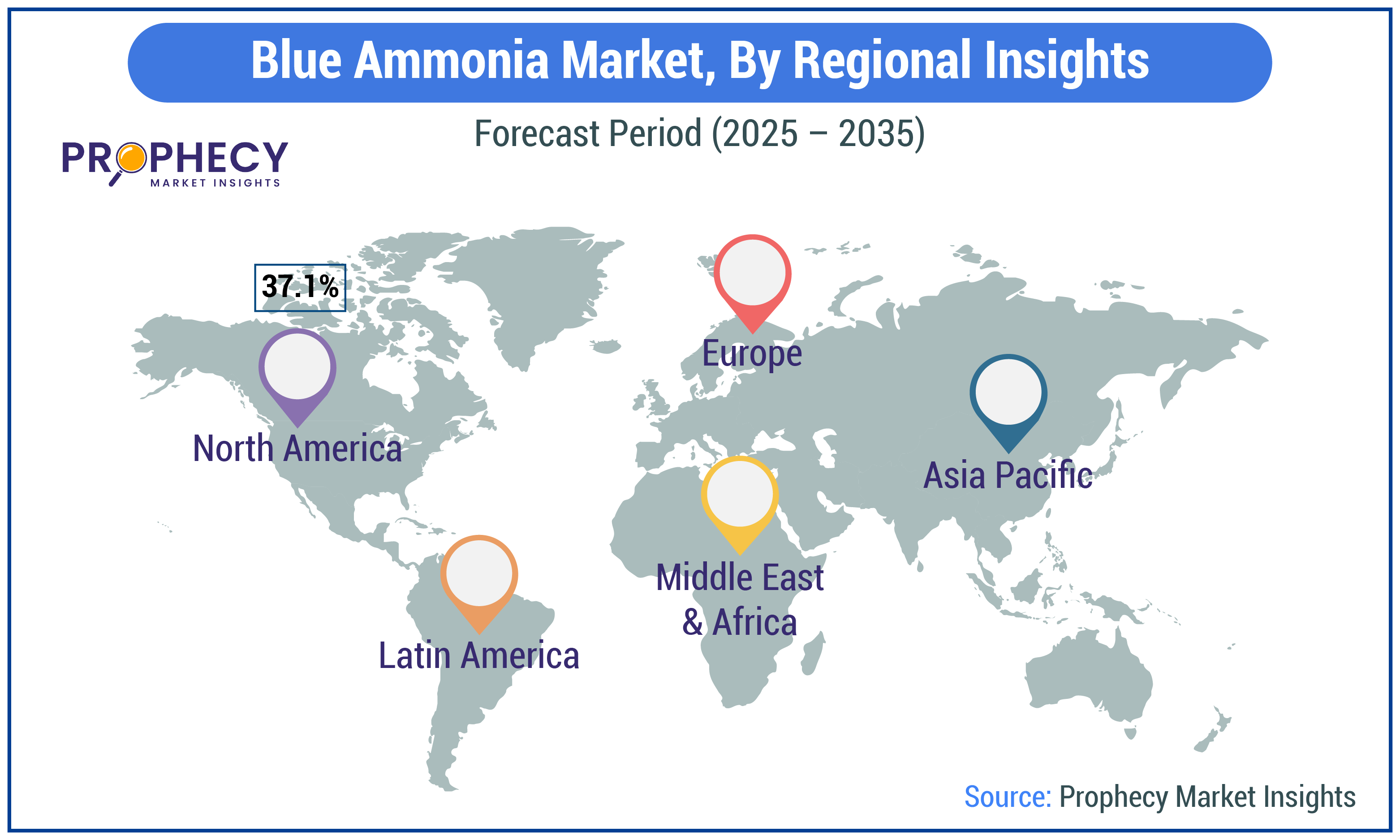
Geographically, the blue ammonia market is studied across North America, Europe, Asia Pacific, Latin America, and the Middle East & Africa.
North America: This region stands as dominant region with strong policy support for clean energy initiatives and advanced carbon capture and storage (CCS) infrastructure in the region. North America is focusing on decarbonizing industrial processes and power generation further raising the blue ammonia adoption in energy and utilities industry and reinforcing its leadership in global market.
- U.S. Blue Ammonia Market Insights:
Due to its large natural gas reserves, robust government policy support and advanced carbon capture and storage (CCS) infrastructure the United States is leading country for blue ammonia market. Major U.S. initiatives—including federal incentives like the Inflation Reduction Act—encourage investment in blue ammonia facilities.
Europe: This region stands second dominant region with countries such as Germany, the Netherlands, and Norway are leading players in investment in blue ammonia production, R&D and import infrastructure. Europe is focusing on utilizing blue ammonia in industrial feedstock and maritime fuel applications. Europe is positioning itself as crucial hub for blue ammonia trade with international partnerships with key exporters such as U.S. and Middle East.
- Germany Blue Ammonia Market Insights:
Germany is the blue ammonia market leader in Europe due to its major players such as Uniper and SKW Piesteritz facilitating import logistics and develop ammonia cracking facilities with strong industry government alignment pushing the sustainable alternative for blue ammonia.
Asia Pacific: Blue ammonia market in Asia-Pacific is expanding rapidly in the region with its strong commitment to clean energy transition and carbon neutrality goals. Japan and South Korea are leading, incorporating blue ammonia into their national energy strategies to decarbonize power generation and heavy industries with long term agreements for import of blue ammonia.
- Japan Blue Ammonia Market Insights:
Japan leads the market among the nations in this region due to its basic hydrogen strategy focusing on low-carbon hydrogen and ammonia imports with target of 3Mt/year by 2030 and preferring cleaner fuel across power generation, industrial sector and transportation.
Blue Ammonia Market Report Scope:
|
Attribute |
Details |
|
Market Size 2025 |
USD 149.5 Million |
|
Projected Market Size 2035 |
USD 5017.5 Million |
|
CAGR Growth Rate |
47.1% (2025-2035) |
|
Base year for estimation |
2024 |
|
Forecast period |
2025 – 2035 |
|
Market representation |
Revenue in USD Million & CAGR from 2025 to 2035 |
|
Regional scope |
North America - U.S. and Canada Europe – Germany, U.K., France, Russia, Italy, Spain, Netherlands, and Rest of Europe Asia Pacific – China, India, Japan, Australia, Indonesia, Malaysia, South Korea, and Rest of Asia-Pacific Latin America - Brazil, Mexico, Argentina, and Rest of Latin America Middle East & Africa – GCC, Israel, South Africa, and Rest of Middle East & Africa |
|
Report coverage |
Revenue forecast, company share, competitive landscape, growth factors, and trends |
Segmentation:
By Technology:
- Steam Methane Reforming
- Autothermal Reforming
- Gas Partial Oxidation
By Purity:
- 99.99% Purity
- 99.9% Purity
- 99% Purity
By Application:
- Power Generation
- Transportation
- Industrial Feedstock
- Others
By End-User Industry:
- Industry Agriculture
- Utilities
- Oil & Gas
- Logistics
By Region:
- North America
- U.S.
- Canada
- Europe
- Germany
- U.K.
- France
- Russia
- Italy
- Spain
- Netherlands
- Rest of Europe
- Asia Pacific
- China
- India
- Japan
- Australia
- Indonesia
- Malaysia
- South Korea
- Rest of Asia Pacific
- Latin America
- Brazil
- Mexico
- Argentina
- Rest of Latin America
- Middle East & Africa
- GCC
- Israel
- South Africa
- Rest of Middle East & Africa
Blue Ammonia Market Competitive Landscape & Key Players
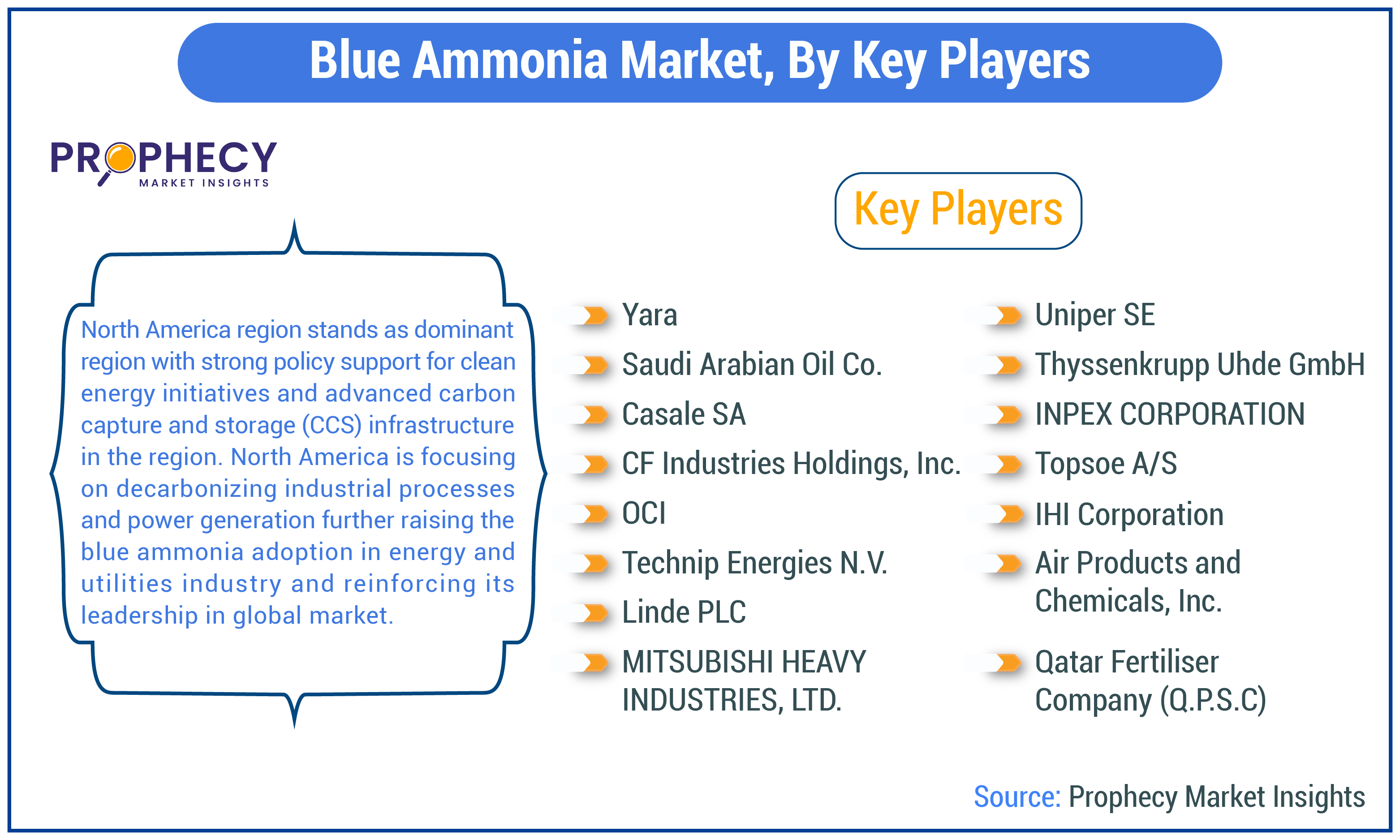
The key players operating in the blue ammonia market include, Yara, Saudi Arabian Oil Co., Qatar Fertiliser Company (Q.P.S.C), OCI, Technip Energies N.V., and others. Given organizations are focusing on cleaner alternative to green ammonia with a strategic shift by major players toward commercial-scale blue ammonia production as a cornerstone of the emerging hydrogen economy.
Blue Ammonia Market Companies:
- Yara
- Saudi Arabian Oil Co.
- Casale SA
- CF Industries Holdings, Inc.
- OCI
- Technip Energies N.V.
- MITSUBISHI HEAVY INDUSTRIES, LTD.
- Linde PLC
- Qatar Fertiliser Company (Q.P.S.C)
- Air Products and Chemicals, Inc.
- Uniper SE
- Thyssenkrupp Uhde GmbH
- INPEX CORPORATION
- Topsoe A/S
- IHI Corporation
View an Additional List of Companies in the Blue Ammonia Market
Blue Ammonia Market Recent News
- In December 2023, Centrica and Mitsubishi Power Europe announced plans to build Europe’s first ammonia-fueled power plant in Ireland, aimed at reducing emissions and demonstrating low-carbon ammonia technology.
- In June 2023, the BASF and Yara International ASA collaborated to develop and build a world-scale low-carbon blue ammonia production facility with carbon capture in the Gulf Coast region of the United States. To meet the expanding worldwide demand for low-carbon ammonia, the companies are investigating the possibility of a facility with a total capacity of 1.2 to 1.4 million tons annually.
- In April 2023, Saudi Aramco successfully transported the first shipment of blue ammonia to Japan through a collaborative effort involving multiple parties across the low-carbon blue ammonia value chain.
Analyst View:
Blue ammonia market grow significantly with global shift towards sustainable and low-carbon energy systems and increasing net-zero targets and growing demand for clean hydrogen carriers. Experts highlights the blue ammonia scalability and compatibility with existing ammonia infrastructure with low-cost production compared to traditional green ammonia. Overall, analysts remain optimistic about the market’s medium-to-long-term growth, specifically in North America, Middle East and Asia-Pacific region with export ecosystem and production are rapidly changing.
More Related Reports
U.S Ammonia Market
Bluetooth Speaker Market
Bluetooth Beacons Market
North America Ammonia Market
Ammonia Market
Blue Ammonia Market Company Profile
|
Company Name |
Linde PLC |
|
Headquarter |
Dublin, Ireland |
|
CEO |
Sanjiv Lamba |
|
Employee Count |
65,289 Employees |
Blue Ammonia Market Highlights
FAQs
Blue ammonia market size was valued at USD 149.5 Million in 2025 and is expected to reach USD 5017.5 Million by 2035 growing at a CAGR of 47.1%.
Technology, purity, application, end-user industry, and region are the segmentation for the target market.
North America, Asia Pacific, Europe, Latin America, and the Middle East & Africa. North America is expected to dominate the market.
The key players operating the blue ammonia market include Yara, Saudi Arabian Oil Co., Casale SA., CF Industries Holdings, Inc., OCI, Technip Energies N.V., MITSUBISHI HEAVY INDUSTRIES, LTD., Linde PLC, Qatar Fertiliser Company (Q.P.S.C), Air Products and Chemicals, Inc., Uniper SE, Thyssenkrupp Uhde GmbH, INPEX CORPORATION, Topsoe A/S, and IHI Corporation.