Food Extrusion Market Overview
- 2025 Market Size: USD 87.42 Billion
- 2036 Projected Market Size: USD 149.57 Billion
- CAGR (2026-2036): 5%
- North America: Largest Market in 2025
The food extrusion process is one of the high-temperature, short-time methods. It involves the forcible passage of food materials through a die with the application of pressure and mechanical shear to obtain products such as snacks, cereals, pasta, and pet food. This method changes the food to be more easily digestible, intensifies the texture, prolongs the storage period, and makes it possible to have absolute control over the shape and consistency.
Along with that, it lessens a microbial contamination, lowers the amount of wasted material, and provides the possibility of adding nutrients, thus, being a very effective and multi-functional technology for the production of safe, and standardized, and nutrient-packed food products.
The food extrusion market is expanding as a result of the higher consumption of convenient and ready-to-eat snacks, cereals, and pet foods, which is further supported by the increasing consumer preference for nutritious and fortified products.
Basically, the technological innovations in the extrusion machines, the capability of producing different shapes and textures, as well as the longer shelf life of the extruded foods, are among the factors that are pushing the industry growth. Moreover, the market is being accelerated by the going-on rapid adoption of the worldwide urbanization and busy lifestyles, which are also increasing.
Overview of Prospects of Extrusion Technology:
- The extrusion technology is one that can firmly be kept in sight for the near future as a method versatile and efficient, capable of being utilized for the production of the wide range of food products, such as snacks, cereals, pasta, and plant-based alternatives.
- The feature of the method to enhance texture, flavor, and nutritional content, as well as food safety and longer shelf life, is what makes it so attractive to manufacturers.
- The technology of extrusion has a bright future to penetrate deeply into various new sectors of food market and product segments, thus becoming a great driver of sustainability and profitability in the food industry, due to the combined effect of a growing demand for convenient, fortified and clean-label foods by consumers and the rapid pace of innovations in equipment design and process optimization.
Current Industry Dynamics & Insights:
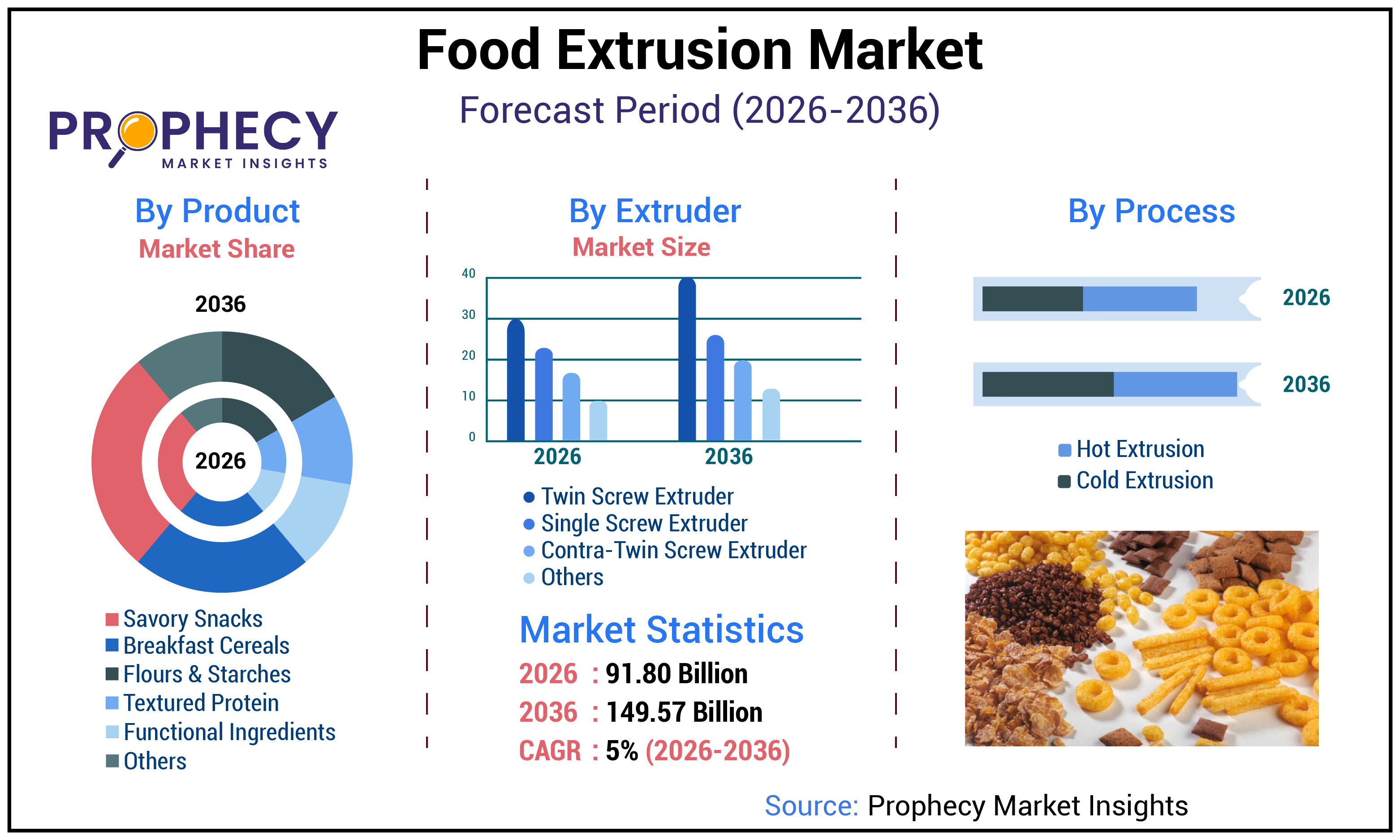
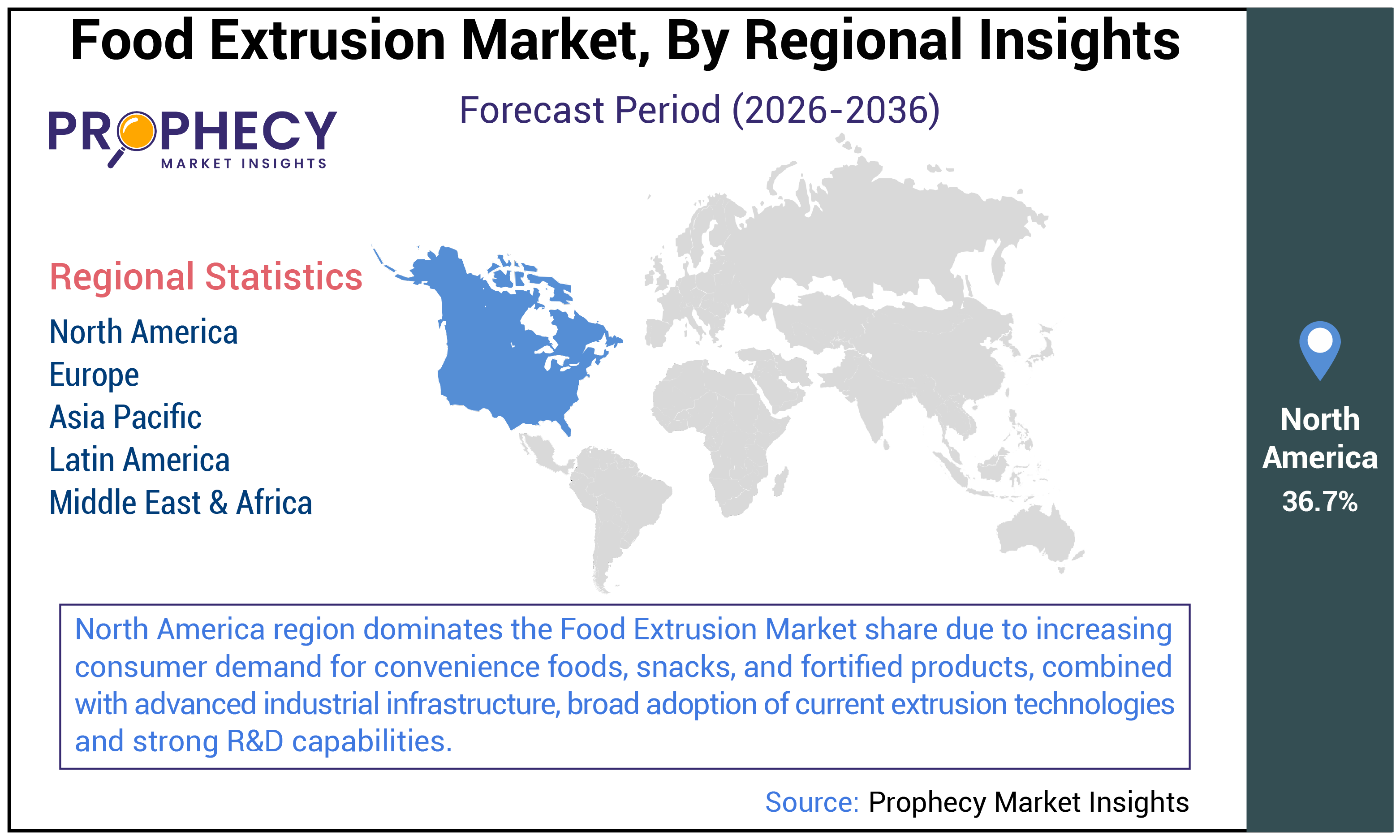
- North America has the largest regional share in the market, with almost 36.7%.
- Europe is second dominating region in the market.
- By product type, savory snacks dominate the food extrusion market share.
Food Extrusion Market Drivers & Restraints
Drivers and Restraints:
|
Drivers |
Restraints |
Opportunities & Trends |
|
|
|
Key Drivers:
Rising Urbanization and Busy Lifestyles
The food extrusion market is being propelled by the increasing manufacturing in urbanization and the busy lifestyles of people, which in turn is raising the demand for convenient, ready-to-eat, and quick-preparation foods. Urban consumers, who have little time for cooking, choose snacks, cereals, and instant meals, the production of which extrusion technology can do very efficiently with a longer shelf life and quality that is stable.
Such a change in the patterns of consumption urges producers to utilize the extrusion method to be able to offer timely, nutritious, and convenient food products to their customers.
- For instance, according to the data published by World Bank Group, currently, 4.4 billion people, or more than half of the world's population, reside in urban areas. This trend is predicted to continue, with nearly seven out of ten people living in cities by 2050, when the urban population is predicted to more than quadruple.
Restraints:
Market Fragmentation and Competition in Equipment Supply
Food extrusion market fragmentation and the highly competitive situation might result in the restriction of market growth as this could lead to price pressures, quality standards that are not always consistent, and limited after-sales support, which in turn creates a difficult environment for small manufacturers to make confident investment decisions.
- Counterbalance Statements: One of the feasible ways for the supply side of the industry to overcome such issues is to put more emphasis on the standardization of their products, the establishment of a service network, and the provision of affordable modular solutions whereas manufacturers may lessen the risks by selecting reliable suppliers for cooperation and investing in training for the better use of the equipment and its greater trustworthiness.
Opportunities & Trends:
Development of Low-Fat, Low-Sugar, and Functional Foods
The food extrusion market is looking towards the development of low-fat, low-sugar, and functional foods as a significant trend of the future. As consumers are progressively demanding healthier and nutritionally enhanced products.
With extrusion technology, one can have exact control over the ingredients and the processing parameters which makes it possible to produce snack foods, cereals, and meals that comply with these health criteria while still retaining the flavor and texture. Consequently, this trend will be a major factor behind the market growth which is expected to be fueled by innovation, the expansion of product portfolios, and the attraction of health-conscious consumers.
Food Extrusion Market Segmentations & Regional Insights
Product type, extruder, process, application, and region are the divisions of the food extrusion market.
By Product Type:
Savory snacks, breakfast cereals, flours & starches, textured protein, functional ingredients, and others are product type on which food extrusion market is segmented. Savory snacks dominate the food extrusion market share due to their high global demand as convenient, ready-to-eat items catering to busy lifestyles and snacking habits. Their great variety, tasty alternatives, and long shelf life make them extremely popular with consumers.
Breakfast cereals are the second most popular segment, owing to health awareness, vitamin and mineral fortification, and their use as a quick, nutritious breakfast option, particularly among urban and working populations.
By Extruder:
Based on the extruder, the food extrusion market is divided into single screw extruder, twin screw extruder, contra-twin screw extruder, and others. The twin screw extruder dominates the food extrusion market share due to its adaptability, superior mixing and shearing capabilities, and capacity to handle a diverse variety of raw materials, including high-moisture and nutrient-rich ingredients. It is frequently used in the production of snacks, cereals, and plant-based proteins as it guarantees constant product quality and allows for fine control over texture and functioning.
The single screw extruder is the second most popular, due to its lower cost, simpler design, and efficiency in producing typical products such as breakfast cereals and basic snacks, making it ideal for small to medium-sized companies.
By Process:
The food extrusion market is categorized into cold extrusion, and hot extrusion, on the account of process. Hot extrusion dominates the food extrusion market share due to its enables high-temperature, high-shear processing, which improves the texture, flavor, digestibility, and shelf life of items such as snacks, cereals, and textured proteins. Its capacity to efficiently process varied components and generate ready-to-eat dishes makes it a popular choice among manufacturers.
Cold extrusion is the second most common method, mostly used for products such as pasta, doughs, and biscuits, where lower temperatures maintain nutrients and avoid cooking, making it ideal for applications requiring minimum thermal effect.
By Application:
The food extrusion market on the account of application is categorized food, feed, pet food, pharmaceuticals, and others. The food application segment dominates the food extrusion market size due to the rising global demand for ready-to-eat snacks, breakfast cereals, and fortified meals, which is being driven by urbanization, busy lives, and growing health consciousness.
The feed segment is the second most dominating since extrusion technology is widely utilized in animal feed production to improve digestibility, nutritional availability, and product homogeneity, hence promoting the global growth of the livestock and aquaculture industries.
Regional Insights:
Geographically, the Food extrusion market is studied across North America, Europe, Asia Pacific, Latin America, and the Middle East & Africa.
North America: This region dominates the food extrusion market share due to increasing consumer demand for convenience foods, snacks, and fortified products, combined with advanced industrial infrastructure, broad adoption of current extrusion technologies, and strong R&D capabilities.
- U.S. Food Extrusion Market Insights:
North America's food extrusion market is dominated by the U.S. due to its big consumer preference for ready-to-eat snacks, cereals, and functional foods, high disposable income, and significant presence of leading food manufacturers investing in innovative extrusion technology.
Europe: This is the second most dominant region, owing to rising health-conscious consumption, an increasing preference for in breakfast cereals and plant-based protein products, tight food safety standards, and significant investment in new and sustainable food processing technology.
- Germany Food Extrusion Market Insights:
In Europe, Germany leads the market due to its well-established food processing sector, high demand for healthy and fortified goods, emphasis on innovation and sustainability, and stringent adherence to food safety and quality requirements that stimulate the use of advanced extrusion processes.
Asia Pacific: The food extrusion market in APAC is booming on account of rising urbanization, increasing demand for quick and ready-to-eat snacks, an expanding middle-class population, and rising health awareness, all of which drive consumption of fortified and nutritious products. The rapid development of the food processing industry, as well as the use of new extrusion technology, are further driving growth.
- China Food Extrusion Market Insights:
China leads the APAC market due to its big population, growing urban lifestyle patterns, high snack and breakfast cereal consumption, and major investments in advanced food manufacturing facilities.
Food Extrusion Market Report Scope:
|
Attribute |
Details |
|
Market Size 2026 |
USD 91.80 Billion |
|
Projected Market Size 2036 |
USD 149.57 Billion |
|
CAGR Growth Rate |
5% (2026-2036) |
|
Base year for estimation |
2025 |
|
Forecast period |
2026 – 2036 |
|
Market representation |
Revenue in USD Billion & CAGR from 2026 to 2036 |
|
Regional scope |
North America - U.S. and Canada Europe – Germany, U.K., France, Russia, Italy, Spain, Netherlands, and Rest of Europe Asia Pacific – China, India, Japan, Australia, Indonesia, Malaysia, South Korea, and Rest of Asia-Pacific Latin America - Brazil, Mexico, Argentina, and Rest of Latin America Middle East & Africa – GCC, Israel, South Africa, and Rest of Middle East & Africa |
|
Company Landscape |
Market Share Analysis of Companies Heat Map Analysis Company Overview, Products Overview Financial Information, Key Highlights Business Strategies Overview SWOT Analysis |
|
Report coverage |
Revenue forecast, company share, competitive landscape, growth factors, and trends |
|
Value Added Data Infosets |
Fundamental market insights such as the size of the market, growth rate, segmentation, regional study, and key players, our reports carry value-added data sets such as trade flow (import-export) analysis, production and consumption overview, price trend evaluation, supply and value chain mapping, and raw material availability. Moreover, we provide strategic tools as PESTLE and Porter’s Five Forces analysis, examination of the regulatory landscape, as well as monitoring of technology and innovation thereby providing a comprehensive overview which facilitates sensible and anticipatory decision-making. |
Segmentation:
By Product Type:
- Savory Snacks
- Breakfast Cereals
- Flours & Starches
- Textured Protein
- Functional Ingredients
- Others
By Extruder:
- Single Screw Extruder
- Twin Screw Extruder
- Contra-Twin Screw Extruder
- Others
By Process:
- Cold Extrusion
- Hot Extrusion
By Application:
- Food
- Feed
- Pet Food
- Pharmaceuticals
- Others
By Region:
- North America
- U.S.
- Canada
- Europe
- Germany
- U.K.
- France
- Russia
- Italy
- Spain
- Netherlands
- Rest of Europe
- Asia Pacific
- China
- India
- Japan
- Australia
- Indonesia
- Malaysia
- South Korea
- Rest of Asia Pacific
- Latin America
- Brazil
- Mexico
- Argentina
- Rest of Latin America
- Middle East & Africa
- GCC
- Israel
- South Africa
- Rest of Middle East & Africa
Food Extrusion Market Competitive Landscape & Key Players
Food Extrusion firms' key growth strategies include investing in innovative extrusion technology to increase efficiency and product quality, diversifying product portfolios with healthy, fortified, and plant-based options, and targeting new countries with rising demand for convenience foods.
Food Extrusion Market Companies:
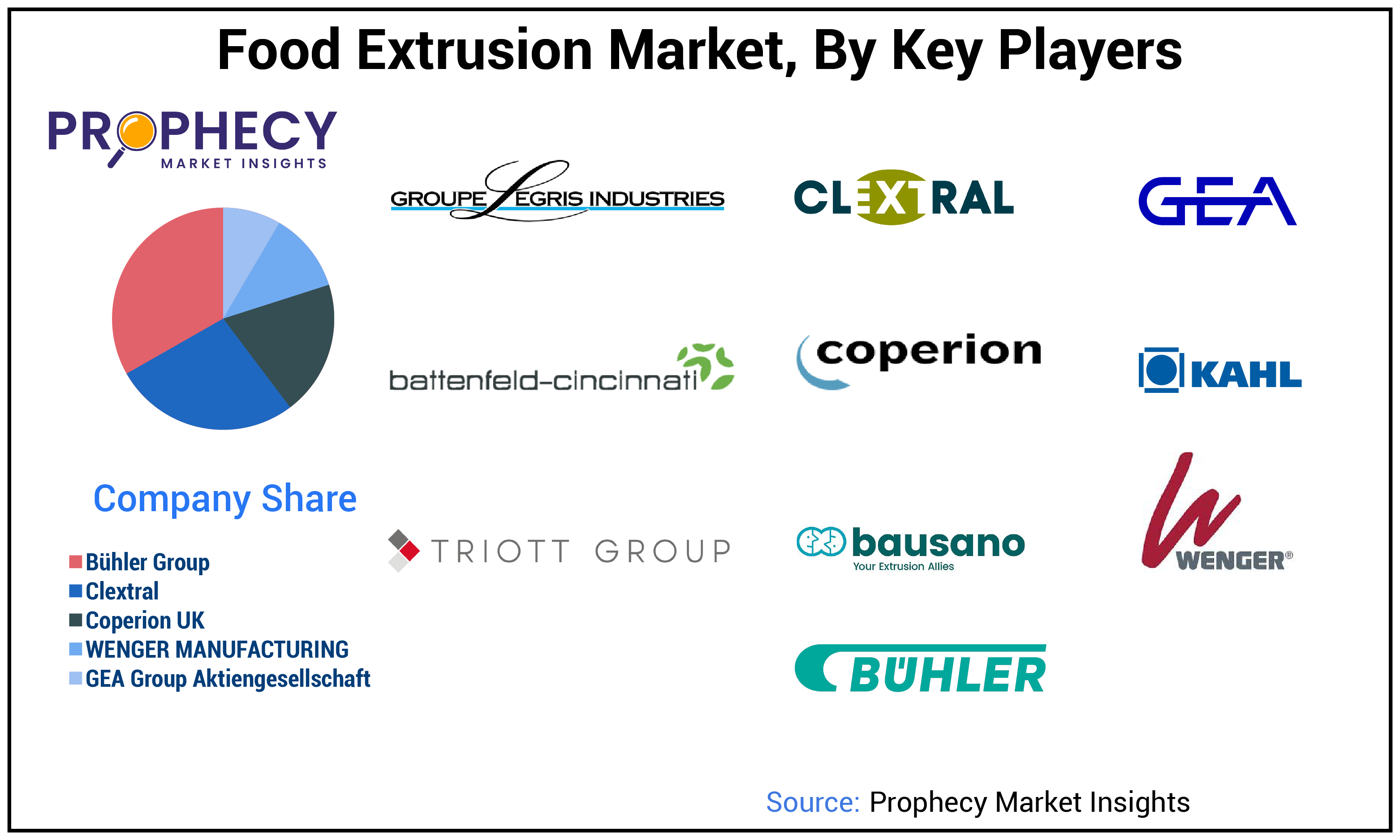
- Bühler Group
- Clextral
- Coperion UK
- WENGER MANUFACTURING
- GEA Group Aktiengesellschaft
- Doering Systems, Inc.
- Amandus Kahl GmbH & Co. KG
- Triott Group
- Groupe Legris Industries
- Bonnot
- CPM
- Bausano S.p.A.
- BC Extrusion Holding GmbH
- Doering Systems, Inc.
- SnackTek
View an Additional List of Companies in the Food Extrusion Market
Food Extrusion Market Recent News
- In August 2025, The Middleby Corporation, a leading worldwide manufacturer of equipment solutions for commercial foodservice, food processing, and residential kitchens, announced the acquisition of Oka-Spezialmaschinenfabrik GmbH & Co. KG (Oka), expanding its portfolio of Middleby Food Processing equipment innovations. Oka is a leading designer and manufacturer of industrial extrusion, molding, depositing and cutting industrial production equipment in bakery, confectionery and pet-food markets.
Analyst View:
Food extrusion is a high-temperature, short-time technology for producing snacks, cereals, pasta, and pet food with better digestibility, texture, shelf life, and nutrient content while minimizing microbial contamination and waste. The market is expanding due to rising demand for convenient, ready-to-eat, and fortified foods, technological advancements in extrusion equipment, the capacity to generate different forms and textures, and the impact of urbanization and busy lives on the consumption of convenient food items.
Analysis of Sources:
Primary Sources:
- In-depth interviews
- Company-specific data
- Surveys and questionnaires
- Focus group discussions (FGDs)
- Others
Secondary Sources:
- Food and Agriculture Organization of the UN
- European Commission
- Others
More Related Reports
Food Fiber Market
Baby Food Market
Food Waste Disposers Market
Ethnic Food Market
Food Supplements Market
Food Extrusion Market Company Profile
|
Company Name |
Product Portfolio |
|
Bühler Group |
Extrusion Solutions for Food Manufacturing |
|
Coperion UK |
Extrusion of Many Types of Food and Pet Food Products |
|
Leistritz Extrusionstechnik GmbH |
Twin Screw Extruders and Systems |
|
WENGER MANUFACTURING |
Extrusion Cooking Systems |
|
GEA Group Aktiengesellschaft |
Extruders |
Food Extrusion Market Highlights
FAQs
Food extrusion market size was valued at USD 91.80 Billion in 2026 and is expected to reach USD 149.57 Billion by 2036 growing at a CAGR of 5%.
Product type, extruder, process, application, and region are the segmentation for the food extrusion market.
Advancements in extrusion technology, a rise in the popularity of plant-based and gluten-free products, and the expansion of the pet food sector, and so on are some of the food extrusion market growth drivers.
North America, Asia Pacific, Europe, Latin America, and the Middle East & Africa. North America is expected to dominate the food extrusion market.
The key players operating the food extrusion market include Bühler Group, Clextral, Coperion UK, WENGER MANUFACTURING, GEA Group Aktiengesellschaft, Doering Systems, Inc., Amandus Kahl GmbH & Co. KG, Triott Group, Bonnot, CPM, Bausano S.p.A., BC Extrusion Holding GmbH, Doering Systems, Inc., and SnackTek.