Ethnic Food Market Overview
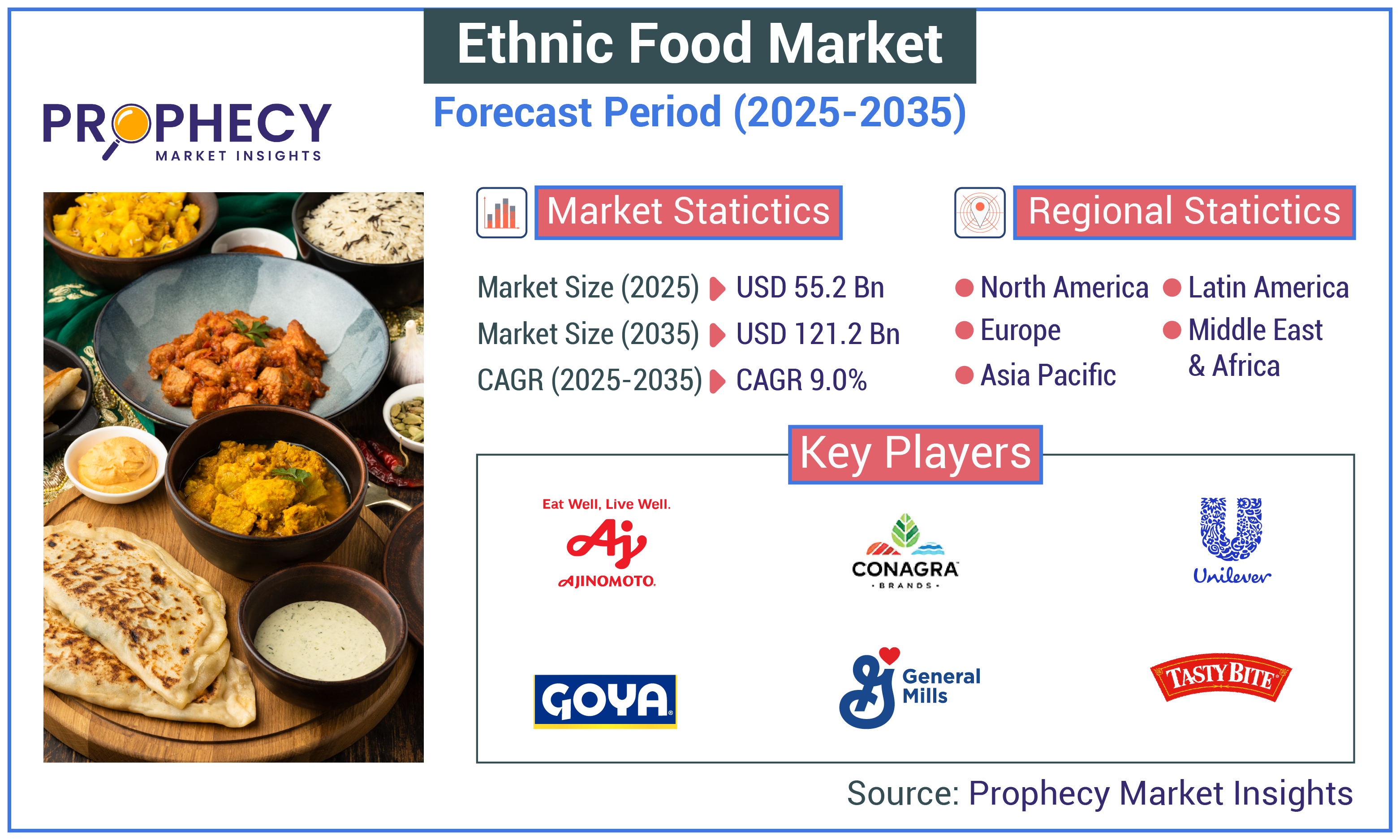
- By 2035, ethnic food market size is contemplated to enlarge at a valuation of USD 121.2 Billion.
- In 2024, the ethnic food market valuation was USD 51.4 Billion.
- Ethnic food market is developing at a CAGR of 9.0%.
Ethnic food encompasses cooking practices and foods that are "authentic", it is food that is traditional to a certain culture, region or geographical area, it has culturally unique flavors, ingredients, and cooking methods. Ethnic foods represent cultural heritage and the diversity of the world's cuisines. This cultural identity and ethnic food are attractive to native populations as well as to consumers who seek global taste explorations. Ethnic foods are increasingly becoming part of diets across a variety of local, national, and global systems.
The ethnic food market growth is on the rise based on moving towards a greater global society, the increase in international travel, and the emergence of multicultural populations. Consumers are willing to try more cosmopolitan cuisine that is attributable to the world turn to being global societies through social media, cooking shows, and dining out with friends. The demand for ethnic food is also increasing due to consumer demand for convenient and ready-to-eat ethnic meals, and distribution through retail and internet sales models.
The ethnic food market will continue to have immense potential and growth prospects for the future, driven by consumer interests seeking out flavors of the world and the need for models of traditional recipes that are health-conscious. Technological improvements in packaging and preservation will improve availability and access, and with trends of fusion and clean label products, ethnic food trends will continue to strive demand alongside trade in international markets and developing economies.
Recession Risk & Tariff Analysis:
- When the economy declines, consumers often cut back on premium or specialty products, including ethnic foods. This might mean restaurants and specialty stores have declining revenues while the demand for low-cost staples may rise. Ethnic food segments with imported components may be at further risk for declining sales due to disrupted supply chains and changing priorities of consumers in constrained economies.
- Tariffs on imported food ingredients and products may significantly affect sales in the ethnic food market by increasing costs for manufacturers and retailers. Countries that rely on authentic spices, sauces, or packaged meals imported through cross-border supply chains may experience price fluctuations that limit access to a product for consumers and manufacturers as authentic versions may vary in premium pricing structures and availability for niche or region-specific ethnic foods.
Impact of Generative AI on Ethnic Food Market:
- Generative AI provides food companies with the ability to evaluate consumer preferences, regional taste attributes, and market trends, which ultimately assist in generating new ethnic food products. Generative AI enables the creation of simulated recipes or recipe combinations, to speed up product innovation and development, therefore supporting brands with authentic and personalized meals, designed for equitable cultural taste profile for consumers in a global market.
- Generative AI also fuels highly targeted advertising and marketing through culturally relevant content, and promotions, for rope-specific ethnic groups. Generative AI can facilitate regionally-targeted campaigns, multilingual food or food labeling, and adaptive packaging, that have a greater resonance with a diverse audience's their personal lived experience, and enhances product placement and engagement across digital and physical retail.
Ethnic Food Market Drivers & Restraints
Key Drivers:
Rising Multicultural Population and Globalization is changing the dynamics of the market
The growth in migration and exchange of culture between nations has developed strong demand for ethnic foods. While displaced in search of new opportunities to provide for themselves and families, (as well as refugees) migrants tend to share traditional food products that can incorporate into new communities with diversity.
Additionally, consumers of diverse cultures from host countries become more receptive to global tastes and have made ethnic food consumption more available through restaurant, supermarket, and online space, influenced by urbanization and connectivity to global media. The research also indicates that people will include a more global variety of culinary choices beyond traditional or local food features have changed culinary preferences.
- For instance, according to the World Health Organization, there are close to 1 billion people who migrate around the world, and of that number, approximately 281?million are international migrants as of mid-2020. Given such a vast population, there is exposure of ethnic cuisine in different regions of the world resulting in greater demand and access more varieties of traditional and fusion ethnic food products on the global stage.
Restraints:
High Dependency on Imported Ingredients to repel market growth:
Ethnic-specific food products can often depend on regional ingredients that rely on local regional imports of spices, herbs, and sauces. This has the downside of putting producers/makers at increased risk of national and trade restrictions related to food imports, geopolitical tensions, and supply chains being disrupted.
Further, changing import tariffs and transportation costs can increase the bases of an ethnic product's price, decrease availability of an item or selection, and affect the scalability of connection between an ethnic producer and its wholesalers, particularly with small and medium-sized enterprises, as many ethnic food producers. All of this can limit the reach of potential customers and create inconsistencies related to quality in different markets.
- Counterbalance Statements: Manufacturers are increasingly moving to use local alternatives or grow their traditional crops in order to minimize total import reliance. Additionally, new advances in food technology and vertical farms allow producers of ethnic food to grow rare ingredients, be as authentic as possible and reduce risk exposure in their supply chain and more sustainably adapt in order to better weather the ups and downs of long-term market cycles.
Opportunities & Trends:
Fusion Cuisine and Customization is a growing opportunity
The trend towards a fusion of food/cuisine and cultural influences represents one major opportunity in the ethnic food industry. Fusion cuisine is particularly appealing to the emerging base of customers, in both ethnic foods and overall food trends, as many younger and forward-thinking and adventurous perspectives are looking for the new flavor and excitement offered in diverse food experiences. And since more people are embracing customized meals, including ethnic food options tailored for dietary restrictions, such as gluten and vegan options, then there is ample opportunity for brand differentiation. Developers, promoting authentic ethnic products, who want to and can hone in on authentic and innovated products, have endless opportunities for customers among new segments, as well as to expand global reach and brand perspectives.
Ethnic Food Market Segmentations & Regional Insights
Product, nature, cuisine type, packaging type, distribution channel and region are the divisions of the ethnic food market.
By Product:
Based on product, the market is divided into ready-to-eat meals, snacks & savory items, condiments, beverages, desserts & confectionery. The ready-to-eat meals segment is currently has largest ethnic food market share driven by the increasing need of busy urban consumers for convenient, authentic cuisines. Ready-to-eat meals represent time-saving meals that faithfully reproduce traditional flavors and have gained ubiquity and usage across supermarkets, online channels, and foodservice sectors. Their long shelf life, when suitable, provides additional market opportunity on a global basis.
Snacks and Savory Items represents the second biggest eating ethnic food category and reflects the needs of busy individuals leading on-the-go lifestyles and multicultural preferences and tastes. Exotic ethnic snack products such as samosas, spring rolls, or empanadas have grown rapidly in use and popularity all over the world. In addition, the accelerating demand for new global street food has largely driven the growth of snacks and savory items and the adoption of ethnic snacks and savory items across regional and national borders.
By Nature:
Based on the nature, the ethnic food market is divided into vegetarian/vegan, meat-based/ non-vegetarian, gluten-free/allergen-free, and organic/clean label. Meat-based ethnic foods are the most prevalent in the market since most ethnic foods have traditional meat food products such as kebabs, curries and stir fries. Meat-based ethnic foods are popular across all food segments- restaurants, ready-to-eat, and frozen- because they appeal to customers' desire for authentic flavor and cultural relevance with meat-based ethnic foods.
Vegetarian and vegan ethnic foods have a second-place in ethnic food market share presence due to increasing awareness of health, ethics, and trends towards plant-based. Packed vegetarian selections are standard in Indian, Mediterranean, and Middle Eastern cuisines. The growing popularity of meat-free alternatives led manufacturers to expand plant-based ethnic foods opportunities into both traditional and modern fusion formats.
By Cuisine Type:
Based on the cuisine type, the ethnic food market is divided into asian, latin american, middle eastern, african, european, and others. Asian cuisine dominates the ethnic food market share due to its flavor characteristics and widespread global acceptance. There is a near-constant presence with regard to Chinese, Indian, and Japanese dishes in restaurants, retail, and frozen. The variety, variety of products and mixability with other ethnic dishes are central to this market's leading position.
Latin American cuisine is second in size as interests in Mexican, Brazilian, and Peruvian dishes grow worldwide. With brash, hot flavors and fresh ingredients and the popularity of tacos, tortillas, and salsas, Latin American cuisine is experiencing an increase in purchases. Cultural familiarity and growing populations in major markets should continue to grow consumers' appetites for Latin American cuisine across the country.
By Packaging Type:
Based on the packaging type, the ethnic food market is divided into canned, frozen, and pouched. Frozen packaging has taken the largest ethnic food market share since it allows for flavor, texture and nutritional value to be preserved for longer periods of time. Also, it allows for the distribution of ready-to-eat meals and specialty products without reducing quality. Moreover, the added value of frozen food is that consumer preference is currently moving toward convenience and very little food preparation, increasing the opportunity for frozen ethnic products in the market.
The second largest form of packaging for ethnic food is canned, due to a long shelf life and convenient storage options, particularly with products such as sauces, beans, and ready meals. Canning envelopes you with additional factors including cost, durability, and maintaining food safety, making it a preferred format for consumers and manufacturers, particularly in areas lacking effective cold chain infrastructures.
By Distribution Channel:
Supermarkets/hypermarkets, convenience stores, specialty stores, online retail, foodservice outlets are distribution channel of the ethnic food market. Supermarkets and hypermarkets are the main players in the ethnic food market share, given their large selection of products, established supply chains, and accessibility for consumers. Supermarkets and hypermarkets have a direct influence on purchasing behavior and brand awareness, on a global scale.
The online retail channel ranks second in ethnic food distribution, since digital retail provides consumers with convenience, variety, and access to more niche ethnic food products that are not available locally. In the past decade, e-commerce adoption has increased and, with the use of personalized recommendations and their ability to make products available with home delivery, consumers are becoming comfortable buying more ethnic ingredients and ready meals online.
Regional Insights:
Geographically, the ethnic food market is studied across North America, Europe, Asia Pacific, Latin America, and the Middle East & Africa.
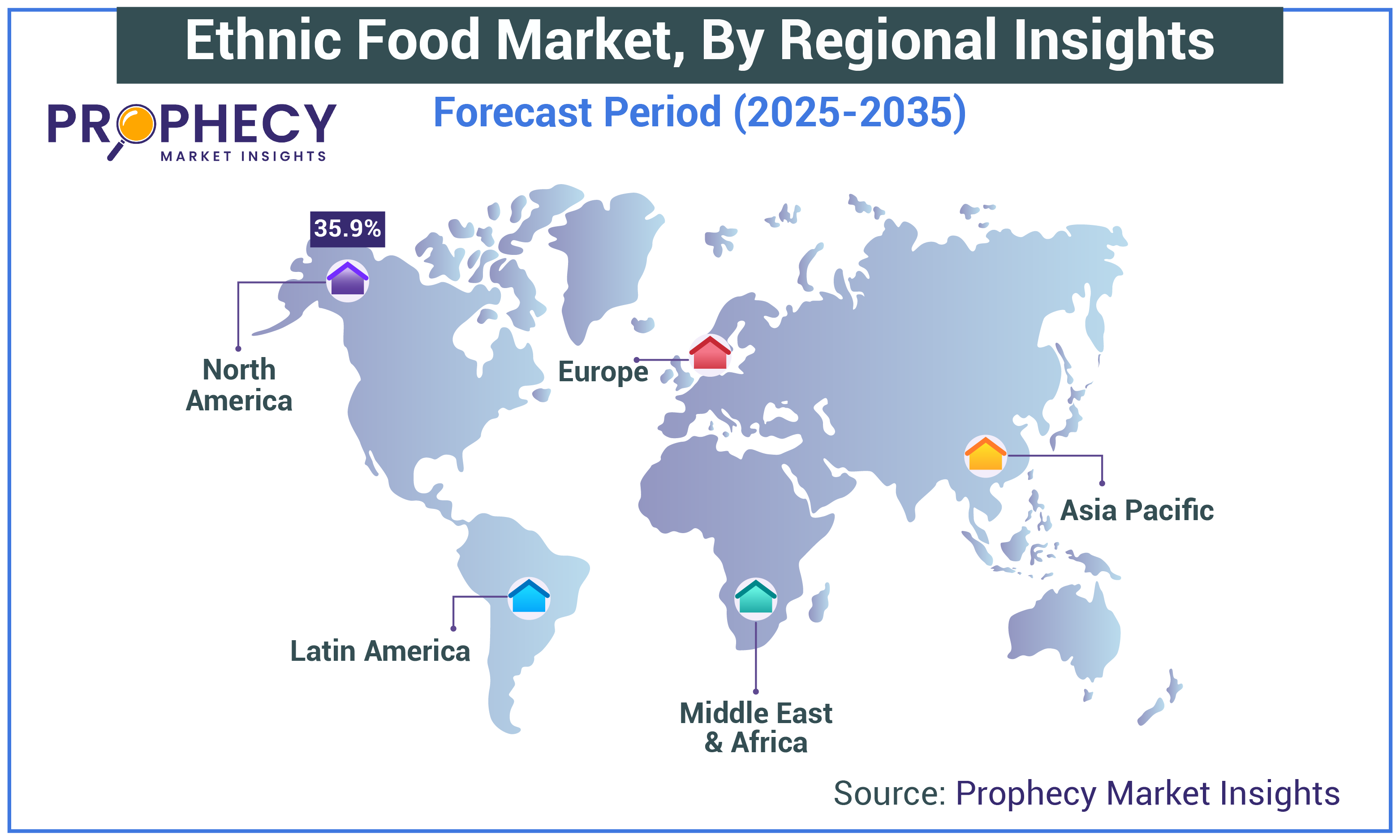
North America: This region leads the ethnic food market size with 35.9% share, due to its cultural diversity and a strong appetite for international cuisines! In particular, the growing Hispanic and Asian populations play an important role in influencing product availability and product development. large immigrant population is propelling market growth.
- U.S. Ethnic Food Market Insights:
The U.S. is the dominant player in the North America ethnic food market share, largely due to the multicultural population and openness to international ethnic cuisines. An important driver for ethnic food demand is the presence of Asian, Latin American, and Mediterranean communities in the U.S., where there are more ethnic food restaurants and products than in many other locations.
Europe: This region is in second place in the ethnic food market growth, fueled by its cultural diversity as well, and demand for Mediterranean, Middle Eastern, and Asian cuisines throughout Europe where demand is steady. Countries such as the UK, Germany and France have a strong demand for ethnic meals, supported by new retail channels that are expanding at a rapid pace. There is a steady increase in the regional immigrant populations that support growth and sustained interest in culinary diversity in their communities.
- U.K. Ethnic Food Market Insights:
The U.K. is the leading player in the ethnic food market in Europe, thanks to a large immigrant population and global culinary culture. British consumers show a strong interest in Indian, Chinese, and Middle Eastern ethnic foods. As noted, supermarkets and takeaway restaurants, as well as specialty stores, have plenty of ethnic food options underpinning the United Kingdom's position as a leading market in Europe.
Asia Pacific: This region is the third largest market in ethnic foods, driven mainly by urbanization trends, growing disposable incomes, and a growing interest in cross-regional cuisines. Many Asian countries such as Japan, China, and India have previously been large suppliers of ethnic foods but the domestic demand for international ethnic cuisines and fusion ethnic is steadily growing.
- Japan Ethnic Food Market Insights:
Japan is also the leader of the Asia Pacific ethnic food market, with an increasing interest in global ethnic food options, including Korean, Chinese, and Western. The population of Japan is heavily urbanized, and with a good retail supply chain network, and growing international exposure, Japanese consumers are increasingly searching for more culinary experiences, whether at restaurants or with packaged ethnic food products.
|
Attribute |
Details |
|
Market Size 2025 |
USD 55.2 Billion |
|
Projected Market Size 2035 |
USD 121.2 Billion |
|
CAGR Growth Rate |
9.0% (2025-2035) |
|
Base year for estimation |
2024 |
|
Forecast period |
2025 – 2035 |
|
Market representation |
Revenue in USD Billion & CAGR from 2025 to 2035 |
|
Regional scope |
North America - U.S. and Canada Europe – Germany, U.K., France, Russia, Italy, Spain, Netherlands, and Rest of Europe Asia Pacific – China, India, Japan, Australia, Indonesia, Malaysia, South Korea, and Rest of Asia-Pacific Latin America - Brazil, Mexico, Argentina, and Rest of Latin America Middle East & Africa – GCC, Israel, South Africa, and Rest of Middle East & Africa |
|
Report coverage |
Revenue forecast, company share, competitive landscape, growth factors, and trends |
Segmentation:
By Product:
- Ready-to-Eat Meals
- Snacks & Savory Items
- Condiments
- Beverages
- Spices & Seasonings
- Desserts & Confectionery
By Nature:
- Vegetarian/Vegan
- Meat-Based/Non-Vegetarian
- Gluten-Free/Allergen-Free
- Organic/Clean Label
By Cuisine Type:
- Asian
- Latin American
- Middle Eastern
- African
- European
- Others
By Packaging Type:
- Canned
- Frozen
- Pouched
By Distribution Channel:
- Supermarket & Hypermarkets
- Convenience Stores
- Specialty Stores
- Online Retail
- Foodservice Outlets
By Region:
- North America
- U.S.
- Canada
- Europe
- Germany
- U.K.
- France
- Russia
- Italy
- Spain
- Netherlands
- Rest of Europe
- Asia Pacific
- China
- India
- Japan
- Australia
- Indonesia
- Malaysia
- South Korea
- Rest of Asia Pacific
- Latin America
- Brazil
- Mexico
- Argentina
- Rest of Latin America
- Middle East & Africa
- GCC
- Israel
- South Africa
- Rest of Middle East & Africa
Ethnic Food Market Competitive Landscape & Key Players
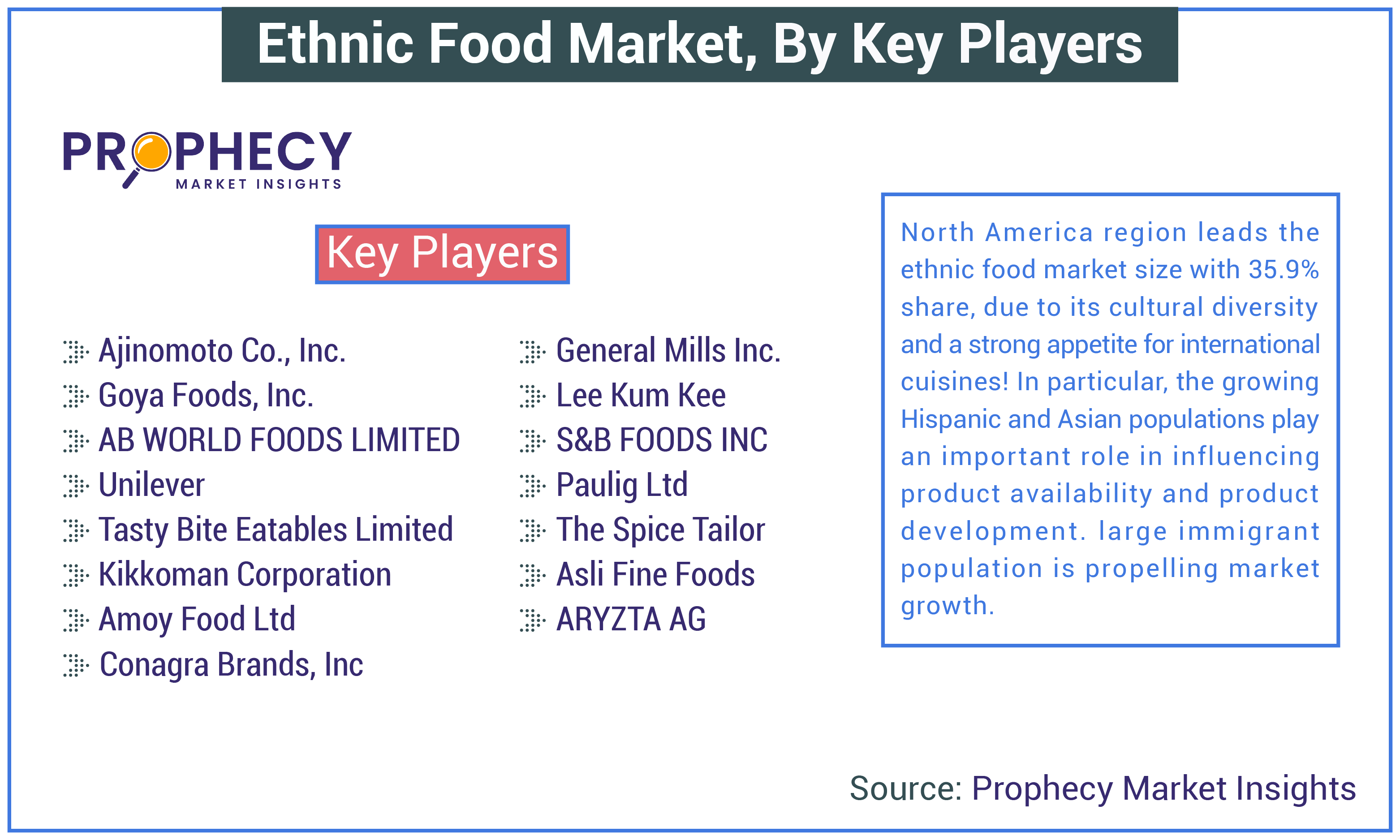
Leading companies in the ethnic food market include, Ajinomoto Co., Inc., Goya Foods, Inc., AB WORLD FOODS LIMITED, Unilever, Tasty Bite Eatables Limited, Kikkoman Corporation, and among others. The ethnic food industry is extremely competitive since it is an amalgam of global food conglomerates and limiting regional players. Competitors are differentiating on the basis of authenticity, flavor innovations, and distribution. Product diversity, clean-label options, and a robust retail partnership, which define the quality of regional partners, are also differentiators. Within the growing competition in emerging markets and online platforms is also growing.
Ethnic Food Market Companies:
- Ajinomoto Co., Inc.
- Goya Foods, Inc.
- AB WORLD FOODS LIMITED
- Unilever
- Tasty Bite Eatables Limited
- Kikkoman Corporation
- Amoy Food Ltd
- Conagra Brands, Inc
- General Mills Inc.
- Lee Kum Kee
- S&B FOODS INC
- Paulig Ltd
- The Spice Tailor
- Asli Fine Foods
- ARYZTA AG
View an Additional List of Companies in the Ethnic Food Market
Ethnic Food Market Recent News
- In March 2025, The Unilever Food Solutions annual Future Menus initiative, which aids chefs in developing and creating the current food trends. This year, Future Menus taps into South American and Asian cuisine in order to create growth within professional kitchens around the world. The Future Menus initiative is a key ingredient in UFS's success story as their turnover reached nearly €3 billion, volume has already exceeded pre-pandemic levels and growth was at high-single digits driven by volume, with positive price growth in 2024. As a result, UFS now represents over 20% of Unilever's Foods business.
- In January 2025, Kikkoman do Brasil Indústria e Comércio de Alimentos e Bebidas Ltda. (KDB), Kikkoman Groups' soy sauce production and sales base in South America, received vegan certification from FoodChain ID for its Honjozo (traditionally brewed) soy sauce that produced and marketed exclusively for the Brazilian market. KDB began the process to obtain vegan certification in 2024.
Analyst View:
The ethnic food market is experiencing substantial growth due to globalization, growing multicultural populations, and an increasing interest from consumers to experience the tastes typically found in ethnic foods. Many trends in ethnic food consumption are reshaping consumer demand same as eating ethnic experience restaurant and at-home using clean-label ingredients and a personalized meal solution.
Recently, there has been progress in the expansion of ethnic food distribution and retail channels both in brick and mortar and via online channels. The ethnic market will continue to find growth opportunities through inventiveness and customize to health and more adventurous consumers. There are restraints to consider including the costly price of ingredient imports, high production costs, and regulations related to ethnic food. In spite of the finder, the ethnic food market remains very fluid and growing due to changing tastes, global migration and products will continue to experience improvement in planning, production, and packaging.
Ethnic Food Market Company Profile
|
Company Name |
Unilever |
|
Headquarter |
England, United Kingdom |
|
CEO |
Fernando Fernandez |
|
Employee Count |
128,000 Employees |
Ethnic Food Market Highlights
FAQs
Ethnic food market size was valued at USD 55.2 Billion in 2025 and is expected to reach USD 121.2 Billion by 2035 growing at a CAGR of 9.0%.
Product, nature, cuisine type, packaging type, distribution channel, and region are the segmentation for the target market.
North America, Asia Pacific, Europe, Latin America, and the Middle East & Africa. North America is expected to dominate the market.
The prominent players operating in the market include, Ajinomoto Co., Inc., Goya Foods, Inc., AB WORLD FOODS LIMITED, Unilever, Tasty Bite Eatables Limited, Kikkoman Corporation, Amoy Food Ltd, Conagra Brands, Inc, General Mills Inc., Lee Kum Kee, S&B FOODS INC, Paulig Ltd, The Spice Tailor, Asli Fine Foods, and ARYZTA AG.