Europe Non Meat Ingredients Market Overview
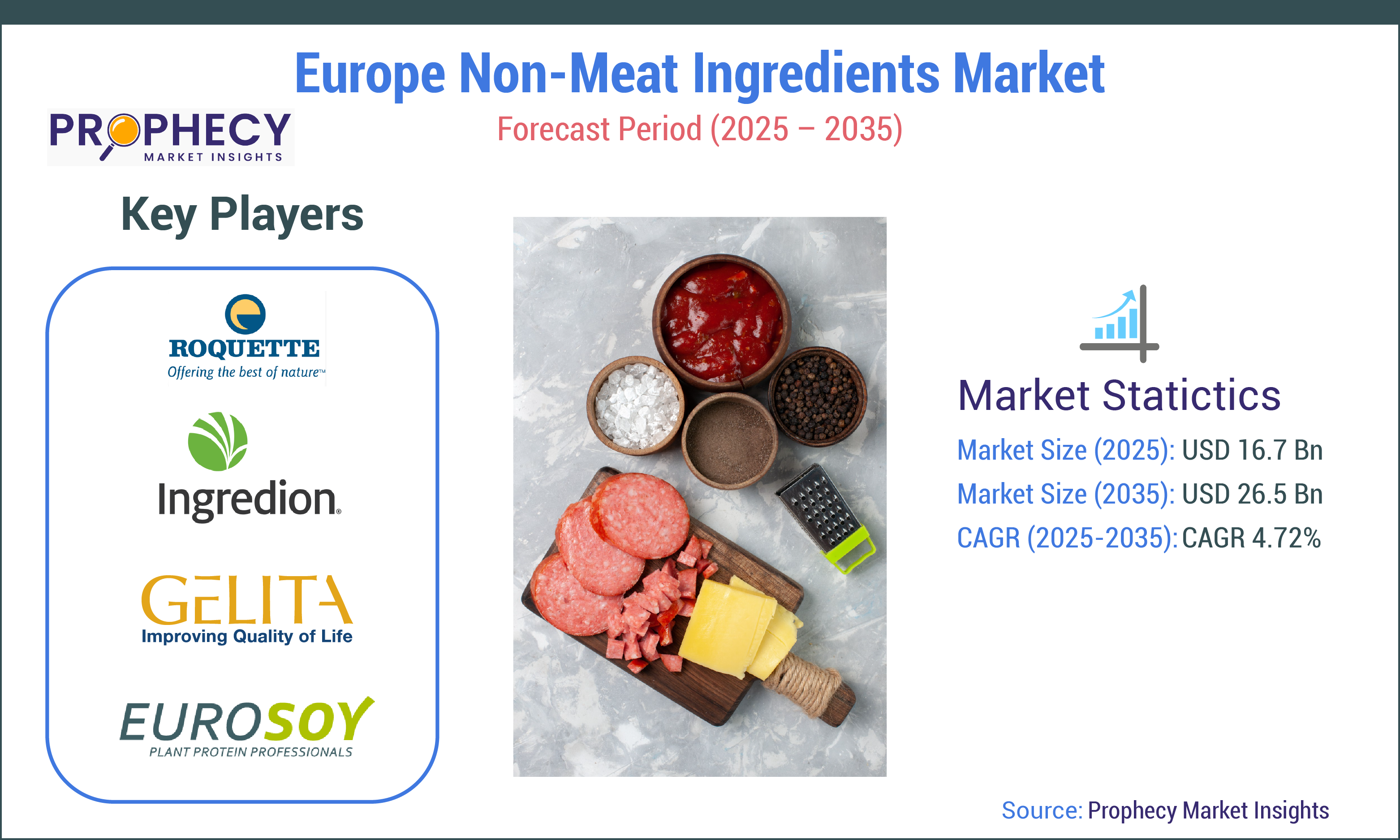
- By 2035, the Europe non-meat ingredients market size is contemplated to enlarge at a valuation of USD 26.5 Billion.
- In 2025, the Europe non-meat ingredients market valuation was USD 16.7 Billion.
- Europe non-meat ingredients market is developing at a CAGR of 4.72%.
Non-meat ingredients refers to meat options or plants used in processed meat products to increase taste, texture, shelf life and nutritional value. These may include soy protein, pea protein, starch, gums, spices, preservatives and taste enhancer. The benefits of non-meat ingredients include supporting vegetarian and vegetarian diet, reducing cholesterol and reducing fat intake, reducing environmental effects compared to animal meat and providing functional benefits such as better taste, moisture retention and extended product stability.
Europe non-meat ingredients market is booming due to growing health consciousness, plant-based and increasing demand for flexitarian diet and environmental and animal welfare concerns. Stringent European Union rules on food security and clean label products have encouraged manufacturers to use high quality, durable and natural ingredients. Additionally, innovation in meat options, expanding vegetarian product lines by major food brands, and strong support from government initiatives promoting permanent food systems is further promoting market expansion throughout the region.
Future trends in Europe non-meat material market include rapid innovation in plant proteins and mycoprotein, catering for consumer demands for cleaner labels, nutrition enhanced nutrition (added omega-3s, antioxidant), and authentic flavors. Expect the use of novel protein expansion-such as insect and microbial-derived ingredients and operated by laboratory components, stability goals, regulatory support and cost-efficient scalability through laboratory components. These changes have been lined with consumer preference for both Europe's strong clean-labeled movement, technology-focused R&D, and plant-based and flexitarian foods.
Recession Risk and Tariff Analysis:
- Europe faces challenges with non-meat material market economic recession and increasing tariffs. The risk of recession, especially in major economies such as Germany, can reduce consumer expenses and limit the investment of the food industry.
- Additionally, new European Union tariffs are increasing input costs on imports such as U.S. corn, putting pressure on manufacturers. These factors can lead to high prices, slow innovation and supply chain changes, although they can also encourage more local sourcing within Europe.
Impact of Generative AI on Europe Non-Meat Ingredients Market:
- The generative AI is positively affecting Europe non-meat material market by accelerating the component search, improving product formulations and optimizing supply chains. It enables plant-based and rapid identification of microbial ingredients with better taste, texture and nutrition.
- AI also increases recipe development, reduces costs, and supports stability through better demand forecasting and traceability. This technical change is helping companies meet the growing consumer demands more efficiently for clean and high-demonstration materials.
Europe Non Meat Ingredients Market Drivers & Restraints
Key Drivers:
The Market Growth is Attributable to Shift towards Plant-Based Diets
Growing changes towards plant-based diets is a major driver for Europe non-meat material market, as consumers seek rapidly healthy, durable and moral food options. This trend occurs due to increasing concerns at animal welfare, climate change and health risks of processed meat. As a result, the demand for meat options made with plants protein, fiber, natural taste and components such as binders is increasing. Food companies are responding by expanding vegetarian product lines and investing in clean-labeled innovations, accelerating the use of non-meat ingredients throughout the region.
- For Instance, according to the data published by ProVeg International, 51% of European meat eaters reduced their annual meat intake in 2023, with Germany, France, and Italy leading the way. 38% of Europeans are currently following a flexitarian, pescatarian, vegan, or vegetarian diet. 53% of Europeans intend to increase their consumption of legumes, while 40% plan on consuming more plant-based alternatives.
Increasing Demand for Flexitarian Diet and Environmental and Animal Welfare Concerns to Propel Market Diversification
Demand for non-meat products is considerably increased in Europe by the growing popularity of the flexitarian diet, which reduces meat consumption without totally displacing people. Customers are choosing more ethical and long-lasting food alternatives as a result of this dietary shift as well as growing environmental and animal welfare concerns. In order to make meat choices that fit these values protein, fiber, and natural enhancers non-meat ingredients, including plants, are crucial. Customers and producers are prioritizing products that promote cruelty-free and ecologically friendly food production as a result of growing awareness of the negative environmental effects of animal farming, which is driving market expansion throughout the area.
- For Instance, according to the data published by ProVeg International, European meat consumers who are reducing their meat intake, 47% are doing so for health concerns, 29% for animal welfare, and 26% for the environment. The flexitarian diet transcends generational backgrounds, with 29% of Boomers, 27% of Gen X, 26% of Gen Z, and 28% of Millennials identifying as flexitarian.
Restrains:
Fragmented Supply Chains is Disturbing Market Growth
In Europe, non-metal materials fragmented supply chains in the market refers to many regions or suppliers refer to scattered and inconsistent sourcing of raw materials such as plant proteins, natural binders, and additives, which are often leading to quality, delay and high-cost variability. This makes continuous product standards for fragmentation makers and make it difficult to scale.
- Counterbalance Statements: A major solution is building integrated, localized supply networks within Europe that reduce imports on imports, improve traceability, and ensure more reliable access to high quality, durable materials. Cooperation with regional producers, investing in vertical farming, and adopting digital supply chain platforms can lead to further operations and increase flexibility.
Opportunities & Trends:
Future Market Opportunities can be Revealed by the Rapid Innovation in Plant Proteins and Mycoprotein
Europe's Non-Meat Ingredients Market by providing more sustainable, wholesome, and genuine meat substitutes. In addition to improvements in mycoprotein fermentation (e.g., fungal-derived proteins) that are leading to better meat-like mouthfeel and comprehensive amino acid profiles, advanced extraction and protein-pairing techniques are improving the texture and flavor of pea, lentil, and soy-based components. These innovations position innovative plant and microbial proteins as key drivers of market growth and the transformation of the food industry. They also provide scalable, resource-efficient manufacturing, which is in line with consumer demand for clean-label, health-focused goods.
Europe Non Meat Ingredients Market Segmentations & Regional Insights
Product type, source, ingredient types, form, application, end user, and country are the divisions of the Europe non-meat ingredients market.
By Product Type:
Fresh meat products, processed and cured meat products, marinated and seasoned meat products, ready-to-eat products, frozen meat products, and others are type including in the Europe non-meat ingredients market. Due to their extensive use in plant-based cold cuts, deli slices, and sausages all of which are popular for their extended shelf life, ease of use, and proven customer acceptance processed and cured meat products have the biggest Europe non-meat ingredients market share.
Due to busy lives and the increased popularity of convenience meals, customers are choosing quick, wholesome, plant-based meal alternatives that don't require extra preparation, making ready-to-eat products the second most popular category.
By Source:
Chemical substances, plants, and animals are source for which market is categorized. Chemical substances have the most Europe non-meat ingredients market share since they are crucial for improving the flavor, texture, color, and shelf life of a variety of meat substitute products.
The growing desire from consumers for natural, clean-label, and sustainable food alternatives has made plant-based components the second most popular source.
By Ingredient Types:
Binders, fillers, extenders, flavoring agents, coloring agents, and others are ingredient types of the Europe non-meat ingredients market. Binders have the biggest Europe non-meat ingredients market share given that they are crucial to preserving the texture, structure, and moisture retention of plant-based and meat substitute products.
Due to the necessity to make non-meat products taste resembling conventional meat, flavoring agents are second in importance as a component category.
By Form:
On the account of form, the non-meat ingredients market is distributed into dry/powder, liquid, and paste/gel. The dry/powder form has the most Europe non-meat ingredients market share primarily due to its extended shelf life, ease of storage and transportation, and broad range of applications in frozen and processed non-meat products.
The second most popular type is liquid, which is utilized extensively in marinated and ready-to-eat items to more evenly distribute tastes, colors, and beneficial ingredients.
By Source:
Extending meat, binding and emulsifying, texture improvement, improving nutritional value, and others are applications of the market. Due to their importance in maintaining the uniformity, mouthfeel, and structural integrity of non-meat products, binding and emulsifying have the biggest Europe non-meat ingredients market share.
While manufacturers continue to place a high premium on attaining a genuine meat-like bite and chewiness, texture improvement is the second most popular use.
By End User:
By end user, the market is categorized into meat processors, food manufacturers, foodservice industry, and others. Due to their extensive use of non-meat ingredients in traditional meat products to enhance their texture, shelf life, flavor, and nutritional profile, as well as to create hybrid or plant-forward options to satisfy flexitarian consumers, meat processors hold the largest market share in the Europe non-meat ingredients market.
Food manufacturers, which are driving development via innovation in wholly plant-based and ready-to-eat meat substitutes, are the second most important end user.
By Country:
On the virtue of country, the market is categorized into Germany, U.K., France, Russia, Italy, Spain, Netherlands, and Rest of Europe. However, due to its sophisticated food processing sector, increased demand for clean-label and ecological goods, and large consumer base for plant-based and flexitarian diets, Germany leads the Europe non-meat ingredients market growth.
Europe Non-Meat Ingredients Market Report Scope:
|
Attribute |
Details |
|
Market Size 2025 |
USD 16.7 Billion |
|
Projected Market Size 2035 |
USD 26.5 Billion |
|
CAGR Growth Rate |
4.72% (2025-2035) |
|
Base year for estimation |
2024 |
|
Forecast period |
2025 – 2035 |
|
Market representation |
Revenue in USD Billion & CAGR from 2025 to 2035 |
|
Regional scope |
Europe – Germany, U.K., France, Russia, Italy, Spain, Netherlands, and Rest of Europe |
|
Report coverage |
Revenue forecast, company share, competitive landscape, growth factors, and trends |
Segmentation:
By Product Type:
- Fresh Meat Products
- Processed and Cured Meat Products
- Marinated and Seasoned Meat Products
- Ready-to-Eat Products
- Frozen Meat Products
- Others
By Source:
- Chemical Substances
- Plants
- Animals
By Ingredient Types:
- Binders
- Fillers
- Extenders
- Flavoring Agents
- Coloring Agents
- Others
By Form:
- Dry/Powder
- Liquid
- Paste/Gel
By Application:
- Extending Meat
- Binding and Emulsifying
- Texture Improvement
- Improving Nutritional Value
- Others
By End User:
- Meat Processors
- Food Manufacturers
- Foodservice Industry
- Others
By Country:
- Germany
- U.K.
- France
- Russia
- Italy
- Spain
- Netherlands
- Rest of Europe
Europe Non Meat Ingredients Market Competitive Landscape & Key Players
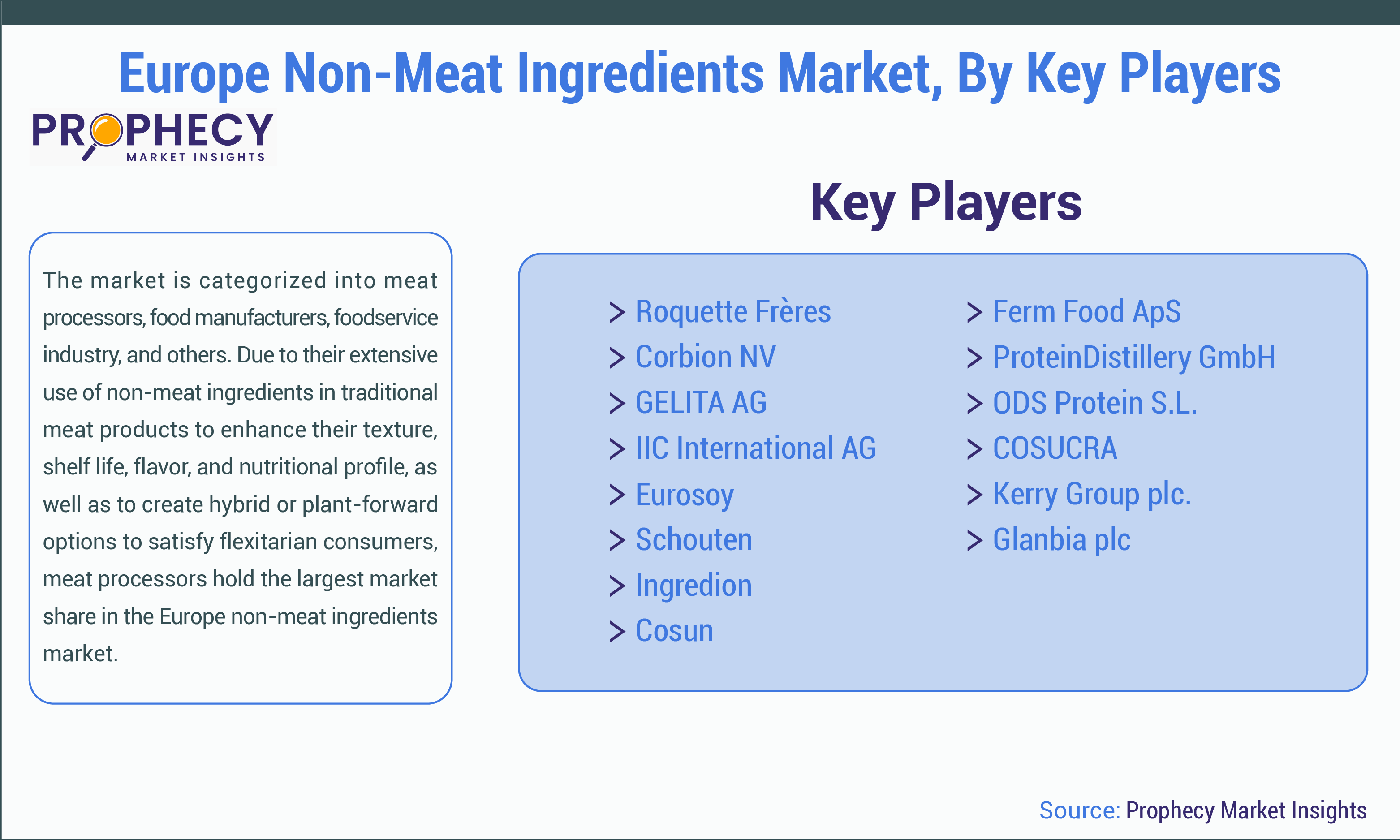
The key players operating in the Europe non-meat ingredients market include Corbion NV, Ferm Food ApS, Eurosoy, Schouten, and others. In order to appeal to flexitarian and vegan consumers, European non-meat ingredient firms are concentrating on research and development, local sourcing, sustainable manufacturing, AI-driven innovation, and strategic alliances. They are also selling clean-label, health-focused goods.
List of Key Players in the Market:
- Roquette Frères
- Corbion NV
- GELITA AG
- IIC International AG
- Eurosoy
- Schouten
- Ingredion
- Cosun
- Ferm Food ApS
- ProteinDistillery GmbH
- ODS Protein S.L.
- COSUCRA
- Kerry Group plc.
- Glanbia plc
Europe Non Meat Ingredients Market Recent News
- In June 2025, With the introduction of its new Taste of the World Burgers, a trio of internationally inspired goods that signal a change in the company's approach to meat substitutes, Schouten Europe is expanding its line of plant-based products. Three new burger variants were presented by the Dutch company: Thai, Italian, and Mexican. The business cites changing consumer tastes as the reason for the range's emphasis on unique gourmet flavor profiles rather than meat imitation.
- In April 2025, the leading international nutraceutical exhibition, Vitafoods Europe 2025, will feature IFF Pharma Solutions. SeaGel, VERDIGEL SC, GRINDSTED Pectin Premium, Ac-Di-Sol, Avicel, Accelerate, and METHOCEL are just a few of the unique and reliable brands that the team will be showcasing in hall 4 at booth 4F25 at the Fira Barcelona Gran Via on May 20–22.
Analyst View:
The Europe non-meat ingredients market is expanding rapidly due to growing environmental and animal welfare concerns, the popularity of plant-based and flexitarian diets, and increased health consciousness. In order to increase taste, texture, shelf life, and nutrition while promoting sustainable food systems, processed meat and substitute products use non-meat substances such soy protein, pea protein, starches, gums, and flavor enhancers.
The use of premium, natural ingredients is being encouraged by stringent EU rules and the desire for clean-label products. With robust research and development, regulatory support, and changing customer tastes for healthier, environmentally friendly food options, the industry is expected to gain from the quick innovation in plant proteins, mycoprotein, and new sources including insect and microbial proteins.
More Related Reports
Meat Substitute Market
Meat Market
Meat Ingredients Market
Clean Meat Market
Meat Processing Equipment Market
Europe Non Meat Ingredients Market Company Profile
|
Company Name |
Roquette Frères |
|
Headquarter |
Lestrem, France |
|
CEO |
Thierry Fournier |
|
Employee Count |
11,000 Employees |
FAQs
Europe non-meat ingredients market size was valued at USD 16.7 Billion in 2025 and is expected to reach USD 26.5 Billion by 2035 growing at a CAGR of 4.72%.
Product type, source, ingredient types, form, application, end user, and country are the segmentation for the Europe Non-Meat Ingredients Market.
The market is segmented by countries Germany, U.K., France, Russia, Italy, Spain, Netherlands, and Rest of Europe. Germany region is expected to dominate the Market.
The key players operating the Europe non-meat ingredients market include Roquette Frères, Corbion NV, GELITA AG, IIC International AG, EurosoySchouten, Ingredion, Cosun, Ferm Food ApS, ProteinDistillery GmbH, ODS Protein S.L., Inspire Fitness, COSUCRA, Kerry Group plc., and glanbia plc.