Cat Food Market Overview
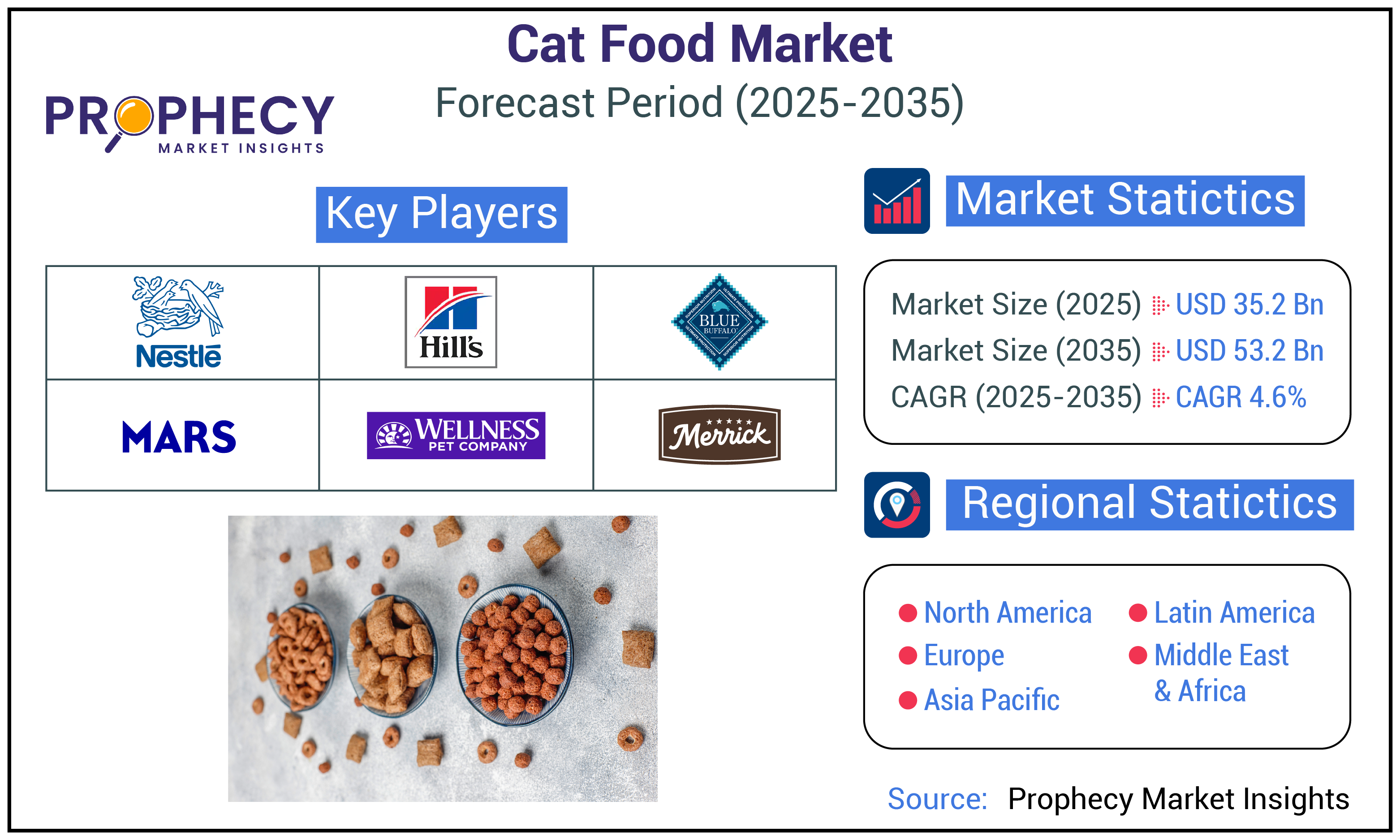
- By 2035, cat food market size is contemplated to enlarge at a valuation of USD 53.2 Billion.
- In 2024, the cat food market valuation was USD 33.9 Billion.
- Cat food market is developing at a CAGR of 4.6%.
Cat food is nutritionally prepared specifically to satisfy the dietary requirements of cats, offering vital proteins, lipids, vitamins, and minerals for their well-being. A cat's immune system is supported, skin and coat are kept healthy, strong muscles and bones are encouraged, and healthy digestion and energy levels are guaranteed. Cats that eat the right food will live longer, be happier, and be more active.
The cat food market continues to grow significantly as a result of numerous important causes. First off, the consumer base has grown due to the growing popularity of cats as pets, especially among Gen Z and millennials. Urban dwellers find cats intriguing due to their adaptability for apartment living and comparatively minimal care needs. The demand for specialty and high-end cat food items has increased as a result of the rise in cat ownership. Second, there is now more focus on pet nutrition and health due to the trend of pet humanization, which views pets as members of the family. Nowadays, pet owners are more inclined to spend money on premium, health-conscious cat food options.
Through 2035, the worldwide cat food market will grow significantly due to a number of important developments. Consumer behavior is still influenced by the humanization of pets, as pet owners increasingly regard cats such as members of the family and look for specialized, high-quality food. The demand for high-end products, such as grain-free, organic, and functional formulations catered to certain health requirements including weight management and urinary tract health, has increased as a result. Furthermore, technological developments are changing the market; subscription services and online shopping platforms are improving accessibility and convenience, while breakthroughs with AI-powered customized feeding solutions are becoming more popular. Additionally, consumers are becoming more concerned about sustainability, selecting companies that use ingredients that are obtained ethically and have eco-friendly packaging.
Recession Risk & Tariff Analysis:
- The cat food market is vulnerable to recessions since they may cause consumers to spend less on high-end pet supplies, which would raise demand for less expensive alternatives.
- Tariffs and trade restrictions imposed on imported products or packaging materials can also increase production costs, which may have an effect on supply chains and prices. Nonetheless, consistent pet ownership and rising pet humanization serve to protect the market from negative effects.
Impact of Generative AI on Cat Food Market:
- Personalized nutrition programs based on each cat's health information, preferences, and dietary requirements are made possible by generative AI, which is revolutionizing the cat food industry.
- It assists companies in creating creative recipes, streamlining supply chains, and boosting consumer interaction with chatbots and AI-driven marketing, all of which contribute to better product quality and happier customers.
Cat Food Market Drivers & Restraints
Key Drivers:
The Market is Maturing Progressively due to the Rising Adoption of Cats
The cat food market is mostly driven by the growing number of people who own cats as pets, which increases need for specialized nutrition products and broadens the consumer base. As more homes adopt cats, particularly in cities where they may fit in small places, pet owners are looking for easy, high-quality, and health-conscious cat food solutions to protect their pets' health. By stimulating innovation in product diversity, such as premium, organic, and customized diets, and increasing sales through both traditional and online retail channels, the expanding pet population propels market expansion.
- For Instance, according to the data published by Insurance Zebra, 28% of dogs and 31% of cats are adopted out of shelters each year. In 2023, people spent $147 billion on their pets. Approximately 4.1 million shelter animals are adopted each year (2 million dogs and 2.1 million cats).
Restraints:
Supply Chain Disruptions may Impedes the Market Development
Unexpected occurrences that disrupt the flow of raw materials, production, or distribution including pandemics, natural disasters, or geopolitical tensions cause supply chain disruptions, which can result in delays, higher expenses, and inventory shortages. This can have an effect on product availability and ingredient sourcing in the cat food industry, which can affect both producers and customers.
- Counterbalance Statements: Businesses can invest in local sourcing, diversify their supplier base, improve inventory management with real-time tracking, and implement flexible logistics solutions to reduce these risks. Enhancing resilience and guaranteeing a consistent supply of products can also be achieved by forming solid alliances and utilizing technology to increase supply chain visibility.
Opportunities & Trends:
The Rise of E-Commerce could be used to Investigate Future Market Prospects
One major trend influencing the cat food market going forward is the growth of e-commerce platforms, which give customers more accessibility, variety, and convenience. Pet owners can quickly compare products, access premium and niche brands, and schedule regular delivery when they order online, guaranteeing a consistent supply of cat food without having to visit stores frequently. This change also makes it possible for firms to employ data-driven marketing to tailor offerings and reach a larger, worldwide audience. E-commerce is anticipated to propel long-term industry expansion by improving customer experience and increasing purchase possibilities as digital penetration increases.
- For Instance, according to the data published by SellersCommerce, there are 2.77 billion global online shoppers. With over 33% of the world’s population shopping online, ecommerce is now a USD 6.8 trillion industry and will reach the USD 8 trillion mark by 2027. In 2025, 21% of retail purchases are expected to take place online, and this share will rise to 22.6% by 2027.
Cat Food Market Segmentations & Regional Insights
Product type, ingredients, price range, distribution channel, and region are the divisions of the cat food market.
By Product Type:
Dry food, wet/canned food, snacks/treats, frozen/raw food, freeze-dried/dehydrated, and others are product type on which cat food market is segmented Due to its cost-effectiveness, extended shelf life, and convenience, dry cat food has the biggest cat food market share and is a preferred option for busy pet owners and those looking for less expensive options. It is simple to serve and store, and by lowering plaque, it promotes tooth health.
The second most popular category is wet/canned cat food because it has a higher moisture content, a more enticing flavor, and better hydration all of which are particularly advantageous for cats with kidney or urinary problems.
By Ingredients:
Based on the ingredients, the cat food market is divided into animal-based, plant-based, grain-free, and others. Since cats are obligate carnivores and need high-quality animal proteins for optimum health, meat, chicken, and fish are crucial ingredients in the majority of cat food formulations, which explains why animal-based ingredients hold the biggest cat food market share.
Grain-free cat food is the second-largest category, driven by consumer demand for natural, allergy-free diets and increased knowledge of dietary sensitivities. Pet owners looking for specialized nutrition for their cats may find grain-free choices appealing as they frequently include alternative carbohydrate sources including potatoes or legumes.
By Price Range:
Low, medium, and high are price range of the cat food market. Due to its ability to mix affordability and quality, the medium price range has the biggest cat food market share. This is since it appeals to a wide spectrum of pet owners who desire wholesome goods without having to spend high rates.
The demand for premium, organic, grain-free, and specialty diets is rising, and pet owners are becoming more ready to spend money on higher-quality, frequently natural or functional items for their pets' health and well-being, which is driving the second-largest market sector.
By Distribution Channel:
Offline, and online retail are distribution channel of the cat food market. Since many customers still choose to buy from traditional pet stores, supermarkets, and veterinary clinics as they value quick product availability and in-person assistance from store employees, offline retail has the biggest cat food market share.
Due to its convenience, greater selection of products, competitive price, and subscription services, online retail is the second largest and fastest-growing channel. These factors draw in tech-savvy customers who want hassle-free shopping and doorstep delivery.
Regional Insights:
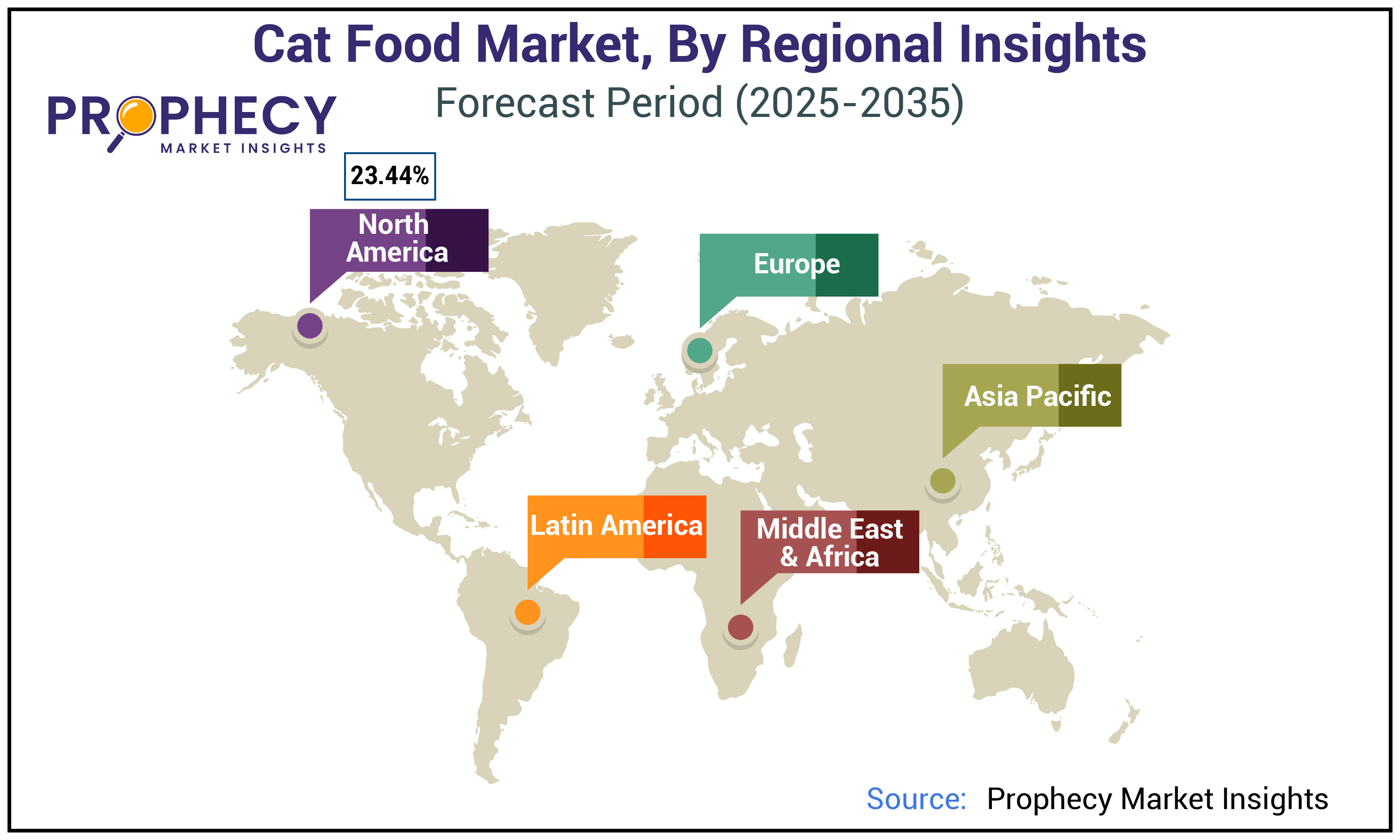
Geographically, the cat food market is studied across North America, Europe, Asia Pacific, Latin America, and the Middle East & Africa.
North America: Due to high pet ownership rates, significant pet humanization trends, and a general consumer willingness to spend money on specialized and high-end pet nutrition, North America currently has the largest proportion of the cat food market size. Additionally, the area benefits from sophisticated retail infrastructure, which includes both vast offline networks and quickly expanding e-commerce platforms.
- U.S. Cat Food Market Insights:
The high percentage of pet owners, high levels of consumer buying power, and a well-established pet food sector with several high-end and cutting-edge brands are the reasons why the U.S. leads the cat food market growth. Furthermore, American customers' strong emphasis on pet nutrition and health is fueling the market for specialty and high-end cat food products.
Europe: Similar causes, including rising pet adoption, increased pet health awareness, and a strong desire for natural and organic cat food products, along with stringent regulations that promote better standards for product quality and safety, have made Europe the second-largest market.
- Germany Cat Food Market Insights:
Germany is the market leader in Europe due to its sizable pet population, the growing trend of pet humanization, and stringent regulations that promote the production of safe and high-quality pet food. Additionally, German customers have a strong preference for natural and organic cat food, which is driving market expansion.
Asia Pacific: Growing urbanization, rising disposable incomes, and a trend toward pet humanization are the main drivers of the Asia-Pacific cat food market's notable expansion. The demand for specialty and high-end cat food items is rising as more people in the area keep cats as pets. The growth of e-commerce platforms, which offer easy access to a variety of cat food options, supports this tendency.
- China Cat Food Market Insights:
In the cat food market, China is clearly the market leader. China's urban cat population, which topped 78.5 million in 2022, and the country's expanding middle class with rising disposable incomes are to blame for this supremacy. China is now a major player in the Asia-Pacific cat food market because to the trend of pet humanization in cities, which has increased demand for high-end cat food products.
Cat Food Market Report Scope:
|
Attribute |
Details |
|
Market Size 2025 |
USD 35.2 Billion |
|
Projected Market Size 2035 |
USD 53.2 Billion |
|
CAGR Growth Rate |
4.6% (2025-2035) |
|
Base year for estimation |
2024 |
|
Forecast period |
2025 – 2035 |
|
Market representation |
Revenue in USD Billion & CAGR from 2025 to 2035 |
|
Regional scope |
North America - U.S. and Canada Europe – Germany, U.K., France, Russia, Italy, Spain, Netherlands, and Rest of Europe Asia Pacific – China, India, Japan, Australia, Indonesia, Malaysia, South Korea, and Rest of Asia-Pacific Latin America - Brazil, Mexico, Argentina, and Rest of Latin America Middle East & Africa – GCC, Israel, South Africa, and Rest of Middle East & Africa |
|
Report coverage |
Revenue forecast, company share, competitive landscape, growth factors, and trends |
Segmentation:
By Product Type:
- Dry Food
- Wet/Canned Food
- Snacks/Treats
- Frozen/Raw Food
- Freeze-Dried/Dehydrated
- Others
By Ingredients:
- Animal-based
- Plant-based
- Grain-Free
- Others
By Price Range:
- Low
- Medium
- High
By Distribution Channel:
- Offline
- Online Retail
By Region:
- North America
- U.S.
- Canada
- Europe
- Germany
- U.K.
- France
- Russia
- Italy
- Spain
- Netherlands
- Rest of Europe
- Asia Pacific
- China
- India
- Japan
- Australia
- Indonesia
- Malaysia
- South Korea
- Rest of Asia Pacific
- Latin America
- Brazil
- Mexico
- Argentina
- Rest of Latin America
- Middle East & Africa
- GCC
- Israel
- South Africa
- Rest of Middle East & Africa
Cat Food Market Competitive Landscape & Key Players
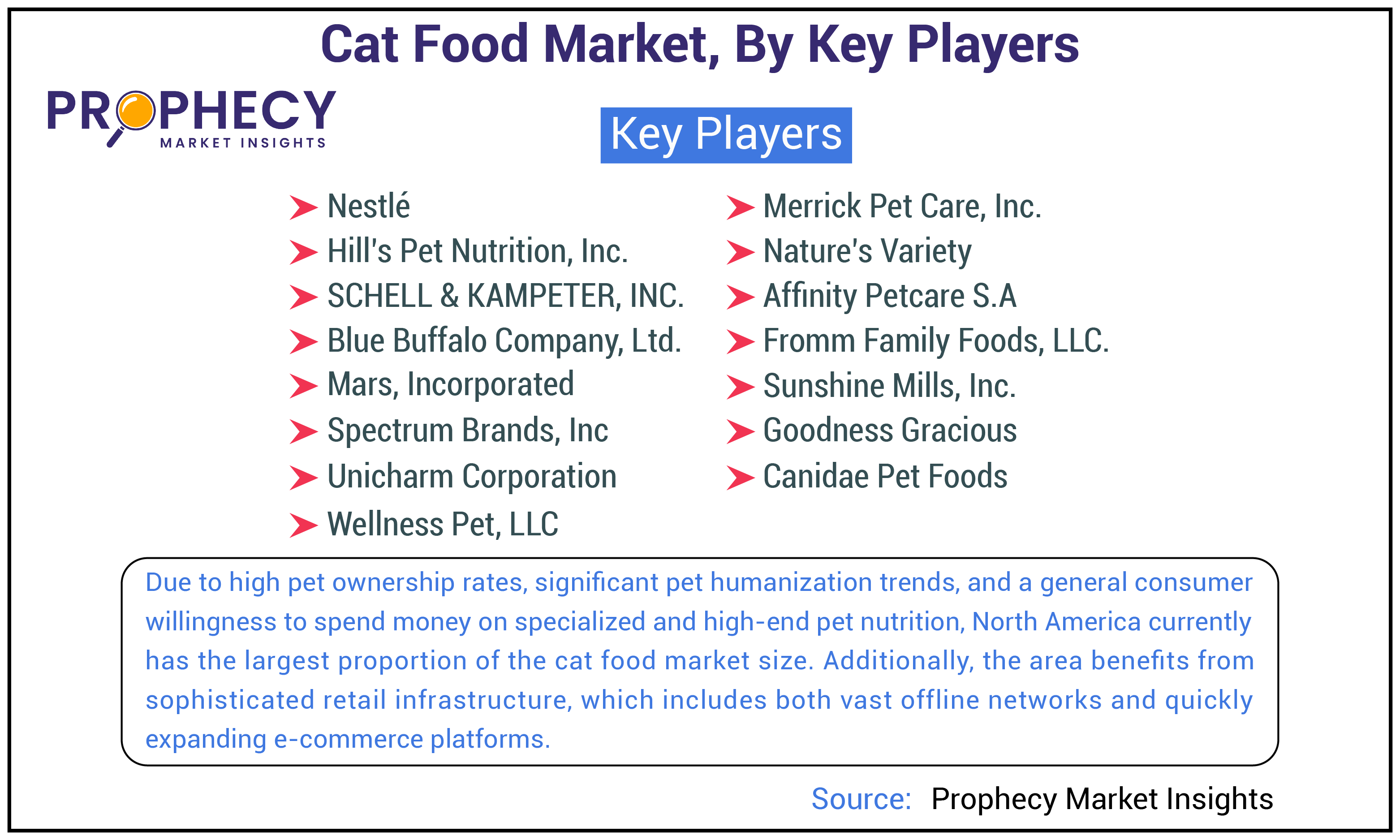
In order to satisfy changing consumer demands, cat food firms should concentrate on product innovation by creating premium, health-conscious, and specialist diets. Customer reach and engagement can be improved by utilizing digital marketing and growing your e-commerce presence. The key players operating in the cat food market include, Nestlé, Hill’s Pet Nutrition, Inc., Unicharm Corporation, VERRA, Mars, Incorporated, and others.
Cat Food Market Companies:
- Nestlé
- Hill’s Pet Nutrition, Inc.
- SCHELL & KAMPETER, INC.
- Blue Buffalo Company, Ltd.
- Mars, Incorporated
- Spectrum Brands, Inc
- Unicharm Corporation
- Wellness Pet, LLC
- Merrick Pet Care, Inc.
- Nature’s Variety
- Affinity Petcare S.A
- Fromm Family Foods, LLC.
- Sunshine Mills, Inc.
- Goodness Gracious
- Canidae Pet Foods
View an Additional List of Companies in the Cat Food Market
Cat Food Market Recent News
- In March 2025, the introduction of its cat food brand marks the entry of Avanti Pet Care, a division of Avanti Feeds, one of the biggest aquaculture businesses in India, into the pet market. The first product to be introduced is the Avant Furst line of cat food. By the end of 2025, the company intends to add dry, wet, and treat forms of cat and dog food to its lineup.
- In February 2025, as part of its strategy to focus on "fewer, bigger, and better" innovations for greater business impact, Nestlé Purina PetCare is expanding its cutting-edge pyramid-shaped wet cat food in both Europe and the US. Under the Purina Gourmet Revelations brand, a new version of the product will be introduced in 15 European areas. It is composed of a clear jelly with delicately chopped salmon, chicken, or white fish. In 2026, additional rollouts are planned in order to achieve scale and spur growth.
Analyst View:
The cat food market is growing quickly due to an increase in cat ownership, particularly among younger urban consumers who consider their pets to be members of the family. This has raised demand for premium, health-focused products that support overall feline well-being. The market is changing because to trends including environmentalism, pet humanization, and technical advancements notably AI-powered customized diets and the expansion of e-commerce. Customers are increasingly looking for cat food that is of a high caliber, useful, and ethically manufactured, setting up the industry for sustained robust growth through 2035.
More Related Reports
Ethnic Food Market
Food Fiber Market
Food Safety Testing Market
Baby Food Market
Food Waste Disposers Market
Cat Food Market Company Profile
|
Company Name |
Nestlé |
|
Headquarter |
Vevey, Switzerland |
|
CEO |
Laurent Freixe |
|
Employee Count |
277,000 Employees |
Cat Food Market Highlights
FAQs
Cat food market size was valued at USD 35.2 Billion in 2025 and is expected to reach USD 53.2 Billion by 2035 growing at a CAGR of 4.6%.
Product type, ingredients, price range, distribution channel, and region are the segmentation for the target market.
North America, Asia Pacific, Europe, Latin America, and the Middle East & Africa. North America is expected to dominate the market.
The key players operating the cat food market include Nestlé, Hill’s Pet Nutrition, Inc., SCHELL & KAMPETER, INC., Blue Buffalo Company, Ltd., Mars, Incorporated, Spectrum Brands, Inc, Unicharm Corporation, Wellness Pet, LLC, Merrick Pet Care, Inc., Nature’s Variety, Affinity Petcare S.A, Fromm Family Foods, LLC., Sunshine Mills, Inc., Goodness Gracious, and Canidae Pet Foods.