Autonomous Ai Agents Market Overview
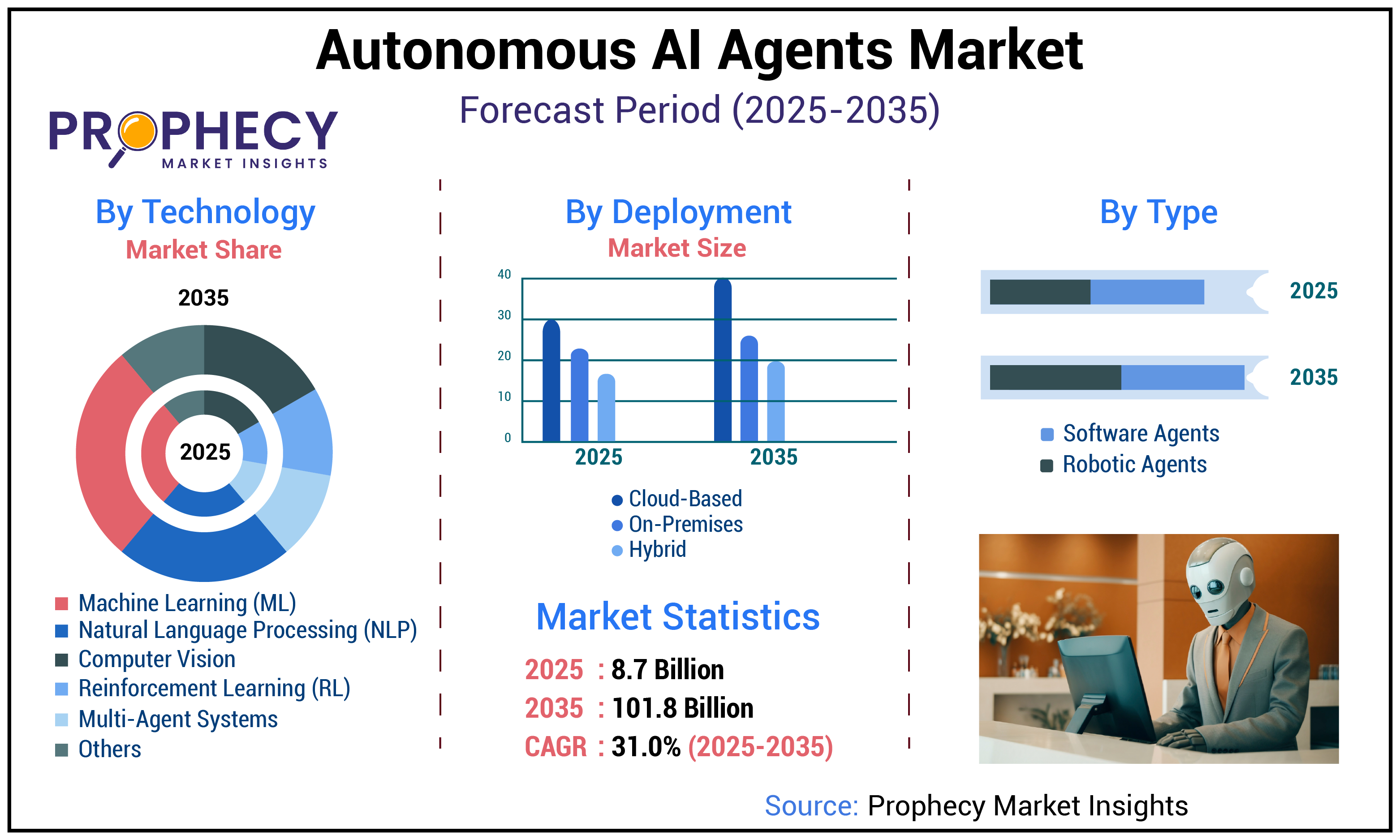
- 2024 Market Size: USD 6.9 Billion
- 2035 Projected Market Size: USD 101.8 Billion
- CAGR (2025-2035): 31.0%
- North America: Largest Market in 2024
Autonomous Al agents are self-guided machines capable of understanding their surroundings, choosing, and doing something to reach certain goals without the constant presence of a human being. They use machine learning, natural language processing, and logical thinking to change, obtain knowledge, and get better with time. The primary advantages are greater productivity, simplification of challenging operations through automation, reduction in the amount of work performed by humans, quicker decision-making, savings, and the possibility of round-the-clock operation besides being able to adjust to changing conditions across sectors such as healthcare, financial services, transportation, and customer support.
One of the biggest factors that have been steering the autonomous Al agents market is the increasing requirement from the different application sectors for process automation, faster decision making, and cost-saving. The use of these agents has become a necessity for companies as they are the main drivers of customer loyalty through personalized engagements, improving productivity, and also decreasing the incidence of human mistakes. Developments in generative Al, natural language processing, and machine learning are not only sustaining but also attracting innovation, whereas the rise in digital transformation, remote operations, and data-driven decision-making is spreading adoption at an international level.
Key Statistics of AI Agent in Various Industries:
- 78% of organizations are already using AI in some form, and 85% have adopted agents in at least one workflow.
- 58% of organizations use AI agents for summarizing emails, documents, and meetings.
- 64% apply AI agents for automating repetitive business workflows, such as follow-ups, updates, and internal reports.
- 44% of consumers say they would prefer interacting with AI for simple service tasks, like bookings or tracking.
- 70% of airline bookings through digital channels are now influenced or executed by AI assistants, especially chat-based agents.
- 27% of users review AI-generated output before taking action, showing a shift toward agent-assisted, not agent-led, and decision-making.
Current Industry Dynamics & Insights:
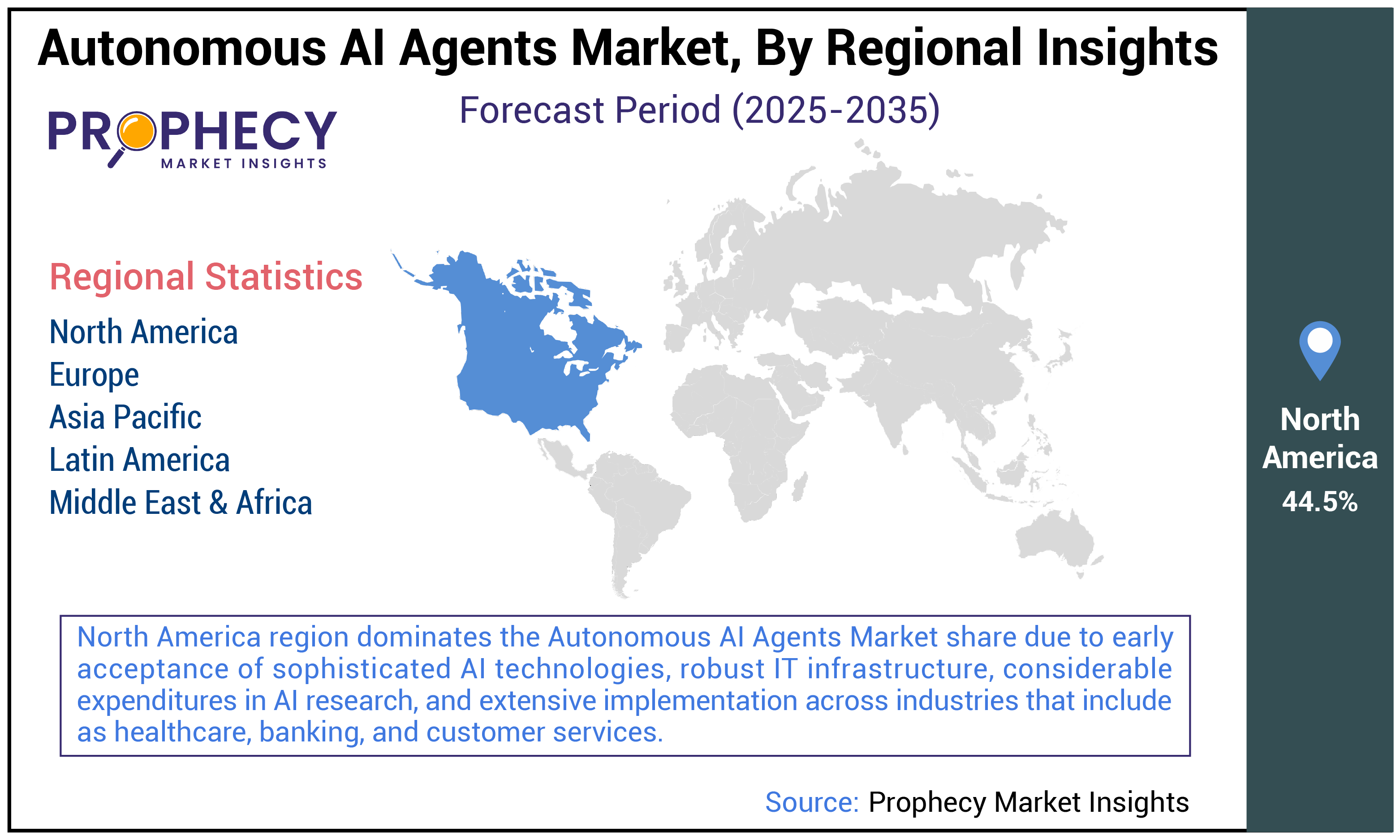
- North America has the largest regional share in the market, with almost 44.5%.
- Europe is second dominating region in the market.
- By Type, software agents dominate the autonomous AI agents market growth.
Autonomous Ai Agents Market Drivers & Restraints
Drivers and Restraints:
|
Drivers |
Restraints |
Opportunities & Trends |
|
|
|
Key Drivers:
Digitalization
One of the main factors that contribute to the increase in the autonomous Al agents market growth is the digitization, as it provides a huge amount of data in real-time, allows the creation of interconnected systems and speeds up the need for smart automation. As companies are moving towards digital platforms, Al agents are capable of completing various tasks such as data analysis, workflow automation and customer's personalization on a large scale without any difficulty. Such evolution upgrades capabilities to work with less wastage and time consumption as well keeps distant and virtual activities on track efficiently and finally facilitates quick and efficient decision making which rely on data hence such self-reliant Al agents are becoming more and more vital within the digital economy that places the emphasis on the use of technologies.
- For Instance, according to article published by World Bank Group, in 2022, more than 90 percent of people in high-income countries were online, compared to 26 percent in low-income countries. Among low- and middle-income countries, Europe and Central Asia region has the highest internet penetration at 84 percent. The online population in South Asia doubled from 2018 to 2020, largely driven by India, which has brought one-third of its population online since 2018.
Restraints:
Limited Human Trust in Fully Autonomous Systems
The market potential for fully autonomous systems might be restricted due to the limited trust held by humans in these systems. Consequently, organizations as well as end-users might be reluctant to handing over control to Al for important decisions or activities because they fear mistakes, unpredictability, or insufficient transparency.
- Counterbalance Statements: This problem is solvable with the use of explainable AI (XAI) methods, thorough validation procedures, and human-in-the-loop systems, which enable human control and understanding of Al reasoning, thus enabling trust, utilization, and the safe deployment of self-governing Al agents in different sectors.
Opportunities & Trends:
Expansion of AI Agents in Virtual Assistants, Chatbots, and Enterprise Automation
Al agents becoming more prevalent in virtual assistants, chatbots, and enterprise automation is a main trend that lies in the future of the Autonomous Al Agents market. The reason why these Al-powered tools would be in such demand is that they deliver smart, scalable, and customized solutions that would allow the businesses to meet their clients' need, simplify their workflow and raise their efficiency.
Improvements in natural language processing, machine learning, and context-aware Al will not only keep these agents more competent to undertake challenging tasks but will also allow them to be used in many different sectors and so, having a positive impact on the market.
Autonomous Ai Agents Market Segmentations & Regional Insights
Type, technology, deployment, end user, and region are the divisions of the autonomous AI agents market.
By Type:
Software agents, and robotic agents are type on which autonomous AI agents market is segmented. Software agents currently dominate the autonomous AI agents market share due to their widespread adoption in IT, finance, customer service, and enterprise automation, where they efficiently handle data analysis, task automation, and virtual interactions without the need for physical hardware.
Robotic agents are the second most popular segment, driven by their increasing use in manufacturing, logistics, healthcare, and service robotics, where physical interaction with the environment is required for tasks such as material handling, surgery assistance, and delivery, thereby improving operational efficiency and productivity.
- In June 2025, Accenture has announced the availability of its AI Refinery distiller agentic framework and supporting software development kits (SDKs), which provide developers with an enterprise-grade platform for quickly building, deploying, and scaling sophisticated AI agents. The distiller framework covers the whole agent lifecycle, including agent memory management, multi-agent cooperation, agentic workflow management, model customization and assessment, governance and observability, and cross-platform interoperability.
By Technology:
Based on the technology, the autonomous AI agents market is divided into machine learning (ML), natural language processing (NLP), computer vision, reinforcement learning (RL), Multi-agent systems, and others. Machine learning (ML) dominates the autonomous AI agents market size as it serves as the foundation for AI decision-making, allowing agents to learn from data, improve performance over time, and tackle difficult tasks in areas such as finance, healthcare, and corporate automation.
Natural language processing (NLP) is the second most dominant technology, powering intelligent communication, chatbots, and virtual assistants. It enables AI agents to effectively understand, interpret, and respond to human language, which is critical for customer engagement and service automation.
By Deployment:
Cloud-based, on-premises, and hybrid are deployment of the autonomous AI agents market. Cloud-based deployment dominates the autonomous AI agents market share due to its scalability, cost-effectiveness, and ease of use, allowing enterprises to install AI agents without incurring significant infrastructure costs while enabling real-time data processing and remote operations.
On-premises deployment is the second most popular, preferred by companies with stringent data security, privacy, and regulatory requirements since it enables complete control over sensitive information and AI operations, making it appropriate for sectors such as banking, healthcare, and government.
By End User:
The autonomous AI agents market on the account of end user is categorized into customer support & engagement, healthcare & medical assistance, finance & banking, retail & e-commerce, industrial automation & manufacturing, and others. Customer assistance & Engagement dominates the Autonomous AI Agents market share, as organizations increasingly rely on AI agents such as chatbots and virtual assistants to provide 24/7 assistance, improve customer experiences, and decrease operational costs across sectors.
Healthcare & Medical Assistance is the second most popular end-user, driven by the need for AI agents to help with patient monitoring, diagnostics, virtual consultations, and administrative duties, hence enhancing efficiency and accuracy in a sector with a high need for prompt and exact services.
Regional Insights:
Geographically, the autonomous AI agents market is studied across North America, Europe, Asia Pacific, Latin America, and the Middle East & Africa.
North America: This region dominates the autonomous AI agents market share due to early acceptance of sophisticated AI technologies, robust IT infrastructure, considerable expenditures in AI research, and extensive implementation across industries that include as healthcare, banking, and customer services.
- U.S. autonomous AI agents market Insights:
North America's autonomous AI agents market is dominated by the U.S. as to its leadership in AI research and development, presence of major tech firms, strong IT infrastructure, and fast adoption of AI across industries such as healthcare, banking, and customer service.
Europe: This is the second most dominant region, driven by expanding digital transformation initiatives, supportive government policies, and increased use of AI agents in enterprise automation, industrial applications, and customer engagement, as well as a strong emphasis on regulatory compliance and ethical AI deployment.
- Germany autonomous AI agents market Insights:
Germany is Europe's top country, owing to its strong industrial and manufacturing foundation, major investment in AI and automation technology, and government programs pushing digital transformation and AI integration across corporate and industrial applications.
Asia Pacific: The autonomous AI agents market in Asia Pacific is expanding as a result of fast digitization, increased use of AI-driven automation in industries such as manufacturing, healthcare, and e-commerce, and increased expenditures in AI research and infrastructure.
- China autonomous AI agents market Insights:
China dominates the market in this area, due to its big technology industry, government backing for AI research, widespread data availability, and significant emphasis on integrating AI agents into business automation, smart cities, and customer service apps.
Autonomous AI Agents Market Report Scope:
|
Attribute |
Details |
|
Market Size 2025 |
USD 8.7 Billion |
|
Projected Market Size 2035 |
USD 101.8 Billion |
|
CAGR Growth Rate |
31.0% (2025-2035) |
|
Base year for estimation |
2024 |
|
Forecast period |
2025 – 2035 |
|
Market representation |
Revenue in USD Billion & CAGR from 2025 to 2035 |
|
Regional scope |
North America - U.S. and Canada Europe – Germany, U.K., France, Russia, Italy, Spain, Netherlands, and Rest of Europe Asia Pacific – China, India, Japan, Australia, Indonesia, Malaysia, South Korea, and Rest of Asia-Pacific Latin America - Brazil, Mexico, Argentina, and Rest of Latin America Middle East & Africa – GCC, Israel, South Africa, and Rest of Middle East & Africa |
|
Company Landscape |
Market Share Analysis of Companies Heat Map Analysis Company Overview, Products Overview Financial Information, Key Highlights Business Strategies Overview SWOT Analysis |
|
Report coverage |
Revenue forecast, company share, competitive landscape, growth factors, and trends |
|
Value Added Data Infosets |
Besides fundamental market insights such as the size of the market, growth rate, segmentation, regional study, and key players, our reports carry value-added data sets such as trade flow (import-export) analysis, production and consumption overview, price trend evaluation, supply and value chain mapping, and raw material availability. Moreover, we provide strategic tools as PESTLE and Porter’s Five Forces analysis, examination of the regulatory landscape, as well as monitoring of technology and innovation thereby providing a comprehensive overview which facilitates sensible and anticipatory decision-making. |
Segmentation:
By Type:
- Software Agents
- Virtual Assistants
- Chatbots
- Others
- Robotic Agents
- Service Robots
- Industrial Robots
- Others
By Technology:
- Machine Learning (ML)
- Natural Language Processing (NLP)
- Computer Vision
- Reinforcement Learning (RL)
- Multi-Agent Systems
- Others
By Deployment:
- Cloud-Based
- On-Premises
- Hybrid
By End User:
- Customer Support & Engagement
- Healthcare & Medical Assistance
- Finance & Banking
- Retail & E-Commerce
- Industrial Automation & Manufacturing
- Others
By Region:
- North America
- U.S.
- Canada
- Europe
- Germany
- U.K.
- France
- Russia
- Italy
- Spain
- Netherlands
- Rest of Europe
- Asia Pacific
- China
- India
- Japan
- Australia
- Indonesia
- Malaysia
- South Korea
- Rest of Asia Pacific
- Latin America
- Brazil
- Mexico
- Argentina
- Rest of Latin America
- Middle East & Africa
- GCC
- Israel
- South Africa
- Rest of Middle East & Africa
Autonomous Ai Agents Market Competitive Landscape & Key Players
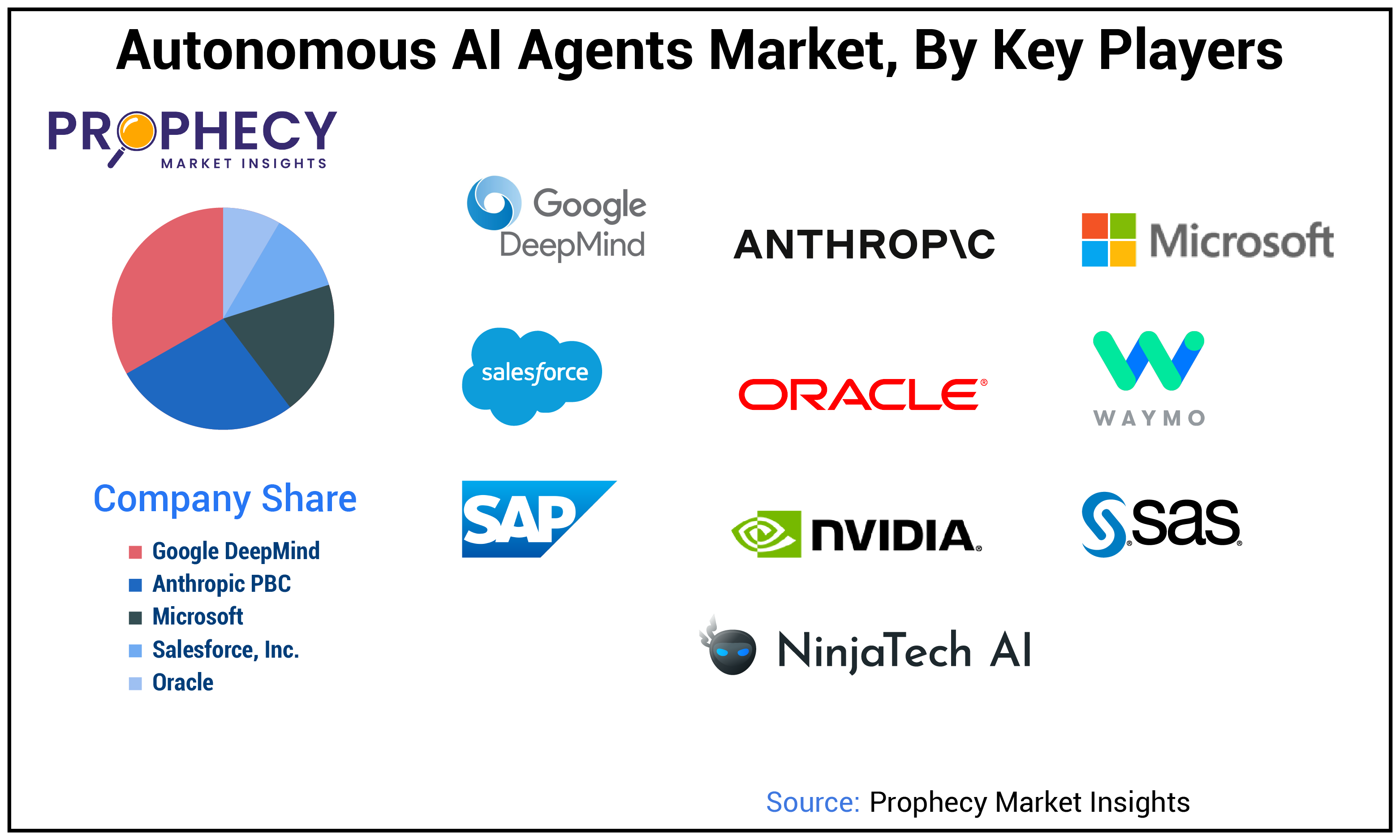
The key players operating in the autonomous AI agents market include, Anthropic PBC, SAP SE, Salesforce, Inc., and others. Autonomous AI Agents firms may flourish by improving AI technology, expanding into high-demand areas, creating strategic collaborations, utilizing cloud deployment, and assuring safe, ethical adoption through explainable AI and human-in-the-loop systems.
Autonomous AI Agents Market Companies:
- Google DeepMind
- Anthropic PBC
- Microsoft
- Salesforce, Inc.
- Oracle
- Waymo LLC
- SAP SE
- SAS Institute Inc.
- NVIDIA Corporation
- NinjaTech AI
- PlayOS, Inc.
- Softude
- Dealroom.co B.V.
View an Additional List of Companies in the Autonomous AI Agents Market
Autonomous Ai Agents Market Recent News
- In June 2025, H business, a major European AI research and product business supported by USD 220 million from tier-one investors, has announced the public debut of their autonomous AI agent platform, which includes three specialized agents designed to do complicated digital tasks with a human in the loop.
- In September 2024, Salesforce and NVIDIA have launched a cooperation to create advanced AI capabilities for enterprises, including autonomous agents. This collaboration focuses on integrating NVIDIA's AI platform with Salesforce's Agentforce, establishing an environment for billions of Agentforce to be deployed in the future years.
- In October 2024, starting next month, Microsoft will let firms to create their own autonomous AI agents, competing with Salesforce's customizable tools announced in September. AI agents can function as virtual workers, carrying out a variety of duties without supervision.
Analyst View:
Autonomous AI agents are self-directed systems that employ machine learning, natural language processing, and reasoning to complete tasks, learn, and adapt without requiring ongoing human interaction. They increase efficiency, automate difficult operations, decrease human burden, allow for speedier decision-making, and run 24/7 in industries such as healthcare, banking, transportation, and customer service. Rising demand for automation, personalized customer interaction, cost savings, and AI technical developments, together with a worldwide movement toward digital transformation, remote operations, and data-driven decision-making, are driving market expansion.
Analysis of Sources:
Primary Sources:
- In-depth interviews
- Company-specific data
- Surveys and questionnaires
- Focus group discussions (FGDs)
- Others
Secondary Sources:
- MDPI
- PubMed Central (PMC)
- Others
More Related Reports
Autonomous Ships Market
Autonomous Cars Market
Autonomous Vehicle Market
Autonomous Underwater Vehicle Market
Autonomous Delivery Vehicle Market
Autonomous Ai Agents Market Company Profile
|
Company Name |
Product Portfolio |
|
Google DeepMind |
Generalist AI Agent for 3D Virtual Environments |
|
Anthropic PBC |
Effective AI Agents |
|
Oracle |
AI Agent Platform |
|
SAS Institute Inc. |
Agentic AI |
|
NVIDIA Corporation |
Generative AI-Powered Video Analytics AI Agents |
Autonomous Ai Agents Market Highlights
FAQs
Autonomous AI agents market size was valued at USD 8.7 Billion in 2025 and is expected to reach USD 101.8 Billion by 2035 growing at a CAGR of 31.0%.
Type, technology, deployment, end user, and region are the segmentation for the Autonomous AI Agents Market.
Increasing demand for automation, faster decision-making, and cost efficiency across industries, and so on are some of the autonomous AI agents market growth drivers.
North America, Asia Pacific, Europe, Latin America, and the Middle East & Africa. North America is expected to dominate the autonomous AI agents Market.
The key players operating the autonomous AI agents market include Google DeepMind, Anthropic PBC, Microsoft, Salesforce, Inc., Oracle, Waymo LLC, SAP SE, SAS Institute Inc., NVIDIA Corporation, NinjaTech AI, PlayOS, Inc., Softude, and Dealroom.co B.V.