Ai Chatbot Market Overview
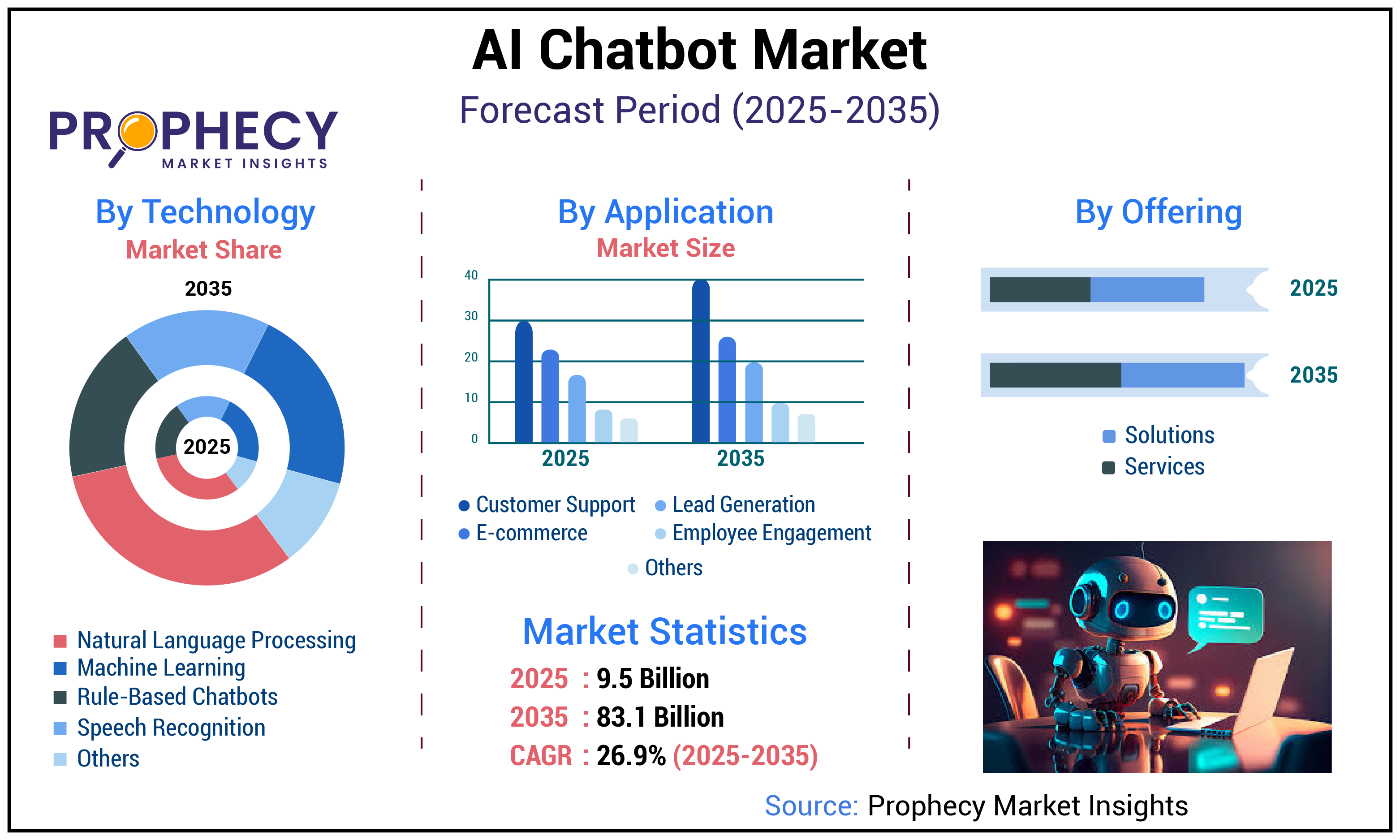
- By 2035, the AI chatbot market size is contemplated to dominate at a valuation of USD 83.1 Billion.
- In 2024, the AI chatbot market was estimated 6.4 billion globally.
- In 2025, the AI chatbot market valuation was USD 9.5 Billion.
- AI chatbot market is developing at a CAGR of 26.9%.
An Al chatbot uses artificial intelligence to mimic conversations that are similar to those of a human either by text or voice. It helps in customer service, delivering information, simplifying tasks, and increasing user participation on websites, applications, and chat services.
The expanding Al chatbot market is fueled by a soaring need for customer support around the clock, faster progress in language understanding (NLP) and machine learning, and growing use of messaging platforms for business chat. Businesses are using Al chatbots to lower their operational costs, make response times quicker, and create user experiences that are personalized. Also, the use of voice assistants and chatbots that can speak many languages is helping the chatbots to be used in more places.
The Al chatbot market is undergoing significant changes, and several key trends can be observed. One of the major trends is the transition towards more human-like conversational capabilities through the use of advanced Natural Language Processing (NLP) models. Another trend is the adoption of generative Al, which allows for context-aware and personalized responses. Additionally, voice-enabled chatbots are becoming more popular as they offer the convenience of hands-free interactions.
Key Indicators:
- For instance, the U.S. General Services Administration (GSA) has included OpenAI’s ChatGPT Enterprise into its Multiple Award Schedule (MAS) so federal agencies can use it for free during the first year. The initiative supports the AI Action Plan while working to simplify agency operations together with public service delivery.
Impact of AI Chatbot Market:
- The terms chatbot and AI represent distinct yet related concepts because chatbots function as conversation-simulating applications whereas AI represents the entire domain of technological systems for learning and decision-making. Traditional chatbots function based on predetermined scripts and rules, which limit their adaptability. On the other hand, Al chatbots utilize NLP, machine learning, and context awareness to provide more versatile, conversational, and human-like dialogues.
- Basically, Al is the technology that allows simple chatbots to change into smart virtual assistants which are able to understand what the user wants, remember what was talked about before, and give unique responses that are related to the situation.
Ai Chatbot Market Drivers & Restraints
Key Drivers:
Messaging Platform Integration Accelerates Global Chatbot Adoption
The adoption of messaging platforms has pushed chatbot usage forward since businesses link them to popular communication channels such as Facebook Messenger, WhatsApp and Slack to reach customers who use these platforms regularly. The integration provides users with a smooth and recognizable interface when interacting with brands. It also removes the requirement to download different applications or go through complicated websites.
- For instance, several top Al companies such as OpenAl, Anthropic, and Google are giving their chatbot models, such as ChatGPT, Claude, and Gemini, to the U.S. government departments for one dollar per agency for one year. The move cuts the cost of Al-driven communication substantially, making it easier for government agencies to use sophisticated messaging tools.
Restraints:
Virtual Assistants Face Security and Conversational Limitations
Organizations integrate virtual assistants such as bots into various business units primarily to enhance marketing engagement, grow brand awareness, offer customer support, and deliver end-to-end solutions. But, along with facilitating numerous advantages to users, these services are also limited in the market. The limitations of these markets include breaches in security and conversational gaps such as misunderstanding requests, performing the wrong actions, and struggling to recognize and understand user's accents.
- Counterbalance Statements: Virtual assistants encounter obstacles through security risks and communication misinterpretations yet ongoing developments in AI technology and natural language processing and voice recognition progressively solve these problems.
Opportunities & Trends:
Tech Giants Advance Cloud-Based Conversational Bots
Leading companies like IBM Corporation, Unibot, Google Inc., and several others are concentrating their efforts on creating conversational bots. These conversational bots are powered by a cloud-based natural language processing (NLP) engine. Conversational bots help users to communicate with online web services using interactive text, live chat, audio, graphics, and task modules. These end-users are primarily interested in implementing sophisticated cloud-based conversational bot solutions in their businesses to enhance their productivity.
Ai Chatbot Market Segmentations & Regional Insights
Offering, technology, deployment type, application and End-Use Industry are the divisions of the AI chatbot market.
By Offering:
The market is segmented with offering, solutions and services. In the Al chatbot market share, solutions lead the offering segment. This is due to the capacity of these systems to meet the types of inquiries expected while the conversation is progressing with advanced, customizable platforms that integrate natural language processing, machine learning capabilities.
The services segment is the second largest contributor to the Al chatbot market share. This is mainly due to the high demand for continuous customization, integration support, maintenance, and training. Multiple organizations use service providers to optimize chatbot efficiency while maintaining process alignment and providing ongoing updates which makes services vital for chatbot solutions.
By Technology:
The AI chatbot market is separated into several segments based on technology that includes natural language processing, machine learning, rule-based chatbots, speech recognition and others. Natural Language Processing (NLP) serves as the leading technology in AI chatbot market size as it allows these systems to comprehend human language while delivering precise responses that understand context.
The second most important technology in the AI chatbot market growth is machine learning as it enables chatbots to learn through user interactions while enhancing response precision and adjusting to changing customer requirements. Its pattern recognition, intent prediction, and conversation personalization capabilities make it the primary factor for the sophisticated, smart chatbot performance.
By Deployment:
The cloud-based and on-premises are the given deployment segments for AI chatbot market. The market for AI chatbots mainly operates through cloud deployment as it provides scalable solutions at low costs and seamless integration with multiple digital platforms. Businesses select cloud solutions because they provide adaptable systems which can be accessed remotely while enabling continuous updates and AI model improvements without substantial infrastructure costs.
Organizations that need maximum control over their infrastructure along with data security and regulatory compliance select on-premises deployment as their second most popular option in the AI chatbot market. The banking sector along with healthcare organizations and government entities heavily rely on this deployment method because their sensitive data demands rigorous internal control.
By Application:
The AI chatbot market is divided into segments given as customer support, e-commerce, lead generation, employee engagement and others. Customer support is the leading use case for the Al chatbot market share. Businesses are progressively implementing chatbots to deliver round-the-clock support, facilitate immediate query resolution, and manage large numbers of interactions without tiring their staff.
The e-commerce industry is the second largest user of Al chatbots. This is largely due to the increasing reliance on chatbots to get recommendations on products, track orders, receive personalized deals, and get help with purchases. Their capacity to involve customers instantaneously and simplify the shopping process has rendered them an essential instrument to elevate the turnover and loyalty of e-commerce.
By End-Use Industry:
The AI chatbot market end-use industry’s include banking, retail, healthcare, telecommunications and others. The retail sector is the dominant segment in the end-use industry. The AI chatbot market primarily serves retail companies which use chatbots to improve their customer interactions while offering customized shopping experiences and resolving customer questions to boost their sales on digital and physical platforms.
The banking sector represents the second largest segment of end-users within the AI chatbot market because financial institutions utilize chatbots to answer account questions while conducting transactions and offering customized financial guidance along with improved fraud detection.
Regional Insights:
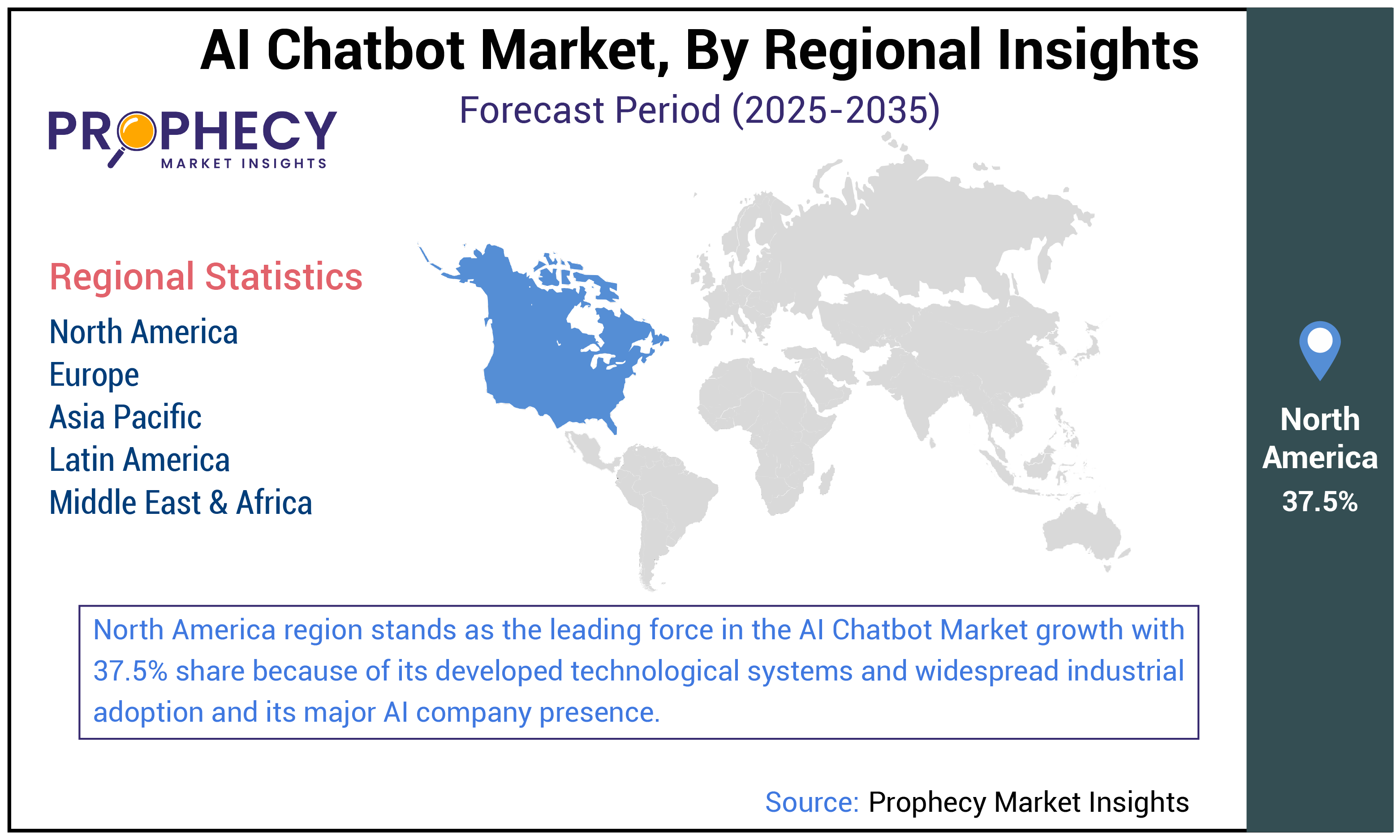
Geographically, the AI chatbot market is studied across North America, Europe, Asia Pacific, Latin America, and the Middle East & Africa.
North America: This region stands as the leading force in the AI chatbot market growth with 37.5% share because of its developed technological systems and widespread industrial adoption and its major AI company presence. The region concentrating on client experience innovation and implementing Al in business at an early stage has not only facilitated the market growth but also given it a higher pace.
- U.S. AI Chatbot Market Insights:
The U.S. leads the AI chatbot market as the leading nation because of its robust network of AI developers and substantial funding for conversational AI research and extensive implementation in retail and banking and healthcare and technology sectors. Its leadership in revolutionary ideas, the first use of advanced natural language processing and machine learning technologies, has been going on for some time.
Europe: This region represents the second major region within the AI chatbot market size because of rising digital transformation efforts along with regulatory frameworks that back AI adoption and rising requirements for multilingual chatbot systems. The UK, Germany, and France are a few of the countries that are leading the adoption in retail, banking, and healthcare. This is mainly due to the focus of the region on improving customer engagement and operational efficiency.
- U.K. AI Chatbot Market Insights:
The U.K. stands as the leading nation in Europe's AI chatbot market due to its advanced technological base and substantial AI research funding and wide-ranging business sector implementation including retail and banking and government services. The focus on customer experience and the delivery of services through the digital channel have put the country in a leading position in the region.
Asia-Pacific: This region experiences rapid growth in the AI chatbot market due to the widespread adoption of smartphones and expanding internet infrastructure and growing business usage of messaging platforms including WeChat, LINE and WhatsApp. Countries such as China, India, and Japan have taken the lead in this area. The governments in these places have provided solid backing for artificial intelligence projects.
- China Nutrition Product Market Insights:
China is the leading country in the Asia-Pacific Al chatbot market. Its large user base, government support for Al, and the use of chatbots in platforms such as WeChat for digital payments, e-commerce, and customer service have contributed to the growth of Al chatbots in the region. The country's sophisticated Al ecosystem and fast adoption in areas like retail, banking, and public services have not only maintained but also strengthened its position as the leader in the region.
AI Chatbot Market Report Scope:
|
Attribute |
Details |
|
Attribute |
Details |
|
Market Size 2025 |
USD 9.5 Billion |
|
Projected Market Size 2035 |
USD 83.1 Billion |
|
CAGR Growth Rate |
26.9% (2025-2035) |
|
Base year for estimation |
2024 |
|
Forecast period |
2025 – 2035 |
|
Market representation |
Revenue in USD Billion & CAGR from 2025 to 2035 |
|
Regional scope |
North America - U.S. and Canada Europe – Germany, U.K., France, Russia, Italy, Spain, Netherlands, and Rest of Europe Asia Pacific – China, India, Japan, Australia, Indonesia, Malaysia, South Korea, and Rest of Asia-Pacific Latin America - Brazil, Mexico, Argentina, and Rest of Latin America Middle East & Africa – GCC, Israel, South Africa, and Rest of Middle East & Africa |
|
Report coverage |
Revenue forecast, company share, competitive landscape, growth factors, and trends |
Segmentation:
By Offering:
- Solutions
- Services
By Technology:
- Natural Language Processing
- Machine Learning
- Rule-Based Chatbots
- Speech Recognition
- Others
By Deployment:
- Cloud-Based
- On-Premises
By Application:
- Customer Support
- E-commerce
- Lead Generation
- Employee Engagement
- Others
By End-Use Industry:
- Banking
- Retail
- Healthcare
- Telecommunications
- Hospitality
- Others
By Region:
- North America
- U.S.
- Canada
- Europe
- Germany
- U.K.
- France
- Russia
- Italy
- Spain
- Netherlands
- Rest of Europe
- Asia Pacific
- China
- India
- Japan
- Australia
- Indonesia
- Malaysia
- South Korea
- Rest of Asia Pacific
- Latin America
- Brazil
- Mexico
- Argentina
- Rest of Latin America
- Middle East & Africa
- GCC
- Israel
- South Africa
- Rest of Middle East & Africa
Ai Chatbot Market Competitive Landscape & Key Players
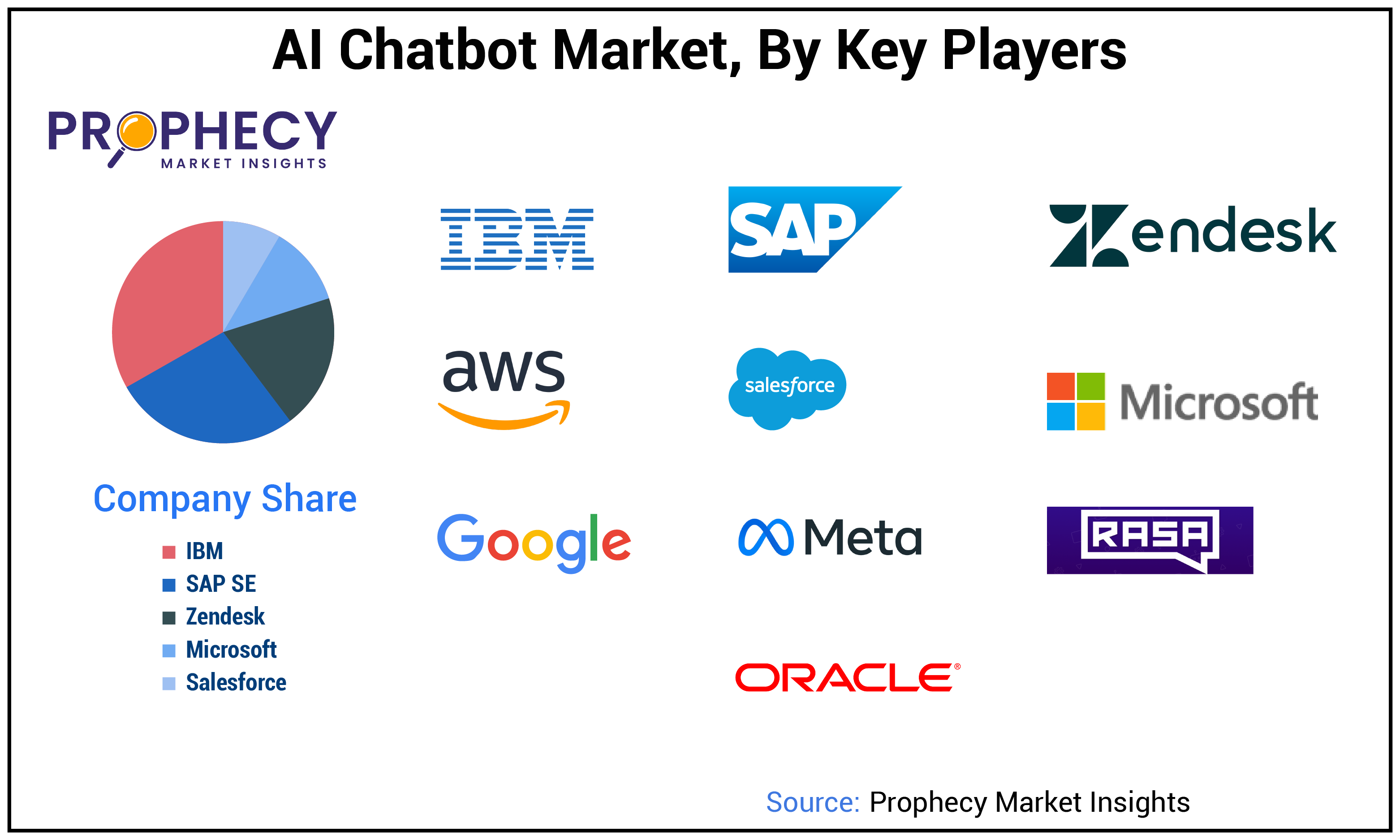
The key players operating in the AI chatbot market include, IBM, SAP SE?, Nuance Communications, SALESFORCE, Amazon, and others. The Al chatbot market is a competitive and dynamic space. It has global tech giants, specialized Al firms, and new startups competing for market share by implementing innovations and strategic partnerships. Leading companies focus on improving NLP abilities, combining generative Al, and providing customized solutions for different sectors to set their products apart.
AI Chatbot Market Companies:
- IBM
- SAP SE?
- Zendesk
- Microsoft
- Salesforce
- Amazon
- Intercom
- Nuance Communications
- Rasa
- Meta
- OpenAI
- ServiceNow.
- Oracle
- HubSpot, Inc.
View an Additional List of Companies in the AI Chatbot Market
Ai Chatbot Market Recent News
- In August 2025, Anthropic has added a memory feature to its Claude chatbot only two days ago. The new memory function allows users to get back their previous chats and get a summary of them on-demand, thus making the conversation flow easier and uninterrupted.
- In June 2024, IBM Corporation announced several new AI assistant innovations, including watsonx Assistant for Z, which supports mainframe teams with generative AI and automation. New features in watsonx Orchestrate, watsonx Assistant, and watsonx Code Assistant for Z aim to improve enterprise productivity by automating workflows and providing conversational search capabilities.
- In November 2023, National Westminster Bank plc, a retail banking company in the UK, and IBM Corporation partnered to enhance NatWest's virtual assistant, Cora, with generative AI, enabling more personalized and conversational customer interactions. This collaboration aims to improve customer experiences, offering access to a wider range of services and information through secure, AI-powered digital assistants.
Analyst View:
The Al chatbot industry is perceived by analysts as progressing into a stage of maturity, where breakthrough technologies in natural language processing, generative Al, and multimodal capabilities are redefining chatbots from simple-query handlers to smart, context-aware virtual assistants. The market is still growing largely because of cost savings and efficiency, which are the main reasons for adoption. However, these days, the growth of the market is more linked to personalization, the smooth flow of information between enterprise systems, and the expansion of the industry into new verticals such as healthcare, finance, and education.
More Related Reports
E-commerce Market
Artificial Intelligence (AI) in Life Sciences Market
AI in Healthcare Market
Chatbot Market
E-Commerce Automotive Aftermarket
Ai Chatbot Market Company Profile
|
Company Name |
Intercom |
|
Headquarter |
Québec, Canada |
|
CEO |
Michel Gagnon |
|
Employee Count |
27 Employees |
Ai Chatbot Market Highlights
FAQs
AI chatbot market size was valued at USD 9.5 Billion in 2025 and is expected to reach USD 83.1 Billion by 2035 growing at a CAGR of 26.9%.
Offering, technology, deployment type, application and end-use industry are the segmentation for the AI chatbot market.
North America, Asia Pacific, Europe, Latin America, and the Middle East & Africa. North America is expected to dominate the AI chatbot market.
The key players operating the AI chatbot market include IBM, SAP SE, Zendesk, Microsoft, SALESFORCE, Amazon, Google, HUNTING PLC, Nuance Communications, SAP SE, Rasa, Meta, OpenAI, ServiceNow., and Oracle