Global Autonomous Underwater Vehicle Market Overview
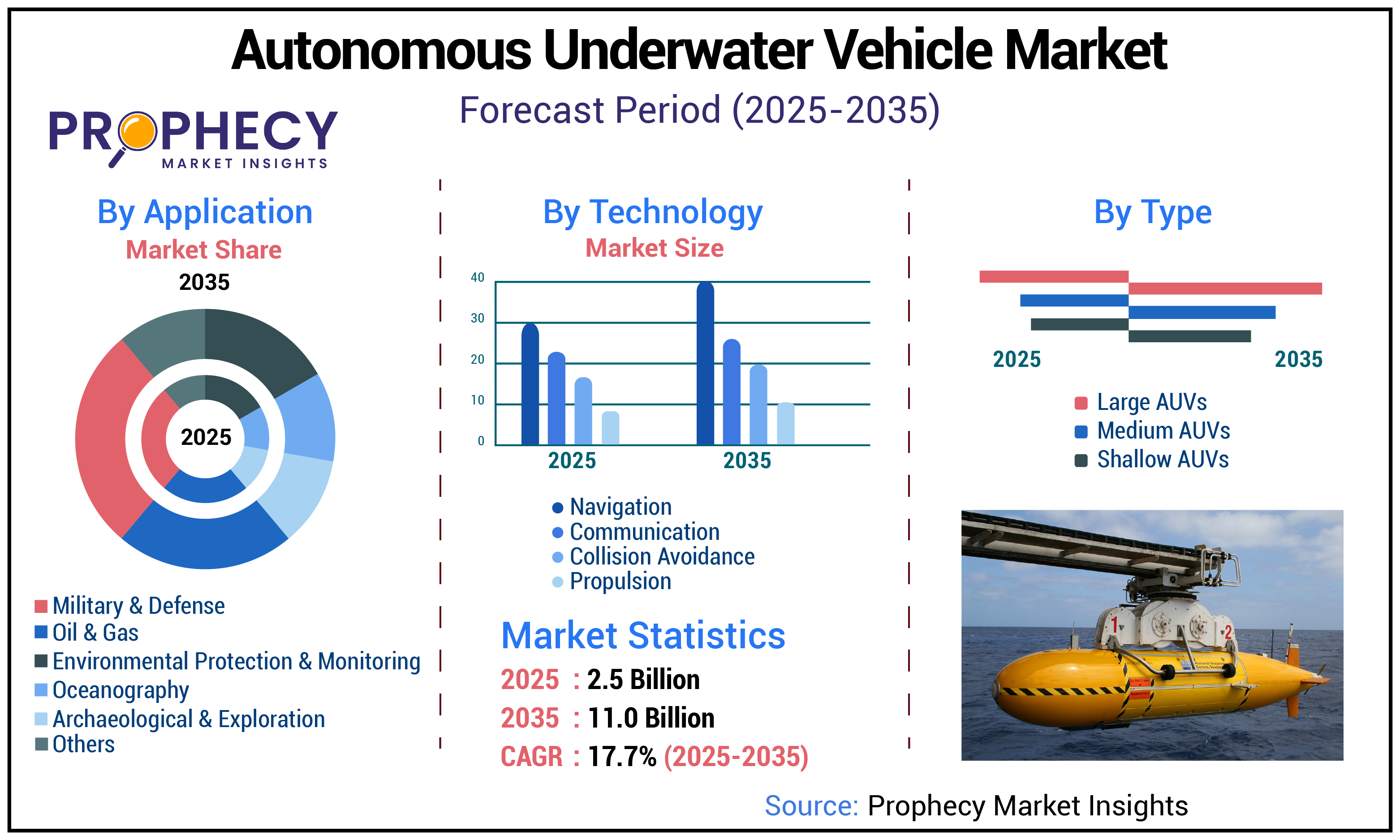
- Autonomous underwater vehicle market size is contemplated to enlarge at a valuation of USD 11.0 Billion, by 2035.
- In 2024, the market valuation was USD 2.1 Billion.
- Autonomous underwater vehicle market is growing at a CAGR 17.7%.
An autonomous underwater vehicle (AUV) is a robotic, unmanned submersible that can operate underwater independently, without requiring continuous input or control from a human operator, and is pre-programmed to complete specific tasks. AUVs offer several advantages, including the ability to collect data in harsh environments, reduce human labor and increase safety, and conduct research in remote or dangerous areas, making it valuable for ocean exploration and various underwater applications.
The increasing demand for underwater exploration, research, and security applications, increasing investments in offshore oil and gas drilling, such as, inspection and maintenance, data collection, exploration and development, and the rising deployment of advanced technologies for border and maritime security, which includes, surveillance and reconnaissance, anti-submarine warfare, and coastal defense. These factors contributed in driving the autonomous underwater vehicle market growth.
Technological advancements, such as, improvements in navigation systems and sensor technology allow AUVs to operate more autonomously and efficiently, longer battery life and increased payload capacity enable AUVs to undertake longer and more complex missions, and advancements in AI and robotics, are factors further having a positive impact on the autonomous underwater vehicle market expansion.
Impact of Generative AI on Autonomous Underwater Vehicle Market:
- Generative AI is transforming the autonomous underwater vehiclee (AUV) market by improving mission planning, object detection, and navigation. Real-time data processing is enhanced by AI-driven models, which allow AUVs to adjust to erratic underwater conditions.
- By improving sonar imaging, anomaly identification, and predictive maintenance, generative AI raises operational effectiveness. In deep-sea exploration, defense, and marine research, it also makes autonomous decision-making easier, minimizing the need for human intervention. AUVs will become smarter, more dependable, and more efficient as AI technology develops, propelling market expansion and innovation.
Global Autonomous Underwater Vehicle Market Drivers & Restraints
Key Drivers:
The Growing Demand for Underwater Exploration is Propelling the Market Growth
One of the main factors propelling the autonomous underwater vehicle (AUV) market is the rising desire for underwater exploration. AUVs are essential for deep-sea mapping, resource development, and environmental monitoring in sectors such as oil and gas, marine research, defense, and underwater archaeology.
AUVs make it possible to capture high-precision, reasonably priced data in challenging underwater conditions. AUV use is increasing in tandem with growing interest in offshore energy, subsea infrastructure, and ocean conservation, which is driving technology breakthroughs and commercial expansion in autonomous underwater operations.
- For instance, according to the facts stated by ARIZONA BOARD OF REGENTS, The same temptations that space exploration encounters also apply to ocean exploration. There have been some requests for human exploration missions to be prioritized and for "aquanauts," who would explore the ocean in a similar manner to how astronauts explore space.
- However, it appears that using robots and remote-controlled submersibles primarily is far more cost-effective, almost as successful in examining the chemistry, biodiversity, and seafloor topography of the oceans, and infinitely safer than using human agents. The bottom line is that sending aquanauts to study the seafloor is more rational than sending astronauts to examine Mars' atmosphere.
Restraints:
Communication and Navigation Challenges Faced in Deep-Sea Environments is Restricting the Market Expansion
Communication and navigation issues in deep-sea environments are a significant drawback of the autonomous underwater vehicle (AUV) business. The inability of AUVs to rely on GPS signals underwater, in contrast to aerial or terrestrial systems, results in inaccurate navigation.
The main technique for transmitting data underwater, acoustic communication, has problems with delay, signal loss, and poor bandwidth. These restrictions have an impact on numerous AUV cooperation, mission efficiency, and real-time data sharing. To increase operational dependability and deep-sea exploration, these obstacles must be overcome.
- Counterbalance Statements: Industries should implement AI-driven path planning, enhanced acoustic modems, and advanced inertial navigation systems (INS) to enhance AUV communication and navigation. Data transmission can be improved by technologies such as optical and quantum-based communication. Better localization is also ensured by combining satellite-linked surface buoys with underwater sensor networks, which lowers navigation mistakes and increases mission success.
Opportunities & Trends:
Amalgamating Artificial Intelligence with Autonomous Underwater Vehicle is Unlocking Growth Opportunities for the Upcoming Years
Future autonomous underwater vehicle market growth will be fueled by the combination of AI and autonomous underwater vehicle, which will improve adaptive mission planning, real-time decision-making, and autonomous navigation. In challenging underwater conditions, AI-powered AUVs can interpret sensor data, optimize routes, and enhance object recognition. Operational reliability is increased by machine learning's improvements to anomaly detection, predictive maintenance, and energy saving. Swarm intelligence powered by AI enables smooth collaboration between several AUVs. AUVs will grow in intelligence and efficiency as AI develops, increasing its use in the offshore, defense, and research sectors.
- For instance, in September 2024, according to the facts published by Informa TechTarget, using advanced AI the AUV performed complex underwater tasks with no human intervention. Using AI to drive a AUV and stream data directly back to shore, will allow offshore workers to concentrate on the more complex elements of its roles. It estimates that this AI driven way of working reduces inspection timelines by up to 50%, cutting operational costs and improving inspection data quality, said the company. It can also support 3D reconstruction of assets alongside visual data.
Global Autonomous Underwater Vehicle Market Segmentations & Regional Insights
The autonomous underwater vehicle market is segmented into type, speed, shape, technology, payload, application, and region.
By Type:
Based on type, the market is trifurcated into shallow AUVs, medium AUVs, and large AUVs. The large AUVs hold the largest autonomous underwater vehicle market share. This is due to its use in deep-water exploration, oil and gas activities, and submarine exploration. Additionally, it is used in the oil and gas sector for mapping seabed, pipeline inspection, and resource exploration, thus promoting the segment’s growth.
The medium AUVs is the fastest growing segment of the autonomous underwater vehicle market. This growth is driven by its versatility for tasks such as subsea pipeline inspections and surveying large underwater areas.
By Speed:
On the basis of speed, the market is bifurcated into less than 5 knots, and more than 5 knots. The less than 5 knots segment is the dominating segment in the autonomous underwater vehicle market. This dominance is driven by the need for longer endurance and applications in coastal surveys mapping, shallow water mine hunting, and harbor operations.
The more than 5 knots segment is the second dominating segment in the autonomous underwater vehicle market. This is due to its widespread use in commercial and defense sectors, growing adoption of unmanned surface vehicles and its efficiency in long-distance operations.
By Shape:
According to shape, the market is divided into torpedo, laminar flow body, streamlined rectangular style, and multi-hull vehicle. Torpedo is the segment which is projected to govern the autonomous underwater vehicle market. This is due to its hydrodynamic efficiency, high-speed capability, and extended operational range, making it suitable for various applications such as defense, oil & gas, and oceanographic research.
The streamlined rectangular shape is the segment growing with the highest CAGR. This is due to the fact that it offers a good balance between space utilization, stability, and maneuverability, making it suitable for various applications, including scientific research, inspection, and maintenance tasks.
By Technology:
Stemming from technology, the market is collision avoidance, communication, navigation, and propulsion. The navigation segment is holding the superior position in the autonomous underwater vehicle market, as AUVs need to know its precise location to navigate effectively, whether for oceanographic surveys, underwater inspections, or military operations. Additionally, accurate navigation is crucial for collecting reliable data, such as bathymetric data, environmental monitoring, and underwater mapping, and accurate navigation enhances the safety and effectiveness of AUV operations.
By Payload:
Dependent on payload, the market is sub-segmented into sensors, cameras, synthetic aperture sonars, echo sounders, acoustic doppler current profilers (ADCPS) and others. The sensors segment is expected to influence the autonomous underwater vehicle market. This is due to its ability to provide real-time data and improve navigation, crucial for various underwater applications. Moreover, sensors can collect data on temperature, salinity, dissolved oxygen, and other parameters, crucial for scientific research and environmental monitoring.
By Application:
Application-wise, the market is pigeonholed into military and defense, oil and gas, environmental protection and monitoring, oceanography, archaeological and exploration, and others. The military and defense is the application which is ruling over the autonomous underwater vehicle market. This is due to the growing need for underwater surveillance, intelligence gathering, and reconnaissance activities. Furthermore, AUVs are used for tasks such as mine detection and neutralization, anti-submarine warfare, and submarine surveillance.
Regional Insights:
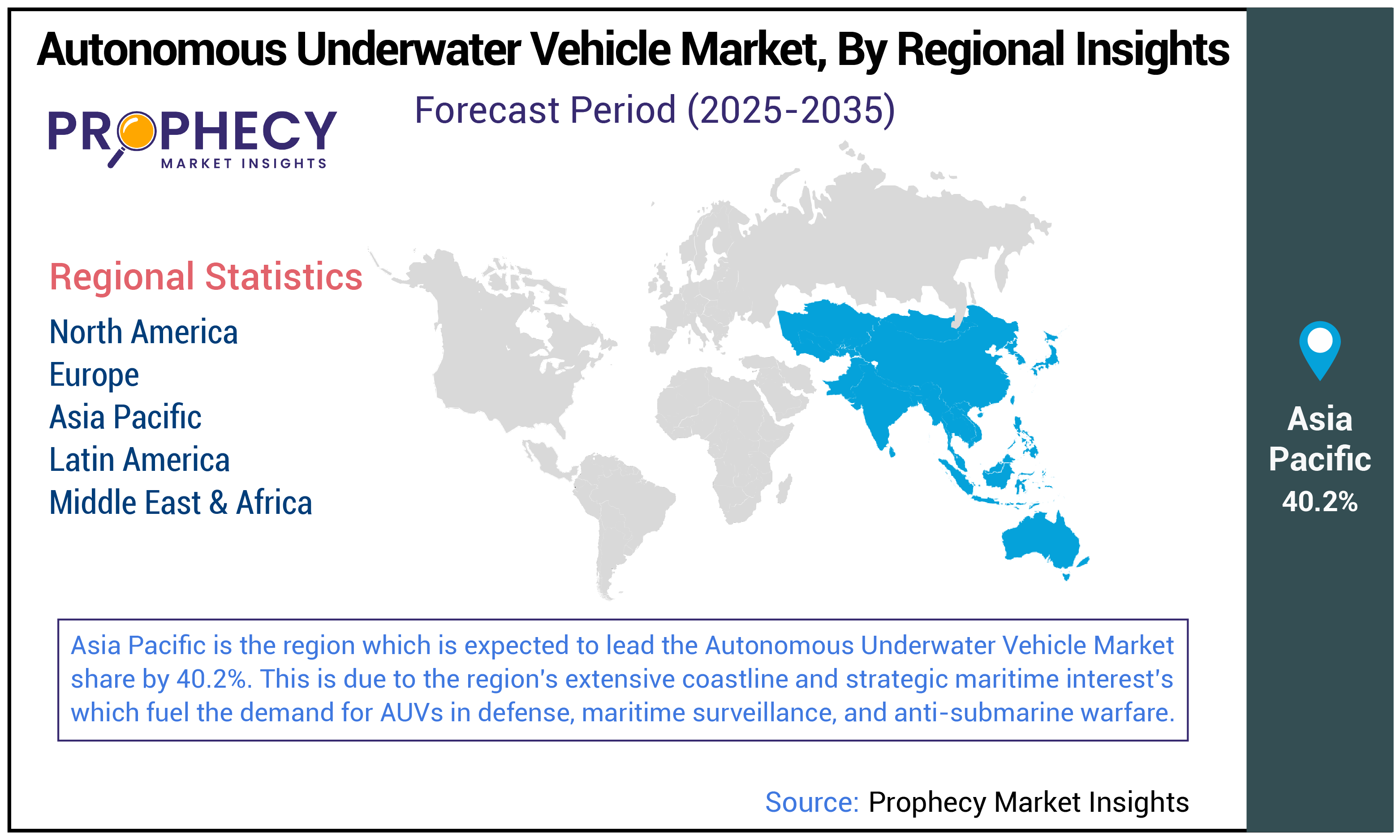
Geographically, the market is analyzed across North America, Europe, Asia Pacific, Latin America, and the Middle East & Africa.
Asia Pacific: This is the region which is expected to lead the autonomous underwater vehicle market share by 40.2%. This is due to the region's extensive coastline and strategic maritime interest’s which fuel the demand for AUVs in defense, maritime surveillance, and anti-submarine warfare, the growing demand for offshore oil and gas resources, coupled with the need for underwater infrastructure inspection and maintenance, and the Increased government investment in maritime technology and research, along with collaborations between industry players and research institutions, are fostering innovation and driving the autonomous underwater vehicle market growth in this region.
- China Autonomous Underwater Vehicle Market Insights:
The Chinese autonomous underwater vehicle market is anticipated to be the leading market, in the recent years. This is due to China’s, increasing navy adoption, focus on cost-effective technology, and investments in subsea exploration and defense capabilities. In addition to this, China is a leading energy importer and consumer, investing heavily in industries such as subsea exploration, oil and gas, renewables, and defense, all of which require AUVs.
North America: The region where the autonomous underwater vehicle market grows with the fastest growth rate, during the forecast period is North America. This is due to this region’s strong defense spending, technological innovation, and increasing commercial applications, particularly in the US Navy's focus on unmanned maritime operations and the offshore energy sector's adoption of AUVs. The extensive coastline, maritime activities, and defense investments of this region also drives market expansion.
- U.S. Autonomous Underwater Vehicle Market Insights:
The autonomous underwater vehicle market in U.S. is the fastest growing market, in the recent years. This is due to U.S. heavy investment in the defense sector and related research and development, heavy investments on AUVs by the U.S. navy for defense applications such as mine countermeasures, anti-submarine warfare, and underwater research. Additionally, AUVs are used in the U.S. for commercial applications such as oil and gas exploration, pipeline inspections, and environmental monitoring, and the country's extensive coastline, interest in the sea, and the need for advanced underwater technologies, further drives the market growth.
Europe: This region experienced considerate amount of autonomous underwater vehicle market growth in the recent years. The growth of this region were driven by factors, such as, the increasing investments on AUVs by the European nations for naval surveillance and maritime security, and the advancements in underwater exploration. Furthermore, Europe is a hub for marine research, leading to a need for AUVs for oceanographic studies and exploration, and the European oil and gas sector is a major driver for AUV deployment for pipeline inspection and maintenance.
- Germany Autonomous Underwater Vehicle Market Insights:
The autonomous underwater vehicle market in Germany is experiencing significant amount of growth in the recent years. This is due this country’s strong investments in advanced technologies and its significant hub for AUV development and deployment. In addition to this, the increasing underwater exploration, defense and security applications, and environmental monitoring, are factors contributing in the market growth of Germany.
Autonomous Underwater Vehicle Market Report Scope:
|
Attribute |
Details |
|
Market Size 2025 |
USD 2.5 Billion |
|
Projected Market Size 2035 |
USD 11.0 Billion |
|
CAGR Growth Rate |
17.7% (2025-2035) |
|
Base year for estimation |
2024 |
|
Forecast period |
2025 – 2035 |
|
Market representation |
Revenue in USD Billion & CAGR from 2025 to 2035 |
|
Regional scope |
North America - U.S. and Canada Europe – Germany, U.K., France, Russia, Italy, Spain, Netherlands, and Rest of Europe Asia Pacific – China, India, Japan, Australia, Indonesia, Malaysia, South Korea, and Rest of Asia-Pacific Latin America - Brazil, Mexico, Argentina, and Rest of Latin America Middle East & Africa – GCC, Israel, South Africa, and Rest of Middle East & Africa |
|
Report coverage |
Revenue forecast, company share, competitive landscape, growth factors, and trends |
Segmentation:
By Type:
- Shallow AUVs
- Medium AUVs
- Large AUVs
By Speed:
- Less Than 5 Knots
- More Than 5 Knots
By Shape:
- Torpedo
- Laminar Flow Body
- Streamlined Rectangular Style
- Multi-Hull Vehicle
By Technology:
- Collision Avoidance
- Communication
- Navigation
- Propulsion
By Payload:
- Sensors
- Cameras
- Synthetic Aperture Sonars
- Echo Sounders
- Acoustic Doppler Current Profilers (ADCPs)
- Others
By Application:
- Military and Defense
- Oil and Gas
- Environmental Protection and Monitoring
- Oceanography
- Archaeological and Exploration
- Others
By Region:
- North America
- U.S.
- Canada
- Europe
- Germany
- U.K.
- France
- Russia
- Italy
- Spain
- Netherlands
- Rest of Europe
- Asia Pacific
- China
- India
- Japan
- Australia
- Indonesia
- Malaysia
- South Korea
- Rest of Asia Pacific
- Latin America
- Brazil
- Mexico
- Argentina
- Rest of Latin America
- Middle East & Africa
- GCC
- Israel
- South Africa
- Rest of Middle East & Africa
Global Autonomous Underwater Vehicle Market Competitive Landscape & Key Players
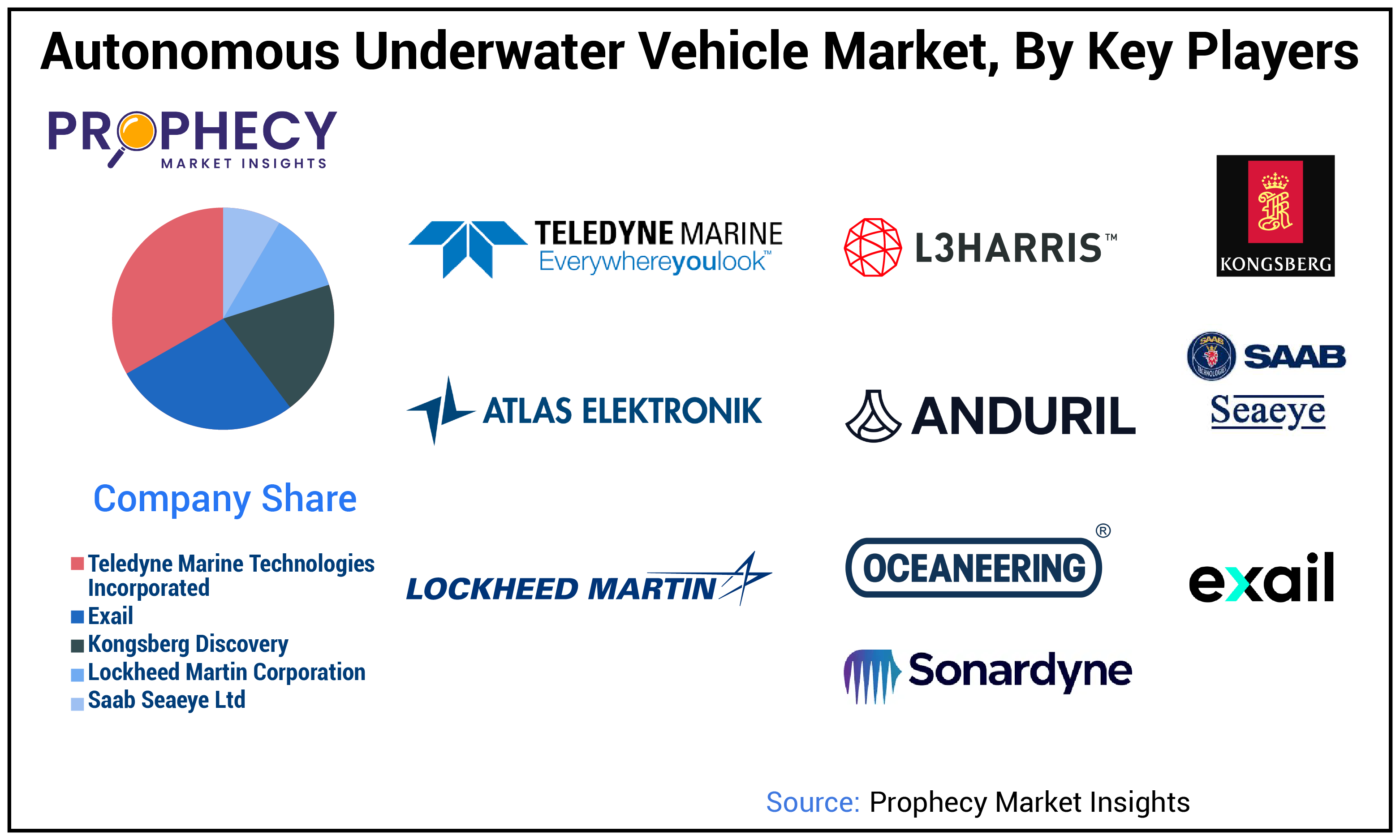
The prominent players operating in the market include, Teledyne Marine Technologies Incorporated, Exail, Kongsberg Discovery, and others. These key players are focusing on strategies, such as, AI-powered autonomy, expanding applications, and strategic partnerships and acquisitions, focusing on advanced navigation systems, longer battery life and power systems, and reliable communication systems, for driving Autonomous Underwater Vehicle Market growth.
Autonomous Underwater Vehicle Market Companies:
- Teledyne Marine Technologies Incorporated
- Exail
- Kongsberg Discovery
- Lockheed Martin Corporation
- Saab Seaeye Ltd
- ATLAS ELEKTRONIK GmbH
- L3Harris Technologies, Inc.
- Anduril Industries
- SUNFISH, Inc.
- Oceaneering International, Inc.
- Sonardyne International Ltd.
- EdgeTech
- RTsys
- SEABER
View an Additional List of Companies in the Autonomous Underwater Vehicle Market
Global Autonomous Underwater Vehicle Market Recent News
- In March 2025, According to Nova Systems, it has created state-of-the-art artificial intelligence (AI) technology that can scan sonar pictures from autonomous underwater vehicles (AUVs) and identify invisible hazards. In collaboration with the Australian Maritime College in Tasmania, Nova Systems' Test and Evaluation (T&E) Advanced Practitioners Course included an exclusive first look at the instrument for key defense stakeholders.
- In September 2024, Beam, a prominent supplier of advanced offshore wind services, had accomplished a historic first by launching the first artificial intelligence (AI)-powered autonomous underwater vehicle. In a commercial setting, the technology had already been effectively applied to evaluate jacket structures on the Seagreen wind farm, a joint venture between SSE Renewables, TotalEnergies, and PTTEP. Seagreen is the biggest offshore location in Scotland.
- In June 2024, Anduril Industries announced the opening of a new manufacturing facility at Quonset Point, Rhode Island, to facilitate the large-scale production of its Dive-LD series of autonomous underwater vehicles (AUVs). By making an early investment in a larger production facility, Anduril would be able to meet client demands and fulfill orders at a never-before-seen pace.
- In July 2023, Together with industry partners, L3Harris created and integrated a homing and docking solution called Torpedo Tube Launch and Recovery (TTL&R) that allowed the autonomous underwater vehicle (AUV) to be launched and recovered from an active submarine using its well-proven Iver4 AUV technology. Enabling the TTL&R capabilities for real-world missions was something L3Harris was excited about.
Analyst View:
Increased investments in offshore oil and gas drilling, including inspection and maintenance, data collection, exploration, and development, the growing demand for underwater exploration, research, and security applications, and the growing use of cutting-edge technologies for border and maritime security, including surveillance and reconnaissance, anti-submarine warfare, and coastal defense.
These elements had a part in propelling the autonomous underwater vehicle market expansion. AUVs may now function more independently and effectively thanks to technological developments including enhanced navigation systems and sensor technologies.AUVs can carry out longer and more sophisticated missions due to longer battery life and larger cargo capacities. Developments in robotics and artificial intelligence are also positively influencing the autonomous underwater vehicle market's growth.
More Related Reports
Logistics Automation Market
Autonomous Cars Market
Automotive PCB Market
Autonomous Vehicle Market
Autonomous AI Agents Market
Global Autonomous Underwater Vehicle Market Company Profile
|
Company Name |
Teledyne Marine Technologies Incorporated |
|
Headquarter |
Daytona Beach, Florida, United States |
|
CEO |
Mr. Edwin Roks |
|
Employee Count (2024) |
14,900 Employees |
Global Autonomous Underwater Vehicle Market Highlights
FAQs
Autonomous underwater vehicle market size was valued at USD 2.5 Billion in 2025 and is expected to reach USD 11.0 Billion by 2035 growing at a CAGR of 17.7%.
Type, speed, shape, technology, payload, application, and region are the segmentation for the autonomous underwater vehicle market.
North America, Asia Pacific, Europe, Latin America, and the Middle East & Africa. Asia Pacific is expected to dominate the market.
The key players operating in the autonomous underwater vehicle market include Teledyne Marine Technologies Incorporated, Exail, Kongsberg Discovery, SUNFISH, Inc., Lockheed Martin Corporation, ATLAS ELEKTRONIK GmbH, L3Harris Technologies, Inc., Anduril Industries, Oceaneering International, Inc., Sonardyne International Ltd., EdgeTech, RTsys, and SEABER.