Global Autonomous Delivery Vehicle Market Overview
- 2025 Market Size: USD 3392.6 Billion
- 2036 Projected Market Size: USD 78043.0 Billion
- CAGR (2026-2036): 33%
- North America: Largest Market in 2025
A autonomous delivery vehicle is in simple terms a self-driving car that can work the delivery of goods as parcels, groceries, or meals without the need for a human. It finds and gets to the location by itself with the help of a range of sophisticated sensors, AI-based navigation, and connectivity technologies. ADVs are flexible delivery units able to complete last-mile delivery on the road, on the sidewalk, or even from the air (drones).
The major benefits, however, are the elimination of delivery costs, more rapid and trustworthy deliveries, fewer carbon emissions, a resultant increase in safety as the lessening of human error, and the extra feature of delivery without contact making it the best choice in e-commerce, logistics, and urban smart-city applications industries.
The autonomous delivery vehicle market is expanding at a very high speed. The major factor that is propelling the growth of this market is the need for fast and less expensive last-mile deliveries, which is essentially the direct consequence of the spectacular rise in e-commerce and food delivery services. Among the reasons that are driving the ARDs rapid adoption are labor cost increases, driver shortages, and the demand for contactless delivery in the post-pandemic period.
Besides this, developments in AI, robotics, and connectivity technologies are turning autonomous vehicles into safer and more efficient ones. The upbeat investments in smart city infrastructure, together with the increasing environmental concerns and the emission of carbon dioxide reduction regulations, are some of the reasons that are pushing the market to grow further worldwide.
The Value of Autonomous Vehicles for Last-Mile Deliveries in Urban Environments:
- Last-mile deliveries with Autonomous Delivery Vehicles (ADVs) in urban environments are what these vehicles are worth in essence. Such delivery vans -the core of supply chain- systems by this arrangement become able to work with tight cost operable manner and get the effect of quick delivery smoothly in such places as populated).
- They do it by using AI and up-to-the-minute info their devices to get around to the worst set of roads and be able soon after by their chosen decentralized routing alternative to get rid of delays and achieve zero delivery mistake, resulting them in the latter's eventual elimination.
- At the same time, as free human errors, they supply a contactless and trustworthy delivery that is strengthening customer loyalty, despite being involved in traffic jams and emission of hydrocarbons at a lower rate than in case of dispatch of traditionally driven vehicles.
- ADVs are a resourceful means for retailers, e-commerce platforms, and logistics providers to grasp and respond to the consumers’ over willingness to be instantly served in a sustainable manner in urban areas as well as be timely and efficient in their delivery.
Current Industry Dynamics & Insights:
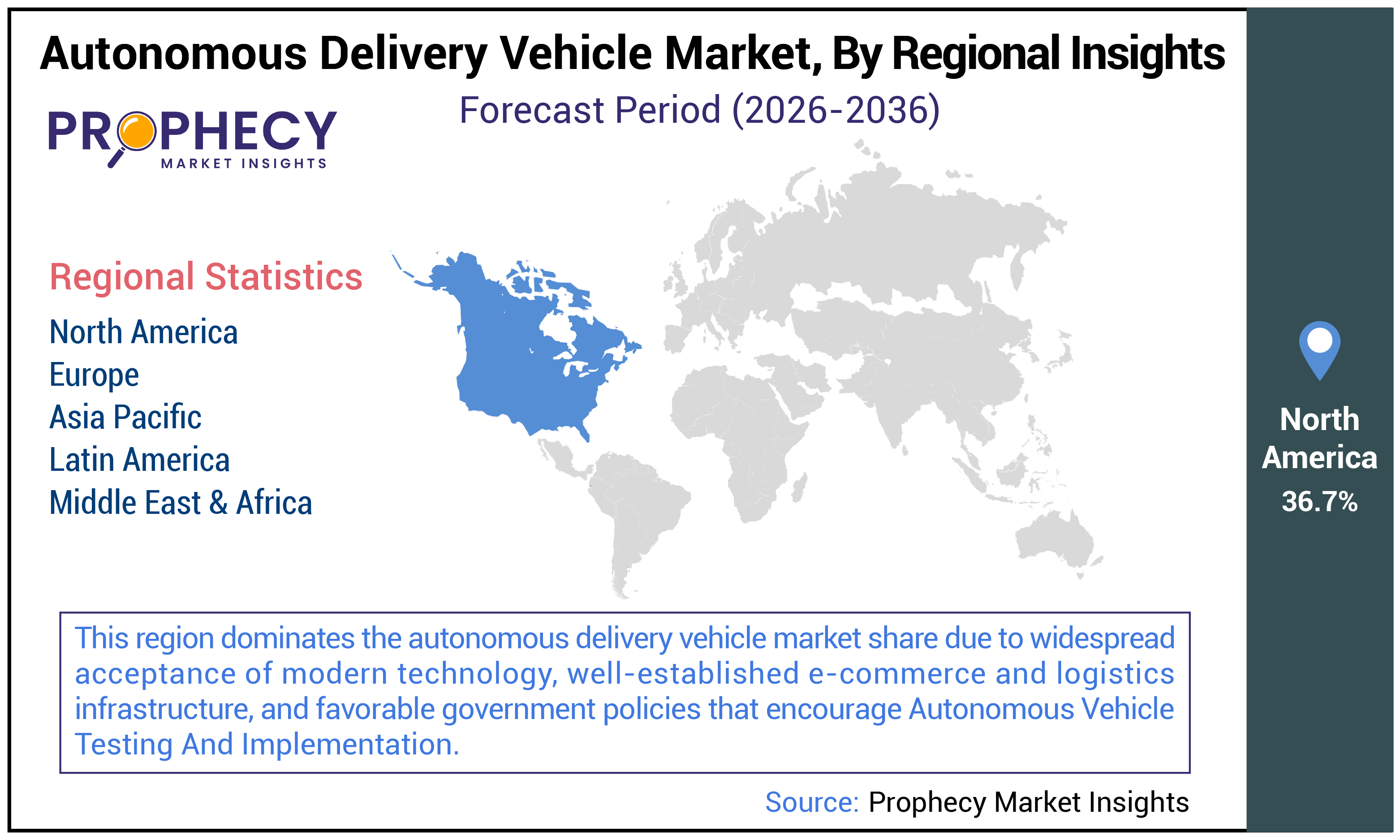
- North America has the largest regional share in the market, with almost 34.5%.
- Europe is second dominating region in the market.
- By component, hardware dominates the autonomous delivery vehicle market size.
Global Autonomous Delivery Vehicle Market Drivers & Restraints
Drivers and Restraints:
|
Drivers |
Restraints |
Opportunities & Trends |
|
|
|
Key Drivers:
Rapid Growth of E-commerce and Food Delivery Services
The rise of e-commerce and food delivery services at a fast pace is one of the main factors that propel the autonomous delivery vehicle market forward as it leads to a considerable increase in the demand for delivery solutions for the last mile that are fast, reliable, and scalable.
The increase in online orders and on-demand food deliveries puts delivery methods that are traditional in a situation of high labor costs, traffic congestion, and delayed shipments, among other challenges. ADVs constitute a device-free, money-saving solution, which is why companies are able to keep up with the increasing customer demand for speed and convenience while also ensuring a stable service, thus, in effect, they are directly driving market expansion.
- For Instance, according to data published by SellersCommerce, There are 2.77 billion online shoppers globally as of 2025. That means 33% of the world’s population is shopping online. This marks a 2.2% increase from the previous year. The number of online shoppers will increase to 2.86 billion in 2026, reflecting the boom in eCommerce due to the increased internet penetration and convenience.
Restraints:
Public Acceptance and Trust Issues
Distrust and hesitation of the general public towards the use of ADVs are among factors that can hamper the expansion of the autonomous delivery vehicle market. In fact, consumers as well as communities might be unwilling to put their trust in vehicles without a driver because they worried about safety, privacy, and even the dependability of such vehicles. Navigation errors and accidents, for example, can be cited as reasons for the lack of confidence in this technology.
- Counterbalance Statements: One effective measure is the establishment of rigorous safety regulations, the introduction of pilot programs and the implementation of publicity campaigns which not only demonstrate the safety of the operations, inform the public and gradually gain their trust, thus allowing the market to expand more freely.
Opportunities & Trends:
Increased Use of IoT and 5G for Real-Time Monitoring
The future of the autonomous delivery vehicle market is heavily influenced by their expanded use of IoT and 5G for real-time monitoring. These technologies allow vehicles to communicate easily with each other, with the infrastructure, and with fleet management systems. Such connectivity enables delivery vehicles to be located in real-time, their routes to be dynamically optimized, their maintenance to be anticipated, and their safety to be increased thus, delivery operations being, quicker, more reliable, and efficient.
Consequently, as 5G networks and IoT devices become more common, ADVs will be able to work with less delay and more accuracy, hence, they will be more viable and can be deployed in large numbers for urban logistics solutions.
Global Autonomous Delivery Vehicle Market Segmentations & Regional Insights
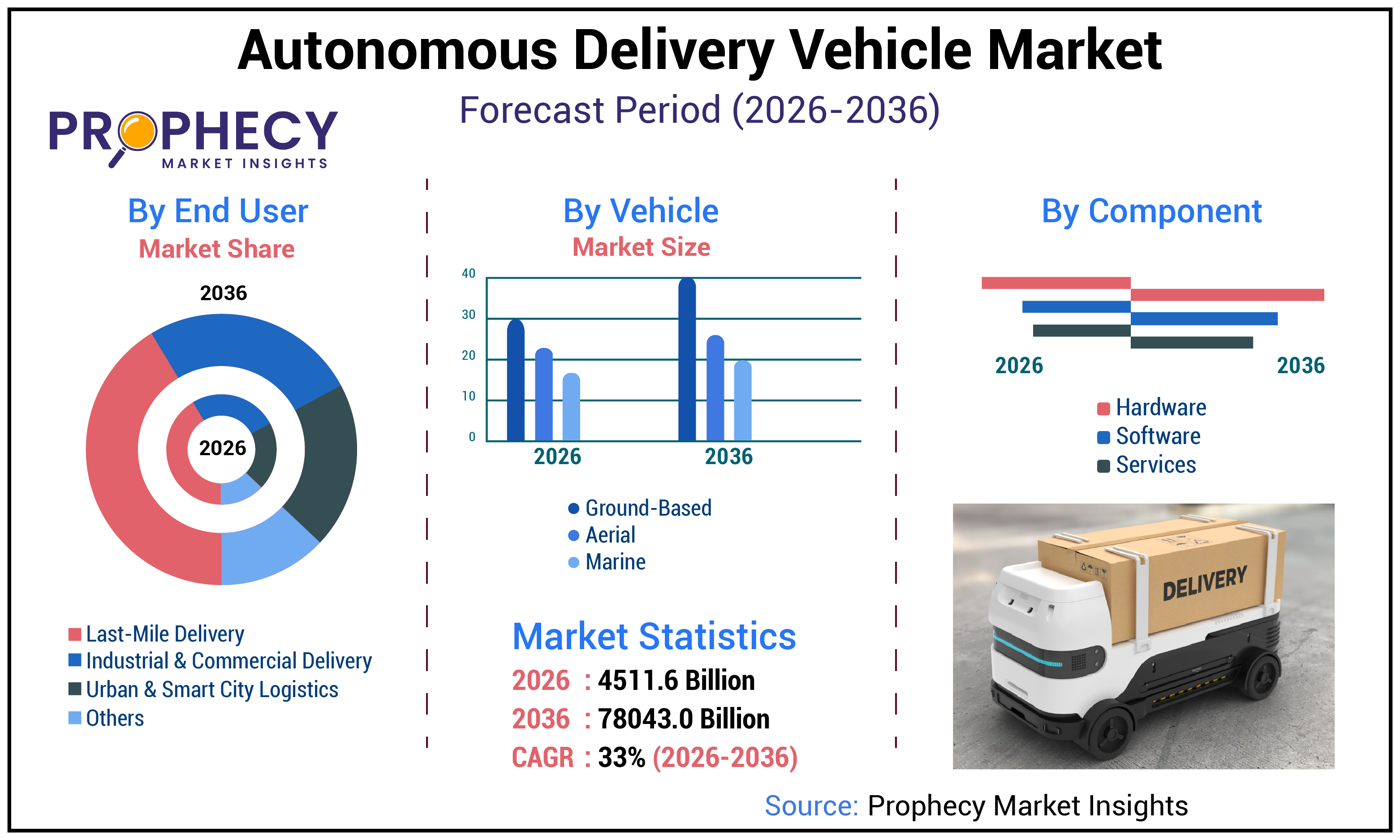
Component, vehicle type, end user, and region are the divisions of the autonomous delivery vehicle market.
By Component:
Hardware, software, and services are component on which autonomous delivery vehicle market is segmented. Hardware dominates the autonomous delivery vehicle market share since vehicles require significant investment in sensors (LiDAR, radar, and cameras), computer units, battery systems, and vehicle chassis to ensure safe and dependable autonomous operations.
Software is the second most important component, as advanced AI-based navigation, fleet management, and route optimization systems are vital for enabling autonomy, increasing efficiency, and supporting scalability, making them indispensable alongside hardware. Services, while rising, often generate less money than tangible hardware and software systems.
By Vehicle Type:
From the perspective of vehicle type, the autonomous delivery vehicle market is divided into ground-based, aerial, and marine. Ground-based vehicles dominate the autonomous delivery vehicle market share due to its versatility for last-mile deliveries in urban and suburban regions, ability to transport bigger payloads, and ease of integration with existing road infrastructure.
Aerial vehicles (drones) are the second most dominant segment due to their ability to avoid traffic congestion and deliver goods quickly, particularly for lightweight parcels and urgent deliveries, making them ideal for niche applications such as food, medicine, and e-commerce, though they have regulatory and payload limitations when compared to ground-based vehicles.
By End User:
Last-mile delivery, industrial & commercial delivery, urban & smart city logistics, and others are end users of the autonomous delivery vehicle market. The last-mile delivery sector dominates the autonomous delivery vehicle market growth due to the increasing rise of e-commerce, grocery, and food delivery services, which has created a significant need for fast, cost-effective, and reliable delivery solutions straight to customers.
The Industrial & Commercial Delivery segment is the second most dominant, as businesses increasingly use ADVs for intra-campus logistics, warehouse-to-store deliveries, and supply chain efficiency, lowering labor costs and streamlining operations, despite its smaller size compared to the consumer-focused last-mile segment.
Regional Insights:
Geographically, the autonomous delivery vehicle market is studied across North America, Europe, Asia Pacific, Latin America, and the Middle East & Africa.
North America: This region dominates the autonomous delivery vehicle market share due to widespread acceptance of modern technology, well-established e-commerce and logistics infrastructure, and favorable government policies that encourage autonomous vehicle testing and implementation.
- U.S. Autonomous Delivery Vehicle Market Insights:
The U.S. leads the autonomous delivery vehicle market in North America due to its robust e-commerce ecosystem, early acceptance of autonomous technology, significant R&D investments, and supportive legislative frameworks that promote ADV testing and deployment.
Europe: This is the second most dominant region, driven by rapid digitalization, investment in smart city initiatives, increased demand for efficient urban logistics, and stringent sustainability regulations that encourage the adoption of autonomous delivery solutions, despite having a slightly smaller market size than North America.
- Germany Autonomous Delivery Vehicle Market Insights:
Germany is Europe's leading country, owing to its advanced automotive industry, strong logistics infrastructure, focus on Industry 4.0 and smart city initiatives, and government support for green and automated mobility solutions, making it the continent's most appealing market for autonomous delivery innovations.
Asia Pacific: The autonomous delivery vehicle market in APAC is quickly expanding because to the exponential expansion of e-commerce and food delivery services, rising urbanization, rising labor costs, and government initiatives encouraging smart cities and autonomous technology.
- China Autonomous Delivery Vehicle Market Insights:
China dominates the APAC market due to its massive e-commerce ecosystem, high urban population density, significant investments in AI and robotics, and supportive regulations for testing and deploying autonomous delivery solutions, making it the region's leading ADV adoption hub.
Autonomous Delivery Vehicle Market Report Scope:
|
Attribute |
Details |
|
Market Size 2026 |
USD 4511.6 Billion |
|
Projected Market Size 2036 |
USD 78043.0 Billion |
|
CAGR Growth Rate |
33% (2026-2036) |
|
Base year for estimation |
2025 |
|
Forecast period |
2026- 2036 |
|
Market representation |
Revenue in USD Billion & CAGR from 2026 to 2036 |
|
Regional scope |
North America - U.S. and Canada Europe – Germany, U.K., France, Russia, Italy, Spain, Netherlands, and Rest of Europe Asia Pacific – China, India, Japan, Australia, Indonesia, Malaysia, South Korea, and Rest of Asia-Pacific Latin America - Brazil, Mexico, Argentina, and Rest of Latin America Middle East & Africa – GCC, Israel, South Africa, and Rest of Middle East & Africa |
|
Company Landscape |
Market Share Analysis of Companies Heat Map Analysis Company Overview, Products Overview Financial Information, Key Highlights Business Strategies Overview SWOT Analysis |
|
Report coverage |
Revenue forecast, company share, competitive landscape, growth factors, and trends |
|
Value Added Data Infosets |
Besides fundamental market insights such as the size of the market, growth rate, segmentation, regional study, and key players, our reports carry value-added data sets such as trade flow (import-export) analysis, production and consumption overview, price trend evaluation, supply and value chain mapping, and raw material availability. Moreover, we provide strategic tools as PESTLE and Porter’s Five Forces analysis, examination of the regulatory landscape, as well as monitoring of technology and innovation thereby providing a comprehensive overview which facilitates sensible and anticipatory decision-making. |
Segmentation:
By Component:
- Hardware
- Sensors
- Onboard Computing Units
- Others
- Software
- Autonomous Navigation Software
- AI-based Route Optimization
- Others
- Services
- Fleet Management Services
- Maintenance & Support Services
- Others
By Vehicle Type:
- Ground-based
- Aerial
- Marine
By End User:
- Last-Mile Delivery
- Industrial & Commercial Delivery
- Urban & Smart City Logistics
- Others
By Region:
- North America
- U.S.
- Canada
- Europe
- Germany
- U.K.
- France
- Russia
- Italy
- Spain
- Netherlands
- Rest of Europe
- Asia Pacific
- China
- India
- Japan
- Australia
- Indonesia
- Malaysia
- South Korea
- Rest of Asia Pacific
- Latin America
- Brazil
- Mexico
- Argentina
- Rest of Latin America
- Middle East & Africa
- GCC
- Israel
- South Africa
- Rest of Middle East & Africa
Global Autonomous Delivery Vehicle Market Competitive Landscape & Key Players
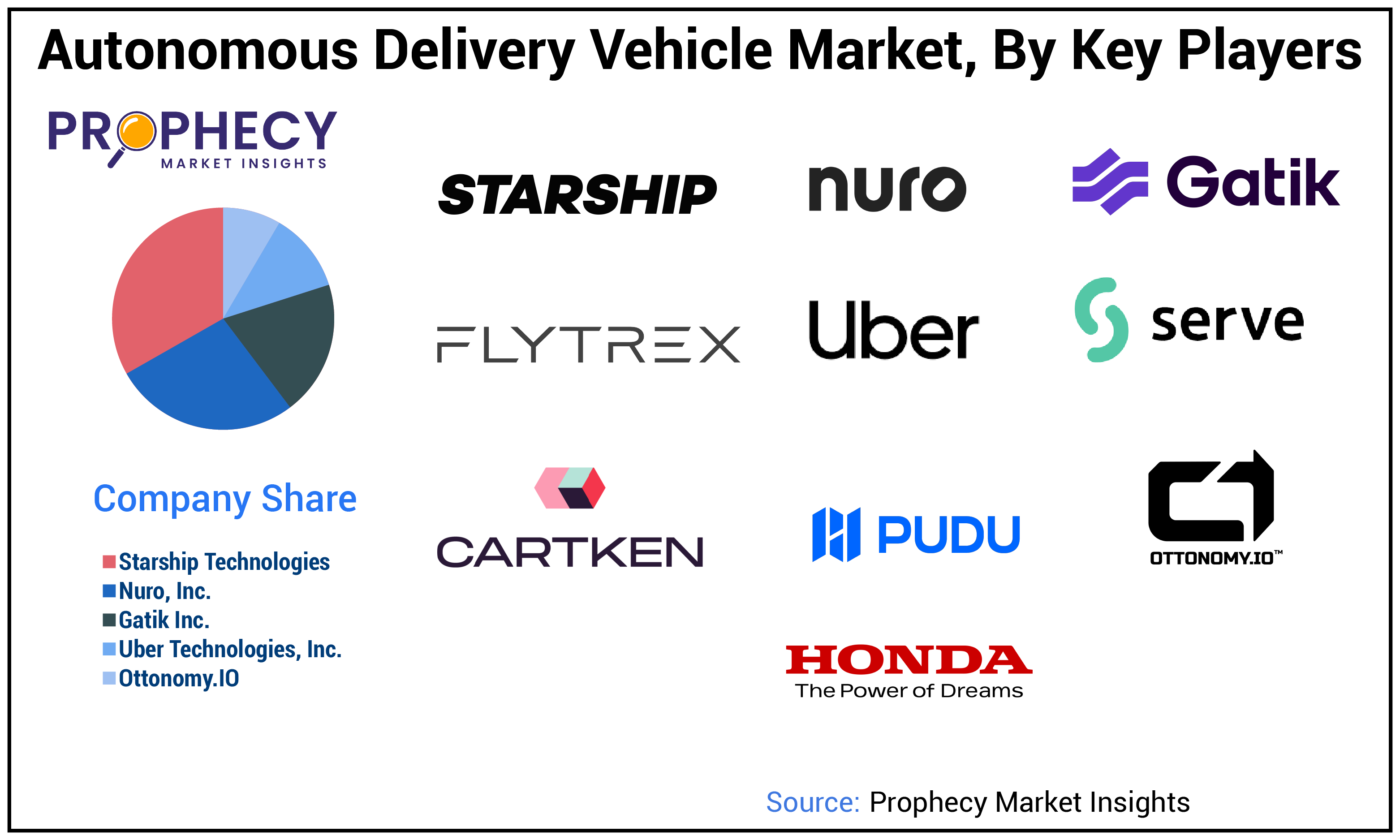
Key growth strategies for autonomous delivery vehicle companies include investing in advanced AI, sensor, and connectivity technologies to improve safety and efficiency, forming strategic alliances with e-commerce, logistics, and food delivery platforms to expand deployment, and piloting solutions in smart cities and controlled environments to establish credibility.
Autonomous delivery vehicle market Companies:
- Starship Technologies
- Nuro, Inc.
- Gatik Inc.
- Uber Technologies, Inc.
- Ottonomy.IO
- Serve Robotics Inc
- Cartken Inc.
- Pudu Technology Inc.
- Beijing Technology Co., Ltd.
- Flytrex
- American Honda Motor Co., Inc.
- Coco Robotics
- Zipline International Inc.
- Jiluo Technology (Shanghai) Co., Ltd.
- Torc Robotics
View an Additional List of Companies in the Autonomous delivery vehicle market
Global Autonomous Delivery Vehicle Market Recent News
- In October 2025, Uber Technologies, Inc. announced a collaboration with NVIDIA to advance the next generation of robotaxi and autonomous delivery fleets utilizing NVIDIA AI Architecture. Uber expects to significantly grow its global autonomous fleets as a result of this partnership.
- In September 2025, The UAE plans to expand the usage of autonomous technology across the country, from self-driving cabs to driverless delivery vehicles, over the next year, according to 7X Group. The company is now conducting experiments in Masdar City, Abu Dhabi, delivering things to customers via self-driving vehicles.
Analyst View:
An autonomous delivery vehicle (ADV) is a self-driving system that uses artificial intelligence, sensors, and communication technologies to transport things such as parcels, groceries, or meals without the need for human intervention. These vehicles work on roadways, sidewalks, or with drones, providing faster, more dependable, and contactless deliveries while lowering labor expenses, human error, and carbon emissions.
The ADV market is quickly expanding, driven by the growth of e-commerce and food delivery, rising labor costs, driver shortages, technology breakthroughs in AI and robotics, smart city initiatives, and environmental rules supporting sustainable logistics solutions around the world.
Analysis of Sources:
Primary Sources:
- In-depth interviews
- Company-specific data
- Surveys and questionnaires
- Focus group discussions (FGDs)
- Others
Secondary Sources:
- U.S. Department of Transportation (USDOT)
- European Commission
- China Ministry of Transport (MOT)
- National Institute of Standards and Technology (NIST)
- Others
More Related Reports
Autonomous Ships Market
Autonomous Cars Market
Autonomous Vehicle Market
Autonomous AI Agents Market
Autonomous Underwater Vehicle Market
Global Autonomous Delivery Vehicle Market Company Profile
|
Company Name |
Product Portfolio |
|
Ottonomy.IO |
Autonomous Delivery Robots |
|
Gatik Inc. |
Autonomous Delivery Transportation |
|
Starship Technologies- |
Autonomous Delivery |
|
Serve Robotics Inc |
Autonomous Sidewalk Delivery |
|
Cartken Inc. |
Autonomous Robotic Deliveries |
Global Autonomous Delivery Vehicle Market Highlights
FAQs
Autonomous delivery vehicle market size was valued at USD 4511.6 Billion in 2026 and is expected to reach USD 78043.0 Billion by 2036 growing at a CAGR of 33%.
Component, vehicle type, end user, and region are the segmentation for the autonomous delivery vehicle market.
Rising e-commerce and food delivery demand, the need for efficient last-mile solutions, continuous advancements in technology as AI, sensor fusion, and connectivity, and so on are some of the autonomous delivery vehicle market growth drivers.
North America, Asia Pacific, Europe, Latin America, and the Middle East & Africa. North America is expected to dominate the autonomous delivery vehicle Market.
The key players operating the autonomous delivery vehicle market include Starship Technologies, Nuro, Inc., Gatik Inc., Uber Technologies, Inc., Ottonomy.IO, Serve Robotics Inc, Cartken Inc., Pudu Technology Inc., SilexPro, Flytrex, American Honda Motor Co., Inc., Coco Robotics, Zipline International Inc., Jiluo Technology (Shanghai) Co., Ltd., and Torc Robotics.