Global Neonatal Ventilators Market By Overview
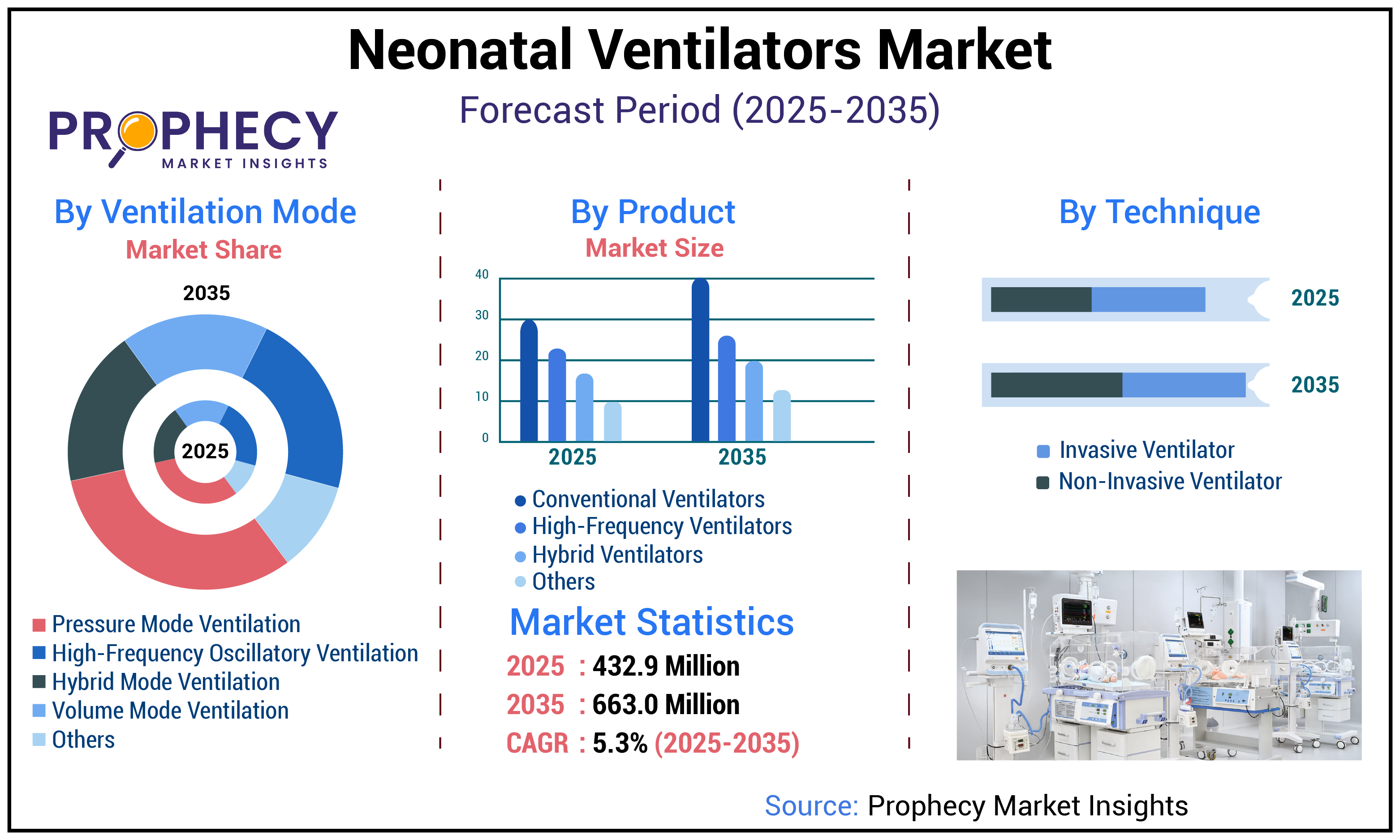
- By 2035, the neonatal ventilators market size is contemplated to enlarge at a valuation of USD 663.0 Million.
- In 2024, the neonatal ventilators market valuation was USD 414.7 Million.
- Neonatal ventilators market is developing at a CAGR of 5.3%.
A neonatal ventilator is a medical type of machine. Its primary use is to assist newborn babies in breathing particularly those born early or with some difficulty in breathing. These babies may have their lungs not fully developed or some conditions such as respiratory distress syndrome. They may therefore not breathe effectively on their own. The ventilator aides by supplying them with oxygen and forcing air into their lungs in a manner of control. It applies various modes which include CPAP (Continuous Positive Airway Pressure) and SIMV (Synchronized Intermittent Mandatory Ventilation).
The neonatal ventilators market is experiencing robust growth, driven by rising rates of preterm births, low birth weight, and respiratory complications among newborns. Increased use of high-end ventilator systems is entailed by advances in neonatal care, especially in geographical regions with a high incidence of preterm birth such as Asia-Pacific. Newer equipment is more mobile, less obtrusive and even features AI-driven functions that help increase clinical accuracy.
Governments across the globe are also giving priority to reducing infant mortality and enhancing maternal-child healthcare services, and this aspect presents a very good opportunity of neonatal ventilators of the next generation. The continuous advancements in technology, such as AI, machine learning, and better data connectivity, are opening the door to adaptive ventilation, remote monitoring, and telemedicine services. Manufacturers are also reviewing ventilator designs that suit a particular health profile of the neonate, and this has opened up the potential of expanding the market territory.
Impact of Generative AI on Neonatal Ventilators Market:
- Some studies suggest that tools such as generative design and fluid dynamics simulations are being used to improve different parts of the machine such as airflow systems, structural components, and how the ventilator connects to the baby. These tools could be speeding things up quite a bit. Engineers can now test out different designs faster, which might help them create ventilators that fit the needs of various newborn age groups more precisely. That, in turn, could mean better performance, and improved safety for the baby.
- AI is transforming ventilation for babies by adjusting settings based on factors such as lung maturity, birth date, and medical conditions. Predictive models and adaptive algorithms can fine-tune oxygen levels, air pressure, and tidal volume, enabling better decision-making and more precise respiratory support for neonatal intensive care unit teams.
Global Neonatal Ventilators Market By Drivers & Restraints
Key Drivers:
Rising Premature Birth Rates and Tech Advancements Drive Growth in the Neonatal Ventilator Market
The neonatal ventilators market is growing steadily, driven primarily by the increasing number of premature births. On top of that, there’s been a lot of progress in neonatal care technology in recent years. Since 2014, preterm birth rates have been going up. Which might be due to older maternal age, chronic health issues, and differences in healthcare access. This demand has pushed for ventilators with more advanced features.
Things such as non-invasive modes, age-specific designs, and smart software that can adjust in real time are getting more attention. As neonatal care moves more toward precision medicine, hospitals are starting to invest in ventilators that can adapt to each baby’s specific needs. The idea is to improve care while also making things easier for medical staff.
- For instance, U.S. child health data shows that the preterm birth rate went from 9.6% in 2014 to 10.5% by 2021. That increase has led to more funding and interest in improving neonatal care. Groups such as the March of Dimes, along with medical device companies, are now focusing on new ventilator tech. This includes AI-powered systems, volume-targeted modes, and custom interfaces made especially for very low birth weight infants. These efforts are meant to respond not just to the medical urgency, but also to the growing demand for more personalized care in neonatal intensive care units.
Restraints:
High Development Costs and Regulatory Hurdles Slow Innovation in Neonatal Ventilator Market
Building advanced neonatal ventilators, especially ones that use AI is complex. It usually takes a lot of research, testing, and funding. Such investment could be a major challenge for many companies. In fact, the high cost of developing and getting these machines approved could be slowing down progress in the market. Smaller might find it hard to keep up. The design and certification process is expensive and time-consuming. While the bigger players might have the resources to handle all this, startups and smaller firms could struggle to compete. And that might be one reason innovation in this area isn't moving faster.
- For instance, a 2022 report in Frontiers in Pediatrics noted that neonatal ventilators can cost anywhere from $30,000 to $50,000 per unit. Even the basic models usually cost between $1,000 and $10,000, and that doesn’t include things such as maintenance or training.
Counterbalance Statements: The development of high-tech neonatal ventilators using AI is becoming more affordable due to increased investment by larger companies, strict regulations, government grants, public-private partnerships, and startup-friendly programs. Tools such as generative AI, digital simulations, and modular designs are also speeding up development, indicating a market shift towards smarter, more accessible solutions.
Opportunities & Trends:
AI-Integrated Smart Ventilators Could Transform Neonatal Respiratory Care
The neonatal ventilator marketplace is fast developing due to increasing popularity of AI-based technologies in the responsive and adaptive care of preterm infants. These ventilators automatically switch the settings according to the real-time data monitoring, saving the neonatal intensive care unit professionals from excessive strain and also enhances results. It could also help anticipate the condition of a baby and advise on customized care on the basis of the condition of the baby or the date of birth.
- For instance, a 2023 study published in Frontiers in Pediatrics has stated that inflated AI-assisted ventilators may ensure oxygen stabilization and reduce the risk of lung damage in critically premature babies. Initial tests indicate that they can save between 30 and 35 percent manual adjustments and shave off 20 percent of the time it takes to wean a baby off the ventilator. That is a good step on the way to safer and more efficient care in neonatal intensive care units
Global Neonatal Ventilators Market By Segmentations & Regional Insights
Product type, technique, ventilation mode, technology, interface, application and region are the divisions of the neonatal ventilators market.
By Product Type:
Based on product type the neonatal ventilator is segmented categorized into conventional ventilators, high-frequency ventilators, hybrid ventilators, and others. Conventional neonatal ventilators prevail the neonatal ventilators market share in the sense that they provide reliable, controlled airflow that enables sustained oxygenation in infants and particularly those in intensive care. Their track record of safety, standard performance, and the ease with which they could be added to a neonatal intensive care unit makes them the choice of every healthcare provider.
The second largest neonatal ventilators market share owned by the high-frequency neonatal ventilators thanks to their usage to provide a good respiratory support minimizing the lung injury in vulnerable newborn infants. They are well designed to be used on critical cases of respiratory distress and other complex cases of neonatal care where accuracy is of great demand.
By Technique:
The neonatal ventilator market is generally divided into two main types: invasive and non-invasive ventilation. Currently, invasive ventilation is still a front runner. This is largely attributed to the fact that it is sometimes necessary to babies due to critical health conditions especially when they are born extremely prematurely or with other serious complications. It is utilized via a tube into the windpipe (called endotracheal intubation) and gives more regulated support, which is typically required in neonatal intensive care units.
On the other hand, non-invasive ventilation is also gaining popularity as a less invasive procedure to the invasive one. It does not necessitate intubation but rather administers respiratory assistance through outside implements including nasal masks or prongs. They are administered via nasal continuous positive airway pressure (nCPAP) and bilevel positive airway pressure (BiPAP).
By Ventilation Mode:
Neonatal ventilators can work in different modes, including pressure mode, volume mode, hybrid mode, high-frequency oscillatory ventilation (HFOV), and a others. The most common pressure mode is the well-used one among them. It is the most commonly used when an immediate intervention is needed since it is relatively easy and can adapt to change of lung efforts in the baby. That is why it makes it a convenient and adaptable solution to numerous neonatal intensive care units teams.
The second most commonly used mode is that of high frequency oscillatory ventilation (HFOV) and it is specifically referred to where regular ventilation is failing to respond in critical situations. The rate of breathing in is very fast and the amount of breaths used is small, contributing to the limited possibility of lung injury. This is of particular benefit to the extremely low birth weight babies who have very fragile lungs.
By Technology:
The neonatal ventilator market includes several types of technology such as mechanical, electro-pneumatic, pneumatic, and volume-targeted ventilators. Among these, electro-pneumatic ventilators seem to be the most common. As they offer precise control and are widely used in modern neonatal intensive care units thanks to their advanced features.
Volume-targeted ventilators are the second most dominant when it comes to technology. They automatically adjust the pressure to provide an equal amount of air and this reduces the risk of damaging the lungs. This qualifies them to be used on premature children who require milder and less invasive form of respiratory support.
By Interface:
When it comes to how ventilators connect to the baby, the main interfaces include nasal cannulas, face masks, and endotracheal tubes. Nasal cannulas have the largest neonatal ventilators market share due to the gentle and non-invasive nature of respiratory support that minimizes the airway injury risk. Their comfort ability, ease of use, and applicability to premature or low-birth-weight infants make them a favorite choice in neonatal care facilities.
The second most common interface is the endotracheal tubes as they are necessary in critical cases of invasive ventilation. Their capability to maintain the airway and supply the right level of oxygen and pressure makes them invaluable to newborns with serious respiratory complications, or surgery.
By Application:
Ventilators are used in a range of situations, including routine neonatal care, post-operative support, chronic respiratory management, and respiratory distress syndrome (RDS) therapy. Among these, routine neonatal care is most dominant due to the high rate of preterm births and the necessity of ventilators in general neonatal practice. Improved technology in ventilators has enhanced safety, efficiency and increased demand. The prevalence of the neonatal intensive care unit (NICU) around the world also evidences the hegemony of this use.
The second most demanding use is therapy of respiratory distress syndrome as ventilators are instrumental in treating newborns in case of underdeveloped lung or acute respiratory problems. Their high degree of precision in providing ventilation that suits those delicate neonatal lungs makes the possibility of success quite immediate in an emergency relief and an intensive care situation.
By End User:
The main users of neonatal ventilators include hospitals, specialized neonatal care units, pediatric intensive care units (PICUs), research centers, and home care settings. Hospitals dominate as the major end users of neonatal ventilators as highly advanced infrastructure, qualified medical personnel, and retrocession of respiratory assistance are available on a 24/7 basis in maternity and pediatric units. Their centralized care facilities have placed them in a position to be used first in the management of neonatal respiratory-related cases.
The second-largest share is possessed by the specialized neonatal care units as such facilities are specifically dedicated to a high-risk newborn. The availability of care by trained neonatologists and special equipment means that there will be optimum utilization of ventilators to assist critical or premature infants under constant supervision.
Regional Insights:
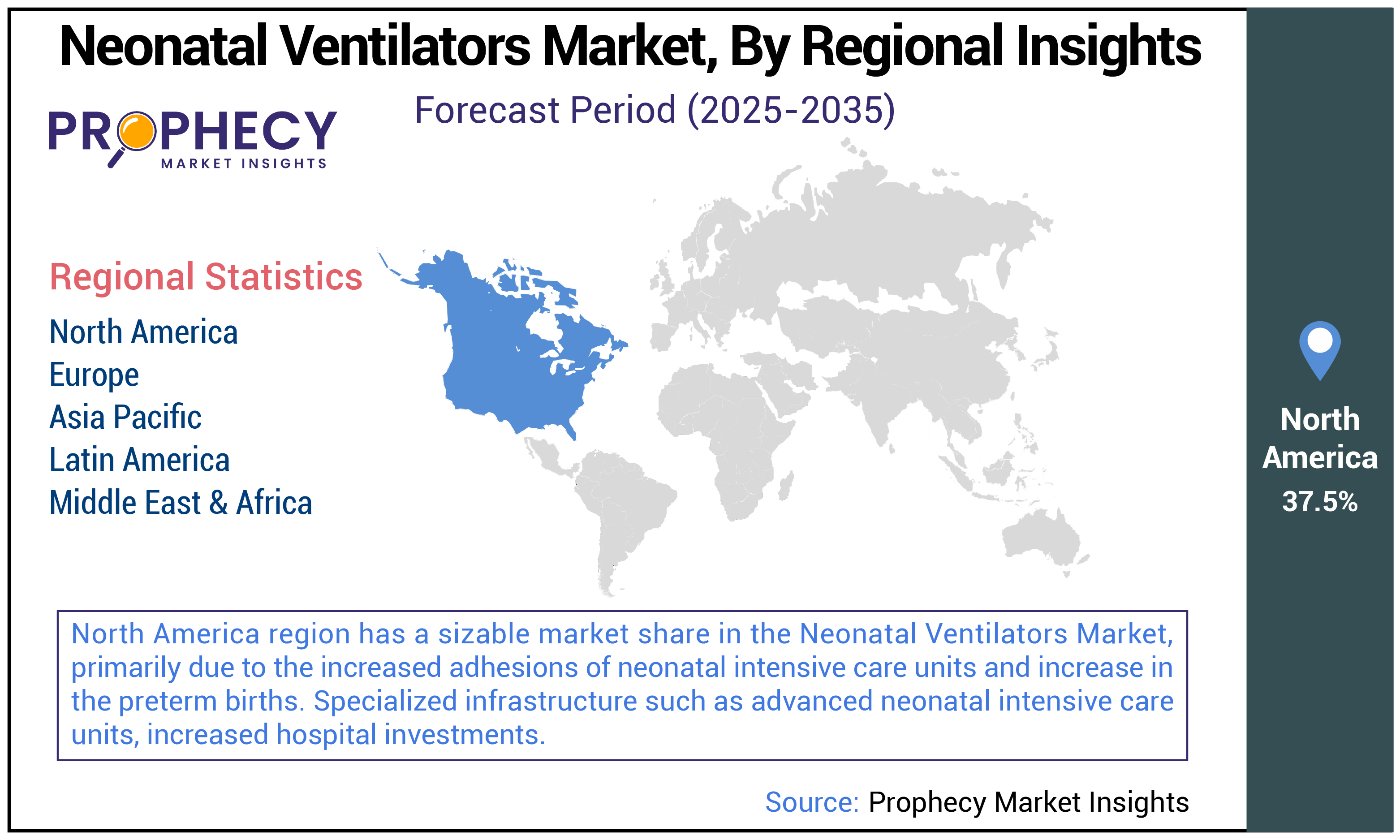
Geographically, the neonatal ventilators market is studied across North America, Europe, Asia Pacific, Latin America, and the Middle East & Africa.
North America: This region has a sizable market share in the neonatal ventilators market, primarily due to the increased adhesions of neonatal intensive care units and increase in the preterm births. Specialized infrastructure such as advanced neonatal intensive care units, increased hospital investments, and the existence of the advanced respiratory care facilities in the U.S. and Canada have aided in the adoption of intelligent ventilators. Clinical focus on the adaptive, AI-integrated, non-invasive, and especially non-invasive ventilation modes also add to the demand, particularly in tertiary care centers.
- U.S. Neonatal Ventilators Market Insights:
The U.S. is the dominant market in North America as it takes the biggest share. The high number of neonatal intensive care units and heavy rate of preterm births ensures that the market is buoyant in demand of neonatal ventilators. Its leadership in the market can be attributed to its dedication to healthcare innovation as well as the fact that the nation spends a lot on healthcare.
Asia-Pacific: This market is the fastest-growing neonatal ventilator market due to rising birth rate, development in medical infrastructure, and growing concern on the neonatal health. The rapidly growing urbanization, increasing network of hospitals and the state efforts to curb the infant mortality are further fuelling the growth of the market.
- China Neonatal Ventilators Market Insights:
China leads Asia-Pacific in the development of its neonatal care facilities and the industry has flourished significantly. The government makes it a priority to enhance its healthcare services, and that along with the increased cases of preterm births and the inflated neonatal intensive care units, adds to the need of neonatal ventilators. Moreover, the rise in the usage of advanced medical technological applications and investment in healthcare in the country is facilitating the implementation of state-of-the-art neonatal ventilators in not only urban but also in semi-urban areas.
Europe: This region consists of a considerable market share in global neonatal ventilator market due to well-developed healthcare infrastructure, high neonatal care standards, and stable demand to advanced medical equipment. The presence of robust government regulations and high insurance penetration rates and constant investments in neonatal intensive care units facilitate the use of the latest ventilators in the region.
- Germany Neonatal Ventilators Market Insights:
Germany is the largest market in the European region, with a strong healthcare system and emphasis on medical technology, which supports the consumption of neonatal ventilators. The advanced respiratory support devices and solutions have a stable patient base as the country focuses on the increased number of neonatal outcomes with an expanded neonatal intensive care unit and integration of respiratory support equipment with advanced solutions.
Neonatal Ventilators Market Report Scope:
|
Attribute |
Details |
|
Market Size 2025 |
USD 432.9 Million |
|
Projected Market Size 2035 |
USD 663.0 Million |
|
CAGR Growth Rate |
5.3% (2025-2035) |
|
Base year for estimation |
2024 |
|
Forecast period |
2025 – 2035 |
|
Market representation |
Revenue in USD Million & CAGR from 2025 to 2035 |
|
Regional scope |
North America - U.S. and Canada Europe – Germany, U.K., France, Russia, Italy, Spain, Netherlands, and Rest of Europe Asia Pacific – China, India, Japan, Australia, Indonesia, Malaysia, South Korea, and Rest of Asia-Pacific Latin America - Brazil, Mexico, Argentina, and Rest of Latin America Middle East & Africa – GCC, Israel, South Africa, and Rest of Middle East & Africa |
|
Report coverage |
Revenue forecast, company share, competitive landscape, growth factors, and trends |
Segmentation:
By Product Type:
- Conventional Ventilators
- High-Frequency Ventilators
- Hybrid Ventilators
- Others
By Technique:
- Invasive Ventilator
- Non-Invasive Ventilator
By Ventilation Mode:
- Pressure Mode Ventilation
- Volume Mode Ventilation
- Hybrid Mode Ventilation
- High-Frequency Oscillatory Ventilation
- Others
By Technology:
- Mechanical Ventilators
- Electro-Pneumatic Ventilators
- Pneumatic Ventilators
- Volume Targeted Ventilators
- Others
By Interface:
- Nasal Cannulas
- Face Masks
- Endotracheal Tubes
- Others
By Application:
- Routine Neonatal Care
- Post-Operative Support
- Chronic Respiratory Management
- Respiratory Distress Syndrome Therapy
- Others
By End User:
- Hospitals
- Specialized Neonatal Care Units
- Pediatric Intensive Care Units
- Research Institutions
- Home Care Settings
- Others
By Region:
- North America
- U.S.
- Canada
- Europe
- Germany
- U.K.
- France
- Russia
- Italy
- Spain
- Netherlands
- Rest of Europe
- Asia Pacific
- China
- India
- Japan
- Australia
- Indonesia
- Malaysia
- South Korea
- Rest of Asia Pacific
- Latin America
- Brazil
- Mexico
- Argentina
- Rest of Latin America
- Middle East & Africa
- GCC
- Israel
- South Africa
- Rest of Middle East & Africa
Global Neonatal Ventilators Market By Competitive Landscape & Key Players
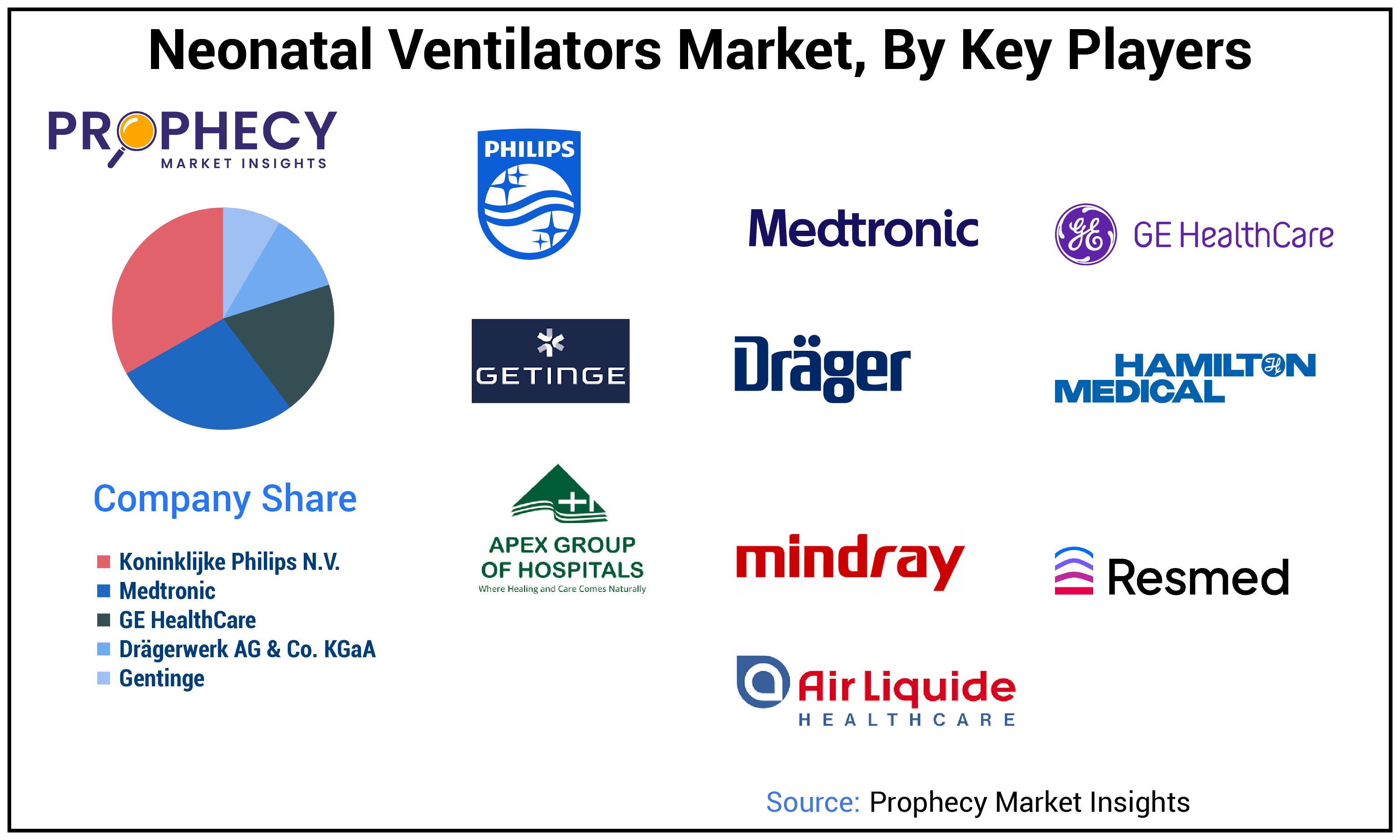
To spur consumption in the neonatal ventilator market, companies can launch new devices that have advanced features and are easy to use specifically designed to support premature and low-birth-weight infants. Research investments in AI-powered adaptive ventilation, portable, and telemedicine-compatible systems will increase the market. Also, strategic collaboration with hospitals and governments and training of neonatal staff can increase the use of devices as well as the positive neonatal care outcomes. The key players operating in the neonatal ventilators market include, Koninklijke Philips N.V., Medtronic, LÖWENSTEIN MEDICAL SE & CO. KG, Gentinge, Hamilton Medical, and others.
Neonatal Ventilators Market Companies:
- Koninklijke Philips N.V.
- Medtronic
- GE HealthCare
- Drägerwerk AG & Co. KGaA
- Gentinge
- Hamilton Medical
- Apex Group of Hospitals
- Fisher & Paykel Healthcare Limited
- LÖWENSTEIN MEDICAL SE & CO. KG
- AIR LIQUIDE MEDICAL SYSTEMS
- Metran Co., Ltd.
- RESMED.
- ZOLL Medical Corporation.
- Shenzhen Mindray Bio-Medical Electronics Co., Ltd.
- Bunnell 330 Cutler Drive
View an Additional List of Companies in the Neonatal Ventilators Market
Global Neonatal Ventilators Market By Recent News
- In late 2024, Europlaz in the U.K. introduced a cutting-edge?sidestream CO? sampling port integrated into their neonatal flow sensor, designed to enhance accuracy in ventilatory monitoring and support lung-protective strategies. This patented design allows for real-time CO? monitoring alongside flow measurements while significantly reducing dead space a critical factor in supporting delicate neonatal lungs.
- In June 2024, Dr. Satish Deopujari and his team in Nagpur developed an affordable open-source neonatal respiratory support device to provide compressed air not pure oxygen immediately after birth. This development targets a critical gap in neonatal care. In many Indian healthcare settings, infants are often given 100% oxygen, which can cause serious complications such as lung damage, brain injury, or retinopathy of prematurity (ROP).
Analyst View:
The neonatal ventilator market is growing due to rising preterm births, respiratory care advancements, and neonatal intensive care unit investments. Smart and AI-integrated ventilators are being adopted, with North America leading due to advanced healthcare infrastructure. Emerging Asia-Pacific economies are gaining ground with low-cost solutions. The industry will benefit from digitized care models and predictive software.
More Related Reports
Paediatric Ventilators Market
Neonatal Intensive Care Respiratory Devices Market
Volume Mode Ventilators Market
Mid-end ICU Ventilators Market
Non-Invasive Ventilators Market
Global Neonatal Ventilators Market By Company Profile
|
Company Name |
LÖWENSTEIN MEDICAL SE & CO. KG |
|
Headquarter |
Bad Ems, Germany |
|
CEO |
Benjamin Löwenstein |
|
Employee Count |
3,400 Employees |
Global Neonatal Ventilators Market By Highlights
FAQs
Neonatal ventilators market size was valued at USD 432.9 Million in 2025 and is expected to reach USD 663.0 Million by 2035 growing at a CAGR of 5.3%.
Product type, technique, ventilation mode, technology, interface, application and region are the divisions of the neonatal ventilators market.
North America, Asia Pacific, Europe, Latin America, and the Middle East& Africa. North America is expected to dominate the market.
The key players operating the neonatal ventilators market include Koninklijke Philips N.V.,Medtronic, GE HealthCare, Drägerwerk AG & Co. KGaA, Gentinge, Hamilton Medical, Apex Group of Hospitals, FISHER & PAYKEL HEALTHCARE LIMITED, LÖWENSTEIN MEDICAL SE & CO. KG, AIR LIQUIDE MEDICAL SYSTEMS, Metran Co., Ltd., RESMED., ZOLL Medical Corporation., Shenzhen Mindray Bio-Medical Electronics Co., Ltd., and Bunnell 330 Cutler Drive.