Global Midend ICU Ventilators Market Overview
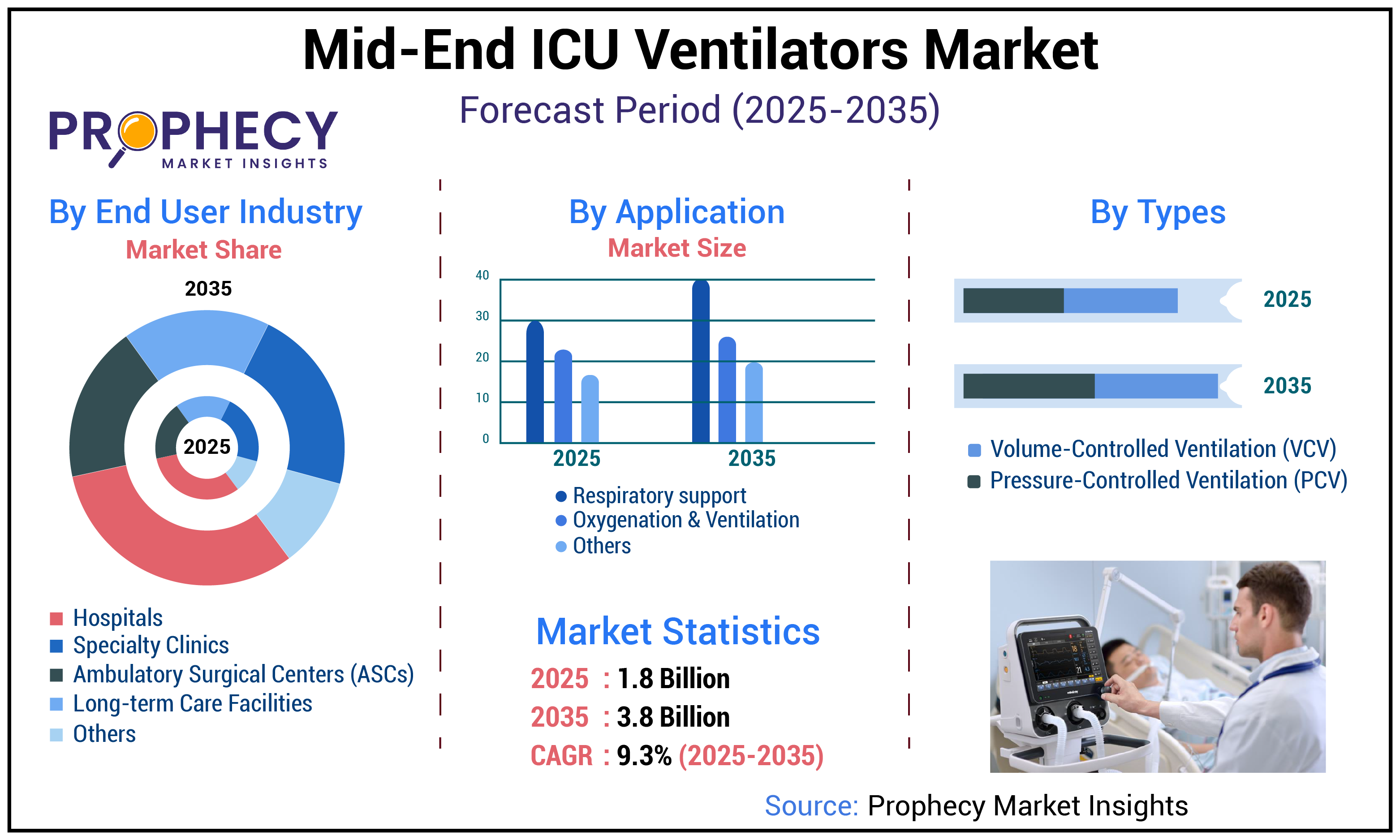
- By 2035, the mid-end ICU ventilators market size is contemplated to enlarge at a valuation of USD 3.8 Billion.
- In 2024, the mid-end ICU ventilators market valuation was USD 1.5 Billion.
- Mid-end ICU ventilators market is developing at a CAGR of 9.3%.
An ICU ventilators is a life-support device used in intensive care units to help patients breathe when they are unable to do so on their own. It delivers controlled oxygen and airflow to support or replace spontaneous breathing. A mid-end ICU ventilators offers a balance between basic and advanced features, making it ideal for standard critical care. It helps by providing reliable respiratory support with multiple ventilation modes and monitoring capabilities, without the high cost of premium systems.
The rising incidence of respiratory conditions, including chronic obstructive pulmonary disease (COPD) and acute respiratory distress syndrome (ARDS), continues to fuel demand for ventilators. The COVID-19 pandemic underscored the need for scalable, high-performance ventilation solutions, leading to a surge in innovation and adoption. Real-time monitoring, adaptive settings, and improved safety protocols are among the technological advancements that have broadened the use of ventilators in various healthcare environments. At the same time, the development of healthcare infrastructure in emerging economies such as India and China, along with an increased awareness of critical care standards, is fueling ongoing market growth.
The market for mid-end ICU ventilators is set to grow substantially, fueled by new developments in telehealth integration and remote monitoring. To enhance clinical workflows, manufacturers are concentrating on creating devices that are more intelligent and user-friendly, with seamless connections to electronic health records. These innovations will make it possible to modify treatments in real time and improve the management of patients remotely, culminating in improved outcomes.
Tariff Analysis:
- Due to tariffs and unpredictable trade rules, especially between the U.S. and China, companies have begun prioritizing local production over global exports in 2025. In order to maintain their competitiveness, leading companies in the medical device sector are establishing manufacturing facilities in crucial markets instead of depending on international shipments.
- A supply chain that is more focused on the region and has fewer dependencies on global trade. This assists companies in avoiding tariff risks; however, it also results in greater variation in the pricing and availability of mid-range ventilators based on location.
Impact of Generative AI on Mid-end ICU Ventilators Market:
- While traditional AI already improves ventilators through real-time monitoring and predictive maintenance, generative AI takes this further by creating synthetic medical data for training algorithms, simulating diverse clinical scenarios, and enabling customized patient care recommendations. Generative AI speeds up design innovation for mid-end ventilators, reducing the cost of advanced features.
Global Midend ICU Ventilators Market Drivers & Restraints
Key Drivers:
Adaptive Ventilation Modes Gain Traction in Mid-End ICU Ventilators Market with Patient-Centered Innovations
Adaptive ventilation modes, which automatically modify ventilation parameters based on the patient's current breathing needs, are becoming more and more popular in the mid-end intensive care unit ventilators market. By continuously observing and reacting to variations in the patient's breathing patterns, these modes maximize respiratory support, enhancing patient comfort and safety, lowering the risk of ventilators-induced lung injury, and making the transition off of mechanical ventilation simpler. Additionally, this technology lessens the strain for intensive care unit staff, freeing up doctors to concentrate on other crucial facets of patient care.
- For instances, the UVENT-S ICU ventilators, it includes intelligent adaptive modes such as AdVent and ProVent, is a modern example. AdVent uses lung protection techniques by maintaining a predetermined minute ventilation and modifying support in response to the patient's spontaneous breathing efforts. ProVent automatically adjusts ventilation parameters to further improve care.
Restraints:
Rising Manufacturing Costs Challenge Pricing and Innovation in the ICU Ventilators Market
The economic burden on manufacturers has increased as a result of global supply chain disruptions and rising raw material, component, and logistical prices. Companies are finding it difficult to maintain competitive pricing while adhering to quality and regulatory standards as a result of these increasing manufacturing costs, particularly in regions where consumers are price-sensitive. Profitability and market reach may be impacted by this dynamic, which may restrict vendors' capacity to grow or make investments in additional technological innovation.
- Counterbalance Statements: Businesses must put strong cybersecurity measures in place to mitigate these risks, including network segmentation, secure authentication procedures, end-to-end data encryption, and frequent software updates. Adopting industry frameworks and standards for data protection, staff education, and compliance monitoring also contributes to the safe and moral application of IoT technology in logistics.
Opportunities & Trends:
Specialized Mid-End ICU Ventilators Open Up New Markets for Long-Term Care and Emergency Care
The mid-end ICU ventilators market presents significant opportunities through the development of specialized ventilators designed for niche applications, such as emergency transport and long-term respiratory care. These targeted devices cater to the unique needs of patients requiring portable and robust ventilation during transfers and those needing sustained respiratory support outside acute ICU settings. Additionally, the integration of advanced features such as smart monitoring, remote patient management capabilities, and adaptable ventilation modes allows vendors to address diverse clinical scenarios and improve patient outcomes.
Global Midend ICU Ventilators Market Segmentations & Regional Insights
By types, mode, mobility, application, end user industry and region are the divisions of the mid-end ICU ventilators market.
By Types:
In regards to types the market for mid-end ICU ventilators is segmented into volume-controlled ventilation (VCV), and pressure-controlled ventilation (PCV). Volume-controlled ventilation (VCV) is the most dominant ventilation mode in mid-end ICU ventilators market share.
VCV is preferred as it delivers a preset tidal volume to the patient consistently, ensuring stable and predictable ventilation, which is crucial for managing diverse respiratory conditions in critical care.
The second most dominant mode is pressure-controlled ventilation (PCV). PCV delivers airflow at a preset pressure, allowing for more natural lung expansion and potentially reducing the risk of ventilators-induced lung injury. It is favored for patients with compromised lung compliance and offers benefits in terms of patient comfort and synchrony with the ventilators.
By Mode:
Based on the Mode, the mid-end ICU ventilators market is divided into invasive, and non-invasive. Invasive type has the biggest mid-end ICU ventilators market share. This dominance is due to the critical role invasive ventilators play in managing patients with severe respiratory failure, acute respiratory distress syndrome (ARDS), and other complex conditions that require precise and controlled mechanical ventilation. Invasive ventilators offer direct airway access, allowing for more dependable control over ventilation parameters such as oxygen delivery, pressure, and tidal volume.
In the market, non-invasive ventilation is the second most popular product. Patients with mild respiratory distress or chronic illnesses including COPD and sleep apnea are increasingly choosing less intrusive respiratory support methods, which is driving its rise.
By Mobility Type:
Based on the mobility, the mid-end ICU ventilators market is divided into portable and non-portable. Non-portable ventilators are currently the most common type in the mid-range ICU ventilators market growth. Their established presence in fixed intensive care unit (ICU) settings, where critically ill patients need constant, sophisticated, and high-acuity respiratory support, is largely responsible for their domination.
Due to the increasing need for flexible respiratory support outside of conventional intensive care units, portable ventilators currently hold the second-dominant position. As portable ventilators allow essential treatment during patient transport, emergency response, and home or step-down care, the COVID-19 pandemic pushed their acceptance.
By Application:
According to the application, the mid-end ICU ventilators market is divided into respiratory support, oxygenation & ventilation, and others. Respiratory assistance is the most common use for mid-range ICU ventilators. This dominance results from the urgent need to treat patients in intensive care units who have acute lung injuries, severe respiratory failure, and other life-threatening diseases. Complete mechanical ventilation is provided by respiratory support ventilators to guarantee proper oxygen delivery and carbon dioxide elimination, both of which are critical for patient survival.
The second-largest use is oxygenation & ventilation, it’s focused specifically on oxygenation and ventilation cater to patients requiring targeted oxygen therapy or less invasive forms of ventilators assistance, often in transitional care or less critical settings.
By End User Industry:
Hospitals, ambulatory surgical centers (ASCS), specialty clinics, long-term care facilities, and others are end user industry on which mid-end ICU ventilators market is categorized. Hospitals lead due to their critical role in handling severe and acute respiratory cases that require intensive monitoring and advanced ventilators support. The high patient volume, well-established ICU infrastructure, specialized personnel, and resources in hospitals drive the extensive adoption of mid-end ICU ventilators.
Long-term care facilities and specialist clinics make up the second-largest end user sector. The need for mid-range intensive care unit ventilators has increased as a result of specialty clinics' expansion of their service offerings to cover critical and emergency care. The growing number of elderly people and the growing number of chronic respiratory conditions that need ventilators support outside of hospitals are driving growth in long-term care institutions.
Regional Insights:
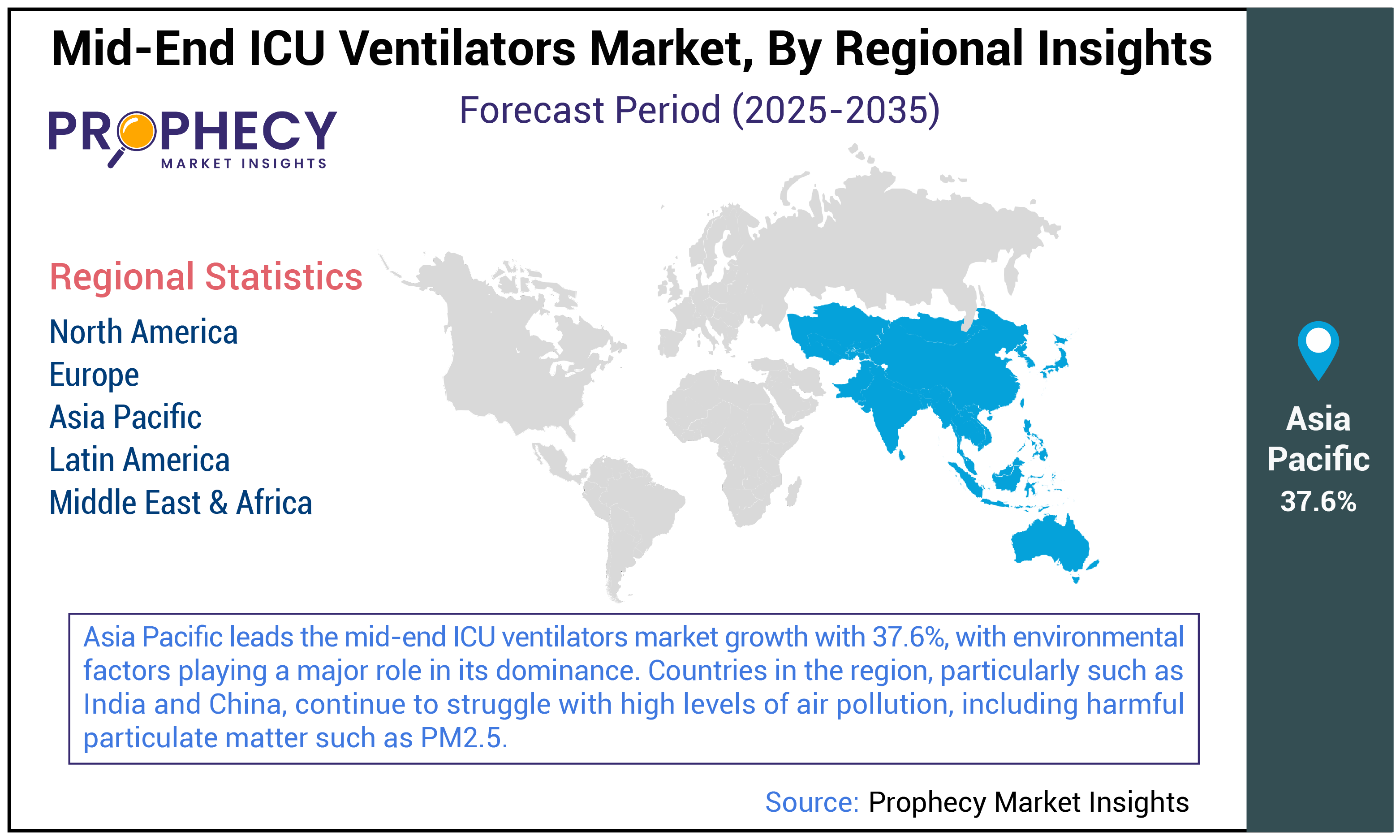
Geographically, the mid-end ICU ventilators market is studied across North America, Europe, Asia Pacific, Latin America, and the Middle East & Africa.
Asia Pacific: In 2025, Asia Pacific leads the mid-end ICU ventilators market growth with 37.6%, with environmental factors playing a major role in its dominance. Countries in the region, particularly such as India and China, continue to struggle with high levels of air pollution, including harmful particulate matter such as PM2.5. This persistent exposure to polluted air significantly increases the incidence of respiratory illnesses such as asthma, COPD, and other lung-related conditions. As a result, the demand for ventilators support in hospitals and ICUs has surged, making respiratory care technologies such as mid-end ICU ventilators essential to managing the growing health burden.
- India Mid-end ICU Ventilators Market Insights:
India leads the Asia-Pacific mid-end ICU ventilators market share, largely due to its severe air pollution and rapidly growing respiratory disease burden. Urbanization and industrial expansion have significantly worsened air quality, resulting in elevated levels of PM2.5 and PM10 that contribute to a surge in COPD, asthma, and other pulmonary conditions directly increasing demand for ventilators support
North America: Due to its advanced healthcare infrastructure, high rates of intensive care unit admissions, and substantial government spending, North America comes in second. The COVID-19 pandemic's aftermath and the prevalence of chronic respiratory disorders have maintained a high demand for mid-range intensive care unit ventilators. Widespread acceptance of technical advancements and strong reimbursement programs that improve ventilators accessibility in hospitals and critical care units benefit the region.
- U.S. Mid-end ICU Ventilators Market Insights:
Due to increased knowledge of respiratory treatment after the COVID-19 epidemic, the United States continues to dominate the mid-end ICU ventilators market. Due to the high number of intensive care unit admissions and the large percentage of patients who need mechanical ventilation, the nation has placed a strong priority on ventilators technology innovation, including tele-ICU integration and smart adaptive modes.
Europe: This region is also a significant market player with steady growth driven by an aging population and increasing ICU admissions requiring mechanical ventilation. Countries such as Germany, the UK, and France contribute substantially to market demand. Regulatory standards promoting high-quality critical care and increasing awareness about respiratory health reinforce the growth of the mid-end ICU ventilators market in Europe
- Germany Mid-end ICU Ventilators Market Insights:
Germany is a major regional player and a leader in the mid-end ICU ventilators industry in Europe. Its solid hospital infrastructure, cutting-edge healthcare system, and rising ICU admissions are all contributing to its great growth. About 42% of the 2.1 million ICU admissions that occur in Germany each year involve patients who need mechanical breathing.
Mid-end ICU Ventilators Market Report Scope:
|
Attribute |
Details |
|
Market Size 2025 |
USD 1.8 Billion |
|
Projected Market Size 2035 |
USD 3.8 Billion |
|
CAGR Growth Rate |
9.3% (2025-2035) |
|
Base year for estimation |
2024 |
|
Forecast period |
2025 – 2035 |
|
Market representation |
Revenue in USD Billion & CAGR from 2025 to 2035 |
|
Regional scope |
North America - U.S. and Canada Europe – Germany, U.K., France, Russia, Italy, Spain, Netherlands, and Rest of Europe Asia Pacific – China, India, Japan, Australia, Indonesia, Malaysia, South Korea, and Rest of Asia-Pacific Latin America - Brazil, Mexico, Argentina, and Rest of Latin America Middle East & Africa – GCC, Israel, South Africa, and Rest of Middle East & Africa |
|
Report coverage |
Revenue forecast, company share, competitive landscape, growth factors, and trends |
Segmentation:
By Types:
- Volume-Controlled Ventilation (VCV)
- Pressure-Controlled Ventilation (PCV)
By Mode:
- Invasive
- Non-Invasive
By Mobility Type:
- Portable
- Non-Portable
By Application:
- Respiratory support
- Oxygenation & Ventilation
- Others
By End User Industry:
- Hospitals
- Ambulatory Surgical Centers (ASCs)
- Specialty Clinics
- Long-term Care Facilities
- Others
By Region:
- North America
- U.S.
- Canada
- Europe
- Germany
- U.K.
- France
- Russia
- Italy
- Spain
- Netherlands
- Rest of Europe
- Asia Pacific
- China
- India
- Japan
- Australia
- Indonesia
- Malaysia
- South Korea
- Rest of Asia Pacific
- Latin America
- Brazil
- Mexico
- Argentina
- Rest of Latin America
- Middle East & Africa
- GCC
- Israel
- South Africa
- Rest of Middle East & Africa
Global Midend ICU Ventilators Market Competitive Landscape & Key Players
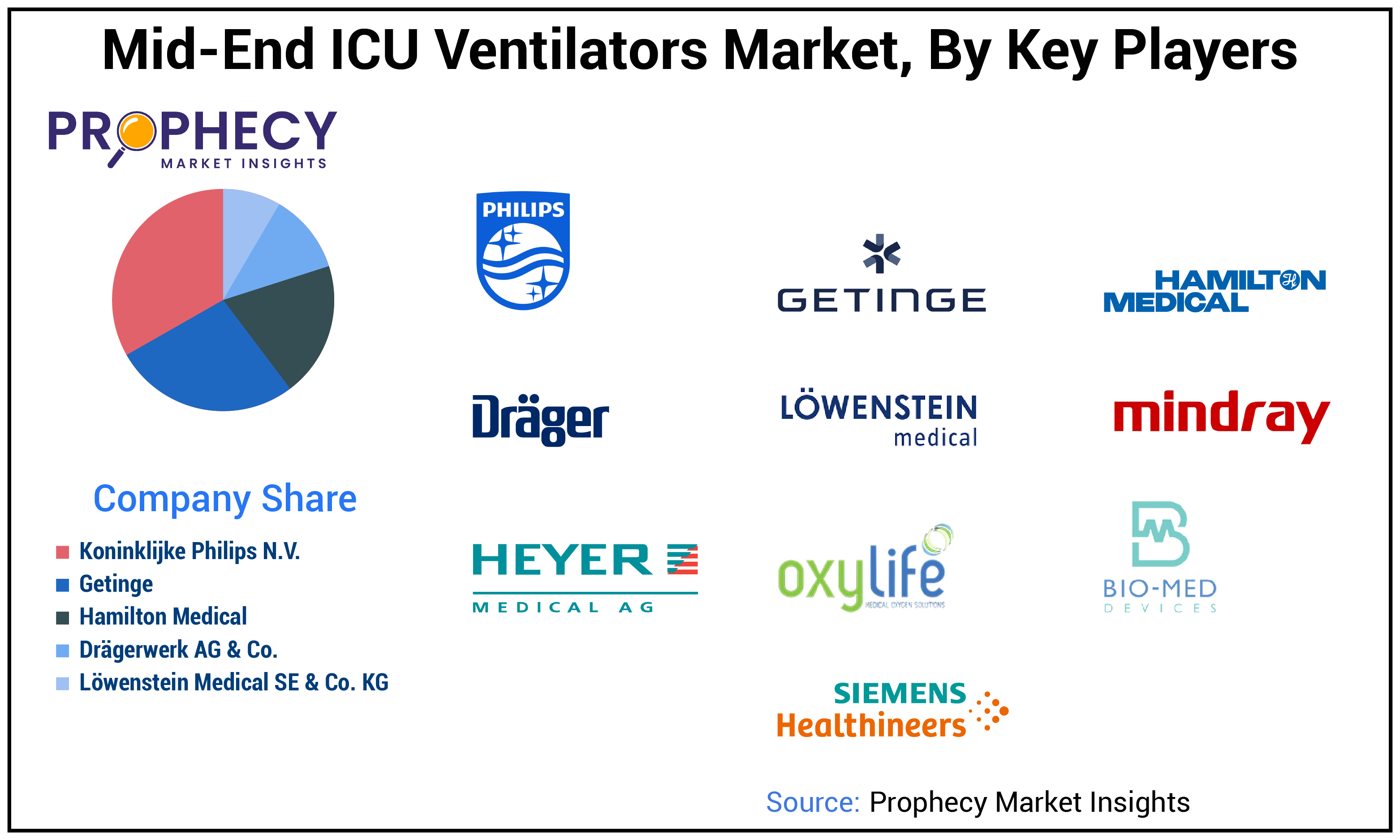
The key players operating in the mid-end ICU ventilators market include, Koninklijke Philips N.V., Getinge, Hamilton Medical, Drägerwerk AG & Co. To increase productivity and satisfy evolving consumer demands, companies in the mid-end ICU ventilators market should prioritize the implementation of cutting-edge technologies such as IoT-enabled smart monitoring, AI-driven adaptive ventilation modes, and telemedicine integration. Forming reliable alliances and partnerships can strengthen their market presence and accelerate innovation cycles.
Mid-end ICU Ventilators Market Companies:
- Koninklijke Philips N.V.
- Getinge
- Hamilton Medical
- Drägerwerk AG & Co.
- Löwenstein Medical SE & Co. KG
- Mindray Medical India Pvt. Ltd.
- Beijing Aeonmed Co., Ltd.
- heyer medical AG
- Bio-Med Devices
- Oxylife
- HERSILL
- Siemens Healthineers Private Limited
- eVent Medical
- Metran Co., Ltd.
- Penlon
View an Additional List of Companies in the Mid-end ICU Ventilators Market
Global Midend ICU Ventilators Market Recent News
- In December 2024, Drägerwerk AG, a leading global medical technology company, announced the launch of its new mid-end ICU ventilators models Evita V600 and V800. In order to support everyday ICU clinical duties more effectively and improve patient outcomes in critical care settings, these ventilators have improved patient monitoring capabilities, sophisticated automated ventilation modes, and modular designs.
- In March 2025, Philips Healthcare unveiled its latest mid-end ICU ventilators equipped with AI-powered adaptive ventilation technology. By automatically modifying breathing parameters in response to real-time patient data, this solution optimizes respiratory support while lowering clinician workload and improving individualized patient care. Additionally, the ventilators easily interfaces with remote monitoring systems, enabling tele-ICU applications in a range of medical settings.
Analyst View:
The market for mid-range intensive care unit ventilators is expected to expand steadily due to the COVID-19 pandemic's aftermath, aging populations, and the rising incidence of respiratory disorders. Clinical results and operational efficiency are being enhanced by technological developments such as AI-powered adaptive ventilation, better patient monitoring, and integration with telehealth platforms. Rapid urbanization, rising healthcare spending, and environmental issues such as air pollution that aggravate respiratory ailments have caused Asia Pacific to lead the world in regional growth. With the help of well-established healthcare systems and ongoing innovation, North America and Europe come in second and third. Furthermore, the integration of IoT, AI, and remote monitoring capabilities will facilitate real-time decision-making and predictive maintenance, streamlining operations and reducing costs.
More Related Reports
Paediatric Ventilators Market
ICU Beds Market
Volume Mode Ventilators Market
Neonatal Ventilators Market
Non-invasive Ventilators Market
Global Midend ICU Ventilators Market Company Profile
|
Company Name |
Löwenstein Medical SE & Co. KG |
|
Headquarter |
Bad Ems, Germany |
|
CEO |
Benjamin Löwenstein |
|
Employee Count |
3,400 Employees |
Global Midend ICU Ventilators Market Highlights
FAQs
Mid-end ICU ventilators market size was valued at USD 1.8 Billion in 2025 and is expected to reach USD 3.8 Billion by 2035 growing at a CAGR of 9.3%.
Types, mode, mobility, application, end user industry, and region are the segmentation for the target market.
North America, Asia Pacific, Europe, Latin America, and the Middle East& Africa North America is expected to dominate the market.
The key players operating the mid-end ICU ventilators market include Koninklijke Philips N.V., Getinge, Hamilton Medical, Drägerwerk AG & Co.,Löwenstein Medical SE & Co. KG, Mindray Medical India Pvt. Ltd., Beijing Aeonmed Co., Ltd., heyer medical AG, Bio-Med Devices, Oxylife,HERSILL, Siemens Healthineers Private Limited, eVent Medical, Metran Co., Ltd., and Penlon.