Generative Ai Market Overview
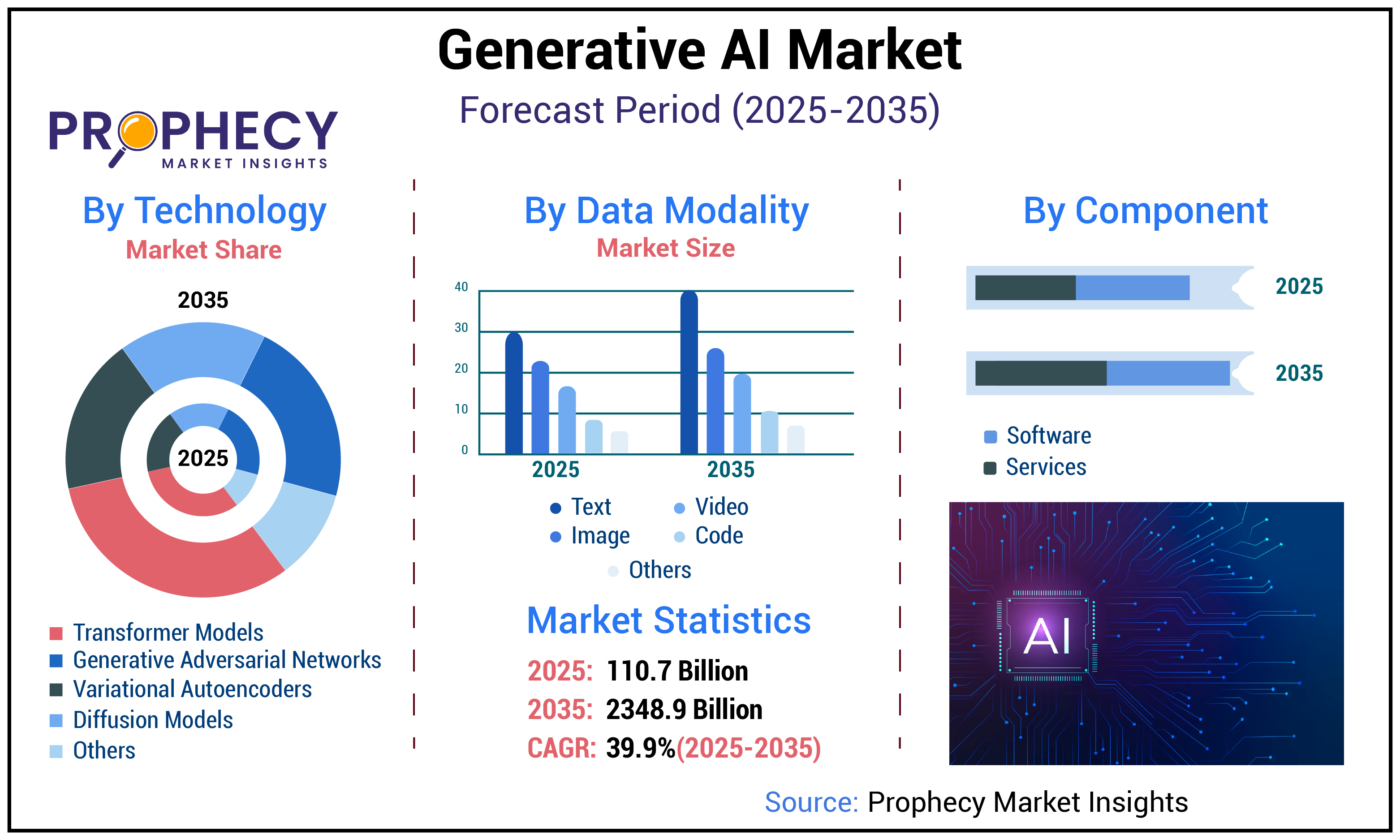
- By 2035, the generative AI market size is contemplated to enlarge at a valuation of USD 2348.9 Billion.
- In 2024, the generative AI market valuation was USD 69.8 Billion.
- Generative AI market is developing at a CAGR of 39.9%.
Generative Al is a variant of machine intelligence that is capable of developing brand-new material that includes not only text, but also pictures, music, computer code, and videos by recognizing patterns in the original data with the use of technologies such as GANs, transformers, and diffusion networks. The major benefits that it brings are an increase in creativity, quicker content creation, reduced costs, customized customer experiences, and the optimization of the various industries that include marketing, healthcare, entertainment, and software development.
The expansion of the generative Al market is primarily fueled by the need for automated content creation, the growing use of Al-driven tools in various sectors, the progress of machine learning models (such as transformers and GANs), and the increased accessibility of high-performance computing and cloud infrastructure. In addition, the demand for tailored customer experiences, lowering the cost of creative processes, and broadening use cases in such sectors as healthcare, media, and finance are the key drivers of its fast global adoption.
Generative Al market is growing significantly. As the increased demand for the creation of automated content. In addition, the use of Al tools in various sectors has also propelled the growth of the market. The development of machine learning models such as transformers and GANs has also contributed to the advancement of the Al market. The rapid expansion of generative Al technologies is being driven by multiple factors. Personalization of customer experiences, as well as cost reduction in creative processes, are two of the main motivators. Moreover, the adoption of generative Al is also becoming more widespread as a result of the growing number of use cases in various industries such as healthcare, media, and finance.
Generative AI’s Impact on Productivity:
- The Productivity boost from generative AI has the potential to boost the world economy by trillions of dollars. According to recent study by McKinsey & Company, generative AI might contribute between USD 2.6 trillion and USD 4.4 trillion yearly across the 63 use cases we examined; in contrast, the UK's total GDP in 2021 was USD 3.1 trillion. This would result in a 15–40% rise in the overall influence of artificial intelligence.
- Additionally, depending on the pace of technology adoption and worker time reallocation to other pursuits, generative AI may allow labor Softwareivity growth of 0.1 to 0.6 percent each year through 2040. Work automation might increase Softwareivity by 0.5 to 3.4 percentage points a year when generative AI is combined with all other technologies.
Generative Ai Market Drivers & Restraints
Key Drivers:
Rising Adoption of Generative AI can Drive the Growth of the Market
Generative Al adoption is speeding up in all kinds of industries. Companies want to increase creativity, make their processes more efficient, and provide tailor-made experiences to their customers. To save time and money, businesses are employing generative Al-powered tech to create content, develop software, support customers, and design software. When businesses implement Al in different areas, technology is finding new ways to solve problems. For example, the use of Al for ads is helping the marketing teams to make their work better and faster. On the other hand, the application of Al for health has been bringing good results in the identification of new diseases and the creation of new medicine. Moreover, the availability of Al using cloud computing and Al-as-a-Service models is attracting large, mid-size, and small companies to use Al.
- For Instance, according to the data published by McKinsey & Company, 78% of respondents say their organizations use AI in at least one business function, up from 72% n early 2024 and 55% a year earlier (Exhibit 8). Respondents most often report using the technology in the IT and marketing and sales functions, followed by service operations. The business function that saw the largest increase in AI use in the past six months is IT, where the share of respondents reporting AI use jumped from 27% to 36%.
Restraints:
Data Privacy and Security Concerns can Hampered the Growth of the Market
Generative Al models often use large datasets that contain sensitive, personal, or proprietary information. This situation leads to data privacy, unauthorized access, and misuse of the data being the main concerns. In the event that such systems are not secured properly, they may leak confidential data or even create new content, which at times, could be in violation of privacy laws or corporate policies.
- Counterbalance Statements: Organizations need to take some serious steps to mitigate the concerned issues raised. Firstly, they should strictly govern the data they handle. Anonymized and encrypted data collections can be safer. Also, adopting secure model training environments can assure safety. Compliance with laws such as GDPR and HIPAA is critical for the responsible and ethical use of Al.
Opportunities & Trends:
Growing Use of AI in Virtual Assistants & Chatbots as a Catalyst for Future Growth in Generative AI Market
One significant trend shaping the market is the growing use of generative Al in virtual assistants and chatbots. Companies are adopting this technology to provide interactions that are not only more as human but also context-aware and emotionally intelligent. Generative Al-powered assistants can do a lot more than traditional bots.
They are able to comprehend complex queries, create personalized responses, and keep learning from the users with whom they interact. As a result, customer engagement and support efficiency are highly improved. The necessity for generative Al in conversational interfaces will escalate exponentially as these frameworks are integrated in omnichannel service in sectors, such as healthcare, banking, e-commerce, and education.
Generative Ai Market Segmentations & Regional Insights
Component, technology, data modality, deployment mode, application, end user, and region are the divisions of the generative AI market.
By Component:
Software and services are offerings on which generative AI market is segmented. Due to the extensive usage of cutting-edge AI models and platforms that facilitate design automation, and content generation, software commands the biggest generative AI market share.
Since companies depend more and more on AI consultancy, integration, and support services to successfully implement and grow generative AI systems, services make up the second-dominant group. Alongside the fast development of software use, this market has been steadily developing due to the increasing demand for customization, training, and maintenance.
By Technology:
Based on the technology, the generative AI market is divided into transformer models, generative adversarial networks (GANs), variational autoencoders (VAEs), diffusion models, and others. Due to their outstanding performance in text generation, multimodal workloads, and natural language processing (NLP), Transformer models are the core technology with the biggest generative AI market share.
Due to their vital roles in clinical drug discovery, biomarker identification, and therapeutic protein research particularly in personalized medicine and immunological studies generative adversarial networks (GANs), Variational Autoencoders (VAEs), and diffusion models rank as the second-dominant sources.
By Data Modality:
Text, image, video, code, and others are data modality of the generative AI market. Since text serves as the basis for popular applications including chatbots, virtual assistants, content creation, and code completion tools such as ChatGPT, Jasper, and GitHub Copilot, it has the biggest market share in the generative AI space.
Due to its increasing use in design, advertising, gaming, and social media content Softwareion, image is the second most popular modality. Image-based generative AI is becoming more and more significant in the creative industry as a result of tools including DALL·E and Midjourney that are transforming the way people create images.
By Deployment Mode:
On the deployment mode, generative AI Market is categorized into cloud-based, and on-premises. Businesses of all sizes may access strong AI models without having to make significant infrastructure expenditures due to cloud-based deployment's scalability, flexibility, and cost-effectiveness, which accounts for the highest generative AI market share.
The second most popular deployment method is on-premises, which is favored by businesses with stringent requirements for data protection, compliance, or customization, including those in the financial, medical, or defense sectors, where complete control over data and model usage is essential despite greater setup costs.
By Application:
The generative AI market on the account of application are categorized into content creation, design & art, healthcare Drug Discovery, drug discovery, gaming, financial modeling & simulation, education & e-learning, software development, and others. Due to the extensive usage of AI tools for producing text, photos, music, and videos across marketing, media, advertising, and social media platforms, content creation commands the biggest generative AI market share.
The second most popular use is software development, which is driven by tools including CodeWhisperer and GitHub Copilot that help developers with code creation, bug fixes, and documentation. These tools greatly increase productivity and speed up the software development lifecycle.
By End User:
Media & entertainment, BFSI (Banking, Financial Services, and Insurance), healthcare, IT & telecommunication, automotive, retail & e-commerce, education, and others are end users of the generative AI market. Since media and entertainment heavily rely on content generation, including automated video creation, script authoring, music composition, and digital artwork, they occupy the highest generative AI market share.
Since businesses in this industry employ generative AI for code generation, network optimization, virtual assistants, and improving customer experience all of which spur innovation and operational efficiency throughout their services IT & telecommunications is the second-dominant sector.
Regional Insights:
Geographically, the generative AI market is studied across North America, Europe, Asia Pacific, Latin America, and the Middle East & Africa.
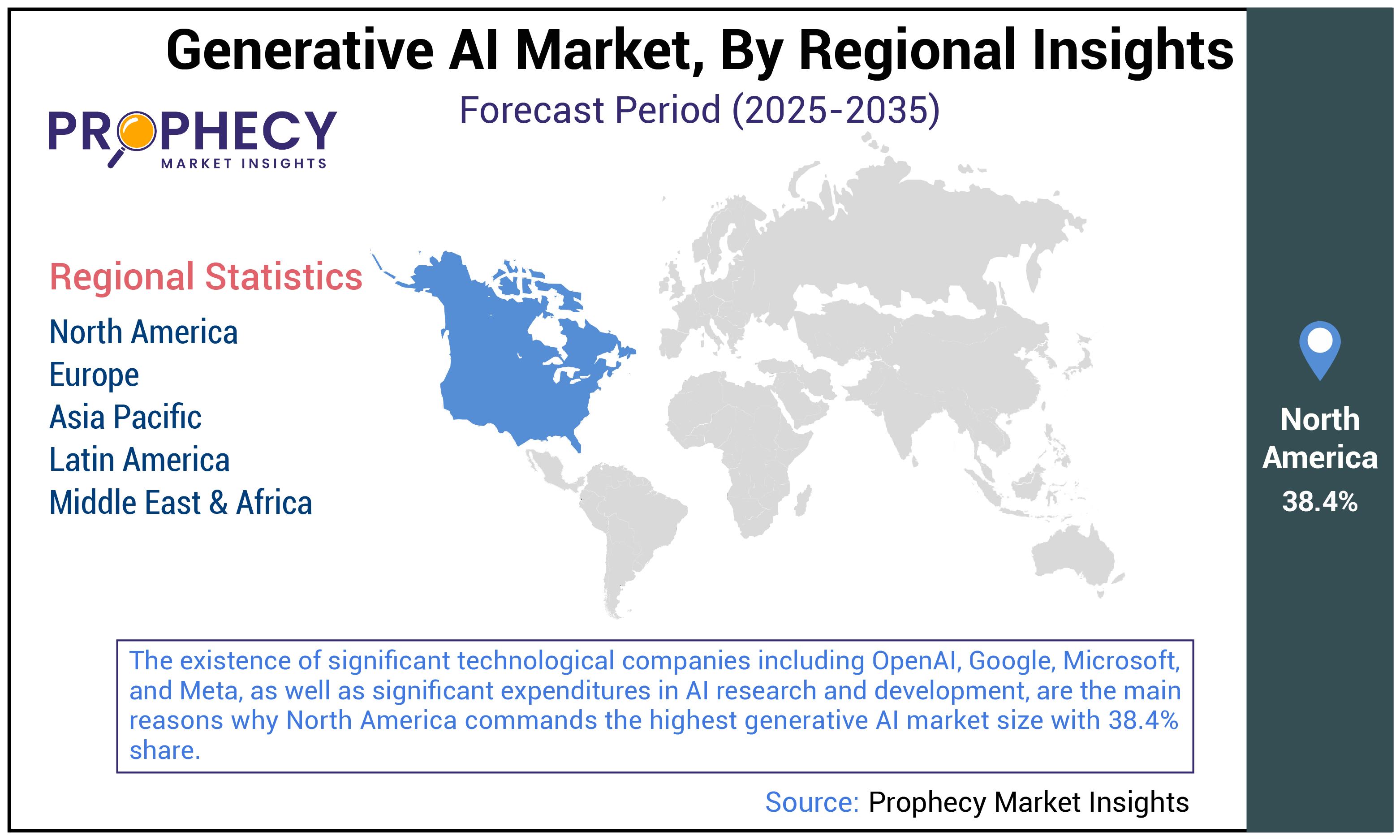
North America: The existence of significant technological companies including OpenAI, Google, Microsoft, and Meta, as well as significant expenditures in AI research and development, are the main reasons why North America commands the highest generative AI market size with 38.4% share. The region's leadership is further supported by its early embrace of cutting-edge technology, robust cloud infrastructure, and demand from industries including media, IT, and healthcare.
- U.S. Generative AI Market Insights:
Due to its robust ecosystem of AI startups, prominent tech companies notably OpenAI, Google, and Microsoft, significant R&D expenditures, a high concentration of competent labor, and cloud infrastructure, the United States leads the North American generative AI market.
Europe: The second-dominant region is Europe, fueled by rising government support for AI research, the expanding use of AI in the industrial, banking, and automotive sectors, as well as a significant emphasis on ethical AI development and data protection laws including GDPR.
- Germany Generative AI Market Insights:
Germany is the market leader in Europe due to its sophisticated manufacturing sector, robust automotive industry that uses AI for design and simulation, growing use of AI in enterprise software, healthcare, and industrial automation, as well as strong government support for AI innovation and digital transformation.
Asia Pacific: Due to growing digital transformation across industries, increased investment in AI research, expanding tech infrastructure, and rising demand for automation and personalized services in nations consisting of China, India, Japan, and South Korea, the generative AI market in Asia Pacific is expanding quickly.
- China Generative AI Market Insights:
China leads the APAC market thanks to its significant investments in AI, sophisticated computer infrastructure, government backing for AI leadership, and the development of competitive generative AI platforms by big tech firms including Baidu, Alibaba, and Tencent.
Generative AI Market Report Scope:
|
Attribute |
Details |
|
Market Size 2025 |
USD 110.7 Billion |
|
Projected Market Size 2035 |
USD 2348.9 Billion |
|
CAGR Growth Rate |
39.9% (2025-2035) |
|
Base year for estimation |
2024 |
|
Forecast period |
2025 – 2035 |
|
Market representation |
Revenue in USD Billion & CAGR from 2025 to 2035 |
|
Regional scope |
North America - U.S. and Canada Europe – Germany, U.K., France, Russia, Italy, Spain, Netherlands, and Rest of Europe Asia Pacific – China, India, Japan, Australia, Indonesia, Malaysia, South Korea, and Rest of Asia-Pacific Latin America - Brazil, Mexico, Argentina, and Rest of Latin America Middle East & Africa – GCC, Israel, South Africa, and Rest of Middle East & Africa |
|
Report coverage |
Revenue forecast, company share, competitive landscape, growth factors, and trends |
Segmentation:
By Component:
- Software
- 3D Content Generation
- Text Generation
- Others
- Services
- Training & Consulting
- System Integration
- Others
By Technology:
- Transformer Models
- Generative Adversarial Networks (GANs)
- Variational Autoencoders (VAEs)
- Diffusion Models
- Others
By Data Modality:
- Text
- Image
- Video
- Code
- Others
By Deployment Mode:
- Cloud-based
- On-premises
By Application:
- Content Creation
- Design & Art
- Healthcare Drug Discovery
- Drug Discovery
- Gaming
- Financial Modeling & Simulation
- Education & e-Learning
- Software Development
- Others
By End User:
- Media & Entertainment
- BFSI (Banking, Financial Services, and Insurance)
- Healthcare
- IT & Telecommunication
- Automotive
- Retail & E-commerce
- Education
- Others
By Region:
- North America
- U.S.
- Canada
- Europe
- Germany
- U.K.
- France
- Russia
- Italy
- Spain
- Netherlands
- Rest of Europe
- Asia Pacific
- China
- India
- Japan
- Australia
- Indonesia
- Malaysia
- South Korea
- Rest of Asia Pacific
- Latin America
- Brazil
- Mexico
- Argentina
- Rest of Latin America
- Middle East & Africa
- GCC
- Israel
- South Africa
- Rest of Middle East & Africa
Generative Ai Market Competitive Landscape & Key Players
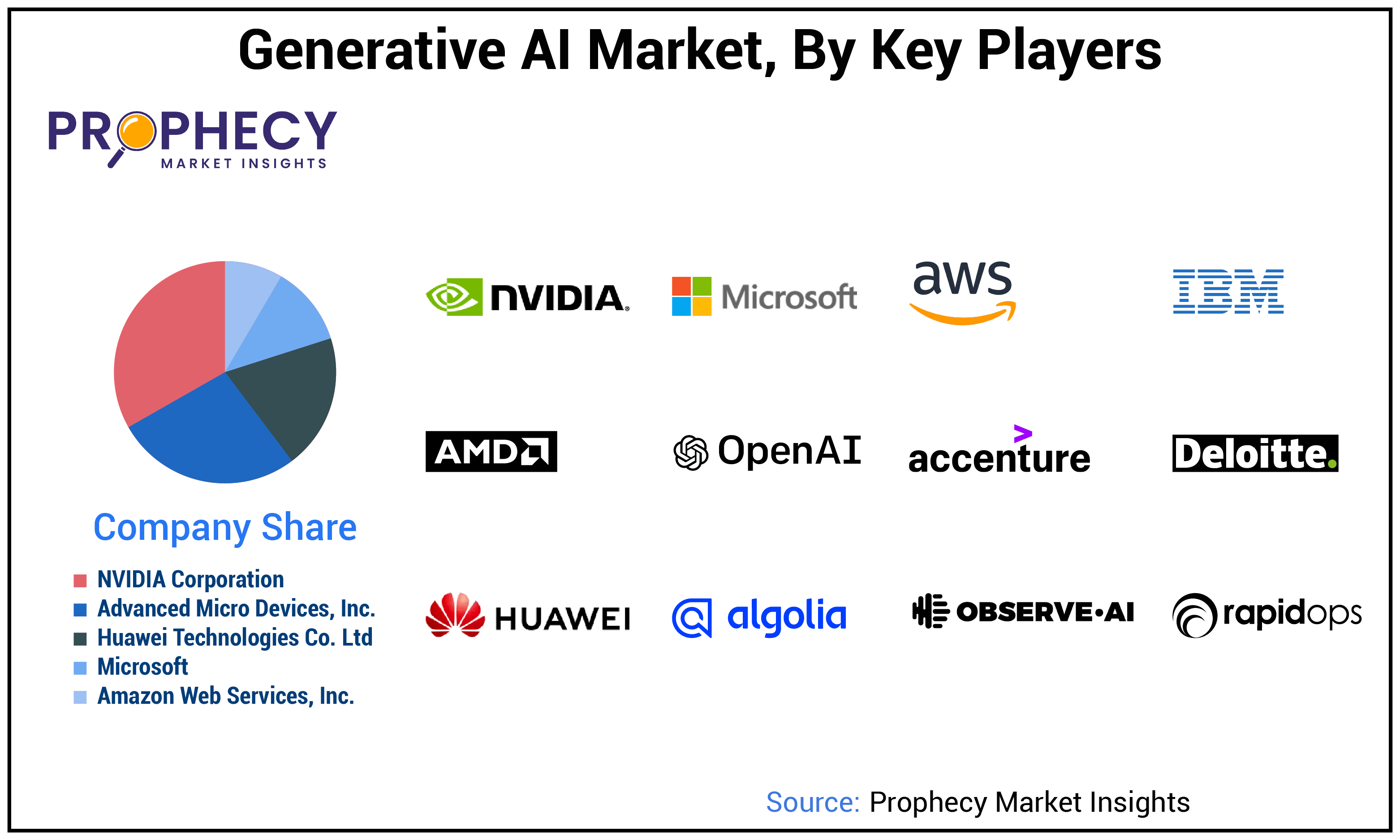
The key players operating in the generative AI market include, NVIDIA Corporation, Advanced Micro Devices, Inc., IBM, Amazon Web Services, Inc., OpenAI, and others. By developing AI models, broadening use cases across sectors, establishing strategic alliances, providing AI-as-a-Service, guaranteeing ethical and compliant AI, and focusing on international and emerging markets for broader adoption, generative AI firms are expanding.
Generative AI Market Companies:
- NVIDIA Corporation
- Advanced Micro Devices, Inc.
- Huawei Technologies Co. Ltd
- Microsoft
- Amazon Web Services, Inc.
- OpenAI
- Accenture
- Deloitte Global
- IBM
- OBSERVE.AI
- Algolia
- Rapidops Inc.
- Fable Inc
- Neoteric sp. z o.o.
- Suki AI, Inc.
View an Additional List of Companies in the Generative AI Market
Generative Ai Market Recent News
- In June 2025, Elsa, a generative artificial intelligence (AI) tool, was introduced by the U.S. Food and Drug Administration (FDA) to assist staff members, ranging from investigators to scientific reviewers, in working more productively. This cutting-edge solution uses AI capabilities and modernizes agency operations to better serve the American people.
- In February 2025, The Fujitsu Cloud Service Generative AI Platform was launched, according to a statement from the company. From automated code development to brainstorming and meeting minute production, generative AI delivers notable productivity advantages across a range of organizational operations.
- In January 2025, the next-generation Smart AI Agent from NTT DATA, a pioneer in digital business and IT services, has been launched globally. With an expected USD 2 billion in income from Smart AI Agent-related business by 2027, this cutting-edge AI tool is a key component of the company's goal to accelerate the adoption of Generative AI.
- In December 2024, Google Cloud has introduced two generative AI models, Veo and Imagen 3, on its Vertex AI platform. This comes as businesses using the technology are reportedly seeing a sharp increase in income. The development of Veo, the IT giant's most advanced video generating model to date, and Imagen 3, a cutting-edge text-to-image generation system, are the results of its most recent innovation push, which was motivated by this metric.
Analyst View:
The field of generative artificial intelligence (AI), which can produce fresh text, images, music, code, and videos, is growing quickly as a result of developments in diffusion models, transformers, and GANs. Its main advantages include more creativity, quicker content creation, cost effectiveness, and customized user experiences in fields including software development, marketing, and healthcare. The market is expected to develop as a result of enhanced machine learning models, higher use of AI technologies across industries, increased demand for automated content, and easier access to cloud and computer infrastructure.
More Related Reports
Metal 3D Printer Market
Generative AI in Cybersecurity Market
Artificial Intelligence (AI) in Life Sciences Market
AI in Healthcare Market
Generative AI in Animation Market
Generative Ai Market Company Profile
|
Company Name |
NVIDIA Corporation |
|
Headquarter |
Santa Clara, California, U.S. |
|
CEO |
Jen-Hsun Huang |
|
Employee Count |
36,000 Employees |
Generative Ai Market Highlights
FAQs
Generative AI market size was valued at USD 110.7 Billion in 2025 and is expected to reach USD 2348.9 Billion by 2035 growing at a CAGR of 39.9%.
Component, technology, data modality, deployment mode, application, end user, and region are the segmentation for the generative AI market.
North America, Asia Pacific, Europe, Latin America, and the Middle East & Africa. North America is expected to dominate the market.
The key players operating the generative AI market include NVIDIA Corporation, Advanced Micro Devices, Inc., Huawei Technologies Co. Ltd, Microsoft, Amazon Web Services, Inc., OpenAI, Accenture, Deloitte Global, IBM, OBSERVE.AI, Algolia, Rapidops Inc., Fable Inc, Neoteric sp. z o.o., and Suki AI, Inc.