Global Cross Laminated Timber Market Overview
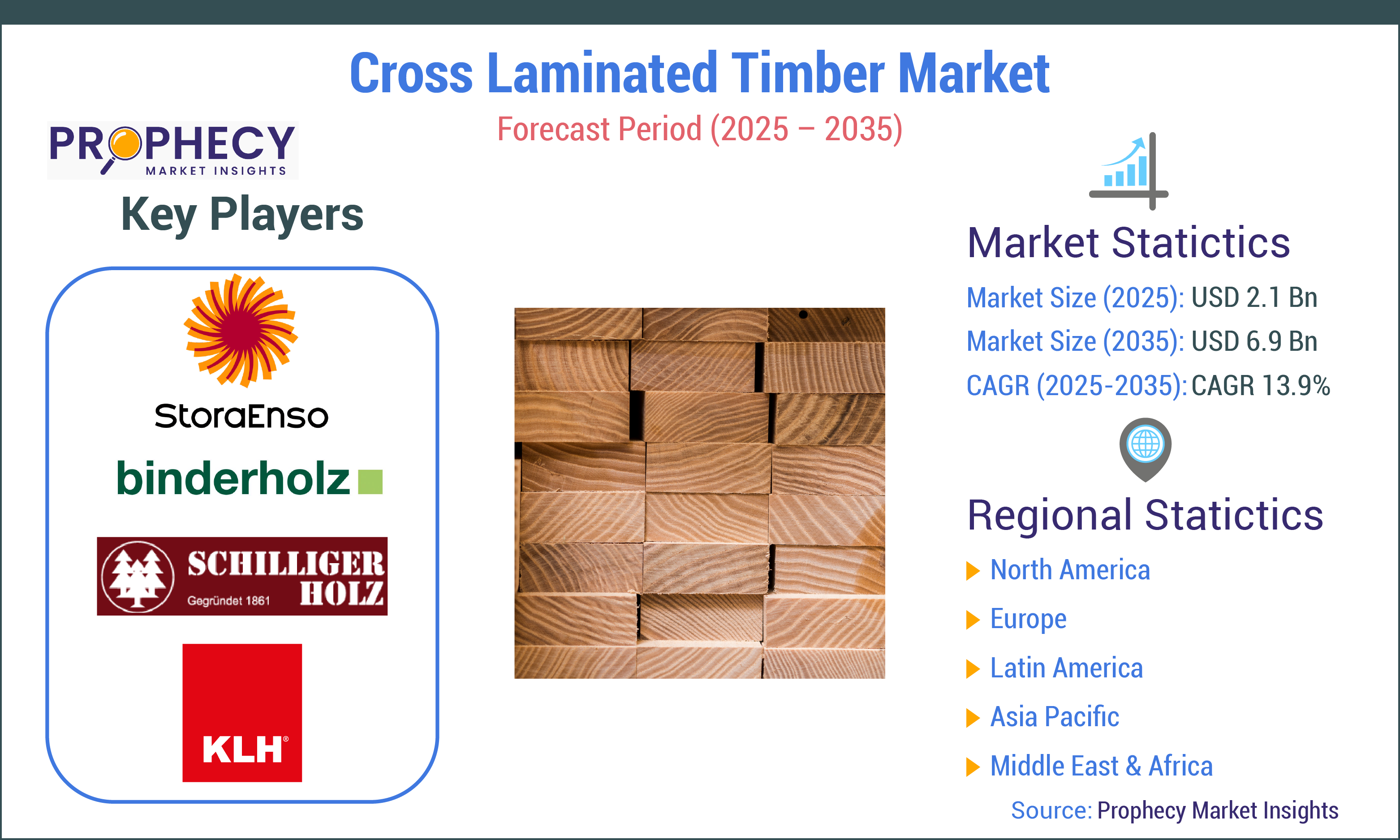
- By 2035, cross laminated timber market size is contemplated to enlarge at a valuation of USD 6.9 Billion.
- In 2024, the cross laminated timber market valuation was USD 1.8 Billion.
- Cross laminated timber market is developing at a CAGR of 13.9%.
The pre-assembled engineered wood lumber product known as cross laminated timber, or Cross Laminated Timber or XLam, is made up of more than two layers of structural composite or solid-sawn wood. In order to create a solid wood element, the layers are arranged so that the adjacent layers are cross-oriented and joined by mechanical fastening or glue. It was created in the European Alpine nations in the early 1990s and is currently a widely used building material in Europe. It is also becoming more and more well-liked in North America and Asia Pacific nations.
The CLT market is expanding because of the growing demand for sustainable building materials and a rising trend in adopting green building practices. The benefits of CLT, such as a great strength-to-weight ratio and lower carbon footprint, make CLT a great choice for contemporary architecture. The government's role in subsidizing sustainable infrastructure and building further increases CLT's market growth.
There is optimism for the future of cross-laminated timber as a result of a push for carbon neutral materials and sustainable buildings globally. Demand is expected to be expanded by engineered wood technology as well as an increasing use in mid- to high-rise construction. Construction applications around the world will also increase due to favorable regulations.
Recession Risk & Tariff Analysis:
- Economic slowdown can reshape construction activity, resulting in little to no demand for cross-laminated timber. A budget-constrained economy during recession periods may push construction companies to narrowly focus on less expensive traditional materials, simply delaying construction schedules of Cross Laminated Timber projects. Therefore, these economic fluctuations may impact Cross Laminated Timber profitability and also obfuscate long-term adoption of Cross Laminated Timber in the housing and commercial construction sectors.
- Economic tariffs on wood suppliers from either table point or aspects of the entire cross-laminated timber supply chain can increase the production costs of Cross Laminated Timber, limit imports and exports, and provide thereby hinder opportunities for consumption-based world market expansion and dissuade investment into Cross Laminated Timber production such as building new production plants. On the contrary, there are countries that are solely dependent on imported raw wood and will likely experience considerable price increases and scarcity issues.
Impact of Generative AI on Cross Laminated Timber Market:
- Generative AI tools support architects and engineers optimize cross-laminated timber building designs based on structural performance, materials, and cost. Being innovative, sustainable construction solutions can be discovered optimizing material waste and accelerating the timeline by automating design intelligently.
- Generative AI analytics have the potential to improve efficiency along the Cross Laminated Timber supply chain by predicting shifts in demand, optimizing inventory processes, and reducing over-lead times. Helping manufacturers become more adaptive to market demand and minimizing excess, Cross Laminated Timber practice usher manufacturers into more significant green building parameters and sustainable urban development objectives.
Global Cross Laminated Timber Market Drivers & Restraints
Key Drivers:
Rise in Sustainable Construction Practices is further leveraging the growth of market:
The increasing focus on sustainable construction practices is a primary driver for the cross-laminated timber market. The carbon footprint of wood is low, and it is a renewable material, which is why developers and builders are using cross laminated timber. More architects and developers are using cross laminated timber to obtain green building certifications or to fulfill sustainable building requirements and to help reduce construction time. In addition, Cross Laminated Timber is suitable for mid-rise and high-rise buildings. This ability to adapt Cross Laminated Timber for heights greater than standard wood structures makes it an attractive alternative to concrete or steel in environmentally minded infrastructure projects.
- For instance, according to the UNECE/FAO Forest Products Annual Market Review 2023, demand for engineered wood like cross laminated timber is rising as governments promote low-carbon building materials in climate-resilient urban development policies.
Restraints:
Limited Awareness and Standardization Challenges:
The growth of the cross-laminated timber market is limited by a lack of awareness, in certain areas, by builders and developers, such as with many emerging economies. The lack of universally recognized building code regulations and performance standards also contributes to slow adoption. These specific situations create uncertainty about varying from traditional materials, such as steel and concrete, which can limit cross-laminated timber market penetration and expansion.
- Counterbalance Statements: With the multiple government incentives for sustainable construction elating cross-laminated timber and increases in global attention to carbon neutrality are speeding up attempts to standardize the use of Cross Laminated Timber, in part from efforts at providing education in the industry, and encouraging long term adoption, despite initial challenges.
Opportunities & Trends:
Green Building Initiatives and Prefabrication Adoption Brings New Opportunities
The worldwide push for sustainable construction has created a significant opportunity for the cross-laminated timber market. The renewable nature of wood coupled with its carbon-sequestering capabilities resonate with sustainable construction requirements. Although rising advances in prefabricated construction use Cross Laminated Timber due to the lightweight, strong, and flexible function of the material, prefabricated construction methods remain positively associated with faster, cleaner, and cost- efficient building methods. Cross laminated timber is becoming a selected material in modern building and infrastructure projects.
Global Cross Laminated Timber Market Segmentations & Regional Insights
By type, application and region are the divisions of the cross laminated timber market.
By Type:
Based on Type, the market is divided into adhesive bonded, and mechanically fastened. The market for cross-laminated timber was dominated by the adhesive-bonded segment. The strength of the adjacent layers determines the strength of the wood-based material. Adhesive-bonded materials are used extensively in the industry as they offer a stronger bond and are less impacted by environmental factors than mechanical fasteners. The fact that adhesives are substantially less expensive than mechanical fasteners is another important factor contributing to the market domination of the adhesive-bonded segment.
The second dominant segment is mechanically fastened. Due to environmental concerns about the use of adhesives made with petrochemicals and other hazardous compounds, the mechanically fastened segment is increasing its market share. Additionally, mechanically fastened timber may be more easily customized, opening up a new market for it worldwide.
By Application:
Residential, and non-residential are application of the cross laminated timber market. Non-Residential dominates the cross laminated timber market share. The highest percentage is accounted for by non-residential structures since cross laminated timber is widely used in the construction of office buildings in Asia Pacific and North America. In Europe, Cross Laminated Timber is also being used more often in commercial construction, which contributes to the expansion of the non-residential building market.
The second-dominant segment is residential. The residential building segment is predicted to compete fiercely with the non-residential segment due to the widespread use of this type of timber in the construction of multi-family structures in emerging countries. Additionally, Cross Laminated Timber is widely utilized in residential buildings in Europe due to its superior thermal insulation capabilities, which has led to the expansion of the residential market segment globally.
By End-Use:
On the basis of End-Use market is divided into structural, and non-structural. Structural dominates cross laminated timber market share. Structural applications dominate the cross-laminated timber (CLT) market due to its strength, performance, durability, and bearing capacity, therefore is widely used for walls, flooring, and roofs of residential and commercial buildings, additionally, sustainability and prefabrication support play a major role in its widespread usage for structural assemblies.
The second-dominant segment is non-structural. Non-structural applications of CLT are being explored more widely for the interior components of a project, such as partitions, ceilings, and decorative panels. Although the non-structural share is significantly smaller than structural applications, there are indicators that increasing architectural innovation and a greater interest in sustainable aesthetics are contributing to growth away from structural timber towards the non-load bearing elements of modern construction.
Regional Insights:
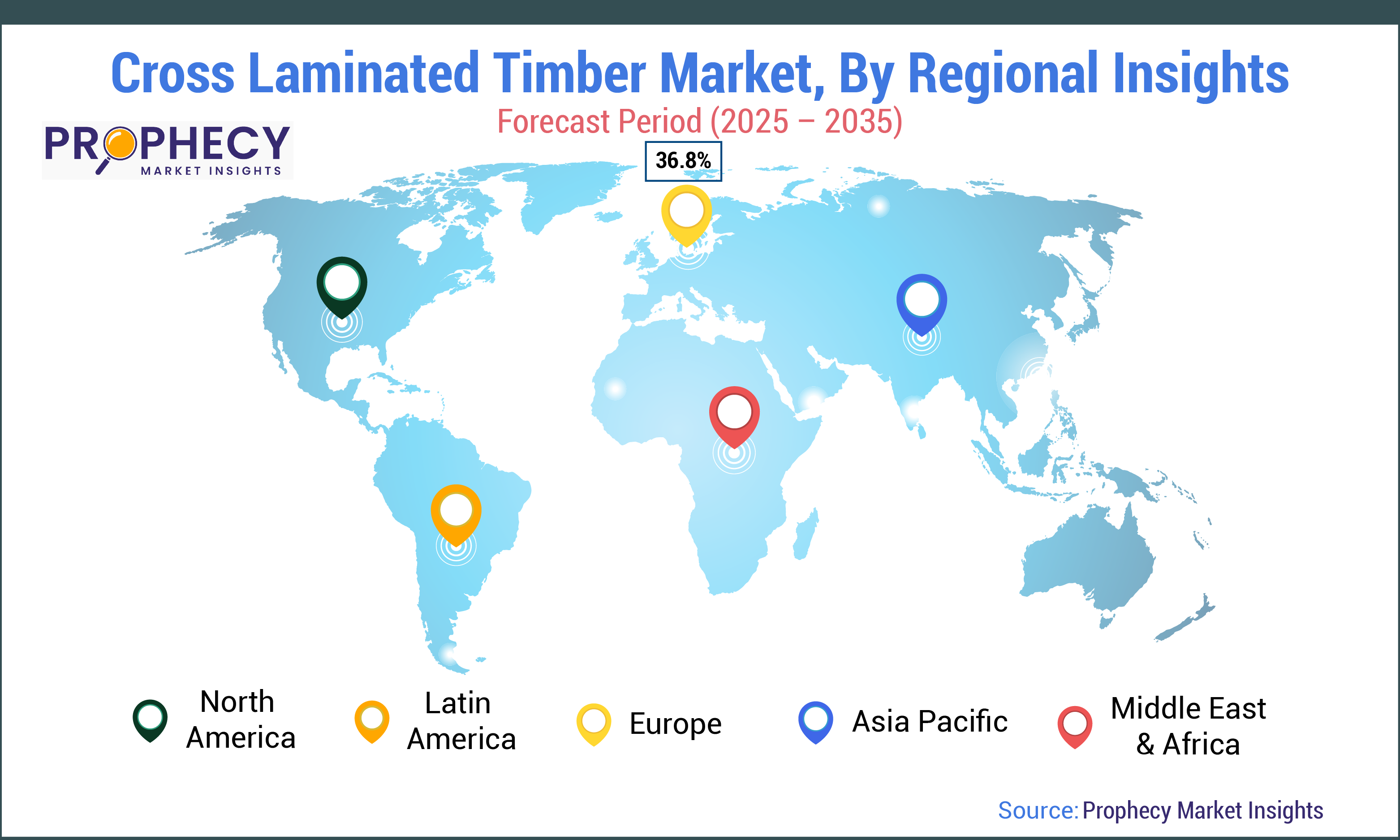
Geographically, the cross laminated timber market is studied across North America, Europe, Asia Pacific, Latin America, and the Middle East & Africa.
Europe: This region dominates the cross laminated timber market growth. Europe is the leader in the Cross Laminated Timber market, as it has a long tradition of sustainable construction and a holistic view of environmental durability. Many countries have green building codes in place that will facilitate the transition to timber from concrete. In mid-rise buildings and other public scale structures, Cross Laminated Timber is not limited to simple structural applications, but can achieve faster construction and outcome with less embodied carbon.
- Austria Cross Laminated Timber Market Insights:
Austria stands out in Europe's cross laminated timber market share as the early adopters of timber engineering and the regional leader in forestry. There is a long tradition of wood construction in Austria, and there is strong institutional support for green building. Building types such as schools and housing in Alberta often highlight the practical advantages of Cross Laminated Timber in terms of building time, seismic performance, and thermal insulation, and as not all sustainable urban development projects are successful, we will highlight the success of Cross Laminated Timber buildings in practice.
North America: North America is the second dominating country. The cross laminated timber market in North America is on the rise with increasing acceptance of sustainable construction materials and new construction methods. There are real-world examples of Cross Laminated Timber in use in office towers and university buildings meeting green certification targets. Changes to regulations, updates to codes and pilot projects dedicated to increasing the use of wood, including Cross Laminated Timber, are enhancing interest in wood-based systems as these projects are often in markets are finding an ideal replacement for steel and concrete.
- U.S. Cross Laminated Timber Market Insights:
Adoption of cross laminated timber in North America comes predominantly from the U.S., particularly in commercial and educational infrastructure. Real-life examples of its use include city offices and college dormitories that have been constructed on sustainability mandates and exploring an interest in new architecture and design. Federal funding for green construction supported by the American Recovery and Reinvestment Act and the recent updates to nationally recognized building codes provide confidence in Cross Laminated Timber as a potential replacement in the use of mid-range, low-rise construction over steel and concrete.
Asia-Pacific: In light of real estate development and the desire for sustainable building practices, the Asia-Pacific region is coming into its own in the cross-laminated timber market. The increased renown of wood in construction is moving slowly compared to what is happening in the West. The old habit of preferring concrete and steel-based constructions is inconsistent, as urbanization and material equity have resonated changing uses of wood in civic infrastructure and pilot eco-projects at the actual level to greater use of wood in buildings.
- Japan Cross Laminated Timber Market Insights:
Japan is leading cross laminated timber uptake in APAC region, where a rich timber culture and government initiatives encompassing a range of sustainability incentives have motivated diffusion of timber in civic infrastructure. Real use cases include schools and community development centres with Cross Laminated Timber geared to earthquake resilience and low carbon objectives. The Promotion of Wood Use in Public Buildings Act legislatively incentivizes governments to move towards a wool friendly approach, thus aiding wider Cross Laminated Timber uptake and growth in the context of Japanese practices rooted in tradition and well-organized modern architectural innovation and project facilitation.
Cross Laminated Timber Market Report Scope:
|
Attribute |
Details |
|
Market Size 2025 |
USD 2.1 Billion |
|
Projected Market Size 2035 |
USD 6.9 Billion |
|
CAGR Growth Rate |
13.9% (2025-2035) |
|
Base year for estimation |
2024 |
|
Forecast period |
2025 – 2035 |
|
Market representation |
Revenue in USD Billion & CAGR from 2025 to 2035 |
|
Regional scope |
North America - U.S. and Canada Europe – Germany, U.K., France, Russia, Italy, Spain, Netherlands, and Rest of Europe Asia Pacific – China, India, Japan, Australia, Indonesia, Malaysia, South Korea, and Rest of Asia-Pacific Latin America - Brazil, Mexico, Argentina, and Rest of Latin America Middle East & Africa – GCC, Israel, South Africa, and Rest of Middle East & Africa |
|
Report coverage |
Revenue forecast, company share, competitive landscape, growth factors, and trends |
Segmentation:
By Type:
- Adhesive Bonded
- Mechanically Fastened
By Application:
- Residential
- Non-residential
By End-Use:
- Structural
- Non-structural
By Region:
- North America
- U.S.
- Canada
- Europe
- Germany
- U.K.
- France
- Russia
- Italy
- Spain
- Netherlands
- Rest of Europe
- Asia Pacific
- China
- India
- Japan
- Australia
- Indonesia
- Malaysia
- South Korea
- Rest of Asia Pacific
- Latin America
- Brazil
- Mexico
- Argentina
- Rest of Latin America
- Middle East & Africa
- GCC
- Israel
- South Africa
- Rest of Middle East & Africa
Global Cross Laminated Timber Market Competitive Landscape & Key Players
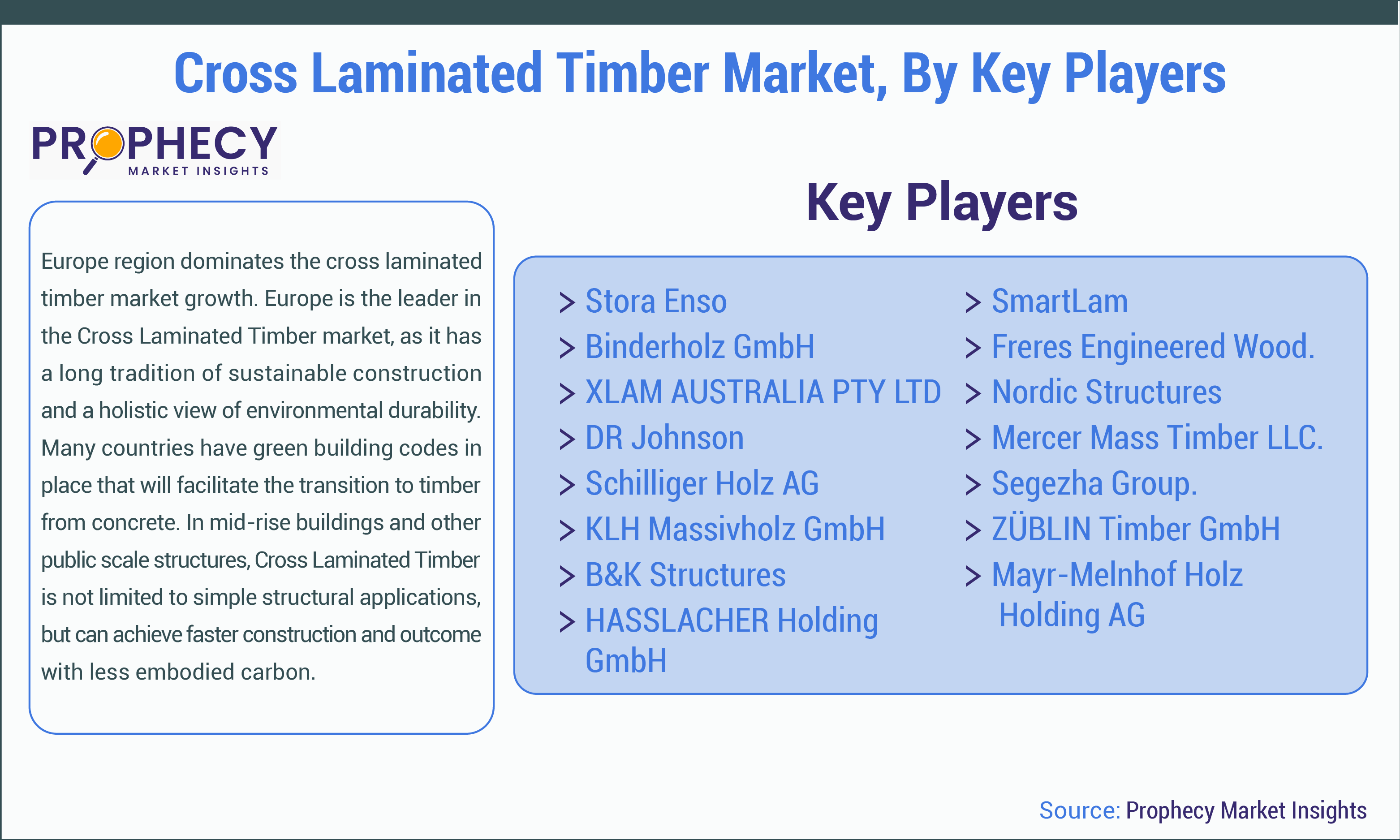
The prominent players operating in the market include, Stora Enso, Binderholz GmbH, XLAM AUSTRALIA PTY LTD, DR Johnson, Schilliger Holz AG, KLH Massivholz GmbH, and others. The market's leading companies are devoting significant efforts to the study and creation of Cross Laminated Timber grades and applications. In an effort to increase their market share, companies are conducting research to create Xlam from timber derived from trees and plants including bamboo, as well as enhancing its resistance to temperature and acoustic variations.
Cross Laminated Timber Market Companies:
- Stora Enso
- Binderholz GmbH
- XLAM AUSTRALIA PTY LTD
- DR Johnson
- Schilliger Holz AG
- KLH Massivholz GmbH
- B&K Structures
- HASSLACHER Holding GmbH
- SmartLam
- Freres Engineered Wood.
- Nordic Structures
- Mercer Mass Timber LLC.
- Mayr-Melnhof Holz Holding AG
- Segezha Group.
- ZÜBLIN Timber GmbH
View an Additional List of Companies in the Cross Laminated Timber Market
Global Cross Laminated Timber Market Recent News
- In June 2023, Mercer Mass Timber, a division of Mercer International Inc., declared that it had acquired Structurlam Mass Timber Corporation and its affiliates. It is expected that the action will boost Mercer Mass Timber's manufacturing capacity and solidify its position as a top mass timber product supplier.
- In January 2020, Mayr Melnhof Holz Holding AG declared plans to invest around USD 145 million to construct a state-of-the-art Cross Laminated Timber production facility in Leoben, Austria. The new plant is designed to support the company's growth strategy, which aims to fortify its position in the European timber industry and advance its forward integration.
Analyst View:
The cross-laminated timber market is continuing to grow and is fueled worldwide by the need for sustainable construction, reduced carbon emissions and green building certifications. Advancements in fire-resistant Cross Laminated Timber panels, as well as designs that provide seismic resistance, are driving the increase in use by residential and commercial builders. Growing opportunities exist because of increasing urbanization in emerging economies and government incentives for timber constructions. There are constraints for the market such as production costs, limited supply chain availability, and lack of awareness in some regions.
More Related Reports
Automotive Adhesive Tape Market
Cross-Linked Polyethylene Market
Cross-Channel Advertising Software Market
Glue Laminated Timber Market
Self-Adhesive Labels Market
Global Cross Laminated Timber Market Company Profile
|
Company Name |
Stora Enso |
|
Headquarter |
Helsinki, Finland |
|
CEO |
Hans Sohlström |
|
Employee Count |
20,000 Employees |
Global Cross Laminated Timber Market Highlights
FAQs
Cross laminated timber market size was valued at USD 2.1 Billion in 2025 and is expected to reach USD 6.9 Billion by 2035 growing at a CAGR of 13.9%.
Type, application, end-use, and region are the segmentation for the target market.
North America, Asia Pacific, Europe, Latin America, and the Middle East & Africa. Europe is expected to dominate the market.
The prominent players operating in the market include, Stora Enso, Binderholz GmbH, XLAM AUSTRALIA PTY LTD, DR Johnson, Schilliger Holz AG, KLH Massivholz GmbH, B&K Structures, HASSLACHER Holding GmbH, SmartLam, Freres Engineered Wood., Nordic Structures, Mercer Mass Timber LLC., Mayr-Melnhof Holz Holding AG, Segezha Group., and ZÜBLIN Timber GmbH.