Us Virtual Power Plant Market Overview
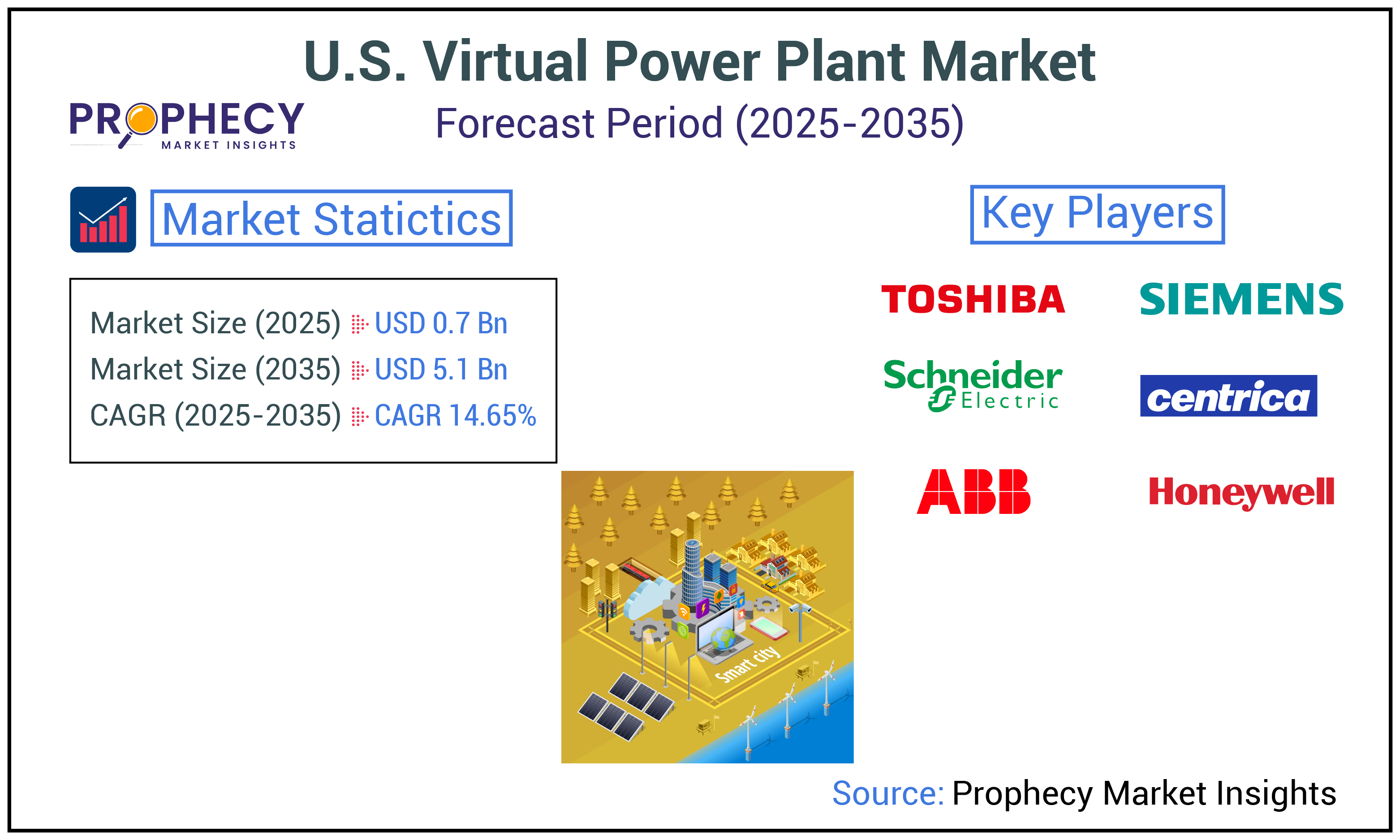
- By 2035, the U.S. virtual power plant market size is contemplated to enlarge at a valuation of USD 5.1 Billion.
- In 2025, the U.S. virtual power plant market valuation was USD 0.7 Billion.
- U.S. virtual power plant market is developing at a CAGR of 14.65%.
A virtual power plant (VPP) is a computer network that combines and controls distributed energy sources such as solar panels, wind turbines, batteries, and energy users with flexible consumption to work as one power plant. The implementation of smart grids yields a plethora of benefits that entail a better overall grid stability as well as the efficient distribution of energy. This, coupled with the aforementioned characteristics, leads to the reduction of operational costs, the augmentation of renewable energy utilization, the real-time management of energy, along with the optimal participation in electricity markets in terms of prices and demand response.
The U.S. virtual power plant market is growing quickly, mainly due to the increasing use of renewable energy. The need for flexible aggregation platforms that can handle the varying nature of solar and wind energy and ensure grid stability is the main driver of this growth. The positive atmosphere in terms of regulations is largely due to a combination of supportive federal and state policies. This ranges from FERC regulations on wholesale market access, to state-level initiatives such as California's SB 1339 and New York's REV program. Besides this, the current environment is also favorable to developers because of various tax incentives such as the ITC benefits provided under the Inflation Reduction Act.
The U.S. virtual power plant market is expected to grow significantly until the late 2020s due to the rapid expansion of demand response and mixed-asset VPPs, the increased integration of DERS (solar, storage, micro-CHPs), and higher adoption of Al, loT, and advanced analytics for real-time energy dispatch optimization. Electric vehicles, such as those with vehicle-to-grid systems, are driving these changes. Decentralized energy systems are becoming more widespread due to blockchain and smart contracts, which allow peer-to-peer trading, and favorable regulatory support from FERC Orders and federal funding for grid modernization. These developments are transforming energy systems into ones that are more efficient, resilient, and decentralized.
Recession Risk & Tariff Analysis:
- The U.S. virtual power plant market has the potential to decrease owing to a recession as less energy may be needed due to slower economic activity, and less money may be invested in VPPs. In this way, the market can stagnate despite the rising need for clean energy.
- Inevitably, elevated import tariffs on solar panels, batteries, and other crucial components are pushing up project costs. As a result, developers experience delays and financial difficulties. Collectively, these elements create obstacles that affect VPP market expansion in the near future.
Impact of Generative AI on U.S. Virtual Power Plant Market:
- Generative Al is helping the U.S. virtual power plant market grow. It is making more electricity be used, for example, data centers need a lot of electricity. So, to meet this demand, they need to produce electricity in a smart way, and it can only be done with decentralized energy solutions.
- At the same time, it improves VPP performance by allowing on-the-spot forecasting, energy that is dispatched in an optimized manner, and automated decision-making across the DERs, which are energy systems that have become more efficient, adaptable and are reliable.
Us Virtual Power Plant Market Drivers & Restraints
Key Drivers:
Expansion of Electric Vehicles can boost the Development of the Market
The growing use of electric vehicles (EVs) in the U.S. is having a major impact on the Virtual Power Plant (VPP) market. This is because EVs provide a new source of energy storage that can be easily managed and used when needed. EV adoption is rising, especially with government incentives and growing charging infrastructure. Their batteries can serve as mobile energy assets through vehicle-to-grid (V2G) technology due to this trend. This also makes electric vehicles able to keep extra power and return it to the power lines when demand is high, thus improving the stability and efficiency of the grid. Electric vehicle networking into the VPP is a better energy distribution system that leads to faster adoption of decentralized, environmentally friendly energy systems.
- For Instance, according to the data published by International Energy Agence, In the United States, electric car sales increased to 1.6 million in 2024, with the sales share growing to more than 10%. However, growth in electric car sales slowed down significantly in 2024, increasing by just 10% compared to 40% in 2023.
Restraints:
Cybersecurity Risks can Hampered the Market Growth
The U.S. Virtual Power Plant market faces significant Cybersecurity risks due to the extensive use of digital platforms, cloud systems, and Internet of Things (IoT) connected devices. VPPs are susceptible to cyber-attacks, data breaches, and unauthorized access. Such threats can hinder energy management, expose private information, and potentially destabilize the grid.
- Counterbalance Statements: To resolve such issues, VPP operators deploy multi-layered security systems that include the use of encrypted communication channels, the employment of Artificial Intelligence for on-line threat identification, the use of secure authorization methods and the routine examination of the system. Cybersecurity fortification not merely safeguards activities but may also serve to establish confidence in the digital energy ecosystem.
Opportunities & Trends:
The Future of the Market Looks Promising due to Growing Demand for Energy Resilience
Energy resilience is experiencing growing interest, which is leading to the evolution of the U.S. Virtual Power Plant (VPP) market. This trend is basically the result of several factors, such as the increase in power outages caused by extreme weather conditions, the deterioration of infrastructure, and the steady increase in power consumption.
Distributed energy resources and battery storage can be coordinated via VPPs to stabilize the energy supply when there is an electricity outage or when the demand for electricity is too high. This ensures that there is a steady flow of electricity in the grid. In other words, VPPs provide a decentralized way to manage energy. This permits them to become a fundamental instrument in advance grid stability, minimizing the need for expensive infrastructure renovations, and backing a climate-resilient energy system.
Us Virtual Power Plant Market Segmentations & Regional Insights
Component, source, technology, application, and end user are the divisions of the U.S. Virtual Power Plant Market.
By Component:
Hardware, software, and services are component on which U.S. virtual power plant market is segmented. Since software is the crucial layer that combines, coordinates, and optimizes various DERs utilizing artificial intelligence (AI), machine learning, and real-time analytics, it dominates the U.S. Virtual Power Plant market share and holds, usually 45–60% of total value.
The need for physical components consisting of as energy storage systems, smart meters, inverters, and communication gateways which are necessary for data collection, control, and networking of VPP resources has led to the second-largest category, hardware.
By Source:
Based on the source, the U.S. virtual power plant market is divided into renewable energy sources, conventional energy sources, and hybrid energy sources. Due to the quick uptake of solar and wind energy, robust government subsidies, and rising environmental concerns that encourage the integration of clean energy into VPP networks, renewable energy sources now have the greatest U.S. virtual power plant market U.S.
The second-dominant market is hybrid energy sources, which offer increased grid stability and flexibility by fusing the sustainability of renewable energy sources with the dependability of conventional electricity. This is particularly helpful during intermittent renewable generating times.
By Technology:
Demand response, distributed generation, mixed asset, energy storage systems integration, and others are technology of the U.S. virtual power plant market. Demand response technology has the biggest market share in the Virtual Power Plant market in the United States as it allows utilities to control peak loads, lessen grid stress, and optimize energy consumption in real-time, providing instant cost and reliability advantages.
Due to the growing number of rooftop solar panels and small-scale wind turbines, which are crucial parts of decentralized energy systems and necessary for the expansion of VPPs in both the residential and commercial sectors, distributed generation is the second-largest segment.
By Application:
On the application, U.S. virtual power plant market is categorized into peak load management, energy trading, grid balancing, remote monitoring and forecasting, and others. Peak load management has the most market share in the U.S. virtual power plant market given that it helps utilities prevent blackouts and save energy costs by directly addressing system stress during times of high demand.
The second-dominant technique is grid balancing, which matches generation and demand in real-time to guarantee a steady supply of electricity. This is particularly crucial given the growing proportion of intermittent renewable energy sources.
By End User:
Industrial sector, commercial sector, residential sector, utilities and power retailers, and others are end user of the U.S. virtual power plant market. Utilities and power retailers dominate the U.S. Virtual Power Plant market since they coordinate and deploy distributed energy resources (DERs) on a wide scale to control peak demand, assure grid stability, and engage in energy trading.
Due to its high energy consumption and requirement for cost optimization, dependability, and sustainability, the industrial sector is the second-dominant end user. For this reason, VPPs are a useful tool for load control and energy efficiency.
U.S. Virtual Power Plant Market Report Scope:
|
Attribute |
Details |
|
Market Size 2025 |
USD 0.7 Billion |
|
Projected Market Size 2035 |
USD 5.1 Billion |
|
CAGR Growth Rate |
14.65% (2025-2035) |
|
Base year for estimation |
2024 |
|
Forecast period |
2025 – 2035 |
|
Market representation |
Revenue in USD Billion & CAGR from 2025 to 2035 |
|
Report coverage |
Revenue forecast, company share, competitive landscape, growth factors, and trends |
Segmentation:
By Component:
- Hardware
- Smart Meters
- Remote Terminal Units
- Others
- Software
- Cloud-based
- Cloud-based
- Services
- Consulting
- Integration & Deployment
- Others
By Source:
- Renewable Energy Sources
- Conventional Energy Sources
- Hybrid Energy Sources
By Technology:
- Demand Response
- Distributed Generation
- Mixed Asset
- Energy Storage Systems Integration
- Others
By Application:
- Peak Load Management
- Energy Trading
- Grid Balancing
- Remote Monitoring and Forecasting
- Others
By End User:
- Industrial Sector
- Commercial Sector
- Residential Sector
- Utilities and Power Retailers
- Others
Us Virtual Power Plant Market Competitive Landscape & Key Players
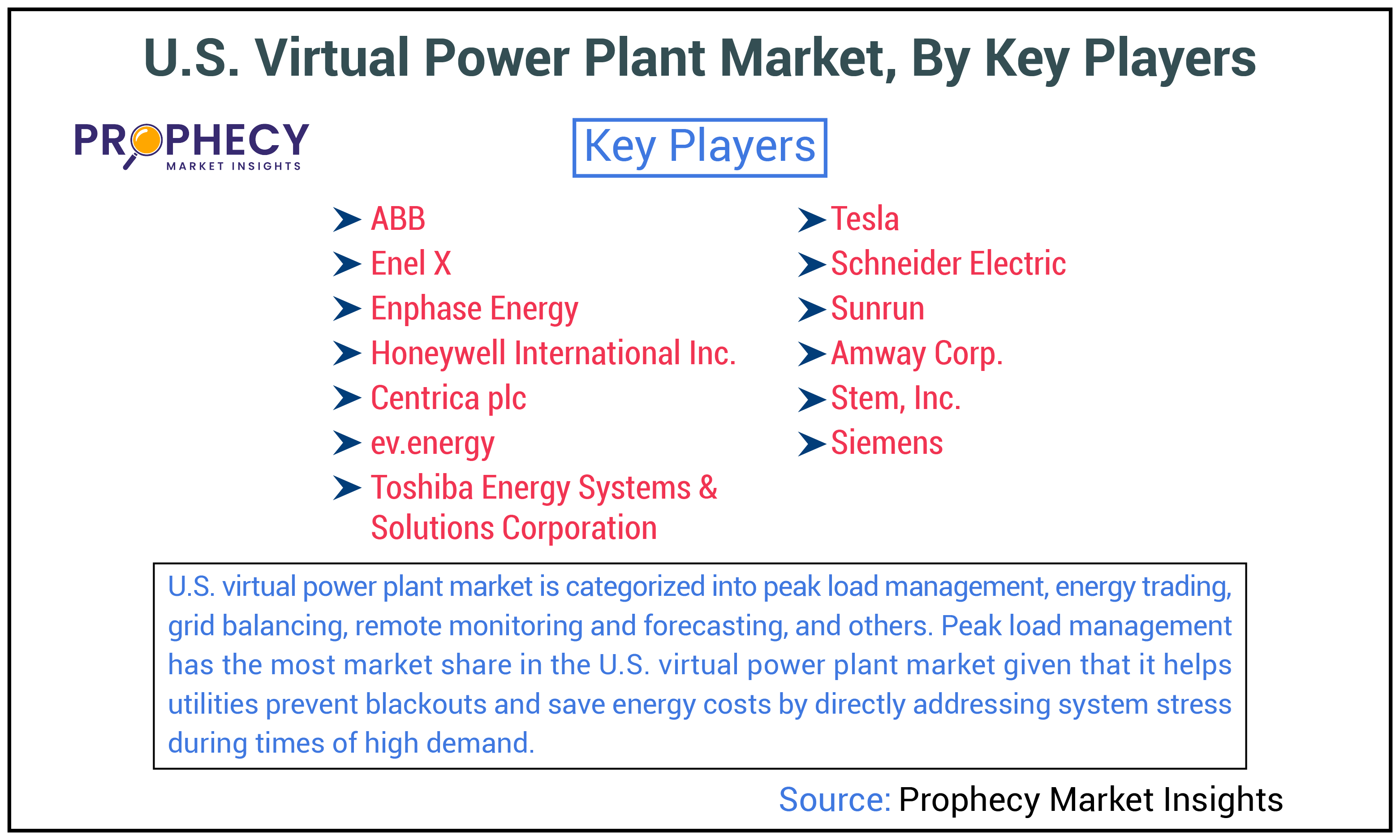
U.S. virtual power plant companies grow by working with utilities, utilizing AI/IoT, expanding solar-plus-storage, and utilizing clean energy subsidies to offer flexible, intelligent energy solutions. The key players operating in the U.S. virtual power plant market include, Tesla, Schneider Electric, ENPHASE ENERGY, Stem, Inc., Siemens, and others.
U.S. Virtual Power Plant Market Companies:
- ABB
- Enel X
- Enphase Energy
- Honeywell International Inc.
- Toshiba Energy Systems & Solutions Corporation
- Centrica plc
- ev.energy
- Tesla
- Schneider Electric
- Sunrun
- Amway Corp.
- Stem, Inc.
- Siemens
Us Virtual Power Plant Market Recent News
- In December 2023, Expanding its support for virtual power plants (VPPs) through grid services programs across the United States powered by the new IQ Battery 5P is a recent announcement from Enphase Energy, Inc., a global energy technology company and the world's top supplier of microinverter-based solar and battery systems. When demand for electricity is strong, grid services assist utility companies avoid operating costly, polluting power plants. In exchange, the utilities may provide homeowners yearly incentive payments of hundreds to thousands of dollars to help them buy an Enphase Energy System with IQ Battery 5P.
Analyst View:
The increased use of renewable energy, advantageous federal and state legislation, and developments in smart grid technology are all contributing to the U.S. Virtual Power Plant (VPP) market's rapid expansion. For real-time energy management, cost reduction, and grid stability, VPPs combine dispersed energy resources such as solar, wind, and batteries into a single system. Demand response and peer-to-peer energy trading are being propelled by favorable laws, tax breaks, and advancements in blockchain, IoT, and artificial intelligence. The market is expanding because to the emergence of electric cars and decentralized energy systems, which are improving the energy network's resilience, efficiency, and readiness for the future.
More Related Reports
Virtual Power Plant Market
Virtual Extensible LAN Market
Mobile Virtual Network Operator Market
Virtual Critical Care Solutions Market
Asia Pacific Virtual Power Plant Market
Us Virtual Power Plant Market Company Profile
|
Company Name |
ABB |
|
Headquarter |
Zurich, Switzerland |
|
CEO |
Morten Wierod |
|
Employee Count |
105,000 Employees |
FAQs
U.S. virtual power plant market size was valued at USD 0.7 Billion in 2025 and is expected to reach USD 5.1 Billion by 2035 growing at a CAGR of 14.65%.
Component, source, technology, application, end user, and country are the segmentation for the U.S. virtual power plant market.
The key players operating the U.S. virtual power plant market include ABB, Enel X, Enphase Energy, Honeywell International Inc., Toshiba Energy Systems & Solutions Corporation, Centrica plc, ev.energy, Tesla, Schneider Electric, Sunrun, Amway Corp., Stem, Inc., and Siemens.