Us Smart Textile Market Overview
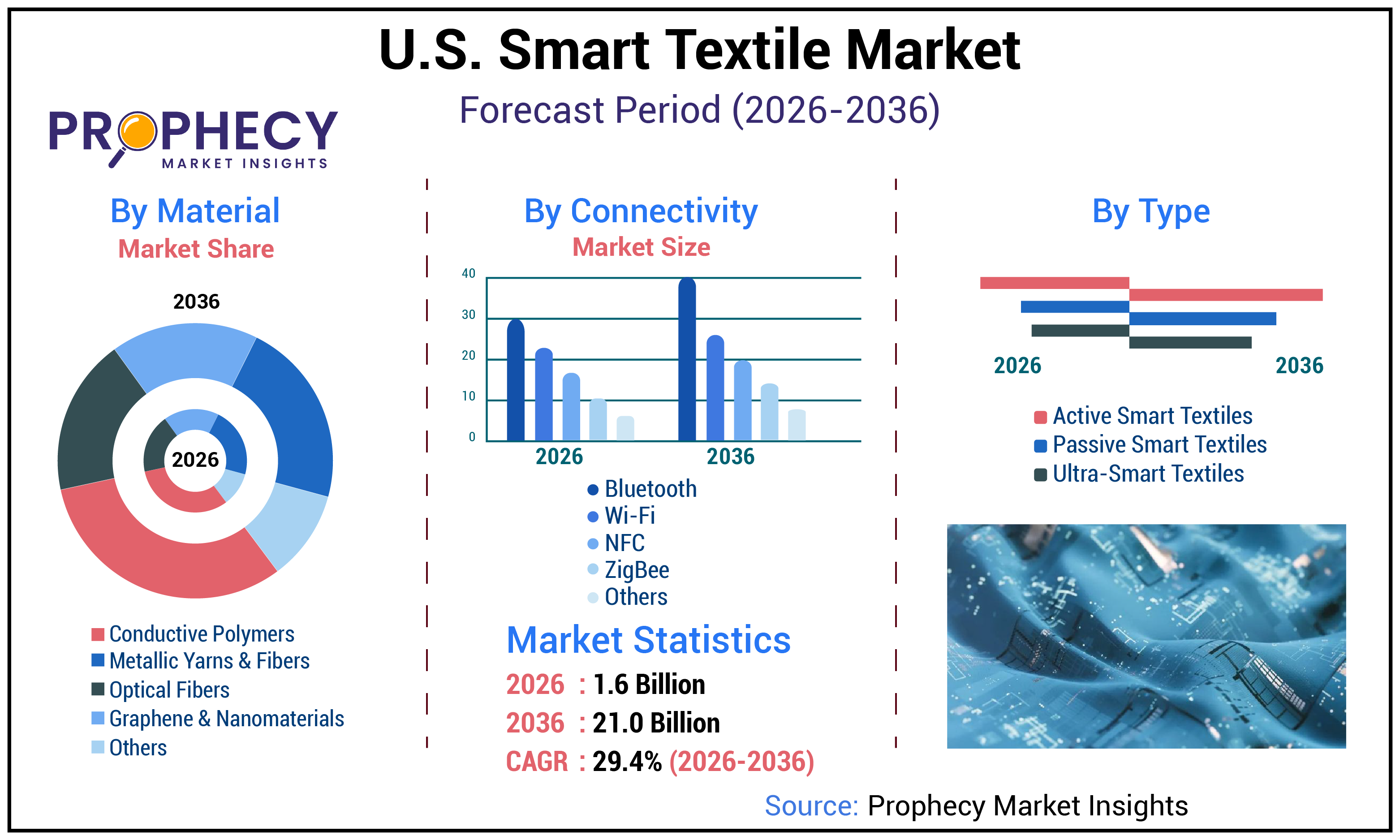
- 2026 Market Size: USD 1.6 Billion
- 2036 Projected Market Size: USD 21.0 Billion
- CAGR (2026-2036): 29.4%
Smart textiles are technologically advanced materials that have been integrated with digitally interactive elements such as sensors, actuators, or conductive materials, thus providing them with the ability to sense, respond, and adapt to the surroundings or biological conditions. For example, these fabrics can track body temperature, movement, or pulse and are being utilized in different areas like healthcare, sports, the army, and apparel. By combining the characteristics of conventional fabrics with the cutting-edge technology of the future, smart textiles turn into potential sources of additional benefits, enhanced user experience, and increased efficiency.
The U.S. smart textile market is broadly influenced by factors such as the rising requirement for health-monitoring wearable devices, the use of technologically advanced fabrics in the sports and defense industries, and the continuous technological innovations such as embedded sensors and IoT integration. In addition, the consumer emphasis on fitness and wellness, and the energetic research and development efforts, which are largely supported by leading tech companies and government initiatives, are also propelling the market upward.
U.S. Rules and Regulations for Smart Textile:
- In the US, intelligent fabrics are governed by different rules and regulations from various departments or agencies such as the Federal Trade Commission (FTC), the Food and Drug Administration (FDA), and the Consumer Product Safety Commission (CPSC).
- The FTC is responsible for ensuring that there is transparency in the process by looking after the advertising and labeling.
- The FDA, however, is the one to assign the medical device regulations to the smart textiles that are intended for medical or health-monitoring purposes.
- Additionally, the areas of electrical safety, data privacy (e.g. under the Health Insurance Portability and Accountability Act—HIPAA), and wireless communication (according to the Federal Communications Commission—FCC) are very significant for the products to be able to assure product safety, reliability, and customer protection.
Us Smart Textile Market Drivers & Restraints
Drivers and Restraints:
|
Drivers |
Restraints |
Opportunities & Trends |
|
|
|
Key Drivers:
Increasing Consumer Preference for Connected and Comfortable Clothing
The U.S. smart textile market is being positively influenced by the trend of consumers opting for stylish, comfortable, and functional clothing. Clothes that can measure health parameters, record fitness performance, and give individualized insights are what consumers want, and all this without the fabrics being less wearable.
The demand for such revolutionary fabrics made to integrate technology invisibly is pushing producers to develop even thinner, more airy, and more sensor-embedded materials, thus they can add more products to their portfolio and the market growth can speed up not only in the fashion segment but also in healthcare and sports.
Restraints:
Lack of Standardized Testing and Regulatory Clarity
The absence of standardized tests and detailed regulations for the U.S. smart textile market acts as a deterrent to its growth, as it is a source of uncertainty for both manufacturers and investors. In the absence of well-defined rules regarding safety, performance, and data privacy of products, enterprises find it difficult to get certifications, maintain quality, and have a strong presence in the market. This uncertainty in regulation is causing a slowdown in the rate of innovation, an increase in the expenses related to compliance with regulations, and a decrease in the trust that consumers have in the reliability of products, which in effect, is a barrier to the widespread use and commercialization of smart textile technologies.
- Counterbalance Statements: One way to deal with this is by formulating global industry standards and well-defined regulations that pave the way for product consistency, make it easier for products to get approval and foster the use of smart textiles to various sectors, such as healthcare, defense, and consumer, through the collaboration of government agencies, research institutions, and industry players.
Opportunities & Trends:
Development of Energy-Harvesting Smart Fabrics
Essentially, the evolution of energizing electronic textiles through body movement, heat, or photon-energy is the prime future trend of the U.S. smart textile market. Hence, these materials will be able to supply power to multifunctional devices, and so the latter become autonomous and rechargeable in an elegant fashion.
Transient or compact solar cells and piezoelectric generators embedded into the fabric surface can open infinite possibilities of next-generation self-powered wearable devices in fields ranging from medical monitoring to army wear and casual technology use, thus facilitating a considerable market expansion over time.
Us Smart Textile Market Segmentations & Regional Insights
Type, material, connectivity, functionality, end user are the divisions of the U.S. smart textile market.
By Type:
Passive smart textiles, active smart textiles, and ultra-smart textiles are type on which U.S. Smart Textile Market is segmented. Given that they can perceive and react to environmental stimuli including temperature, pressure, or wetness, active smart textiles have the biggest U.S. smart textile market share. This makes them extremely valuable in applications related to healthcare, sports, and military.
The second-largest category is made up of passive smart textiles, which are more affordable and simpler. They are mostly employed for simple sensing tasks including heat or moisture detection, which makes them extensively useful in athletic and protective apparel.
By Material:
Based on the material, the U.S. Smart Textile Market is divided into conductive polymers, metallic yarns and fibers, optical fibers, graphene and nanomaterials, and others. Conductive polymers have the most U.S. smart textile market share owing to their affordability, flexibility, and light weight, which make them perfect for incorporating electronic components into textiles without sacrificing wearability or comfort.
In recognition of their superior electrical conductivity and longevity, metallic yarns and fibers are the second most popular material category. This makes them ideal for use in high-performance sports textiles, military, and industrial settings where durability and dependability are crucial.
By Connectivity:
The U.S. smart textile market is categorized into Bluetooth, Wi-Fi, NFC, ZigBee, and others on the account of connectivity. Bluetooth has the biggest U.S. smart textile market share owing to its low power consumption, simple integration with wearables and smartphones, and dependable short-range connectivity, which makes it perfect for consumer electronics, healthcare monitoring, and fitness tracking.
Wi-Fi is the second most popular type of connectivity since it allows for faster data transfer and wider network coverage, which is advantageous for applications that need cloud-based data analysis and real-time monitoring, especially in industrial and medical smart textile solutions.
By Functionality:
Sensing, energy harvesting, thermoelectric & heating, luminescent/illuminating, and others are functionality of the U.S. smart textile market. Although sensing functionality is utilized extensively in the healthcare, sports, and defense industries to monitor factors as heart rate, temperature, and mobility, it has the biggest U.S. smart textile market share. Sensing-based textiles are now the most economically feasible and widely used category due to the increasing demand for wearable fitness and health monitoring gadgets.
The second-largest market is made up of thermoelectric and heating features, which are increasingly used in smart clothing for temperature control, outdoor wear, and military uniforms that offer protection and comfort in a variety of weather conditions.
By End User:
The U.S. smart textile market on the account of end user is categorized individuals / consumers, commercial enterprises, defense & government agencies, and others. Defense and government organizations have the most U.S. smart textile market size owing to the high need for sophisticated military gear and uniforms with sensors to track environmental conditions, soldier health, and communication. Adoption in this market is further fueled by substantial government financing and R&D projects.
The second-largest end-user category is made up of individuals and consumers, who are motivated by wearable technology for fitness tracking, health monitoring, and fashion-tech applications as well as by growing awareness of connected lifestyles and personal wellness.
U.S. Smart Textile Market Report Scope:
|
Attribute |
Details |
|
Market Size 2026 |
USD 1.6 Billion |
|
Projected Market Size 2036 |
USD 21.0 Billion |
|
CAGR Growth Rate |
29.4% (2025-2035) |
|
Base year for estimation |
2025 |
|
Forecast period |
2026 – 2036 |
|
Market representation |
Revenue in USD Billion & CAGR from 2026 to 2036 |
|
Company Landscape |
Market Share Analysis of Companies Heat Map Analysis Company Overview, Products Overview Financial Information, Key Highlights Business Strategies Overview SWOT Analysis |
|
Report coverage |
Revenue forecast, company share, competitive landscape, growth factors, and trends |
|
Value Added Data Infosets |
Besides fundamental market insights such as the size of the market, growth rate, segmentation, regional study, and key players, our reports carry value-added data sets such as trade flow (import-export) analysis, production and consumption overview, price trend evaluation, supply and value chain mapping, and raw material availability. Moreover, we provide strategic tools as PESTLE and Porter’s Five Forces analysis, examination of the regulatory landscape, as well as monitoring of technology and innovation thereby providing a comprehensive overview which facilitates sensible and anticipatory decision-making. |
Segmentation:
By Type:
- Passive Smart Textiles
- Active Smart Textiles
- Ultra-Smart Textiles
By Material:
- Conductive Polymers
- Metallic Yarns and Fibers
- Optical Fibers
- Graphene and Nanomaterials
- Others
By Connectivity:
- Bluetooth
- Wi-Fi
- NFC
- ZigBee
- Others
By Functionality:
- Sensing
- Energy Harvesting
- Thermoelectric & Heating
- Luminescent/Illuminating
- Others
By End User:
- Individuals / Consumers
- Commercial Enterprises
- Defense & Government Agencies
- Others
Us Smart Textile Market Competitive Landscape & Key Players
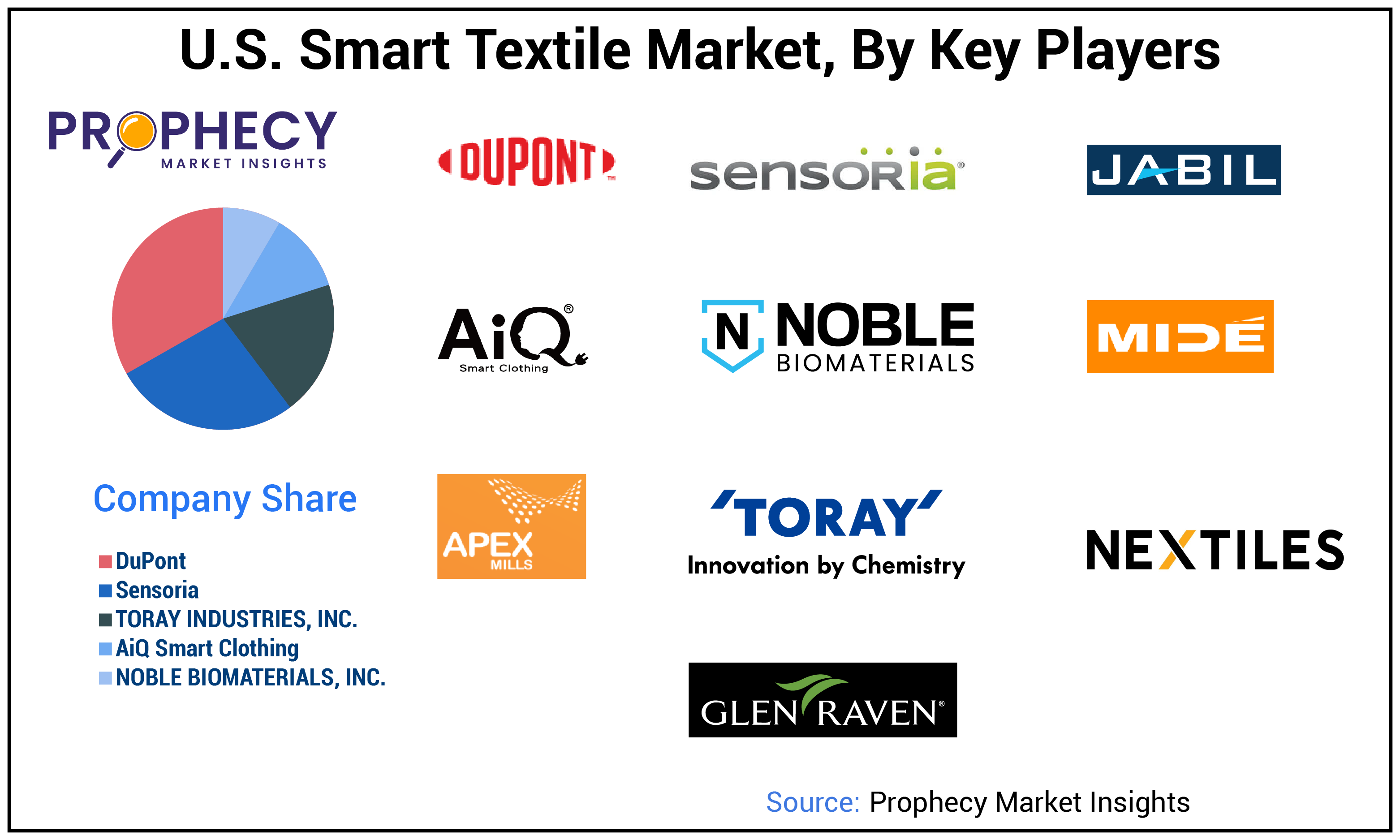
Engaging in R&D to improve fabric functionality and durability, partnering with technology companies for sensor and IoT integration, and concentrating on sustainable, eco-friendly materials to satisfy consumer demand are all important growth strategies for smart textile companies in the United States. In order to diversify their product offerings and focus on high-growth industries such as healthcare, defense, and sports, businesses are now embracing acquisitions and partnerships.
U.S. Smart Textile Market Companies:
- DuPont
- Sensoria
- TORAY INDUSTRIES, INC.
- AiQ Smart Clothing
- NOBLE BIOMATERIALS, INC.
- APEX MILLS
- Siren
- Jabil Inc.
- Hexoskin
- Mide Technology Corp.
- Nextiles, Inc.
- GLEN RAVEN
- Textronics
- Milliken
- Outlast Technologies GmbH
Us Smart Textile Market Recent News
- In October 2025, Makalot Industrial Co., Ltd., a leading global textile and apparel company, announced a number of new innovative textile technologies and sustainable fabrics ahead of its participation in the Functional Fabric Fair (FFF) 2025 in Portland, Oregon. Additionally, the company announced the expansion of its regional supply chain facilities to better serve US customers.
Analyst View:
The U.S. smart textile market is quickly expanding due to rising demand for health-monitoring wearables, increased usage of innovative fabrics in sports and military, and continued breakthroughs in sensor and IoT integration. These technologically innovative materials blend traditional fabric qualities with digital functionality, providing increased comfort, performance, and efficiency, while strong R&D support and consumer interest in exercise and wellness fuel market growth.
Analysis of Sources:
Primary Sources:
- In-depth interviews
- Company-specific data
- Surveys and questionnaires
- Focus group discussions (FGDs)
- Others
Secondary Sources:
- World Intellectual Property Organization (WIPO)
- European Commission (EC)
- Others
More Related Reports
Smart Classroom Market
Smart Weapons Market
Smart Healthcare Products Market
Smart Home Market
Asia Pacific Smart Textile Market
Us Smart Textile Market Company Profile
|
Company Name |
Product Portfolio |
|
Sensoria |
Smart Socks |
|
AiQ Smart Clothing |
Smart Clothing |
|
Siren |
Smart Textiles |
|
Jabil Inc. |
Smart Garment Solution |
|
Hexoskin |
Smart Clothing |
FAQs
U.S. smart textile market size was valued at USD 1.6 Billion in 2025 and is expected to reach USD 21.0 Billion by 2035 growing at a CAGR of 29.4%.
Type, material, connectivity, functionality, end user are the segmentation for the U.S. smart textile market.
Advancements in material science, the expansion of the Internet of Things (IoT), and a growing focus on health and wellness applications, such as real-time patient monitoring and therapeutic clothing, and so on are some of the U.S. smart textile market growth drivers.
The key players operating the U.S. smart textile market include DuPont, Sensoria, TORAY INDUSTRIES, INC., AiQ Smart Clothing, NOBLE BIOMATERIALS, INC., Siren, Jabil Inc., Mide Technology Corp., Nextiles, Inc., GLEN RAVEN, Textronics, Milliken, and Outlast Technologies GmbH.