Global Smart Textile Market By Overview
- 2024 Market Size: USD 5.4 Billion
- 2035 Projected Market Size: USD 69.40 Billion
- CAGR (2025-2035): 26.4%
- North America: Largest Market in 2024
Intelligent fabrics or smart textiles are essentially materials that have been implanted with sensors, actuators, and electronic components that enable them to identify and respond to changes in the environment or the user's body. These fabrics can be very helpful in monitoring temperature, movement, and pressure, or even the health of the user while still being comfortable and flexible. Smart fabrics, in general, can lead to increased performance and comfort, continuous health and fitness monitoring, safety improvement by giving early warnings of dangerous situations, energy generation, and a whole lot of new possibilities in the fashion, sports, healthcare, military, and automotive industries.
The evolution of the smart textile market is primarily dependent on the increased use of wearable technology, the healthy lifestyle trend, and the improvement of sensor technology and nanomaterials. With the help of IoT and AI, the performance of fabrics has been significantly improved, so the data can be obtained in real-time and the fabrics can be interactive. Besides that, the mobility of these devices in the mentioned sectors, i.e., healthcare, sports, defense and automotive, and consumers' inclination towards comfort, performance, and safety, are the two major factors that, together, have been driving the market growth at a fast pace.
Recent Trends in Smart Textiles:
- Wearable and health-monitoring integration: Smart fabrics with implanted biometric sensors (e.g. heart rate, respiration, posture) is a rapidly expanding trend, and these are mostly in the healthcare and fitness sectors.
- Energy harvesting & active functionalities: The introduction of materials that can absorb body-heat or movement, change their color /shape, or even cool/hear the body is making a transition from being only research projects to products in the pipeline.
- Sustainability & eco-materials push: More and more emphasis is being placed on recycled fibres, biodegradable components, lower-impact finishing, and also on the transparency of the textile supply chain.
- Advanced manufacturing and Industry 4.0 integration in the textile sector: The evolution of smart textile manufacturing is part of digital weaving/knitting machines, the use of robotics, IoT for production monitoring, and embedding of electronics in the fabric manufacture.
- Cross-industry and multifunctional usage: Smart textiles are repurposed beyond just sportswear; they are utilized in automotive interiors, military/defence equipment, smart home furnishings, and architectural products.
- Regulatory and policy encouragement getting more: Authorities and trade organizations are providing incentives or a roadmap for "technical textiles" and smart textile manufacturing, particularly in Asia-Pacific.
Current Industry Dynamics & Insights:
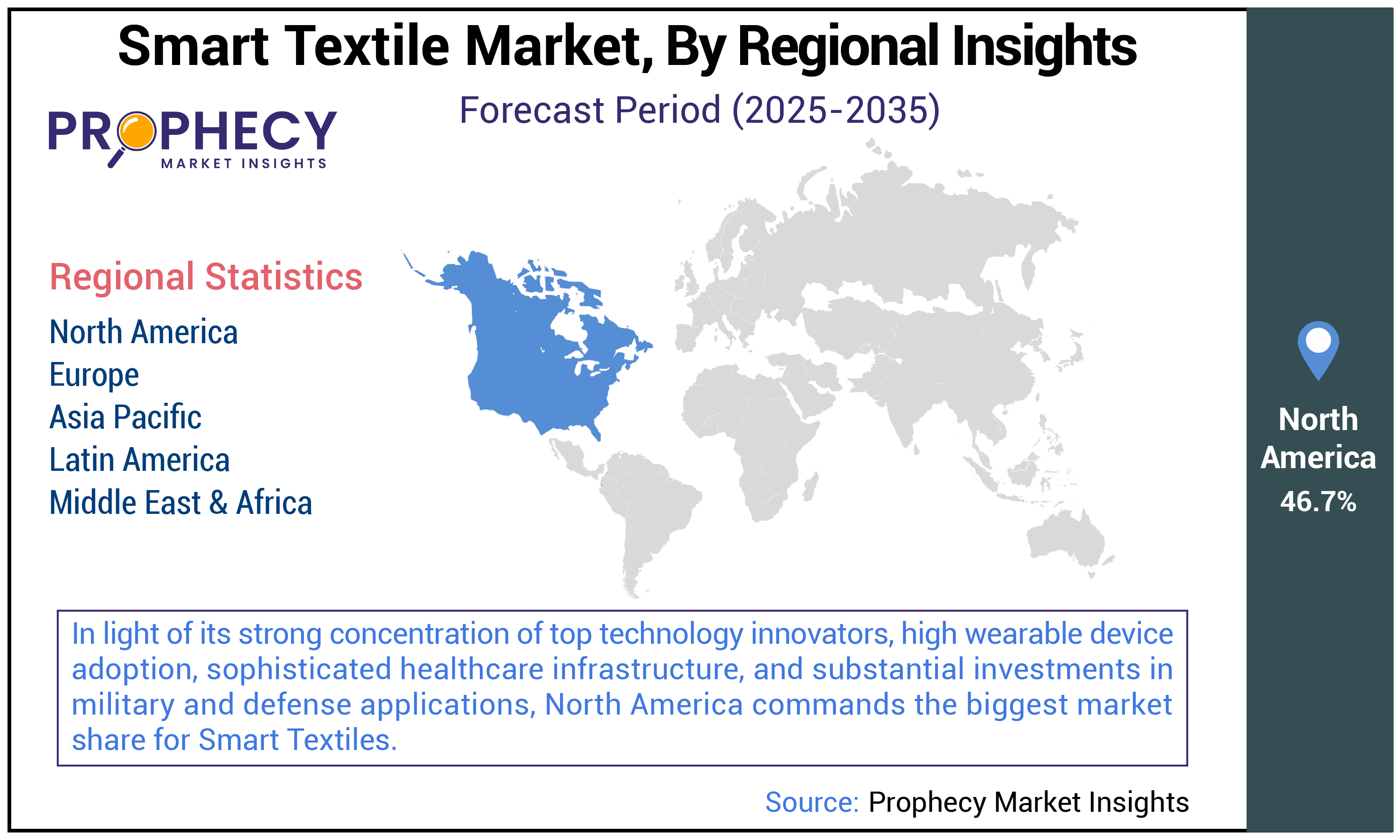
- North America has the largest regional share in the market, with almost 46.7%.
- Europe is second dominating region in the market.
- By type, active smart textiles dominate the smart textile market.
Global Smart Textile Market By Drivers & Restraints
Drivers and Restraints:
|
Drivers |
Restraints |
Opportunities & Trends |
|
|
|
Key Drivers:
Rising Demand for Wearable Health and Fitness Monitoring Devices
As the need for health and fitness monitoring devices that can be worn on the body increases, the smart textile market is growing rapidly. Consumers are looking for comfortable, non-intrusive, and real-time health tracking solutions. Smart textiles equipped with sensors can, in fact, be continuous monitoring of vital signs, for example, pulse, temperature, and movement, providing more convenience than traditional wearable devices. This increasing incorporation of health monitoring features in daily wear not to only improve the experience of users but also help them in preventive healthcare and thus, get adopted faster by the sports, medical, and lifestyle sectors which is, in fact,, the main reason for market growth.
- For Instance, according to the data published by Total Telecom, An increasing interest in wearable technology is seen from the astounding 21% of adults worldwide who own a smartwatch. It was estimated in 2022 that there were more than 1.1 billion wearable gadgets in use worldwide. In 2020, the global wearable technology user penetration rate was 5.9%. 74% of respondents think wearing wearables and sensors will improve their ability to connect with other gadgets and the real world.
Restraints:
Data Privacy and Security Concerns
One of the major challenges that the smart textile market has to deal with is the issue of data privacy and security. The reason for this is that these fabrics store sensitive personal information such as health metrics and location data, thus making them attractive targets for cyber-attacks or unauthorized access. The problem of such risks leads to the reduction of consumer trust in the products and thus the limitation of the use of these products on a large scale, particularly in healthcare and defense sectors.
- Counterbalance Statements: In order to deal with this problem, the companies are implementing encrypted data transmission, block chain-based data management, as well as strict adherence to privacy regulations such as GDPR and HIPAA, thus ensuring secure data handling and increasing user trust in smart textile technologies.
Opportunities & Trends:
Expansion of AI and Machine Learning in Fabric Intelligence
With AI and machine learning growing in fabric intelligence, the smart textile market is heavily influenced by this development which is turning to be a major future trend. The new generation of technologically advanced fabrics not only sense but also analyze and respond to the user's needs. Through AI algorithms, smart fabrics become aware of user behavior, get adjusted to the changing situations, and can even offer health monitoring, performance optimization, and environmental adaptability as a predictive application. This breakthrough spreads to the healthcare, sports, defense, and fashion industries where it makes possible to personalize, save energy, and automate on these sectors' application areas, thus, creating a route to the subsequent generation of implausibly intelligent and self-regulating textiles.
Global Smart Textile Market By Segmentations & Regional Insights
Type, material, connectivity, functionality, end user, and region are the divisions of the Smart Textile Market.
By Type:
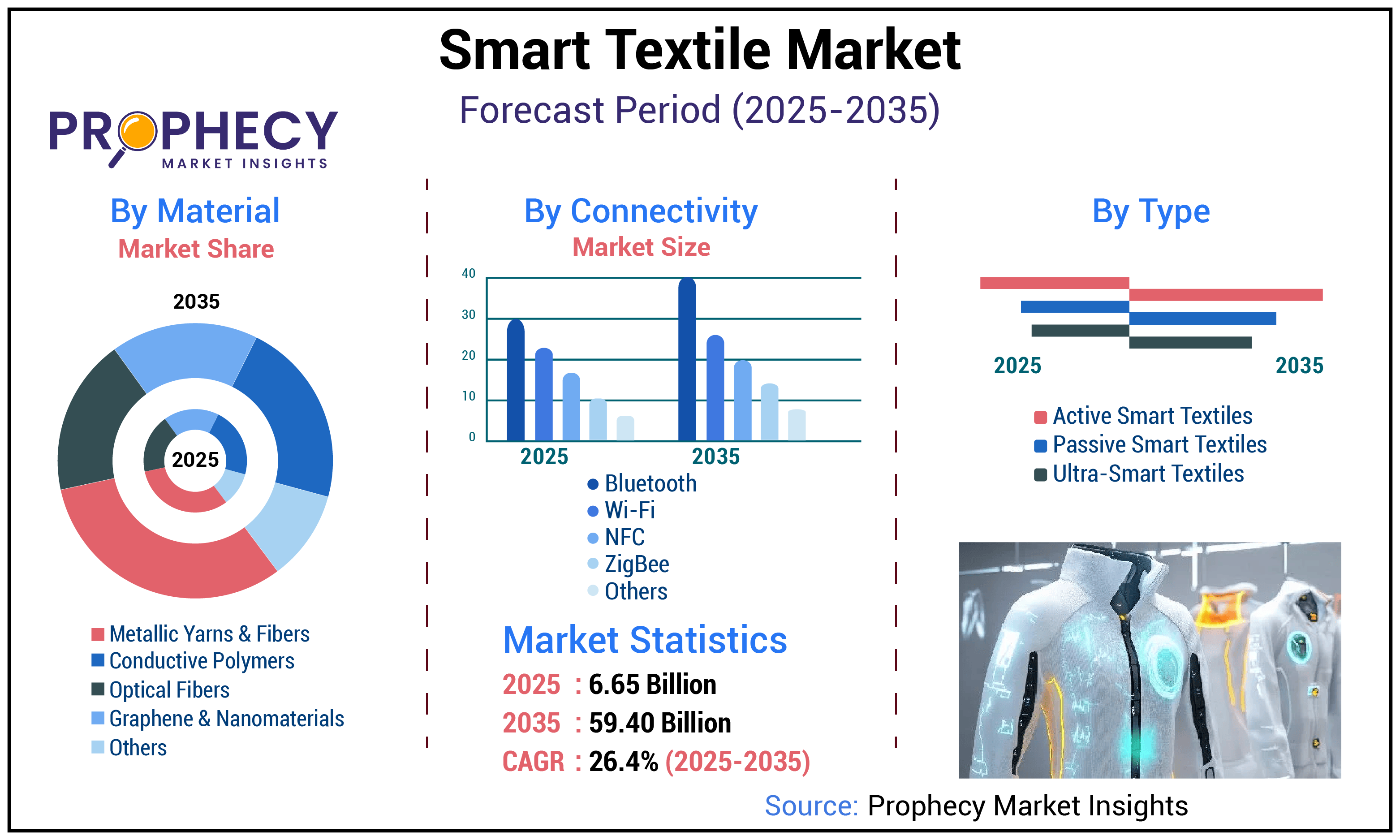
Passive smart textiles, active smart textiles, and ultra-smart textiles are type on which smart textile market is segmented. With regard to its capacity to detect and react to physiological or environmental changes, active smart textiles have the most market share and are ideal for use in defense, sports, and healthcare. Their features, including motion detection, moisture control, and temperature regulating, improve user comfort and performance and encourage widespread adoption.
Although they are easier to use and more affordable, passive smart textiles are the second most common category. They are mostly employed in simple sensing applications like temperature or pressure monitoring, which makes them a popular option in consumer and industrial sectors where dependability and price are crucial.
By Material:
Based on the material, the smart textile market is divided into conductive polymers, metallic yarns and fibers, optical fibers, graphene and nanomaterials, and others. In light of their superior electrical conductivity, durability, and ease of integration into fabrics, metallic yarns and fibers have the largest market share in the smart textile market. This makes them perfect for wearable electronics, sensing, and heating applications in the healthcare, defense, and sports sectors.
The second-dominant material category is made up of conductive polymers, which are more and more appealing for creating soft, stretchable, and comfortable smart fabrics for consumer wearables and medical monitoring applications because of their flexibility, lightweight qualities, and affordability when compared to metals.
By Connectivity:
The Smart Textile Market is categorized into Bluetooth, Wi-Fi, NFC, ZigBee, and others on the account of connectivity. With its low power consumption, small size, and smooth wireless connectivity with wearables and smartphones, Bluetooth has the biggest market share in the smart textile market. This makes it perfect for consumer, healthcare, and fitness applications.
Since it allows for high-speed data transfer and real-time monitoring over extended distances, Wi-Fi is the second most popular connectivity technology. This is especially useful for industrial, military, and medical applications that need consistent and dependable data communication.
By Functionality:
Sensing, energy harvesting, thermoelectric & heating, luminescent/illuminating, and others are functionality of the smart textile market. Since sensing functionality is essential to the majority of applications and allows fabrics to monitor factors including temperature, pressure, movement, and biometrics for use in sports, healthcare, and safety, it has the biggest market share in the smart textile market. This market's dominance is further reinforced by the rising demand for wearable’s that track fitness and health.
The second-dominant category is thermoelectric and heating functionality, which is fueled by its extensive application in military equipment, outdoor sportswear, and protective apparel, where comfort and temperature control are essential for both performance and safety.
By End User:
The smart textile market on the account of end user is categorized individuals / consumers, commercial enterprises, defense & government agencies, and others. Although wearable technology is increasingly being used for fitness tracking, health monitoring, and fashion applications, consumers and individuals have the highest market share in the smart textile market. Strong demand in this market is driven by rising personal wellness awareness and the accessibility of reasonably priced smart apparel.
Since smart textiles are increasingly utilized in military uniforms and equipment to monitor soldiers' health, improve protection, and enhance situational awareness through integrated sensing and communication technologies, defense and government agencies make up the second-dominant end-user segment.
Regional Insights:
Geographically, the Smart Textile Market is studied across North America, Europe, Asia Pacific, Latin America, and the Middle East & Africa.
North America:
In light of its strong concentration of top technology innovators, high wearable device adoption, sophisticated healthcare infrastructure, and substantial investments in military and defense applications, North America commands the biggest market share for smart textiles. The region's dominance is further reinforced by its emphasis on innovation and early adoption of IoT-based textiles.
- United States Smart Textile Market Insights:
Due to its sophisticated R&D ecosystem, robust presence of top tech and textile businesses, and strong consumer demand for wearable health and fitness solutions, the United States leads the North American smart textile market. The United States' leadership is also fueled by significant defense spending and innovation in intelligent military equipment.
Europe:
Europe is the second-dominant region due to government programs supporting smart and technological textile research and manufacture as well as the increased demand for sustainable and performance-enhancing textiles in the fashion, sports, and automotive sectors.
- Germany Smart Textile Market Insights:
Germany is the market leader in Europe owing to its large technical textile industry, significant investment in smart manufacturing, and expanding use of intelligent fabrics in the automotive, healthcare, and sports sectors, all of which are bolstered by strong government and industrial research programs.
Asia Pacific:
The Asia-Pacific (APAC) smart textile market is expanding quickly as a result of growing wearable technology use, expanding textile manufacturing capabilities, and rising investments in the sports, healthcare, and defense industries. The expansion of the market is further supported by government initiatives that promote smart and technology textiles, especially in China, Japan, and India.
- China Smart Textile Market Insights:
China is the dominant hub for smart textile development and export due to its robust industrial basis, large-scale textile production, quick integration of electronics into fabrics, and substantial investment in IoT-driven innovations and smart manufacturing.
Smart Textile Market Report Scope:
|
Attribute |
Details |
|
Market Size 2025 |
USD 6.65 Billion |
|
Projected Market Size 2035 |
USD 69.40 Billion |
|
CAGR Growth Rate |
26.4% (2025-2035) |
|
Base year for estimation |
2024 |
|
Forecast period |
2025 – 2035 |
|
Market representation |
Revenue in USD Billion & CAGR from 2025 to 2035 |
|
Regional scope |
North America - U.S. and Canada Europe – Germany, U.K., France, Russia, Italy, Spain, Netherlands, and Rest of Europe Asia Pacific – China, India, Japan, Australia, Indonesia, Malaysia, South Korea, and Rest of Asia-Pacific Latin America - Brazil, Mexico, Argentina, and Rest of Latin America Middle East & Africa – GCC, Israel, South Africa, and Rest of Middle East & Africa |
|
Company Landscape |
Market Share Analysis of Companies Heat Map Analysis Company Overview, Products Overview Financial Information, Key Highlights Business Strategies Overview SWOT Analysis |
|
Report coverage |
Revenue forecast, company share, competitive landscape, growth factors, and trends |
|
Value Added Data Infosets |
Besides fundamental market insights such as the size of the market, growth rate, segmentation, regional study, and key players, our reports carry value-added data sets such as trade flow (import-export) analysis, production and consumption overview, price trend evaluation, supply and value chain mapping, and raw material availability. Moreover, we provide strategic tools as PESTLE and Porter’s Five Forces analysis, examination of the regulatory landscape, as well as monitoring of technology and innovation thereby providing a comprehensive overview which facilitates sensible and anticipatory decision-making. |
Segmentation:
By Type:
- Passive Smart Textiles
- Active Smart Textiles
- Ultra-Smart Textiles
By Material:
- Conductive Polymers
- Metallic Yarns and Fibers
- Optical Fibers
- Graphene and Nanomaterials
- Others
By Connectivity:
- Bluetooth
- Wi-Fi
- NFC
- ZigBee
- Others
By Functionality:
- Sensing
- Energy Harvesting
- Thermoelectric & Heating
- Luminescent/Illuminating
- Others
By End User:
- Individuals / Consumers
- Commercial Enterprises
- Defense & Government Agencies
- Others
By Region:
- North America
- U.S.
- Canada
- Europe
- Germany
- U.K.
- France
- Russia
- Italy
- Spain
- Netherlands
- Rest of Europe
- Asia Pacific
- China
- India
- Japan
- Australia
- Indonesia
- Malaysia
- South Korea
- Rest of Asia Pacific
- Latin America
- Brazil
- Mexico
- Argentina
- Rest of Latin America
- Middle East & Africa
- GCC
- Israel
- South Africa
- Rest of Middle East & Africa
Global Smart Textile Market By Competitive Landscape & Key Players
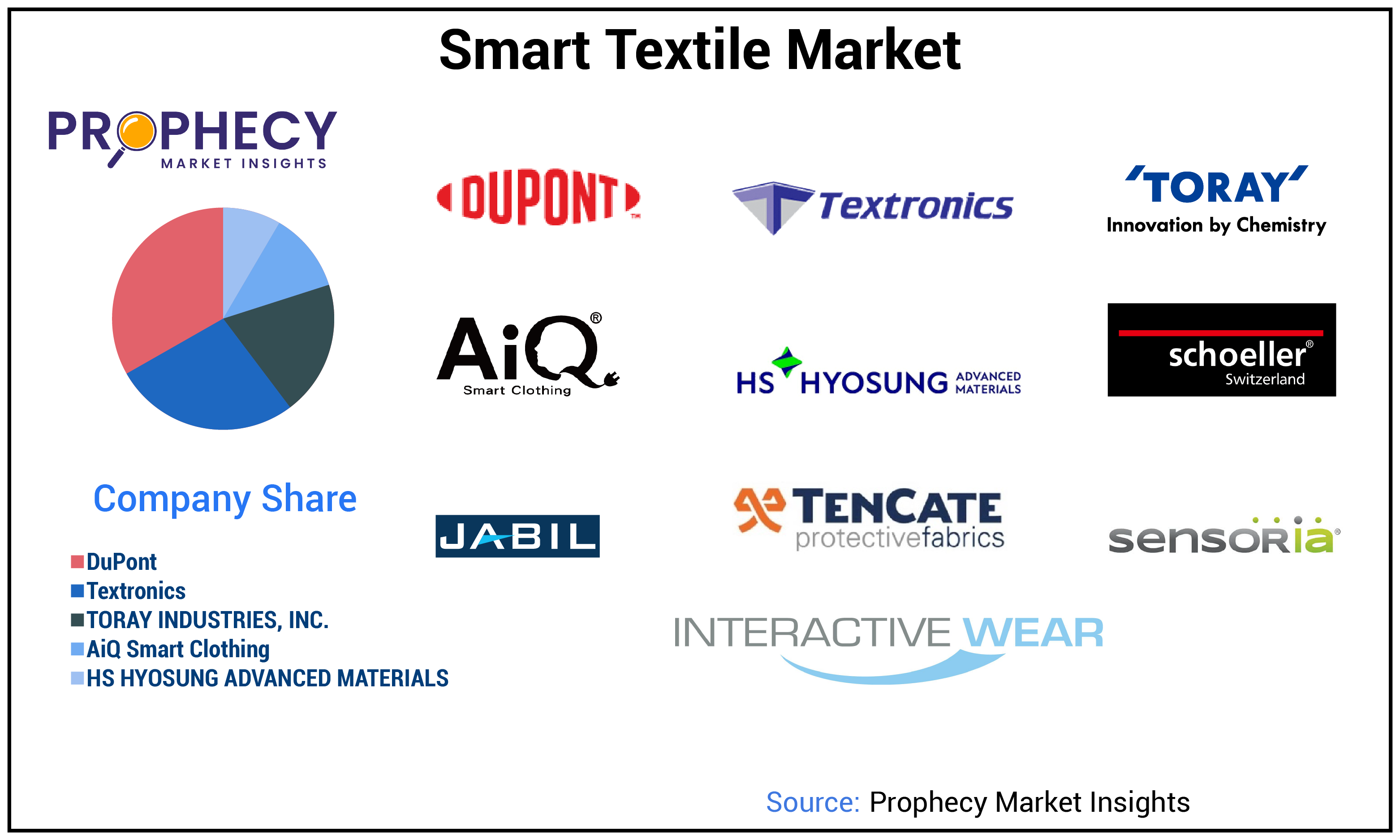
Investing in R&D to improve fabric functionality and durability, establishing strategic alliances with tech and healthcare companies to integrate cutting-edge sensors and IoT solutions, and concentrating on sustainable and eco-friendly materials to satisfy environmental standards are all important growth strategies for smart textile companies.
Smart Textile Market Companies:
- DuPont
- Textronics
- TORAY INDUSTRIES, INC.
- AiQ Smart Clothing
- HS HYOSUNG ADVANCED MATERIALS
- INTERACTIVE WEAR AG
- Schoeller Switzerland
- Sensoria
- Jabil Inc.
- TenCate Protective Fabrics
- Milliken
- WEARABLE X
- Peratech Holdco Limited
- Thermosoft International Corporation
- Xenoma Inc
View an Additional List of Companies in the Smart Textile Market
Global Smart Textile Market By Recent News
- In August 2025, In order to embed "smart" sensors directly onto textiles and upholstery and turn common fabrics into interactive, responsive surfaces, Ricoh has introduced a novel conductive printing technology that blends inkjet printing with artificial intelligence.
- During Milan Design Week, an immersive installation named Soul/Soil showcased the technology.
Analyst View:
Intelligent fabrics, also known as smart textiles, are materials that have sensors and electronics built into them that enable them to recognize and react to changes in the body or environment. This allows for real-time monitoring of temperature, movement, and health while preserving comfort and flexibility. The growing use of wearable technology, developments in IoT, AI, and sensor technologies, as well as increased demand in the automotive, healthcare, sports, and military industries, are the main drivers of market expansion. The market for smart textiles is growing faster because to the emphasis on performance, comfort, and safety as well as enhanced mobility and interaction.
Analysis of Sources:
Primary Sources:
- In-depth interviews
- Company-specific data
- Surveys and questionnaires
- Focus group discussions (FGDs)
- Others
Secondary Sources:
- World Intellectual Property Organization (WIPO)
- World Trade Organization (WTO)
- International Organization for Standardization (ISO)
- European Commission (EC)
- Others
More Related Reports
Smart Classroom Market
Smart Weapons Market
Smart Healthcare Products Market
Smart Home Market
Smart TV Market
Global Smart Textile Market By Company Profile
|
Company Name |
Product Portfolio |
|
DuPont |
Smart Textiles for Wellness Monitoring |
|
HS HYOSUNG ADVANCED MATERIALS |
Advanced Materials |
|
INTERACTIVE WEAR AG |
Smart Textiles and Wearable Electronics |
|
AiQ Smart Clothing |
Smart Clothing |
Global Smart Textile Market By Highlights
FAQs
Smart Textile Market size was valued at USD 6.65 Billion in 2025 and is expected to reach USD 69.40 Billion by 2035 growing at a CAGR of 26.4%.
Type, material, connectivity, functionality, end user, and region are the segmentation for the Smart Textile Market.
High demand for wearable technology, advancements in nanotechnology and flexible electronics, and growing applications in healthcare, sports, and military sectors, and so on are some of the Smart Textile Market growth drivers.
North America, Asia Pacific, Europe, Latin America, and the Middle East & Africa. North America is expected to dominate the Smart Textile Market.
The key players operating the Smart Textile Market include DuPont, Textronics, TORAY INDUSTRIES, INC., AiQ Smart Clothing, HS HYOSUNG ADVANCED MATERIALS, Schoeller Switzerland, Sensoria, TenCate Protective Fabrics, Milliken, WEARABLE X, Peratech Holdco Limited, Thermosoft International Corporation, and Xenoma Inc.