Global NextGeneration Anode Materials Market Overview
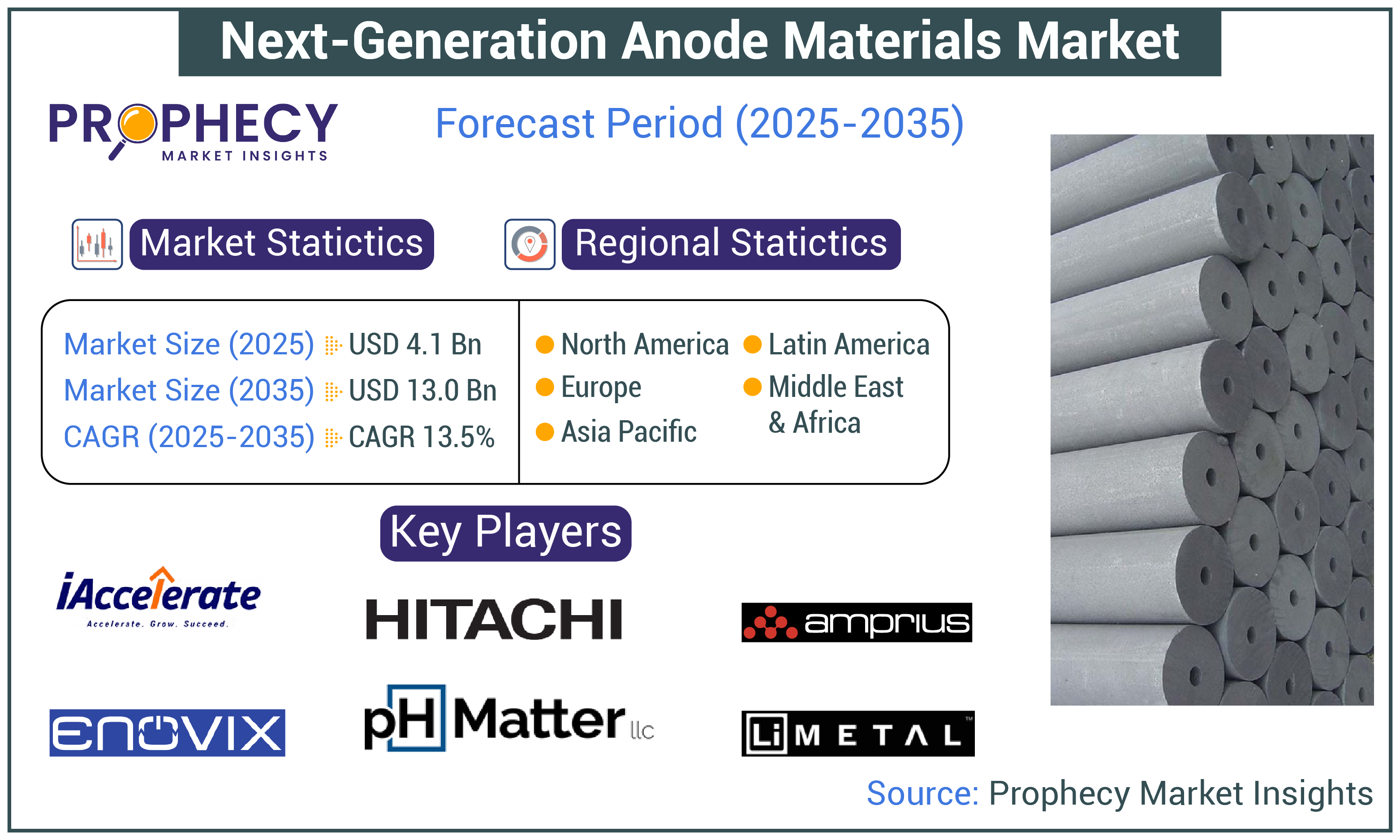
- Next-generation anode materials market size is anticipated to enlarge at a rate of USD 13.0 Billion, by 2035.
- In 2024, the next-generation anode materials market valuation was USD 3.7 Billion.
- The market is increasing at a CAGR 13.5%.
?Next-generation anode materials are the advanced materials being developed or optimized to replace or improve upon the conventional graphite anodes, which is currently used in lithium-ion batteries (LIBs) and other energy storage systems. These innovative materials aim to increase battery capacity, charging speed, lifespan, and safety, by supporting the growing demand for high-performance batteries in electric vehicles (EVs), portable electronics, and grid storage. Companies and research institutions are investing heavily in R&D to bring these materials to commercial scale, and silicon-based and lithium metal anodes are significantly boosting battery performance, which is a critical role in the future of solid-state and high-energy batteries.
The growing adoption of electrical vehicles, technological advancement in battery development is enabling the practical use of high-capacity anode materials, resulting to drive next-generation anode materials market growth. The demand for longer battery life and faster charging in smartphones, laptops, and wearables is fueling the adoption of more energy-dense anode materials, and government regulations are promoting to clean energy adoption, is expected to pitch next-generation anode materials market growth.
Commercialization of silicon-based anodes, integration in solid state batteries, and strategic partnerships or collaborations to accelerate the commercial viability of next-generation anode materials, is contributes to create significant opportunities for next-generation anode materials market growth.
Impact of Generative AI on Next-Generation Anode Materials Market:
- AI is significantly impact on the next-generation anode materials market by accelerating the discovery, development, and optimization of advanced battery materials. AI models can analyze large datasets of chemical properties and simulate various material combinations at high speed. This enables the rapid identification of novel anode materials, such as silicon-carbon composites, nano-engineered lithium alloys, or graphene variants, which offer higher energy density, better stability, and longer lifespans. AI can model the environmental impact and cost of production for various material formulations, this supports the development of eco-friendly, scalable, and cost-effective anode.
Global NextGeneration Anode Materials Market Drivers & Restraints
Key Drivers:
The Booming Electric Vehicles sector is contributing to Phenomenal Market
The exponential growth of the electric vehicles (EVs) industry is one of the most driving forces behind the surge in demand for next-generation anode materials. As governments and private sectors globally shift the transition from internal combustion engine (ICE) vehicles to zero-emission EVs, the need for high-performance, durable, and energy-efficient batteries has increased. Next-generation anode materials, such as silicon-based composites, lithium metal, and lithium titanium oxide offer significant advantages that align perfectly with the evolving requirements of modern EV batteries.
The EV sector is fueled by strong regulatory and economic support, such as carbon neutrality goals, fuel economy standards, subsidies, and tax incentives. Major automotive companies are investing into EV production and battery technologies, in partnership with battery manufacturers and anode material developers. The rapid growth in EV market increases battery production volumes, it is accelerating innovation and commercial interest in high-capacity, next-generation anode materials, that can deliver enhanced performance for electric mobility, resulting to drive next-generation anode materials market growth.
- For instance, according to data published by World Resources Institute, in September 2023, the major countries are adopting electric vehicles, to produce fewer greenhouse gas emissions. Norway sales 80% of passenger vehicles, Iceland sales 40%, Sweden sale 32%, Netherlands sales 24%, and China sales 22%. China has biggest electric car market in the world. By 2030, the electric vehicles sales need to grow to 75% to 95%.
Restraints:
Safety and Regulatory Concerns Delay Market Growth
Some materials, such as lithium metal can concern with safety risks, such as overheating or short-circuiting due to dendrite growth. Regulatory bodies are cautious about approving these materials for large-scale deployment, especially in electric vehicles or aviation.
- Counterbalance Statements: The development of solid-state battery architectures, advanced separators, and thermal management systems is modifying these safety risks. As safety testing progresses and standards evolve, regulatory acceptance is expected to improve.
Opportunities & Trends:
Development of Solid-State Batteries can create Significant Opportunities for Market Amplification
The ongoing development and future commercialization of solid-state batteries (SSBs) represent a transformative opportunity for the next-generation anode materials market. SSBs are widely observed as the future of advanced energy storage due to their potential to deliver superior energy density, enhanced safety, and longer lifespan compared to conventional lithium-ion batteries. As research and industry increasingly focus on overcoming the technical and manufacturing challenges of SSBs, the demand for innovative anode materials tailored to solid-state systems is expected to increases. SSB have the ability to utilize high-capacity anode materials, such as lithium metal and silicon-based composites, with more effectively than traditional liquid electrolyte system. The next-generation anode materials are crucial for the production of higher energy storage capabilities, particularly for electric vehicles, and growing demand for high-performance battery solutions, can significantly developed SSB, resulting to drive next-generation anode materials market share.
- For instance, according to article published by Elsevier B.V., in January 2025, this article states that development of sold-state batteries (SSB) is emerging as an alternative to conventional lithium-ion batteries. SSB has the potential for higher energy density and improved safety, as it can replace the flammable liquid electrolyte with a solid-state electrolyte (SSE). Development of SSB can hinder several challenges, such as reduce high manufacturing cost, which is driven by complex material processing and low-throughput production methods. Researchers are focusing on enhancing the electrode-electrolyte interface through advanced fabrication technologies such as 3D printing, plasma treatment, and atomic layer deposition (ALD). These methods aim to improve interface contact, enable precise material layering, and support scalable, cost-effective manufacturing, and commercialization of next-generation of all solid-state batteries.
Global NextGeneration Anode Materials Market Segmentations & Regional Insights
The next-generation anode materials market is segmented into material type, manufacturing process, application, end-user, and region.
By Material Type:
Based on material type, the market is classified into, silicon oxide blend, lithium metal, lithium titanium oxide, silicon-carbon composite, and silicone-graphene composite. Silicon-carbon composite are currently the most dominant segment in next-generation anode materials market share, as it offers a balanced combination of high capacity and structural stability. Major battery manufacturers and startups are investing heavily in silicon-carbon composite technology for use in electric vehicles (EVs), wearable electronics, and consumer devices, which contributes to segment’s growth in next-generation anode materials market growth.
Silicon oxide blends has second dominance in target market due to their improved cycle stability and compatibility with existing battery production lines. Silicon oxide helps to reduce the swelling that pure silicon experiences during lithiation and enables better stability or lifespan, even under high charge/discharge rates, resulting to propel growth of segment in next-generation anode materials market size.
By Manufacturing Process:
Chemical vapor deposition, sputtering, lithography, and ball milling, are divided based on manufacturing process for target market. Ball milling is currently the most widely used and dominant segment in the market. This method is cost-effective, scalable, and suitable for large-scale production, which makes it highly attractive for commercial applications, especially in the automotive and consumer electronics sectors, is responsible for segment’s growth in next-generation anode materials market share.
Chemical Vapor Deposition (CVD) is the second most dominant segment in next-generation anode materials market share. CVD offers excellent control over material thickness, purity, uniformity, which is crucial for solid-state batteries and high-performance lithium metal anodes, is anticipated to fuel segment’s growth in next-generation anode materials market size.
By Application:
By application, the market is classified into electric vehicle, energy storage, consumer electronics, and others. The electric vehicle (EV) sector is the leading segment in next-generation anode materials market size. Next-gen anode materials such as silicon-carbon composites offer significantly higher lithium-ion storage capacity, which translates into longer driving range, crucial for electrical vehicle, is projected to fuel segment growth in next-generation anode materials market share.
By End-User:
Under end-user, the market is categorized into, electrical & electronics, transportation, aerospace & defense, energy storage, automotive, and others. The automotive industry holds the largest next-generation anode materials market share, due to booming demand for electric vehicles. Next-generation anode materials such as silicon-carbon composites and lithium metal anodes are essential for improving the driving range, battery efficiency, charging speed, are key features for EV manufacturers, is estimated to impel next-generation anode materials market size.
Regional Insights:
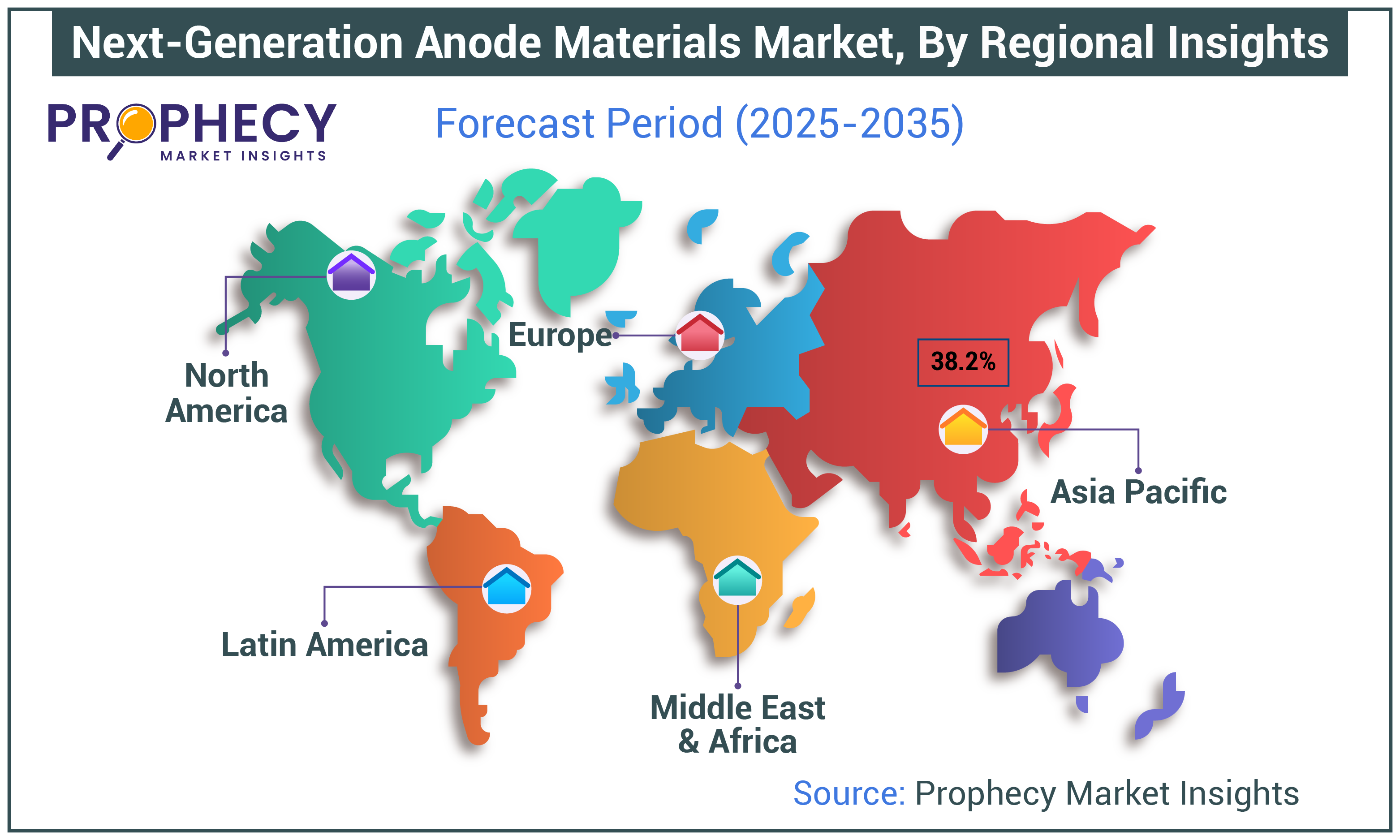
Geographically, the market is studied across North America, Europe, Asia Pacific, Latin America, and the Middle East & Africa.
Asia Pacific: This is the largest and most dominant region accounting for the largest share of the global market. This region is highly investing in production infrastructure, it is leading electric & electronics manufacturer, growing demand for electric vehicles, renewable energy storage solutions, and ongoing research & development in battery technology, is contributing to region expansion in carbon nanotube market size.
- China Next-Generation Anode Materials Market Insights:
China has leading country in Asia Pacific region, due to its massive production capabilities and significant demand across multiple industries. The country’s large-scale manufacturing infrastructure which makes it to dominate the supply of next-generation anode materials globally, growing consumer of electric vehicles, and demands for next-generation anode materials, in smart devices, flexible electronics, is expected to next-generation anode materials market growth.
North America: This is the fastest-growing region in the target market growth, which is driven by technological advancements, increased investments in energy storage technologies, and the growing demand from electronic and automotive industries. This region is heavily investing using next-generation anode materials for lightweight materials, battery technologies, and growing focused on next-generation anode materials technologies, is projected to propel next-generation anode materials market share.
- U.S. Next-Generation Anode Materials Market Insights:
U.S. is leading country in North America region in target market. The U.S. contains major electronics companies, its strong industrial base, innovation in battery technology, and increasing applications across various industries, is responsible for the next-generation anode materials market growth.
Europe: Europe is experiencing steady growth in market. The next-generation anode materials market is attributed by, its strong focus on advanced technology, ongoing g focus on energy storage, presence of major aerospace & defense sector, sustainability, and the automotive & aerospace industries.
- Germany Next-Generation Anode Materials Market Insights:
Germany is the dominant country in Europe for the market. Germany is a key player in manufacturing production in the Europe, its strong commitment to renewable energy storage and green technologies makes it a leading market for next-generation anode materials used in batteries and supercapacitors, is projected to impel next-generation anode materials market share.
Next-Generation Anode Materials Market Report Scope:
|
Attribute |
Details |
|
Market Size 2025 |
USD 4.1 Billion |
|
Projected Market Size 2035 |
USD 13.0 Billion |
|
CAGR Growth Rate |
13.5% (2025-2035) |
|
Base year for estimation |
2024 |
|
Forecast period |
2025 – 2035 |
|
Market representation |
Revenue in USD Billion & CAGR from 2025 to 2035 |
|
Regional scope |
North America - U.S. and Canada Europe – Germany, U.K., France, Russia, Italy, Spain, Netherlands, and Rest of Europe Asia Pacific – China, India, Japan, Australia, Indonesia, Malaysia, South Korea, and Rest of Asia-Pacific Latin America - Brazil, Mexico, Argentina, and Rest of Latin America Middle East & Africa – GCC, Israel, South Africa, and Rest of Middle East & Africa |
|
Report coverage |
Revenue forecast, company share, competitive landscape, growth factors, and trends |
Segmentation:
By Material Type:
- Lithium Metal
- Lithium Titanium Oxide
- Silicon Oxide Blend
- Silicon-Carbon Composite
- Silicone-Graphene Composite
By Manufacturing Process:
- Sputtering
- Chemical Vapor Deposition
- Lithography
- Ball Milling
By Application:
- Electric Vehicle
- Energy Storage
- Consumer Electronics
- Others
By End-User:
- Electrical & Electronics
- Transportation
- Aerospace & Défense
- Energy Storage
- Automotive
- Others
By Region:
- North America
- U.S.
- Canada
- Europe
- Germany
- U.K.
- France
- Russia
- Italy
- Spain
- Netherlands
- Rest of Europe
- Asia Pacific
- China
- India
- Japan
- Australia
- Indonesia
- Malaysia
- South Korea
- Rest of Asia Pacific
- Latin America
- Brazil
- Mexico
- Argentina
- Rest of Latin America
- Middle East & Africa
- GCC
- Israel
- South Africa
- Rest of Middle East & Africa
Global NextGeneration Anode Materials Market Competitive Landscape & Key Players
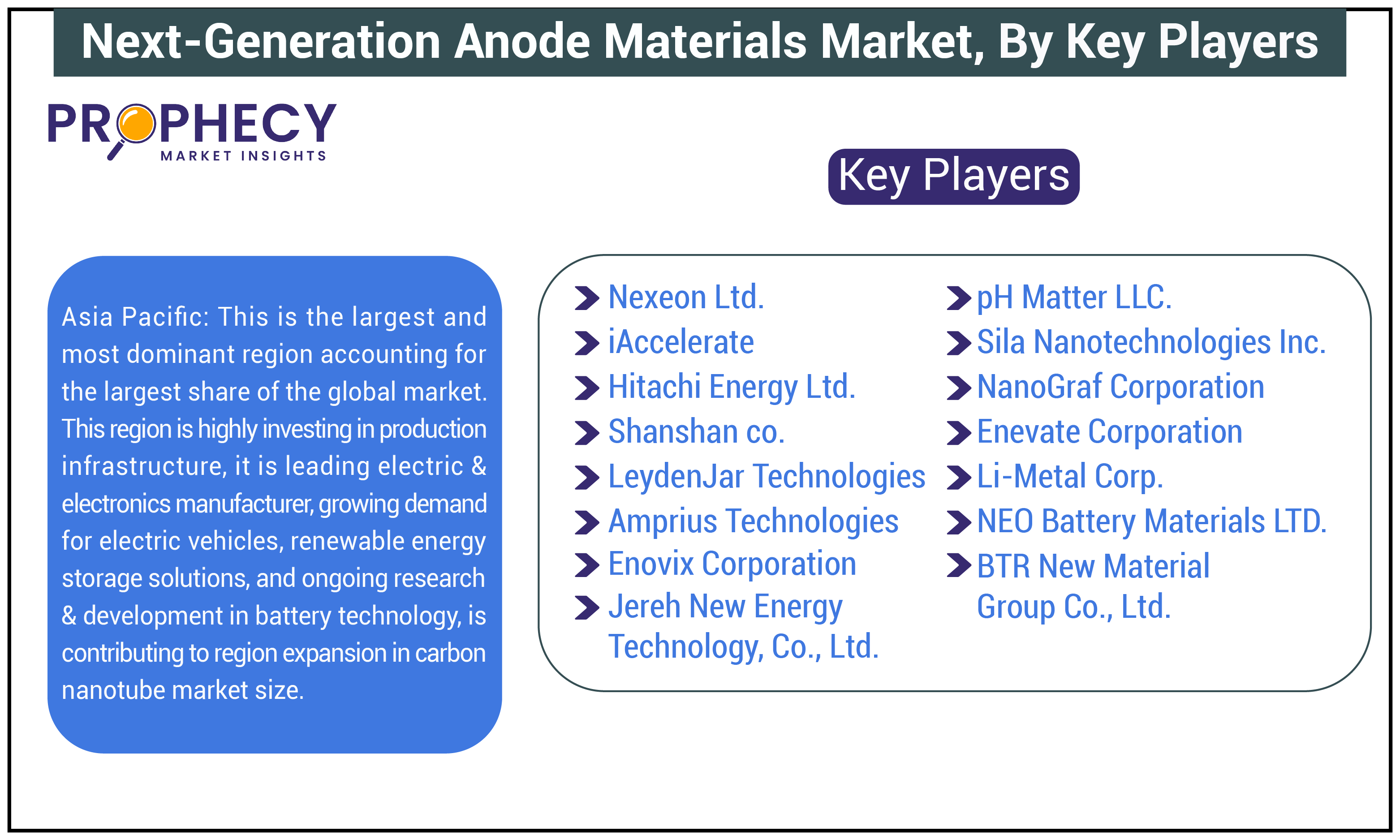
The major companies are functioning in the next-generation anode materials market are, Nexeon Ltd., iAccelerate, Hitachi Energy Ltd., and others. This companies are constantly innovating and developing new products to meet energy storage demand through their strategic partnership and collaboration. The key players are focusing on development of advancement battery technology using next-generation anode materials through acquisition, is anticipated to growth of Next-Generation Anode Materials market size.
Next-Generation Anode Materials Market Companies:
- Nexeon Ltd.
- iAccelerate
- Hitachi Energy Ltd.
- Shanshan co.
- LeydenJar Technologies
- Amprius Technologies
- Enovix Corporation
- pH Matter LLC.
- Sila Nanotechnologies Inc.
- Jereh New Energy Technology, Co., Ltd.
- NanoGraf Corporation
- BTR New Material Group Co., Ltd.
- Enevate Corporation
- Li-Metal Corp.
- NEO Battery Materials LTD.
View an Additional List of Companies in the Next-Generation Anode Materials Market
Global NextGeneration Anode Materials Market Recent News
- In November 2024, Sila introduced new battery engineering services to support product innovators’ transition to next-generation anode materials. This Battery Engineering Services help to consume electronics (CE), micromobility design teams, and cell manufacturing partners, to develop a better battery. Sila’s Battery Engineering Services team to collaborate with OEMs to develop battery with product vision, and understand product requirements or help to identify and enhance high-performance batteries.
- In November 2024, Ionic Mineral Technologies (Ionic MT), an emerging leader in nano-silicon anode battery material production, has successfully leased and fully permitted the expansive 4,000-acre Silicon Ridge halloysite property from the State of Utah. The strategic acquisition significantly enhanced the company’s halloysite reserves, a critical feedstock for scaling production of its Ionisil nano-silicon anode material to meet the growing demand of next-generation, in fast charging electric vehicles (EVs).
- In October 2024, the research team led by Next-generation Battery Research Center at the Korea Electrotechnology Research Institute (KEPRI), announced the development in battery technology. The team was created a new anode material based on a tin-based alloy, specifically a tin-iron compound (FeSn2), which overcomes reliance on conventional focus on lithium metal. This innovation promises to significantly enhance the performance, and safety of all-solid-state batteries.
- In June 2024, Toshiba Corporation, Sojitz Corporation of Japan, and Brazil’s CBMM, the world’s leading producer of niobium, were collaborated to develop of a next generation lithium-ion battery that uses niobium titanium oxide (NTO) in the anode. This marked as global first operation of model e-vehicle powered by lithium-ion battery with NTO anodes. This partnership was implemented the practical use of niobium in battery material applications with the development of an NTO anode that aimed to deliver high energy density.
Analyst View:
The next-generation anode materials market is undergoing rapid transformation, driven by the increasing demand for higher-performing batteries in applications such as electric vehicles (EVs), energy storage systems, and consumer electronics. Technological advancement in battery, ongoing material innovation, and strategic partnerships with material providers, research institutions to enhance next-generation anode material performance, is expected to impel next-generation anode materials market share.
More Related Reports
Next-generation Products in Tobacco Market
Next-Generation Biofuels Market
Next-Generation Sequencing Informatics Market
Next-Generation Sequencing (NGS) Market
Next-generation Products in Tobacco Market
Global NextGeneration Anode Materials Market Company Profile
|
Company Name |
Hitachi Energy Ltd. |
|
Headquarter |
Zurich, Switzerland |
|
CEO |
Claudio Facchin |
|
Employee Count |
270,000 Employees |
Global NextGeneration Anode Materials Market Highlights
FAQs
Next-generation anode materials market size was valued at USD 4.1 Billion in 2025 and is expected to reach USD 13.0 Billion by 2035 growing at a CAGR of 13.5%.
Products, manufacturing process, application, end-user, and region are the segmentation for the target market.
North America, Asia Pacific, Europe, Latin America, and the Middle East & Africa. Asia Pacific is expected to dominate the market.
The key players operating in the next-generation anode materials market include Nexeon Ltd., iAccelerate, Hitachi Energy Ltd., Shanshan co., LeydenJar Technologies, Amprius Technologies, Enovix Corporation, pH Matter LLC., Sila Nanotechnologies Inc., Jereh New Energy Technology, Co., Ltd., NanoGraf Corporation, BTR New Material Group Co., Ltd., Enevate Corporation, Li-Metal Corp., and NEO Battery Materials LTD.