North America Floating Wind Power Market Overview
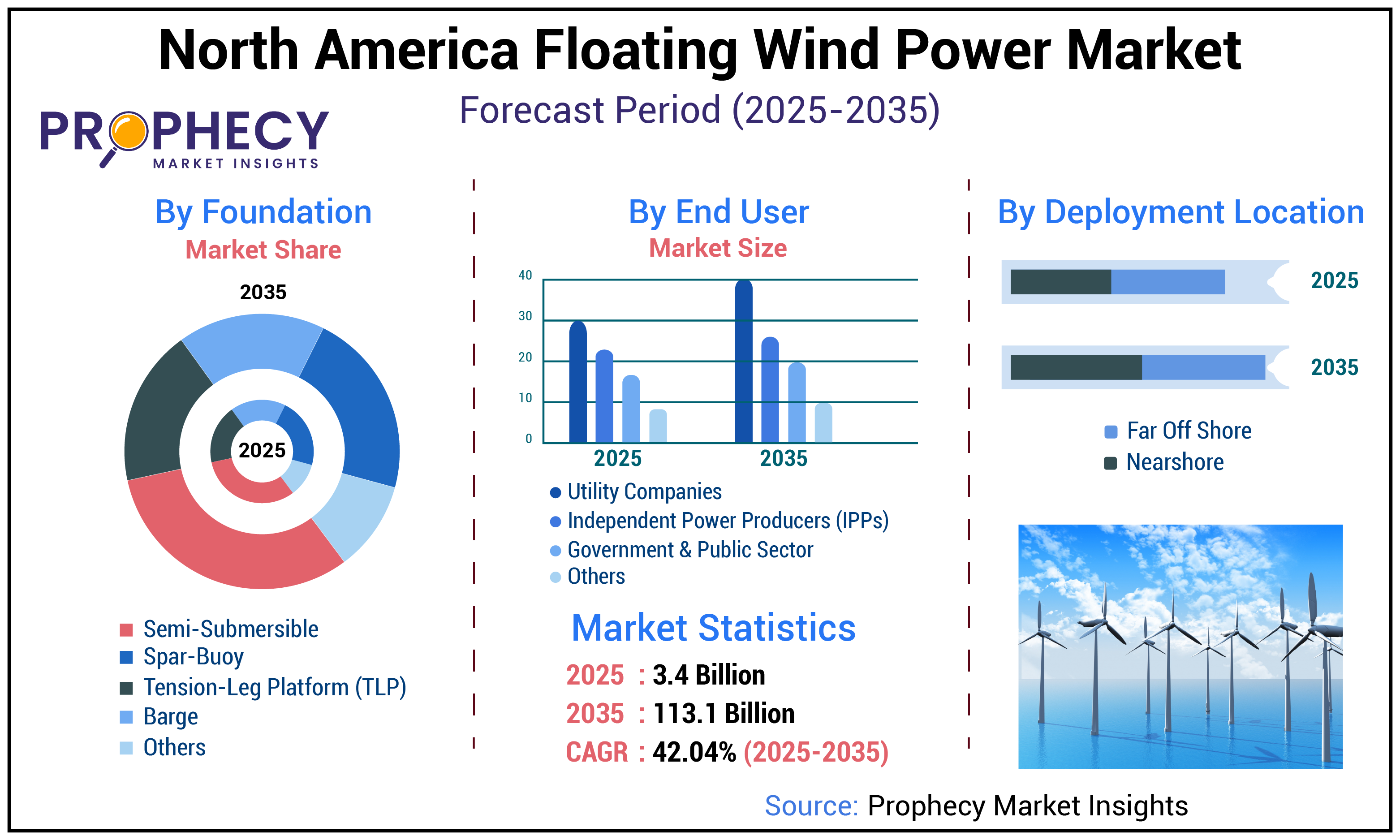
- 2025 Market Size: USD 3.4 Billion
- 2035 Projected Market Size: USD 113.1 Billion
- CAGR (2025-2030): 42.04%
- North America: Largest Market in 2024
Floating wind power is offshore wind energy systems in which wind turbines are on floating platforms that are anchored to the seabed, thus allowing the generation of the power in the deep waters where fixed foundations are not feasible. This technology permits the access to better and more stable wind resources far from the coast. This is mainly for the purpose of extending green energy sources, cutting down on carbon gases and providing clean electricity to coastal grids and the industries located in that region.
The expansion of floating wind energy in North America is propelled by various major factors. These include the increasing regional need for clean energy and the carbon reduction goals that governments have established. In contrast to fixed-bottom turbines, floating wind technology allows for installation in very deep waters. This is due to, the wind is not only stronger but also steadier which can double or triple the amount of energy produced making the energy yield significantly higher.
Common LCOE Categories Between Commercial-Scale Fixed-Bottom and Floating Offshore Wind Systems:
|
Category |
Major Cost Element |
Common Cost Elements |
|
Turbine |
Turbine |
Common |
|
Balance of System |
Development and Project Management Substructure Foundation Port, Staging, Logistics, and Transport Turbine Installation Substructure Installation Array Cable Export Cable Onshore Grid Connection |
Common Floating specific Floating specific Floating specific Floating specific Floating specific Floating specific Common Common |
|
Soft Costs |
Soft Costs (Insurance, Contingencies, Construction Finance |
Common |
|
Financing |
Financing Terms |
Common |
|
Energy Production |
Capacity Factor |
Common |
|
Operations and Maintenance |
Operations Maintenance |
Common Floating Specific |
Current Industry Dynamics & Insights:
- U.S. has the largest country share in the North America floating wind offshore market
- By foundation type, semi-submersible probably has the most market share among others.
- In the North America floating offshore wind power market, the segment of turbine capacity above 8 MW is the leading category
- The North America floating offshore wind power market consists primarily of utility companies as its main end users.
North America Floating Wind Power Market Drivers & Restraints
Drivers and Restraints:
|
Drivers |
Restraints |
Opportunities & Trends |
|
|
|
Key Drivers:
Rising Energy Demand & Climate Goals
The floating offshore wind sector is experiencing a surge in demand to the point that energy requirements in the United States and Canada are becoming the decisive factor for the clean energy market. Since wind along the coast is the area expected to contribute most of the new generation, it follows that the rapid pace of climate commitments requires a change in the way wind is harnessed: The deployment of floating offshore wind turbines is the only practicable alternative.
- For Instance, The Department of Energy in the U.S. published a recent study showing that data center electricity use will rise from 4.4% in 2023 to between 6.7% and 12% by 2028. In order to guarantee reliable, affordable, and clean grid operations, the Department of Energy (DOE) is diligently investigating various possibilities. These options encompass energy storage, the use of smart rate structures, the implementation of clean-generation technologies, and onsite generation.
Restraints:
Environmental Concerns
Floating offshore wind projects in North America are generally recognized as a valuable renewable energy source. However, environmental concerns persist as a major barrier to the fast deployment of these wind projects. The installation of turbines and anchoring systems can alter the seabed habitats that store marine life, which in turn, affects the benthic ecosystems and fish populations. Regulatory bodies often require comprehensive environmental impact assessments and the development of mitigation strategies, as a result permitting timelines can be extended, and project costs may also increase.
- Counterbalance Statements: Floating offshore wind ventures in North America have also become more ecological-friendly by implementing additional measures to reduce nature impacts, e.g., by a careful site selection, avoiding operations during sensitive seasons, and using the latest monitoring technology for marine and birds in the area. Besides, several researches support the conversion of turbine foundations into artificial reefs which, in turn, attract and maintain biological diversity in some locations.
Opportunities & Trends:
Integration with Renewable Energy
Integration with other renewable energy sources such as offshore solar and advanced energy storage systems is emerging as a pivotal trend in the North America floating wind power market, aimed at reinforcing grid reliability and optimizing energy output. By integrating floating wind, solar arrays, and large-scale battery storage, developers can not only offset the intermittency of each technology but also deliver a more consistent and reliable power supply to the grid. Such a hybrid system is especially suitable for coastal states and provinces as their peak energy demand changes throughout the day and seasons.
- For Instance, the Biden RWEinistration permitted the lease in Gulf of Maine for research project regarding floating wind. This 9,700-acre lease lies approximately 28 nautical miles offshore and is expected to host up to 12 floating turbines generating around 144 MW. The move aims at fulfilling deployment targets of 30 GW offshore wind by 2030 and 15 GW of floating installations by 2035.
North America Floating Wind Power Market Segmentations & Regional Insights
Foundation type, water depth, turbine capacity, deployment location, end user industry and country are the divisions of the North America floating wind power market.
By Foundation Type:
Spar-buoy, semi-submersible, tension-leg platform (TLP), barge, and others are foundation type on which North America floating wind power market is segmented. The North America floating wind power market has the semi-submersible foundation segment as the current leader, which is also expected to dominate during the forecast period. The main reasons for the popularity of semi-submersible platforms are the wide-ranging water depths and seabed conditions, which they can efficiently operate, due to their adaptability, stability, and so on.
- According to Department of Energy’s Energy, approximately 80% of offshore wind floating projects around the world are designed with semi-submersible platforms. These platforms are the most common due to their low cost, versatility, and stability, particularly in deep waters in North America.
By Water Depth:
Based on the Water Depth, the North America floating wind power market is divided into shallow water (up to 60m), deep water (60m – 200m), and ultra-deep water (200m & above). The deep-water section of North American floating offshore wind dominates the industry as it operates in water depths greater than 60 meters. Offshore wind conditions along the U.S. West Coast and Atlantic seaboard favor floating platforms as the fixed-bottom installations cannot be used in these locations.
- The leasing strategy of the BOEM has been updated to include 12 offshore wind energy auctions until 2028. Out of these, seven auctions are designed for deep-water areas, which are specifically suitable for floating offshore wind. In this way, the federal leasing priorities are harmonized with the competitive and technical advantages of the deep-water segments.
By Turbine Capacity:
Up to 3 MW, 3–5 MW, 5–8 MW, above 8 MW are turbine capacity of the North America floating wind power market. In the North America floating offshore wind power market, the segment of turbine capacity above 8 MW is the leading category and is expected to grow in the future. The majority of pre-commercial and floating projects on the U.S. West Coast and the Gulf of Maine are being developed with large turbines of more than 10 MW. The developers are thus adopting 14-15 MW models more and more to make greater use of their efficiency and to lower the levelized cost of energy (LCOE).'
The 5-8 MW turbine capacity range stands as the second leading category within the North America floating offshore wind power market. Early-stage demonstration and pilot projects including the University of Maine’s Aqua Ventus use this range for their pre-commercial installations.
By Deployment Location:
The North America floating wind power market on the account of deployment location are categorized into nearshore, and far off shore. The North American offshore wind power market has a leading deployment location in the far offshore segment which will dominate the forecast period. Floating wind technology is made to use the less turbulent and fewer variable wind resources found in deeper waters, usually far from the shore where fixed-bottom turbines cannot be used.
The second-dominant market is nearshore channels, which are expanding quickly upon account of the ease of home delivery, a greater range of Foundation Types, tailored suggestions, and the growing appeal of direct-to-consumer (DTC) businesses. The nearshore segment represents the second most significant placement area in the North America floating offshore wind power market. The main application of nearshore floating wind has been the use of pilot, demonstration, and research projects due to the easier grid connections, lower installation costs, and less complex maintenance logistics.
By End user:
Utility companies, independent power producers (IPPs), government & public sector, and others are end-user segments. The North America floating offshore wind power market consists primarily of utility companies as its main end users. Large utility companies lead the floating wind adoption movement because they have the financial resources along with regulatory knowledge and grid infrastructure needed to manage offshore projects at multi-gigawatt scale.
- For instance, Dominion Energy leads the Coastal Virginia Offshore Wind project which represents the biggest offshore wind installation across the United States as it will produce 2.6 GW of electrical power for 660,000 residential units.
By Region:
North America: The North American area is developing into a major floating offshore wind power center due to its extensive deepwater areas and supportive policies and rising clean energy dedication. The U.S. is leading the way through floating offshore wind projects in California and Oregon on the West Coast as well as the Gulf of Maine as floating foundations are necessary for deep water operations.
- For instance, in February 2024, the U.S. DOE Wind Energy Technologies Office and Innovation Fund Denmark offered a USD 4.2 million opportunity to propel the floating offshore wind industry by fostering collaboration and amplifying the impact of research and development efforts in both the countries.
North America Floating Wind Power Market Report Scope:
|
Attribute |
Details |
|
Market Size 2025 |
USD 3.4 Billion |
|
Projected Market Size 2035 |
USD 113.1 Billion |
|
CAGR Growth Rate |
42.04% (2025-2035) |
|
Base year for estimation |
2024 |
|
Forecast period |
2025 – 2035 |
|
Market representation |
Revenue in USD Billion & CAGR from 2025 to 2035 |
|
Regional scope |
North America- U.S., Canada |
|
Company Landscape |
Market Share Analysis of Companies Heat Map Analysis Company Overview, Foundation Types Overview Financial Information, Key Highlights Business Strategies Overview SWOT Analysis |
|
Report coverage |
Revenue forecast, company share, competitive landscape, growth factors, and trends |
|
Value Added Data Infosets |
Besides fundamental market insights such as the size of the market, growth rate, segmentation, regional study, and key players, our reports carry value-added data sets such as trade flow (import-export) analysis, Foundation Typeion and consumption overview, price trend evaluation, supply and value chain mapping, and raw Water Depth availability. Moreover, we provide strategic tools as PESTLE and Porter’s Five Forces analysis, examination of the regulatory landscape, as well as monitoring of technology and innovation thereby providing a comprehensive overview which facilitates sensible and anticipatory decision-making. |
Segmentation:
By Foundation Type:
- Spar-Buoy
- Semi-Submersible
- Tension-Leg Platform (TLP)
- Barge
- Others
By Water Depth:
- Shallow Water (up to 60m)
- Deep Water (60m – 200m)
- Ultra-Deep Water (200m & above)
By Turbine Capacity:
- Up to 3 MW
- 3–5 MWl 5–8 MW
- Above 8 MW
By Deployment Location:
- Nearshore
- Off Shore
By End User:
- Utility Companies
- Independent Power Producers (IPP)
- Government & Public Sector
- Others
By Region:
- North America
- U.S.
- Canada
North America Floating Wind Power Market Competitive Landscape & Key Players
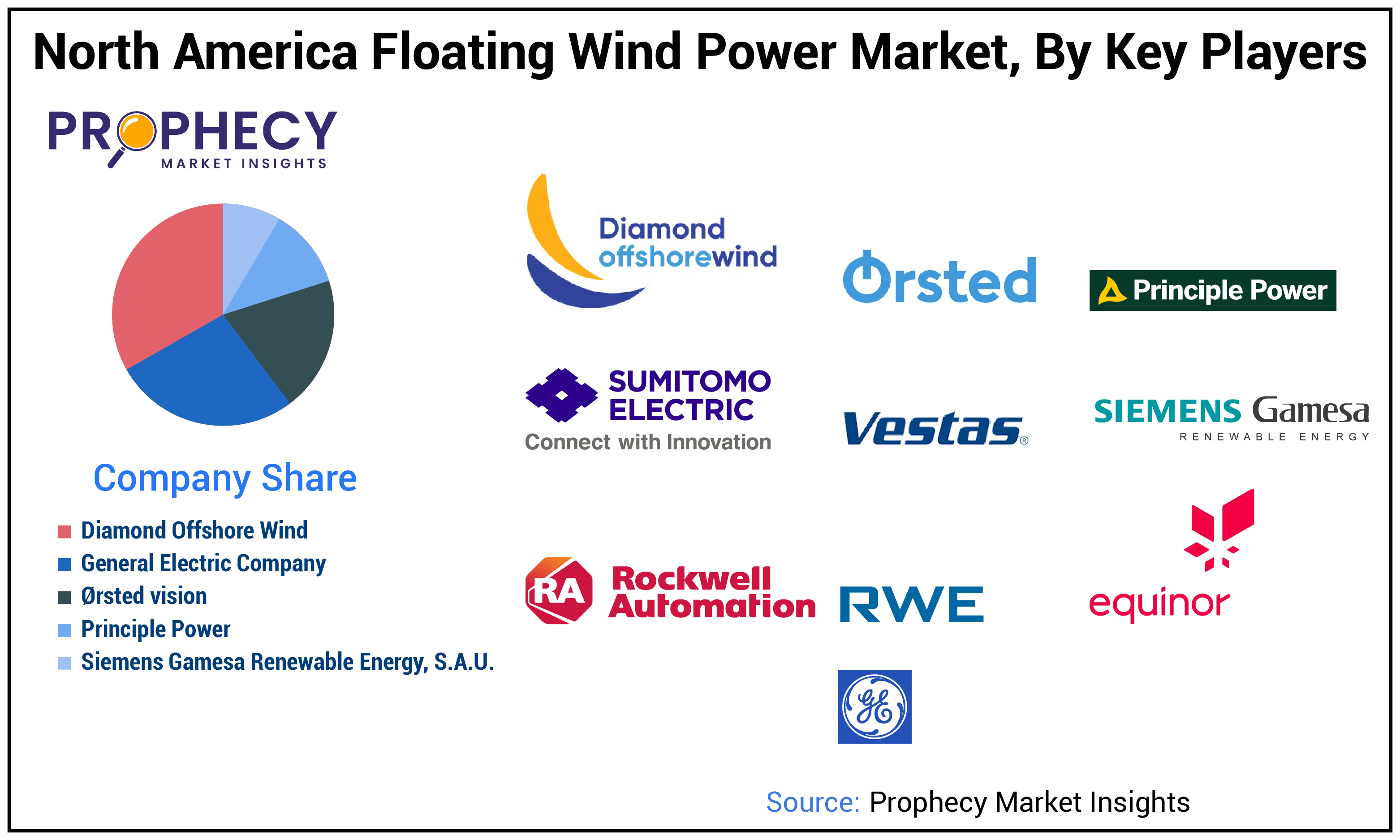
The North America market for floating wind power is characterized by a competitive landscape, which is led by energy majors from across the globe, utilities, and technological solution providers. Strategic partnerships, innovative deepwater deployment, and leases backed by the government are among the factors that are energizing competition at this time in the race to acquire a firm footing in this market in the making.
North America Floating Wind Power Market Companies:
- Diamond Offshore Wind
- General Electric Company
- Ørsted vision
- Principle Power
- Siemens Gamesa Renewable Energy, S.A.U.
- Sumitomo Electric Industries, Ltd
- RWE
- Vestas
- DOOSAN ENERBILITY.
- Equinor ASA
- Macquarie Group Limited
- Rockwell Automation
- Atlantic Shores Offshore Wind, LLC
- Southwire Company, LLC.
- BW Ideol
North America Floating Wind Power Market Recent News
- In November 2024, GE Vernova deployed 674 workhorse 3.6-154 wind turbines for the SunZia project for the developer, Pattern Energy to be completed in 2026. The largest wind farm totaling to 3,500 MW will provide enough power for 3 million people.
- In December 2022, Vestas contracted with The AES Corporation in order to provide 48 of its V150-4.5 MW wind turbines. The company will supply, deliver, and commission its wind turbines for the U.S. Chevelon Butte Wind Farm Phase 2 project. The agreement granted the company an opportunity to demonstrate its capabilities towards large projects, thus solidifying its position within the industry.
Analyst View:
The North America floating wind power market is considered by analysts as a rapid growing and strategically crucial segment of the renewable energy sector. They emphasize that the area's plentiful deepwater resources, increasing energy usage, and encouraging policy framework offer substantial growth prospects for the future. Technological improvements in floating foundations and high-capacity turbines are continuing to lower costs, and making the development of projects increasingly viable. As a result, a larger number of utilities, energy majors, as well as investors are becoming interested in this sector.
Analysis of Sources:
Primary Sources:
- In-depth interviews
- Company-specific data
- Surveys and questionnaires
- Focus group discussions (FGDs)
- Others
Secondary Sources:
- Global Wind Energy Council
- International Energy Agency
- The Carbon Trust
- Bureau of Ocean Energy Management (BOEM)
- Others
More Related Reports
Wind Tunnel Market
Floating Wind Power Market
Floating Solar Panels Market
Floating Crane Market
Asia Pacific Floating Wind Power Market
North America Floating Wind Power Market Company Profile
|
Company Name |
Products |
|
General Electric Company |
Shipping fixture, cable harness, vortex generator and Others |
|
Ørsted vision |
Barrow, Burbo bank, Gunfleet sands, others |
|
RWE |
D-Centrals, Data centers, PPA, Others |
|
Sumitomo Electric Industries, Ltd |
AI-SiC, AIN, Aluminum materials, others |
|
DOOSAN ENERBILITY. |
Outages services, plant upgrades, asset management, others. |
FAQs
North America floating wind power market size was valued at USD 3.4 Billion in 2025 and is expected to reach USD 113.1 Billion by 2035 growing at a CAGR of 42.04%.
Foundation type, water depth, turbine capacity, deployment location, end users and region are the segmentation for the North America Floating Wind Power Market.
Government support and incentives, deep-water resource access, reduced environmental impact, and so on are some of the North America Floating Wind Power Market growth drivers.
Canada and United States are countries in North America floating wind power market. United States is expected to dominate the North America floating wind power market.
Generative AI continues to revolutionize the energy industry through its impact on floating offshore wind operations by providing smarter design processes and predictive maintenance alongside optimized operational methods. Experts recognize that AI-powered simulations speed up turbine and floating platform design processes while decreasing prototyping expenses and boosting operational efficiency.
The key players operating the North America floating wind power market include Diamond Offshore Wind, General Electric Company, Ørsted vision, Principle Power, Siemens Gamesa Renewable Energy, S.A.U., Sumitomo Electric Industries, Ltd, RWE, Siemens Gamesa Renewable Energy, S.A.U., Vestas, DOOSAN ENERBILITY., Equinor ASA, Macquarie Group Limited, Rockwell Automation, and Atlantic Shores Offshore Wind, LLC.