Floating Wind Power Market Overview
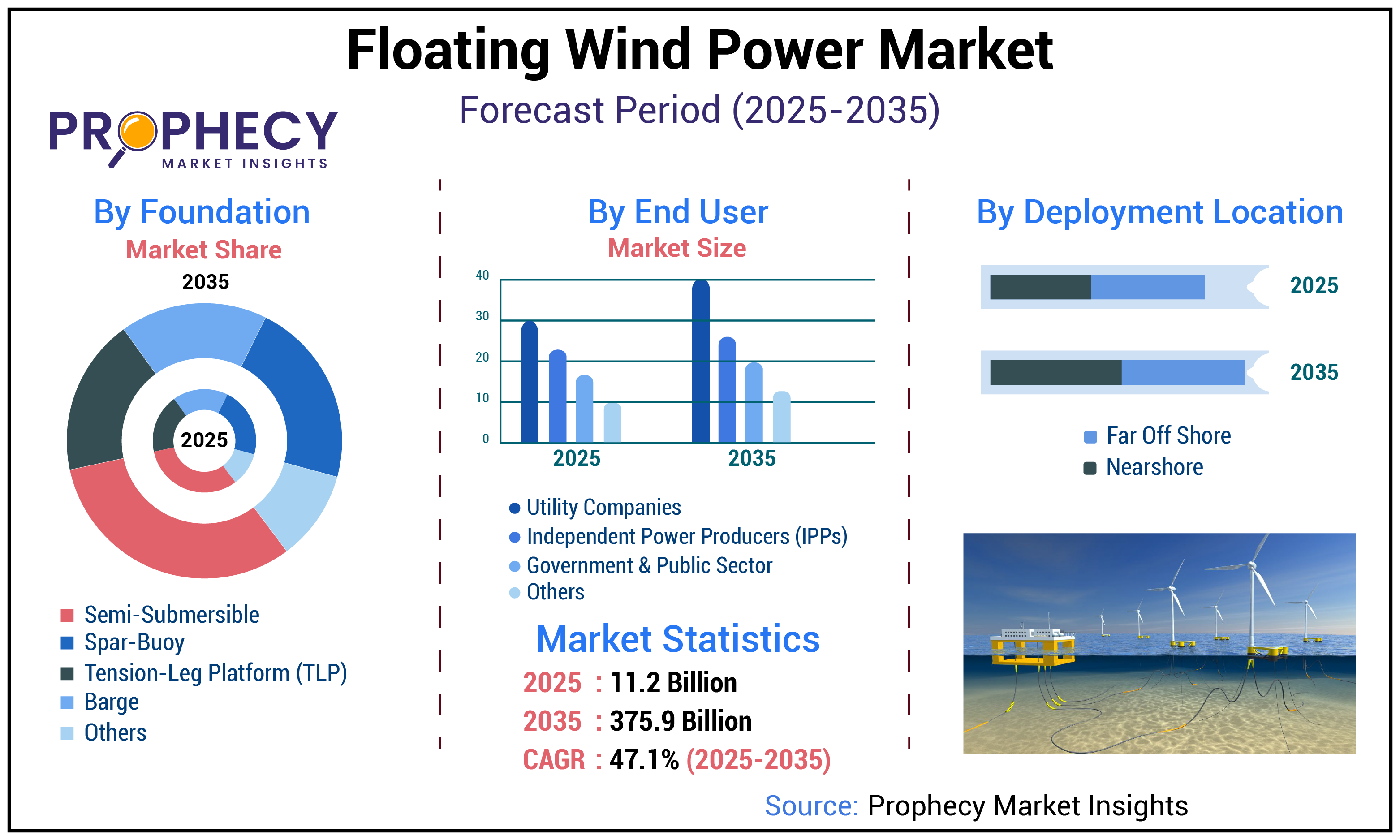
- 2024 Market Size: USD 8.1 Billion
- 2035 Projected Market Size: USD 375.9 Billion
- CAGR (2025-2035): 47.1%
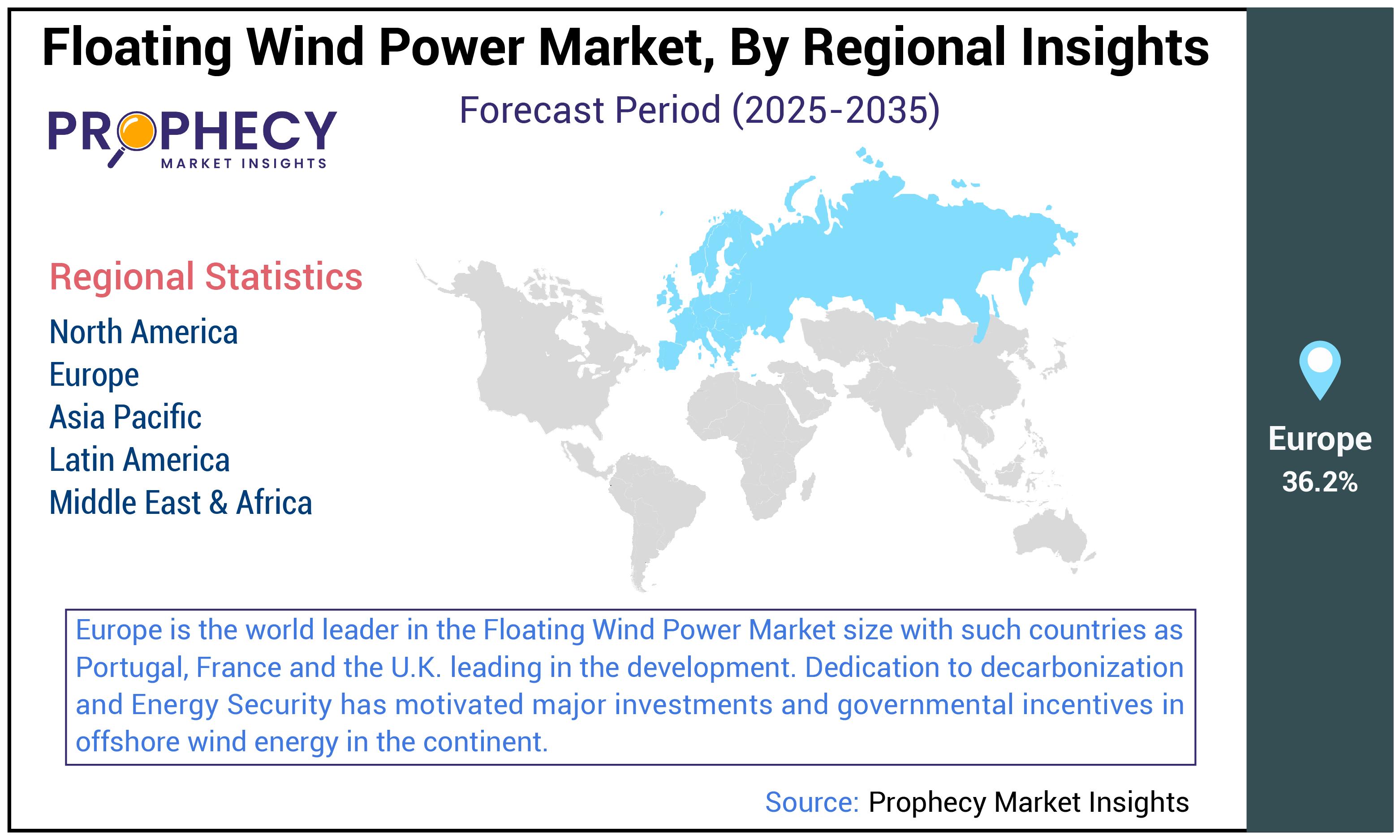
- Europe: Largest Market in 2024
Floating wind power market is a quickly developing sector of the renewable energy field, it is the new place of generating power. The new way to get hold of wind power is an innovation used in the deep water sphere due to the use of the fixed-bottom turbines are not feasible. It can be use by placing wind turbines on floating platforms which are attached to the seabed allowing access to higher quality and more reliable offshore wind thus increasing the potential clean energy generation. As countries are setting high decarbonization targets and aiming to pursue sustainable means of future electricity demand growth, floating wind power emerges as one of the drivers of primary transformation in the world energy picture.
A mix of the technological and government-friendly conditions along with the rising renewable energy demands is fueling the development of the floating wind power market. Fixed offshore installations cannot exploit the large wind potential found in the deep waters; floating platforms push the spatial limitation of fixed platforms to a new depth. Moreover, declining costs due to economies of scale, improved supply chain integration, and on-going innovation in turbine and platform design are making projects more commercially viable today. The use of policy incentives, investments in green frameworks, and an approach towards carbon neutrality by businesses, are also fueling the pace. These factors combined will drive the effective growth on the market and place floating wind power at the forefront of the world energy facility in the future.
Global Development for Floating Offshore Wind Power:
According to the data published by ResearchGate,
- By the end of 2023, the global offshore wind power capacity reached 75.2GW, with an increase of 10.9GW in 2023. Over the past decade, the global offshore market has witnessed a remarkable average annual growth rate of 27%.
- China has consistently outperformed other nations worldwide for six consecutive years and is projected to augment its offshore wind power capacity by 6.3GW by 2023, thereby elevating its total installed capacity to 38GW, surpassing Europe by an impressive margin of 3.7GW (11%).
- Europe achieved a remarkable milestone in 2023, as a total of 11 wind farms were commissioned across six markets, contributing an impressive offshore wind power capacity of 3.8GW, which constituted the majority of the newly installed capacity.
Current Industry Dynamics & Insights:
- Europe has the largest regional share in the floating wind power market, with almost 36.2%.
- The second-largest and fastest-growing area is North America, by accounting for 24.9%.
- By foundation type, semi-submersible platforms probably have the most market share among others.
- On the account of water depth, deep water (60m – 200m) are the most common for floating wind power in the market.
Floating Wind Power Market Drivers & Restraints
|
Drivers |
Restraints |
Opportunities & Trends |
|
|
|
Key Drivers:
Rising demand for renewable energy
Among the key market pulls of the floating wind power market, there is the global trend of increased demand in renewable energy as nations and industries aim to decrease the use of fossil fuel and hope to achieve ambitious net-zero goals. The increasing interest in the issue of climate change, combined with the fluctuating prices and energy security concerns of fossil-based energy, have fuelled investment in clean sources of power. The technology of floating wind is particularly important as it allows access to more distant locations in higher and more constant wind hubs, greatly increasing the amount of renewable energy that can be generated to levels much greater than that which could be harnessed by structures grounded in the seabed.
- For Instance, the European union has already established a feat to harness at least 42.5 percent of its energy through renewable by 2030, and offshore wind, including floating, is central to it. Such as wise, Japan, which has only a small number of shallow-water zones, has recently taken on floating wind to achieve its renewable energy growth objectives, approving various large-scale plans in deep-sea coastal waters. The current policy commitments reflect that the rapid increase in the need to renewable increases the growth of the floating wind power market directly.
Restraints:
High initial capital costs
High costs of upfront capital investment in project development is one of the greatest inhibitors of the floating wind power market. Floating systems have been compared to fixed-bottom offshore wind farms by requiring additional engineering, floating platforms and structures that are costly to deploy, and unique and costly mooring and anchoring systems in addition to complex grid connection infrastructure.
Such aspects increase set-up expenses and may complicate financing, particularly where large-scale commercialization is shown in limited inherent markets. Such financial obstacle may inhibit uptake in some cases and turn away interested individuals with limited policy backing or subsidies.
- Counterbalance Statements: However, as the technology becomes mature the costs are such as to come down steadily due to economies of scale, escalation of competition in the supply chain and the constant innovations concerning the design. Multiple pilot projects are showing cost trend down curves and so floating wind could come cost competitive with other renewable sources within the next decade (particularly as governments and the private sectors step up their investment in long-term clean energy goals).
Opportunities & Trends:
Innovation in materials and construction
The floating wind power market is facing great opportunities due to innovation in the materials and construction methods. The creation of new flexible, durable composite materials, corrosion resistant coverings and modular construction technologies is contributing to increase efficiency, durability and the life expectancy of floating wind platforms and turbines.
These innovations do not only reduce the maintenance costs and the classification of operational life, but also make scaling easier as units are simpler to assemble and deploy under the rough conditions of offshore operations. Moreover, new methods of constructing such as prefabrication and assembly onshore minimizes risks on the installation and the cost of the project makes the project more lucrative and possible to implement in a broader variety of geographic locales.
- For Instance, A prominent example is the Hywind Scotland project of Equinor the first and operating floating wind farm worldwide. The project was considered to have groundbreaking mooring technologies as well as lightweight carbon-fiber turbine blades created by Siemens Gamesa that reduced the mass of a larger turbine but increased the capture of energy. These industry breakthroughs in the real world show how material and construction advances are directly impacting the business viability of floating wind plants.
Floating Wind Power Market Segmentations & Regional Insights
By foundation type, water depth, turbine capacity, deployment location, end user, and region are the divisions of the floating wind power market.
By Foundation Type:
Spar-Buoy, semi-submersible, tension-leg platform (TLP), barge, and others are foundation type on which floating wind power market is segmented. Semi-submersible platforms are currently the most widely deployed floating wind technology in floating wind power market share. They offer a good balance of stability, cost-effectiveness, and suitability for a range of water depths (typically 60–200?m).
The second most dominant are Spar-buoy platforms are gaining traction, especially for deeper waters beyond 200 meter as they offer excellent stability and are suitable for locations with extreme weather conditions.
By Water Depth:
Based on the water depth, the floating wind power market is divided into shallow water (up to 60m), deep water (60m – 200m), ultra-deep water (200m & above). Deep-water sites are abundant in regions such as Europe, Japan, and the U.S. East Coast, where shallow seabed are limited. Floating technologies are specifically targeting this range due to fixed-bottom turbines are not feasible here, yet conditions are still manageable for current floating platforms and installation vessels.
While ultra-deep waters present significant challenges, advancements in floating wind technology are making it increasingly feasible to deploy turbines in these areas hence making it the second most dominant in terms of water depth.
By Turbine Capacity:
Up to 3 MW, 3-5 MW, 5-8 MW, Above 8 MW, are turbine capacity of the floating wind power market. Larger turbines (above 8 MW) are becoming the industry standard due to their higher efficiency and ability to generate more power, making projects more economically viable. The trend towards larger turbines is driven by advancements in technology and the need for cost-effective energy production.
Second place goes to turbines for 5-8 MW capacity range as they are still widely used and offer a balance between size, cost, and efficiency.
By Deployment Location:
On the deployment location, floating wind power market is categorized into nearshore, far and off shore. Far offshore locations are preferred for floating wind farms due to their access to stronger and more consistent wind resources. These areas also reduce conflicts with other maritime activities and are less such as to face opposition from coastal communities.
Nearshore deployments come second, but they are advantageous for reducing transmission costs and facilitating easier maintenance.
By End User:
Utility companies, independent power producers (IPPs), government & public sector, and others are end user of the floating wind power market. Utility companies are the primary investors in large-scale floating wind projects due to their access to capital, experience in energy production, and ability to integrate renewable energy into the grid. They play a crucial role in meeting national renewable energy targets.
The second most dominant in terms of end user is independent power producers (IPPs) as they are increasingly involved in floating wind projects, often in partnership with utility companies. They bring innovation and flexibility to the market and are instrumental in developing and operating renewable energy projects.
Regional Insights:
Geographically, the floating wind power market is studied across North America, Europe, Asia Pacific, Latin America, and the Middle East & Africa.
Europe: Europe is the world leader in the floating wind power market size with such countries as Portugal, France and the U.K. leading in the development. Dedication to decarbonization and Energy Security has motivated major investments and governmental incentives in offshore wind energy in the continent. France has awarded the first commercial-scale floating offshore wind energy farm auction in the world, anticipated to have 250 MW capacity off the Atlantic south of Brittany.
§ Europe is also plagued by the problems of increasing costs, supply chain bottlenecks, and regulatory barriers despite its leadership. The high interest rates, and inflation have also contributed to delays and cancellations in projects; in the U.S. and Europe alone over 30 billion has been dropped in investing on offshore wind. There is also the difficulty of grid connection as well as bureaucracy that is slowing down proper deployment of projects.
- France Floating Wind Power Market Insights:
France is simply the leader of floating wind energy in Europe, and this is due to its location strategy on the Atlantic coast and a high level of renewable energy investment. Some of the first projects including the auction of a 250 MW floating offshore wind farm (the first of its kind in the world on a commercial scale) in the Atlantic Ocean south of Brittany were launched by the country. Significant rank in the floating wind industry has been met with the active policy support and investment in the technology by France.
North America: The U.S. and Canada are emerging as leaders towards floating wind energy and the East Coast of the U.S. is one of the most desirable spots of floating wind energy power. According to the Biden administration, it has declared measures to ready states in floating offshore wind, to transform renewables in the western side. And such pioneering projects as the Equinor Hywind Scotland and Principle Power WindFloat Atlantic are an example to the future steps in the area.
§ North America faces challenges including early-stage financing complexities, high development costs, and political uncertainties. The offshore wind industry is grappling with macroeconomic pressures that are halting growth and profitability. Additionally, developers are navigating the complexities, timing mismatches, and high costs of projects in the development phase
- U.S. Floating Wind Power Market Insights:
U.S. is also becoming a leading power when it comes to floating wind power generation, especially its East Coast. To drive this significant expansion offshore wind, the Biden administration has proposed an ambitious target of 30 GW target offshore wind capacity by 2030 and it is anticipated to play a central part in this aim. Developments of the Vineyard Wind project and the declaration of offshore areas along the Oregon coast to be fitted with floating wind farms point to the dedication of the business to increase the country floating wind production.
Asia Pacific: Asia Pacific outside of China is estimated to have about 15% offshore wind capacity globally at the end of next decade. Nations, such as Japan, South Korea, and Taiwan are eagerly undertaking floating wind developments with the aim of reaching their renewable energy goals. As an example, in South Korea there is an ambition to reach a total cumulative installed capacity of 18.3 GW, 14.3 GW of which is offshore wind.
§ Asia pacific faces significant challenges including underdeveloped supply chains, regulatory issues, and rising interest rates. These barriers are slowing the growth of floating wind power in the region. Additionally, the current supply chain setup is not sufficient to build enough wind projects to meet the region's net-zero targets
- China Floating Wind Power Market Insights:
China is currently developing quickly in the field of the floating power wind and there is a lot of progress in advancing the technologies as well as implementations. The 17 MW floating wind turbine prototype (a new record) developed by the country can produce up to enough electricity that can support 6 300 homes in the United States annually. This is a revolutionary turbine which can work under harsh offshore conditions and includes a large jump in efficiency rates of wind energy. The fierce growth of the floating wind technology in China gives it an edge to be a leader in the Asia Pacific region.
|
Attribute |
Details |
|
Market Size 2025 |
USD 11.2 Billion |
|
Projected Market Size 2035 |
USD 375.9 Billion |
|
CAGR Growth Rate |
47.1% (2025-2035) |
|
Base year for estimation |
2024 |
|
Forecast period |
2025 – 2035 |
|
Market representation |
Revenue in USD Billion& CAGR from 2025 to 2035 |
|
Regional scope |
North America - U.S. and Canada Europe – Germany, U.K., France, Russia, Italy, Spain, Netherlands, and Rest of Europe Asia Pacific – China, India, Japan, Australia, Indonesia, Malaysia, South Korea, and Rest of Asia-Pacific Latin America - Brazil, Mexico, Argentina, and Rest of Latin America Middle East & Africa – GCC, Israel, South Africa, and Rest of Middle East & Africa |
|
Company Landscape |
Market Share Analysis of Companies Heat Map Analysis Company Overview, Foundation Types Overview Financial Information, Key Highlights Business Strategies Overview SWOT Analysis |
|
Report coverage |
Revenue forecast, company share, competitive landscape, growth factors, and trends |
|
Value Added Data Infosets |
Besides fundamental market insights such as the size of the market, growth rate, segmentation, regional study, and key players, our reports carry value-added data sets such as trade flow (import-export) analysis, Foundation Typeion and consumption overview, price trend evaluation, supply and value chain mapping, and raw Turbine Capacity availability. Moreover, we provide strategic tools as PESTLE and Porter’s Five Forces analysis, examination of the regulatory landscape, as well as monitoring of technology and innovation thereby providing a comprehensive overview which facilitates sensible and anticipatory decision-making. |
Segmentation:
By Foundation Type:
- Spar-Buoy
- Semi-Submersible
- Tension-Leg Platform (TLP)
- Barge
- Others
By Water Depth:
- Shallow Water (up to 60m)
- Deep Water (60m – 200m)
- Ultra-Deep Water (200m & above)
By Turbine Capacity:
- Up to 3 MW
- 3-5 MW
- 5-8 MW
- Above 8 MW
By Deployment Location:
- Nearshore
- Far Off Shore
By End User:
- Utility Companies
- Independent Power Producers (IPPs)
- Government & Public Sector
- Others
By Region:
- North America
- U.S.
- Canada
- Europe
- Germany
- U.K.
- France
- Russia
- Italy
- Spain
- Netherlands
- Rest of Europe
- Asia Pacific
- China
- India
- Japan
- Australia
- Indonesia
- Malaysia
- South Korea
- Rest of Asia Pacific
- Latin America
- Brazil
- Mexico
- Argentina
- Rest of Latin America
- Middle East & Africa
- GCC
- Israel
- South Africa
- Rest of Middle East & Africa
Floating Wind Power Market Competitive Landscape & Key Players
Growth in this sector can be increased among companies by making innovations on research and development to enhance efficiency in the turbine and stability in the floating platforms. They should focus on the minimization of costs by modular construction and supply chain optimization. Additionally, the government should also cooperate to make the process as simple as possible through permitting, and other policy incentives.
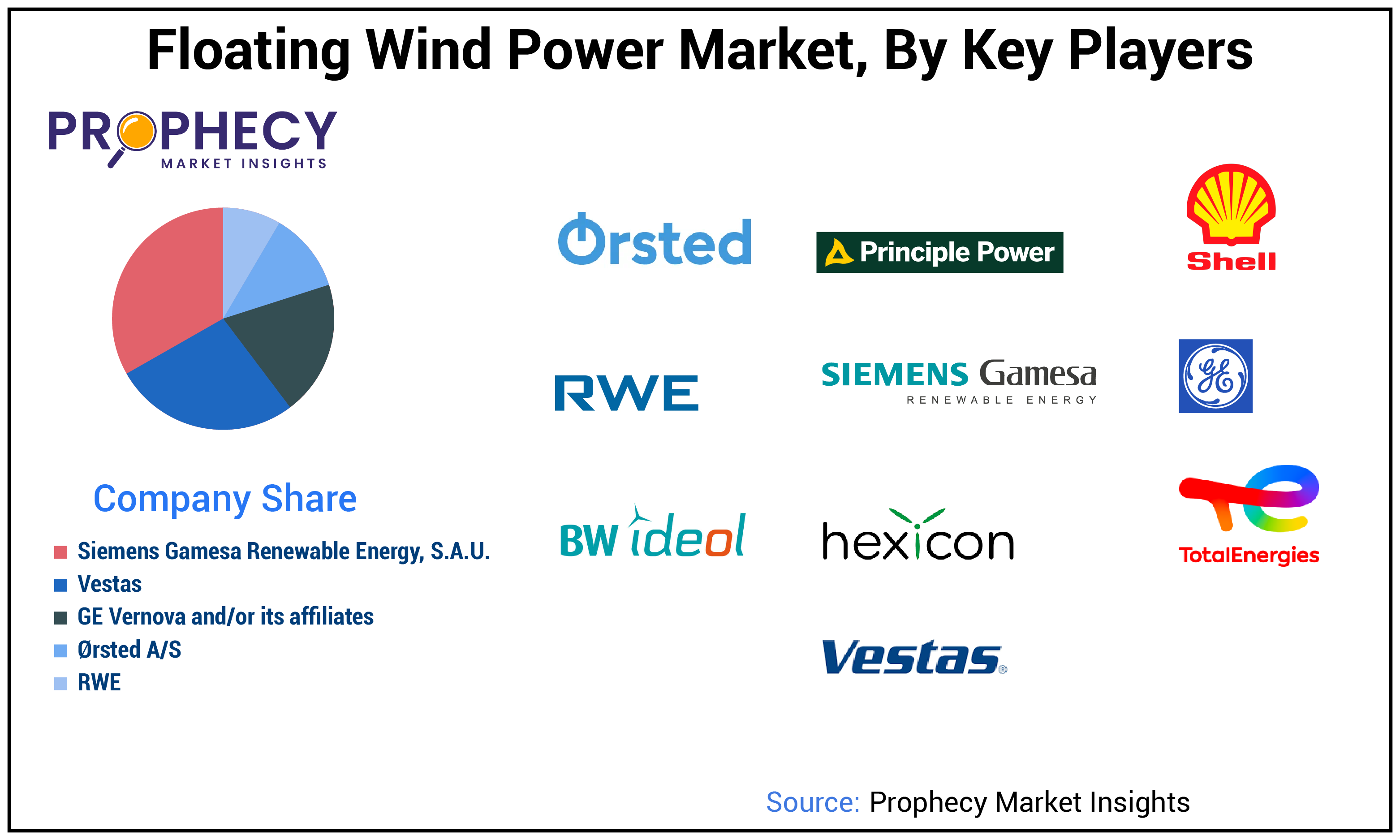
The entry into deep and ultra-deep water locations and strategic alliances into finance and sharing of technology will further boost acceptance in the market. The key players operating in the floating wind power market include, Vestas, Shell, Ørsted A/S, and others.
Floating Wind Power Market Companies:
- Siemens Gamesa Renewable Energy, S.A.U.
- Vestas
- GE Vernova and/or its affiliates
- Ørsted A/S
- RWE
- Equinor ASA
- Shell
- TotalEnergies
- Principle Power
- Hexicon
- BW Ideol
- Stiesdal
- Odfjell Oceanwind
- Saitec Offshore
- SIF GROUP
View an Additional List of Companies in the Floating Wind Power Market
Floating Wind Power Market Recent News
- In June 2025, Morocco opened its first offshore wind project, a 1 GW offshore wind farm off the coast of Essaouira. This project was announced in the context of the UN Ocean Conference and found its place in the national strategy of Morocco to diversify its energy production and get the share of renewable sources of energy to over 52 percent by 2030. The off-shore wind farm is supported by the Mediterranean Blue Partnership fund aiming at energy independence and economic competitiveness.
- In 2025, the final turbine was assembled for the 30 MW Éoliennes Flottantes du Golfe du Lion (EFGL) floating wind pilot project off the coast of Leucate and Barcarès in France. This is an important project in terms of demonstrating the viability of floating wind technology on commercial basis. The pilot should demonstrate how floating wind activities can be adopted into energy systems without interfering with technicalities and logistical issues that are associated with offshore implementations.
Analyst View:
The floating wind energy sector is set to grow substantially as a result of technological improvements, falling prices, and growing regulatory support for renewable energy. Their point on the scalability and commercial viability of floating wind energy technology is evidenced by low-profile projects such as EFGL and the Essaouira farm in Morocco.
According to experts, is predicted that semi-submersible platforms and bigger turbines will take over most of the near and far-offshore implementations as there is a greater efficiency and a sense of stability. They however note that adoption may be hampered in some regions by supply chain limitations, large upfront capital outlays and regulatory obstacles. In general, analysts are optimistic, and they stress that strategic alliances, R&D investments, and supportive governmental models are going to play a pivotal role towards fast-tracking market growth.
Analysis of Sources:
Primary Sources:
- In-depth interviews
- Company-specific data
- Surveys and questionnaires
- Focus group discussions (FGDs)
- Others
Secondary Sources:
- International Energy Agency (IEA)
- International Renewable Energy Agency (IRENA)
- World Bank Group
- IFC (International Finance Corporation)
- Others
More Related Reports
Hybrid Solar Wind Energy Storage Market
Offshore Wind Turbine Market
Wind Turbine Composites Market
Wind Turbine Rotor Blades Market
Wind Tunnel Market
Floating Wind Power Market Company Profile
|
Company Name |
Product Portfolio |
|
Vestas |
V236-15.0 MW and V164-9.5 MW |
|
Siemens Gamesa Renewable Energy, S.A.U. |
SG 14-236 and SG 14-222 |
|
Odfjell Oceanwind |
DeepStar and DeepSea Semi |
|
Equinor ASA |
Hywind Scotland and Hywind Tampen |
|
BW Ideol |
Hibiki, Floatgen, Damping Pool and Others |
Floating Wind Power Market Highlights
FAQs
Floating wind power market size was valued at USD 11.2 Billion in 2025 and is expected to reach USD 375.9 Billion by 2035 growing at a CAGR of 47.1%.
Foundation type, water depth, turbine capacity, deployment location, end user, and region are the segmentation for the floating wind power market.
Access to untapped wind resources, corporate sustainability commitments and so on are some of the floating wind power market growth drivers.
North America, Asia Pacific, Europe, Latin America, and the Middle East & Africa. Europe is expected to dominate the floating wind power market.
The introduction of generative AI and technological innovation is having remarkable influence on the types of foundations developing in the floating wind power market. Algorithms can be used to tune semi-submersible, spar-buoy, and TLP platforms using AI-driven design tools in search of stability, material efficiency, and cost minimization. Advanced simulations enhanced by the AI can accurately model situational conditions in the ocean to enhance wave, current and extreme weather resistance.
The key players operating the floating wind power market include Siemens Gamesa Renewable Energy, S.A.U., Vestas, GE Vernova and/or its affiliates, Ørsted A/S, RWE, Equinor ASA, Shell, TotalEnergies, Principle Power, Hexicon, BW Ideol, Stiesdal , Odfjell Oceanwind, Saitec Offshore, and SIF GROUP.