Native Protein Purification Market Overview
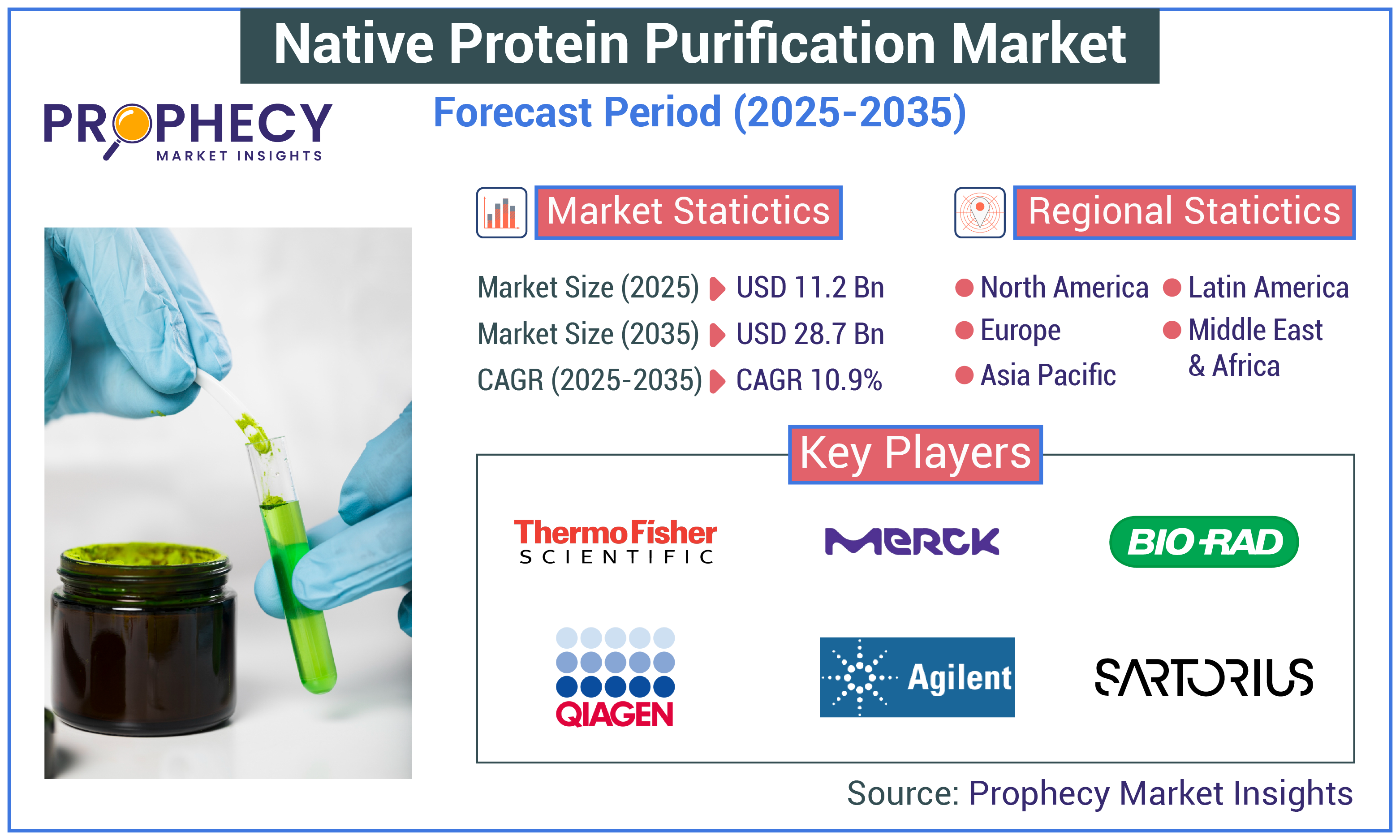
- By 2035, the native protein purification market size is contemplated to enlarge at a valuation of USD 28.7 Billion.
- In 2024, the native protein purification market valuation was USD 10.1 Billion.
- Native protein purification market is developing at a CAGR of 10.9%.
Native protein purification isolates proteins from cells or tissues and keeps their natural structures and biological activities. The process of purification avoids the use of harsh chemicals or extreme conditions, which allows the protein to keep its native conformation, interactions and functions. Major advantages provide the features such as examining proteins in the states where they are functional, gaining the enhanced understanding of protein-protein interactions, and the precise studying of biological processes that can be used in research, diagnostics, or therapy development.
The native protein purification market growth is driven by increasing demand for functional proteins in drug discovery, diagnostics, and biologics development. As researchers and pharmaceutical companies focus more on preserving protein activity for accurate results, native purification techniques are preferred over denaturing methods. Also, progress in proteomics, structural biology, and personalized medicine has increased the demand for proteins that are high in purity and biologically active, thereby deepening the market expansion.
The future trend of the native protein purification market is anticipated to emphasize on the aspects of the automation, miniaturization, and the compatibility with high-throughput screening technologies. In the wake of the rise of precision medicine and biologics, the need for purification systems that are not only efficient and scalable but also able to retain protein functionality will be skyrocketing. One of the major implications of microfluidics, affinity-based techniques and Al-driven purification platforms is the increased efficiency in time, accuracy and yield, allowing native protein purification to be used more widely in the fields of biomedical research and therapy development.
Recession Risk & Tariff Analysis:
- The native protein purification market carries troubles that include both recession risks and increasing tariffs. Economic declines usually result in less money being available for research and development in biotech, as well as postponed investments.
- On the other hand, tariffs on laboratory equipment, chemicals, and pharmaceutical inputs can raise the company's costs and cause supply chain disruptions. The mentioned issues can have a negative impact on the margin of profit and the speed of market expansion. This is particularly true for those companies which depend on the international sourcing of goods or exports.
Impact of Generative AI on Native Protein Purification Market:
- Generative Al is having a positive influence on the native protein purification industry, as it is speeding up protein structure prediction, facilitating purification protocols, and contributing to innovative experimental design.
- One way AI can be really helpful in protein purification is by identifying the best purification methods through the analysis of huge datasets. Besides that, AI can also forecast how the protein will interact in its natural environment, thus cutting down the number of experiments that can be time-consuming and use lots of resources.
Native Protein Purification Market Drivers & Restraints
Key Drivers:
The Growth of the Market can be Boost by Rise in Chronic and Genetic Diseases
The increase in chronic and hereditary diseases such as cancer, diabetes, Alzheimer's, and rare genetic disorders has notably escalated the need for cutting-edge therapeutic solutions as well as biomarker research. Affected situations always call for detailed knowledge of the involved proteins' functions and structures; therefore, the usage of native protein purification in research to unravel the pathological processes and create specific drugs is indispensable. As healthcare systems and pharmaceutical companies are concentrating more on personalized and protein-based therapies the requirement for functionally active, high-quality proteins keeps on increasing which is leading to an expansion in this market segment.
- For Instance, according to the data published by WHO, Noncommunicable diseases (NCDs) killed at least 43 million people in 2021, equivalent to 75% of non-pandemic-related deaths globally. In 2021, 18 million people died from an NCD before age 70 years; 82% of these premature deaths occur in low- and middle-income countries. Cardiovascular diseases account for most NCD deaths, or at least 19 million deaths in 2021, followed by cancers (10 million), chronic respiratory diseases (4 million), and diabetes (over 2 million including kidney disease deaths caused by diabetes).
- For Instance, according to the data published by bluebird bio, Inc., There are an estimated 10,000 different types of single-gene diseases (also called monogenic diseases), which are diseases caused by mutations in a single gene. It is estimated that 10 out of every 1000 people are affected. This means that between 70 million and 80 million people in the world are living with one of these diseases.
Restraints:
Challenge of Complexity in Native Protein Purification can hampered the Growth of the Market
Purifying proteins in their natural state is a complicated and slow process. This is because the protein's original composition and functionality have to be ensured during the phases of the process, namely: extraction, separation, and purification. For this reason, perfect buffer conditions, temperature control, and delicate handling are needed; these in turn require well-trained staff and distinct procedures. Such complicated nature can result in the project taking more time and also the company's operational costs increasing.
- Counterbalance Statements: The crucial answer to current challenges in laboratory settings is the integration of innovative purification systems that are automated and the use of Al for protocol optimization. Not only do these measures simplify operations, they infuse reliability by minimizing human error, and they create an avenue for process accessibility even for labs with lesser experience, all without losing the high standards of output.
Opportunities & Trends:
Personalized Medicine as a Catalyst for Future Growth in Native Protein Purification Market
The increasing need for personalized medicine is probably to be one of the most significant future trends influencing the Native Protein Purification market. This is due to the development of personalized therapies depends greatly on identifying the particular protein functions and relationships in patients.
Native purification techniques are really important to get proteins that work in the body and are used in making tests, in treatment that focuses on the problem, and in finding new indicators of the disease. In the future when medicine gets more exact, the proteins that will be needed must be good and functional and made especially for the profiles of the patients. Hence native purification will become a very important step in making the new healthcare solutions of tomorrow.
Native Protein Purification Market Segmentations & Regional Insights
Offering, sources, technology, application, end users, and region are the divisions of the native protein purification market.
By Offering:
Product and services are offerings on which native protein purification market is segmented. The product sector of the Native Protein Purification market has the most market share, mostly attributed to the high demand for specialized tools, chemicals, and chromatography systems needed to maintain protein functioning during purification.
Since many research institutes and small biotech companies outsource purification chores to specialized service providers in order to save time, cut costs, and access professional capabilities without investing in costly infrastructure, the services segment is the second-dominant area and has been rising significantly.
By Sources:
Based on the sources, the native protein purification market is divided into plant-based systems and plant tissues, whole blood, serum, human plasma systems, animal tissue, and others. Due to its extensive usage in pharmaceutical development and biomedical research, animal tissue has the biggest native protein purification market share. As it offers a rich and dependable supply of physiologically active proteins with structures that are quite similar to those of human proteins.
Due to their vital roles in clinical diagnostics, biomarker identification, and therapeutic protein research particularly in personalized medicine and immunological studies whole blood, serum, and human plasma systems rank as the second-dominant sources.
By Technology:
Chromatography, electrophoresis, ultrafiltration, immunoprecipitation, and others are coating of the native protein purification market. Chromatography has the most native protein purification market share as its high efficiency, scalability, and capacity to separate proteins with high activity and purity from a variety of sample types.
The second-dominant method, electrophoresis, is prized for its accuracy in determining the molecular weight and purity of proteins throughout purification processes, particularly in academic and diagnostic labs where thorough protein profiling is crucial.
By Application:
On the application, native protein purification market is categorized into biological research, drug discovery and development, forensic investigations, diagnostics, environmental monitoring, and others. Drug Discovery and Development has the biggest native protein purification market share since functionally active proteins are essential for identifying therapeutic targets, conducting validation studies, and producing biologics.
The increasing use of native proteins in government-funded and university research to examine protein function, connections, and cellular processes under physiological settings has made biological research the second-dominant use.
By End User:
The native protein purification market on the account of end user are categorized into pharmaceutical & biotechnology companies, academic & research institutes, diagnostic laboratories, and others. Pharmaceutical and biotechnology companies dominate the native protein purification market share for the reason of its widespread application in therapeutic development, biologics manufacturing, and drug discovery.
The second-largest end users are academic and research institutes given that they are essential to basic studies of protein structure and function, which are frequently funded by institutional and governmental sources. This creates a steady need for native protein purification equipment and services.
Regional Insights:
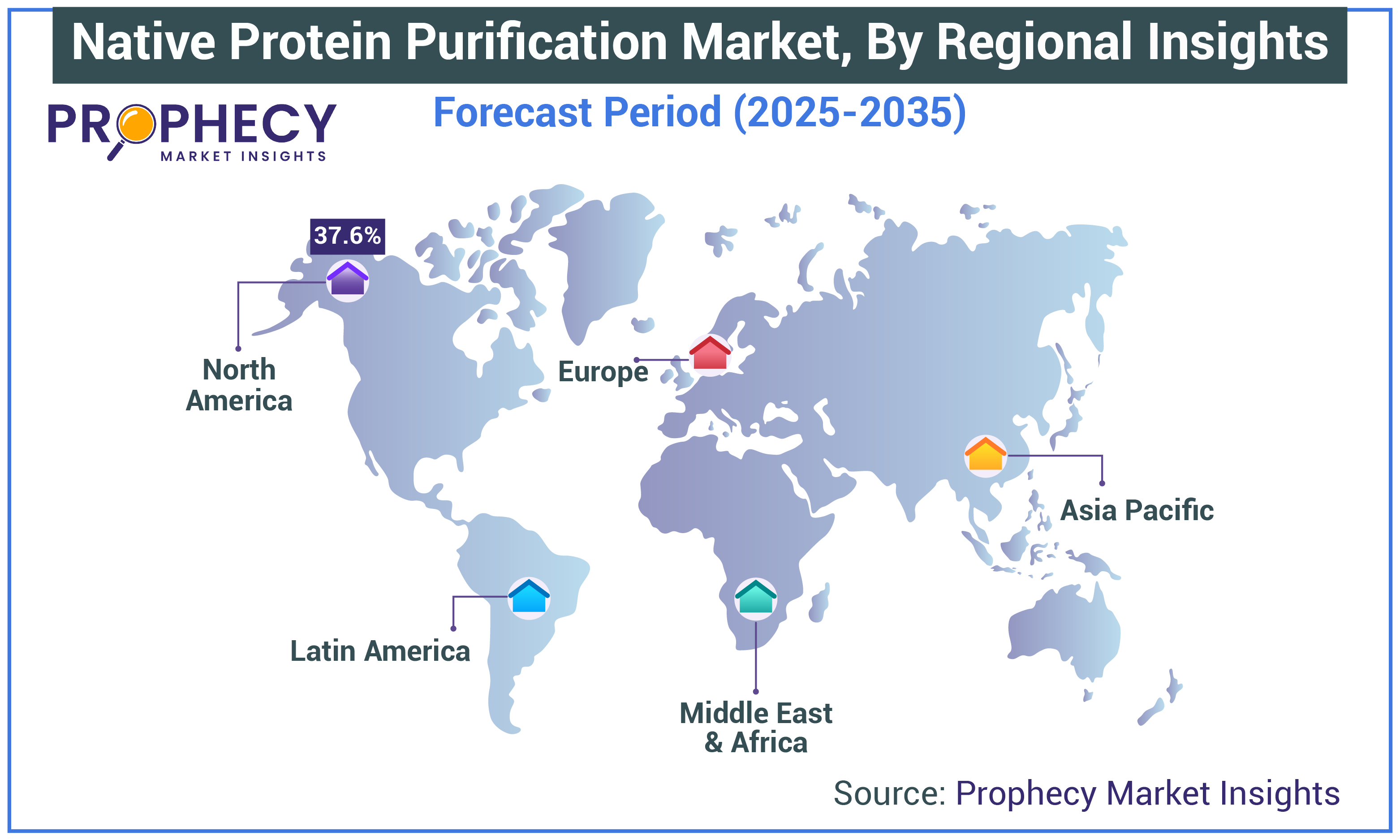
Geographically, the native protein purification market is studied across North America, Europe, Asia Pacific, Latin America, and the Middle East & Africa.
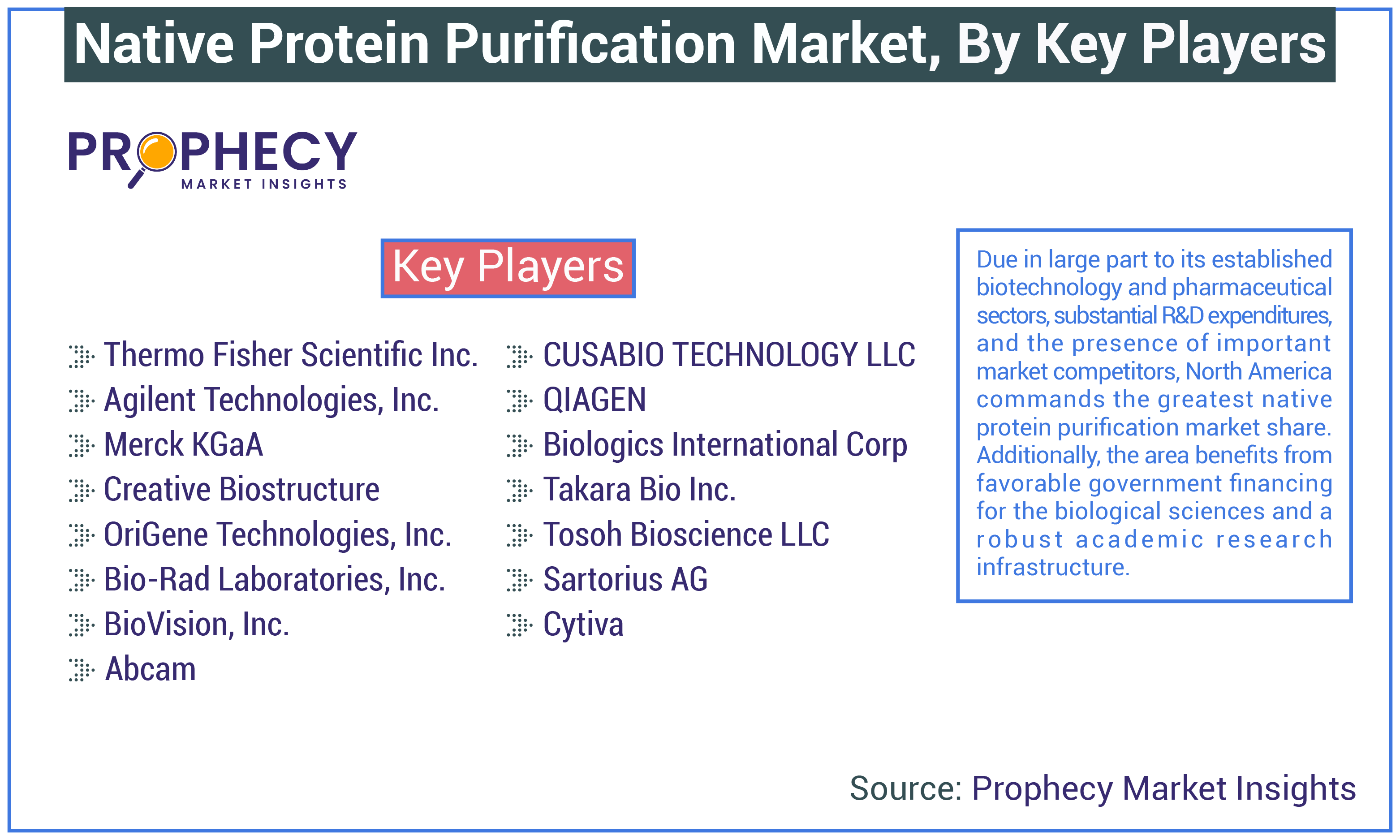
North America: Due in large part to its established biotechnology and pharmaceutical sectors, substantial R&D expenditures, and the presence of important market competitors, North America commands the greatest native protein purification market share. Additionally, the area benefits from favorable government financing for the biological sciences and a robust academic research infrastructure.
- U.S. Native Protein Purification Market Insights:
The U.S. leads the native protein purification market in North America owing to its robust pharmaceutical and biotechnology industries, substantial investment in biomedical research, and high concentration of prominent academic institutions and industry participants.
Europe: With expanding biotech centers, a greater emphasis on personalized medicine, and supporting regulatory frameworks that promote advanced protein research and treatment development across nations including Germany, the UK, and France, Europe is the second-dominant area.
- Germany Native Protein Purification Market Insights:
Germany dominates the market thanks to its thriving biotech sector, vibrant university research environment, and substantial public and private investment in the life sciences. The need for native protein purification technologies is further fueled by Germany's emphasis on biologics and precision medicine.
Asia Pacific: The growing frequency of hereditary and chronic illnesses, increased expenditures in biotechnology and pharmaceutical research, and the expansion of university research activities throughout the area are all contributing to the robust growth of the native protein purification market in Asia Pacific.
- China Native Protein Purification Market Insights:
China is a major hub for protein research and production, and it leads the Asia Pacific market thanks to its quickly expanding biotech industry, substantial government investment for R&D, robust manufacturing base, and developing partnerships with international pharmaceutical firms.
Native Protein Purification Market Report Scope:
|
Attribute |
Details |
|
Market Size 2025 |
USD 11.2 Billion |
|
Projected Market Size 2035 |
USD 28.7 Billion |
|
CAGR Growth Rate |
10.9% (2025-2035) |
|
Base year for estimation |
2024 |
|
Forecast period |
2025 – 2035 |
|
Market representation |
Revenue in USD Billion & CAGR from 2025 to 2035 |
|
Regional scope |
North America - U.S. and Canada Europe – Germany, U.K., France, Russia, Italy, Spain, Netherlands, and Rest of Europe Asia Pacific – China, India, Japan, Australia, Indonesia, Malaysia, South Korea, and Rest of Asia-Pacific Latin America - Brazil, Mexico, Argentina, and Rest of Latin America Middle East & Africa – GCC, Israel, South Africa, and Rest of Middle East & Africa |
|
Report coverage |
Revenue forecast, company share, competitive landscape, growth factors, and trends |
Segmentation:
By Offering:
- Product
- Chromatography Systems
- Filtration Systems
- Magnetic Beads and Resins
- Reagent & Kits
- Others
- Services
- Protein Expression & Isolation
- Research Outsourcing Services
- Protein Production
- Protein Purification
- Others
By Sources:
- Plant-Based Systems and Plant Tissues
- Whole Blood
- Serum
- Human Plasma Systems
- Animal Tissue
- Others
By Technology:
- Chromatography
- Electrophoresis
- Ultrafiltration
- Immunoprecipitation
- Others
By Application:
- Biological Research
- Drug Discovery and Development
- Forensic Investigations
- Diagnostics
- Environmental Monitoring
- Others
By End User:
- Pharmaceutical & Biotechnology Companies
- Academic & Research Institutes
- Diagnostic Laboratories
- Others
By Region:
- North America
- U.S.
- Canada
- Europe
- Germany
- U.K.
- France
- Russia
- Italy
- Spain
- Netherlands
- Rest of Europe
- Asia Pacific
- China
- India
- Japan
- Australia
- Indonesia
- Malaysia
- South Korea
- Rest of Asia Pacific
- Latin America
- Brazil
- Mexico
- Argentina
- Rest of Latin America
- Middle East & Africa
- GCC
- Israel
- South Africa
- Rest of Middle East & Africa
Native Protein Purification Market Competitive Landscape & Key Players
Particularly in emerging markets, Native Protein Purification firms are concentrating on research and development, strategic alliances, product diversification, and regional growth. In an effort to improve productivity and solidify their position in the market, they are also implementing AI technology and exploring mergers and acquisitions. The key players operating in the native protein purification market include, Thermo Fisher Scientific Inc., Agilent Technologies, Inc., CUSABIO TECHNOLOGY LLC, OriGene Technologies, Inc., Bio-Rad Laboratories, Inc., and others.
Native Protein Purification Market Companies:
- Thermo Fisher Scientific Inc.
- Agilent Technologies, Inc.
- Merck KGaA
- Creative Biostructure
- OriGene Technologies, Inc.
- Bio-Rad Laboratories, Inc.
- BioVision, Inc.
- Abcam
- CUSABIO TECHNOLOGY LLC
- QIAGEN
- Biologics International Corp
- Takara Bio Inc.
- Tosoh Bioscience LLC
- Sartorius AG
- Cytiva
View an Additional List of Companies in the Native Protein Purification Market
Native Protein Purification Market Recent News
- In March 2025, to get the proteins required for this, researchers at the Technical University of Munich (TUM) have created a process that uses physics instead of traditional chemistry. They have been successful in purifying proteins from cell extracts or cultures using short-wave, UV radiation that is invisible to humans. Compared to earlier approaches, this procedure is both softer and more effective.
- In November 2023, Leading life sciences company Cytiva presents the cutting-edge Cytiva Protein Select technology, which expedites and simplifies the purification of recombinant proteins. It is no longer required to employ particular affinity binding partners for every protein because the self-cleaving traceless tag and complementary affinity chromatography resin standardize purification for every protein.
Analyst View:
Native protein purification is crucial for researching protein functions, relationships, and biological processes in research, diagnostics, and therapy development because it avoids harsh conditions and maintains proteins' native structure and activity. Proteomics and structural biology advancements, as well as the growing need for functional proteins in drug development and customized treatment, are driving market expansion. The usage of native protein purification in biomedical and therapeutic applications is expected to grow in the future due to automation, miniaturization, and AI-driven, high-throughput purification systems that increase efficiency and scalability.
More Related Reports
Hen Egg White Protein Market
PEGylated Proteins Market
Functional Protein Market
Protein Purification and Isolation Market
C-Reactive Protein Test Market
Native Protein Purification Market Company Profile
|
Company Name |
Thermo Fisher Scientific Inc. |
|
Headquarter |
Waltham, U.S. |
|
CEO |
Marc N. Casper |
|
Employee Count |
125,000 Employees |
Native Protein Purification Market Highlights
FAQs
Native protein purification market size was valued at USD 11.2 Billion in 2025 and is expected to reach USD 28.7 Billion by 2035 growing at a CAGR of 10.9%.
Offering, sources, technology, application, end user, and region are the segmentation for the native protein purification market.
North America, Asia Pacific, Europe, Latin America, and the Middle East & Africa. North America is expected to dominate the market.
The key players operating the native protein purification market include Thermo Fisher Scientific Inc., Agilent Technologies, Inc., Merck KGaA, Creative Biostructure, OriGene Technologies, Inc., Bio-Rad Laboratories, Inc., BioVision, Inc., ABCAM, CUSABIO TECHNOLOGY LLC, QIAGEN, Biologics International Corp, Takara Bio Inc., Tosoh Bioscience LLC, Sartorius AG, and Cytiva.