Japan Immersive Technologies Market Overview
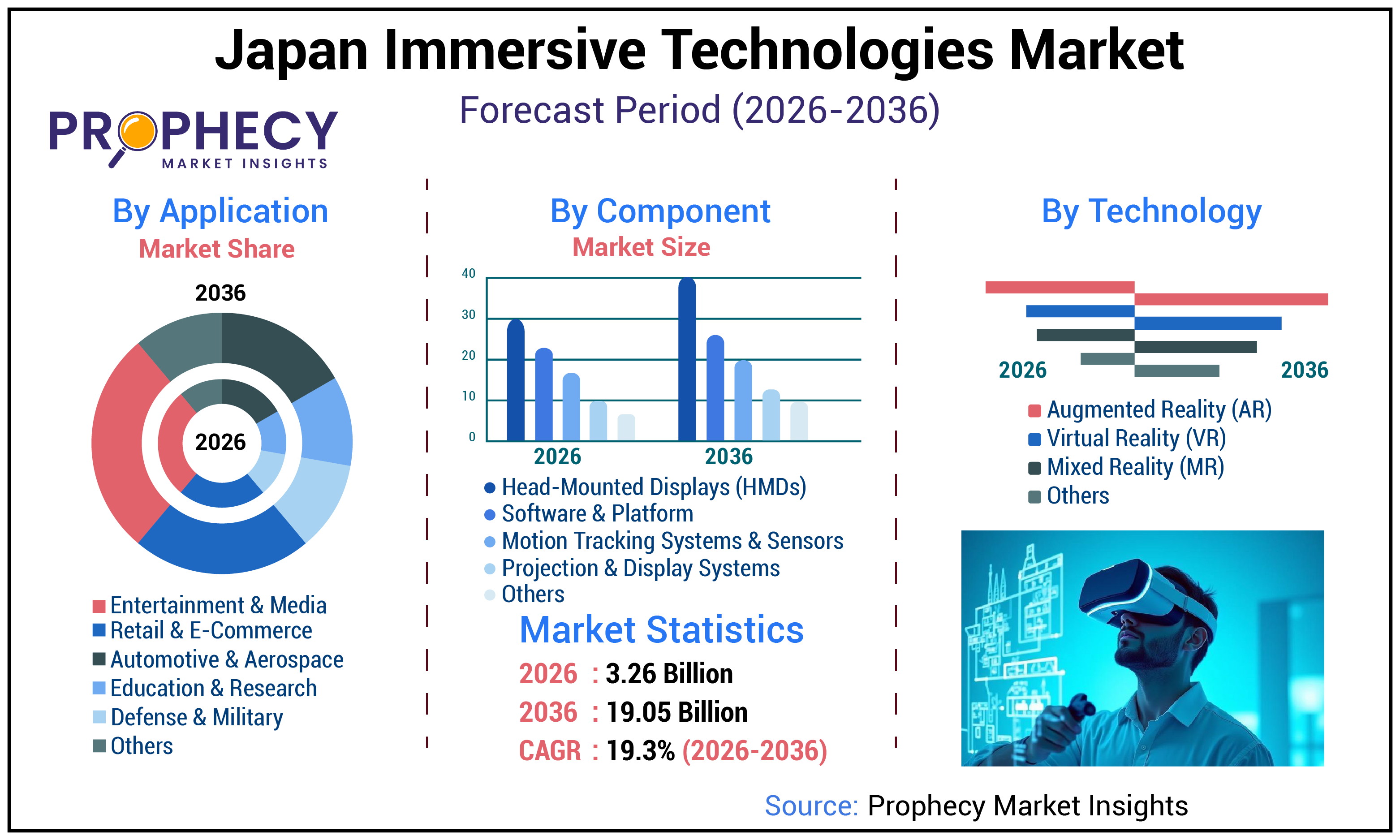
- 2026 Market Size: USD 3.26 Billion
- 2036 Projected Market Size: USD 19.05 Billion
- CAGR (2026-2036): 19.3%
Immersive technologies are essentially the use of virtual reality (VR), augmented reality (AR), mixed reality (MR), and extended reality (XR) based concepts to digitally merge the actual and the virtual worlds and thus provide the users with the interactive and the near-to-life experiences. These technologies, to expose some facets of their advantages, escalate the engagement and the learning level of the users by the implementation of the realistic simulation, improve the users' productivity by the utilization of the advanced visualization technique, substantially reduce the operational costs through the replacement of the physical with the virtual prototypes, and facilitate the users in performing the high-risk or the complex tasks in a safer, more controlled environment.
Japan immersive technologies market is expanding very fast mainly because of the country’s solid technological base, large R&D investments, and advanced digital infrastructure such as the widely available 5G. The high use of AR/VR in such industries as gaming, automotive, robotics, healthcare, and education is, therefore, the main reason for the demand increase and is also supported by Japan’s culture of innovation and early technology adoption.
The government’s initiatives which include Society 5.0, smart manufacturing, and digital transformation are also the reasons for the market to be extended at a fast pace. In addition to that, the fan base of the entertainment and anime industries in Japan, along with the growing use of XR in theme parks, museums, and retail, are, therefore, the main contributors to the rapid adoption of immersive technologies.
The Role of Immersive Technologies in Modernizing Japan Education:
- Immersive technologies are reshaping the education system of Japan significantly through a different interaction level, experience, and excitement, which this new type of education still is able to offer beyond traditional classroom methods.
- Pupils, with the help of VR and AR, can understand difficult scientific theories, visit historical sites, and perform virtual experiments which are all aspects of learning, and thus become more accessible and unforgettable.
- Along with this, these tools also facilitate personalized instruction, skill-focused training, and remote teaching essential elements of Japan’s digital transformation strategy.
- Moreover, the use of immersive simulations is boosting vocational and technical education where, for example, in healthcare, engineering, or the production sector, they provide safety and a close-to-real practice environment.
- With government support through brand initiatives as Society 5.0 and a growing trend of EdTech investment, immersive technologies are prominent in the nation’s efforts to build an education system that is more innovative, inclusive, and prepared for the future.
Japan Immersive Technologies Market Drivers & Restraints
Drivers and Restraints:
|
Drivers |
Restraints |
Opportunities & Trends |
|
|
|
Key Drivers:
Rising Demand for Immersive Tools in Healthcare Training and Medical Simulations
Japan immersive technologies market is largely influenced by the demand for such devices in healthcare training and medical simulations. As hospitals, medical schools, and research institutes seek to enhance training quality and patient safety through the use of VR, AR, and MR, they are the major adopters of these technologies. These techs enable medical staff to perform surgeries, emergency response, and complicated operations rehearsals in lifelike, tightly controlled virtual surroundings without a risk to patient safety. The result is better skill retention, lower training expenses, and shorter learning cycles.
Moreover, the elderly population in Japan and the increasing healthcare needs are the reasons that the institutions are turning to advanced simulation-based training for efficiency and accuracy. The incorporation of immersive devices in healthcare is further fueled by the devices becoming more precise, affordable, and AI-enabled diagnostics integration, which is leading to a broader application of such devices in the healthcare sector and thus considerable market growth opportunities.
Restraints:
Slow Integration in Traditional Industries with Rigid Workflows
Japan immersive technologies market growth is constrained by the slow integration of immersive technologies in traditional industries with rigid workflows. These sectors such as construction, manufacturing, and public services that heavily depend on established processes, legacy systems, and conservative decision-making have been affected.
In such organizations, AR/VR solutions may not be on the top of the list of concerns to address as a result of fear of disruption, high upfront investment, workforce resistance, and uncertainty about return on investment. Consequently, the implementation process is slowed and a large-scale adoption is kept at a low level.
- Counterbalance Statements: It is better to have a phased adoption model, demonstrate clear ROI through pilot projects, and provide comprehensive training programs to build workforce confidence as the way out of this predicament. Moreover, developing interoperable, user-friendly XR tools that can be easily integrated with the existing systems can contribute to the reduction of operational friction and the speeding up of acceptance in traditional industries.
Opportunities & Trends:
EdTech Modernization through Immersive STEM and Vocational Training Tools
One of the prominent future trends of the immersive technologies market in Japan is EdTech modernization by means of immersive STEM and vocational training tools. The demand for more practical, interactive, and skill-focused learning methods is the main reason behind this trend. With the help of VR and AR students can understand scientific concepts, perform virtual labs, and participate in hands-on simulations that are prohibitively expensive, dangerous, or infeasible for real classrooms.
Immersive tools for vocational education offer safe and efficient ways to acquire the necessary skills in healthcare, engineering, robotics, and manufacturing, thus making the training process less time-consuming and more productive. As a result of the government's digital education initiatives such as Society 5.0, schools and training centers in Japan are increasingly adopting XR-based learning platforms, thereby positioning immersive EdTech as a major driver of the local market growth in the long run.
Japan Immersive Technologies Market Segmentations & Regional Insights
Component, technology, and application are the divisions of the Japan immersive technologies market.
By Component:
Based on the component, the Japan immersive technologies market is divided into head-mounted displays (HMDs), projection & display systems, motion tracking systems & sensors, software & platform, and others. Head-mounted displays (HMDs) have the largest Japan immersive technologies market share as they are the primary interface for AR, VR, and MR experiences and are growing in popularity in gaming, education, healthcare, and enterprise training. This dominance is fueled by the availability of portable and reasonably priced HMDs as well as growing industry and consumer demand for immersive experiences.
In order to create meaningful experiences, immersive solutions largely rely on applications, content production tools, simulation software, and cloud-based XR platforms, making software and platforms the second-largest component. As the increasing need for enterprise-grade apps, interactive learning modules, and localized content, software continues to be a major source of revenue after HMDs.
By Technology:
On the account of Technology, the Japan immersive technologies market can be categorized into augmented reality (AR), virtual reality (VR), mixed reality (MR), and others. Due to its widespread use in retail, e-commerce, education, healthcare, and industrial applications where it improves real-world settings without requiring complete immersion augmented reality (AR) continues to hold the largest Japan immersive technologies market share. The vast number of tech-savvy people in the area may easily experience AR thanks to its connectivity with smartphones and tablets.
The second-dominant technology is virtual reality (VR), driven by increased demand in gaming, entertainment, and professional training simulations. Although VR requires specific gear, its capacity to deliver totally immersive experiences makes it crucial for applications that demand realistic simulation and hands-on learning, establishing it as the next great contributor after AR.
By Application:
Architecture, engineering & construction (AEC), automotive & aerospace, healthcare & medical training, education & research, defense & military, entertainment & media, retail & e-commerce, and others are application of the Japan immersive technologies market. Due to the region's rapidly expanding gaming industry, virtual events, and immersive content consumption all of which are fueled by a sizable, tech-savvy population and rising smartphone and internet penetration, entertainment and media continue to hold the largest Japan immersive technologies market share.
As AR and VR technologies allow for virtual try-ons, product visualization, and interactive shopping experiences, which increase customer engagement and boost sales, retail and e-commerce are the second-largest use. After entertainment, this industry is a big contributor because to the increasing usage of online retail and the drive for unique consumer experiences.
Japan Immersive Technologies Market Report Scope:
|
Attribute |
Details |
|
Market Size 2026 |
USD 3.26 Billion |
|
Projected Market Size 2036 |
USD 19.05 Billion |
|
CAGR Growth Rate |
19.3% (2026-2036) |
|
Base year for estimation |
2025 |
|
Forecast period |
2026 – 2036 |
|
Market representation |
Revenue in USD Billion & CAGR from 2026 to 2036 |
|
Company Landscape |
Market Share Analysis of Companies Heat Map Analysis Company Overview, Products Overview Financial Information, Key Highlights Business Strategies Overview SWOT Analysis |
|
Report coverage |
Revenue forecast, company share, competitive landscape, growth factors, and trends |
|
Value Added Data Infosets |
Besides fundamental market insights such as the size of the market, growth rate, segmentation, regional study, and key players, our reports carry value-added data sets such as trade flow (import-export) analysis, production and consumption overview, price trend evaluation, supply and value chain mapping, and raw material availability. Moreover, we provide strategic tools as PESTLE and Porter’s Five Forces analysis, examination of the regulatory landscape, as well as monitoring of technology and innovation thereby providing a comprehensive overview which facilitates sensible and anticipatory decision-making. |
Segmentation:
By Component:
- Head-Mounted Displays (HMDs)
- Projection & Display Systems
- Motion Tracking Systems & Sensors
- Software & Platform
- Others
By Technology:
- Augmented Reality (AR)
- Virtual Reality (VR)
- Mixed Reality (MR)
- Others
By Application:
- Architecture, Engineering & Construction (AEC)
- Automotive & Aerospace
- Healthcare & Medical Training
- Education & Research
- Defense & Military
- Entertainment & Media
- Retail & E-Commerce
- Others
Japan Immersive Technologies Market Competitive Landscape & Key Players
Key growth strategies for immersive technology enterprises in the Asia Pacific area include producing affordable, lightweight, and mobile-compatible AR/VR devices to reach a broader user base, and investing in localized content and apps for gaming, education, healthcare, and retail. Businesses are also using cloud-based XR platforms, digital twin technologies, and AI integration to enhance enterprise solutions. Participating in government-led smart city and Industry 4.0 initiatives, as well as forming partnerships with telecom companies, e-commerce sites, and academic institutions, all aid in expanding market reach.
Japan Immersive Technologies Market Companies:
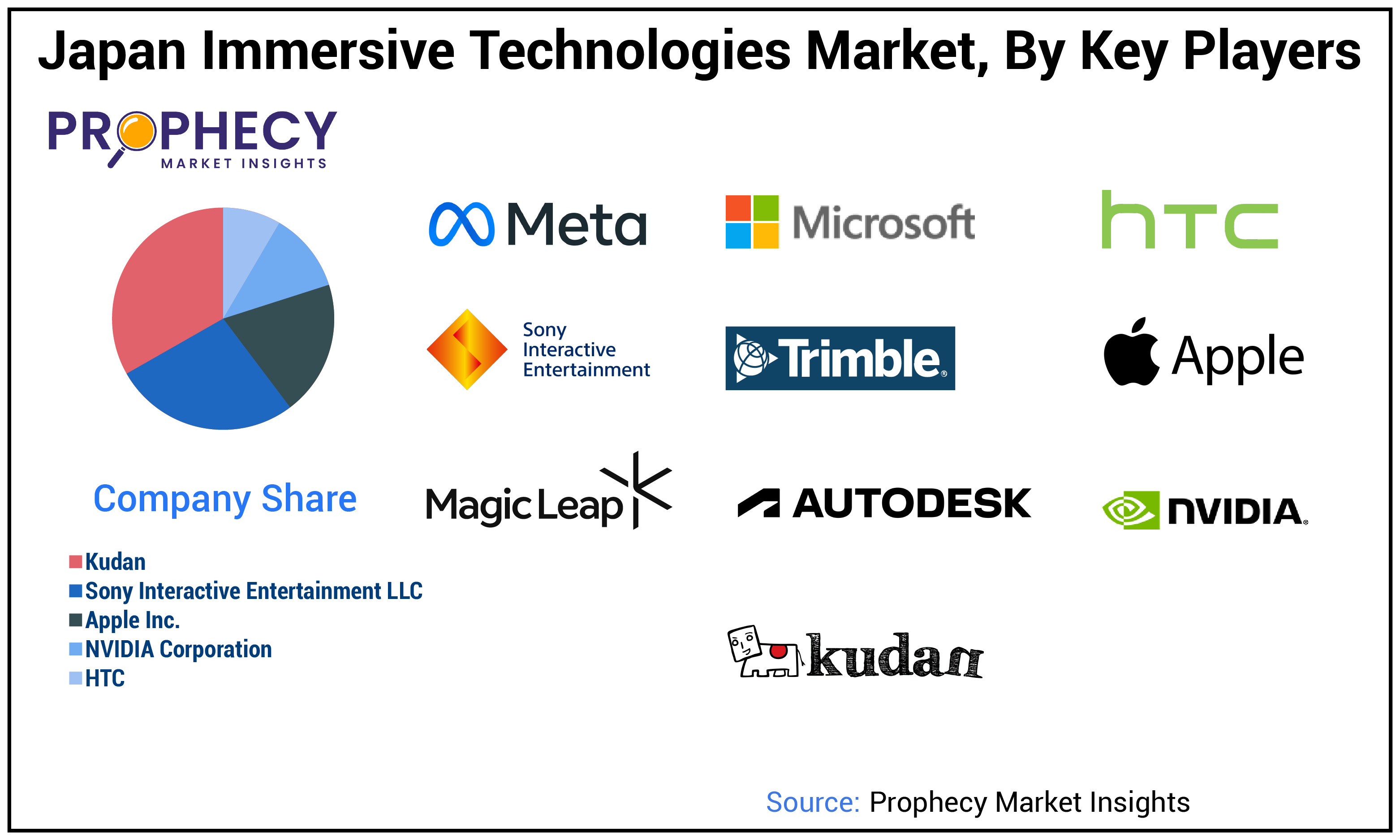
- Kudan
- Sony Interactive Entertainment LLC
- Apple Inc.
- NVIDIA Corporation
- HTC
- Immersive Inc
- Niantic Spatial, Inc.
- Trimble Inc.
- Autodesk, Inc.
- BENTLEY systems, incorporated
- Dassault Systèmes
- Accenture
- Epic Games, Inc.
- Meta
- Microsoft
Japan Immersive Technologies Market Recent News
- In June 2025, the leading Japanese ICT solutions provider for telecommunications and smart venue infrastructure, NTT Communications Corporation (NTT Com), and HTC Corporation, a global leader in cutting-edge smartphones and virtual reality platforms, announced the signing of a strategic Memorandum of Understanding (MOU). In order to usher in a new era of immersive experiences, the two businesses will collaborate to advance the creation and implementation of large-scale immersive location-based entertainment (LBE) throughout Japan.
Analyst View:
Immersive technologies as VR, AR, MR, and XR blend real and virtual environments to deliver interactive, lifelike experiences that enhance learning, improve productivity through advanced visualization, reduce costs by replacing physical prototypes with virtual ones, and enable safer execution of high-risk tasks. Japan immersive technologies market is rising rapidly due to its solid technological base, large R&D spending, and excellent digital infrastructure, including widespread 5G.
Demand is further accelerated by Japan's innovative culture and high usage in the gaming, automotive, robotics, healthcare, and educational sectors. Government efforts such as Society 5.0 and smart manufacturing support this expansion, while the country’s dynamic entertainment, anime, theme park, and retail industries continue to encourage immersive technology use across consumer and enterprise applications.
Analysis of Sources:
Primary Sources:
- In-depth interviews
- Company-specific data
- Surveys and questionnaires
- Focus group discussions (FGDs)
- Others
Secondary Sources:
- Ministry of Science and ICT (MSIT)
- Asia-Pacific Economic Cooperation (APEC)
- Others
More Related Reports
E-Passport Technologies Market
Pharmaceutical Anti-counterfeiting Technologies Market
Water-Energy Nexus Technologies Market
Education Technology (Ed Tech) and Smart Classrooms Market
Asia Pacific Immersive Technologies Market
Japan Immersive Technologies Market Company Profile
|
Company Name |
Product Portfolio |
|
Meta |
Immersive Technologies |
|
Microsoft |
Immersive Experiences in Education |
|
Apple Inc. |
Immersive Art Experience |
|
KUDAN |
Immersive Technology |
FAQs
Japan immersive technologies market size was valued at USD 3.26 Billion in 2026 and is expected to reach USD 19.05 Billion by 2036 growing at a CAGR of 19.3%.
Component, technology, application are the segmentation for the Japan immersive technologies market.
Government initiatives such as the Society 5.0 vision, the nation's strong gaming and anime culture, and the expansion of 5G networks, which enable high-quality experiences, and so on are some of the Japan Immersive Technologies Market growth drivers.
The key players operating the Japan immersive technologies market include KUDAN, Sony Interactive Entertainment LLC, Apple Inc., NVIDIA Corporation, HTC, Immersive Inc, Trimble Inc., Autodesk, Inc., Bentley systems, incorporated, Dassault Systèmes, Accenture, Epic Games, Inc., Meta, and Microsoft,.