Immersive Technologies Market Overview
- 2025 Market Size: USD 44.90 Billion
- 2036 Projected Market Size: USD 478.48 Billion
- CAGR (2026-2036): 24%
- North America: Largest Market in 2025
Immersive technologies are next-generation digital instruments that include virtual reality (VR), augmented reality (AR), mixed reality (MR), and 3D simulations. Such tools combine the real and virtual worlds to generate extremely lifelike, user-interactive experiences. These technologies enable users to understand complex settings, interact with digital content in a more natural way, and carry out simulations of real-life situations. Some of their main advantages are: learning and training getting supported through skill development, decision-making becoming more accurate by using lifelike simulations, productivity and safety being elevated, the customer engagement becoming more effective, and design, prototyping, and industry collaboration becoming more time-saving and efficient.
The development of the immersive technologies market has been facilitated by the increasing need for realistic training and simulation in various industries as healthcare, manufacturing, education, and defense, where the use of VR/AR can be a great cost-saving and safety-enhancing measure. The rising implementation of remote work and virtual collaboration tools, as well as improvements in hardware, 5G connectivity, and AI, are together enabling immersive experiences to be more reachable and efficient. Besides that, a growing number of applications in gaming, retail, real estate, and customer experience, on top of which is the investment of tech companies, are leading to the expansion of the market at a rapid pace worldwide.
Policy Implications of Immersive Technologies:
- Immersive technologies introduce a number of significant policy implications that government authorities have to consider as the use of these technologies is becoming more and more widespread in different sectors.
- Data privacy and security issues should be at the top of the list of things that governments have to respond to as VR/AR technologies gather very sensitive biometric, behavioral, and spatial data.
- Besides that, policies have to guarantee digital safety to hinder the occurrence of such risks as psychological harm, misinformation, and unsafe virtual interactions.
- In order to ensure that everyone has equal access and that no one is left behind in the digital world, it is very important that there are clear norms with regard to accessibility, interoperability, and ethical design.
- On top of that, workforce and education policy measures have to be altered in such a way that they are able to provide necessary support for skill growth in connection with immersive environments while at the same time regulatory mechanisms should be there to offer guidance on the proper use of such areas as healthcare, defense, and public services.
Current Industry Dynamics & Insights:
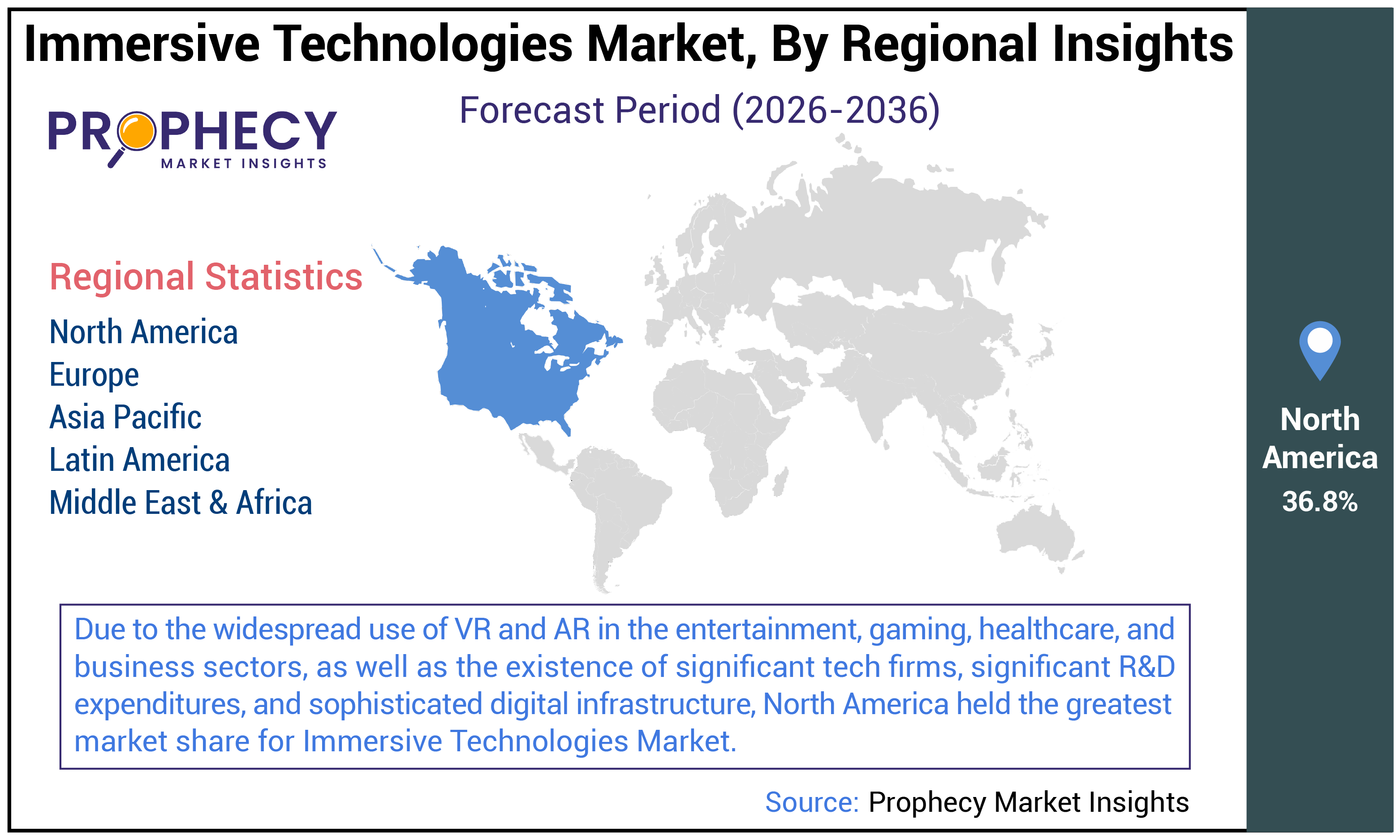
- North America has the largest regional share in the market, with almost 36.8%
- Europe is second dominating region in the market.
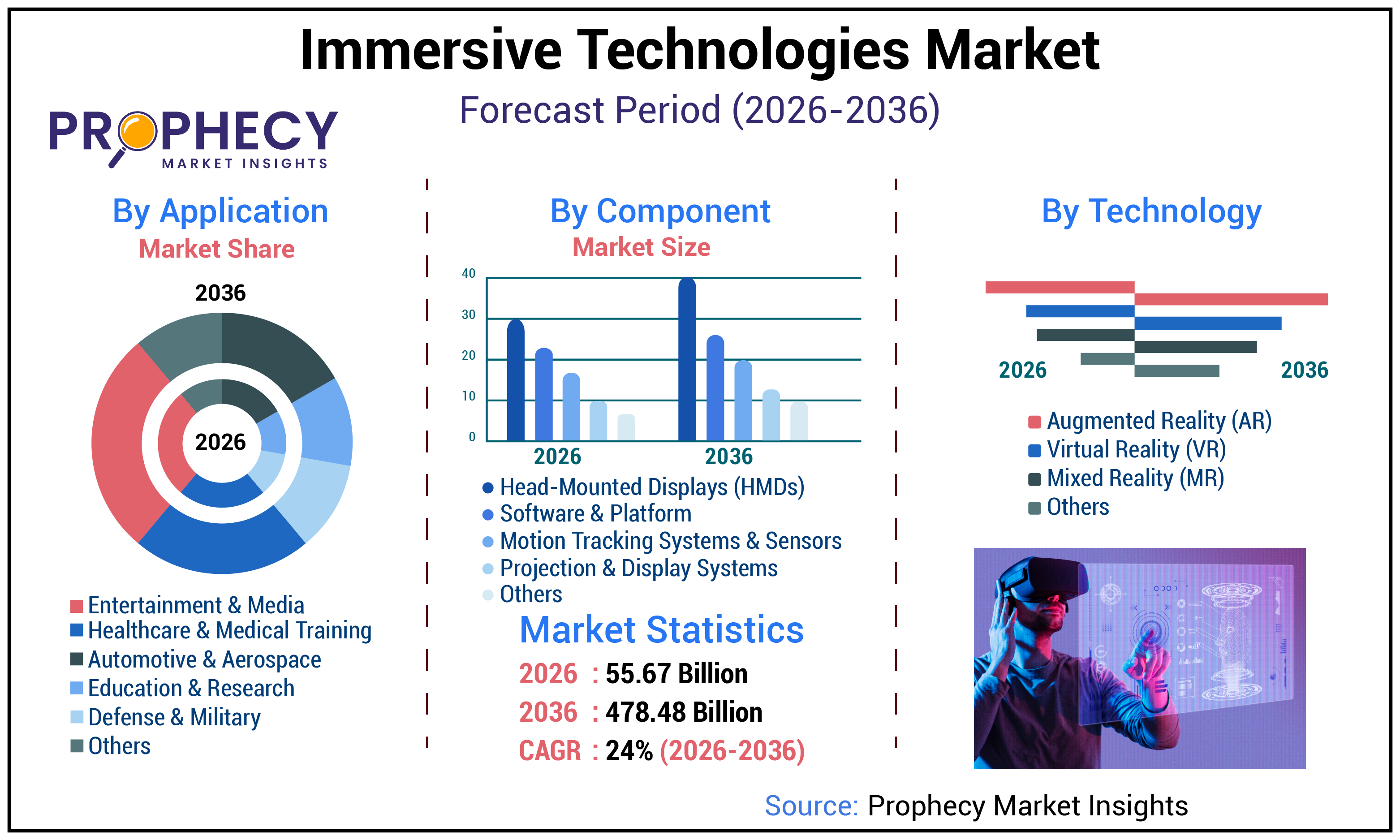
- By Component, Head-Mounted Displays (HMDs) dominates the Immersive Technologies Market.
Immersive Technologies Market Drivers & Restraints
Drivers and Restraints:
|
Drivers |
Restraints |
Opportunities & Trends |
|
|
|
Key Drivers:
Rise of Remote Work & Hybrid Workplaces
One of the major factors behind the growth of immersive technologies is the shift towards remote work and hybrid work models, which has led to a demand for more engaging, interactive, and effective collaboration tools that transcend the capabilities of traditional video conferencing. With VR and AR, teams can interact, create, train, and resolve issues in a shared virtual environment, which is a close approximation of the experience of actually being there. It makes work more efficient, improves communication, and cuts down on the need for travel. The adoption of flexible work models by companies has made them turn to immersive platforms as a means of ensuring teamwork, employee engagement, and smooth running of operations, thus leading to a faster market growth.
- For Instance, according to the data published by World Economic Forum, by 2030, the number of global digital jobs that can be performed remotely from anywhere is expected to rise by roughly 25% to around 92 million.
Restraints:
Regulatory Uncertainty in Sensitive Sectors
The growth of immersive technologies is being restricted by regulatory uncertainty in these sectors that are very sensitive to changes, i.e., healthcare, defense, and education, as organizations are reluctant to implement VR/AR solutions without having the clear guidelines regarding safety, data privacy, device certification, and ethical use. The ambiguity in the investment slows the process of deployment it also creates compliance risks.
- Counterbalance Statements: The way out is for governments and industry bodies to provide not only standards but also certification frameworks and data protection rules that are compatible with the requirements of the immersive environments. Transparent regulations contribute to the creation of trust which in turn fosters innovation that is done in a responsible way and provides enterprises with the certainty of being able to expand the use of immersive technologies in such sectors as those that are characterized by high risks.
Opportunities & Trends:
Integration of Haptics for More Realistic Interactions
One of the major future trends that can be seen in the market of immersive technologies is the use of haptics for more lifelike interactions. As it substantially elevates the feeling of being there and the lifelikeness of the virtual worlds. Haptic devices, by allowing users to experience textures, pressure, vibrations, and movement, make VR/AR scenarios more attractive and successful, which is primarily the case in the fields of training, gaming, healthcare simulation, and remote operations. As the development of haptic technology proceeds, gets less expensive and more compatible with different immersive systems, it will open up new possibilities and increase the use of the haptic technology idea in the various sectors that are looking for realistic virtual interactions.
Immersive Technologies Market Segmentations & Regional Insights
Component, technology, application, and region are the divisions of the Immersive Technologies Market.
By Component:
Based on the component, the immersive technologies market is divided into head-mounted displays (HMDs), projection & display systems, motion tracking systems & sensors, software & platform, and others. Considering they are the main interface for VR and AR experiences and are extensively used in gaming, training, education, healthcare, and enterprise applications, head-mounted displays (HMDs) have the most market share in the immersive technologies market. Their supremacy is further fueled by their increasing price, enhanced comfort, and robust backing from key tech corporations.
Software & Platforms is the second-largest segment, driven by the increasing need for cloud-based collaboration tools, applications, and immersive content. Strong software ecosystems, content creation tools, and platform integration are becoming increasingly necessary as hardware adoption rises, making this business segment the next significant source of income.
By Technology:
On the account of Technology, the Immersive Technologies Market can be categorized into Augmented Reality (AR), Virtual Reality (VR), Mixed Reality (MR), and others. Due to its greater accessibility, affordability, and ease of adoption compared to VR or MR, augmented reality (AR) has the most market share in the immersive technologies market. AR is appropriate for sectors including retail, manufacturing, healthcare, logistics, and field services where real-world overlays boost productivity without isolating the user. It is compatible with smartphones, tablets, and lightweight glasses.
Due to its widespread use in gaming, training, simulation, and education, virtual reality (VR) is currently the second most popular technology. VR has significant market momentum behind AR since it provides completely immersive experiences and is frequently utilized for high-impact training in the defense, aviation, and medical industries.
By Application:
Architecture, engineering & construction (AEC), automotive & aerospace, healthcare & medical training, education & research, defense & military, entertainment & media, retail & e-commerce, and others are application of the immersive technologies market. Considering VR and AR are most commonly used in gaming, virtual experiences, and interactive content areas where consumer demand is high and hardware adoption is quickly increasing Entertainment & Media has the biggest market share in the immersive technologies market. Continuous innovation, significant investments from big digital companies, and a sizable user base prepared to pay for immersive experiences all help this market.
Due to the increasing demand for realistic simulations, remote training, surgical planning, and patient therapy, Healthcare & Medical Training is the second most popular application. After entertainment, the healthcare industry is one of the fastest-growing and most influential application industries due to its rising reliance on immersive solutions to save costs, enhance outcomes, and eliminate training hazards.
Regional Insights:
Geographically, the Immersive Technologies Market is studied across North America, Europe, Asia Pacific, Latin America, and the Middle East & Africa.
North America:
Due to the widespread use of VR and AR in the entertainment, gaming, healthcare, and business sectors, as well as the existence of significant tech firms, significant R&D expenditures, and sophisticated digital infrastructure, North America held the greatest market share for immersive technologies market. Additionally, the region gains from early acceptance of new technology and high demand for aviation and defense training simulators.
- United States Immersive Technologies Market Insights:
Considering it is home to top VR/AR businesses, significant gaming studios, and widespread adopters in the fields of enterprise training, healthcare, and defense, the United States leads the immersive technologies market throughout North America. Strong venture capital investment, cutting-edge digital infrastructure, and substantial R&D activity that spurs innovation all benefit the United States.
Europe:
In light of the increasing integration of immersive solutions in automotive design, industrial training, cultural heritage, and education, Europe is the second-dominant area. Europe's robust automotive and industrial sectors, investments in Industry 4.0, and supporting digital innovation regulations all contribute to the region's rapid market expansion.
- Germany Immersive Technologies Market Insights:
Germany is the market leader in Europe owing to its robust industrial base, especially in the automotive and manufacturing sectors, where immersive technologies are extensively utilized for training, design, and prototyping. Germany is the main force behind the rise of immersive technology in the region due to its emphasis on Industry 4.0, high adoption of cutting-edge engineering tools, and robust technical environment.
Asia Pacific:
Due to significant digital transformation in industry, education, healthcare, and entertainment, as well as rising smartphone penetration and reasonably priced VR/AR equipment, the Immersive Technologies market in Asia-Pacific (APAC) is expanding quickly. Adoption is also being accelerated by robust government programs supporting Industry 4.0, digital skills, and smart cities. Demand for immersive experiences is further fueled by the e-sports and gaming businesses.
- China Immersive Technologies Market Insights:
Due to its large consumer base, robust local VR/AR gear manufacturing, substantial government support for digital innovation and the metaverse, and quick adoption of immersive tools in the retail, educational, and industrial sectors, China dominates the APAC market.
Immersive Technologies Market Report Scope:
|
Attribute |
Details |
|
Market Size 2026 |
USD 55.67 Billion |
|
Projected Market Size 2036 |
USD 478.48 Billion |
|
CAGR Growth Rate |
24% (2026-2036) |
|
Base year for estimation |
2025 |
|
Forecast period |
2026 – 2036 |
|
Market representation |
Revenue in USD Billion & CAGR from 2026 to 2036 |
|
Regional scope |
North America - U.S. and Canada Europe – Germany, U.K., France, Russia, Italy, Spain, Netherlands, and Rest of Europe Asia Pacific – China, India, Japan, Australia, Indonesia, Malaysia, South Korea, and Rest of Asia-Pacific Latin America - Brazil, Mexico, Argentina, and Rest of Latin America Middle East & Africa – GCC, Israel, South Africa, and Rest of Middle East & Africa |
|
Company Landscape |
Market Share Analysis of Companies Heat Map Analysis Company Overview, Products Overview Financial Information, Key Highlights Business Strategies Overview SWOT Analysis |
|
Report coverage |
Revenue forecast, company share, competitive landscape, growth factors, and trends |
|
Value Added Data Infosets |
Besides fundamental market insights such as the size of the market, growth rate, segmentation, regional study, and key players, our reports carry value-added data sets such as trade flow (import-export) analysis, production and consumption overview, price trend evaluation, supply and value chain mapping, and raw material availability. Moreover, we provide strategic tools as PESTLE and Porter’s Five Forces analysis, examination of the regulatory landscape, as well as monitoring of technology and innovation thereby providing a comprehensive overview which facilitates sensible and anticipatory decision-making. |
Segmentation:
By Component:
- Head-Mounted Displays (HMDs)
- Projection & Display Systems
- Motion Tracking Systems & Sensors
- Software & Platform
- Others
By Technology:
- Augmented Reality (AR)
- Virtual Reality (VR)
- Mixed Reality (MR)
- Others
By Application:
- Architecture, Engineering & Construction (AEC)
- Automotive & Aerospace
- Healthcare & Medical Training
- Education & Research
- Defense & Military
- Entertainment & Media
- Retail & E-Commerce
- Others
By Region:
- North America
- U.S.
- Canada
- Europe
- Germany
- U.K.
- France
- Russia
- Italy
- Spain
- Netherlands
- Rest of Europe
- Asia Pacific
- China
- India
- Japan
- Australia
- Indonesia
- Malaysia
- South Korea
- Rest of Asia Pacific
- Latin America
- Brazil
- Mexico
- Argentina
- Rest of Latin America
- Middle East & Africa
- GCC
- Israel
- South Africa
- Rest of Middle East & Africa
Immersive Technologies Market Competitive Landscape & Key Players
Continuous innovation in hardware and software to improve realism, comfort, and usability; growing content ecosystems through collaborations with developers, businesses, and academic institutions; and utilizing cloud, AI, and 5G to boost performance and scalability are all important growth strategies for immersive technology companies. Additionally, businesses are concentrating on industry-specific solutions for manufacturing, retail, healthcare, and defense because they are more valuable and in greater demand.
Immersive technologies market Companies:
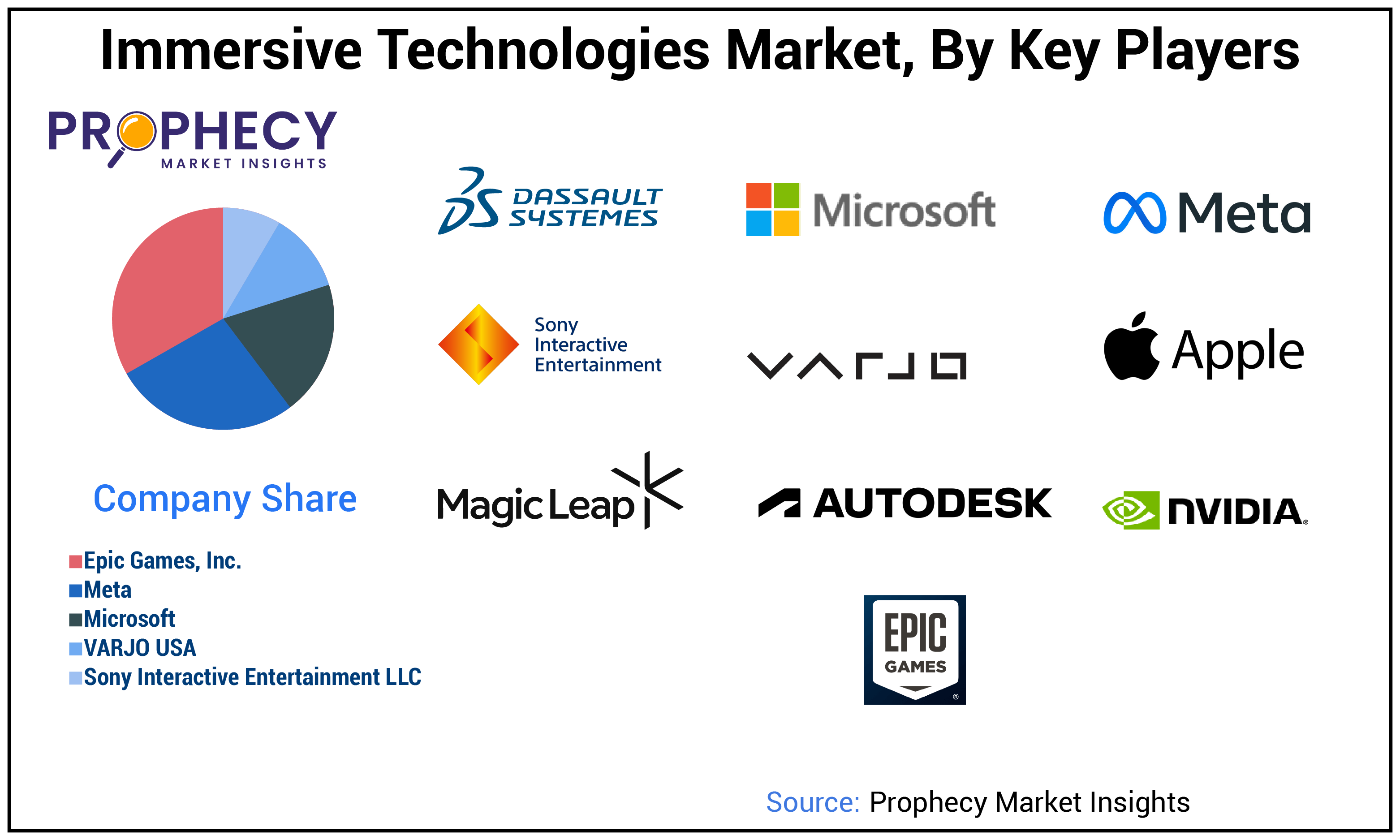
- Epic Games, Inc.
- Meta
- Microsoft
- VARJO USA
- Sony Interactive Entertainment LLC
- Apple Inc.
- NVIDIA Corporation
- Magic Leap, Inc.
- Niantic Spatial, Inc.
- Trimble Inc.
- Autodesk, Inc.
- BENTLEY systems, incorporated
- Dassault Systèmes
- The Wild
- Accenture
View an Additional List of Companies in the Immersive technologies market
Immersive Technologies Market Recent News
- In September 2025, The LX3+ and LX6+ Advanced Equipment Simulator for Surface Mining is the newest simulation technology breakthrough from Immersive Technologies, the largest and most reputable provider of surface and underground mining equipment training solutions worldwide. These new platforms improve the realism and efficacy of early-stage mining equipment operator training by adding motion base functionality to the LX platform series.
Analyst View:
VR, AR, MR, and 3D simulations are examples of immersive technologies that combine real and virtual worlds to produce incredibly realistic, interactive experiences that enhance learning, decision-making, productivity, safety, and design processes. The growing need for realistic training in the fields of healthcare, manufacturing, education, and defense, as well as the growing use of remote work tools and developments in hardware, 5G, and artificial intelligence, are driving market expansion. The global spread of immersive technologies is being accelerated by growing applications in gaming, retail, real estate, and customer engagement, which are backed by significant investment from technology corporations.
Analysis of Sources:
Primary Sources:
- In-depth interviews
- Company-specific data
- Surveys and questionnaires
- Focus group discussions (FGDs)
- Others
Secondary Sources:
- National Science Foundation (NSF)
- European Commission
- Eurostat
- Others
More Related Reports
E-Passport Technologies Market
Pharmaceutical Anti-counterfeiting Technologies Market
Water-Energy Nexus Technologies Market
Education Technology (Ed Tech) and Smart Classrooms Market
Roll-to-Roll Technologies for Flexible Devices Market
Immersive Technologies Market Company Profile
|
Company Name |
Product Portfolio |
|
Meta |
Immersive Technologies |
|
Microsoft |
Immersive Experiences in Education |
|
Apple Inc. |
Immersive Art Experience |
|
VARJO USA |
Immersive Technology |
Immersive Technologies Market Highlights
FAQs
Immersive Technologies Market size was valued at USD 55.67 Billion in 2026 and is expected to reach USD 478.48 Billion by 2036 growing at a CAGR of 24%.
Component, technology, application, and region are the segmentation for the Immersive Technologies Market.
Increasing digital transformation, advancements in AR/VR hardware and software, and rising demand for enhanced user experiences in gaming, entertainment, and training, and so on are some of the Immersive Technologies Market growth drivers.
North America, Asia Pacific, Europe, Latin America, and the Middle East & Africa. North America is expected to dominate the Immersive Technologies Market.
The key players operating the Immersive Technologies Market include Epic Games, Inc., BYD Europe B.V., Microsoft, VARJO USA, Sony Interactive Entertainment LLC, Apple Inc., NVIDIA Corporation, Magic Leap, Inc., SilexPro, Trimble Inc., Autodesk, Inc., bentley systems, incorporated, Dassault Systèmes, The Wild, and Accenture.