Water Energy Nexus Technologies Market Overview
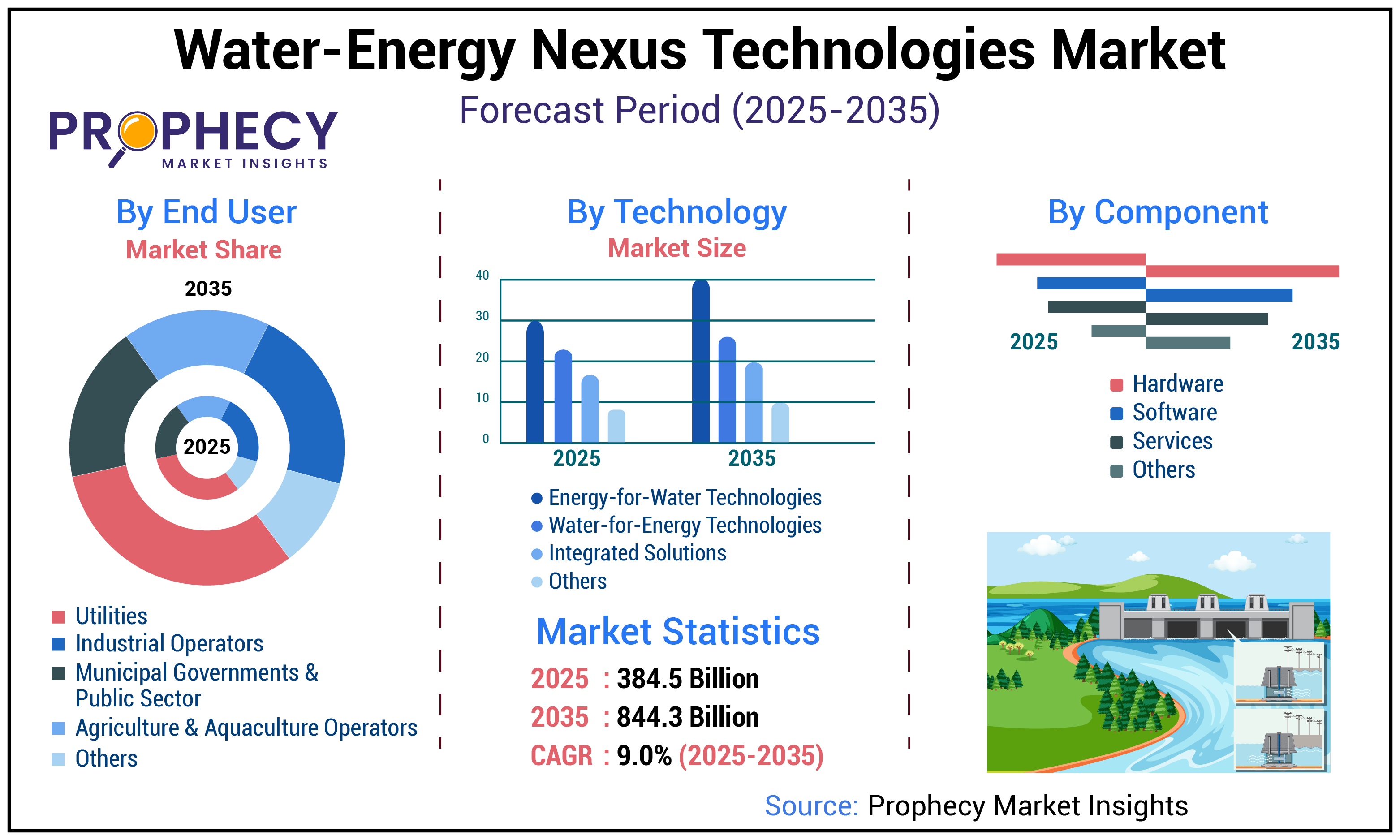
- 2024 Market Size: USD 357.8 Billion
- 2035 Projected Market Size: USD 844.3 Billion
- CAGR (2025-2030): 9.0%
- North America: Largest Market in 2024
Water-energy nexus technologies refer to cross-cutting projects that remove the dependence between the water and the energy sectors by improving the use of water for energy generation as well as the use of energy for water treatment, distribution, and recycling. The main advantages comprise increased productivity, lowered carbon dioxide emissions, saved water resources, as well as being protected from climate change and lack of resources.
One of the main factors that have led to the water-energy nexus technologies market growth is a major combination of global water scarcity, an increased demand for energy, and the need for sustainable resource management. The whole situation has been aggravated by climate change effects, tightened environmental laws, and water purification processes, which consume a lot of energy leading to high energy bills.
As a result, governments, industries, and utilities are taking the plunge and implementing these types of solutions. Besides that, renewable energy, digital monitoring, and smart infrastructure developments have also contributed to the reduction of the costs of these technologies. Moreover, the water-energy nexus technologies market expansion is that, the growing investments in sustainable development and practices of the circular economy, which are also more than that, merely expanding the water-energy nexus technologies market.
The Changing Nature of the Water–Energy Nexus in Urban Water Supply Systems:
- The water–energy relationship at the water supply level in cities has changed rapidly over time due to these cities having to deal with getting more people, the effects of the climate, and the need for infrastructure.
- In the past, urban water systems were energy-heavy because of the processes of pumping, treatment, and distribution, however, there has been a change towards implementing renewable energy, intelligent grids, and water recycling to save money and lower the environmental impact.
- Digital monitoring, decentralized treatment, and energy recovery from wastewater are transforming urban systems into resilient, efficient, and sustainable solutions. These innovations are driven by the increasing requirement to balance water security with carbon-friendly energy use.
Current Industry Dynamics & Insights:
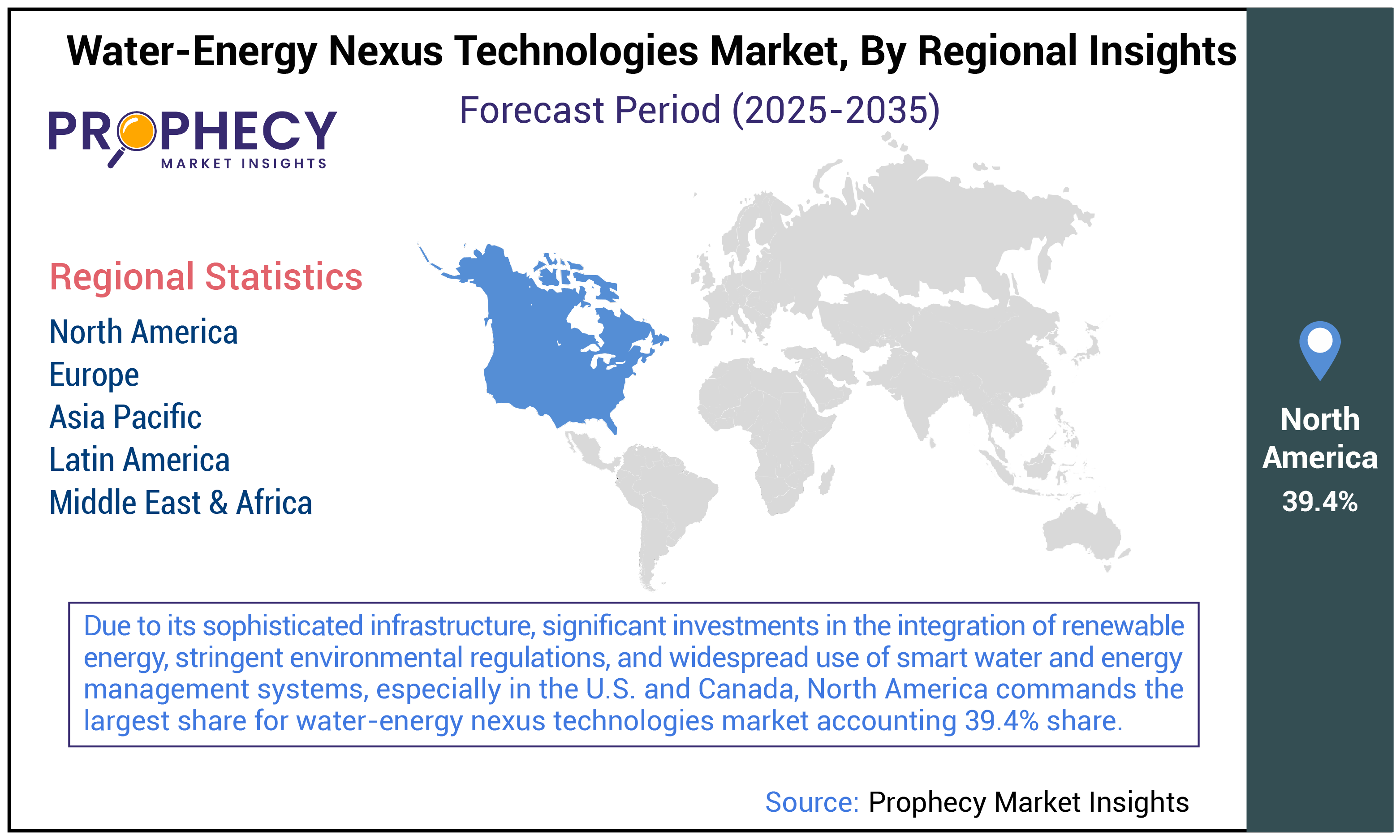
- North America has the largest regional share in the market, with almost 39.4%.
- Europe is second dominating region in the market.
- By component, hardware dominates the water-energy nexus technologies market.
Water Energy Nexus Technologies Market Drivers & Restraints
Drivers and Restraints:
|
Drivers |
Restraints |
Opportunities & Trends |
|
|
|
Key Drivers:
Rising Global Water Scarcity
The global shortage of water has been cited as a key factor to the water-energy nexus technology market growth, where increasing water needs in urban, industrial and agricultural sectors are compelling governments and organizations to take up sustainable practices. With traditional water treatment and desalination processes requiring a lot of energy, the demand for energy-saving, renewable-powered, and combined water-energy technologies is proliferating substantially. The solutions indeed are an excellent way to not only ensure a reliable water supply but they also go a long way in minimizing energy costs and carbon emissions. It is worth noting that these solutions become indispensable when it comes to 'solving the shortage of resources and at the same time promoting sustainable development in the long run.
- For Instance, according to article published by UNICEF, four billion people almost two thirds of the world’s population experience severe water scarcity for at least one month each year. Over two billion people live in countries where water supply is inadequate. Half of the world’s population could be living in areas facing water scarcity by as early as 2025. Some 700 million people could be displaced by intense water scarcity by 2030. By 2040, roughly 1 in 4 children worldwide will be living in areas of extremely high water stress.
Growing Energy Demand
The increase in worldwide energy needs is leading quicker to the use of water-energy nexus technologies, because energy production, industrial activities, and city systems have a large water usage for cooling, processing, and distribution. The conventional techniques not only put pressure on water and energy efficiency but also cause a vicious cycle that necessitates the use of more advanced solutions such as energy-efficient water pumping, renewable-powered desalination, and wastewater-to-energy systems. These technologies help to save energy and water management in a sustainable way, which will be the main drivers of market growth.
- For Instance, according to article published by IEA, Global energy demand grew by 2.2% in 2024, a notably faster rate than the annual average of 1.3% seen between 2013 and 2023. Electricity demand grew more rapidly than both overall energy demand and GDP, increasing by 4.3% in 2024.
Restraints:
Overcoming Policy and Regulatory Uncertainties
Water-energy nexus technologies market is susceptible to changes in policies and regulations such that uncertainties may lead to the market being restrained due to creating risks for investments, slowing down the process of project approvals and causing irregularities in the use of technology in different regions. Such inconsistencies in the market inhibit private sector involvement to the extent that it is not even possible to deploy projects on a large scale.
- Counterbalance Statements: One major fix is to increase handling courses, school cooperation, free-source gadgets, and internet-based getting to know stages that may open the field of the quantum world, create a bigger workforce, and quicken the growth of the market.
Opportunities & Trends:
Rise of Digital Platforms
The expansion of digital platforms, IoT, AI, and digital twins is becoming the leading future trend in the water-energy nexus technologies market growth to facilitate real-time monitoring, predictive analytics, and system optimization. Utilities and industries can leverage these technologies for demand forecasting, inefficiency detection, outcome simulation for improved decision-making which will lead to the conservation of both water and energy. Digitalization is positioned to have a game-changing effect on the entire water-energy management cycle by increasing operational efficiency, building capacity, and decreasing costs.
Water Energy Nexus Technologies Market Segmentations & Regional Insights
Component, technology, end user, and region are the divisions of the water-energy nexus technologies market.
By Component:
Hardware, software, and services are component on which water-energy nexus technologies market is segmented. Since hardware comprises vital physical components including pumps, membranes, turbines, cooling systems, and sensors that serve as the foundation for water treatment, desalination, and energy recovery systems, it commands the biggest water-energy nexus technologies marketshare.
The second most dominant market is software, which is fueled by the quick uptake of digital twins, IoT, and AI, which allow for predictive analytics, intelligent monitoring, and system optimization.
By Technology:
Based on the technology, the water-energy nexus technologies market is divided into water-for-energy technologies, energy-for-water technologies, and integrated solutions. Energy-for-water technologies has the biggest water-energy nexus technologies market share given that energy-intensive processes consisting of water treatment, desalination, pumping, and distribution create a high demand for energy-efficient and renewable solutions that lower costs and emissions.
Supported by the increasing need for sophisticated cooling systems, water recycling in power plants, and produced water treatment in sectors including oil and gas, water-for-energy technologies come in second.
By End User:
Utilities, industrial operators, municipal governments & public sector, agriculture & aquaculture operators, and others are deployment of the water-energy nexus technologies market. Utilities are the main adopters of energy-efficient and renewable-powered solutions to meet growing demand and regulatory standards given that they oversee extensive water supply, wastewater treatment, and power generation infrastructure. As a result, they hold the largest market share in the water-energy nexus technologies market.
Due to their significant reliance on water for production, cooling, and processing in industries consisting of mining, oil and gas, and manufacturing, industrial operators make up the second most dominant segment. As a result, they are compelled to implement technologies for energy recovery, recycling, and produced water treatment in order to reduce expenses and maintain compliance.
Regional Insights:
Geographically, the water-energy nexus technologies market is studied across North America, Europe, Asia Pacific, Latin America, and the Middle East & Africa.
North America: Due to its sophisticated infrastructure, significant investments in the integration of renewable energy, stringent environmental regulations, and widespread use of smart water and energy management systems, especially in the U.S. and Canada, North America commands the largest share for water-energy nexus technologies market accounting 39.4% share.
- U.S. Water-Energy Nexus Technologies Market Insights:
The U.S. leads the North American water-energy nexus technologies market owing to its substantial expenditures in renewable energy, vast urban water infrastructure, and robust federal and state laws that support sustainable energy and water solutions.
Europe: With its aggressive climate policies, emphasis on circular economy principles, and extensive use of sustainable technologies consisting of wastewater-to-energy and renewable-powered desalination, particularly in nations that include Germany, the United Kingdom, and the Netherlands, Europe is the second-largest region.
- Germany Water-Energy Nexus Technologies Market Insights:
Due to its aggressive energy transition objectives, cutting-edge wastewater-to-energy projects, and pioneering use of digital technologies including IoT and smart grids to improve water and energy systems, Germany is a market leader in Europe and a leader in sustainable resource management.
Asia Pacific: Rapid urbanization, increased energy consumption, acute water shortages in many regions, and government programs supporting renewable energy and sustainable water management are all contributing to the APAC region's robust growth in the water-energy nexus technologies market. The need for energy-efficient water and wastewater solutions is further increased by industrial development in industries including manufacturing, power production, and agricultural.
- China Water-Energy Nexus Technologies Market Insights:
China leads the APAC market due to its substantial investments in renewable energy, strict water conservation regulations, and expansive infrastructure projects that incorporate cutting-edge water treatment, desalination, and smart energy technologies to meet its expanding industrial and population demands.
Water-Energy Nexus Technologies Market Report Scope:
|
Attribute |
Details |
|
Market Size 2025 |
USD 384.5 Billion |
|
Projected Market Size 2035 |
USD 844.3 Billion |
|
CAGR Growth Rate |
9.0% (2025-2035) |
|
Base year for estimation |
2024 |
|
Forecast period |
2025 – 2035 |
|
Market representation |
Revenue in USD Billion & CAGR from 2025 to 2035 |
|
Regional scope |
North America - U.S. and Canada Europe – Germany, U.K., France, Russia, Italy, Spain, Netherlands, and Rest of Europe Asia Pacific – China, India, Japan, Australia, Indonesia, Malaysia, South Korea, and Rest of Asia-Pacific Latin America - Brazil, Mexico, Argentina, and Rest of Latin America Middle East & Africa – GCC, Israel, South Africa, and Rest of Middle East & Africa |
|
Company Landscape |
Market Share Analysis of Companies Heat Map Analysis Company Overview, Products Overview Financial Information, Key Highlights Business Strategies Overview SWOT Analysis |
|
Report coverage |
Revenue forecast, company share, competitive landscape, growth factors, and trends |
|
Value Added Data Infosets |
Besides fundamental market insights such as the size of the market, growth rate, segmentation, regional study, and key players, our reports carry value-added data sets such as trade flow (import-export) analysis, production and consumption overview, price trend evaluation, supply and value chain mapping, and raw material availability. Moreover, we provide strategic tools as PESTLE and Porter’s Five Forces analysis, examination of the regulatory landscape, as well as monitoring of technology and innovation thereby providing a comprehensive overview which facilitates sensible and anticipatory decision-making. |
Segmentation:
By Component:
- Hardware
- Pump
- Sensors
- Others
- Software
- Digital Twins
- Predictive Analytics & Optimization Software
- Others
- Services
- Consulting & Integration
- Operating & Maintenance
- Others
By Technology:
- Water-for-Energy Technologies
- Desalination with Renewable Energy
- Water Recycling & Reuse in Energy Plants
- Others
- Energy-for-Water Technologies
- Renewable-powered Desalination
- Energy-efficient Water Pumping Systems
- Others
- Integrated Solutions
- IoT & Digital Monitoring Platforms
- Energy Recovery Systems
- Others
By End User:
- Utilities
- Industrial Operators
- Municipal Governments & Public Sector
- Agriculture & Aquaculture Operators
- Others
By Region:
- North America
- U.S.
- Canada
- Europe
- Germany
- U.K.
- France
- Russia
- Italy
- Spain
- Netherlands
- Rest of Europe
- Asia Pacific
- China
- India
- Japan
- Australia
- Indonesia
- Malaysia
- South Korea
- Rest of Asia Pacific
- Latin America
- Brazil
- Mexico
- Argentina
- Rest of Latin America
- Middle East & Africa
- GCC
- Israel
- South Africa
- Rest of Middle East & Africa
Water Energy Nexus Technologies Market Competitive Landscape & Key Players
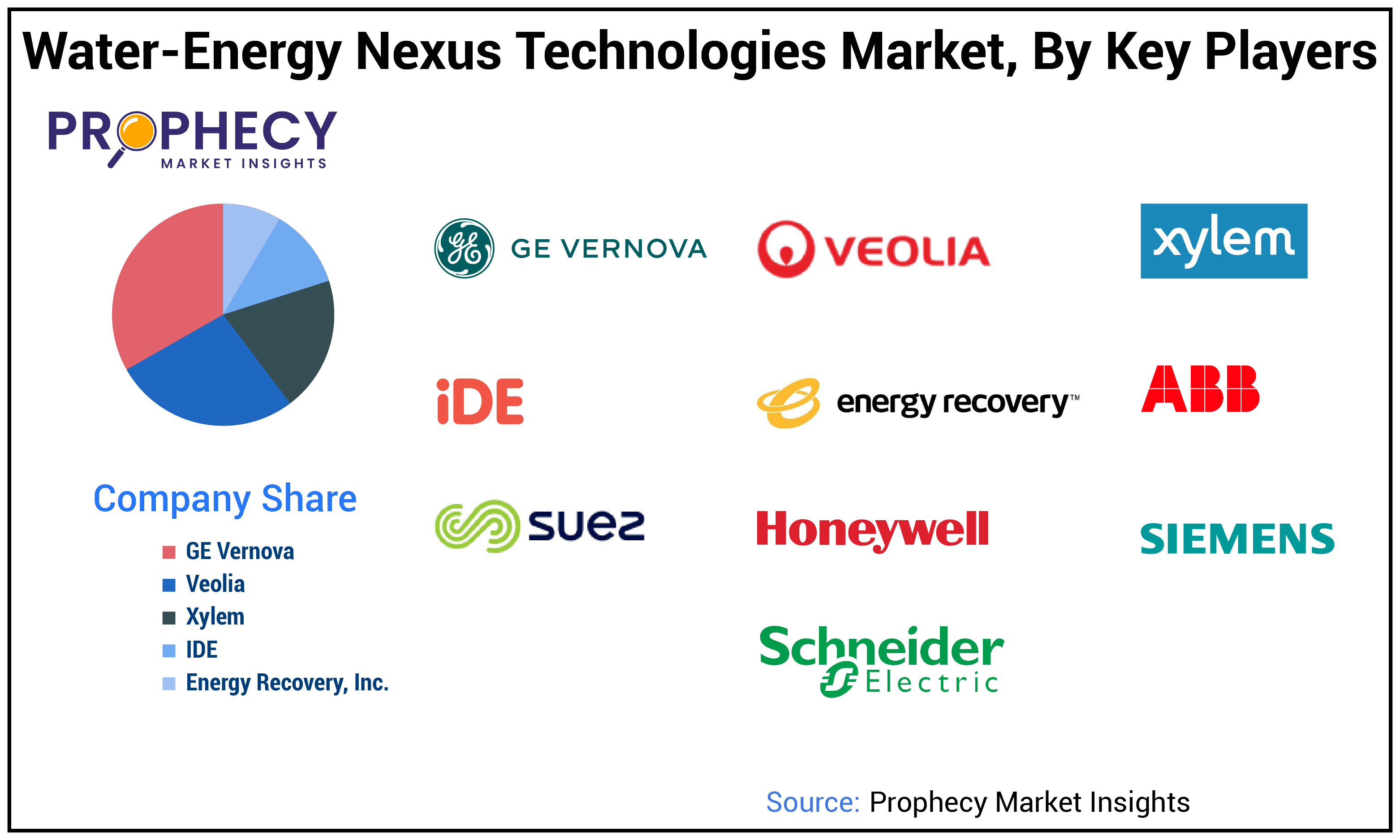
The key players operating in the water-energy nexus technologies market include, Veolia, SUEZ, IDE, and others. R&D for creative solutions, strategic alliances, growth into emerging markets, digital technology adoption, and sustainability-focused projects to support global climate goals and draw in green investments are important growth strategies for water-energy nexus technologies companies.
Water-Energy Nexus Technologies Market Companies:
- GE Vernova
- Veolia
- Xylem
- IDE
- Energy Recovery, Inc.
- ABB
- SUEZ
- Honeywell International Inc.
- Siemens
- Schneider Electric
- ACCIONA
- Nanfang Pump Industry Co., Ltd
- Elemental Water Makers B.V.
- Desolenator
- Devise Engineering S.A
View an Additional List of Companies in the Water-Energy Nexus Technologies Market
Water Energy Nexus Technologies Market Recent News
- In February 2025, The Food and Agriculture Organization of the United Nations (FAO), the Government of Mexico, and the Caribbean Community (CARICOM) have partnered to create the Resilient Caribbean Initiative (RCI), which recently announced the opening of a comprehensive online course called "The Water-Energy-Food (WEF) Nexus: Building Resilience in the Caribbean." The course aims to provide participants in the Caribbean and beyond the skills and information they need to tackle the interrelated problems of food, energy, and water security.
- In October 2024, The Inter-Regional Technical Platform on Water Scarcity (iRTP-WS) workplan for 2024–2025 was successfully launched virtually by the Food and Agriculture Organization (FAO) with the topic "Integrated Water Solutions: Navigating Climate Change and WEFE Nexus Dynamics." With an emphasis on tackling the intricate water-related issues brought on by climate change, this event was a significant turning point in FAO's efforts to promote cross-regional cooperation and stimulate innovation in water resource management.
Analyst View:
Energy-Water With advantages including increased productivity, lower carbon emissions, and resource conservation, Nexus Technologies improve the effective use of water in energy generation as well as energy in water treatment, distribution, and recycling. Global water scarcity, increased energy consumption, the effects of climate change, more stringent environmental rules, and the high energy costs of water purification are all factors driving market expansion.
With the help of developments in digital monitoring, smart infrastructure, and renewable energy, governments, businesses, and utilities are embracing these solutions more and more. Additionally, rising investments in sustainability and the circular economy are propelling market growth.
Analysis of Sources:
Primary Sources:
- In-depth interviews
- Company-specific data
- Surveys and questionnaires
- Focus group discussions (FGDs)
- Others
Secondary Sources:
- World Bank Group
- International Energy Agency (IEA)
- International Renewable Energy Agency (IRENA)
- European Environment Agency (EEA)
- Others
More Related Reports
Deep-water and Ultra-deep Water Exploration and Production Market
Bottled Water Market
Smart Water Bottle Market
Produced Water Treatment Technologies Market
Tonic Water Market
Water Energy Nexus Technologies Market Company Profile
|
Company Name |
Product Portfolio |
|
Veolia |
Water & Wastewater Energy Services |
|
SUEZ |
Drinking Water Treatment, Operation & Maintenance, and so on |
|
Xylem |
Water Solution & Water Technology |
|
Acciona Agua |
Water Treatment & Management |
|
IDE |
Water Treatment and Desalinations |
Water Energy Nexus Technologies Market Highlights
FAQs
Water-energy nexus technologies market size was valued at USD 384.5 Billion in 2025 and is expected to reach USD 844.3 Billion by 2035 growing at a CAGR of 9.0%.
Component, technology, end user, and region are the segmentation for the water-energy nexus technologies market.
Climate change impact, environmental regulation, renewable energy integration, and so on are some of the water-energy nexus technologies market growth drivers.
North America, Asia Pacific, Europe, Latin America, and the Middle East & Africa. North America is expected to dominate the target market.
By facilitating predictive modeling, digital twins, and system optimization all of which increase productivity, reduce expenses, and hasten the sustainable adoption of integrated water-energy solutions generative AI contributes to the growth of the water-energy nexus technologies market.
The key players operating the water-energy nexus technologies market include GE Vernova, Veolia, Xylem, IDE, Energy Recovery, Inc., ABB, SUEZ, Honeywell International Inc., Siemens, Schneider Electric, ACCIONA, Nanfang Pump Industry Co., Ltd, Elemental Water Makers B.V., Desolenator, and Devise Engineering S.A.