Europe Virtual Power Plant Market Overview
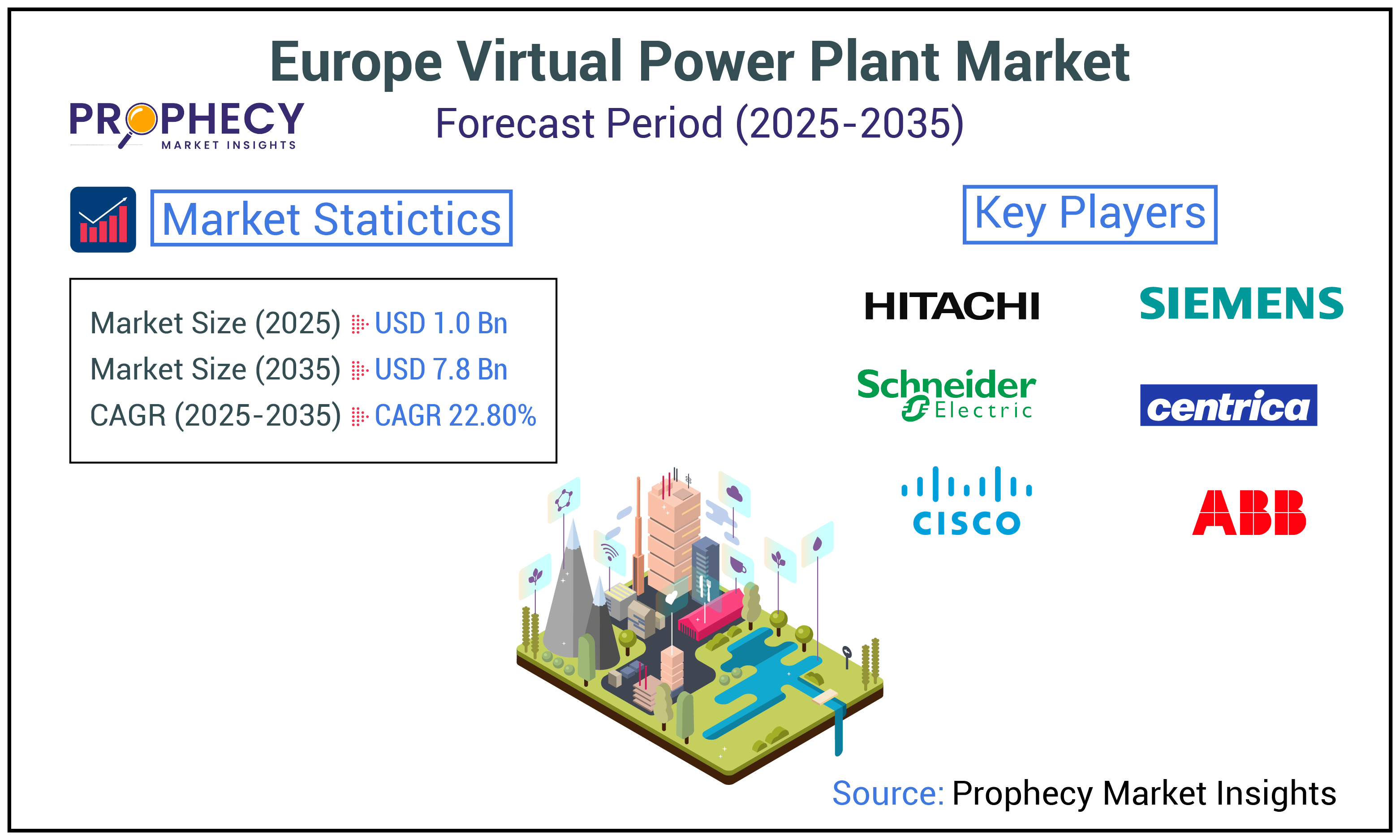
- By 2035, the Europe virtual power plant market size is contemplated to enlarge at a valuation of USD 7.8 Billion.
- In 2025, the Europe virtual power plant market valuation was USD 1.0 Billion.
- Europe virtual power plant market is developing at a CAGR of 22.80%
A virtual power plant (VPP) operates through a cloud-based system which connects distributed energy assets including solar panels batteries and wind turbines to function as one unified power generation facility. Virtual Power Plants coordinate multiple distributed energy resources to balance electrical supply and demand through stored energy dispatch. Utilities together with grid operators can decrease their dependence on fossil fuels and strengthen their energy resilience through their Virtual Power Plant operations.
The virtual power plant (VPP) market in Europe is growing significantly due to an interaction of market factors, technology, and policy assistance. The European Union's renewable energy portion advanced from 23% in 2022 to 24.5% in 2023 while the EU Renewable Energy Directive established 42.5% targets for 2030 which drives VPP implementation for solar and wind integration. The Electricity Regulation (EU) 2019/943 together with national capacity market reforms create incentives for demand response and flexibility services which represent fundamental capabilities of VPPs. Grid flexibility stands as a key driving element in the industry. European electricity grids need cost-effective solutions beyond traditional Peaker plants because VPPs enable flexibility through their aggregation of distributed energy resources to handle peak load and intermittent supply and grid congestion.
The increasing popularity of mixed-asset VPPs represents a significant development which unites different distributed energy resources (DERs) including solar panels, wind turbines, battery storage and electric vehicles to provide grid services along with improved operational flexibility. The decline in technological expenses along with the increasing adoption of digital energy platforms strengthens virtual power plant growth especially because European renewable energy expansion and grid congestion challenges persist.
Key Information:
- For instance, in July 2024, the European Commission approved more than USD 417.1 million for hydrogen investments by Italy, Finland, and Lithuania. This encompasses USD 417.1 million in Italian state funding and USD 208.5 million in Finnish funding directed towards industrial decarbonization. VPPs will help in storing excess energy generated from renewable energy to hydrogen and can be used for later use for electricity generation.
Recession Risk & Tariff Analysis:
- The financial viability of virtual power plants (VPPs) throughout Europe are significantly impacted by recession risk and tariff arrangements. The industrial and commercial energy requirements tend to decrease during economic downturns which leads to lower revenue potential for VPP operators who engage in wholesale markets or demand response programs.
- The high level of uncertainty in the market requires precise predictions and adaptable investment management more than ever before. The changing electricity price structures including TOU pricing and dynamic rates generate new prospects as well as additional operational difficulties.
Impact of Generative AI on Europe Virtual Power Plant Market:
- Generative AI enhances virtual power plants (VPPs) by providing precise forecasting capabilities and smart asset coordination as well as automated decision-making functions. Generative AI processes data through advanced pattern recognition techniques and real-time analytics to generate simulated demand and supply scenarios while optimizing dispatch strategies and minimizing operational system inefficiencies.
- VPPs benefit from this approach because it enables superior integration of solar and wind power as well as faster responses to market signals and grid requirements. The implementation of AI-generated models enables predictive maintenance together with user behavior analysis and adaptive load management which enhances both the resilience and cost-effectiveness of VPPs.
Europe Virtual Power Plant Market Drivers & Restraints
Key Drivers:
Renewable Energy Surge Fuels Virtual Power Plant Expansion Across Europe
The expanding use of renewable energy throughout Europe serves as a key factor driving virtual power plant (VPP) market expansion because nations strive to achieve their climate goals while decreasing their reliance on fossil fuels. The European Union moves forward to achieve its 2030 target of 42.5% renewables in final energy consumption by increasingly implementing Virtual Power Plants (VPPs) which have become vital for Europe’s energy transition plan.
- For Instance, the European Union maintains its acceleration of renewable energy installations throughout 2025 as new forecasts predict that 89 GW of fresh capacity will be installed including 70 GW of solar and 19 GW of wind production reaching unprecedented heights even though challenges arise from permit processing delays and subsidy reductions.
Restraints:
High Initial Costs and Integration Complexities Challenge Virtual Power Plant Deployment
Establishing a VPP demands a substantial initial financial commitment to implement monitoring and control systems together with communication infrastructure and energy management systems (EMS). The essential components enable real-time coordination while maintaining data security and grid compliance. High costs associated with integrating various distributed energy resources (DERS) and ensuring that interoperability can pose financial challenges.
- Counterbalance Statements: Virtual Power Plants (VPPs) generate greater benefits in the long run than initial expenses through improved grid efficiency combined with energy waste reduction and increased revenue generation from energy trading along with ancillary services. As the technology mature and the economy of the scale kick, the cost is expected to decline.
Opportunities & Trends:
Virtual Power Plants Accelerate Europe’s Decarbonization and Sustainable Energy Goals
Virtual Power Plants operate as a crucial component for decarbonization through effective management of solar and wind energy sources. These systems minimize the necessity for Peaker plants that run on fossil fuels through their ability to match supply and demand with renewable energy. VPPs serve as tools to reduce carbon emissions because they reduce energy waste and improve grid adaptability. The sustainable low-emission energy system that supports Europe's climate targets benefits from this direct contribution.
Europe Virtual Power Plant Market Segmentations & Regional Insights
Component, source, technology, application, end user, and country are the divisions of the Europe virtual power plant market.
By Component:
Hardware, software, and services are component on which Europe virtual power plant market is segmented. Software holds the top position in Europe virtual power plant market share. It is due to the central role that advanced software platforms have been playing in real-time energy prediction, distributed asset management, and market optimization.
The hardware infrastructure stands as the second leading component in Europe virtual power plant market share through its smart meters and sensors together with energy storage systems and control units. Real-time data acquisition and distributed energy resource communication depend on these physical assets to implement VPP software control commands.
By Source:
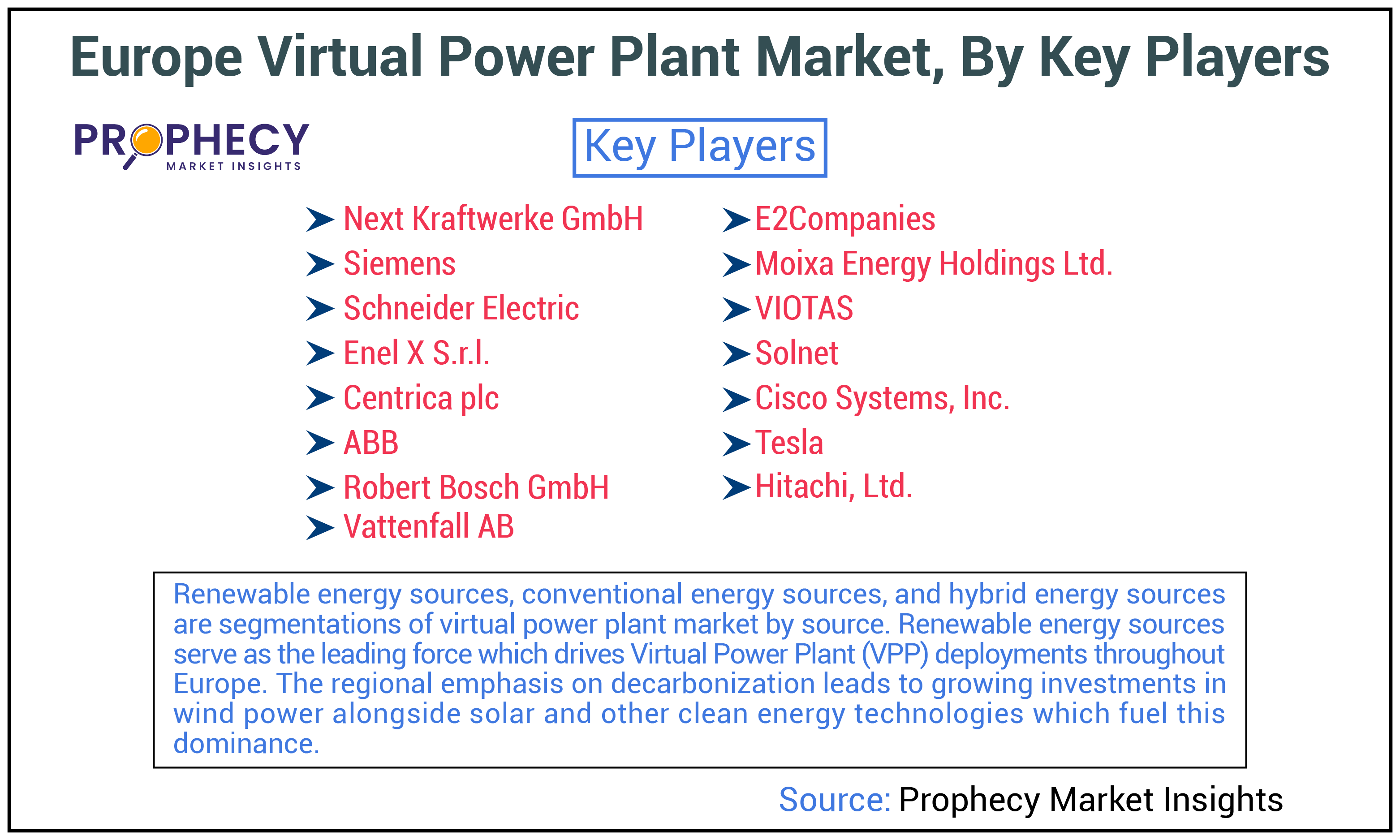
Renewable energy sources, conventional energy sources, and hybrid energy sources are segmentations of virtual power plant market by source. Renewable energy sources serve as the leading force which drives Virtual Power Plant (VPP) deployments throughout Europe. The regional emphasis on decarbonization leads to growing investments in wind power alongside solar and other clean energy technologies which fuel this dominance.
The virtual power plant market in Europe considers hybrid energy sources as its second largest segment as these sources integrate both renewable and conventional power generation to enhance operational adaptability. By this approach VPPs become reliable by synergizing the volatility of renewable energy generation with the reliability of conventional power sources such as gas turbines and CHP plants.
By Technology:
The market is distinguished into demand response, distributed generation, mixed asset, energy storage systems integration, and others in the technology segment. The leading segment of Europe virtual power plant market size is mixed asset technology as it enables the integration of demand response systems with distributed generation and energy storage capabilities. This holistic approach allows operators to maximize flexibility, balance network load effectively and respond dynamically to real -time market conditions.
The virtual power plant market in Europe features demand response as its second major technological segment. The essential function of this system allows users from industrial sites and residential areas to modify their power usage when price signals or grid requirements exist. The increasing flexibility of electricity markets makes demand response programs an economical substitute for regular grid developments along with Peaker plants.
By Application:
Based on the application, the Europe virtual power plant market is divided into peak load management, energy trading, grid balancing, remote monitoring and forecasting, and others. Virtual Power Plants (VPPs) find their primary application in peak load management which drives their adoption throughout Europe. During periods of elevated electricity demand VPPs utilize intelligent load management alongside distributed energy resource dispatch to reduce grid stress.
Virtual Power Plants (VPPs) represent the second most substantial application of grid balancing in Europe as the region depends more on variable renewable energy sources including wind and solar power. The power grid requires VPPs to execute dynamic control of distributed generation units and flexible loads because these sources generate fluctuations which affect grid stability through frequency and voltage variations.
By End User:
Industrial sector, commercial sector, residential sector, utilities and power retailers and others are end-use of the Europe virtual power plant market. The dominant end user in Europe virtual power plant market share consists of utilities together with power retailers due to they handle major energy distribution systems and maintain grid stability. These units utilize VPPs to optimize the energy stitch, integrate distributed renewable resources and participate in energy trading and additional markets.
The industrial sector holds the second most significant position among Europe virtual power plant market growth end users as it consumes substantial energy and places increasing importance on both cost reduction and sustainable practices. The industrial sector continues to join demand response initiatives while implementing local power production alongside energy storage systems for improved energy independence and decreased peak period expenses.
By Country:
On The virtual power plant market in Europe exists mainly under German control with the U.K. and France and the Netherlands following close behind. The leading position of Germany stems from its established renewable energy network and progressive grid transformation programs and government rules that encourage distributed power generation systems.
Europe Virtual Power Plant Market Report Scope:
|
Attribute |
Details |
|
Market Size 2025 |
USD 1.0 Billion |
|
Projected Market Size 2035 |
USD 7.8 Billion |
|
CAGR Growth Rate |
22.80% (2025-2035) |
|
Base year for estimation |
2025 |
|
Forecast period |
2025 – 2035 |
|
Market representation |
Revenue in USD Billion & CAGR from 2025 to 2035 |
|
Regional scope |
Europe - Germany, U.K., France, Russia, Italy, Spain, Netherlands, and Rest of Europe |
|
Report coverage |
Revenue forecast, company share, competitive landscape, growth factors, and trends |
Segmentation:
By Component:
- Hardware
- Smart Meters
- Remote Terminal Units
- Others
- Software
- Cloud-based
- On-premise
- Services
- Consulting
- Integration & Deployment
- Others
By Source:
- Renewable Energy Sources
- Conventional Energy Sources
- Hybrid Energy Sources
By Technology:
- Demand Response
- Distributed Generation
- Mixed Asset
- Energy Storage Systems Integration
- Others
By Application:
- Peak Load Management
- Energy Trading
- Grid Balancing
- Remote Monitoring and Forecasting
- Others
By End Use:
- Industrial Sector
- Commercial Sector
- Residential Sector
- Utilities and Power Retailers
- Others
By Country:
- Germany
- U.K.
- France
- Russia
- Italy
- Spain
- Netherlands
- Rest of Europe
Europe Virtual Power Plant Market Competitive Landscape & Key Players
Companies in the Europe virtual power plant market collectively aim to enhance product quality, extend shelf life, and fulfill consumer demand for functional and clean-label foods. The Europe virtual power plant market competition includes both traditional utility providers and new technology-focused energy startups. The main industry participants concentrate their efforts on AI implementation together with demand-side flexibility and cross-border energy trading functionalities.
Europe Virtual Power Plant Market Companies:
- Next Kraftwerke GmbH
- Siemens
- Schneider Electric
- Enel X S.r.l.
- Centrica plc
- ABB
- Robert Bosch GmbH
- Vattenfall AB
- E2Companies
- Moixa Energy Holdings Ltd.
- VIOTAS
- Solnet
- Cisco Systems, Inc.
- Tesla
- Hitachi, Ltd.
Europe Virtual Power Plant Market Recent News
- In June 2025, during their European “VPP Customer Days” event emsys introduced their new VPP roadmap together with upcoming platform innovations. The event covered market strategy alongside forecasting tools and improved IT security systems while demonstrating cross-border aggregation applications through partnerships with Optimus Energy and Eesti Energia.
- In July 2025, Enpal (Germany) together with Entrix (optimization/trading platform provider) introduced Flexa which represents the biggest VPP across Europe. Through its AI-powered trading system the platform connects residential solar installations with batteries and electric vehicles and heat pumps to build up multiple gigawatts of VPP capacity.
Analyst View:
The Europe virtual power plant (VPP) market functions as a fundamental component in the region's energy transition plan due to growing renewable energy implementation and grid decentralization and increasing energy adaptability needs. Analysts recognize regulatory backing together with expanding public-private investment alongside fast digital transformation which includes AI and IoT integration as important enabling factors. The future prospects continue strong because Europe stands to become the worldwide leader in both VPP solution innovation and implementation despite initial cost and interoperability challenges.
More Related Reports
Virtual Power Plant Market
Virtual Extensible LAN Market
Mobile Virtual Network Operator Market
Virtual Critical Care Solutions Market
Asia Pacific Virtual Power Plant Market
Europe Virtual Power Plant Market Company Profile
|
Company Name |
Robert Bosch GmbH |
|
Headquarter |
Gerlingen, Germany |
|
CEO |
Stefan Hartung |
|
Employee Count |
418,000 Employees |
FAQs
Europe virtual power plant market size was valued at USD 1.0 Billion in 2025 and is expected to reach USD 7.8 Billion by 2035 growing at a CAGR of 22.80%.
Component, source, technology, application, end user, and country are the segmentation for the target market.
The market is segmented into Germany, U.K., France, Russia, Italy, Spain, Netherlands, and Rest of Europe. Germany is expected to dominate the market.
The key players operating the Europe virtual power plant market include Next Kraftwerke GmbH, Siemens, SCHNEIDER ELECTRIC, Enel X S.r.l., Centrica plc, ABB, Robert Bosch GmbH, Vattenfall AB, E2Companies, Moixa Energy Holdings Ltd., VIOTAS., Solnet, Cisco Systems, Inc., CP Kelco U.S.,Inc., and Hitachi, Ltd.