Europe Blue Ammonia Market Overview
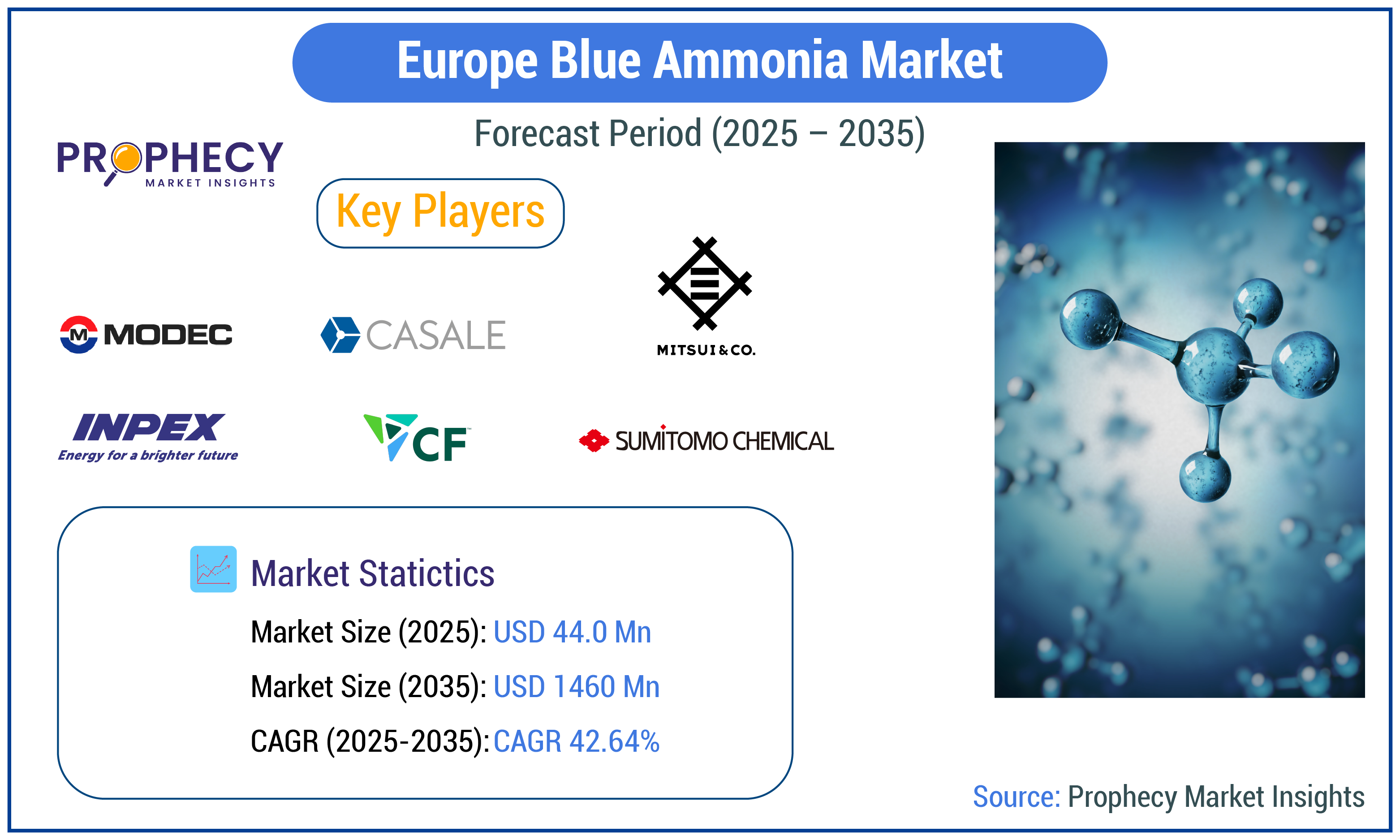
- By 2035, the Europe blue ammonia market size is contemplated to enlarge at a valuation of USD 1460 Million.
- In 2025, the Europe blue ammonia market valuation was USD 44.0 Million.
- Europe blue ammonia market is developing at a CAGR of 42.64%.
Carbon capture and storage (CCS) technology is used to capture and store the carbon dioxide emissions that are produced when hydrogen from natural gas is used to produce blue ammonia, a low-carbon version of ammonia. In contrast to ordinary ammonia, blue ammonia preserves the chemical's utility in energy systems, industrial applications, and fertilizers while drastically lowering greenhouse gas emissions. Using existing ammonia infrastructure for low-emission energy transport, facilitating decarbonization in power production and shipping, supporting global net-zero targets, and acting as a clean hydrogen transporter are some of its main benefits.
The Europe blue ammonia market has expanded considering to the region's strong commitment to carbon neutrality, pro-low-carbon technology government policies, and growing expenditures in CCS and hydrogen infrastructure. Blue ammonia is also a critical solution for the clean energy transition and emissions reduction owing to Europe's extensive ammonia transport and storage networks, as well as its efforts to decarbonize heavy industries, shipping, and power generation.
Europe blue ammonia market looks to have a bright future driven by robust climate policies, rising renewable energy demand, and significant port infrastructure improvements. Low-carbon imports are being encouraged by government programs notably REPowerEU and carbon pricing, and market potential is being increased by growing interest in ammonia as a maritime fuel and hydrogen carrier. Blue ammonia is expected to be essential to Europe's shift to a net-zero economy as the continent constructs new ammonia terminals and negotiates long-term supply agreements.
Recession Risk and Tariff Analysis:
- The expansion of the Europe blue ammonia market may be impacted by tariff-related issues and a modest probability of recession. New levies on EU exports coupled with possible economic slowdowns could discourage industrial investments and postpone the adoption of low-carbon solutions.
- Furthermore, the Europe blue ammonia market is susceptible to changes in the economy and energy prices owing blue ammonia manufacturing is costly, mostly primarily of the costly carbon capture infrastructure. If not offset by robust government backing and advantageous trade policies, these obstacles may impede project development and offtake deals.
Impact of Generative AI on Europe Blue Ammonia Market:
- The Europe blue ammonia market is being impacted by generative AI in two ways. AI provides strong capabilities to boost ammonia production and carbon capture efficiency, even as its rising energy demands particularly from data centers may raise electricity prices and carbon emissions.
- AI may reduce manufacturing expenses and emissions through enhanced enzyme design, optimizing plant operations, and helping with energy grid management. Having been taken into account, AI represents both a difficulty and an opportunity it boosts the use of energy while simultaneously rendering blue ammonia solutions more intelligent, clean, and scalable.
Europe Blue Ammonia Market Drivers & Restraints
Key Drivers:
Europe's Energetic Decarbonization Push to Fuel Economic Development
The Europe blue ammonia market has been growing mostly due the region's ambitious push for decarbonization, and a hunt for cleaner ways to satisfy its climate targets. Industry is also decreasing its carbon emissions through carbon pricing mechanisms, strict emissions limits, and programs such as the European Green Deal and REPowerEU. Blue ammonia is a great fit for these goals, because blue ammonia itself can absorb CO2 emissions as well as transport and store hydrogen. It is key for Europe’s clean energy transition as it can be applied across heavy industry, transport and power generation. It’s just incredibly hard to get these businesses electrified.
- For Instance, according to the data published by Union of the Electricity Industry, The EU originally committed to curbing at least 40% of CO2 emissions below 1990 level by 2030 and set an aspiration of 80-95% reduction by 2050.
Restrains:
High Production Costs are Disrupting the Market's Growth
High Europe blue ammonia costs are largely driven by the energy-intensive production of hydrogen from natural gas, plus the extra cost of carbon capture, utilization and storage (CCUS) technology. These systems are expensive to install and require dedicated infrastructure and continued operational costs that make blue ammonia many times more expensive than standard ammonia.
- Counterbalance Statements: There are some ways to do so such as by increasing the scale of production to access economy of scale, investing in R&D to improve and make cost-competitive the CCUS methods, as well as by benefiting of government subsidies, carbon pricing incentives or public-private partnerships. Moreover, integration of renewable energy to power the operations of CCS can lower the operating costs in the long term.
Opportunities & Trends:
The Growing Need for Clean Marine Fuels May Indicate New Market Prospects
Increasing demand for cleaner marine fuels in Europe is one of the factors driving the blue ammonia market. As the International Maritime Organization aims for deep decarbonization, including 20–30% reductions in emissions by 2030 and net-zero emissions by 2050, shipping is looking for alternatives to carbon. Ammonia, particularly blue ammonia, is fast gaining attraction as a front?runner solution, given its scale?up readiness and alignment with existing ports and fleets. Blue ammonia is expected to provide about 75% of the ammonia-based shipping fuel demand by 2050, but uptake will increase from the late 2020s as bunkering infrastructure develops and engine technology is proven. In summary, as Europe seeks to decarbonize shipping, blue ammonia is well placed to play a major role in its clean?marine?fuel strategy.
Europe Blue Ammonia Market Segmentations & Regional Insights
Technology purity, application, end-user industry, and country are the divisions of the Europe blue ammonia market.
By Technology:
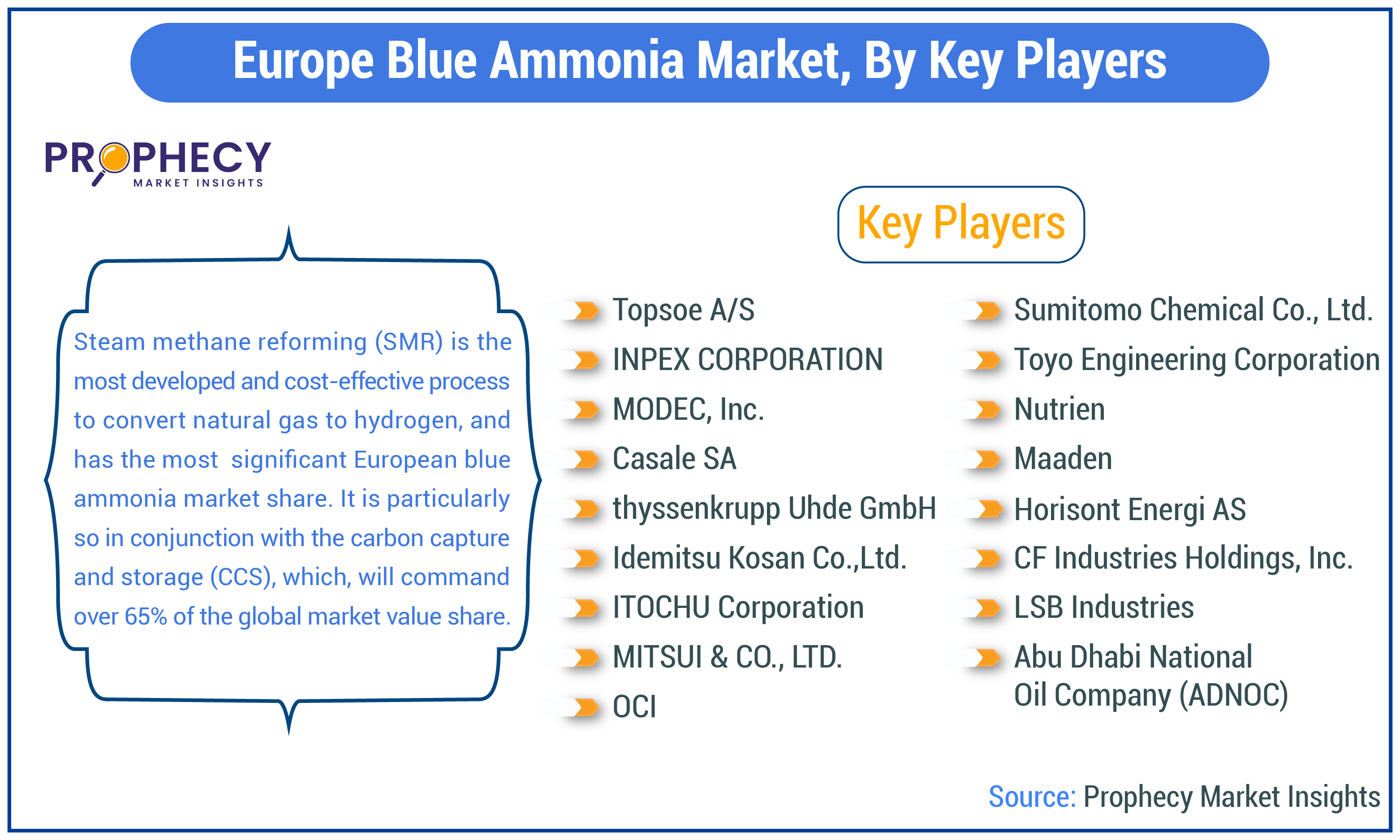
Steam methane reforming, autothermal reforming, and gas partial oxidation are technology including in the Europe blue ammonia market. Steam methane reforming (SMR) is the most developed and cost-effective process to convert natural gas to hydrogen, and has the most significant European blue ammonia market share. It is particularly so in conjunction with the carbon capture and storage (CCS), which, will command over 65% of the global market value share, by 2030.
Autothermal reforming (ATR) is the second most common technology in Europe, due to better energy integration and higher CO2 capture rate (above 90%) and increasing use in new greenfield projects.
By Purity:
99.99% Purity, 99.9% Purity, and 99% Purity are purity for which market is categorized. The Europe blue ammonia market's 99.99% purity category holds the most Europe blue ammonia market share due to the fact it meets stringent specifications for industrial, power-generation, and chemical applications that call for few impurities while balancing performance and cost-effectiveness.
The 99% purity grade, which is the second-largest category, is used for less demanding applications where a little lower purity is acceptable and provides superior cost efficiency, usually in ordinary manufacturing or non-critical chemical processes.
By Application:
Power generation, transportation, industrial feedstock, and others are application of the Europe blue ammonia market. Since ammonia is still a necessary input for the manufacturing of nitrogen fertilizer, chemicals, medicines, and petrochemicals, the greatest application in the Europe blue ammonia market is industrial feedstock, particularly for fertilizers and chemicals.
Blue ammonia is being utilized more and more in dedicated ammonia-fired facilities or co-fired with fossil fuels to decarbonize electricity in the second-largest market, power generation, which benefits from government incentives and grid flexibility requirements.
By End-User Industry:
Europe blue ammonia market is categorized into agriculture, utilities, oil & gas, and logistics, on the account of end-user industry. Since ammonia is still needed for nitrogen-based fertilizers that are essential to feeding the continent, the fertilizer industry, or agriculture, holds the largest end-user share in the Europe blue ammonia market size. Blue ammonia provides a low-carbon drop-in solution without interfering with current supply chains.
In order to comply with decarbonization regulations and maintain grid stability, utilities, which include power generating and energy companies, are the second-largest segment. They are progressively cofiring ammonia or mixing it into the gas mix.
Europe Blue Ammonia Market Report Scope:
|
Attribute |
Details |
|
Market Size 2025 |
USD 44.0 Million |
|
Projected Market Size 2035 |
USD 1460 Million |
|
CAGR Growth Rate |
42.64% (2025-2035) |
|
Base year for estimation |
2024 |
|
Forecast period |
2025 – 2035 |
|
Market representation |
Revenue in USD Million & CAGR from 2025 to 2035 |
|
Regional scope |
Europe – Germany, U.K., France, Russia, Italy, Spain, Netherlands, and Rest of Europe |
|
Report coverage |
Revenue forecast, company share, competitive landscape, growth factors, and trends |
Segmentation:
By Technology:
- Steam Methane Reforming
- Autothermal Reforming
- Gas Partial Oxidation
By Purity:
- 99.99% Purity
- 99.9% Purity
- 99% Purity
By Application:
- Power Generation
- Transportation
- Industrial Feedstock
- Others
By End-User Industry:
- Agriculture
- Utilities
- Oil & Gas
- Logistics
By Country:
- Germany
- U.K.
- France
- Russia
- Italy
- Spain
- Netherlands
- Rest of Europe
Europe Blue Ammonia Market Competitive Landscape & Key Players
The key players operating in the Europe blue ammonia market include Topsoe A/S, INPEX CORPORATION, MODEC, Inc., Casale SA and others. Through strategic partnerships, investments in carbon capture, the growth of the power and marine industries, and EU policy support, European producers of blue ammonia are expanding. They focus on increasing production, securing long-term contracts, and inventing to lower costs and boost competitiveness.
Europe Blue Ammonia Market Companies:
- Topsoe A/S
- INPEX CORPORATION
- MODEC, Inc.
- Casale SA
- thyssenkrupp Uhde GmbH
- Idemitsu Kosan Co.,Ltd.
- ITOCHU Corporation
- MITSUI & CO., LTD.
- Sumitomo Chemical Co., Ltd.
- Toyo Engineering Corporation
- OCI
- Nutrien?
- Maaden
- Horisont Energi AS
- CF Industries Holdings, Inc.
- Abu Dhabi National Oil Company (ADNOC)
- LSB Industries
Europe Blue Ammonia Market Recent News
- In April 2025, to help businesses who trade low-carbon hydrogen products into Europe, the global energy and commodities price information firm Argus has introduced an index. The mass-balanced, all-in cost of low-carbon ("blue") ammonia sent to the ports of Amsterdam, Rotterdam, or Antwerp (ARA) is known as the Argus EU Low-carbon Ammonia Benchmark (EULAB).
Analyst View:
Europe blue ammonia market is growing rapidly as a result of several factors such as stringent climate regulations, government incentives for low-carbon technologies, and increasing investments in hydrogen and carbon capture infrastructure. Blue ammonia, where CO? emissions are absorbed during the process of producing hydrogen from natural gas, has the industrial and energy application of ammonia at a much lower emission rate. It plays a vital role to the decarbonization of industries made up of power, shipping, and heavy industry. Blue ammonia is well-placed to play a major role in Europe's shift towards a net-zero future because of growing ammonia infrastructure, efforts such as REPowerEU, and increasing demand for hydrogen carriers and clean marine fuels.
More Related Reports
U.S Ammonia Market
Bluetooth Speaker Market
Bluetooth Beacons Market
Asia Pacific Blue Ammonia Market
Ammonia Market
Europe Blue Ammonia Market Company Profile
|
Company Name |
Topsoe A/S |
|
Headquarter |
Lyngby, Denmark |
|
CEO |
Roeland Baan |
|
Employee Count |
2,800 Employees |
FAQs
Europe blue ammonia market size was valued at USD 44.0 Million in 2025 and is expected to reach USD 1460 Million by 2035 growing at a CAGR of 42.64%.
Technology, purity, application, end-user industry, and country are the segmentation for the target market.
The market is segmented by countries Germany, U.K., France, Russia, Italy, Spain, Netherlands, and Rest of Europe. Germany region is expected to dominate the Market.
The key players operating the Europe blue ammonia market include Topsoe A/S, INPEX CORPORATION, MODEC, Inc., Casale SA, thyssenkrupp Uhde GmbH, Idemitsu Kosan Co.,Ltd., ITOCHU Corporation, MITSUI & CO., LTD., Sumitomo Chemical Co., Ltd., Toyo Engineering Corporation, OCI, Nutrien, Maaden, Horisont Energi AS, CF Industries Holdings, Inc., Abu Dhabi National Oil Company (ADNOC), and LSB Industries.