Apiculture Market Overview
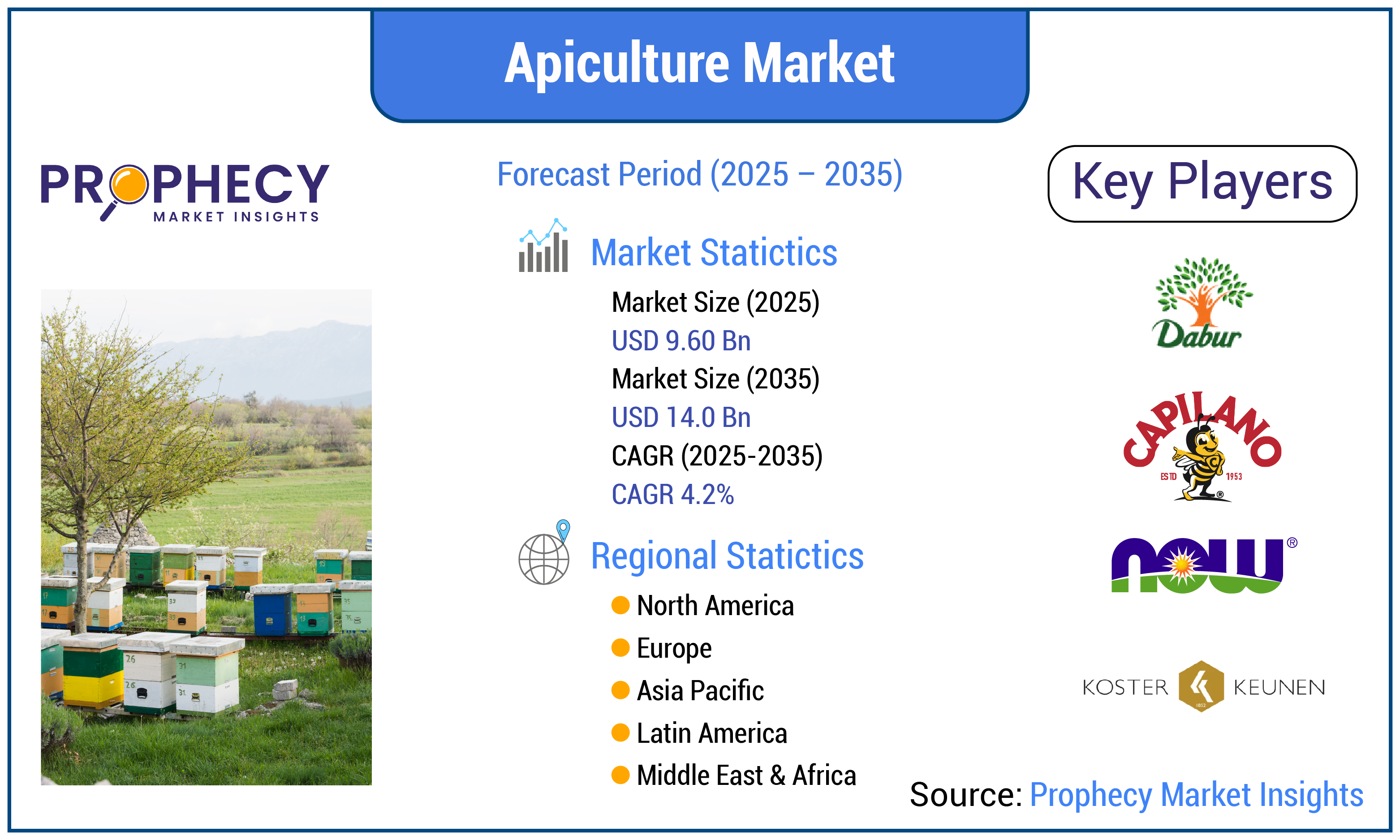
- By 2035, the apiculture market size is contemplated to enlarge at a valuation of USD 14.0 Billion.
- In 2024, the apiculture market valuation was USD 9.32 Billion.
- Apiculture market is developing at a CAGR of 4.2%.
Apiculture is a scientific practice of beekeeping that includes the bee colony maintenance in man-made hives. Production of honey, beeswax and bee-related commodities are major factors of Apiculture as it also plays a crucial role in crop pollination and biodiversity conservation. Beeswax is an essential element in cosmetic products, and honey and royal jelly are commonly discovered in food supplements.
The apiculture market grows with increasing natural and organic product demand such as honey, beeswax and royal jelly around food, cosmetic and pharmaceutical industries. Government support and education initiatives for beekeepers originated from increasing knowledge of the crucial role of bees in pollination and sustainable agriculture. Bee-keeping industry is growing further as a result of growing honey exports from developing countries and technical developments in hive monitoring and disease management. As more companies engage in bee-related products that meet the demands of customers, the market exceeds its potential regarding bee products driving growth on global scale.
Apiculture market is witnessing several key opportunities and trends with major surge in urban bee-keeping regarding both as a hobby and sustainable initiative making local honey with easy access for consumers. Consumer interest in natural, conscious of their health foods has fueled demand for specialty and value-added honey products, including as Manuka, Blossom, Crested Honey, infused honeys, and pollen-based products.
Recession Risk & Tariff Analysis:
- Apiculture market counters moderate recession risks as the honey and other bee related products are non-essential unlike staple foods. Consumer spending on organic and high-quality honey may decline mostly during economic downturns leading towards loss for small-scale and specialty beekeepers.
- Countries such as China, India, the U.S., and the EU which are major exporter of honey and apiculture equipment, due to international trade tariffs the global supply chains get disrupted with increasing cost for beekeepers.
Impact of Generative AI on Apiculture Market:
- Apiculture market is being impacted by generative AI with real-time hive monitoring, AI-powered picture recognition technologies can recognize pests, illnesses, or queen failure in bees, minimizing colony loss and raising output.
- Moreover, beekeepers can strategically plan for seasonal changes along with enhance pollination schedules by using generative models to mimic hive behavior and external factors. More efficiency, predictive analytics, and improved hive management solutions adapted to certain species and regions are all projected as the technology improves fueling more bee-based products in the market.
Apiculture Market Drivers & Restraints
Key Drivers:
Growing Awareness of Health Benefits Drives Market Growth
Apiculture market is growing significantly with higher consumption rate globally as consumers are getting aware of nutritional and medicinal benefits of honey, propolis, royal jelly, and bee pollen. Honey is valued for its antimicrobial qualities, natural antioxidants, and ability to be a superior alternative for refined sugar. A wider trend toward natural, functional foods and holistic health practices is driving the surge in consumption.
- For Instance, according to National Honey Board (US) report the honey sales recorded up to USD 1.1 billion in 2024 reflecting its growing popularity beyond conventional sweetening.
Restraints:
The Market is Affected by Competition from Alternative Sweeteners
The major challenge of growing competition from other sweeteners is restraining factors for apiculture market. Stevia, agave nectar, maple syrup, and date sugar are a few of the many calorie-efficient and healthful substitutes to honey. In order to appeal to certain people with health goals that are willing to cut out sugar from their diets, alternative sugars typically have unique health benefits such being low glycemic or having less energy than common sugar that might slow down the growth for honey products.
- Counterbalance Statements: Honey has a strong market position because of its distinct natural composition, various uses, and customer confidence in its authenticity, despite competition from substitute sweeteners notably agave nectar, maple syrup, and stevia. Skincare, wellness and traditional medicine sectors has increasing need for clean-label, non-artificial ingredients favors honey giving a competitive edge to alternative sweeteners.
Opportunities & Trends:
Rising trend of Honey in Beauty & Personal Care Industry
Use of organic honey is rising in skin care products gradually due to its skin benefits such as moisture retention, antibacterial, and antioxidant effects making it crucial for add-on beauty products. Although it helps hydrate the skin, reduce inflammation, and kill germs that cause acne, this component is also found in face masks, moisturizers, shampoos, lip balms, and soaps. As a result of the increasing recognition of natural and organic beauty products, honey begun to be included in the very compelling natural and organic cosmetics product lines.
Apiculture Market Segmentations & Regional Insights
Product type, Method, End Use, and region are the divisions of the apiculture market.
By Product Type:
Honey, beeswax, propolis, royal jelly and others are product type on which apiculture market is segmented. Honey stays to be the most popular product category in the apiculture market share, providing the largest proportion of global sales. Demand is being boosted significantly by its widespread use as a natural sweetener as well as increasing consumer interest in organic and healthy foods that fuels more adoption of honey in market.
Having broad variety of usage in industrial, pharmacological, and cosmetic goods, beeswax is the second most important section of the apiculture business. Due to its inherent emollient qualities, beeswax is highly valued and frequently used in healthcare products including ointments, moisturizers, and lip balms propelling market growth for beeswax and indirectly apiculture.
By Method:
On the basis of method, apiculture market is categorized into traditional beekeeping and modern beekeeping. Modern beekeeping is the most practiced method regarding the apiculture market share with enabling better colony management and higher honey yields. Modern beekeeping incorporates with automated extractors, hive monitoring sensors and movable frame hives under advance technologies in modern beekeeping.
Traditional beekeeping is the second most popular category in the apiculture market size, especially within rural and remote areas where it continues to be a crucial source of income. Although having less advanced technology, it has a strong foundation in regional culture and environmentally conscious methods, regularly making use of natural raw materials and traditional expertise with steady rate of growth in traditional beekeeping.
By End Use:
Apiculture market on the account of end use is categorized into medical, food & beverages, cosmetics, and others. The food and beverage industry lead the apiculture market share as an end-use category, with highest consumption of honey and other bee products. The demand for clean-label, natural ingredients and growing health consciousness among consumers is fueling adoption in commercial food applications on global scale for bee products in food and beverage industry.
The second-largest proportion is held by the medical segment with usage of bee products such as propolis, honey and royal jelly in therapeutic properties. The medical industry's need for apiculture products is rising along with interest in natural and alternative medicine, preserving its position as the second-largest contributor to the market after the food and beverage sector.
Regional Insights:
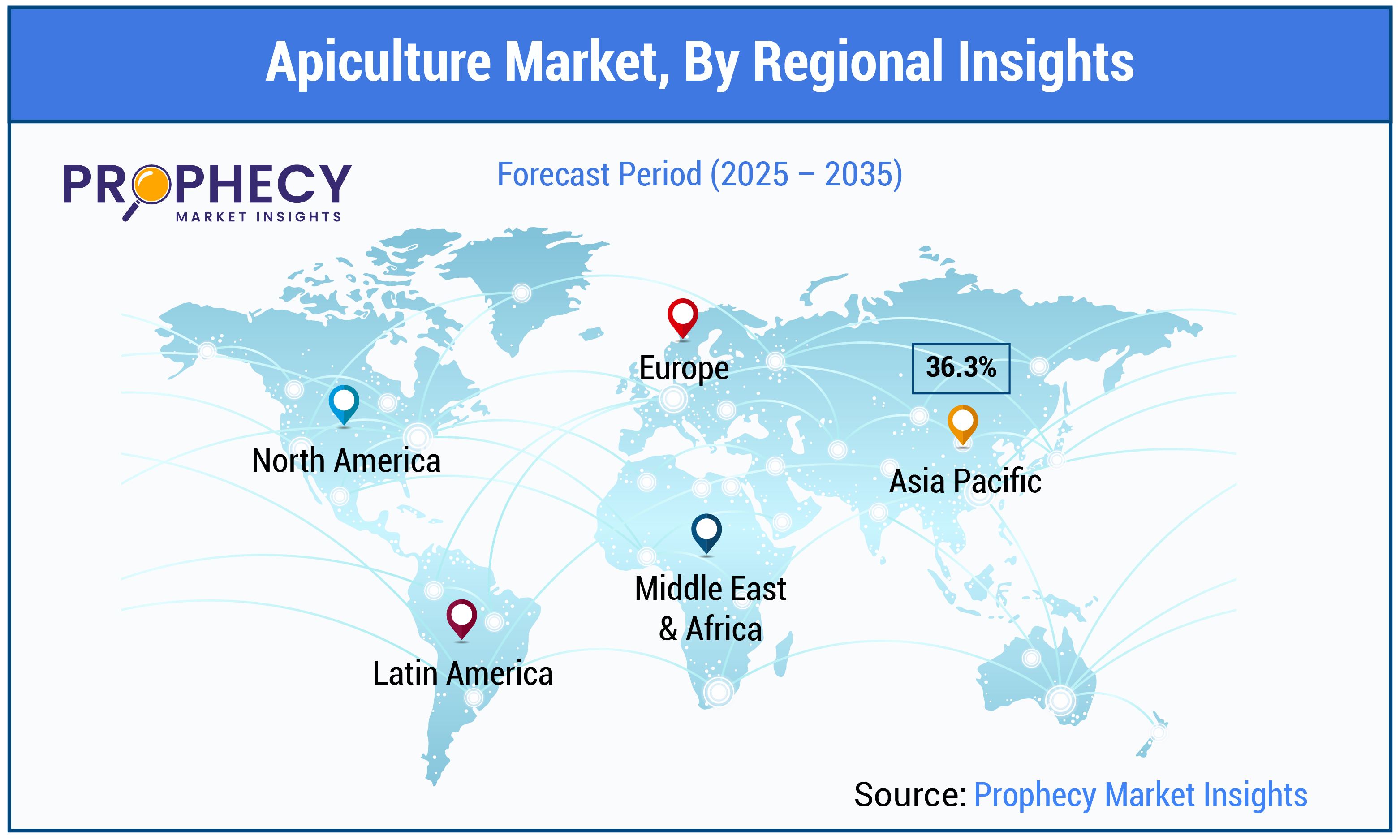
Geographically, the apiculture market is studied across North America, Europe, Asia Pacific, Latin America, and the Middle East & Africa.
Asia Pacific: The apiculture market in Asia-Pacific is largest market globally with high production volumes, large number of small- to medium-scale beekeepers and growing domestic consumption rapidly. Regional expansion is further supported by increasing demand for natural and organic goods in Southeast Asia's rising countries.
- China Apiculture Market Insights:
China leads the market with production of approximately 463,000 tonnes of honey, accounting for about 67% of the region's total output, nearly four times more than India, the second-largest producer at 104,000 tonnes. China also leads in both consumption and export of bee products to major market such as Europe, U.S. and Japan.
Europe: This is the second dominant region for global apiculture market with region producing over 236,000 tonnes of honey annually, representing about 13% of world output, making it second highest producer for honey production. Countries such as Hungary, Germany, Greece, Italy, France and Poland are major key players for honey production and beekeeping.
- Germany Apiculture Market Insights:
Germany is the apiculture market leader in Europe due to its robust bioeconomy plan, massive expenditures in infrastructure and research, and ambitious projects including the UPM biorefinery. Germany is therefore a key contributor to the development of sustainable biorefinery technology in Europe.
North America: This is witnessing a significant growth in the apiculture market on global scale with rising consumer need for natural products, increasing health awareness and government initiatives that are supportive. This region, particularly the U.S. and Canada, plays a significant role in the global apiculture landscape.
- U.S. Apiculture Market Insights:
U.S. is the clear dominant region in the honey market. It produces approximately 60?kt of honey in 2024, accounting for around 61% of North American output. With modern production methods, vast distribution networks and large consumer demand for organic and premium honey, United States captures nearly 84% of the region's honey market share.
Apiculture Market Report Scope:
|
Attribute |
Details |
|
Market Size 2025 |
USD 9.60 Billion |
|
Projected Market Size 2035 |
USD 14.0 Billion |
|
CAGR Growth Rate |
4.2% (2025-2035) |
|
Base year for estimation |
2024 |
|
Forecast period |
2025 – 2035 |
|
Market representation |
Revenue in USD Billion & CAGR from 2025 to 2035 |
|
Regional scope |
North America - U.S. and Canada Europe – Germany, U.K., France, Russia, Italy, Spain, Netherlands, and Rest of Europe Asia Pacific – China, India, Japan, Australia, Indonesia, Malaysia, South Korea, and Rest of Asia-Pacific Latin America - Brazil, Mexico, Argentina, and Rest of Latin America Middle East & Africa – GCC, Israel, South Africa, and Rest of Middle East & Africa |
|
Report coverage |
Revenue forecast, company share, competitive landscape, growth factors, and trends |
Segmentation:
By Method Type:
- Honey
- Beeswax
- Propolis
- Royal Jelly
- Others
By Method:
- Traditional Beekeeping
- Modern Beekeeping
By End Use:
- Medical
- Food & Beverages
- Cosmetics
- Others
By Region:
- North America
- U.S.
- Canada
- Europe
- Germany
- U.K.
- France
- Russia
- Italy
- Spain
- Netherlands
- Rest of Europe
- Asia Pacific
- China
- India
- Japan
- Australia
- Indonesia
- Malaysia
- South Korea
- Rest of Asia Pacific
- Latin America
- Brazil
- Mexico
- Argentina
- Rest of Latin America
- Middle East & Africa
- GCC
- Israel
- South Africa
- Rest of Middle East & Africa
Apiculture Market Competitive Landscape & Key Players
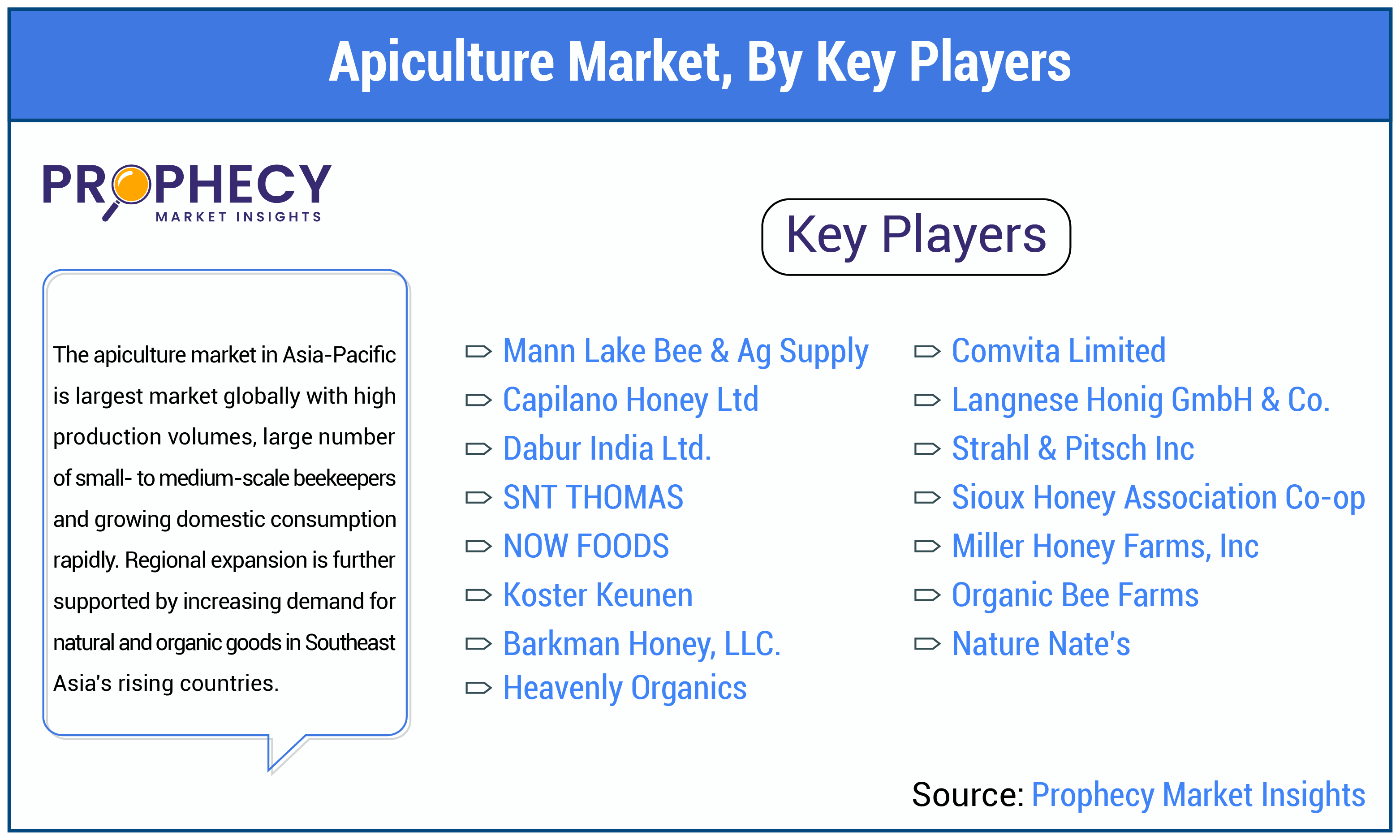
The key players operating in the apiculture market include, Mann Lake Bee & Ag Supply, Capilano Honey Ltd, Comvita Limited, NOW FOODS, Koster Keunen, and others. The goal of apiculture businesses aims to improve the quality, sustainability, and accessibility of bee-derived products such as propolis, honey, and beeswax globally.
Apiculture Market Companies:
- Mann Lake Bee & Ag Supply
- Capilano Honey Ltd
- Dabur India Ltd.
- SNT THOMAS
- NOW FOODS
- Koster Keunen
- Barkman Honey, LLC.
- Heavenly Organics
- Comvita Limited
- Langnese Honig GmbH & Co.
- Strahl & Pitsch Inc
- Sioux Honey Association Co-op
- Miller Honey Farms, Inc
- Organic Bee Farms
- Nature Nate’s
View an Additional List of Companies in the Apiculture Market
Apiculture Market Recent News
- In January 2022, Nature Nate's merged with Cannon Falls, Minnesota-based Sweet Harvest Foods, an independent private equity business that invests in supply chain and agricultural production enterprises on a controlling basis.
- In March 2021, Comvita, a company that offers apiculture-based products like M?nuka Honey, Propolis, and others such products announced the official opening of its state-of-the-art Wellness Lab experiential space in the Viaduct, Auckland.
- In April 2021, Billy Bee and Doyon (brands owned by McCormick & Company Inc.) announced their plans to ensure 100% honey sourcing from Canada. The shift was in response to consumers' preferences. The company also started focusing on the True Source Honey Certification Program, an industry-led effort to ensure that products are ethically and legally sourced.
Analyst View:
Apiculture market as steadily growing with increasing consumer awareness of natural and health beneficial products. The market has ideal long-term potential due to increasing demand for honey and chemicals produced by bees in the food and beverage pharmaceutical, and cosmetic industries. Although there is competition from other sweeteners, analysts point out that honey has an edge in the market due to its versatility and clean-label appeal.
More Related Reports
Food Waste Disposers Market
Organic Honey Market
Food Fiber Market
Food Safety Testing Market
Baby Food Market
Apiculture Market Company Profile
|
Company Name |
Dabur India Ltd. |
|
Headquarter |
Delhi, India |
|
CEO |
Mohit Malhotra |
|
Employee Count |
7747 Employees |
Apiculture Market Highlights
FAQs
Apiculture market size was valued at USD 9.60 Billion in 2025 and is expected to reach USD 14.0 Billion by 2035 growing at a CAGR of 4.2%.
Product type, method, end use, and region are the segmentation for the target market.
North America, Asia Pacific, Europe, Latin America, and the Middle East & Africa. North America is expected to dominate the market.
The key players operating the apiculture market include Mann Lake Bee & Ag Supply, Capilano Honey Ltd, Dabur India Ltd., SNT THOMAS, NOW FOODS, Koster Keunen, Barkman Honey, LLC., Heavenly Organics, Comvita Limited, Langnese Honig GmbH & Co., Strahl & Pitsch Inc , Sioux Honey Association Co-op, Miller Honey Farms, Inc, Organic Bee Farms, and Nature Nate’s.