Global Skin Care Products Market Overview
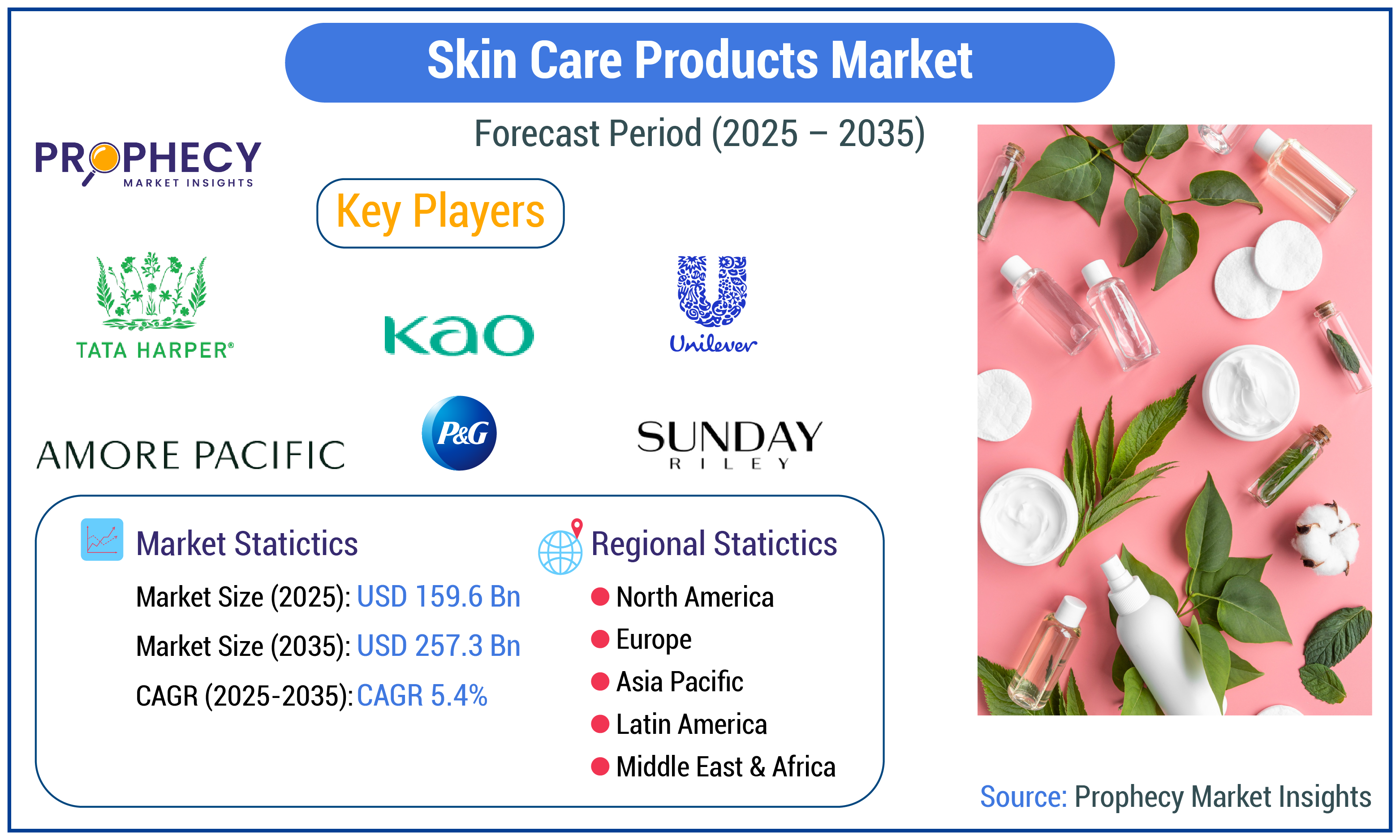
- By 2035, the skin care products market size is anticipated to propel at a rate of USD 257.3 Billion.
- In 2024, the target market valuation was USD 152.2 Billion.
- The market is mounting at a CAGR 5.4%.
Skin care products are substances or formulations designed to support the health, appearance, and integrity of the skin. These products serve various purposes such as cleansing, moisturizing, treating skin conditions, and protecting the skin from environmental damage. The primary categories of skin care products include cleansers, moisturizers, exfoliants, toners, sunscreens, serums, and treatments for specific concerns such as acne, hyperpigmentation, or aging. The use of skin care products has been an essential part of personal hygiene and beauty routines across cultures and centuries.
Increasing awareness of skin health, preventive care and rising disposable income, is anticipated to drive skin care products market growth. Growth in online platforms provide greater access to international brands, influence from social media, beauty influencers, increased pollution in urban areas, and aging population seeking anti-aging solutions, is projected to boost skin care products market growth.
Demand for clean beauty, rising interest in men’s skincare, and strong preference to ayurvedic, herbal products, cam open new opportunities for skin care products market growth. Growing adoption n of biodegradable packaging, use of skin care for specific demographics, and emerging market expansion, is expected to drive skin care products market growth.
Recession Risk & Tarriff Analysis of Skin Care Products Market:
- During a recession, the skin care market faces moderate risk, as consumers may reduce discretionary spending, especially on premium or luxury products. The skin care is often seen as a part of essential self-care, which helps maintain baseline demand even in economic downturns. Affordable, multi-purpose, and value-driven products perform better in such periods, while brands that offer necessity-oriented solutions or cater to emotional wellness may see stable or growing sales.
- Tariffs can significantly impact the skin care products market, especially for companies relying on international trade. Import duties on raw materials like essential oils, active ingredients, and packaging components can raise production costs, during tariffs on finished goods affect pricing and competitiveness in foreign markets.
Impact of Generative AI on Skin Care Products Market:
- AI-powered skin analysis tools that assess users' skin conditions through photos or questionnaires. These tools, integrated into websites or apps, use AI algorithms to offer customized product recommendations, routines, and create personalized formulations based on real-time skin data.
- AI helps researchers simulate ingredient interactions and generate new formulas more quickly and cost-effectively. It can analyze massive datasets, such as clinical trials, customer feedback, and market trends to suggest innovative ingredient combinations that might through traditional R&D. AI models used to create automated product descriptions, social media content, virtual try-ons, and influencer-style content tailored to different demographics and languages.
Global Skin Care Products Market Drivers & Restraints
Key Drivers:
Rising Disposable Income is Contributing to Market Expansion
As incomes rise, particularly in emerging economies, consumers shift from purchasing only basic necessities to investing in products that enhance their lifestyle, health, and personal appearance. Skin care, becomes crucial component of personal care and self-image, thus consumers with higher purchasing power are more expected to explore premium, dermatologist-recommended, or organic skin care brands that gives superior results.
This includes products with anti-aging properties, high-end serums, and multifunctional creams. This increased financial capacity also encourages experimentation with new brands and multi-step skincare routines, moving from basic cleansing and moisturizing. In rapidly growing economies such as China, India, and Southeast Asia, the rise of a younger, urbanized middle class with greater disposable income is driving demand for both luxury and mass-market skin care product. The surge in disposable income increases product accessibility and reshapes consumer shifts towards self-care, wellness, is expected to impel skin care products market growth.
- For instance, according to article published by Euromonitor is privately owned & trademarked, in November 2024, this article states that, global disposable income rise by 3.1% in 2023, driven by growth in Asia Pacific and North America. By 2040, disposable income growth is projected by 2.6% with emerging and developing regions leading the expansion. In Asia Pacific, real growth of 49.8% in consumer spending over 2023-2040, which is higher than North America. Developed Asian nations such as Japan and South Korea are expected to drive a significant increase in spending, though still covering behind China. In 2023, the global wealthy population expanded by 6.4%, driven by an addition of 2.4 Billion individuals, mainly from the U.S., Germany, the U.K. and France.
Growth in E-commerce and Online Shopping is Predicted to Boost Target Market Growth
The rapid growth of e-commerce and online shopping has emerged as a powerful driver in the expansion of the global skin care products market. This shift in consumer behavior is transforming the people discovery, evaluation, and purchase skin care products, making the market more accessible, diverse, and competitive. E-commerce is more convene, in which consumers can browse, compare, and purchase products from anywhere at any time. The rise in online platforms offers wider range of product than physical stores, including international brands. The growing influencing from social media, and influencer marketing have amplified the role of e-commerce in skin care. Platforms, such as Instagram, YouTube become powerful tools, for marketing, discovery, educating products and linking directly online stores or brand websites. The rise of online shopping is transforming skin care products industry, by improving access, enabling personalization, and enhancing engagement, is projected to boost skin care products market growth.
- For instance, over 33% of the world’s population shopping online, in 2025 it is a valued of USD 6.8 trillion and will reach the USD 8 trillion mark by 2027. From the dedicated e-commerce platforms, and social media stores, around globally 897 billion people are shop online. There are over 28 million e-commerce stores are present globally, in which 52% of online shopper are looking for international products, 34% of shopper shop online at least once a week, and 99% of customers are looking for reviews during online shopping. The number of online shoppers will increase to 2.86 billion in 2026, reflecting the boost in e-commerce due to the increased internet penetration and convenience.
Restraints:
High Competition and Market Saturation Impede the Market Growth
The global skin care products market is facing intense competition and saturation, particularly in developed regions such as North America and Europe. A large number of established players compete with emerging indie and organic brands, leading to overcrowding in both physical and digital retail spaces. This saturation limits opportunities for new entrants, drives up marketing costs, and increases pressure on brands to which limits target market growth.
- Counterbalance Statements: Companies are focusing on underserved demographics, such as men’s skincare or mature skin, and by leveraging technologies such as AI-based skin analysis or customized formulations. Growing demand in emerging markets with rising middle-class populations offers unused growth potential. In these regions, the market is, allowing both global and local brands to expand through tailored marketing strategies and region-specific product lines.
Opportunities & Trends:
Shift towards Premium and Specialized Products Fuels Market Expansion
As growing awareness about skin health and consumers become more educated about ingredients, their effects, there is rising demand for products that offer targeted solutions rather than generic benefits. This trend is projecting among middle- and high-income consumers who are willing to spend more on products that cater to specific concerns such as anti-aging, acne, pigmentation, sensitivity, or hydration.
Premium products include advanced formulations, dermatologist-recommended ingredients, and claims such as cruelty-free, organic, clean-label, or clinically tested. The growing interest in customized and science-backed solutions, such as DNA-based skincare or AI-driven product recommendations, has raised consumer expectations and opened up new roles. The growing shift towards premium products rives higher profit margins for companies and creates new space for startups, niche brands that focus on personalization, innovation and premium packaging, is estimated to boost skin care products market share.
Global Skin Care Products Market Segmentations & Regional Insights
The skin care products market is segmented into product, types, packaging, category, distribution channel, Consumer, and region.
By Product:
Based on product, the skin care products market is classified into, face creams & moisturizers, body creams & moisturizers, cleansers & face wash, sunscreen, shaving lotions & creams, and others. Face creams and moisturizers is dominant segment in skin care products market share. Face creams and moisturizers are essential for daily skincare routines, offering hydration, anti-aging benefits, and protection against environmental stressors. Their widespread use and effectiveness contribute to segment’s expansion in skin care products market size.
Body creams and moisturizers is second leading segment in the market. The growing trend towards comprehensive body care routines, influenced by social media and consumer awareness, has led to increased demand for these products, resulting to propel growth of segment in skin care products market share.
By Packaging:
Based on packaging, the skin care products market is divided into bottles, tubes, jars, and others. Bottles is most leading segment in the market. This are widely used for various products such as moisturizers, serums, and cleansers due to their convenience, versatility, and ability to preserve product integrity. Bottles with pumps or droppers, offer controlled dispensing, reducing product waste and enhancing hygiene. Their transparent or semi-transparent nature allows consumers to see the remaining product, assisting in timely repurchase decisions, resulting to drive growth of segment in skin care product market share.
Tubes are the second most popular packaging type in the skincare market. This are particularly favored for products such as creams, gels, and sunscreens due to their portability and ease of use. Tubes allow for precise application, making them suitable for targeted treatments, is projected to fuel segment’s development in skin care products market size.
By Category:
On the basis of category, the market is divided into, premium skin care products, and mass skin care products. Premium skin care products is superior segment in the market, as it is characterized by higher-quality ingredients, urbane formulations, and, luxurious packaging. This segment includes products that claim advanced anti-aging properties, high efficacy in treating specific skin concerns, and use of premium natural, organic, or exclusive ingredients such as peptides, antioxidants, and vitamins, is anticipated to drive skin care products market share in given segment.
By Distribution Channel:
On the basis of distribution channel, the market is classified into supermarkets & hypermarkets, pharmacy & drugstore, convenience stores, online, and others. Supermarkets and hypermarkets dominates in skin care products market share. These retail formats offer a wide range of skin care products at competitive prices, making them accessible to a broad consumer base. This have high foot traffic and the convenience of one-stop shopping, which includes both essential and luxury skin care items, is expected to pitch segment’s development in skin care products market size.
By Consumer:
Under Consumer, the market is categorized into, male, female, and unisex. Female is most dominate segment in the market, as it is the primary consumers of skin care products. This dominance is attributed to a long-standing emphasis on beauty and self-care routines, hormonal changes, and a broader range of skin concerns that necessitate specialized products. The demand is fueled by the increasing importance of self-care and the desire to maintain youthful and healthy skin, is estimated to impel segment growth in skin care products market share.
Regional Insights:
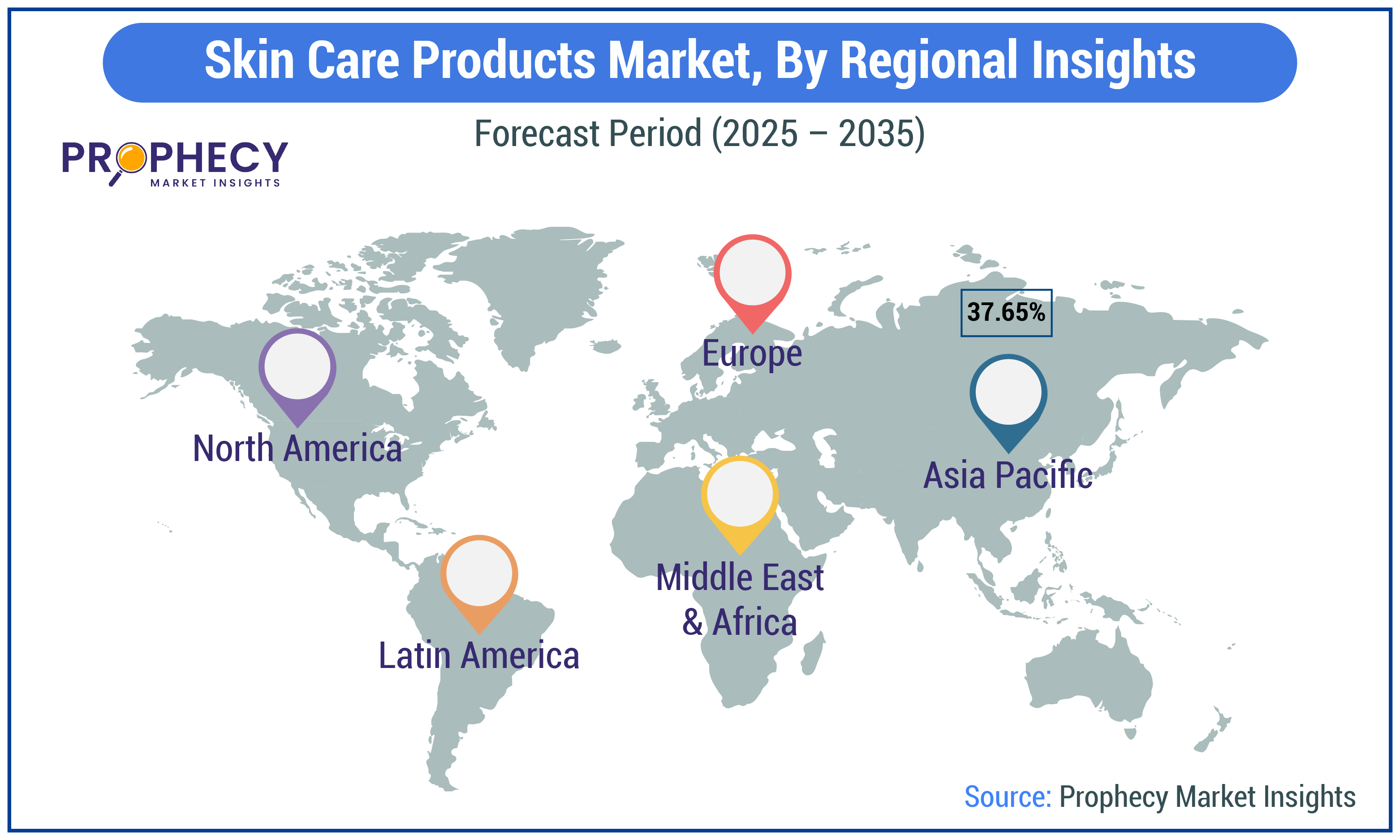
Geographically, the market is studied across North America, Europe, Asia Pacific, Latin America, and the Middle East & Africa.
Asia Pacific: This region held the largest skin care products market share of approximately 37.65%. Countries such as China, Japan, South Korea, and India are central to this growth, driven by factors such as rising disposable incomes, a strong emphasis on skincare routines, and the influence of K-beauty and J-beauty trends. The region's expanding middle class and increasing consumer awareness about skin health boost the demand for both luxury and budget-friendly skincare products, is predicted to fuel region growth in skin care products market share.
- China Skin Care Products Market Insights:
The skin care products market in China has experienced significant growth in recent years and is expected to continuous growth. This dominance is driven by a massive consumer base, rapid urbanization, and increasing disposable incomes. The popularity of K-beauty and J-beauty trends has fueled China's demand for innovative and high-quality skin care products, is predictable to impel skin care products market size.
North America: This is the second-largest market in the global skin care products market. This region is characterized by a mature consumer base with high disposable incomes, leading to strong demand for premium skincare products. Consumers are prioritize anti-aging, sun protection, and skin hydration, with a growing preference for natural and organic formulations. The presence of well-established brands and advanced retail infrastructure supports the skin care products market growth.
- U.S. Skin Care Products Market Insights:
The U.S. is leading country in North America region for target market. This growth is attributed to high consumer spending, a strong preference for premium products, and the presence of major global brands. Presence of major firms, and rising disposable income, is expected to propel skin care products market size.
Europe: This region is expected to witness significant growth in the market during the forecast period. The skin care products market driven by a combination of traditional skincare practices and a growing interest in sustainable and organic products. Consumer preferences are shifting towards products with clean labels and ethical sourcing, influencing market dynamics in the region.
- Germany Skin Care Products Market Insights:
Germany is the dominant country in Europe for the target market, due to increasing awareness of skin health, and demand for innovative and personalized skin care solutions. The country's emphasis on quality and technological advancements in skin care products leads its position as the leader in Europe, is expected to impel skin care products market share.
Skin Care Products Market Report Scope:
|
Attribute |
Details |
|
Market Size 2025 |
USD 159.6 Billion |
|
Projected Market Size 2035 |
USD 257.3 Billion |
|
CAGR Growth Rate |
5.4% (2025-2035) |
|
Base year for estimation |
2024 |
|
Forecast period |
2025 – 2035 |
|
Market representation |
Revenue in USD Billion & CAGR from 2025 to 2035 |
|
Regional scope |
North America - U.S. and Canada Europe – Germany, U.K., France, Russia, Italy, Spain, Netherlands, and Rest of Europe Asia Pacific – China, India, Japan, Australia, Indonesia, Malaysia, South Korea, and Rest of Asia-Pacific Latin America - Brazil, Mexico, Argentina, and Rest of Latin America Middle East & Africa – GCC, Israel, South Africa, and Rest of Middle East & Africa |
|
Report coverage |
Revenue forecast, company share, competitive landscape, growth factors, and trends |
Segmentation:
By Product:
- Face Creams & Moisturizers,
- Body Creams & Moisturizers
- Cleansers & Face Wash
- Sunscreen
- Shaving Lotions & Creams
- Others
By Packaging:
- Bottles
- Tubes
- Jars
- Others
By Category:
- Premium Skin Care Products
- Mass Skin Care Products
By Consumer:
- Male
- Female
- Unisex
By Distribution Channel:
- Supermarkets & Hypermarkets
- Pharmacy & drugstore
- Convenience Stores
- Online
- Others
By Region:
- North America
- U.S.
- Canada
- Europe
- Germany
- U.K.
- France
- Russia
- Italy
- Spain
- Netherlands
- Rest of Europe
- Asia Pacific
- China
- India
- Japan
- Australia
- Indonesia
- Malaysia
- South Korea
- Rest of Asia Pacific
- Latin America
- Brazil
- Mexico
- Argentina
- Rest of Latin America
- Middle East & Africa
- GCC
- Israel
- South Africa
- Rest of Middle East & Africa
Global Skin Care Products Market Competitive Landscape & Key Players
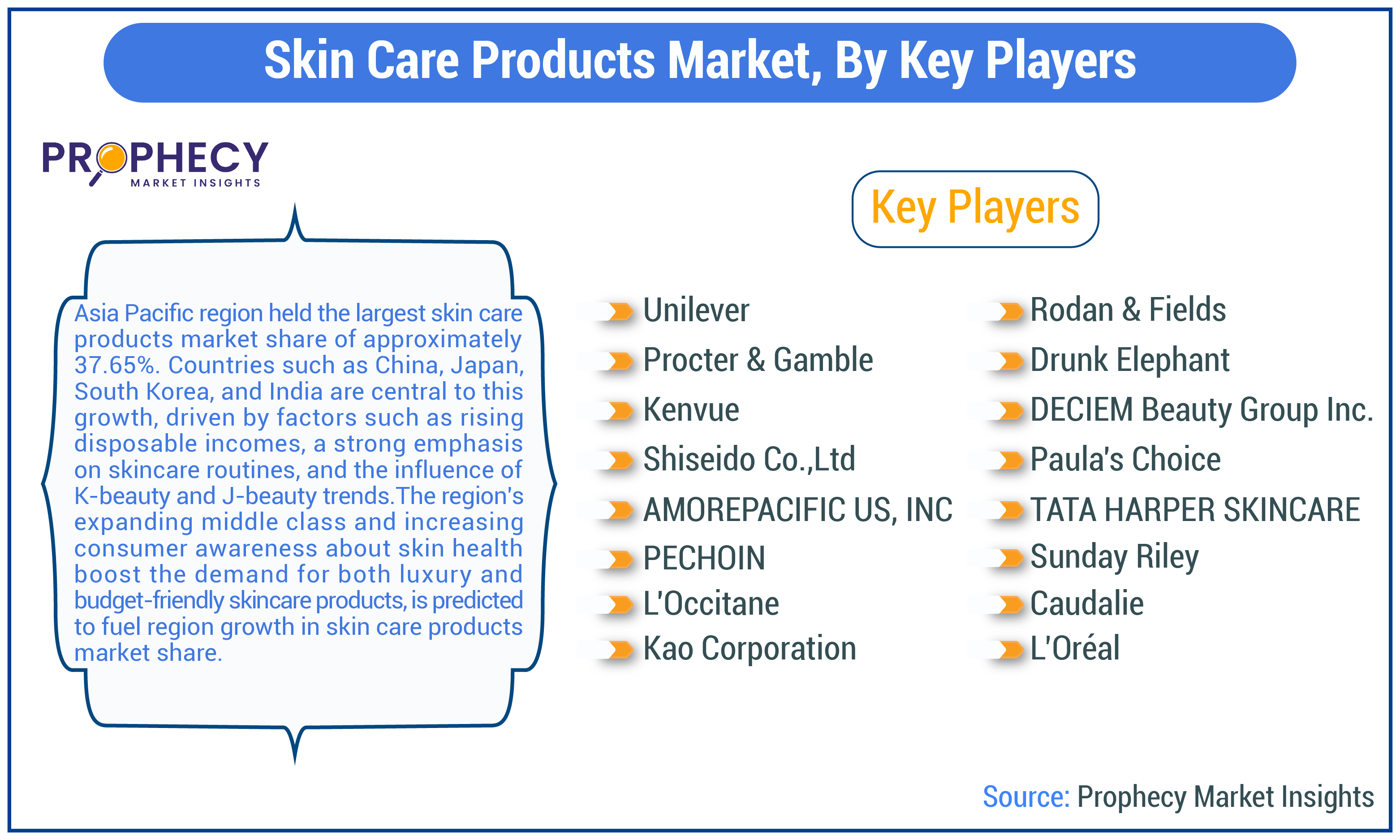
The major companies are functioning in the skin care products market are, Unilever, Procter & Gamble, Kenvue, and others. This companies are constantly focus on product innovation, brand reputation, pricing strategies, marketing reach, and distribution channels, through their acquisition. The are acquiring indie and clean beaty brands to expand their portfolios and tap into growing trends.
Skin Care Products Market Companies:
- Unilever
- Procter & Gamble
- Kenvue
- Shiseido Co.,Ltd
- AMOREPACIFIC US, INC
- PECHOIN
- L'Occitane
- Kao Corporation
- Rodan & Fields
- Drunk Elephant
- DECIEM Beauty Group Inc.
- Paula's Choice
- TATA HARPER SKINCARE
- Sunday Riley
- Caudalie
- L’Oréal
View an Additional List of Companies in the Skin Care Products Market
Global Skin Care Products Market Recent News
- In May 2025, KorinMi, a pioneering Korean skin clinic raised USD 360,00 in a pre-seed funding round to expand Korean skincare clinics in India. This fresh capital aimed to enhance technology, bolster marketing, expand clinic operations, and introduce new line of customized skincare products for Indian skin using advanced Korean skincare science.
- In September 2024, Beiersdorf launched its first Eucerin Hyaluron-Filler Epigenetic Serum and paves for skin rejuvenation under its Eucerin brand. The new product was patented for skin-specific age clock technology, an algorithm that aimed to measure the biological age of skin. These new algorithms used by scientists to identify active ingredient, known as Epicelline that turns back the age clock of skin cells and reverses signs of aging.
- In May 2024, Dove, the U.K. body was brand, launched its Dove Advacned Care Body Wash. With MicroMoisture Technology and the use of Dove’s Directly Esterified Fatty Isethionate (DEFI), was aimed to provide consumers with 24-hour soft skin lotion and deliver gentle cleanse.
- In April 2024, Beiersdorf and Rubedo Life Science announced a multi-year strategic partnership to develop a breakthrough anti-aging solution for the global face care market. This partnership aimed to integrate Beiersdorf’s leadership in skin care innovation with Rubedo’s complementary expertise in targeting cellular senescence. Through this partnership Rubedo’s advanced research in cellular senescence field and Beiersdorf’s market presence to develop advanced anti-aging products.
Analyst View:
The skin care products market is expected to continue expanding at a robust growth rate, driven by the aging population, rising disposable income and rapid growth in e-commerce distribution. The innovation to introduce cutting-edge ingredients, clean formulation, personalized solutions, and shift towards premium, specialized products, can creates new opportunities for skin care products market growth.
More Related Reports
Skin Care Market
Skin Graft Blades Market
Bioengineered Skin Substitutes Market
Electronic Skin Market
Topical Skin Adhesives Market
Global Skin Care Products Market Company Profile
|
Company Name |
L'Oréal |
|
Headquarter |
Clichy, France |
|
CEO |
Nicolas Hieronimus |
|
Employee Count (2024) |
90,000 Employees |
Global Skin Care Products Market Highlights
FAQs
Skin care products market size was valued at USD 159.6 Billion in 2025 and is expected to reach USD 257.3 Billion by 2035 growing at a CAGR of 5.4%.
Product, packaging, category, consumer, distribution channel, and region are the segmentation for the target market.
North America, Asia Pacific, Europe, Latin America, and the Middle East & Africa. Asia Pacific is expected to dominate the market.
The key players operating in the skin care products market include Unilever, Procter & Gamble, Kenvue, Shiseido Co.,Ltd., AMOREPACIFIC US, INC., PECHOIN, L'Occitane, Kao Corporation, Rodan & Fields, Drunk Elephant, DECIEM Beauty Group Inc., Paula's Choice, TATA HARPER SKINCARE, Sunday Riley, Caudalie, and L’Oréal