Global Vitamins Market By Type Overview
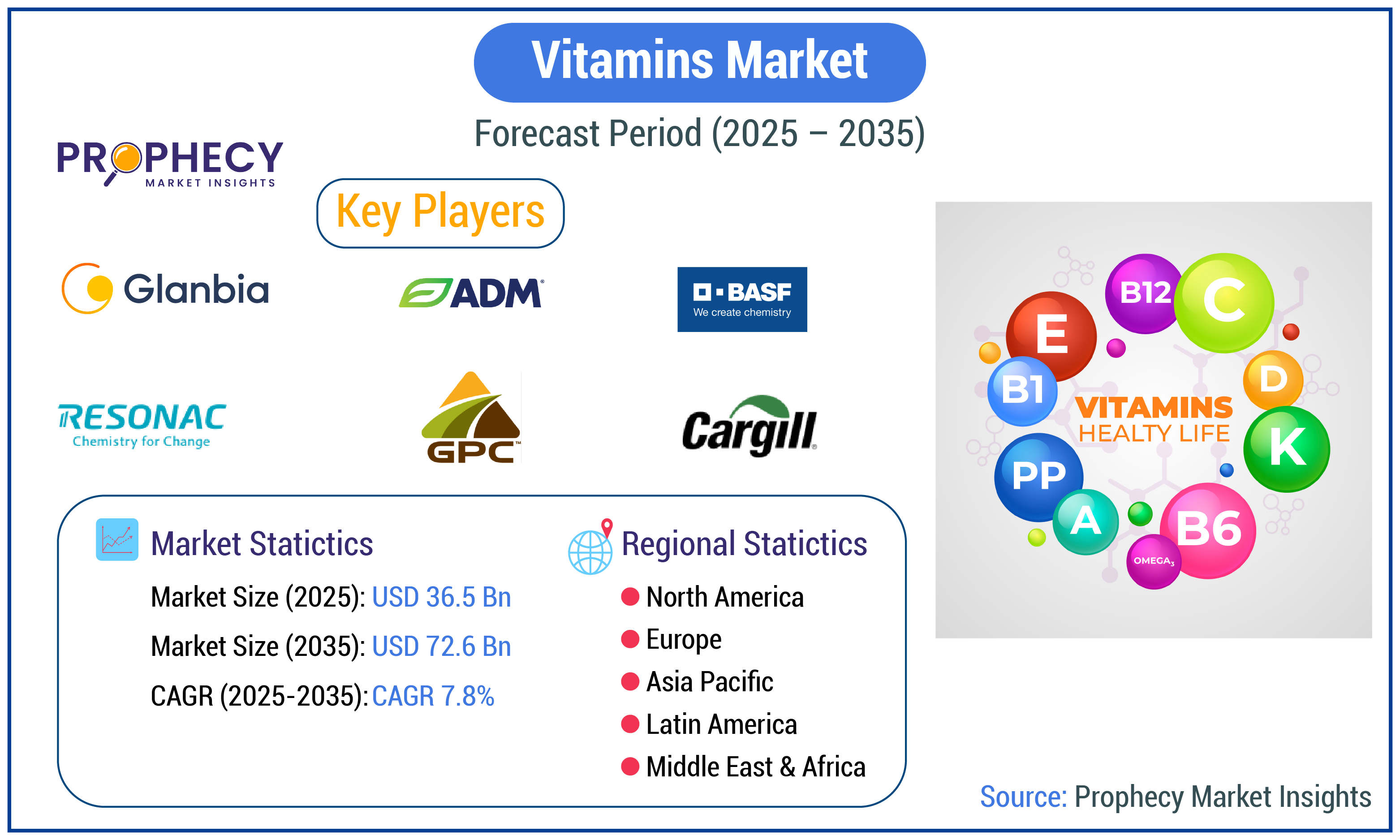
- By 2035, vitamins market size is contemplated to enlarge at a valuation of USD 72.6 Billion.
- In 2024, the vitamins market valuation was USD 34.4 Billion.
- Vitamins market is developing at a CAGR of 7.8%.
Vitamins are chemical molecules that the body requires in very little amounts to function properly. These cannot be produced internally. As a result, it must be obtained from food consumption. Vitamins function as hormones, enzymes, and coenzymes in the human body. Vitamin deficiencies have resulted from a shift in consumer eating and living choices. These developments drive up the need for vitamin supplements, fortified foods, and beverages, hence fuelling the vitamins Market growth.
Vitamins are vital components for the human body's health and fitness. Vitamins are crucial for digestion, health, immunity, mental wellness, and general bodily performance. The reduced quality of agricultural produce and food products has a detrimental influence on human health and is unable to meet the body's nutritional requirements. It is tough to obtain the necessary quantity of vitamins and nutrients by regular meal consumption. Thus, vitamin supplements are used to meet daily nutrient intake targets. The global need for vitamin supplements is expanding.
Prevention of a disease has gained much importance in modern times, which results in increased vitamin purchases for use in daily health regimens. This move towards preventive health has increased the demand for dietary supplements among aging populations who feel that their vitality and working capacity are diminished due to aging. Meanwhile, a strong trend is shaping up toward the natural and the organic, as consumers have begun to expect their vitamins to be from natural sources and reject synthetics from the implications of product development to their marketing.
Recession Risk & Tariff Analysis:
- When economies are recovering from downturns, consumption of non-essential health products shows reduction including specialized vitamin supplements. This can lead to slower market growth and reduced profits.
- Production costs on vitamins cab increase due to tariffs on raw materials. Trade barriers from key suppliers such as China may disrupt supply chains and lead to high consumer prices. Tariffs on point-blank raw Vitamins materials or finished materials can lead to increased production costs and disruption in global supply chains. Countries that import raw materials or production rely on international flows.
Impact of Generative AI on Vitamins Market:
- Generative AI can customize vitamin recommendations by generating products taking into consideration the health information of each individual, lifestyle habits, and nutritional deficiencies. This significantly boosts demand for tailor-made products and solutions that build consumer confidence for adoption. The brands are using AI-enabled platforms in increasing vitamin personalization and creating more individualized experiences that bring about a shift in how consumers interact with the brand according to this study.
- Generative AI helps create the marketing strategy, information and advertising content, and label design to support the prescription. It thus shortens product-to-market deployment, and align relevant product with wider consumer preference across consumption journeys, aiding competitive advantage in the fast-changing world of vitamins.
Global Vitamins Market By Type Drivers & Restraints
Key Drivers:
Increasing market demand for nutritionally fortified processed food products drive market growth.
The highest demand for vitamins is observed in food and beverage fortification. Due to their convenience, consumers are inclined to choose packaged and processed foods. Foods are severely processed to extend their shelf life, taste, texture, and appearance, resulting in the loss of nutritious value. Vitamins are required to fortify this food in order to replenish the nutrients lost from it. Additionally, supplements are available for preventative care and to meet the human body's daily Recommended Dietary Allowance (RDA) based on age. As a result, to meet regulatory requirements and make label claims, food firms are increasingly requiring vitamins for their goods.
- For instance, according to the Council for Responsible Nutrition, which tracks the sales of dietary supplements, the specific supplements that were most consumed in 2021 were vitamin or mineral supplements (98%), specialty supplements (46%; including omega-3 fatty acids, probiotics, etc.).
Restraints:
Limited supply of raw materials for natural vitamins, along with high pricing.
Natural vitamins come from naturally occurring fruits and vegetables in nature. Different foods contain various vitamins, and extracting these naturally existing vitamins requires a lengthy process. In addition, these raw ingredients are generated, delivered, or exported to other production sites where vitamins are manufactured. The increase in supply chain constraints is related to raw material deterioration and high transportation costs required to keep raw materials fresh. The manufacturing process ultimately adds to the existing cost. All of these variables contribute to the cost of raw material procurement and cost restraints in the vitamin market.
- Counterbalance Statements: Although there are limited supplies of raw materials and high prices for natural vitamins, new investments in biotechnology and fermentation technologies are helping to stabilize the supply or the supply chain options. Continued developments in synthetic biology are finding ways to enable cost-effective and scalable alternatives to naturally-sourced vitamins, further supporting reductions in reliance on constrained sources. Furthermore, organic and/or natural product consumers are typically willing to pay a premium price for clean-label goods, creating additional opportunities for sustained growth within the market in spite of input issues.
Opportunities & Trends:
Growth of Personalized Nutrition and customized vitamin supplements:
Personalized nutrition is a major driver of demand in custom vitamin supplements. Consumers increasingly want supplements that match their genetics, lifestyles, and health needs. Personalized vitamins address individual allergies and intolerances and provide safe, effective supplementation. Digital health tools and AI-based assessments also promote this trend by providing specific recommendations for supplementation. With public awareness around health and wellness growing, people are turning their backs on the generic and toward the personalized, as they feel more confident in the results while minimizing risks to success, which is further stimulating innovation from newer players in the vitamin market.
Global Vitamins Market By Type Segmentations & Regional Insights
By type, source, form, application, distribution channel and region are the divisions of the vitamins market.
By Type:
Based on Type, the market is segmented into vitamin E, vitamin B, vitamin C, vitamin D, vitamin A, and others. Vitamin B dominates the vitamins market share. Vitamin B plays a key function in nerve repair and aids in the regeneration of complicated tissue. Vitamin B can be found in a variety of goods, including dairy products, medications, nutritional supplements, and cosmetics. During pregnancy, vitamin B is essential. Future demand for vitamins is expected to increase as a result of these significant and vital uses.
The second dominant segment is Vitamin C. They are also known as ascorbic acid that helps in enhancing skin elasticity and stimulated collagen production which minimizes wrinkles and fine line. Serums, creams, and lotions, containing vitamin C have grown popularity for achieving a more youthful and radiant complexion
By Source:
Based on source, the market is segmented into synthetic and natural. The naturally sourced vitamins are estimated to grow at the highest CAGR during the forecast period. Whole foods provide naturally occurring vitamins. Naturally derived vitamins are properly absorbed by the body and execute their functions. This is due to the fact that vitamins are derived from natural sources combined with enzymes and coenzymes, which increases their efficiency.
Synthetically sourced vitamins come second. Synthetic vitamins are created chemically in laboratories to replicate the chemical structures of naturally occurring vitamins. These synthetic vitamins are commonly used in supplements and fortified meals to improve nutritional value or correct deficiencies. Synthetic nutrients do not include “whole food supplements,” which are made from concentrated, dehydrated whole foods.
By Form:
Based on Form, market is segmented into tablets, capsules, powders, and liquids. Due to their long shelf life, consumer convenience and accurate dosage, Tablets dominates the vitamin market share. They are easy to package, cost efficient and widely available in the market. Companies such as Pharmaceutical and nutraceutical prefer tablets for multivitamin formulations.
Capsules are the second most preferred form and are values for faster absorption and ease of swallowing. They are ideal for vitamins D and E, which are oil-based and fat-soluble, especially in dietary supplement segment for their reduced after taste and quicker bioavailability. This contributes to the significant market share.
By Application:
Healthcare products, food and beverages, feed, personal care products are application of the vitamins market. In the healthcare sector, the vitamin market is expanding due to the rising number of vitamin deficient cases and the growing demand for fortification. Healthcare items such as multivitamin supplements, dietary supplements, infant meals, and special needs supplements are supplemented with various multivitamins depending on the product to meet dietary requirements.
The food and beverages industry ranks second due to increasing demand of fortified products. Requirement of vitamin-enriched meals and beverages for extra health advantages is increasing. Manufactures are incorporating vitamins into a variety of products, including breakfast cereals and energy drinks, driving the growth of this market.
By Distribution Channel:
Based on distribution channel, market is segmented into online retail, pharmacies, supermarkets, health stores. Pharmacies dominate the vitamins market share in distribution channel due to widespread accessibility and trusting consumer connections. In-person purchases and professional assistance provides better services to consumers. Consumers often prefer immediate availability and brand variety.
Online retail is the second dominating segment driven by convenience, access to broad range of products, doorstep services, and easy price comparisons. Regular subscription models, and growing digital literacy is driving the growth of the industry. Young consumers seeking health products online contributes to the major growth factor of the market.
Regional Insights:
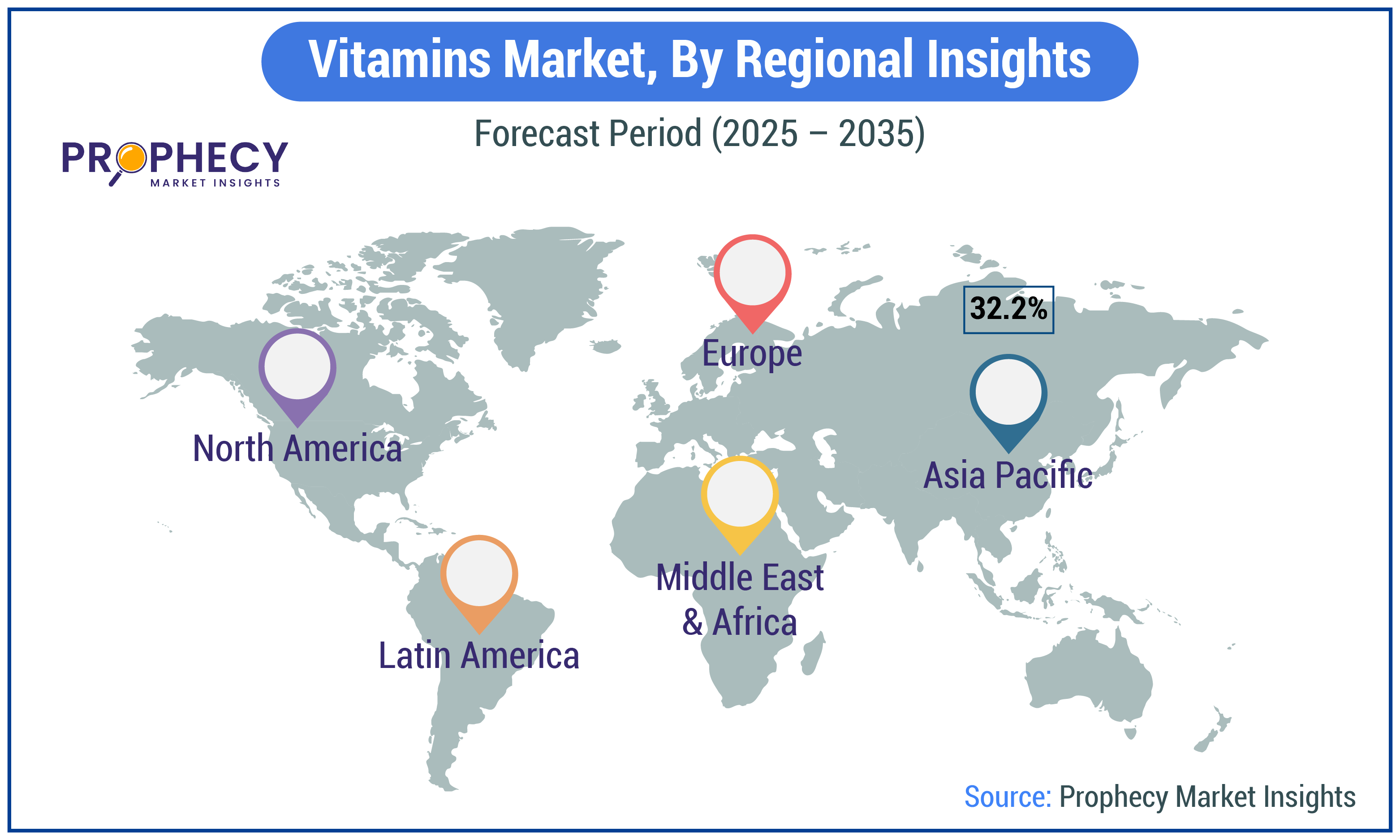
Geographically, the vitamins market is studied across North America, Europe, Asia Pacific, Latin America, and the Middle East & Africa.
Asia Pacific: This region dominates the vitamins market. Rising health awareness, aging populations drive the growth of vitamins market. Increased demand of dietary supplements and personal care products boosts the regional demand. Many government initiatives promote nutrition and preventive healthcare further supports growth across countries such as, Japan, and India.
- China Vitamins Market Insights:
China is a major player in the global vitamins market, being a leading consumer, and exporter of vitamins. It is also a large user of vitamins supplements as a result of the population needing to fulfill their needs. Rising health consciousness, urbanization, and demand for immunity-boosting supplements fuel consumption.
North America: This region is home to a number of Vitamins manufacturers. North Americans are getting more fat and suffering lifestyle-related illnesses as a result of an increase in bad eating habits, a growth in disposable income, and access to a variety of processed and ready-to-eat foods. As a result, regularly ingesting fortified, enhanced, enriched, and improved foods, as well as healthy supplements as part of a diverse diet, may boost health.
- U.S. Vitamins Market Insights:
The presence of Vitamins manufacturers in the U.S. helps impact the market by limiting reliance on imports from other countries. Aging demographics, and awareness of lifestyle-related diseases support consistent demand. E-commerce, and personalized nutrition trends are further propelling market growth across diverse consumer segments.
Europe: In recent years, the vitamins market in Europe has grown dramatically, making a contribution to global income. Growing interest in preventive healthcare, and dietary supplements drives growth. Rising health consciousness among aging population increases demand. Delivery formats innovations and consumer ease enhances market penetration.
- Germany Vitamins Market Insights:
The growth of Vitamins in France is due to the strong healthcare infrastructure and demand for quality supplements. Aging population and preference for personalized and preventive care drive consistent growth. Emphasis on natural and substantial ingredients attract manufactures. A well establish pharmaceutical sector and government’s regulatory standards leads vitamins market.
Vitamins Market Report Scope:
|
Attribute |
Details |
|
Market Size 2025 |
USD 36.5 Billion |
|
Projected Market Size 2035 |
USD 72.6 Billion |
|
CAGR Growth Rate |
7.8% (2025-2035) |
|
Base year for estimation |
2024 |
|
Forecast period |
2025 – 2035 |
|
Market representation |
Revenue in USD Billion & CAGR from 2025 to 2035 |
|
Regional scope |
North America - U.S. and Canada Europe – Germany, U.K., France, Russia, Italy, Spain, Netherlands, and Rest of Europe Asia Pacific – China, India, Japan, Australia, Indonesia, Malaysia, South Korea, and Rest of Asia-Pacific Latin America - Brazil, Mexico, Argentina, and Rest of Latin America Middle East & Africa – GCC, Israel, South Africa, and Rest of Middle East & Africa |
|
Report coverage |
Revenue forecast, company share, competitive landscape, growth factors, and trends |
Segmentation:
By Type:
- Vitamin E
- Vitamin B
- Vitamin C
- Vitamin D
- Vitamin A
- Others
By Source:
- Synthetic
- Natural
By Form:
- Tablets
- Capsules
- Powders
- Liquids
By Application:
- Healthcare Products
- Food and Beverages
- Feed
- Personal Care Products
By Distribution Channel:
- Online Retail
- Pharmacies
- Supermarkets
- Health Stores
By Region:
- North America
- U.S.
- Canada
- Europe
- Germany
- U.K.
- France
- Russia
- Italy
- Spain
- Netherlands
- Rest of Europe
- Asia Pacific
- China
- India
- Japan
- Australia
- Indonesia
- Malaysia
- South Korea
- Rest of Asia Pacific
- Latin America
- Brazil
- Mexico
- Argentina
- Rest of Latin America
- Middle East & Africa
- GCC
- Israel
- South Africa
- Rest of Middle East & Africa
Global Vitamins Market By Type Competitive Landscape & Key Players
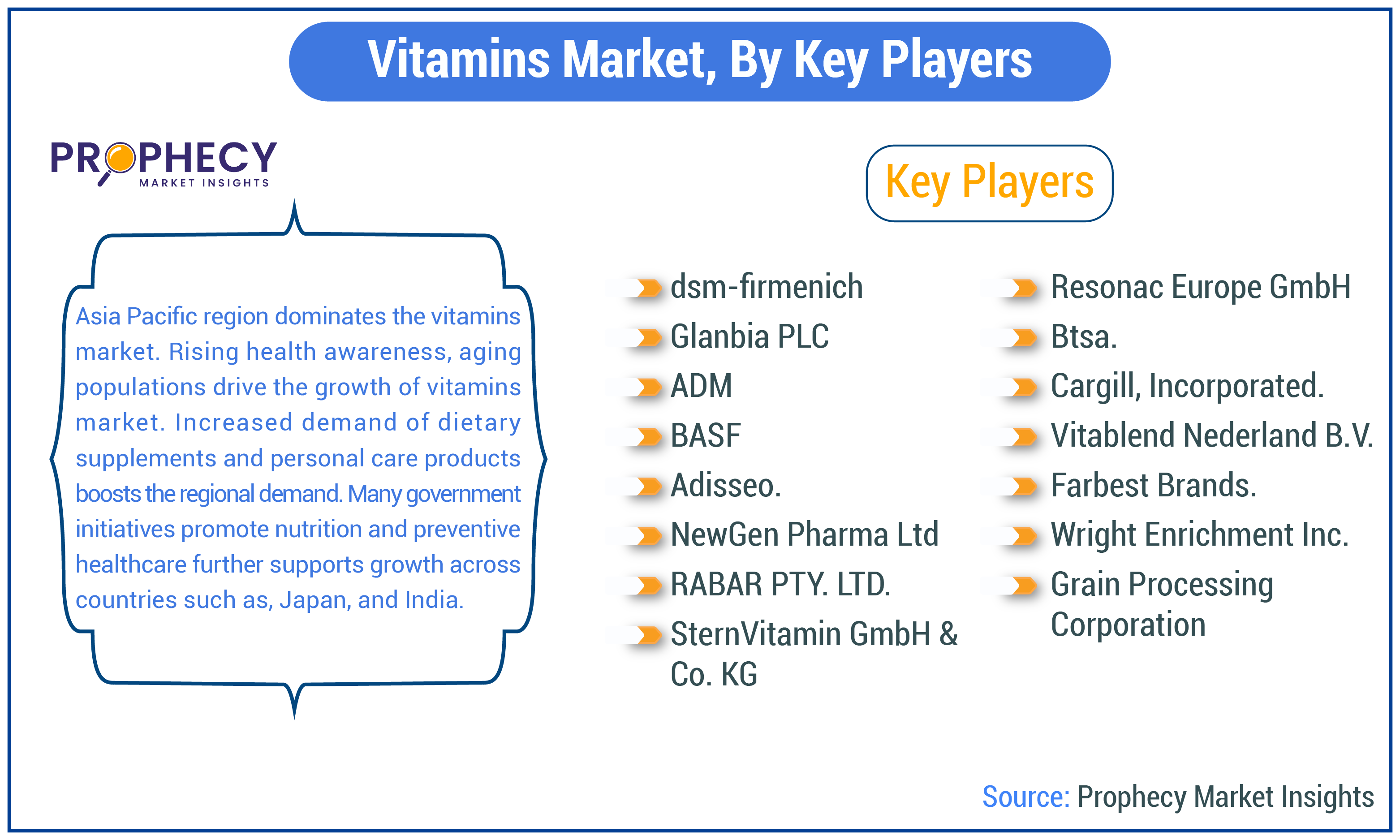
The prominent players operating in the market include, Glanbia PLC, ADM, BASF, Adisseo., SternVitamin GmbH & Co. KG, NewGen Pharma Ltd, and others. In order to boost their profitability and strengthen their position in the market, the major development tactics used by the participants in the vitamin industry include acquisition, company growth, partnership, collaboration, and product introduction.
Vitamins Market Companies:
- dsm-firmenich
- Glanbia PLC
- ADM
- BASF
- Adisseo.
- SternVitamin GmbH & Co. KG
- NewGen Pharma Ltd
- RABAR PTY. LTD.
- Resonac Europe GmbH
- Btsa.
- Cargill, Incorporated.
- Grain Processing Corporation
- Vitablend Nederland B.V.
- Farbest Brands.
- Wright Enrichment Inc.
View an Additional List of Companies in the Vitamins Market
Global Vitamins Market By Type Recent News
- In January 2025, Mela Vitamins teamed up with WNBA champions Azurá Stevens (LA Sparks) and Dana Evans (Chicago Sky) to promote wellness amongst women of colour. The collaboration is aimed at empowering ethnic communities to take control of their health and work towards the existing health disparities.
- In January 2025, A GP from Fairy Meadow, NSW, Australia, raised red flags after seeing multiple patients exhibiting symptoms linked to excessive intake of vitamin B6 a common ingredient in over-the-counter supplements. They warned consumers to be wary of the contents in their vitamin supplement when he consulted on several cases of poisoning of a common ingredient.
Analyst View:
The vitamins market has considerable potential for expansion, nevertheless, its contribution to the global market will increase dramatically during the next six years. Innovation is critical to the success of the vitamin sector. With a growth in demand for vitamins from the nutraceutical and cosmetics industries, manufacturers are investing more in R&D to meet the growing demand from end users. Manufacturers are progressively using cutting-edge technologies to improve productivity and quality. The surge in customer desire for naturally sourced vitamins creates opportunities for businesses to develop natural vitamins and supplements products at reasonable rates and in eco-friendly packaging.
More Related Reports
Food Safety Testing Market
Vitamin D Market
United States Vitamin D Supplements Market
Vitamin B6 (Pyridoxine) Market
Food Fiber Market
Global Vitamins Market By Type Company Profile
|
Company Name |
ADM |
|
Headquarter |
Chicago, Illinois, United States |
|
CEO |
Juan Luciano |
|
Employee Count |
44,043 Employees |
Global Vitamins Market By Type Highlights
FAQs
Vitamins market size was valued at USD 36.5 Billion in 2025 and is expected to reach USD 72.6 Billion by 2035 growing at a CAGR of 7.8%.
Type, source, form, application, distribution channel and region are the segmentation for the target market.
North America, Asia Pacific, Europe, Latin America, and the Middle East & Africa. Asia Pacific is expected to dominate the market.
The prominent players operating in the market include, dsm-firmenich, Glanbia PLC, ADM, BASF, Adisseo., SternVitamin GmbH & Co. KG, NewGen Pharma Ltd, RABAR PTY. LTD., Resonac Europe GmbH, Btsa., Cargill, Incorporated., Grain Processing Corporation, Vitablend Nederland B.V., Farbest Brands., and Wright Enrichment Inc.