Global Stuttering Device Market By Overview
- 2024 Market Size: USD 311.7 Billion
- 2035 Projected Market Size: USD 563.5 Billion
- CAGR (2025-2035):5.3%
- North America: Largest Market in 2024
A stuttering device, also called a fluency-enhancing device, is a specialized device that aids the individual with stammering or a speech dissiliency. Such devices act by altering the auditory feedback, speech rhythm, or timing in a manner that facilitates speaking more fluently and with confidence. They are also utilized in children and adults and are a non-invasive tech-driven product to help control/manage stuttering, improve communications, and improve overall quality of life.
Growing awareness of speech disorders, the adoption of digital health tools, and advancements in assistive communication technologies are driving promising growth in the stuttering devices market. According to the National Institutes of Health (NIH), approximately 80 million people worldwide stutter.
The increasing popularity among professionals in healthcare, as well as access to AI and wearable devices will enhance the need to create more efficient and individualistic solutions to problems of stuttering. Further, the development of healthcare infrastructure in the emerging markets and increased attention to speech therapy programs are possible to continue market growth further in the future.
Market Insights: Prevalence, Therapy Uptake, and Demographic Trends in Stuttering:
- Male-to-female ratio of approximately 3:1. This demographic trend could influence targeted marketing and product development strategies.
- In 2017, approximately 27,977 individuals across all age groups were diagnosed with stuttering, with a crude prevalence of 0.3% in the general population. This indicates a consistent demand for therapeutic interventions.
- Treatment data revealed that up to 45% of 6-year-old patients diagnosed with stuttering received therapy, with an average of slightly fewer than 20 sessions per year
- In those who had recovered from stuttering only 13.4% received stuttering treatment.
Current Industry Dynamics & Insights:
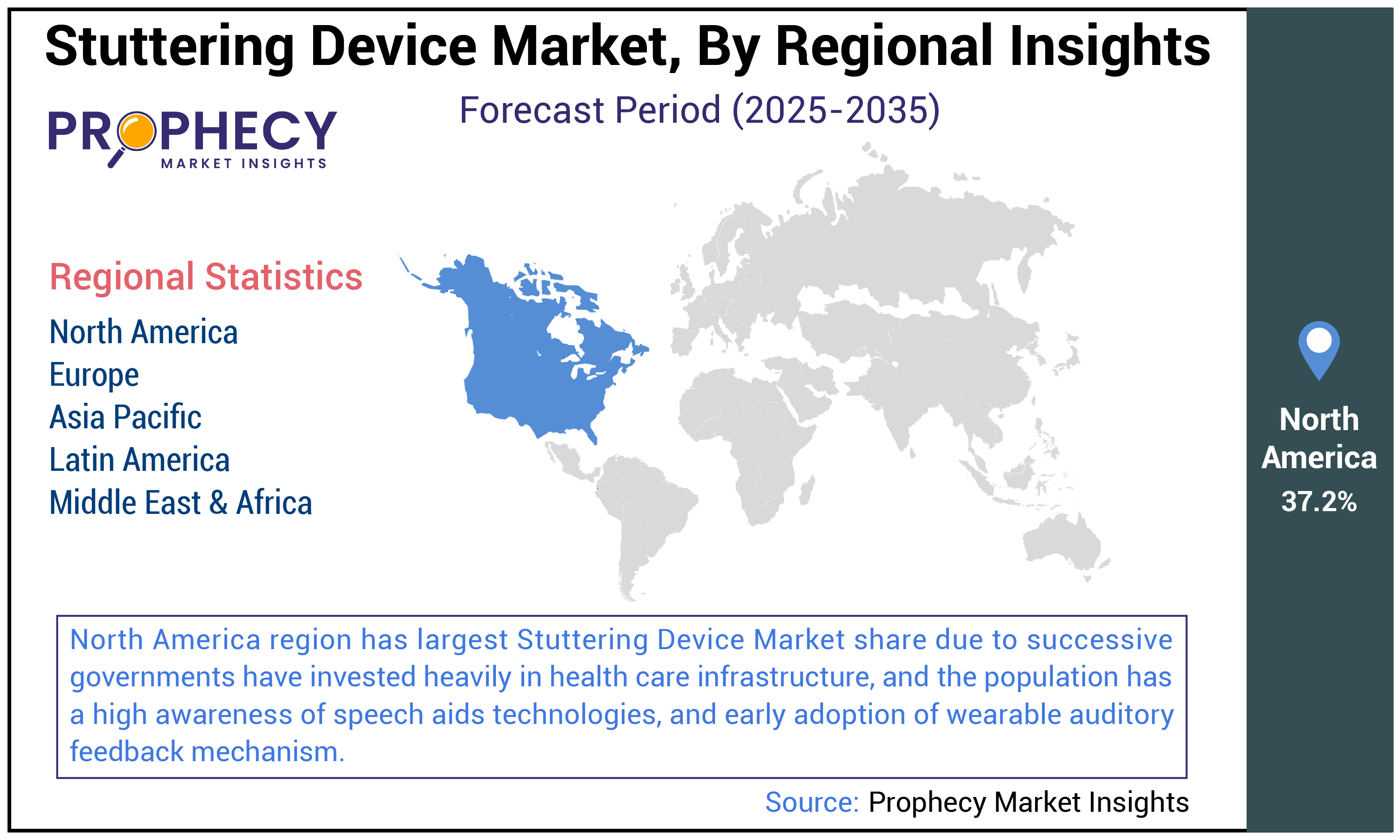
- North America holds the largest stuttering device market share, accounting for almost 37.2%.
- Europe ranks as the second-largest and fastest-growing region, accounting for 24.8%.
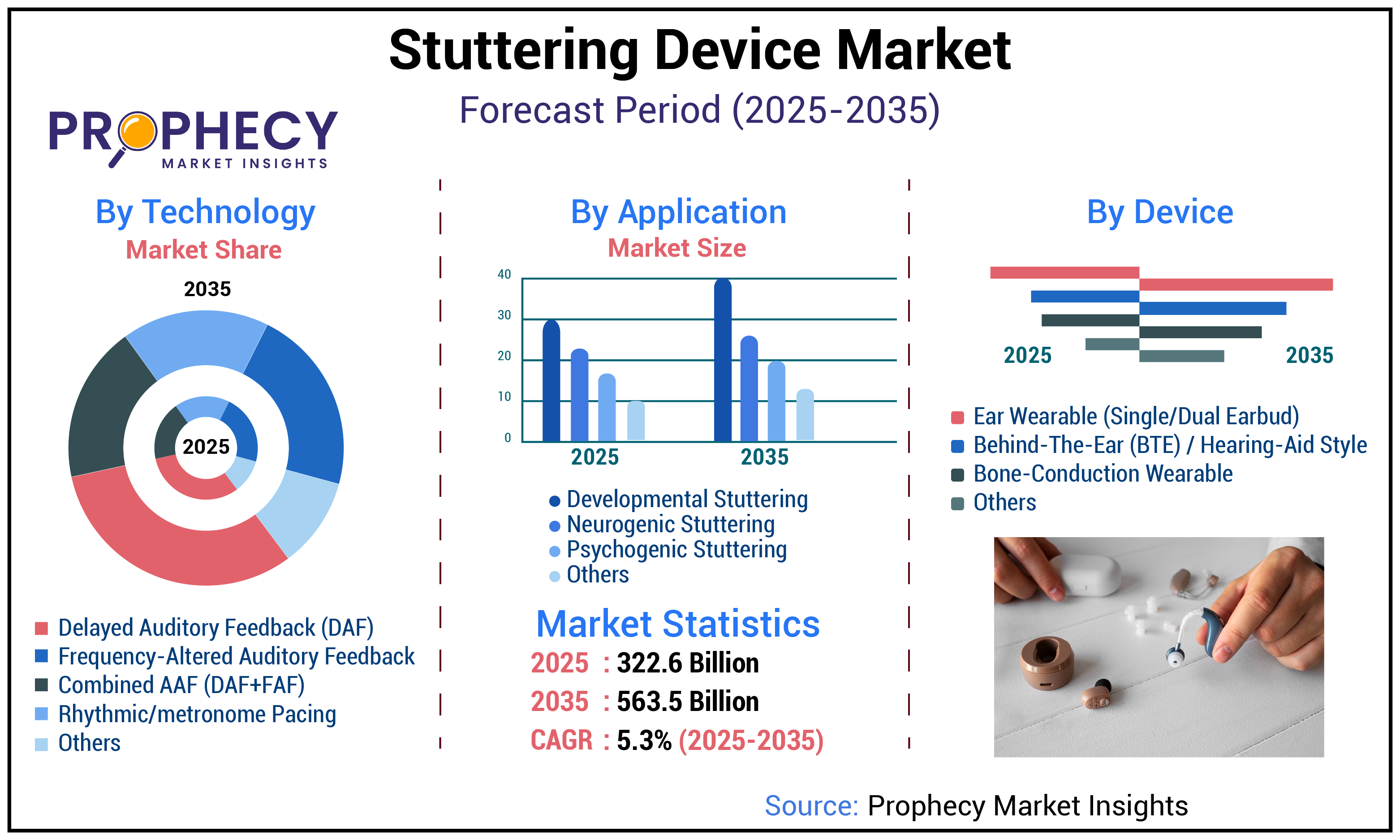
- By device type, ear wearables (single or dual earbuds) capture the largest share of the stuttering device market.
- In terms of technology, delayed auditory feedback (DAF) is the most commonly used method in the stuttering device market.
Global Stuttering Device Market By Drivers & Restraints
Drivers and Restraints:
|
Drivers |
Restraints |
Opportunities & Trends |
|
|
|
Key Drivers:
Early Intervention Focus in Stuttering Therapy
The early diagnosis and treatment of speech disorders, specifically stuttering, are already influencing the stuttering device market. Currently, most pediatric speech therapy programs are being combined with fluency-enhancing devices with the aim of supporting children between the ages of 5 and 9 when the most children take up the therapy. Hospitals, clinics and even independent speech therapists are now often suggesting the use of these devices at initial stages of treatment to help provide better speech fluency, lessen the impact of stuttering and leave the young children feeling more confident. This defined trend towards the importance of applying early intervention makes innovative stuttering devices and digital speech therapy tools a major force of demand in the global market.
- For instance, a study published in Medical Research Archives in June 2025, researchers received encouraging results after determining that a novel parent-child program was effective in reducing stuttering in children aged 3-6 years with a large effect observed within a time frame of 9 months after baseline. This highlights the power of early intervention and affirms the opportunities in the market with the stuttering devices that target early childhood treatment.
Restraints:
Shortage of Trained Professionals
The use of stuttering devices is also largely influenced by the advice they get by speech-language pathologists (SLPs) and other trained therapists. In most areas, especially in developing markets, qualified professionals are limited making the usage of the device and the overall success of the therapy program impaired. Without adequate training and monitoring, patients can use the devices ineffectively, resulting in poor results and poor adoption of the device in the market. The unavailability of trained staff is one of the factors that limit market development of pediatric and remote therapy solutions.
- For instances, according to the World Health Organization (WHO), the number of speech therapists in many low- and middle-income countries is less than 1 per 100,000 population, which limits access to professional advice regarding the treatment of speech disorders and the use of assistive technologies.
- Counterbalance Statements: However, an increasing convergence of teletherapy platform, mobile-based training modules, and artificially intelligent guidance systems are helping to overcome this divide. Patients are now able to have remote monitoring, live guidance, instead of the need to have an individual professional in-person to help them, and they can spread stuttering equipment even in areas where there are few trained personnel.
Opportunities & Trends:
AI and Machine Learning Integration
Integration of artificial intelligence (AI) and machine learning (ML) into stuttering devices is bringing new opportunities of highly customizable and dynamic speech therapy devices. These applications facilitate real-time speech pattern examination, forecasting of stuttering events, and personalized feedback of specific users, enhancing the therapeutic experiences and success. Physicians and patients are able to measure improvement over time, balance therapy intensity and optimize setting in a machine automatically, developing a smart and more effective system of interventions.
- For instance, In a 2024 article that published in Frontiers in Human Neuroscience, it was demonstrated that AI-based stuttering devices were able to detect when a stuttering incident was about to occur with a greater than 85% success rate, which allows the provision of in-time feedback and subsequent enhancement of fluency results in pediatric and adult stuttering patients
Global Stuttering Device Market By Segmentations & Regional Insights
Device type, technology, connectivity, age group, application, end user, and region are the divisions of the stuttering device market.
By Device Type:
Ear wearable (single/dual earbud), behind-the-ear (BTE) / hearing-aid style, bone-conduction wearable, and othersare device type on which stuttering device market is segmented. Single / dual earbud ear wearable is the most common in stuttering device market size due to it is transportable, discreet, and easily integrated with smartphone-based therapy apps. The devices are mostly preferred by pediatric and adult users in their daily use and on-the-go.
The second dominant style is behind-the-ear (BTE) / hearing-aid styled as they possess superior processing, longer battery life and they are preferred in clinical applications or by users who infrequently turn off their auditory feedback.
- For instance, a study published in Frontiers in Human Neuroscience in 2025, where researchers tested ear-worn delayed auditory feedback devices in stuttering adults. The study determined that delayed auditory feedback listening through only one ear bud reduced disfluencies by approximately 25-30% and speech stability was significantly improved when compared to normal listening. On the other hand, speech variability increased in non-stuttering participants, emphasizing the specific advantage of the device for the correction of stuttering. These findings place ear bud-style wearable as viable solutions that are portable and practical to improve fluency in everyday communication.
By Technology:
Based on the technology, the stuttering device market is divided into delayed auditory feedback (DAF), frequency-altered auditory feedback (FAF), combined AAF (DAF+FAF), rhythmic/metronome pacing, and others. The most popular technology is the delayed auditory feedback (DAF), it is used everywhere and has proven to be effective in reducing the severity of stuttering due to it provides speech feedback in real time. The clinicians regularly advise it and incorporate it into the majority of stuttering devices.
Frequency-Altered Auditory Feedback (FAF) is next in line due to of its complementing nature in treatment as it provides alternative patterns of feedback which helps users to gain fluency and this is where adults with simple stuttering problems come in.
- For instance, A 2022 randomized controlled trial, published in the Journal of Fluency Disorders found that coupling delayed auditory feedback (DAF) with trans cranial direct current stimulation (tDCS) reduced stuttered syllables from 8.45% to 5.36%, which is a reduction of ~36.5% in disfluencies when compared to delayed auditory feedback alone. This hybrid modality allows the fluency improving potential of the auditory feedback devices to be enhanced and provides an exciting pathway for future stuttering devices that combine neuromodulation with real-time auditory feedback.
By Connectivity:
Bluetooth (BLE) to smartphone, wired (3.5 mm/USB), standalone (no phone required), and others are connectivity of the stuttering device market. Bluetooth to smartphone remains the most prominent in stuttering device market share due to of the thriving trend of mobile-based therapy app which enables tracking, adaptive feedback, and teletherapy functionality, making it convenient and appealing to the users.
The second category is the standalone (no phone required) device, which can be considered by those users who want simple, plug-and-use, and do not want to rely on smartphones, especially in situations with children or at home.
By Age Group:
On the age group, stuttering device market is categorized into pediatric patients, adult patients, and geriatric patients. The main users are Pediatric Patients (0-17) in stuttering device market growth due to they represent the highest volume of therapy adoption at ages just before or near school entry (5-9 years old) so early intervention is the most significant growth point in the market.
Second most dominant category is adult patients (18-64) which is driven by an increasing level of awareness, work-related meeting and communication requirements, and the fact that mobile-integrated stuttering devices will be used by patients personally and in the workplace.
By Application:
Developmental stuttering, neurogenic stuttering, psychogenic stuttering, and others are application of the stuttering device market. Developmental stuttering is the most used application as most of the device use is in it as it majorly occurs among the children and treatment is most practiced during their adolescent stage.
Neurogenic stuttering comes second, due to it arises after a neurological trauma or even incidents and it cannot be treated with the general therapy equipment, especially in hospital and rehabilitation centers.
By End User:
The stuttering device market on the account of end user are categorized into hospitals & clinics, speech therapy centers, homecare users, rehabilitation centers, educational institutions, and others. In stuttering device market growth primary end users are Hospitals and clinics, where stuttering devices can be prescribed by clinicians and the latter can train the patient on the usage of the stuttering devices to get optimal results.
The second most dominant group is homecare users who are driven by the increase in teletherapy and portable/Smart phone connected devices, enabling patients to continue treatment even beyond clinical settings.
Regional Insights:
Geographically, the stuttering device market is studied across North America, Europe, Asia Pacific, Latin America, and the Middle East & Africa.
North America: This region has largest stuttering device market share due to successive governments have invested heavily in health care infrastructure, and the population has a high awareness of speech aids technologies, and early adoption of wearable auditory feedback mechanism. Good insurance cover and the presence of dominant device makers are other factors boosting market growth in this region.
Although there is a strong demand, the cost and reimbursement of devices are still an issue as they are too costly and reimbursement rates do not cover non-clinical aspects of usage. The economic downturns have had a minor effect on the consumer purchase of elective speech therapy products, but clinical usage has remained stable.
- U.S. Stuttering Device Market Insights:
U.S. has the largest market share in North America due to extensive clinical testing, positive FDA reports and robust use of smartphone-connected stutter devices. For instance, in a 2023 survey by the American Speech-Language-Hearing Association (ASHA) that studied the experiences of over 3,800 speech-language pathology professionals, more than 65% of pediatric patients in early interventions programs utilized auditory feedback equipment as a component of their intervention programs.
Europe: This region has the second-largest market of stuttering devices due to the well-developed public healthcare systems and government support of the development of speech therapy and increasing research projects in Germany, the U.K., and France.
Slower regulatory approval and cost-containment policies in some of the EU countries restrict the speedy growth in the market. Economic uncertainties and inflationary pressure also contributed to slow adoption in non-critical therapy applications.
- Germany Stuttering Device Market Insights:
Germany is leading in the European stuttering device market as there has been a strong investment in speech and language therapy in the country, well-established rehabilitation centers, and extensive awareness among service providers and patients. Its strong interventional healthcare tradition and early intervention are some reasons why advanced stuttering devices have afforded high adaptability in both the pediatric and adult patients.
Asia Pacific: This is emerging as the fastest-growing region for stuttering devices, driven by a large pediatric population, improving healthcare access, and rising awareness of early speech therapy intervention in countries such as China, India, and Japan.
Although the expansion opportunities are promising, the emergence of challenges, including limited insurance coverage, differences in healthcare infrastructure in different countries, cultural stigma related to speech disorders is reducing the scale of adoption of stuttering devices. These factors contribute to disparities in access to treatment and device usage rate.
- China Stuttering Device Market Insights:
China is emerging as a major stuttering device market in the Asia Pacific. The demand of speech therapy solutions is fuelled by a large population in the country which supplemented with the increase in awareness and governmental efforts in the healthcare sector. Although the spread of certain types of stuttering devices is still evolving, the general increase in speech therapy services can only point to the success of the market.
Stuttering Device Market Report Scope:
|
Attribute |
Details |
|
Market Size 2025 |
USD 322.6 Billion |
|
Projected Market Size 2035 |
USD 563.5 Billion |
|
CAGR Growth Rate |
5.3% (2025-2035) |
|
Base year for estimation |
2024 |
|
Forecast period |
2025 – 2035 |
|
Market representation |
Revenue in USD Billion& CAGR from 2025 to 2035 |
|
Regional scope |
North America - U.S. and Canada Europe – Germany, U.K., France, Russia, Italy, Spain, Netherlands, and Rest of Europe Asia Pacific – China, India, Japan, Australia, Indonesia, Malaysia, South Korea, and Rest of Asia-Pacific Latin America - Brazil, Mexico, Argentina, and Rest of Latin America Middle East & Africa – GCC, Israel, South Africa, and Rest of Middle East & Africa |
|
Company Landscape |
Market Share Analysis of Companies Heat Map Analysis Company Overview, Device Types Overview Financial Information, Key Highlights Business Strategies Overview SWOT Analysis |
|
Report coverage |
Revenue forecast, company share, competitive landscape, growth factors, and trends |
|
Value Added Data Infosets |
Besides fundamental market insights such as the size of the market, growth rate, segmentation, regional study, and key players, our reports carry value-added data sets such as trade flow (import-export) analysis, production and consumption overview, price trend evaluation, supply and value chain mapping, and raw material availability. Moreover, we provide strategic tools as PESTLE and Porter’s Five Forces analysis, examination of the regulatory landscape, as well as monitoring of technology and innovation thereby providing a comprehensive overview which facilitates sensible and anticipatory decision-making. |
Segmentation:
By Device Type:
- Ear wearable (single/dual earbud)
- Behind-the-ear (BTE) / hearing-aid style
- Bone-conduction wearable
- Others
By Technology:
- Delayed Auditory Feedback (DAF)
- Frequency-Altered Auditory Feedback (FAF)
- Combined AAF (DAF+FAF)
- Rhythmic/metronome Pacing
- Others
By Connectivity:
- Bluetooth (BLE) to smartphone
- Wired (3.5 mm/USB)
- Standalone (no phone required)
- Others
By Age Group:
- Pediatric Patients (0–17)
- Adult Patients (18–64)
- Geriatric Patients (65+)
By Application:
- Developmental Stuttering
- Neurogenic Stuttering
- Psychogenic Stuttering
- Others
By End User:
- Hospitals & Clinics
- Speech Therapy Centers
- Homecare Users
- Rehabilitation Centers
- Educational Institutions
- Others
By Region:
- North America
- U.S.
- Canada
- Europe
- Germany
- U.K.
- France
- Russia
- Italy
- Spain
- Netherlands
- Rest of Europe
- Asia Pacific
- China
- India
- Japan
- Australia
- Indonesia
- Malaysia
- South Korea
- Rest of Asia Pacific
- Latin America
- Brazil
- Mexico
- Argentina
- Rest of Latin America
- Middle East & Africa
- GCC
- Israel
- South Africa
- Rest of Middle East & Africa
Global Stuttering Device Market By Competitive Landscape & Key Players
One of the ways companies can spur the growth of stuttering device market is through R&D into more advanced, AI-powered, and user-friendly stuttering devices both pediatric and adult specific. Increased integration of teletherapy and use of mobile apps will make them more accessible and engage patients. Increased awareness-creating efforts, training to speak therapists, working with hospitals and clinics, etc will boost adoption. Moreover, providing low-cost pricing structures, subscribing-based therapy plans, and localized solutions in the emerging economies can further increase the user base and enable rapid market expansion.
Stuttering Device Market Companies:
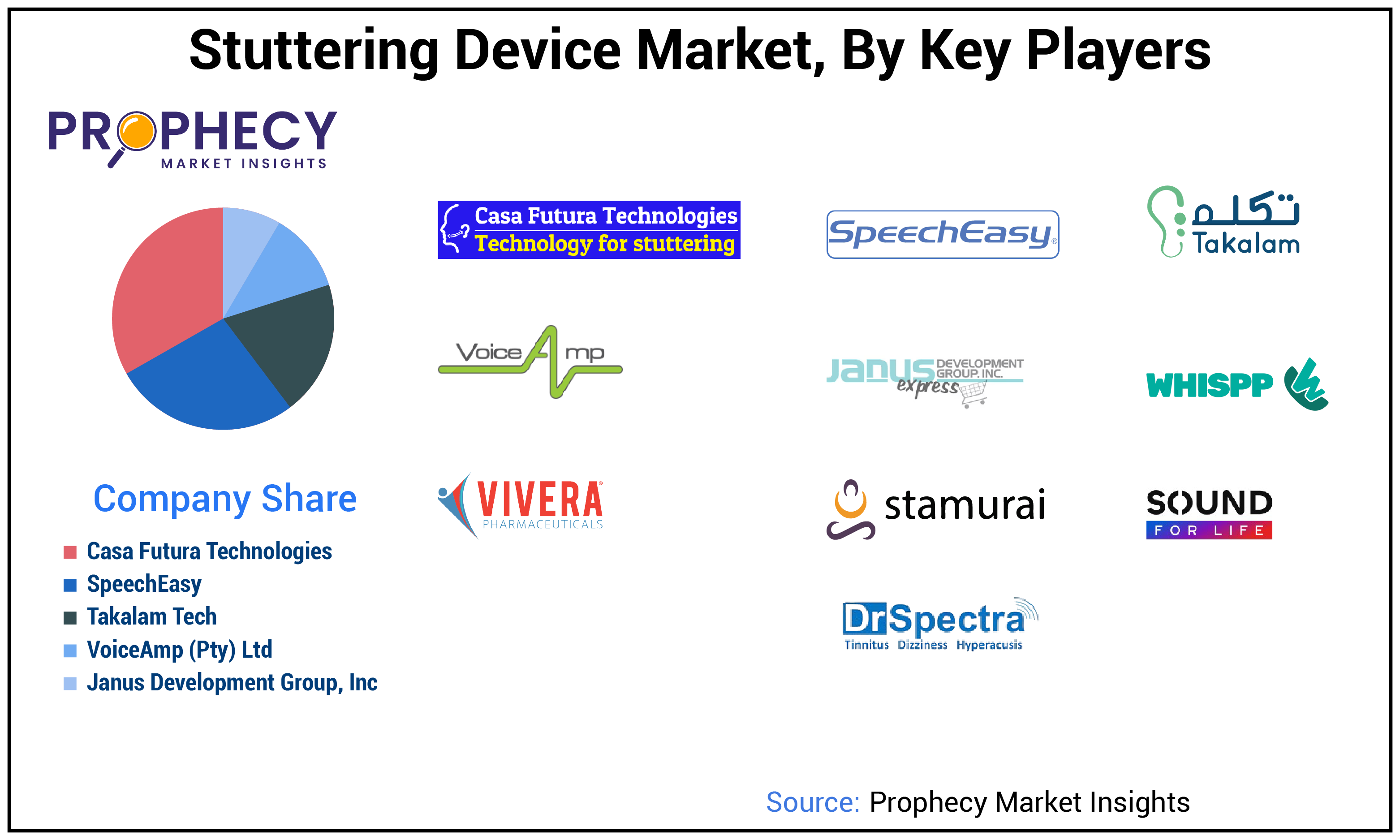
- Casa Futura Technologies
- SpeechEasy
- Takalam Tech
- VoiceAmp (Pty) Ltd
- Janus Development Group, Inc
- Whispp
- Vivera Pharmaceuticals, Inc.
- Stamurai
- Drspectra Wellness Private Limited
- SOUND FOR LIFE LTD
View an Additional List of Companies in the Stuttering Device Market
Global Stuttering Device Market By Recent News
- In March 2025, a study indicated that the digital speech therapy app Eloquent could make people who stutter better at speaking and reading. The app showed a more than 50 percent reduction in the severity of stuttering along with an increased confidence and a decrease in avoidance of speaking situations, which further points to the utility of technology-based therapy.
- In October 2024, Whispp was granted a TIME Best Inventions award in the AI-powered category, thanks to its assistive voice technology. The app transforms inarticulate speech during telephone and video conversations into intelligible voices that sound natural, thereby making communication easier among individuals with severe speech disorders than speech-to-text apps.
Analyst View:
Increasing awareness of speech disorders, the use of AI and mobile-integrated speaking tools, and a focus on early interventions in children are driving significant growth in the stuttering device market. Technological advancement and teletherapy options are improving access and outcomes of treatment in different regions. The market will benefit firmly with innovation, strategic alliances, and adoption in a new market within pediatric and adult segments despite challenges such as the lack of trained professionals and the inconsistent healthcare infrastructure.
Analysis of Sources:
Primary Sources:
- In-depth interviews
- Company-specific data
- Surveys and questionnaires
- Focus group discussions (FGDs)
- Others
Secondary Sources:
- Frontiers in Human Neuroscience
- National Institutes of Health (NIH)
- The Stuttering Foundation
- American Speech-Language-Hearing Association
- Others
More Related Reports
Cognitive Dysfunction Devices Market
Implantable Drug Device Market
Diabetes Monitoring Device Market
Bone Regeneration Market
Hair Removal Device Market
Global Stuttering Device Market By Company Profile
|
Company Name |
Product Portfolio |
|
SpeechEasy |
Comfort Fit, Completely In Canal (CIC), In The Canal (ITC), Behind The Ear (BTE) and Others |
|
Casa Futura Technologies |
SmallTalk, Basic fluency system, School DAF |
|
TakalamTech |
Stuttering device with an in-ear mini speaker |
|
VoiceAmp |
Personalized fluency stuttering device |
|
Forbrain |
Delayed auditory feedback stuttering device |
Global Stuttering Device Market By Highlights
FAQs
Stuttering device market size was valued at USD 322.6 Billion in 2025 and is expected to reach USD 563.5 Billion by 2035 growing at a CAGR of 5.3%.
Device type, technology, connectivity, age group, application, end user, and region are the segmentation for the stuttering device market.
Rising prevalence of speech disorders in children and adults, increased research and clinical trials, customization and personalization of therapy and so on are some of the stuttering device market growth drivers.
North America, Asia Pacific, Europe, Latin America, and the Middle East & Africa. North America is expected to dominate the stuttering device market.
Advanced technology and generative AI are transforming the way stuttering devices are developed as it makes them intelligent, learning, and personalized auditory stimulus devices. These new technologies enable live speech patterns analysis, predictive stuttering detection and program-designed therapy, making these devices far more effective. The combination with mobile apps and wearable devices is increasing reach ability, making them more acceptable in the pediatric and adult populations and boosting market development.
The key players operating the stuttering devicemarket include Casa Futura Technologies, SpeechEasy, Takalam Tech, VoiceAmp (Pty) Ltd, Janus Development Group, Inc, Whispp, Vivera Pharmaceuticals, Inc., Stamurai, Drspectra Wellness Private Limited, and SOUND FOR LIFE LTD