Global Plant Based Meat Market Overview
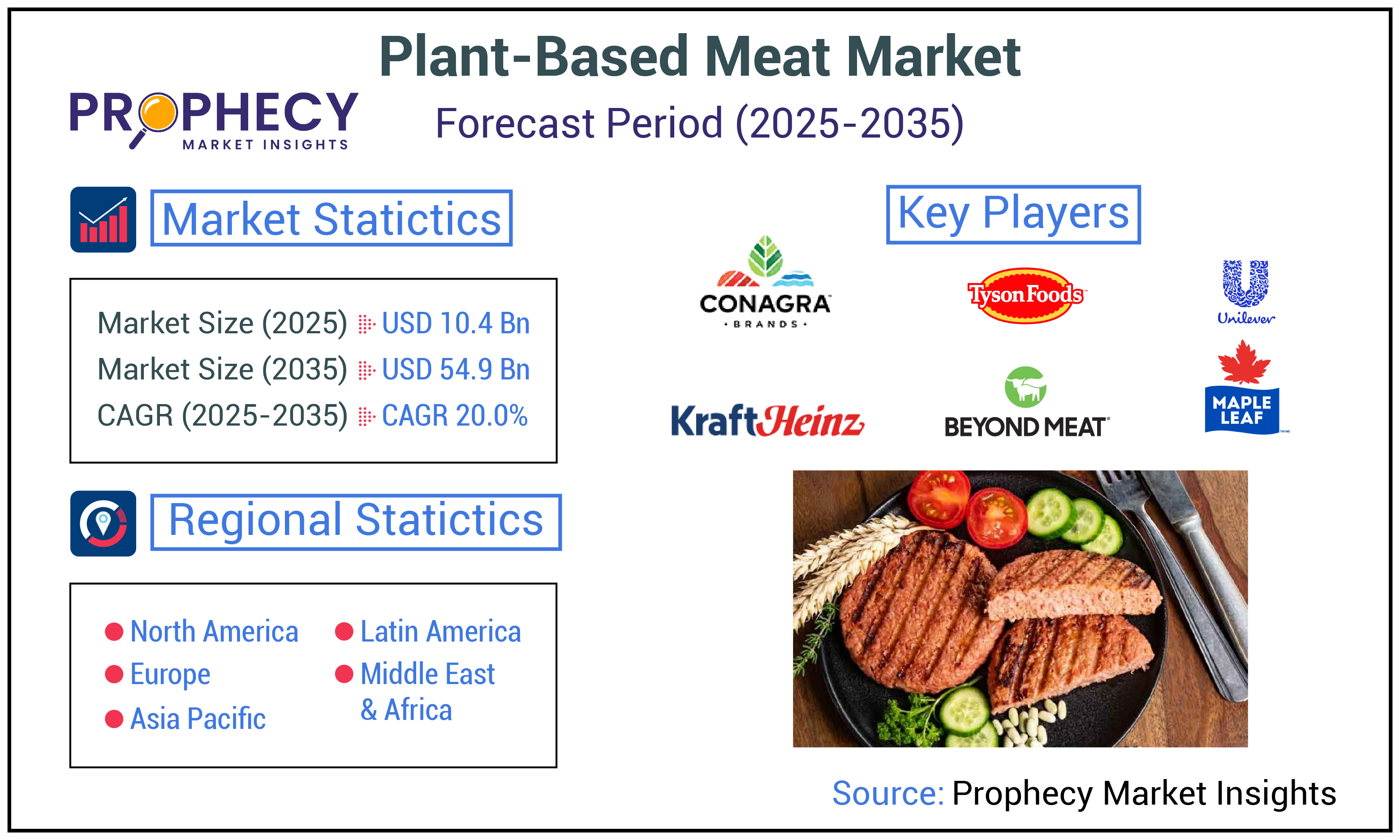
- By 2035, plant based meat market size is contemplated to enlarge at a valuation of USD 54.9 Billion.
- In 2024, the plant based meat market valuation was USD 8.9 Billion.
- Plant based meat market is developing at a CAGR of 20.0%.
Plant-based meat is food products that are made to taste, experience and visually resemble animal meat but consists entirely of ingredients from plants (soy, peas, wheat) with the goal of provide sustainable, humane, and healthy options for people who are reducing or eliminating their consumption of meat.
Plant-based meat continues to grow rapidly as consumers better realize the health, environmental sustainability, and ethic challenges associated with animal agriculture. Increased adoption of vegan and flexitarian diets, advancements in food technology, and growing availability of products in retail shops are also supporting the rising demand. Additionally, government policies and initiatives that support plant-based products, influencer-led marketing, films, celebrities and the shift in consumer emphasis towards sustainable food systems that consider meat alternatives are pushing consumers to expand their discovery of plant-based a further accelerate the growth of the plant-based meat market in developed and emerging regions.
In the future, plant-based meat will focus on enhanced innovation for taste, clean-label formulations, and global penetration. Continued investment in research and development will enhance the realism and price point of the products. As sustainability becomes increasingly important in all parts of the world, plant-based meat will be significant factor for global protein consumption.
Recession Risk & Tariff Analysis:
- In tough economic times, consumers in low- and middle-income countries may choose cost over sustainability or health, which will mostly impact the premium plant-based meat segments. Companies may face slower growth, lessened budgets for innovation, and market pressures to lower prices. Small companies may not be able to get funded to continue while large companies may consolidate to stay alive and operate profitably.
- Tariffs on imported raw materials such as soy or pea protein could lead to an increased cost of production and potentially impact pricing and margins for the plant-based meat manufacturer. A trade restriction imposed on major agricultural exporters and importers may impact supply chains. Companies will be slaves to sourcing local suppliers or will need to raise prices not to be competitive and affect their plan for global expansion.
Impact of Generative AI on Plant Based Meat Market:
- Generative AI can help hasten the development of plant-based meat analogues by evaluating the interactions between diverse ingredients, along with the textures and flavors needed to create more realistic analogues. In doing so, it creates less trial-and-error R&D, allowing companies to innovate with speed to create better tasting products while hitting on consumer expectations with regards to texture, nutrition, and sensory experience.
- Generative AI allows for deeper evaluation of consumer behavior, dietary trends, and location-based preferences. By providing predictable models and simulated demand patterns, companies can leverage the models to identify when to launch products, market response, and food production all contributing to better scaling and less food waste in the plant-based food movement.
Global Plant Based Meat Market Drivers & Restraints
Key Drivers:
Rising Environmental and Sustainability Concerns is changing the dynamics of the market
One of the strongest growth factors of the plant-based meat market is the increasing concern around issues facing the environment from traditional livestock farming. Consumers and governments understand the challenges of carbon dioxide and methane output, habitat loss, land degradation, and water consumption presented by meat production. With plant-based meat, there can be a solid move towards sustainability and a reduced carbon footprint. The transition towards plant-based diets is central to meeting climate targets globally. The transition towards sustainability extends to individuals and organizations, and as they change their diets, the sector continues to grow.
- For instance, according to Stanford Woods Institute for the Environment, the concentration of livestock increases the environment burden. The meat industry has the ability to increase global warming. Transitioning to plant-based diets may help reduce carbon emissions and environmental degradation.
Restraints:
High Production Costs and Premium Pricing to repel market growth:
A significant obstacle to the plant-based meat market is the comparatively high cost of production. These costs are driven by processing technologies, specialty ingredient sources, and R&D intermediately not available in traditional meat. Ultimately, significant costs mean retailers pricing an item higher than traditional meat, limiting the product's mass-market appeal and limiting the ability to reach the price conscious segment.
Even with environmental or health benefits, consumers are often unwilling to switch from animal to plant, especially in prices regions. Greater supply chain inefficiencies and a lack of manufacturing infrastructure for plant-based protein only further drive prices upward, and limits functional options for lower-income populations.
- Counterbalance Statements: As production technologies improve and output increases, the manufacturing costs on plant protein are steadily decreasing. More and more plant-based options are increasingly being offered at a lower price point since competition increases investments innovation of new ingredients. The timely funding by Government agencies coupled with a rapidly growing consumer base desire for affordable plant-based option will expedite cost reductions, and broaden the price accessibility and competitive presence in highly capitalized meat markets.
Opportunities & Trends:
Expansion into Emerging Markets with Clean-Label Innovation is a growing opportunity
There is an opportune moment to broaden the scope of plant-based meat products into developing regions where income levels are rising and dietary preferences are changing due to growing health awareness. Developing regions continue to urbanize, thus creating demand for more sustainable protein alternatives. A crucial trend to watch is the move towards clean-label products, which are based on the idea that natural, easily recognized ingredients with no artificial additives tend to be healthier.
As consumers look for more transparency in food products and health benefits for themselves, manufacturers will need to innovate and utilize simplicities in their recipes while also providing more whole food ingredients. This combination will help sustain growth within the developing plant-based meat market and foster long-term consumer trust across markets.
Global Plant Based Meat Market Segmentations & Regional Insights
By product, source, meat type, end-user and region are the divisions of the plant based meat market.
By Product:
Based on product, the market is divided into burgers, sausages, patties, nuggets, tenders & cutlets, grounds, and others. Due to their familiarity, popularity, simplicity, and acceptance by consumers, burgers are leading the market for plant based meat market share. Many popular fast food and retail brands began offering plant-based burger options increasing visibility in the mainstream market. Both being gated type and familiar taste are appealing factors being a product type in foodservice and consumer retail categories.
Sausages hold the next largest share of the market as they offer more meal versatility, and flavor impact. Plant-based sausages appeal to both the traditional consumer and health-conscious consumers with an uptick in use in breakfasts and as grilling products. New formulations and greater availability in restaurants and supermarkets have led them both to grow in importance.
By Source:
Based on source, the market is divided into soy, pea, wheat, and others. Soybean dominates the plant based meat market share. Since the protein is extracted from soybeans, it has a full complement of all amino acids needed for human nourishment. The disadvantage of soy, however, is that it can be manipulated into all sorts of flavors and textures. This product, therefore, can be used to make a variety of crackers as substitutes for meats in diverse meat dishes.
Pea comes second in plant based meat market share. Pea protein is a substitute for animal-derived proteins. It is good for consumers wanting to get their protein needs from plant sources since peas provide key amino acids to make a higher-quality protein profile. It is also hypoallergenic and easily digestible, making it attractive to people with dietary restrictions and limits.
By Meat Type:
Based on the meat type, the plant based meat market is divided into chicken, pork, beef, fish, and others. Chicken dominates the category for plant-based meat market growth. Making safer alternatives to meat products has been of concern to consumers for saturated fat, cholesterol, and other health problems. While plant-based chicken typically has the same kind of protein, it has less cholesterol and saturated fat.
Fish comes second. It is often fortified with active ingredients such as omega-3 fatty acids, commonly found in conventional fish and obtainable from algae and other plant sources. Offering consumers food with the same taste and texture as seafood, plant-based fish products provide an environmentally friendly alternative that reduces the pressure on marine ecosystems.
By End-User:
Vegan consumers, vegetarian consumers, health-conscious consumers, and others are end-user of the plant based meat market. The plant based meat market share is nearly dominated by healthy consumers, who are increasingly aware of nutrition, cholesterol-free options, and lower-intake of saturated fats. This segment largely seeks protein-rich, low-calorie, healthy options as substitutes for conventional meat.
The second-largest segment is vegan consumers, continually enable plant-based meat as a dietary staple. Their lifestyle approach to animals (animal welfare) and environmental sustainability, as consumers, often keeps them loyal to plant-based. This group also can inspire greater diversity in variety, plant-based protein content, and has a long-term influence on trends in plant-based innovation.
Regional Insights:
Geographically, the plant based meat market is studied across North America, Europe, Asia Pacific, Latin America, and the Middle East & Africa.
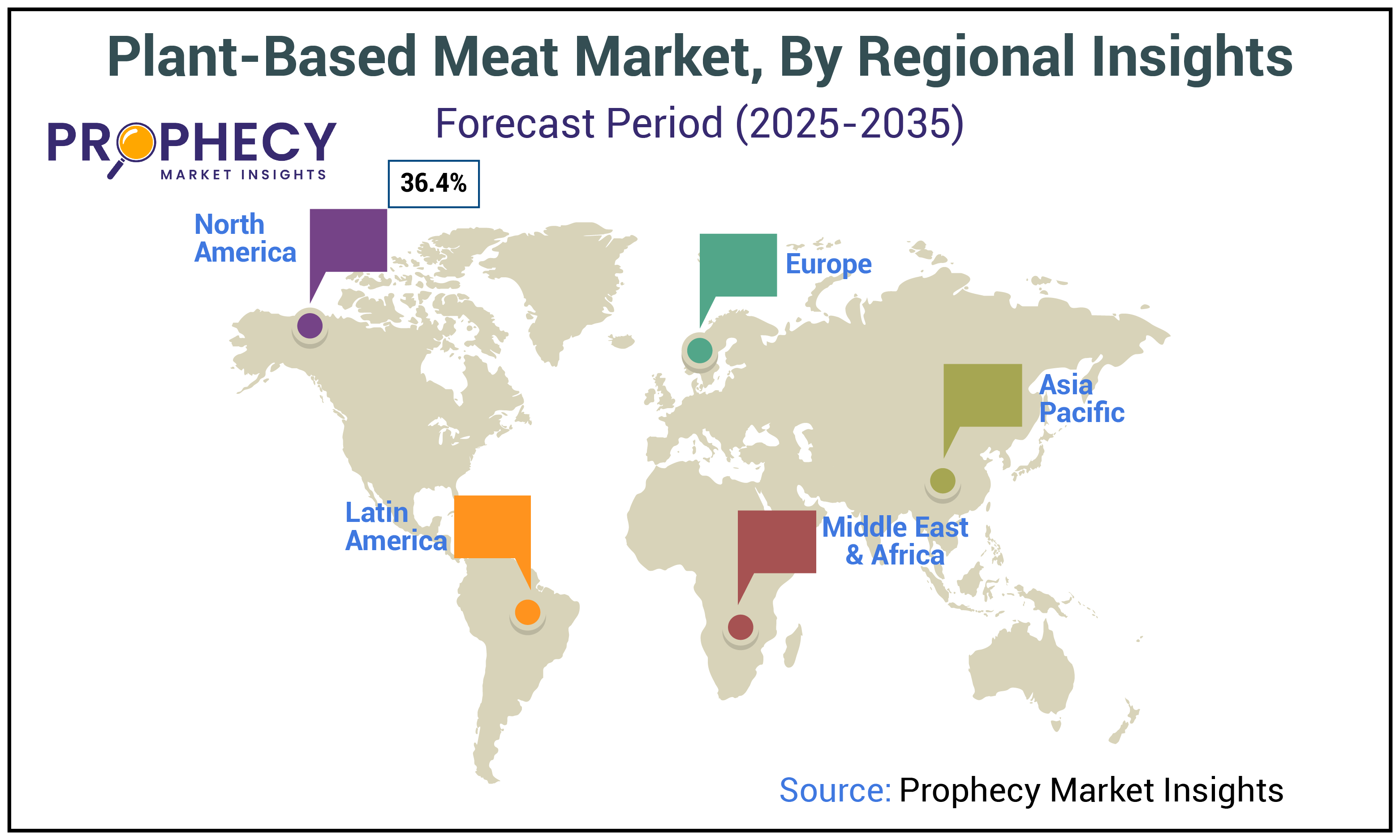
North America: This region results in the largest plant based meat market share accounts for 36.4% of plant-based meat alternatives. This should occur as the majority of consumers within the United States continue to demand healthier focused or sustainable food alternatives. With sustaining networks of retail and foodservice markets that are significant, the plant-based meat alternatives segment is being propelled forward into growth and innovation.
- U.S. Plant Based Meat Market Insights:
The U.S. dominates the plant-based meat industry in North America and the rapid adoption of plant-based meat products is fueled by a strong consumer base, food innovations, and broad distribution which supports retail availability. The United States also has leading brands, increasing health awareness, and environmental awareness that all drive demand leading to the United States becoming a nutritional hub of plant-based meat consumption globally.
Europe: This region is second dominating in plant based meat market share, which have shown a growing concern for animals and the environmental impact of food - ultimately leading them to invest in their future sustainability pathway for decision-making. With the help of their government policies, countries such as Germany, United Kingdom, and the Netherlands acquired a strong penetration into retail with the rising demand for meat alternatives within the retail and foodservice sectors.
- Germany Plant Based Meat Market Insights:
Germany leads the European plant-based meat industry supported by its health-conscious population and long-standing vegetarian culture. Strong demand along with retail and food service channels, government policies, and innovation from home producers make Germany a focal point for plant-based food growth and one of the most advanced consumers in this region.
Asia Pacific: This region is beginning to grow as a major producer of plant-based meat alternatives as they are growing in their awareness of health trends, evolving markets into higher disposable spending, and dietary trend changes in countries such outlets were focused on sustainable or plant-based alternatives first. With a rise of urban centers and disposition towards Western alimentary countries, overall global cognizance is bringing plant-based meat more directly towards sustainable avenues.
- China Plant Based Meat Market Insights:
China provides the largest contribution to the Asia Pacific plant-based meat industry along with health-awareness, food safety issues, and a very large and diverse consumer base. Government policies to curtail meat consumption for environmental and health reasons, as well as rapid urbanization, and western dietary integration into their lifestyles will have a tremendously positive effect on plant-protein growth in China.
Plant Based Meat Market Report Scope:
|
Attribute |
Details |
|
Market Size 2025 |
USD 10.4 Billion |
|
Projected Market Size 2035 |
USD 54.9 Billion |
|
CAGR Growth Rate |
20.0% (2025-2035) |
|
Base year for estimation |
2024 |
|
Forecast period |
2025 – 2035 |
|
Market representation |
Revenue in USD Billion & CAGR from 2025 to 2035 |
|
Regional scope |
North America - U.S. and Canada Europe – Germany, U.K., France, Russia, Italy, Spain, Netherlands, and Rest of Europe Asia Pacific – China, India, Japan, Australia, Indonesia, Malaysia, South Korea, and Rest of Asia-Pacific Latin America - Brazil, Mexico, Argentina, and Rest of Latin America Middle East & Africa – GCC, Israel, South Africa, and Rest of Middle East & Africa |
|
Report coverage |
Revenue forecast, company share, competitive landscape, growth factors, and trends |
Segmentation:
By Product:
- Burgers
- Sausages
- Patties
- Nuggets
- Tenders & Cutlets
- Grounds
- Others
By Source:
- Soy
- Pea
- Wheat
- Others
By Meat Type:
- Chicken
- Pork
- Beef
- Fish
- Others
By End-User:
- Vegan Consumers
- Vegetarian Consumers
- Health-Conscious consumers
- Others
By Region:
- North America
- U.S.
- Canada
- Europe
- Germany
- U.K.
- France
- Russia
- Italy
- Spain
- Netherlands
- Rest of Europe
- Asia Pacific
- China
- India
- Japan
- Australia
- Indonesia
- Malaysia
- South Korea
- Rest of Asia Pacific
- Latin America
- Brazil
- Mexico
- Argentina
- Rest of Latin America
- Middle East & Africa
- GCC
- Israel
- South Africa
- Rest of Middle East & Africa
Global Plant Based Meat Market Competitive Landscape & Key Players
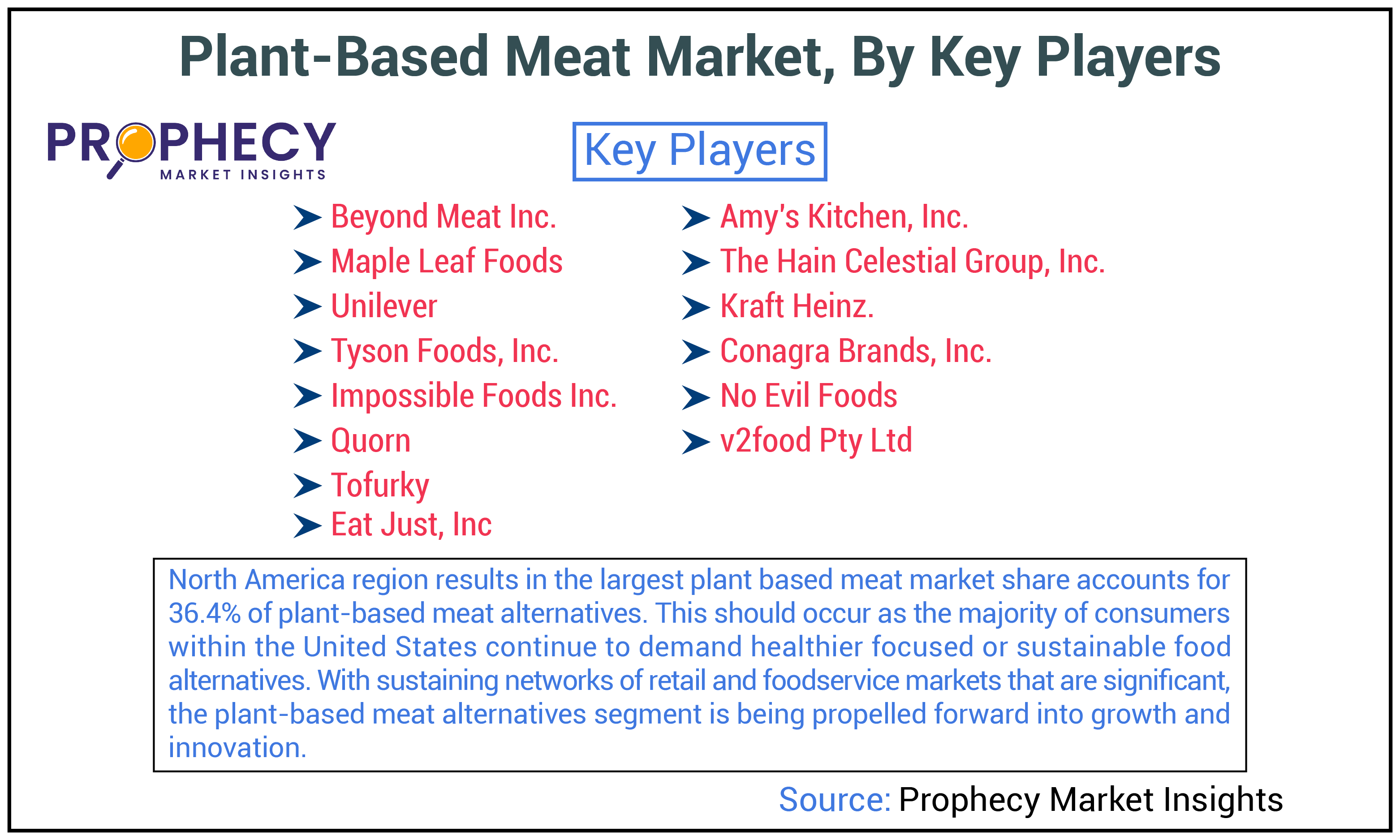
Leading companies in the plant based meat market include Beyond Meat Inc., Maple Leaf Foods, Unilever, Tyson Foods, Inc., Impossible Foods Inc., Quorn, Tofurky, Eat Just, Inc, and among others. The competition in the plant-based meat arena is quite intense, and companies are virtually sprinting towards innovation, taste accreditations, and nutritional advancements as a means to seek consumer acceptance. Players mainly compete through product differentiation, international presence, and strategic partnerships with retailers as well as foodservice chains. Sustainability, clean-label claims, and cost factors are major market positioning and differentiator criteria.
Plant Based Meat Market Companies:
- Beyond Meat Inc.
- Maple Leaf Foods
- Unilever
- Tyson Foods, Inc.
- Impossible Foods Inc.
- Quorn
- Tofurky
- Eat Just, Inc
- Amy's Kitchen, Inc.
- The Hain Celestial Group, Inc.
- Kraft Heinz.
- Conagra Brands, Inc.
- No Evil Foods
- v2food Pty Ltd
View an Additional List of Companies in the Plant Based Meat Market
Global Plant Based Meat Market Recent News
- In April 2024, with the introduction of Plantspired Plant-Based Chick'n, Nasoya, a leader in the plant-based food revolution, entered the new plant-based meat market. Bee-Free Honey and Kung-Pao are the two flavors of the new product.
- In October 2023, three new plant-based fish substitutes were introduced in Spain, Germany, Italy, Poland, and other European nations by Nestle S.A., a multinational food and drink processing conglomerate firm located in Switzerland. Under the Garden Gourmet brand, the new goods include marine-style crispy nuggets and marine-style crispy filets.
Analyst View:
The plant-based meat market is rapidly evolving with increased concern for the environment, increased public interest in health, and demand for sustainable choices that continue to fuel growth. Analysts are already observing significant trends with respect to clean-label products and realistic meat analogues that leverage sophisticated food technology. The continued developments in terms of taste, texture, and nutritional value generally serve to expand the footprints of consumer acceptance by finding ways to position them similar to popular meat products.
There is clear market opportunities related to geographical and foodservice opportunities, but high costs of production, limited consumer familiarity in some markets and price sensitivity still represent significant barriers. Therefore, the ongoing innovation, strategic partnerships and resultant economies of scale will mostly continue to support future demand and global market expansion for the long-term.
More Related Reports
Plant Stem Cell Market
Desalination Plants Market
Plant Biostimulant Market
Plant Genotyping Equipment Market
Biomass Heating Plant Market
Global Plant Based Meat Market Company Profile
|
Company Name |
Beyond Meat Inc. |
|
Headquarter |
El Segundo, California, U.S. |
|
CEO |
Ethan Brown |
|
Employee Count |
686 Employees |
Global Plant Based Meat Market Highlights
FAQs
Plant based meat market size was valued at USD 10.4 Billion in 2025 and is expected to reach USD 54.9 Billion by 2035 growing at a CAGR of 20.0%.
Product, source, meat type, end-user, and region are the segmentation for the plant based meat market.
North America, Asia Pacific, Europe, Latin America, and the Middle East & Africa. North America is expected to dominate the market.
The prominent players operating in the market include, Beyond Meat Inc., Maple Leaf Foods, Unilever, Tyson Foods, Inc., Impossible Foods Inc., Quorn, Tofurky, Eat Just, Inc, Amy's Kitchen, Inc., The Hain Celestial Group, Inc., Kraft Heinz., Conagra Brands, Inc., No Evil Foods, and v2food Pty Ltd.