Global Organic Food And Beverages Overview
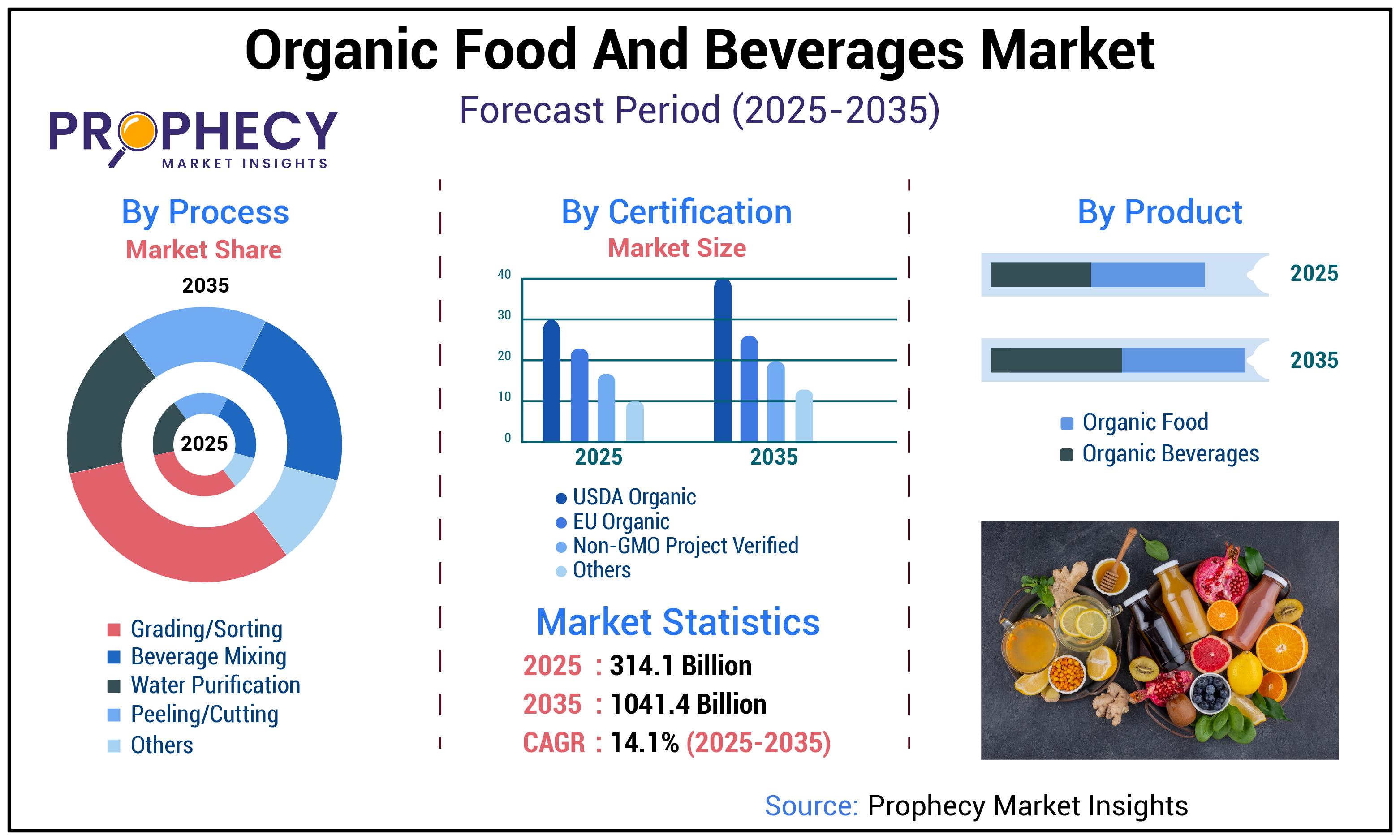
- Organic food and beverages market size is expected to expand at a rate of USD 1041.4 Billion, by 2035.
- In 2024, the market valuation was USD 281.4 Billion.
- Organic food and beverages market is growing at a CAGR 14.1%.
Organic food and beverages refer to products that are produced, processed, and handled using methods that obey with the standards of organic farming. These standards are established by governmental and certifying bodies to promote environmental sustainability, biodiversity, and animal welfare. Organic farming avoids the use of synthetic chemicals such as pesticides, herbicides, and fertilizers. It relies on natural substances and physical, mechanical, or biologically based farming methods to the fullest extent possible. Organic food includes fruits, vegetables, grains, dairy products, and meat, while organic beverages can include milk, juices, tea, coffee, wine, and other drinks made from organically grown ingredients.
The consumers are increasingly aware of the health risks associated with synthetic pesticides, GMOs, and growing environmental awareness to reduce chemical use, improved spoil health, is anticipated to drive organic food and beverages market growth. Rising government support, regulations, expanding retail, e-commerce platforms for online grocery shopping, and rising disposable incomes in developing regions, is projected to boost organic food and beverages market growth.
The growing trend towards veganism, clean eating, functional foods, innovations in organic processed foods & beverages, and expansion in emerging markets, can create future opportunities for organic food and beverages market growth. The expansion of privet label, brand expansion, improvement in technology, supply chain management, and rapid adoption of organic food and beverages in foodservice or hospitality, is estimated to impel organic food and beverages market growth.
Recession Risk and Tariff Analysis on Organic Food and Beverages Market:
- During economic downturns or recessions, consumers often shift their spending toward essential and lower-cost goods. Since organic products typically carry a price premium compared to conventional alternatives, the market may experience a slowdown in growth. Budget-conscious consumers may choose for non-organic items, which impacts sales volume.
- Tariffs and trade barriers can affect the global supply chain of organic products, especially for countries that rely on imports of organic raw materials or finished goods. Increased tariffs on organic ingredients can lead to higher production costs, reducing competitiveness in price-sensitive markets. The protective tariffs can benefit local organic producers by encouraging domestic consumption and reducing reliance on imports.
Impact of Generative AI on Organic Food and Beverages Market:
- Food companies can use AI algorithms to analyze vast datasets, including customer preferences, ingredient profiles, and health trends, to create new organic food and beverage formulations. AI enhances personalization by creating targeted campaigns, content, and product recommendations tailored to individual tastes and lifestyles.
- AI-generated social media content, recipe ideas, and nutrition tips are helping brands connect more meaningfully with health-conscious consumers, especially in digital spaces. AI models improve supply chain efficiency by forecasting demand more accurately, optimizing inventory, and reduces waste.
Global Organic Food And Beverages Drivers & Restraints
Key Drivers:
Rapid Expansion of Online Grocery Shopping is Donating to Market Amplification
With the rise of e-commerce platforms, mobile apps, and digital grocery services, consumers can now browse, compare, and purchase a wide variety of organic items without the limitations of physical store availability. This trend is significant in urban areas and among health-conscious, time-constrained consumers that prefer the convenience of scheduled deliveries and contactless shopping.
Online platforms often provide detailed product descriptions, certification information, and user reviews, which help consumers make informed decisions about organic options. For producers and retailers, e-commerce allows direct-to-consumer (DTC) selling, which reduces distributers and increasing profit margins by enabling better customer engagement. The expansion of online grocery shopping enhances product visibility, consumer convenience, and market reach, is anticipated to drive organic food and beverages market growth.
- For instance, according to the data published by GWI, 59% of grocery shoppers prefer online shopping. U.S. online grocery purchase is growing at 23% from 2020, where 89% of shopper are reaching for privet-label products to stretch their grocery budgets. 35% of online grocery shopper are in high-income category. 61% are kids, and 47% of parents that have kids aged 3-11, prefer to quick, easy, and stress-free grocery solutions. 59% are married, and 67% of urban areas lived people prefer online grocery shopping. 35% of food shoppers in APAC regularly use coupons, showing that price incentives are a key factor in driving repeat purchases.
Restraints:
Market Growth Delayed by Limited Shelf Life and Supply Chain Challenges
Organic food and beverages have a shorter shelf life than conventional products. This makes them more disposed to spoilage during storage, transportation, and retail display. Maintaining strict organic standards, such as preventing cross-contamination with non-organic products adds complexity to the supply chain. These factors can lead to higher costs, product losses, and logistical inefficiencies, resulting to limits organic food and beverages market growth.
- Counterbalance Statements: To address these challenges, companies are investing in advanced cold chain logistics, AI-powered inventory management, and sustainable packaging that extends freshness without compromising organic integrity. Increased use of local sourcing and shorter supply chains helps reduce transit time and spoilage, ensuring fresher products and greater consumer satisfaction.
Opportunities & Trends:
Advancement in Food Technology Fuels Market Expansion
As consumer preferences evolve toward healthier, safer, and more sustainable food options, technological innovation has become crucial part of food technology. Modern food technologies, such as precision agriculture, biotechnology, and smart packaging, and blockchain-based traceability systems are revolutionizing organic products to be grown, processed, stored, and delivered.
The smart farming and automation, in which technologies such as drones, robotics, IoT sensors, and AI-driven analytics allow farmers to monitor soil health, crop conditions, water use, and pest activity in real time. These tools enable precision farming, is critical in organic agriculture in which chemical interventions are limited. Advances in food processing technologies are allowing organic manufacturers to extend shelf life, preserve nutritional content, and enhance food safety without relying on artificial preservatives or additives, resulting to propel organic food and beverages market share.
- For Instance, according to the article published by NCBI, this article states that, food innovation technologies are increasingly achieving global food security and supporting organic food sector. The advancement in digital technologies, such as data analytics, predictive modeling, robotics, and the Internet of Things (IoT). These innovations are playing a transformative role in enhancing the efficiency, sustainability, and productivity of modern farming practices.
- The regulatory framework supporting to the organic standards through EU Regulation 2018/848, which emphasizes the need for preventive, non-chemical strategies throughout the production and supply chain. Technology-based preventive measures, such as precision farming tools and digital monitoring systems, provide a compliant and efficient way for organic farmers to protect their crops. This shift is pushing food processing technologies to evolve in a preservation of the natural flavor and integrity of organic products by following to the highest environmental standards.
Global Organic Food And Beverages Segmentations & Regional Insights
The organic food and beverages market is categorized into product, process, certification, distribution channel, and region.
By Products:
Based on product, the organic food and beverages market is classified into, organic food, and organic beverages. Organic food is the leading segment in the market. This includes organic fruits and vegetables, dairy products, meat, poultry, grains, and packaged organic snacks. The dominance of this segment is driven by strong consumer demand for healthy, chemical-free food options, especially in everyday essentials such as fruits, vegetables, and dairy. Increasing health awareness, concerns over pesticide use, and rising availability of organic groceries have significantly boosted the organic food and beverages market share.
Organic beverages form the second-largest segment, witnessing rapid growth due to the rising popularity of clean-label drinks. This includes organic tea, coffee, juices, plant-based milk, and functional drinks. Consumers, especially millennials and Gen Z, are showing increasing interest in beverages that align with wellness trends and sustainability, resulting to propel segment’s expansion in organic food and beverages market size.
By Process:
grading/sorting, peeling/cutting, water purification, beverage mixing, and others are classified by process for market. Grading/sorting is the largest and most dominant process segment. It is critical in the organic sector to ensure quality, size uniformity, and removal of defective items before packaging. Advanced sorting technologies help to reduce waste and ensures top-quality produce reaches consumer, contributing to propel growth of segment in organic food and beverages market share.
Beverage mixing is the second most superior process, particularly due to the surge in demand for organic drinks such as juices, teas, plant-based milks, and wellness beverages. This process involves combining organic ingredients by maintaining purity, taste, and nutritional integrity, is expected to pitch segment’s development in organic food and beverages market size.
By Certification:
By certification, organic food and beverages market is divided into USDA organic, EU organic, non-GMO project verified, and others. The market is dominated by USDA organic segment. Products bearing the USDA organic seal must meet strict federal guidelines covering soil quality, animal raising practices, pest & weed control, and the use of additives. This certification is highly trusted and widely recognized by U.S. consumers and in many international markets, making it superior segment in the organic food and beverages market share.
EU organic certification holds the second-largest share, especially across Europe, in which consumer awareness of organic labeling is high. The EU has a comprehensive regulatory framework that ensures environmental sustainability, biodiversity, and animal welfare. EU Organic-certified products are in high demand in countries such as Germany, France, and the Netherlands, is projected to drive organic food and beverages market size.
By Distribution Channel:
Supermarkets/hypermarkets, specialty stores, convenience stores, online retail, and others are categorized by distribution channel for market. The supermarkets/hypermarkets segment is the dominant distribution channel in the market. These retail formats have a wide reach and offer a large variety of organic food and beverages brands, making them the go-to shopping destinations for consumers. Supermarkets and hypermarkets provide convenience with their one-stop-shop model, allowing customers to purchase a wide range of products, all in one place, is holding a superior position in organic food and beverages market size.
Regional Insights:
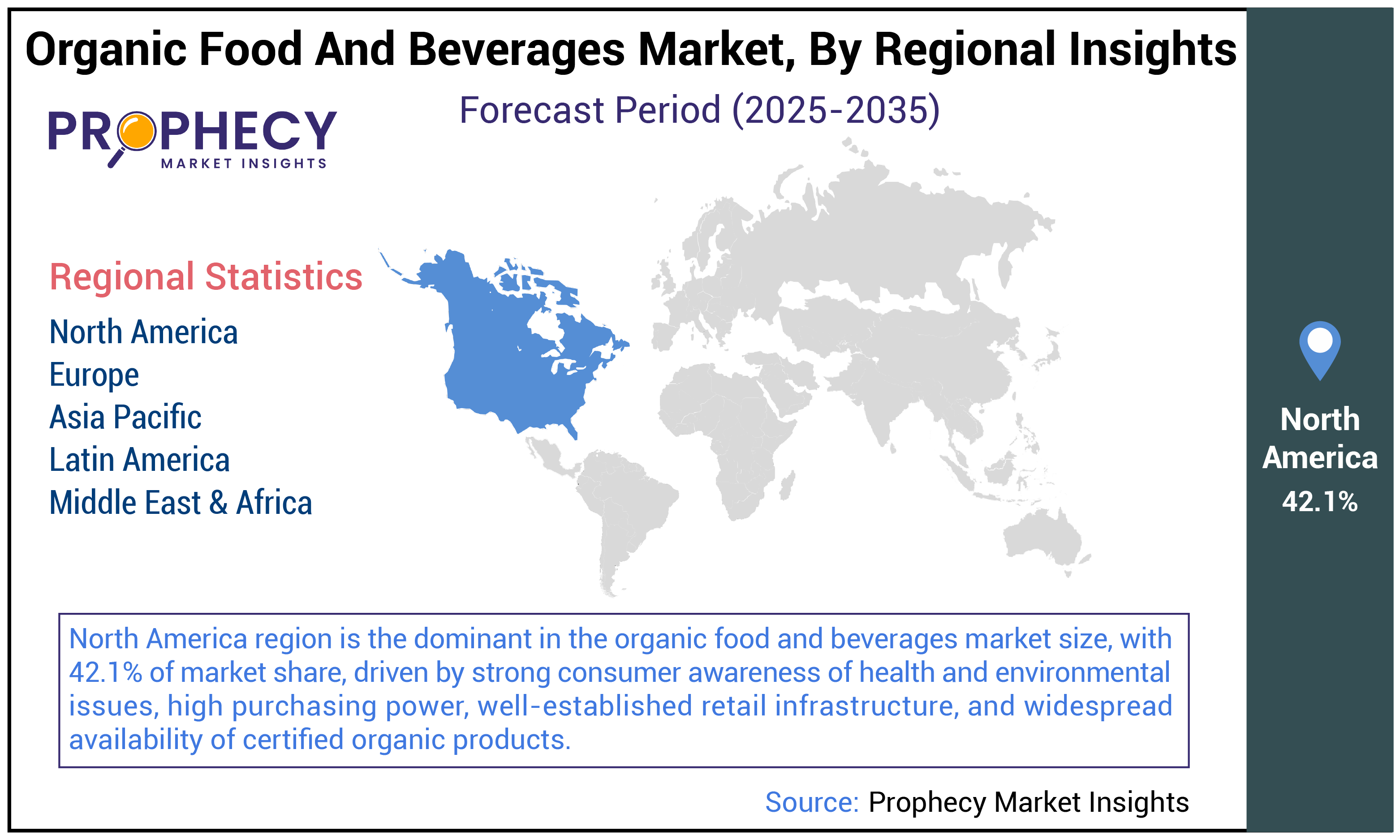
Geographically, the market is studied across North America, Europe, Asia Pacific, Latin America, and the Middle East & Africa.
North America: This region is the dominant in the organic food and beverages market size, with 42.1% of market share, driven by strong consumer awareness of health and environmental issues, high purchasing power, well-established retail infrastructure, and widespread availability of certified organic products. The presence of strict regulations such as the USDA Organic standard also boosts consumer confidence. The U.S. organic market has strong e-commerce growth and a trend toward clean-label, plant-based, and functional organic products, is estimated to impel organic food and beverages market share.
- U.S. Organic Food and Beverages Market Insights:
The U.S. is the largest market for organic food and beverages in North America. The U.S. leads in both production and consumption of organic products, driven by strong consumer demand for healthier, environmentally friendly options. The country's regulatory framework, including the USDA Organic certification and growing e-commerce platforms contributing to organic food and beverages market share.
Europe: This region holds the second-largest share of the market. Government support, strict regulatory frameworks, and a cultural preference for natural and sustainable foods contribute to this region's strength. European consumers show strong interest in ethical sourcing, environmental sustainability, and traceability, which aligns closely with the organic product value proposition, is anticipated to drive organic food and beverages market share.
- Germany Organic Food and Beverages Market Insights:
Germany is a leading consumer of organic food and beverages in Europe. It has the largest organic market in Europe, fueled by a strong consumer base that values sustainability, health, and environmental impact. The market is highly influenced by EU organic certification standards, and consumers are willing to pay a premium for organic products, resulting to propel organic food and beverages market size.
Asia Pacific: This region is emerging as a significant player in the global market, experiencing rapid growth due to rising disposable incomes, urbanization, and increasing health awareness among consumers. Countries are witnessing growing demand for organic products, particularly in urban centers in which consumers are more conscious of food safety, sustainability, and health. The organic certification systems in these countries are evolving, with a shift toward international standards such as EU Organic and USDA Organic, is predicted to boost region expansion in organic food and beverages market size.
- China Organic Food and Beverages Market Insights:
In the Asia-Pacific region, China is emerging as a dominant player in the organic food and beverages market. China’s growing middle class, increasing disposable incomes, and rising health concerns are driving demand for organic products. The government is investing in organic farming practices, and the market for organic foods is expanding rapidly, particularly in urban areas, is estimated to fuel organic food and beverages market growth.
Organic Food and Beverages Market Report Scope:
|
Attribute |
Details |
|
Market Size 2025 |
USD 314.1 Billion |
|
Projected Market Size 2035 |
USD 1041.4 Billion |
|
CAGR Growth Rate |
14.1% (2025-2035) |
|
Base year for estimation |
2024 |
|
Forecast period |
2025 – 2035 |
|
Market representation |
Revenue in USD Billion & CAGR from 2025 to 2035 |
|
Regional scope |
North America - U.S. and Canada Europe – Germany, U.K., France, Russia, Italy, Spain, Netherlands, and Rest of Europe Asia Pacific – China, India, Japan, Australia, Indonesia, Malaysia, South Korea, and Rest of Asia-Pacific Latin America - Brazil, Mexico, Argentina, and Rest of Latin America Middle East & Africa – GCC, Israel, South Africa, and Rest of Middle East & Africa |
|
Report coverage |
Revenue forecast, company share, competitive landscape, growth factors, and trends |
Segmentation:
By Product:
- Organic Food
- Fruits & Vegetables
- Meat, Fish & Poultry
- Dairy Products
- Frozen & Processed Food
- Others
- Organic Beverages
- Non-dairy Beverages
- Coffee & Tea
- Beer & Wine
- Others
By Process:
- Grading/Sorting
- Peeling/Cutting
- Water Purification
- Beverage Mixing
- Others
By Certification:
- USDA Organic
- EU Organic
- Non-GMO Project Verified
- Others
By Distribution Channel:
- Supermarkets/Hypermarkets
- Specialty Stores
- Convenience Stores
- Online Retail
- Others
By Region:
- North America
- U.S.
- Canada
- Europe
- Germany
- U.K.
- France
- Russia
- Italy
- Spain
- Netherlands
- Rest of Europe
- Asia Pacific
- China
- India
- Japan
- Australia
- Indonesia
- Malaysia
- South Korea
- Rest of Asia Pacific
- Latin America
- Brazil
- Mexico
- Argentina
- Rest of Latin America
- Middle East & Africa
- GCC
- Israel
- South Africa
- Rest of Middle East & Africa
Global Organic Food And Beverages Competitive Landscape & Key Players
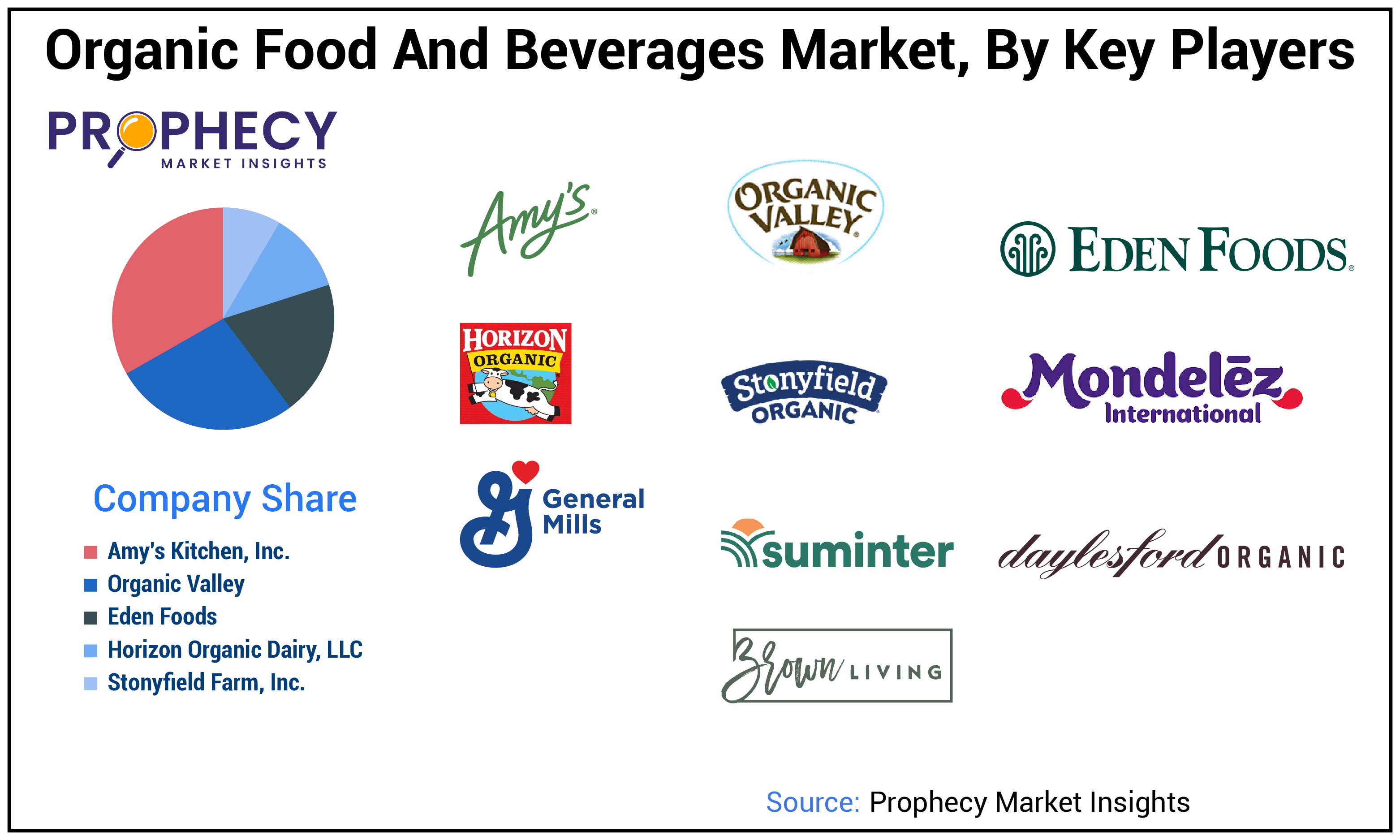
Amy's Kitchen, Inc., Organic Valley, Eden Foods, and others are the key players operating in the organic food and beverages market. This companies are constantly innovating and developing new products, advanced process system through their strategic partnership and collaboration. Companies compete on health positioning, packaging convenience, and marketing strategies, is anticipated to fuel organic food and beverages market share.
Organic Food and Beverages Market Companies:
- Amy's Kitchen, Inc.
- Organic Valley
- Eden Foods
- Horizon Organic Dairy, LLC
- Stonyfield Farm, Inc.
- Mondelez International group.
- General Mills
- Suminter India Organics
- Daylesford Organic Limited
- Brown Living
- Hain Celestial
- Organic Tattva
- The Kraft Heinz Company
- Organic India Pvt. Ltd.
- Organics.com
View an Additional List of Companies in the Organic Food and Beverages Market
Global Organic Food And Beverages Recent News
- In May 2025, IKTIFA signed agreement with Emirates Macaroni Factory to produce Saba' Sanabel pasta using organic wheat from the farm. This agreement added new products to IKTIFA’s portfolio, which includes vvarious types of pasta and other potential products through the Emirates Macaroni Factory. This collaboration focused on introduce more organic food products in upcoming years to meet consumer demand.
- In May 2025, Japan and the European Union were aimed to expand their mutual agreement for organic food, to allow for larger range of products can be labeled as organic food. This contains alcoholic beverages such as sake, livestock products and processed livestock products. Under the Organic Japanese Agricultural Standards system, the agricultural and livestock products were produced, which reduces burdens on the environment and without reliance on pesticide or chemical fertilizer.
- In February 2025, ROAR Organic, the rapidly growing beverage brand redefining hydration, launches its new Dragon Fruit Punch, which was available in their organic ready-to-drink lineup. The Dragon Fruit Punch was packed with electrolytes, vitamins C, B5, B6, and B12, and antioxidants, all made on an organic coconut water base. This was designed to support lifestyle, and aimed to provide functional hydration.
- In September 2024, Natural & Organics Products Expo launched The Artisan Food & Drink Expo, a new initiative that aimed to offer dedicated platform for brands that champion provenance, high quality ingredients and unique curation. The Artisan Food & Drink Expo allowed buyers to explore a varied range of distinctive food and drink offerings.
Analyst View:
The market is driven primarily by urbanization, changing lifestyles, affordability, and convenience, especially in developing regions in which growing demand for organic food and beverages. The rapid growth in e-commerce, online shopping and growing health awareness, and rapid knowledge about side effects of synthetic food, is anticipated to drive organic food and beverages market growth.
More Related Reports
Baby Food Market
Organic fertilizers Market
Organic Farming Market
Food Fiber Market
Food Safety Testing Market
Global Organic Food And Beverages Company Profile
|
Company Name |
General Mills Inc |
|
Headquarter |
Golden Valley, Minnesota, U.S. |
|
CEO |
Jeff Harmening |
|
Employee Count |
34,000 Employees |
Global Organic Food And Beverages Highlights
FAQs
Organic food and beverages market size was valued at USD 314.1 Billion in 2025 and is expected to reach USD 1041.4 Billion by 2035 growing at a CAGR of 14.1%.
Product, process, certification, distribution channel, and region are the segmentation for the organic food and beverages market.
North America, Asia Pacific, Europe, Latin America, and the Middle East & Africa. North America is expected to dominate the market.
The key players operating in the organic food and beverages market include Amy's Kitchen, Inc., Organic Valley, Eden Foods, Horizon Organic Dairy, LLC., Stonyfield Farm, Inc., Mondelez International group, General Mills, Suminter India Organics, Daylesford Organic Limited, Brown Living, Hain Celestial, Organic Tattva, The Kraft Heinz Company, Organic India Pvt. Ltd., and Organics.com