Smart Packaging Market Overview
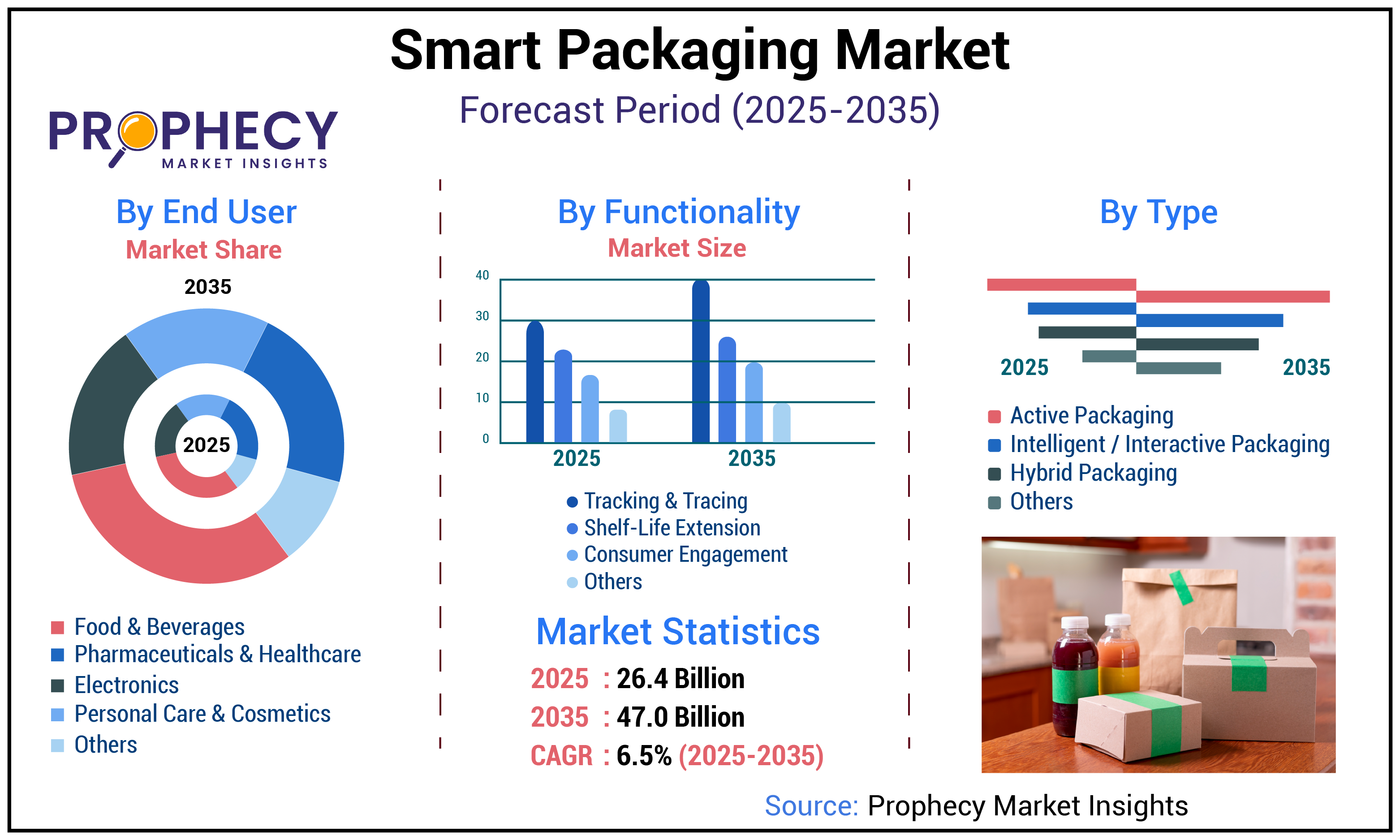
- 2024 Market Size: USD 25.0 Billion
- 2035 Projected Market Size: USD 47.0 Billion
- CAGR (2025-2035): 6.5%
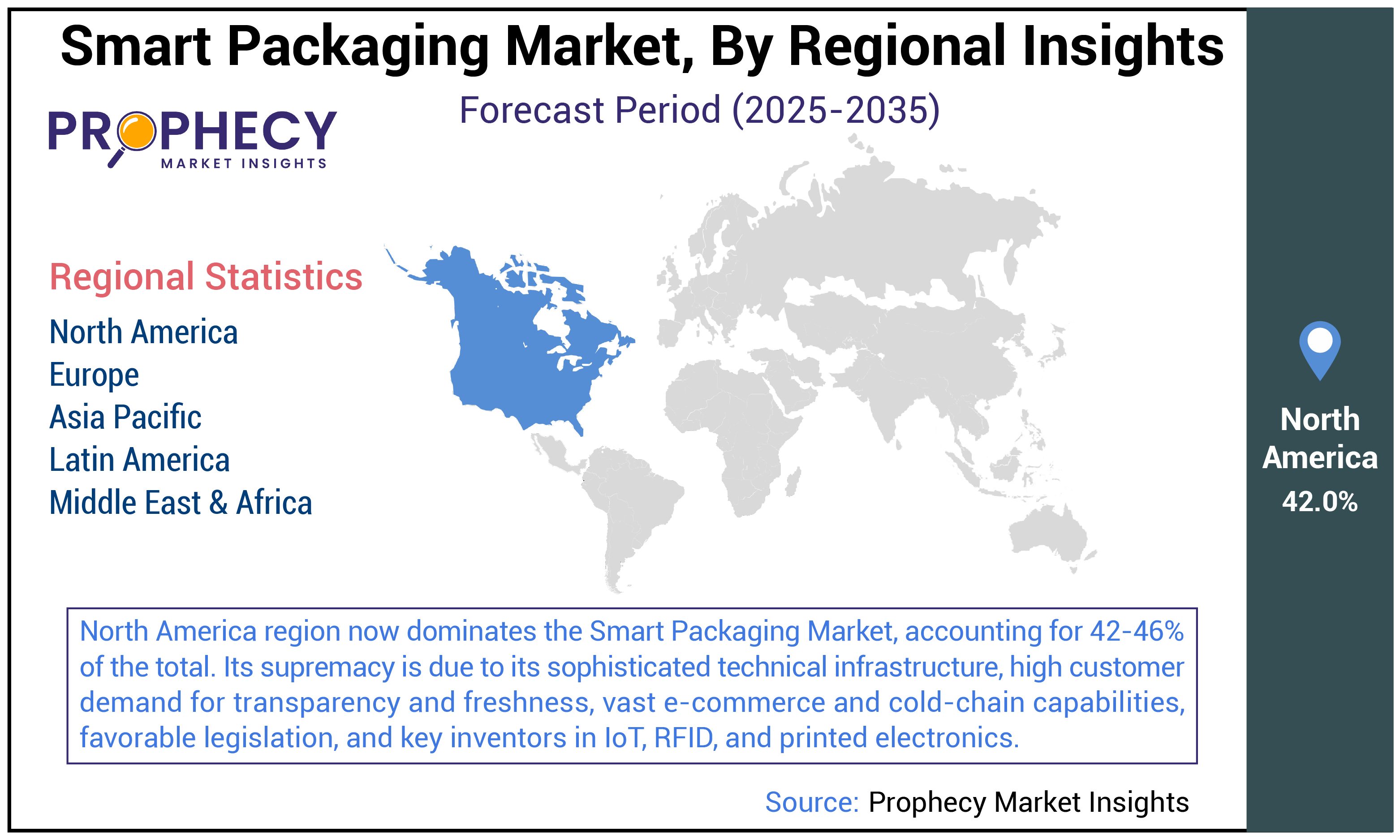
- North America: Largest Market in 2024
Smart packaging are packaging systems that have been integrated with different technologies such as sensors, QR codes, RFID, or indicators that go beyond the basic functionalities of protection and containment, for instance, being able to access, freshness monitoring, product authentication, or interactive consumer engagement. Some of the advantages of this technology are the safety of a product better than before, longer storage time, more efficient delivery of goods, less waste of products, and closer relationships between brands and consumers as a result of the availability of information and personalization of services.
Consumer demand for product transparency, safety, and freshness is driving the adoption of smart packaging, which finds a particular application in food, pharmaceuticals, and luxury goods sectors. The introduction of the Internet of Things (IoT), the use of sensors, the employment of radio frequency identification (RFID), the availability of quick response (QR) codes, and the use of near-field communication (NFC) are some of the technological breakthroughs that have paved ways for monitoring the condition of products in real-time, making them traceable, and allowing for interactive consumer engagement. At the same time, the rise of e-commerce and the increase in global trade are two factors that are intensifying the demand for intelligent, tamper-proof packaging, which can facilitate the transport of goods.
Potential Natural Antimicrobial Agents and Biopolymers for Food Packaging:
|
Classification |
Antimicrobial agents and biopolymers |
|
Plant volatiles and plant/spice extracts |
|
|
Polysaccharides and derivatives |
|
|
Proteins/enzymes/ bacteriocins |
|
|
Lipid based coatings |
|
|
Chelating agents |
|
Current Industry Dynamics & Insights:
- North America has the largest regional share in the market, with almost 43.56%.
- Europe is second dominating region in the market.
- By type, active packaging dominate the smart packaging market.
Smart Packaging Market Drivers & Restraints
Drivers and Restraints:
|
Drivers |
Restraints |
Opportunities & Trends |
|
|
|
Key Drivers:
Urbanization
Urbanization is the key factor for the growth of the smart packaging market as it has led a demand for such packaging which is easy to use, safe and sustainable in the case of hectic city lifestyles. More and more consumers are choosing the convenience of ready-to-eat meals, online shopping, and the speed of delivery.
Smart packaging becomes a guarantee for freshness, the guarantee of the authenticity of the product and for the possibility of tracking the product in real-time. Also, higher disposable urban incomes lead brands to implement more sophisticated and interactive packaging technologies, which is the adoption of the market that makes the fire continue to burn even more.
- For Instance, according to the data published by World Bank Group, in order to fulfill the World Bank's purpose of eradicating poverty and promoting shared prosperity on a habitable world, more livable cities must be built. Currently, 4.4 billion people, or more than half of the world's population, reside in urban areas. This trend is predicted to continue, with nearly seven out of ten people living in cities by 2050, when the urban population is predicted to more than quadruple.
Restraints:
Regulatory Hurdles
Regulations that act as obstacles may limit the growth of the smart packaging market in the way that they create difficulties for compliance in different regions. The issue is particularly prevalent in the food and pharmaceutical sectors as the safety, labeling, and data privacy rules differ significantly. Such incompatibilities hinder the use of these products across the globe and escalate the prices of producers.
- Counterbalance Statements: One way to resolve the issue is by creating universally applicable guidelines across different countries and encouraging coordination among the regulators, packaging companies and the technology providers. As a result, the process of getting approvals can be simplified, the amount of work needed to be reduced and the time for a safe and compliant smart packaging to be put into use can be faster.
Opportunities & Trends:
E-Commerce Growth
E-commerce expansion will significantly influence the smart packaging industry, which is one of the main future trends. This is due to the fact that e-commerce requires that the packaging be safe, tamper-proof and traceable to be able to guarantee the safety of the product during the shipping process. The mentioned smart packaging technologies as RFID, QR codes and sensors are the enablers of the supply chain visibility, the anti- counterfeit measures and the delivery that can be tracked in real-time. Moreover, interactive elements give brands the opportunity to connect with consumers via digital channels, which in turn makes e-commerce a more effective source of the uptake of intelligent packaging in the following years.
- For Instance, according to the data published by SellersCommerce, there are 2.77 billion global online shoppers. In 2025, 21% of retail purchases are expected to take place online, and this share will rise to 22.6% by 2027. Ecommerce sales will surpass $6.8 trillion in 2025. There are over 28 million eCommerce stores globally. 52% of online shoppers look for products internationally. 34% of shoppers shop online at least once a week.
Smart Packaging Market Segmentations & Regional Insights
Type, material, functionality, end user, and region are the divisions of the smart packaging market.
By Type:
Active packaging, intelligent / interactive packaging, and hybrid packaging are type on which smart packaging market is segmented. The main reason active packaging has the largest smart packaging market share is that it uses technologies including moisture absorbers, oxygen scavengers, and antimicrobial agents to directly improve product quality and shelf life. This makes it particularly useful for food, drinks, and medicines.
Intelligent/Interactive Packaging comes in second place. It uses sensors, QR/NFC codes, and augmented reality capabilities to provide real-time monitoring, customer involvement, and supply-chain visibility a feature that is becoming more and more desirable in industries involving e-commerce and healthcare.
- In January 2024, The ProActive Intelligence Moisture Protect (MP-1000), a patent-pending innovative moisture-adsorbing technology that does away with the need for desiccant packets, has been introduced by ProAmpac, a pioneer in flexible packaging and material science. MP-1000 platforms are perfect for applications that need the best moisture control, consisting of point-of-care diagnostic kits, live culture probiotics, and hygroscopic powdery food products. They do this by using Aptar's CSP Technologies' 3-Phase Activ-Polymer platform technology to reduce the moisture level in the packaging headspace.
By Material:
Based on the material, the smart packaging market is divided into plastic-based smart packaging, paper & cardboard-based smart packaging, glass-based smart packaging, and others. The greatest smart packaging market share is held by plastic-based smart packaging owing to its many uses in sectors including electronics, food, and medicines as well as its cost-effectiveness, flexibility, and lightweight nature.
Second position goes to smart packaging made of paper and cardboard, whose market share is growing quickly due to the growing need for eco-friendly, recyclable, and sustainable solutions, particularly in consumer products and e-commerce.
By Functionality:
Tracking & tracing, shelf-life extension, consumer engagement, and others are functionality of the smart packaging market. Since Shelf-Life Extension directly addresses spoilage reduction and quality preservation in highly perishable categories consisting of meat, poultry, and seafood, it holds the largest smart packaging market share (roughly 50% of the functionality-driven smart packaging segment). It is also known as functionality involving moisture/gas control.
With its capacity to improve supply chain visibility, anti-counterfeit protection, and customer interaction, Tracking & Tracing (product integrity monitoring, including RFID/NFC-enabled traceability) is the second-leading category and is growing in popularity.
By End User:
The smart packaging market on the account of end user are categorized into food & beverages, pharmaceuticals & healthcare, electronics, personal care & cosmetics, and others. Due to its high perishability, strict safety regulations, and high demand for traceability and freshness-monitoring technologies consisting of RFID, freshness indicators, and moisture absorbers, food and beverages hold the largest smart packaging market share, making up roughly 45–47% of the total value in 2023–2025.
Pharmaceuticals & Healthcare is the second-largest end-user category, and it is growing quickly as a result of growing demands for patient safety improvements, traceability, serialization, and anti-counterfeiting measures.
Regional Insights:
Geographically, the smart packaging Market is studied across North America, Europe, Asia Pacific, Latin America, and the Middle East & Africa.
North America: This region now dominates the smart packaging market, accounting for 42-46% of the total. Its supremacy is due to its sophisticated technical infrastructure, high customer demand for transparency and freshness, vast e-commerce and cold-chain capabilities, favorable legislation, and key inventors in IoT, RFID, and printed electronics.
- U.S. smart packaging Market Insights:
In North America, the U.S. has the largest share of the smart packaging market, thanks to its advanced technological infrastructure, high consumer demand for transparency and freshness, extensive e-commerce and cold-chain capabilities, supportive regulations, and major innovators in IoT, RFID, and printed electronics.
Europe: This region comes in second, accounting for around 26-30%, thanks to severe sustainability standards, food safety and traceability rules, and manufacturers' widespread use of eco-friendly smart packaging technology.
- Germany smart packaging Market Insights:
In Europe, Germany leads the smart packaging market, owing to its strong industrial base, strict food safety standards, and widespread use of sustainable and innovative packaging solutions across sectors.
Asia Pacific: Urbanization, expanding e-commerce, technology advances consisting of as RFID and smart labeling, and legislative support for food safety and sustainability are all driving the Asia-Pacific (APAC) smart packaging market forward.
- China smart packaging Market Insights:
China dominates the APAC market considering to its major pharmaceutical and food sectors, government programs such as "Made in China 2025," quick technological adoption, and strong industrial infrastructure.
Smart Packaging Market Report Scope:
|
Attribute |
Details |
|
Market Size 2025 |
USD 26.4 Billion |
|
Projected Market Size 2035 |
USD 47.0 Billion |
|
CAGR Growth Rate |
6.5% (2025-2035) |
|
Base year for estimation |
2024 |
|
Forecast period |
2025 – 2035 |
|
Market representation |
Revenue in USD Billion & CAGR from 2025 to 2035 |
|
Regional scope |
North America - U.S. and Canada Europe – Germany, U.K., France, Russia, Italy, Spain, Netherlands, and Rest of Europe Asia Pacific – China, India, Japan, Australia, Indonesia, Malaysia, South Korea, and Rest of Asia-Pacific Latin America - Brazil, Mexico, Argentina, and Rest of Latin America Middle East & Africa – GCC, Israel, South Africa, and Rest of Middle East & Africa |
|
Company Landscape |
Market Share Analysis of Companies Heat Map Analysis Company Overview, Products Overview Financial Information, Key Highlights Business Strategies Overview SWOT Analysis |
|
Report coverage |
Revenue forecast, company share, competitive landscape, growth factors, and trends |
|
Value Added Data Infosets |
Besides fundamental market insights such as the size of the market, growth rate, segmentation, regional study, and key players, our reports carry value-added data sets such as trade flow (import-export) analysis, production and consumption overview, price trend evaluation, supply and value chain mapping, and raw material availability. Moreover, we provide strategic tools as PESTLE and Porter’s Five Forces analysis, examination of the regulatory landscape, as well as monitoring of technology and innovation thereby providing a comprehensive overview which facilitates sensible and anticipatory decision-making. |
Segmentation:
By Type:
- Active Packaging
- Intelligent / Interactive Packaging
- Hybrid Packaging
By Material:
- Plastic-based Smart Packaging
- Paper & Cardboard-based Smart Packaging
- Glass-based Smart Packaging
- Others
By Functionality:
- Tracking & Tracing
- Shelf-Life Extension
- Consumer Engagement
- Others
By End User:
- Food & Beverages
- Pharmaceuticals & Healthcare
- Electronics
- Personal Care & Cosmetics
- Others
By Region:
- North America
- U.S.
- Canada
- Europe
- Germany
- U.K.
- France
- Russia
- Italy
- Spain
- Netherlands
- Rest of Europe
- Asia Pacific
- China
- India
- Japan
- Australia
- Indonesia
- Malaysia
- South Korea
- Rest of Asia Pacific
- Latin America
- Brazil
- Mexico
- Argentina
- Rest of Latin America
- Middle East & Africa
- GCC
- Israel
- South Africa
- Rest of Middle East & Africa
Smart Packaging Market Competitive Landscape & Key Players
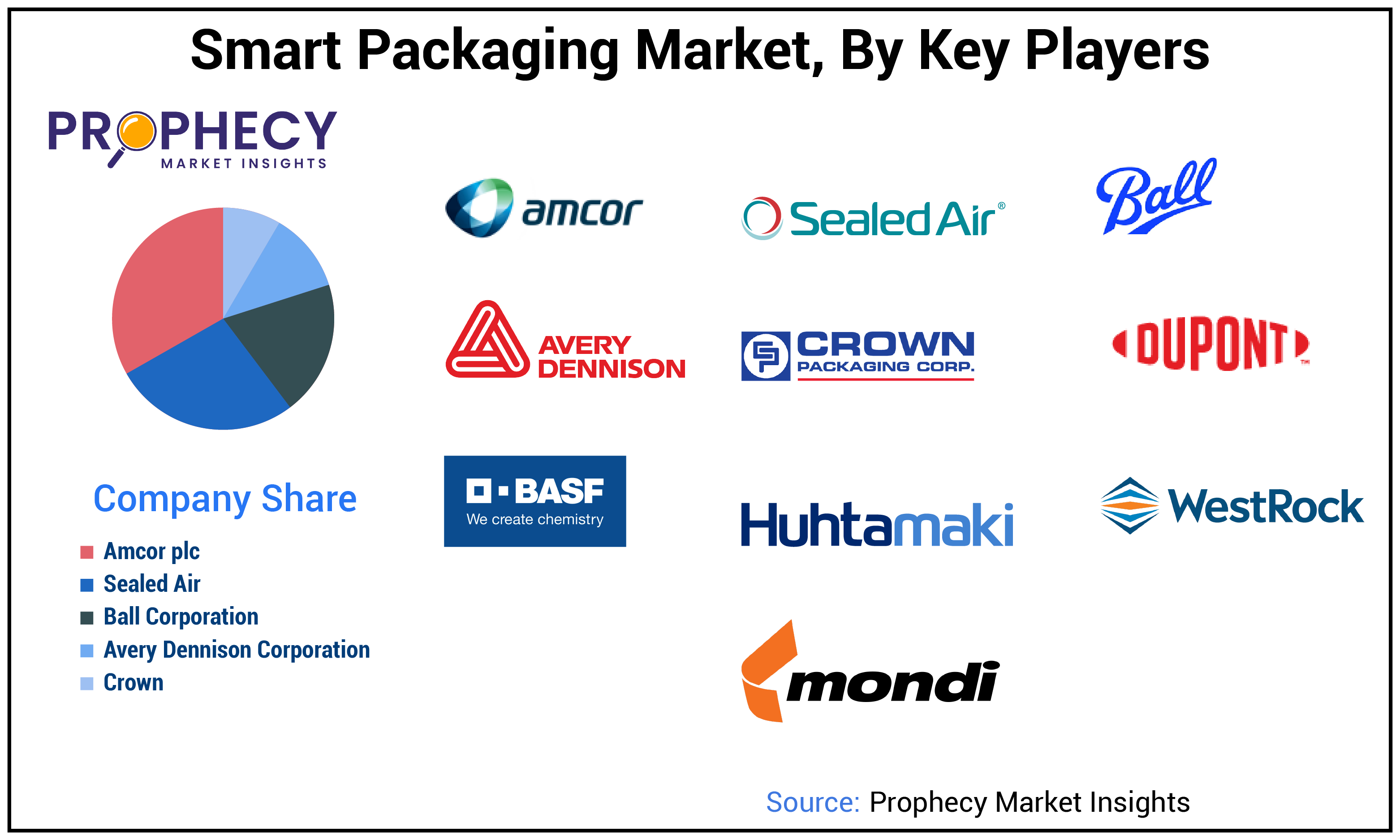
The key players operating in the smart packaging market include, Sealed Air, BASF, Avery Dennison Corporation, and others. Smart packaging producers may expand by investing in research and development, collaborating with important sectors, targeting growing markets, improving IoT integration, and focusing on sustainable, eco-friendly packaging solutions.
Smart Packaging Market Companies:
- Amcor plc
- Sealed Air
- Ball Corporation
- Avery Dennison Corporation
- Crown
- DuPont
- BASF
- Huhtamäki Oyj
- International Paper
- Smurfit Westrock
- 3M
- WestRock
- Tetra Pak International S.A.
- Mondi
- MITSUBISHI GAS CHEMICAL COMPANY, INC.
View an Additional List of Companies in the Smart Packaging Market
Smart Packaging Market Recent News
- In June 2025, Identiv, Inc., a specialist in RFID- and BLE-enabled Internet of Things (IoT) solutions, will showcase its most recent smart packaging solutions for Digital Product Passports (DPPs) and supply chain analytics at the AIPIA & AWA Smart Packaging World Congress 2025 in Amsterdam on June 23-24, 2025. These NFC and BLE-enabled packaging solutions enable firms to trace product provenance, support regulatory compliance and environmental goals, and communicate directly with customers.
- In May 2025, MPE Partners has established a new bespoke food packaging platform by making separate strategic investments in Central Coated Products and Sun America. Following the deal, both firms will continue to operate at their present manufacturing sites, with everyday activities probably to stay constant despite the amalgamation.
- In October 2024, Think Tank, a UK-based custom packaging design business, has introduced new smart packaging shapes to assist clients upgrade their packaging design and expand their commercial reach. Pioneering digital platforms include NFC (near field communication) capabilities, which are used in the technology. Unique digital access codes are implanted in physical objects, which are subsequently tapped by an NFC-enabled smartphone, directing the customer to an internet back-end hub to access digital content.
- In October 2024, SPI and NNZ announced a strategic worldwide alliance that would transform fruit and vegetable packaging solutions in Europe, South Africa, and North America. The agreement brings together SPI's experience and global patent in creative packaging with NNZ's enormous distribution network and industry knowledge to provide cutting-edge solutions to the global fruit and vegetable market.
Analyst View:
Smart packaging uses technology such as sensors, QR codes, RFID, and NFC to go beyond basic protection, allowing for real-time freshness monitoring, product verification, and interactive customer involvement. Its advantages include increased safety, extended shelf life, more efficient transportation, less waste, and greater brand-consumer ties. Consumer desire for transparency and freshness is driving the usage of smart packaging in food, medicines, and luxury products, which is being pushed by IoT use, e-commerce expansion, and global trade.
Analysis of Sources:
Primary Sources:
- In-depth interviews
- Company-specific data
- Surveys and questionnaires
- Focus group discussions (FGDs)
- Others
Secondary Sources:
- Food and Drug Administration (FDA)
- Environmental Protection Agency (EPA)
- National Environment Agency (NEA) Regulations
- Food Safety and Standards Authority of India (FSSAI)
- Others
More Related Reports
Smart Textile Market
Smart Weapons Market
Smart Healthcare Products Market
Smart Home Market
Smart Classroom Market
Smart Packaging Market Company Profile
|
Company Name |
Product Portfolio |
|
Amcor plc |
Digital Connected Packaging System |
|
Sealed Air |
Smart Packaging Services |
|
Avery Dennison Corporation |
Advanced Smart Label Solutions |
|
3M |
Sustainable Packaging Solutions |
|
DuPont |
Active Packaging Solutions |
Smart Packaging Market Highlights
FAQs
Smart Packaging Market size was valued at USD 26.4 Billion in 2025 and is expected to reach USD 47.0 Billion by 2035 growing at a CAGR of 6.5%.
Type, material, functionality, end user, and region are the segmentation for the smart packaging market.
Increasing consumer demand for product safety and convenience, the rise of e-commerce, and so on are some of the Smart Packaging Market growth drivers.
North America, Asia Pacific, Europe, Latin America, and the Middle East & Africa. North America is expected to dominate the smart packaging Market.
Generative AI increases the smart packaging business by allowing for speedier design, individualized labeling, predictive shelf-life management, and supply chain efficiency, as well as fostering innovation in sustainable materials and smart sensors.
The key players operating the smart packaging market include Amcor plc, Sealed Air, Ball Corporation, Avery Dennison Corporation, Crown, DuPont, BASF, Huhtamäki Oyj, International Paper, Smurfit Westrock, 3M, WestRock, Tetra Pak International S.A., Mondi, and MITSUBISHI GAS CHEMICAL COMPANY, INC.