Global Omega Ingredients Market By Overview
- 2024 Market Size: USD 4.4 Billion
- 2035 Projected Market Size: USD 13.5 Billion
- CAGR (2025-2035): 11.8%
- North America: Largest Market in 2024
Features loaded with omega-3 are the essential polyunsaturated fatty acids that consist mainly of EPA, DHA, and ALA. These are the fatty acids that the human body is not capable of producing and therefore they have to be taken from the diet or food sources such as fish oil, krill oil, algae, flaxseed, and chia seeds. They are being widely promoted in dietary supplements, functional foods, and pharmaceuticals due to their confirmed beneficial effects on health. Their benefits, in general, include, among others, the integration of the cardiorespiratory system, the anti-inflammatory processes, the stimulation of brain and eye development, the improvement of cognitive abilities, and the promotion of overall health.
The demand scenario of the Omega-3 ingredients market has been influenced significantly by various factors. These factors are primarily the consumer awareness of health and wellness trends, the prevalence of cardiovascular diseases, and other lifestyle-related diseases, along with the increasing consumption of functional foods, dietary supplements, and fortified beverages. Besides this, the move towards preventive healthcare, the increase in disposable incomes, and the growing trend of plant-based and eco-friendly omega-3 sources such as algal oil are a few more reasons for the market expansion worldwide.
Safety and Standards Regarding Omega 3 Ingredients:
- The healthy Omega-3 components are preserved under very tightly regulated rules so that they stay pure, potent, and safe for consumers.
- There are limits for the levels of various pollutants like heavy metals, PCBs, and the degree of the oxidation of fish and marine oils that are set by the U.S. Food and Drug Administration (FDA), the European Food Safety Authority (EFSA), Codex Alimentarius, and others.
- The quality is guaranteed by the manufacturers who are following Good Manufacturing Practices (GMP) and also by the third-party certification as IFOS (International Fish Oil Standards) which is a good standard that is widely used to keep up the quality, to give the correct information on the EPA/DHA content and to ensure the safety of dietary supplements, fortified foods, and pharmaceuticals.
Current Industry Dynamics & Insights:
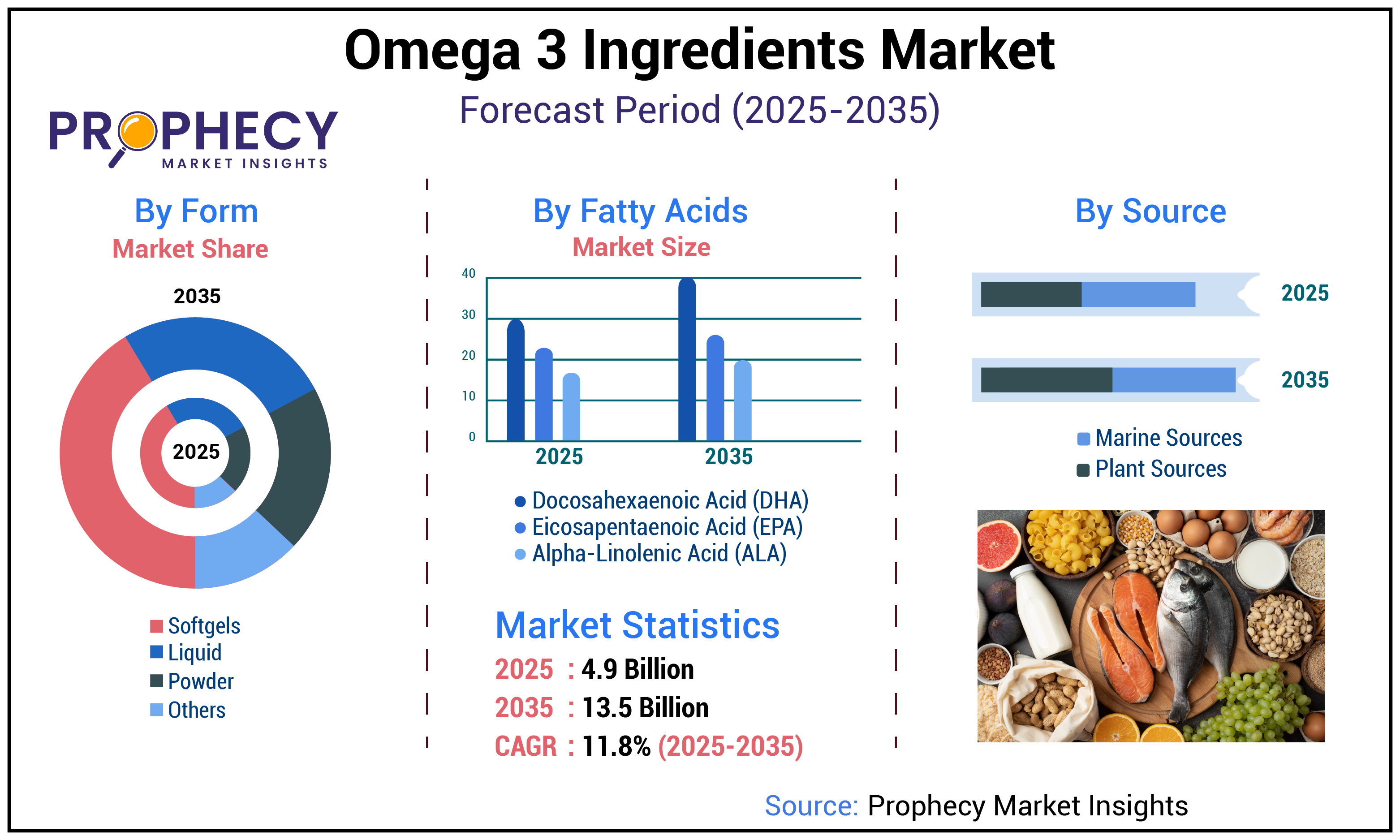
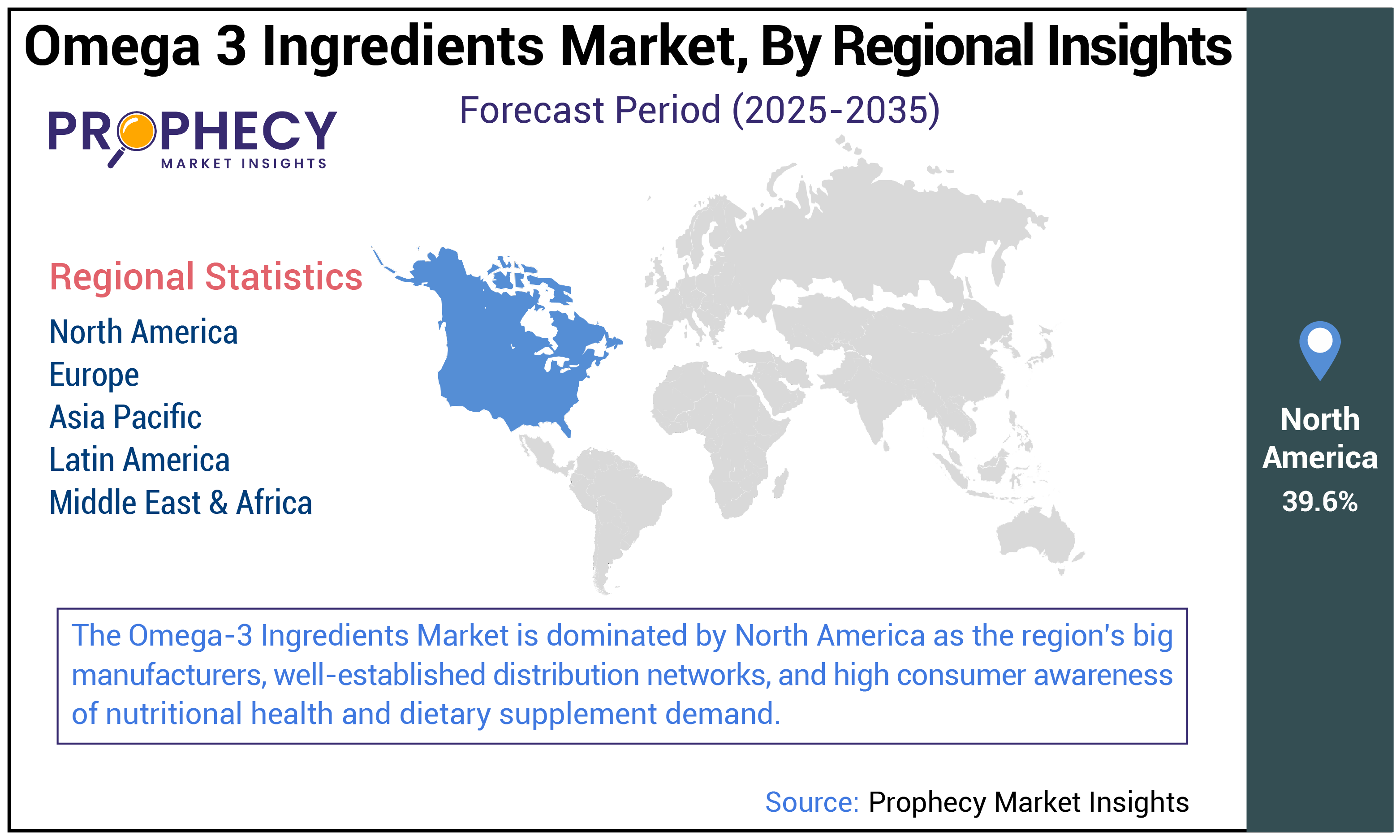
- North America has the largest regional share in the market, with almost 39.6%.
- Europe is second dominating region in the market.
- By fatty acids type, docosahexaenoic acid (DHA) dominate the Omega 3 ingredients market share.
Global Omega Ingredients Market By Drivers & Restraints
Drivers and Restraints:
|
Drivers |
Restraints |
Opportunities & Trends |
|
|
|
Key Drivers:
Increasing Prevalence of Lifestyle-Related Diseases
Lifestyle-related diseases such as cardiovascular disorders, obesity, diabetes, and hypertension have been one of the primary factors that have driven the demand for Omega-3 ingredients. Since these diseases are typically caused by unhealthy diets and lack of exercise, people are opting for preventive nutrition products, such as omega-3 supplements, which have been confirmed by clinical trials to be effective in keeping the heart healthy, relieving inflammatory conditions, and improving metabolic functions.
The growing trend of health consciousness and the continually rising need for natural, scientifically validated products are the two main reasons why omega-3 has become so widely used in the food, supplement, and pharmaceutical industries.
- For Instance, according to the data published by WHO, Cardiovascular diseases account for most NCD deaths, or at least 19 million deaths in 2021, followed by cancers (10 million), chronic respiratory diseases (4 million), and diabetes (over 2 million including kidney disease deaths caused by diabetes).
Restraints:
Stability and Oxidation Issues of Omega-3 Oils
Firstly, the limited stability of omega-3 oils and their tendency to go through oxidation is one of the main reasons why the market cannot expand to a great extent. These are very sensitive oils to degradation if they are exposed to heat, light, or air, and this leads to the generation of bad odors, the product having a short shelf life, and also the nutritional value is lost. Manufacturers face a lot of challenges in ensuring product quality during their processing and storage because of this situation.
- Counterbalance Statements: Therefore, there are several advanced methods such as microencapsulation, antioxidant addition, and the use of better packaging techniques which are used to protect omega-3s from an oxidative process, to increase their stability, and to ensure that the quality of supplements and fortified food products do not change.
Opportunities & Trends:
Fortification of Foods and Beverages with Omega-3s
Adding omega-3E fatty acids to foods and drinks is becoming the main next-trend in the market, as consumers are increasingly demanding convenient products that are good for their health. In this way, the producers embedding omega-3 ingredients into daily consumables as milk products, fruit drinks, health bars, and bakery can give the buyers a chance to complete their dietary requirements without the need of a separate supplement.
This move not only encourages the adoption of preventive health practices but also extends the usage of omega-3E and agrees with the increasing consumer inclination towards functional and fortified products which contribute to health of the heart, brain, and general wellness.
Global Omega Ingredients Market By Segmentations & Regional Insights
Fatty acids type, source, form, end user, and region are the divisions of the omega 3 ingredients market.
By Fatty Acids Type:
Based on the fatty acids type, the omega 3 ingredients market is divided into alpha-linolenic acid (ALA), eicosapentaenoic acid (EPA), and docosahexaenoic acid (DHA). Due to its critical role in the development of the brain, eye, and nervous system, docosahexaenoic acid (DHA) has the biggest omega 3 ingredients market share among the three fatty acids and is therefore in high demand in newborn formulae, nutritional supplements, and functional foods. Further contributing to its popularity are its extensive use in healthcare applications and robust clinical validation.
The second most prevalent form, eicosapentaenoic acid (EPA), is widely used in pharmaceutical formulations and heart health supplements due to its anti-inflammatory and cardiovascular properties.
By Source:
The omega 3 ingredients market is categorized into marine sources, and plant sources on the account of source. The omega-3 ingredients market size is dominated by marine sources since fish, krill, and cod liver oils offer highly concentrated and accessible forms of EPA and DHA, which have been shown in studies to promote eye, brain, and cardiovascular health. The dominance of omega-3s produced from marine sources is further reinforced by well-established extraction techniques and high customer trust.
With oils from flaxseed, chia, and algae providing sustainable and allergy-free substitutes with expanding uses in functional foods and supplements, plant sources rank second in terms of market share and are becoming more popular among vegan and eco-conscious consume.
By Form:
Liquid, softgels, powder, and others are function of the omega 3 ingredients market. As the most popular format for dietary supplements, the softgel form has biggest omega-3 ingredients market share since it provides accurate dosing, ease of administration, improved oxidation prevention, and a longer shelf life. Its popularity is also fueled by its ease of use and familiarity with consumers.
The second most popular form is the liquid form, which is preferred for its adaptability in pharmaceutical, baby nutrition, and food and beverage fortification applications as well as its quicker rate of absorption. However, stability and taste issues plague this form.
By End User:
The omega 3 ingredients market on the account of end user is categorized into pharmaceuticals, food & beverages, animal nutrition & pet food, and others. Since EPA and DHA have been shown to be effective in treating inflammation, cardiovascular disease, and other metabolic disorders, prescription medications and medical-grade supplements have widely adopted them, giving the pharmaceuticals segment the largest market share in the market for omega-3 ingredients.
Considering consumers are choosing more convenient food forms to incorporate omega-3s into their daily diets, the food and beverage industry is the second most dominating, driven by the growing demand for functional and fortified goods that support heart, brain, and general wellbeing.
Regional Insights:
Geographically, the omega 3 ingredients market is studied across North America, Europe, Asia Pacific, Latin America, and the Middle East & Africa.
North America: The omega-3 ingredients market is dominated by North America as the region's big manufacturers, well-established distribution networks, and high consumer awareness of nutritional health and dietary supplement demand.
- U.S. Omega 3 Ingredients Market Insights:
The U.S. leads the omega-3 ingredients market in North America as its sophisticated R&D capabilities, strong dietary supplement culture, and high level of consumer awareness of preventative healthcare. Leading omega-3 producers are based there, and the nation enjoys advantageous laws that encourage the development of functional foods.
Europe: Due to strict quality requirements, growing consumption of omega-3-enriched products, and the growing popularity of sustainable and plant-based omega-3 sources especially in nations as Germany, the United Kingdom, and France—Europe is currently the second-largest market.
- Germany Omega 3 Ingredients Market Insights:
In Europe, Germany leads the market owing to its robust nutraceuticals industry, increasing demand for fortified foods, and consumer preference for high-quality, sustainable omega-3 products derived from both marine and plant-based sources.
Asia Pacific: This region omega-3 ingredients market is expanding quickly as a result of growing disposable incomes, health consciousness, and dietary choices that are moving toward functional foods and preventative nutrition.
- China Omega 3 Ingredients Market Insights:
Due to its sizable customer base, growing middle class, and robust production capacity for both marine and algal omega-3s as well as government programs supporting nutrition and health—China leads the APAC market.
|
Attribute |
Details |
|
Market Size 2025 |
USD 4.9 Billion |
|
Projected Market Size 2035 |
USD 13.5 Billion |
|
CAGR Growth Rate |
11.8% (2025-2035) |
|
Base year for estimation |
2024 |
|
Forecast period |
2025 – 2035 |
|
Market representation |
Revenue in USD Billion & CAGR from 2025 to 2035 |
|
Regional scope |
North America - U.S. and Canada Europe – Germany, U.K., France, Russia, Italy, Spain, Netherlands, and Rest of Europe Asia Pacific – China, India, Japan, Australia, Indonesia, Malaysia, South Korea, and Rest of Asia-Pacific Latin America - Brazil, Mexico, Argentina, and Rest of Latin America Middle East & Africa – GCC, Israel, South Africa, and Rest of Middle East & Africa |
|
Company Landscape |
Market Share Analysis of Companies Heat Map Analysis Company Overview, Products Overview Financial Information, Key Highlights Business Strategies Overview SWOT Analysis |
|
Report coverage |
Revenue forecast, company share, competitive landscape, growth factors, and trends |
|
Value Added Data Infosets |
Besides fundamental market insights such as the size of the market, growth rate, segmentation, regional study, and key players, our reports carry value-added data sets such as trade flow (import-export) analysis, production and consumption overview, price trend evaluation, supply and value chain mapping, and raw material availability. Moreover, we provide strategic tools as PESTLE and Porter’s Five Forces analysis, examination of the regulatory landscape, as well as monitoring of technology and innovation thereby providing a comprehensive overview which facilitates sensible and anticipatory decision-making. |
Segmentation:
By Fatty Acids Type:
- Alpha-Linolenic Acid (ALA)
- Eicosapentaenoic Acid (EPA)
- Docosahexaenoic Acid (DHA)
By Source:
- Marine Sources
- Plant Sources
By Form:
- Liquid
- Softgels
- Powder
- Others
By End User:
- Pharmaceuticals
- Food & Beverages
- Animal Nutrition & Pet Food
- Others
By Region:
- North America
- U.S.
- Canada
- Europe
- Germany
- U.K.
- France
- Russia
- Italy
- Spain
- Netherlands
- Rest of Europe
- Asia Pacific
- China
- India
- Japan
- Australia
- Indonesia
- Malaysia
- South Korea
- Rest of Asia Pacific
- Latin America
- Brazil
- Mexico
- Argentina
- Rest of Latin America
- Middle East & Africa
- GCC
- Israel
- South Africa
- Rest of Middle East & Africa
Global Omega Ingredients Market By Competitive Landscape & Key Players
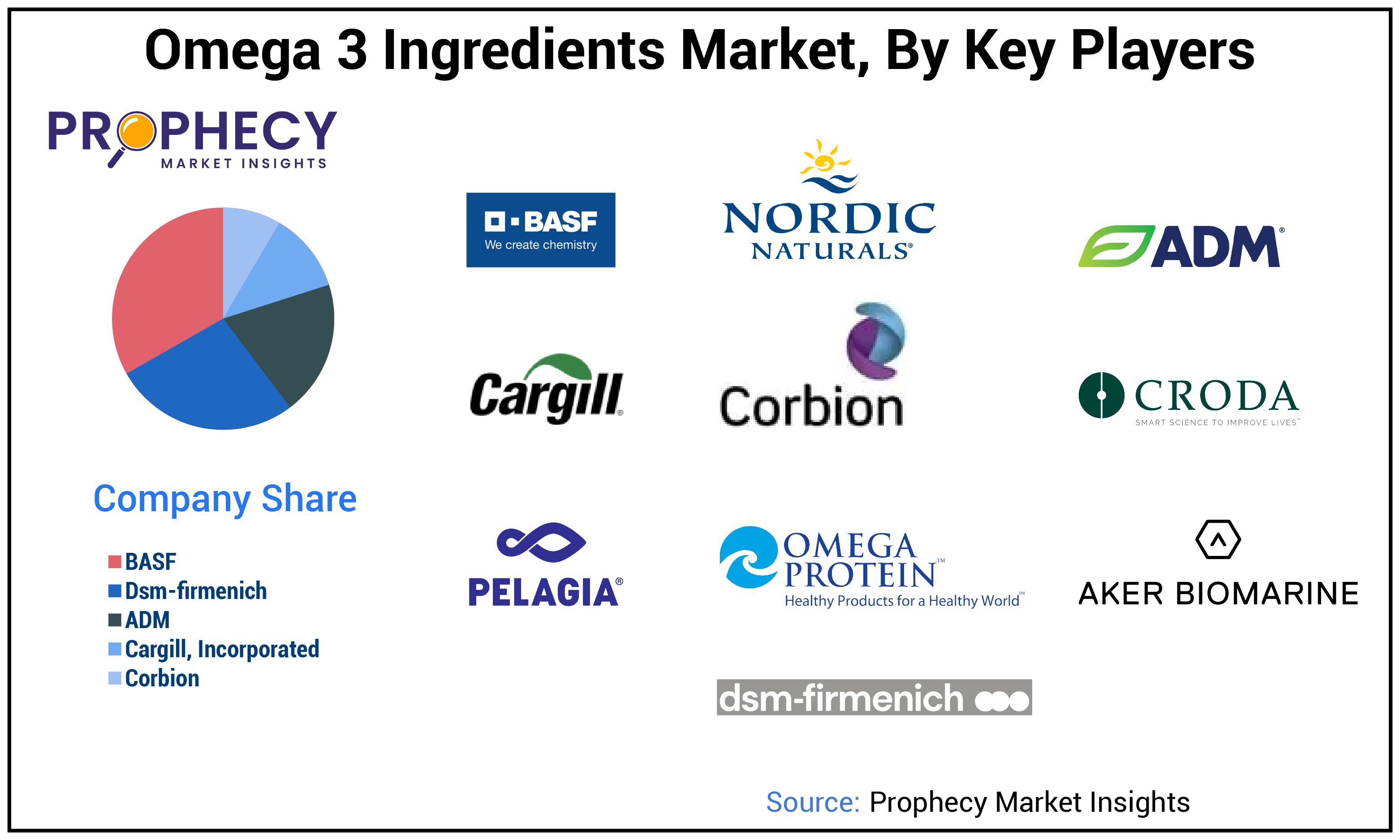
Expanding product portfolios with novel and sustainable sources, such as plant-based and algae-based oils, investing in research and development for enhanced stability and bioavailability, and focusing on developing markets with high health consciousness are important growth strategies for firms that produce omega-3 components.
In order to increase market penetration and long-term growth, businesses are also concentrating on strategic alliances, mergers, and acquisitions to fortify distribution networks, improving food and beverage fortification, and utilizing trends in personalized nutrition to meet the health needs of particular consumers.
Omega 3 Ingredients Market Companies:
- BASF
- Dsm-firmenich
- ADM
- Cargill, Incorporated
- Corbion
- Croda International Plc
- Pelagia AS
- Omega Protein Corporation
- AKER BIOMARINE
- Epax Norway AS
- GOLDEN OMEGA
- SOLUTEX
- Algarithm
- Nordic Naturals
- Copeinca ASA
View an Additional List of Companies in the Omega 3 Ingredients Market
Global Omega Ingredients Market By Recent News
- In February 2025, GC Rieber VivoMega, an expert in omega-3 ingredients, has announced the release of Algae 1060 TG Premium, a DHA and EPA product derived from algae. The nutraceutical is intended to be a premium and reasonably priced way to add to a variety of supplement formulas.
Analyst View:
The body is unable to generate omega-3 components, such as EPA, DHA, and ALA, so it must get them from foods as fish, krill, algae, flaxseed, and chia. They are widely employed in medications, functional foods, and supplements to promote heart health, lower inflammation, boost brain and eye development, and enhance general wellbeing.
Rising health consciousness, an increase in lifestyle-related illnesses, the need for plant-based and fortified goods, trends in preventative healthcare, and rising disposable incomes worldwide are all factors propelling the market's expansion.
Analysis of Sources:
Primary Sources:
- In-depth interviews
- Company-specific data
- Surveys and questionnaires
- Focus group discussions (FGDs)
- Others
Secondary Sources:
- U.S. Food and Drug Administration (FDA)
- European Food Safety Authority (EFSA)
- World Health Organization (WHO)
- U.S. National Institutes of Health (NIH)
- Others
More Related Reports
Omega 3 Supplements Market
Omega-3 Products Market
Fish Oil Omega-3 Market
Bioactive Ingredients Market
Nutricosmetics Market
Global Omega Ingredients Market By Company Profile
|
Company Name |
Product Portfolio |
|
BASF |
Omega 3 Solutions |
|
Croda International Plc |
Omega 3 APIs |
|
Cargill, Incorporated |
Omega-3 Fatty Acids |
|
ADM |
Omega-3-s |
Global Omega Ingredients Market By Highlights
FAQs
Omega 3 ingredients market size was valued at USD 4.9 Billion in 2025 and is expected to reach USD 13.5 Billion by 2035 growing at a CAGR of 11.8%.
Fatty acids type, source, form, end user, and region are the segmentation for the omega 3 ingredients market.
Increased consumer awareness of health benefits like improved heart and brain health, rising demand for functional foods and supplements, and technological advancements in production and formulation, and so on are some of the omega 3 ingredients market growth drivers.
North America, Asia Pacific, Europe, Latin America, and the Middle East & Africa. North America is expected to dominate the omega 3 ingredients market.
The key players operating the omega 3 ingredients market include BASF, Dsm-firmenich, ADM, Cargill, Incorporated, Corbion, Pelagia AS, Omega Protein Corporation, Epax Norway AS, GOLDEN OMEGA, SOLUTEX, Algarithm, Nordic Naturals, and Copeinca ASA.