Global Liquid Hydrogen Market By Overview
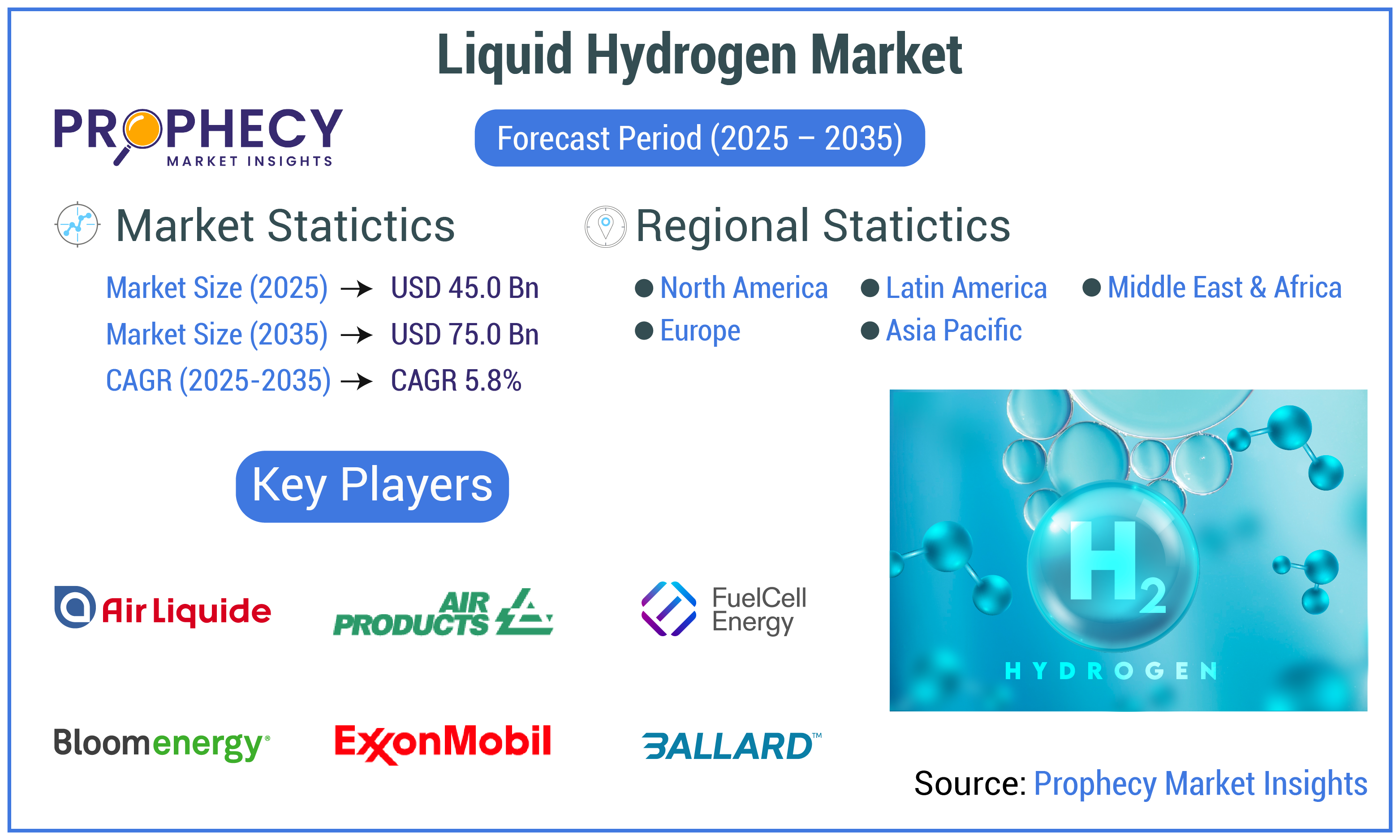
- Liquid hydrogen market size is expected to expand at a rate of USD 75.0 Billion, by 2035.
- In 2024, the target market valuation was USD 41.0 Billion.
- Liquid hydrogen market is growing at a CAGR of 5.8%.
Liquid hydrogen (LH2) is hydrogen in its liquid state, achieved by cooling hydrogen gas (H2) to extremely low temperatures (below -253°C). It's a form of hydrogen storage, offering higher energy density than gaseous hydrogen, making it ideal for applications such as rocket propulsion and fuel cells. These offers several advantages due to its high energy density and ease of transport compared to compressed gaseous hydrogen. It's particularly beneficial for applications where space and weight are critical, such as aerospace. Liquid hydrogen also provides a longer range than compressed hydrogen and is more efficient to transport over long distances.
The liquid hydrogen market is experiencing growth due to a confluence of factors, including the increasing push towards decarbonization, integration of renewable energy sources such as wind and solar into the electricity grid creates a need for energy storage solutions, and liquid hydrogen can play a crucial role in storing excess renewable energy, the growing demand from liquid nitrogen by various industries.
The market’s augmentation is also stimulated by improvements in fuel cell technology that are making hydrogen-powered vehicles more efficient and cost-effective, driving adoption in the transportation sector, and advancements in hydrogen infrastructure, including production, storage, and distribution, are essential for widespread adoption of liquid hydrogen.
Recession Risk and Tariff Analysis:
- The liquid hydrogen market is particularly vulnerable to recession due to its high capital requirements and dependence on government assistance. Reduced financing, postponed infrastructure projects, and a decline in demand in industries such as transportation and aircraft can all result from economic downturns. Expensive manufacturing and storage expenses make these issues much worse and may prevent the industry from expanding.
- Different tariff regulations in different areas have an impact on the worldwide market for liquid hydrogen. Recent taxes on imported electrolyzers and associated parts in the US have raised production costs, which may hinder adoption and discourage foreign investment. On the other hand, India is thinking of lowering tariffs on equipment used to produce green hydrogen in order to increase exports and position itself as a major participant in the world market. In order to stay competitive, European industries are pushing for stronger trade regulations to guard against cheap imports, especially those coming from China.
Impact of Generative AI on Liquid Hydrogen Market:
- The liquid hydrogen market is being greatly impacted by generative AI as it improves manufacturing, storage, and use efficiency. It expedites deployment schedules and lowers costs by streamlining the design and operation of hydrogen plants. AI speeds up creativity in research and development by accelerating the creation of catalysts for hydrogen generation.
- AI also helps to optimize sustainability and energy management plans. Additionally, hydrogen fuel cells are being explored as sustainable power sources for AI data centers, addressing the growing energy demands of AI technologies.
Global Liquid Hydrogen Market By Drivers & Restraints
Key Drivers:
Rising Push towards Decarbonization is expected to pitch the Market Expansion
The liquid hydrogen market is expanding at a rapid pace due to the worldwide effort for decarbonization. Liquid hydrogen, which only emits water vapor when used, emerges as a clean energy transporter as countries work to minimize greenhouse gas emissions. It is a crucial tool for reaching carbon neutrality due to its use in difficult-to-abate industries such as heavy industrial and long-distance transportation. Market development is also supported by government initiatives, such as the European Union's target to create 10 million tonnes of clean hydrogen annually by 2030. Furthermore, significant expenditures on hydrogen technology and infrastructure highlight its critical position in the global energy transition.
- For instance, according to the data published by MDPI, by 2050, global CO2 emissions will have increased from 37.1 Gtpa in 2021 to 49.6 Gtpa, with polluters accounting for 81% of the increase and decarbonisers for 14%. There will only be 14 economies that achieve net zero. Each economy's decarbonisation goals are determined, and both polluters and decarbonisers must reduce its CO2 emissions. Decarbonisation is required since the use of renewable energy has only grown by 4 percentage points over the past ten years. Thus, this rising push towards decarbonization is expected to drive the demand for liquid hydrogen.
Restraints:
The Challenge of Storage and Transportation is Limiting the Market Expansion
The difficulty of transportation and storage is a significant drawback of the liquid hydrogen business. Cryogenic temperatures below -253°C are necessary for liquid hydrogen, which makes handling it challenging and raises the possibility of boil-off and hydrogen leakage. Specialized insulated tanks and infrastructure are required for these circumstances, although these are not commonly accessible. Furthermore, there are space limitations as hydrogen has a poor energy density per volume, requiring enormous storage capacity. Its widespread implementation and integration into current energy systems are restricted by these logistical challenges, particularly in isolated or impoverished areas.
- Counterbalance Statements: Investing in composite storage materials and cutting-edge insulation technologies can increase containment efficiency. Transportation requirements can be decreased by creating decentralized hydrogen hubs and growing cryogenic infrastructure. Global adoption will be streamlined by promoting international standards for hydrogen logistics. Direct storage and transportation issues can also be lessened by research into substitute hydrogen carriers, such as ammonia.
Opportunities & Trends:
Advancements in Fuel Cell Technology is Opening Up Growth Opportunities for the Future Generations
Fuel cell technology developments are expected to greatly expand the demand for liquid hydrogen. Proton exchange membrane (PEM) fuel cells in particular provide greater efficiency and quicker reaction times, which makes it perfect for industrial and transportation applications. This development makes liquid hydrogen a more viable renewable energy source, especially for industries such as heavy-duty haulage and maritime transportation where high energy density and quick refueling are essential. Fuel cell technologies will boost global decarbonization efforts by increasing demand for liquid hydrogen as these develop further.
- For instance, in July 2023, according to the data published by FASTECH, electricity is normally produced at 33–35% efficiency in a traditional combustion-based power plant. Fuel cell systems, on the other hand, may produce energy with up to 60% efficiency (and even higher with cogeneration). Fuel cell systems in hydrogen-powered vehicles may use 60% of the fuel's energy, which reduces fuel consumption by more than 50% when compared to a typical vehicle with a gasoline internal combustion engine. Thus, these rapid advancements in the fuel cell technology fuels the demand for liquid hydrogen in the future.
Global Liquid Hydrogen Market By Segmentations & Regional Insights
The liquid hydrogen market is segmented into production method, distribution method, end-use industry, and region.
By Production Method:
Based on production method, the market is divided into coal gasification, steam methane reforming (SMR), electrolysis, and others. The steam methane reforming (SMR) segment is expected to dominate the liquid hydrogen market share. This is due to its well-established technology with significant economies of scale, making it relatively inexpensive to produce hydrogen, its easy access to raw materials, and high yield.
The coal gasification segment is the second dominating production method, in the target market. This is due to its mature technology that has been used for many years, and it is particularly suitable for situations where there is a large supply of coal.
By Distribution Method:
Contingent to distribution method, the market is sub-segmented into pipelines, cryogenic tanks, and others. The pipelines segment is the leading distribution method in liquid hydrogen market share. This is due to its efficiency, cost-effectiveness, and ability to deliver large volumes of hydrogen over long distances. While other methods such as compressed gas or liquid carriers exist, pipelines offer a continuous, consistent flow, reducing storage needs and potentially lowering overall costs.
The cryogenic tanks segment is the second leading distribution method, in the liquid hydrogen market. This is due to its critical role in safely and efficiently storing and transporting liquid hydrogen, which needs to be kept at extremely low temperatures. Pipelines are also a significant distribution method, especially as infrastructure develops to support growing hydrogen demand.
By End-Use Industry:
Depending upon end-use industry, the market is classified into transportation, electronics, chemicals & petrochemicals, refining, metals, glass, and others. The chemicals & petrochemicals segment is holding the superior position in the liquid hydrogen market share. This is due to its use as a key feedstock for various chemical processes and the refining of petroleum products. Specifically, hydrogen is crucial in producing ammonia, a key component in fertilizers. Additionally, it's used in hydrocracking to create petroleum products such as gasoline and diesel, and in other petrochemical processes such as methanol production.
The transportation segment is the second superior end-use industry, in the target market. This is due to the increasing demand for hydrogen fuel cell vehicles (FCEVs) and the potential for hydrogen to decarbonize transportation, especially in heavy-duty applications.
Regional Insights:
Geographically, the market is studied across North America, Europe, Asia Pacific, Latin America, and the Middle East & Africa.
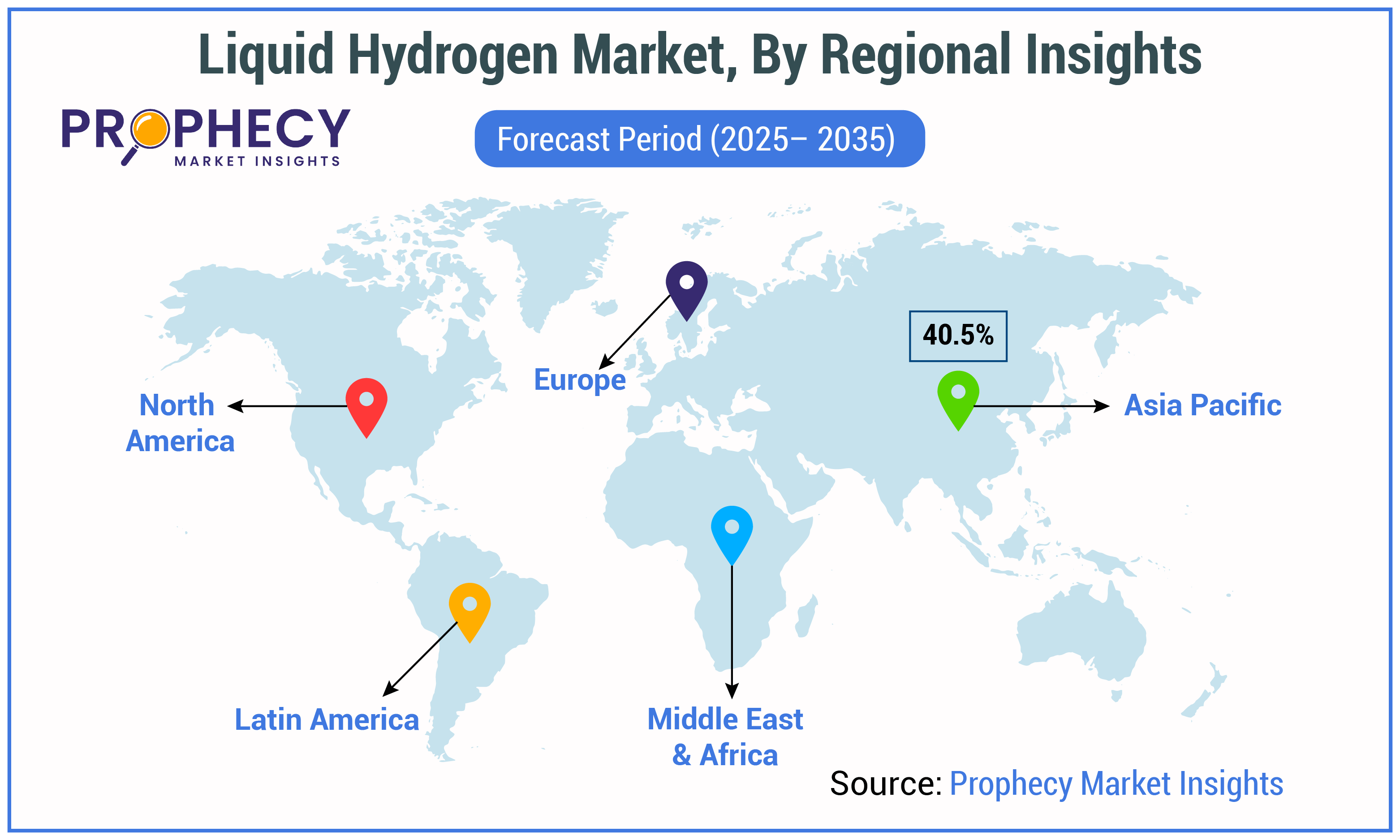
Asia Pacific: This is the region which has the governing liquid hydrogen market with an estimated share of approximately 40.5%, in the recent years. This is due to a combination of factors, such as, this region’s strong government support, increasing demand for clean energy, the growing demand for liquid hydrogen in various industries, the rise of fuel cell vehicles and the development of hydrogen fueling infrastructure, significant progress in hydrogen production and storage technologies is enabling more efficient and cost-effective liquid hydrogen production and distribution, and the presence of key market players in this region.
- China Liquid Hydrogen Market Insights:
The liquid hydrogen market in China is the most ruling market, in the recent years. This is due to this country’s long-term hydrogen strategy, including goals for hydrogen fuel cell vehicle adoption, its heavy investment in hydrogen infrastructure, including production facilities, storage systems, and fueling stations, its diverse demand from various industries, the Chinese government's support for the hydrogen industry through policies and financial incentives helps accelerate the development and deployment of liquid hydrogen technology and infrastructure, and the rapidly growing economy of this country.
North America: This is the region which has the liquid hydrogen market, growing with the fastest growth rate, during the forecast period, in the recent years. This is due to a confluence of factors, such as, this region’s, strong commitment to decarbonization, significant government support for hydrogen infrastructure, and a growing demand from industries such as fuel cell vehicles and power generation. The region's focus on clean energy and its early adoption of hydrogen technology have also contributed to its dominant position.
- U.S. Liquid Hydrogen Market Insights:
The liquid hydrogen market in the U.S. is the fastest growing market, during the forecast period, in the recent years. This is due to this country’s well-established hydrogen production infrastructure, including numerous plants and distribution networks, its diverse applications, including space exploration (NASA), hydrogen fuel cells in commercial vehicles, and industrial processes, its largest network of hydrogen refueling stations in North America, supporting the growth of hydrogen fuel cell vehicles, and a significant number of hydrogen production facilities.
Europe: The region which has the liquid hydrogen market, experiencing significant amount of growth, in the recent years, is Europe. This is due to a number of factors, such as, this region’s strong commitment to hydrogen technology adoption, robust regulatory frameworks, and significant investments in infrastructure and research & development. The European Union's Green Deal and Hydrogen Strategy, along with national initiatives in various European countries, are driving the growth of the hydrogen economy.
- Germany Liquid Hydrogen Market Insights:
The liquid hydrogen market in Germany is experiencing considerate amount of growth, in the recent years. This is due to this country’s well-established industrial sector that relies on hydrogen as a feedstock and for various processes, the national hydrogen strategy of the German government that supports the development and deployment of hydrogen technologies, a significant automotive sector actively investing in hydrogen fuel cell technology, investment in infrastructure, the EU’s hydrogen strategy.
Liquid Hydrogen Market Report Scope:
|
Attribute |
Details |
|
Market Size 2025 |
USD 45.0 Billion |
|
Projected Market Size 2035 |
USD 75.0 Billion |
|
CAGR Growth Rate |
5.8% (2025-2035) |
|
Base year for estimation |
2024 |
|
Forecast period |
2025 – 2035 |
|
Market representation |
Revenue in USD Billion & CAGR from 2025 to 2035 |
|
Regional scope |
North America - U.S. and Canada Europe – Germany, U.K., France, Russia, Italy, Spain, Netherlands, and Rest of Europe Asia Pacific – China, India, Japan, Australia, Indonesia, Malaysia, South Korea, and Rest of Asia-Pacific Latin America - Brazil, Mexico, Argentina, and Rest of Latin America Middle East & Africa – GCC, Israel, South Africa, and Rest of Middle East & Africa |
|
Report coverage |
Revenue forecast, company share, competitive landscape, growth factors, and trends |
Segmentation:
By Production Method:
- Coal Gasification
- Steam Methane Reforming (SMR)
- Electrolysis
- Others
By Distribution Method:
- Pipelines
- Cryogenic Tanks
- Others
By End-Use Industry:
- Transportation
- Electronics
- Chemicals & Petrochemicals
- Refining
- Metals
- Glass
- Others
By Region:
- North America
- U.S.
- Canada
- Europe
- Germany
- U.K.
- France
- Russia
- Italy
- Spain
- Netherlands
- Rest of Europe
- Asia Pacific
- China
- India
- Japan
- Australia
- Indonesia
- Malaysia
- South Korea
- Rest of Asia Pacific
- Latin America
- Brazil
- Mexico
- Argentina
- Rest of Latin America
- Middle East & Africa
- GCC
- Israel
- South Africa
- Rest of Middle East & Africa
Global Liquid Hydrogen Market By Competitive Landscape & Key Players
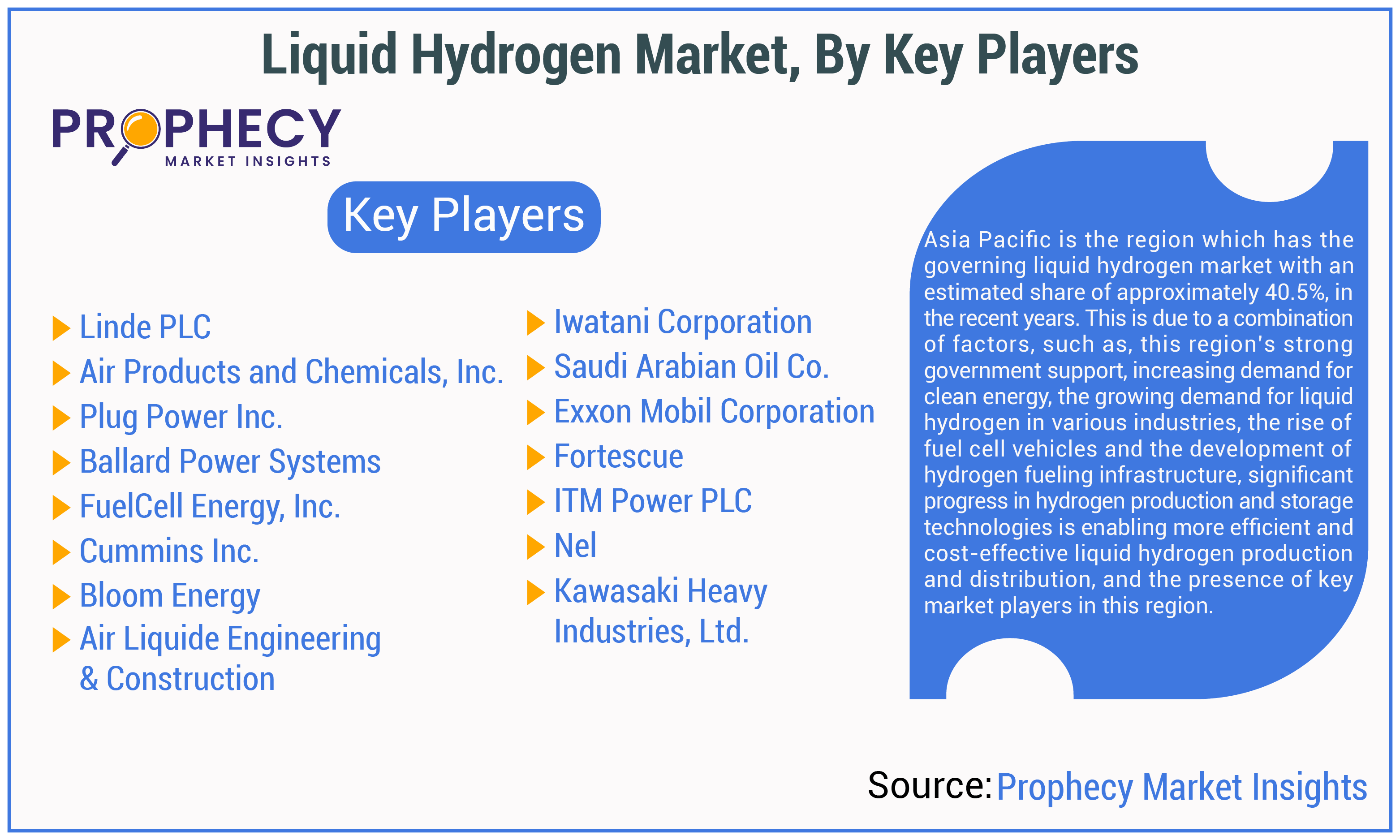
The key players operating in the market include, Linde PLC, Air Liquide Engineering & Construction, Air Products and Chemicals, Inc., and others. These key players are focusing on strategies such as developing efficient liquefaction and storage technologies, expanding infrastructure for delivery, and fostering demand through applications such as fuel cell vehicles and industrial processes. Additionally, these companies are investing in green hydrogen production and exploring new applications in sectors such as space exploration and marine fuel, for driving liquid hydrogen market growth.
Liquid Hydrogen Market Companies:
- Linde PLC
- Air Liquide Engineering & Construction
- Air Products and Chemicals, Inc.
- Plug Power Inc.
- Ballard Power Systems
- FuelCell Energy, Inc.
- Cummins Inc.
- Bloom Energy
- Iwatani Corporation
- Kawasaki Heavy Industries, Ltd.
- Saudi Arabian Oil Co.
- Exxon Mobil Corporation
- Fortescue
- ITM Power PLC
- Nel
View an Additional List of Companies in the Liquid Hydrogen Market
Global Liquid Hydrogen Market By Recent News
- In May 2025, the establishment of a Public-Private Joint Promotion Team for Liquefied Hydrogen Transporters was announced at a ceremony in Busan by the Ministry of Trade, Industry, and Energy (MOTIE) of South Korea. The goal of this project is to position South Korea as a global leader in hydrogen transport technology as part of the Liquefied Hydrogen Carrier Super-Gap Leading Strategy. The nation's shipbuilding industry, which was formerly dominated by LNG carriers, is now concentrating on liquefied hydrogen carriers, a highly developed and complex industry with enormous potential for decarbonizing international marine transportation.
- In April 2025, Oman planned to build the first liquid hydrogen corridor on a commercial scale in history, linking the Sultanate with Germany and the Netherlands. The government-backed green hydrogen business Hydrom will spearhead upstream production efforts, the state-owned energy conglomerate OQ said in a statement. In addition to integrating the corridor into Oman's larger hydrogen strategy and infrastructure plans, these projects would be in line with national ambitions.
- In March 2025, the ground-breaking LS20 mobile liquid hydrogen system, an end-to-end liquefaction and storage system, was introduced by GenH2, a pioneer in the hydrogen infrastructure solutions sector. Through pilot projects and testing, the novel mobile liquefaction unit provides a space-optimized, fully integrated liquid hydrogen solution that can be utilized for a variety of purposes, including energy backup, transportation, and expediting the usage of liquid hydrogen. Additionally, it will serve as a laboratory for evaluating insulation, materials, thermodynamic characteristics, and application use cases.
- In June 2024, Air Liquide and ExxonMobil established a partnership to help ExxonMobil's Baytown, Texas refinery produce low-carbon ammonia and hydrogen. The deal will allow low-carbon hydrogen to be transported over Air Liquide's current pipeline system. Air Liquide will also construct and run four Large Modular Air separation units (LMAs) to provide the facility with up to 6,500 metric tonnes of nitrogen and 9,000 metric tonnes of oxygen per day. To lessen the carbon footprint of the project, the LMAs will mostly use low-carbon power.
- In May 2024, in order to showcase small-scale liquid hydrogen aircraft ground operations at three European airports, Airbus has initiated an innovative aviation hydrogen handling and refueling initiative with assistance from academic partners, airport operators, and top hydrogen-industry businesses. Hydrogen is becoming increasingly popular for both stationary and mobile applications as a result of the push to decarbonize our economy and increase Europe's energy independence. Additionally, hydrogen will be essential to the development of low-carbon aircraft operations and a means of decarbonizing short- and medium-haul flights.
Analyst View:
The growing push for decarbonization, the need for energy storage solutions as a result of the integration of renewable energy sources such as solar and wind into the electrical grid, the potential of liquid hydrogen to store excess renewable energy, and the expanding demand for liquid nitrogen by different industries are all contributing to the growth of the liquid hydrogen market. Advances in hydrogen infrastructure, such as production, storage, and distribution, are crucial for the broad adoption of liquid hydrogen, and improvements in fuel cell technology are fueling the market's expansion by increasing the efficiency and affordability of hydrogen-powered vehicles and promoting its adoption in the transportation sector.
More Related Reports
Liquid Biopsy Market
Liquid Crystal on Silicon Market
Liquid Crystal Polymer (LCP) Market
E-Liquids Market
Liquid Alum Market
Global Liquid Hydrogen Market By Company Profile
|
Company Name |
Linde PLC |
|
Headquarter |
Dublin, Ireland |
|
CEO |
Mr. Sanjiv Lamba |
|
Employee Count (2024) |
65,289 Employees |
Global Liquid Hydrogen Market By Highlights
FAQs
Liquid hydrogen market size was valued at USD 45.0 Billion in 2025 and is expected to reach USD 75.0 Billion by 2035 growing at a CAGR of 5.8%.
Production method, distribution method, end-use industry, and region are the segmentation for the target market.
North America, Asia Pacific, Europe, Latin America, and the Middle East & Africa. Asia Pacific is expected to dominate the market.
The key players operating in the liquid hydrogen market include Linde PLC, Air Liquide Engineering & Construction, Air Products and Chemicals, Inc., Iwatani Corporation, Plug Power Inc., Ballard Power Systems, FuelCell Energy, Inc., Cummins Inc., Bloom Energy, Kawasaki Heavy Industries, Ltd., Saudi Arabian Oil Co., Exxon Mobil Corporation, Fortescue, ITM Power PLC, and Nel.