Global Liquid Crystal Polymer LCP Overview
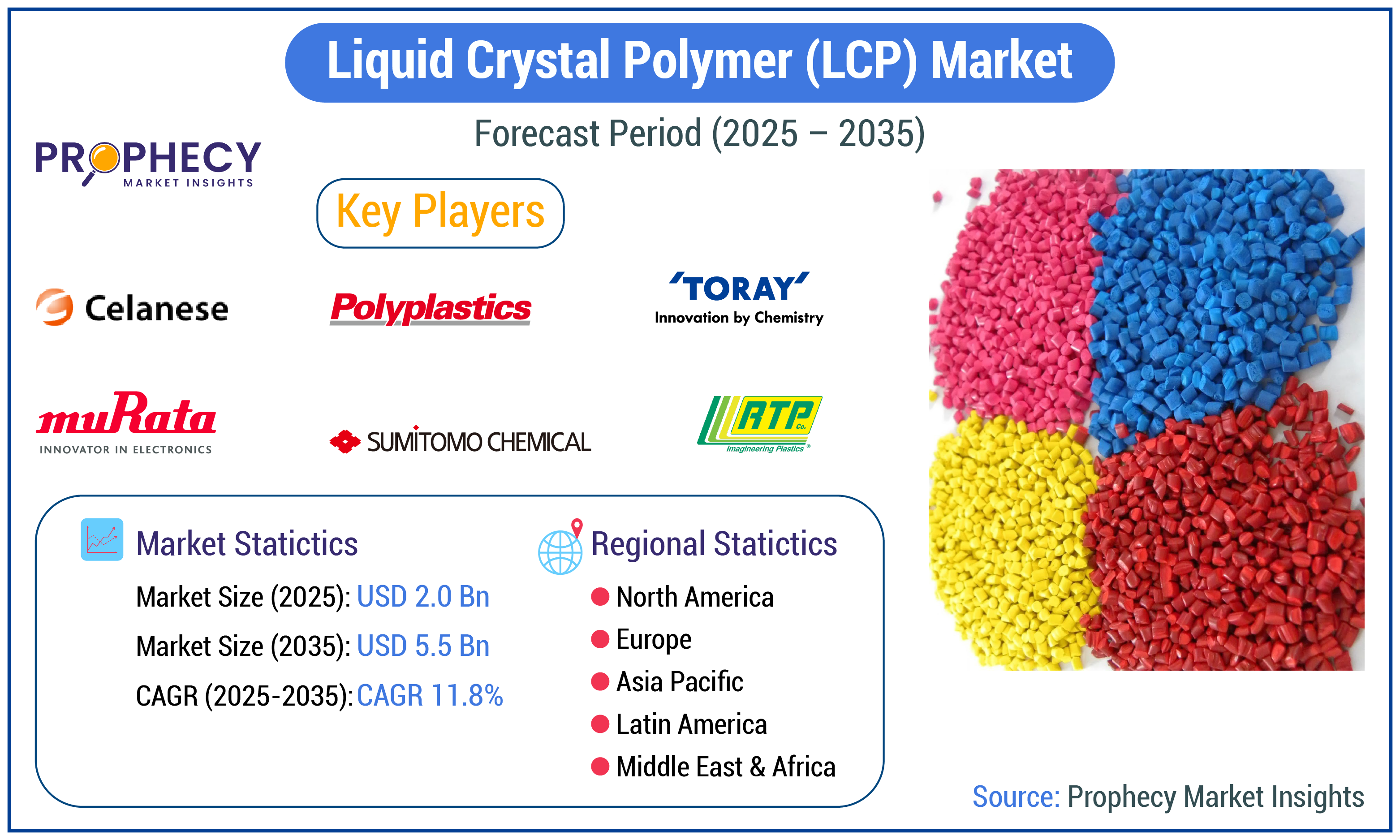
- Liquid crystal polymer (LCP) market size is expected to expand at a rate of USD 5.5 Billion, by 2035.
- In 2024, the liquid crystal polymer (LCP) market valuation was USD 1.8 Billion.
- Liquid crystal polymer (LCP) market is growing at a CAGR 11.8%.
Liquid crystal polymer (LCP) is sub-category or class of high-performance thermoplastics used for molecular alignment that offers mechanical and thermal properties. LCPs are broadly used in demanding applications such as automotive, electronics and industrial components for their heat resistance, high strength and chemical stability essential for electronics and automotive industry.
LCP has high demand for electronics and automotive industries due to need for high-performance materials. LCPs can withstand high temperatures, offer excellent dimensional stability, and provide electrical insulation as devices become smaller and more advanced making LCPs as preferred choice for electrical and micro components. Additionally, increasing demand for connectors with high pin density, especially in smartphones and advanced communication devices have accelerated the usage of LCPs.
Expansion of 5G infrastructure and shift toward electric vehicles (EVs) create new opportunities for LCPs in heat-sensitive and high frequency applications. Automotive industry is shifting towards advanced driver assistance systems (ADAS) and electric vehicles (EVs) has led to growing adoption of LCPs.
Recession Risk & Tariff Analysis
- Liquid crystal polymer (LCP) market faces potential challenges from recession risks and international trade tariffs, impacting production cost and global demand for liquid crystal polymer. Major industries such as automotive, electronics, and industrial manufacturing might lower production volumes and cost expenditure resulting in decrease in LCP demand during economic downturn.
- Cost for LCP manufacturers can increase and affect pricing competitiveness due to tariffs on chemical imports and exports between major economies such as China and US where trade tariffs and geopolitical tensions can disrupt global supply chains for LCPs.
Impact of Generative AI on Liquid Crystal Polymer (LCP) Market:
- Generative AI cover key areas such as materials research, product design, and manufacturing optimization to make a transformative impact on the Liquid crystal polymer market. Discovery and customization of LCP formulations with tailored properties for specific applications is possible through generative AI through advanced data modelling and ML algorithms.
- Design of intricate components can be generated for electronics and automotive sectors through generative AI where LCPs are highly used to meet stringent criteria that enables engineers to create high performance parts.
Global Liquid Crystal Polymer LCP Drivers & Restraints
Key Drivers:
LCPs Replace Traditional Polymers in High-Performance Applications Driving Market Growth
Liquid crystal polymers have exceptional combination properties such as chemical resistance, high temperature resistance and excellent flow characteristics making it suitable for demanding ecosystems replacing the traditional polymers. LCPs offer durability and reliability for performance under extreme condition thus they are used majorly in automotive engine components, electronic connectors, and industrial machinery.
Miniaturization and High-Density Connector Demand Drives the Market Growth
Electronics and electrical industry are witnessing ongoing miniaturization trend as devices have become compact and complex, as a result the LCPs are needed for high thermal and mechanical stress along with reliably confined spaces. LCPs are ideal due to their dimensional stability, low dielectric constant and heat resistance properties for electronic components. Furthermore, increasing demand for connectors with high pin density, specially in smartphones and advanced communication devices have accelerated the usage of LCPs.
Restraints:
High Manufacturing Costs Limiting Growth of the Market
Liquid crystal polymer face restraint such as high manufacturing cost related with advanced materials for LCPs as it includes complex polymerization processes, high-temperature synthesis, and specialized equipment. Raw materials used in LCP synthesis are commonly expensive and need stringent quality control, further growing the overall LCP cost. High manufacturing cost can disrupt the LCP adoption in various industries by close margin.
- Counterbalance Statements: LCP have exceptional performance characteristics which can justify the investment for important application in various industries. Components such as chemical resistance, excellent electrical properties and superior thermal stability make LCPs indispensable in demanding environments such as electronics, automotive, aerospace, and medical devices. Manufacturing cost will be lower eventually due to current advancements in production technologies and growing economies making LCPs more cost-affective across wide range of applications.
Opportunities & Trends:
Emerging Trends and Expanding Opportunities Drives Market Growth
The LCPs are increasingly finding new applications in emerging industries such as aerospace, renewable energy and 3D printing providing new opportunities for major domain in market growth. Growing demand for high performing and miniaturized components in electrical and electronics sector is the key trend driving the growth. High utilization of LCPs in electronics production such as high-frequency communication devices, connectors and flexible printed circuits defines the market share of LCPs in the region. Market shift towards advanced driver-assistance systems (ADAS) and electric vehicles (EVs) by automotive industry has led to growing adoption of LCPs. Due to technological innovations and wide scope of applications the LCP market is estimated for sustained growth across diverse industries.
Global Liquid Crystal Polymer LCP Segmentations & Regional Insights
Liquid Crystal Polymer (LCP) Market is segmented into type, application, end user, and region.
By Type:
Based on type, the liquid crystal polymer (LCP) market is divided into lyotropic, thermotropic, discotic and calamitic, and metallotropic. Thermotropic liquid crystal polymers dominate the segment in liquid crystal polymer (LCP) market share as they are widely used in various high-performance applications as these polymers exhibit liquid crystalline behavior upon heating and are heat resistant. Sectors such as electronics, automotive, and industrial have high demand for thermotropic liquid crystal polymers for their processability in injection molding and extrusion.
Lyotropic liquid crystal polymers holds second dominant position in type segment of liquid crystal polymer market. Lyotropic liquid crystal polymers are ideal for specialized applications such as high-performance fibers and membranes as they have great strength and stiffness.
By Application:
electrical connectors, fiber optics, automotive lamps, industrial machinery, cookware coatings and others are applications of the liquid crystal polymer (LCP) market. Automotive lamps hold largest liquid crystal polymer (LCP) market share in application segment as it is witnessing increasing adoption of high-performance materials in modern vehicle lighting systems. LCPs have outstanding thermal stability and dimensional accuracy along with flame resistance making it ideal for automotive lamp components.
Electrical connectors is the second dominant application in liquid crystal polymer market as LCPs are greatly valued in electrical and electronics industry. LCPs are highly heat resistance, have excellent dielectric properties and precision molding capability for electronic components further leveraging the electrical connectors application in global market.
By End User:
According to the end user, the market is categorized into aerospace, automotive, electrical and electronics, industrial, machinery and others. Electrical and electronics is the dominant sector in liquid crystal polymer (LCP) market share as it consists of LCPs properties such as electrical insulation and high thermal stability making them ideal for manufacturing small electronic components such as tablets, smartphones and other electronic devices.
Automotive is the second dominant sector in the end user segment as LCPs are increasingly used in modern vehicles ideal for under the hood components, lightning systems and electrical connectors. Automotive industry is witnessing a shift towards electrification further increasing the demand for LCPs in global market.
Regional Insights:
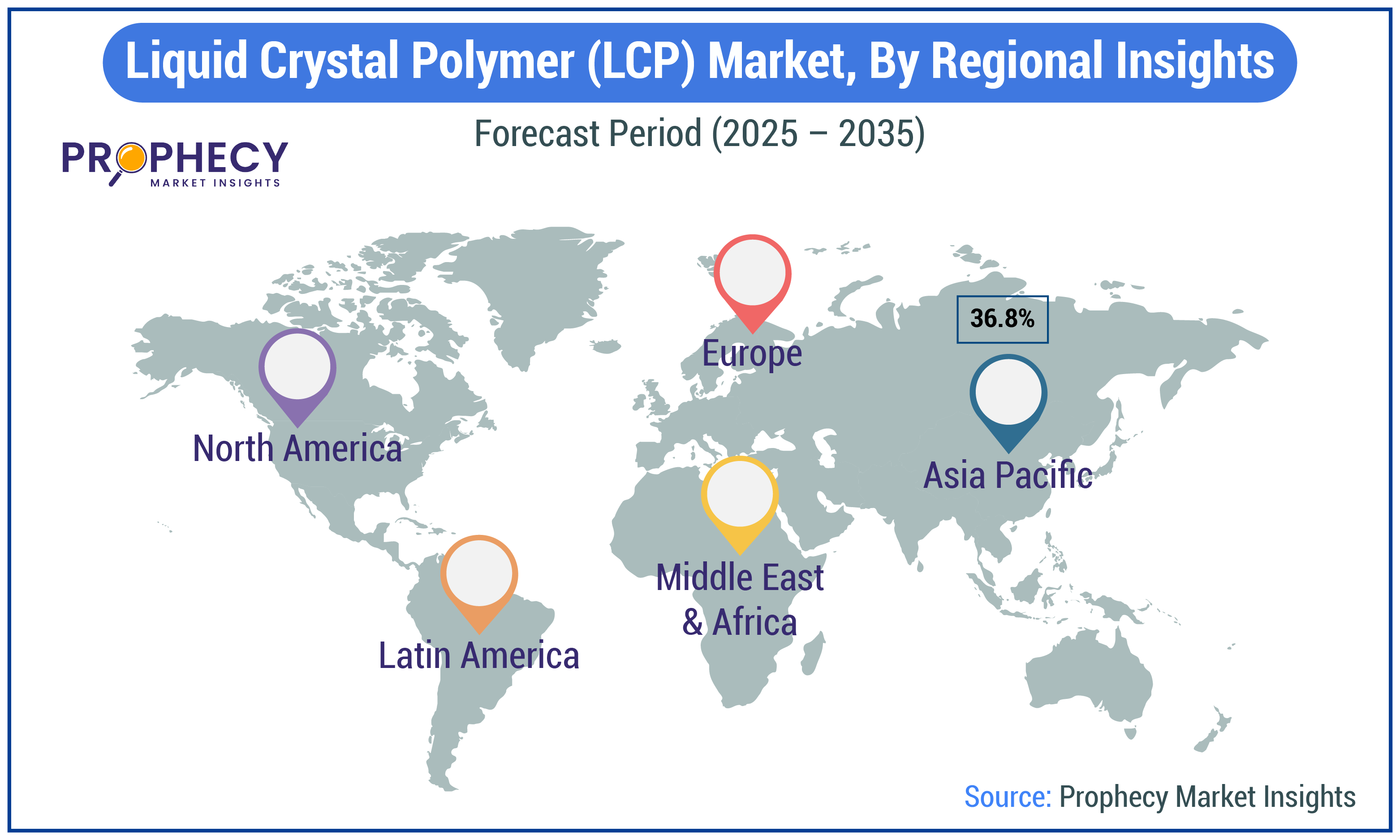
Geographically, the liquid crystal polymer (LCP) market is studied across North America, Europe, Asia Pacific, Latin America, and the Middle East & Africa.
Asia Pacific: This region dominates the liquid crystal polymer market with 36.8% share due to strong presence of major automotive and electronic key industries and manufacturing centers in countries such as China, Japan, South Korea, and Taiwan. High demand for miniaturized electronic components and advanced computing devices further leverages the LCPs market growth in the region.
- China Liquid Crystal Polymer (LCP) Market Insights:
China holds the dominant position in global liquid crystal polymer market as the country has massive electronics manufacturing base, which increases demand for LCPs for high-performance materials in electronic devices. China has strong government support and continued investments in advanced manufacturing technologies which makes it central hub for LCP production in the region.
North America: This region holds the second dominant position for liquid crystal polymers as the region has strong presence in aerospace industries, automotive innovation and high-end electronics. North America is witnessing increasing adoption of electric vehicles and 5G infrastructure along with presence of leading electronics manufacturing industries driving LCP consumption.
- U.S. Liquid Crystal Polymer (LCP) Market Insights:
U.S. is the leading country for liquid crystal polymer in the region. United States has high demand for precision-engineered materials across key sectors such as electronics, automotive, aerospace, and telecommunications. The country’s dominance is due to presence of strong industrial base and advanced technological infrastructure driving LCPs increasing adoption in the region.
Europe: This region is witnessing a significant growth in liquid crystal polymer market due to regions focus on sustainability and energy efficiency has led to increased adoption of lightweight, high-performance materials such as LCPs in industrial machinery and electronic vehicles. Countries such as Germany, France and U.K. are leading key players due to their engineering capabilities and advanced automotive manufacturing increasing the adopt of LCPs in the region.
- Germany Liquid Crystal Polymer (LCP) Market Insights:
Germany is the dominant country in Europe region as it has highly developed automotive and engineering sectors. Germany is global leader in automobile production and uses LCPs in automotive electronics and lightning systems. There is growing demand for precision components made from LCPs in Germany due to its established electronics manufacturing sector and industrial machinery further driving the market share for liquid crystal polymer in the region.
Liquid Crystal Polymer (LCP) Market Report Scope:
|
Attribute |
Details |
|
Market Size 2025 |
USD 2.0 Billion |
|
Projected Market Size 2035 |
USD 5.5 Billion |
|
CAGR Growth Rate |
11.8% (2025-2035) |
|
Base year for estimation |
2024 |
|
Forecast period |
2025 – 2035 |
|
Market representation |
Revenue in USD Billion & CAGR from 2025 to 2035 |
|
Regional scope |
North America - U.S. and Canada Europe – Germany, U.K., France, Russia, Italy, Spain, Netherlands, and Rest of Europe Asia Pacific – China, India, Japan, Australia, Indonesia, Malaysia, South Korea, and Rest of Asia-Pacific Latin America - Brazil, Mexico, Argentina, and Rest of Latin America Middle East & Africa – GCC, Israel, South Africa, and Rest of Middle East & Africa |
|
Report coverage |
Revenue forecast, company share, competitive landscape, growth factors, and trends |
Segmentation:
By Type:
- Lyotropic
- Thermotropic
- Discotic and Calamitic
- Metallotropic
By Application:
- Electrical Connectors
- Fiber Optics
- Automotive Lamps
- Industrial Machinery
- Cookware Coatings
- Others
By End User:
- Aerospace
- Automotive
- Electrical and Electronics
- Industrial and Machinery
- Others
By Region:
- North America
- U.S.
- Canada
- Europe
- Germany
- U.K.
- France
- Russia
- Italy
- Spain
- Netherlands
- Rest of Europe
- Asia Pacific
- China
- India
- Japan
- Australia
- Indonesia
- Malaysia
- South Korea
- Rest of Asia Pacific
- Latin America
- Brazil
- Mexico
- Argentina
- Rest of Latin America
- Middle East & Africa
- GCC
- Israel
- South Africa
- Rest of Middle East & Africa
Global Liquid Crystal Polymer LCP Competitive Landscape & Key Players
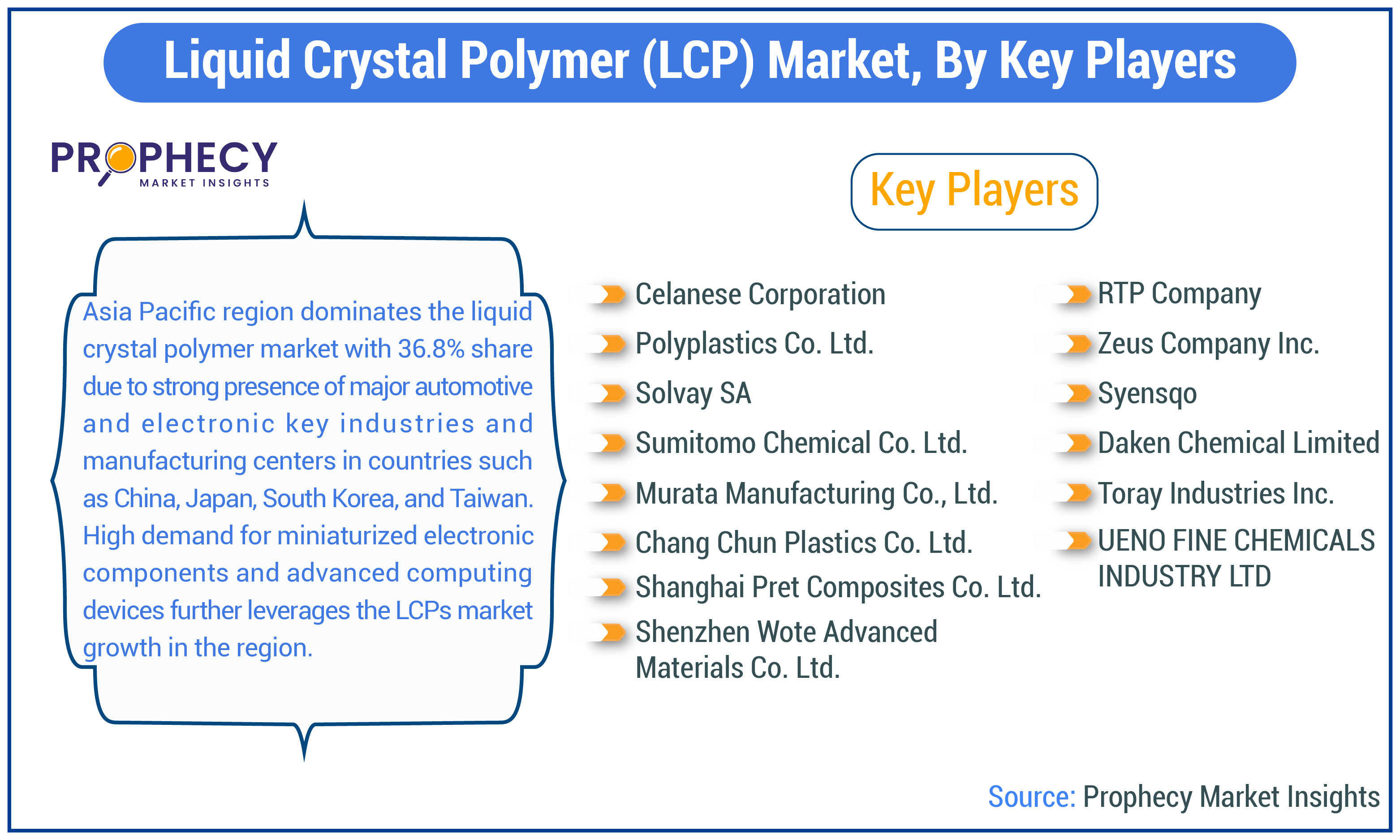
The key players operating in the liquid crystal polymer (LCP) market include, Celanese Corporation, Polyplastics Co. Ltd., UENO FINE CHEMICALS INDUSTRY LTD, Sumitomo Chemical Co. Ltd., TORAY INDUSTRIES INC., and others. Strategic partnerships, capacity expansions, and new end-use developments are popular strategies adopted by a majority of the players operating in the global liquid crystal polymer market.
Liquid Crystal Polymer (LCP) Market Companies:
- Celanese Corporation
- Polyplastics Co. Ltd.
- Solvay SA
- Shenzhen Wote Advanced Materials Co. Ltd.
- Sumitomo Chemical Co. Ltd.
- Toray Industries Inc.
- Chang Chun Plastics Co. Ltd.
- Shanghai Pret Composites Co. Ltd.
- UENO FINE CHEMICALS INDUSTRY LTD
- RTP Company
- Zeus Company Inc.
- Syensqo
- Daken Chemical Limited
- Murata Manufacturing Co., Ltd.
View an Additional List of Companies in the Liquid Crystal Polymer (LCP) Market
Global Liquid Crystal Polymer LCP Recent News
- In August 2022, Polyplastics Co. Ltd. expanded its engineering thermoplastics portfolio and material supply capabilities at the K 2022 exhibition in Düsseldorf, Germany. With the expansion, the company increased its liquid crystal polymer (LCP) sales to Europe, the Middle East, Africa, and the Americas while making timely investments in capacity to better respond to market growth.
- In January 2022, Sumitomo Chemical Co., Ltd. built additional production lines for its liquid crystal polymer (LCP) SUMIKASUPERTM at its Ehime Works in Japan. The capacity expansion was scheduled to be completed by the middle of 2023 and will help in increasing the production capacity by approximately 30%.
Analyst View:
Liquid crystal polymer market as rapidly expanding market due to growing adoption of LCPs in cutting-edge applications in medical, electronics and automotive sectors. The rise of electric vehicles and increasing demand for high-frequency and heat-resistant materials are driving the growth in LCP market. Ongoing miniaturization of electronic components is also a key growth factor for LCP. New opportunities unlock with innovation in 3D printing and advanced manufacturing technologies.
More Related Reports
Liquid Biopsy Market
Liquid Crystal on Silicon Market
Liquid Alum Market
Liquid Soap Market
Liquid Feed Supplements Market
Global Liquid Crystal Polymer LCP Company Profile
|
Company Name |
Solvay SA |
|
Headquarter |
Brussels, Belgium |
|
CEO |
Philippe Kehren |
|
Employee Count (2024) |
9,000 Employees |
Global Liquid Crystal Polymer LCP Highlights
FAQs
Liquid crystal polymer (LCP) market size was valued at USD 2.0 Billion in 2025 and is expected to reach USD 5.5 Billion by 2035 growing at a CAGR of 11.8%.
Type, application, end user, and region are the segmentation for the target market.
North America, Asia Pacific, Europe, Latin America, and the Middle East & Africa. North America is expected to dominate the market.
The key players operating the liquid crystal polymer (LCP) market include Celanese Corporation, Polyplastics Co. Ltd., Solvay SA, Shenzhen Wote Advanced Materials Co. Ltd., Sumitomo Chemical Co. Ltd., TORAY INDUSTRIES INC., Chang Chun Plastics Co. Ltd., Shanghai Pret Composites Co. Ltd., UENO FINE CHEMICALS INDUSTRY LTD, RTP Company, Zeus Company Inc., Syensqo, Daken Chemical Limited, Murata Manufacturing Co., Ltd., and RTP Company.