Global Emulsifiers Market Overview
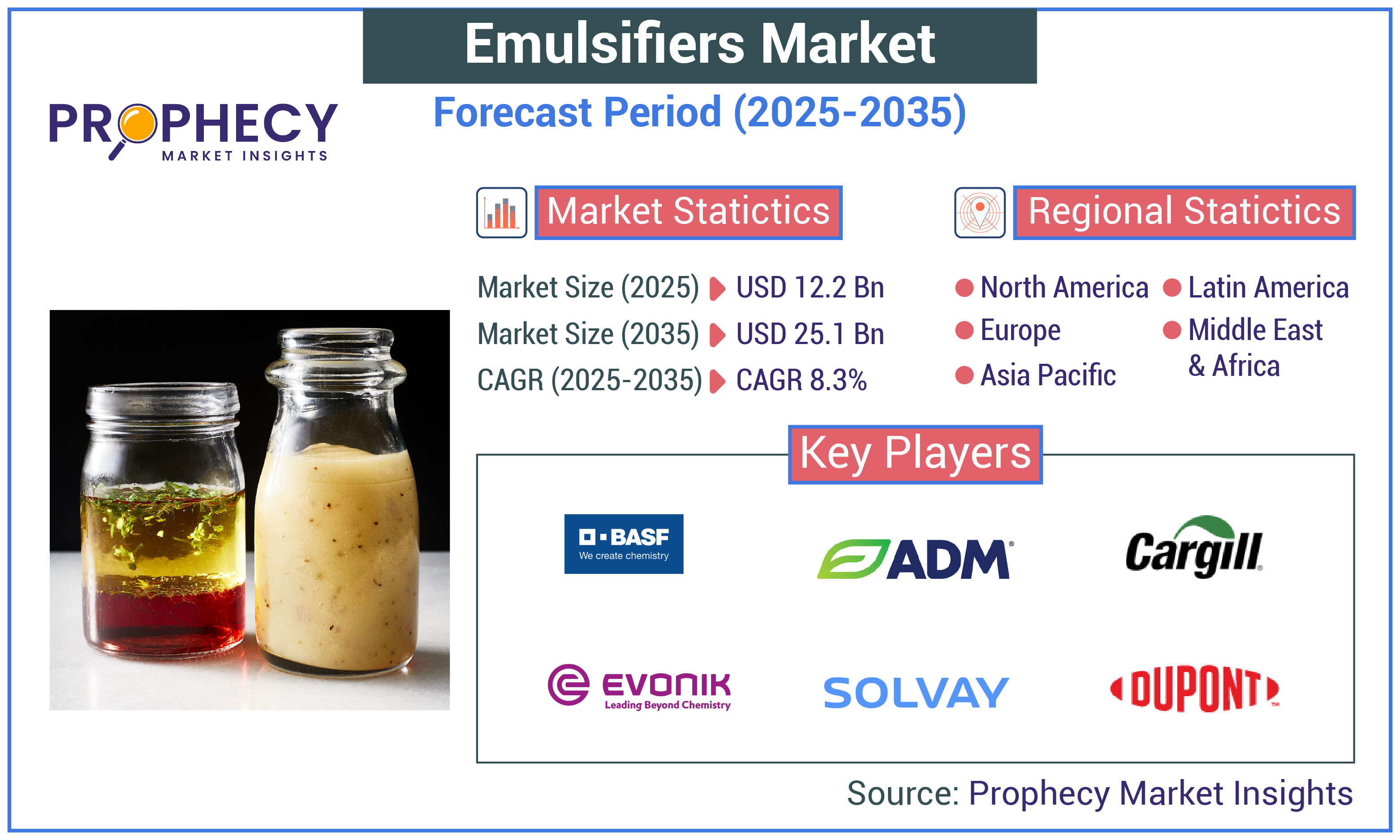
- By 2035, emulsifiers market size is contemplated to enlarge at a valuation of USD 25.1 Billion.
- In 2024, the emulsifiers market valuation was USD 11.37 Billion.
- Emulsifiers market is developing at a CAGR of 8.3%.
An emulsifier is a chemical or natural agent that can help combine two immiscible liquids together in a stable solution, such as oil and water. Emulsifiers can help blend them into stable mixtures and help improve texture, stability, and shelf life in everything from food products to cosmetic ingredients, pharmaceuticals, and industrial formulations, which is a reason, emulsifiers are used in so many industries involved with manufacturing and processing across the globe.
As the demand for processed and convenience foods are increasing, the need for emulsifiers and applications are increasingly, as aware of both health and personal care is increasing, which leads to emulsifiers being more widely applied in the pharmaceutical sector as well. Also, the biggest trend in consumer goods, in every branch, is towards clean label or natural ingredients which generate a lot of idea for innovations in plant-based and bio-based emulsifiers. There are also significant efficiency benefits in industrial applications of formulation and emulsifiers, combined with the stability-enhancing properties, as we see with the growing focus placed on urbanization and health as it intersects with global advances in technology to increase the adoption for this entire category in a variety of end-use industries.
The compulsive trends that are moving the emulsifiers market forward in the future include continued innovation in sustainable formulations of plant, and future intelligent emulsifying formulations and systems. Environmental issues and concerns, and clean label trends are all benefits that promote increasing demand for environmentally friendly emulsifiers in the market. Emerging economies will continue to be an area for expansion, and personalized product development will also be an area to pursue. There will be tons to uncover through emulsifiers in the sectors of food, cosmetics, and pharmaceuticals.
Recession Risk & Tariff Analysis:
- During recessions, reduced consumer spending on luxury foods, beauty products, and personal care preparations may suppress the demand for emulsifiers. Any subsequent reduction in industrial production will, of course, affect emulsification in non-food categories. If consumers are limited by their budgets, preference may shift to less expensive merchant emulsifiers rather than natural emulsifiers inhibiting the longer-term growth of the natural segment and overall market profitability during period of recession.
- The economic action of tariffs on raw materials such as soy, palm oil, or chemical precursors will increase producer costs for emulsifiers and may impact global supply chains for all emulsifier producers. Geopolitical actions generating economic trade tensions in countries whose sellers are major exporters of emulsifiers or major importers may disrupt standard market flow for some ingredients especially synthetics.
Impact of Generative AI on Emulsifiers Market:
- Generative AI allows the rapid generation and testing of new emulsifier blends by modeling interactions between ingredients and predicting stability results. The implicit and explicit claims to speed to market, reduced R&D time, and cost savings allow companies to go faster than their competition, utilize optimal formulations for specific application and formulations, and respond quickly to the consumer demand for performance, safety, and clean-label impacted emulsifier products.
- Generative AI enables market intelligence, assessing huge data sets regarding emerging consumer preferences, regulatory shifts, and regional demand trends to better inform emulsifier manufacturers' strategic decisions, product development to specific local markets, and forecasting demand shifts that improve overall competitiveness and market response in an ever-changing market landscape.
Global Emulsifiers Market Drivers & Restraints
Key Drivers:
Rising Demand for Processed and Convenience Foods is changing the dynamics of the market
The strong growth of the emulsifiers market can be attributed to the expanding presence of processed and convenience foods in consumers' diets globally. Emulsifiers can improve the overall texture, shelf life, and stability in products such as baked goods, sauces, and dairy products, as well as others. The growth of the urban population, along with busy lifestyles and rising levels of disposable income (especially in developing economies), is driving increased consumption of packaged and nearly ready-to-eat foods. This, in turn, drives the need for emulsifiers across the food industry, among other markets, making this trend one of the strongest stimulants for the emulsifiers market.
-
For instance, according to data published by FAO, a 10% increase in income leads to an 11% increase in demand for imports of ultra-processed foods, which highlights the renewed demand for adding food additives, such as emulsifiers, in manufactured food products that comply with industrial production and shelf life and storage standards.
Restraints:
Health Concerns and Regulatory Scrutiny to repel market growth:
The emulsifiers market is seeing restraint from the rise of health consciousness regarding synthetic additives. As consumers become more careful about ingredient transparency, some synthetic emulsifiers are being associated with risk factors, such as gut imbalance. Also, food safety regulations surrounding labeling requirements in regions, such as Europe and North America are increasingly stringent and often difficult for manufacturers to comply with. It subsequently increases compliance costs and limits the use of emulsifiers in food and personal care applications.
- Counterbalance Statements: If regulations pose a hurdle, demand for natural and clean-label emulsifiers continues to increase. Manufacturers are investing tremendous resources into plant-based, GRAS-certified, and regulatory compliant emulsifiers to meet consumers expectations, and using innovation and new formulations to sustain market growth, while dealing with consumer issues surrounding safety and transparency.
Opportunities & Trends:
Rise of Clean-Label, Plant-Based Emulsifiers is a rising trend:
The emulsifiers market is experiencing solid growth driven by demand for clean-label and plant-based products. Consumers want natural, recognizable ingredients, and therefore manufacturers are exploring non-animal-derived emulsifiers, such as sunflower or soy lecithin. This trend is not only conducive to vegan product development, but is also driving innovation in allergen-free products across the food, cosmetics, and pharmaceutical categories. The trends toward transparency, health-conscious choices, and sustainability are changing products' formulations and driving opportunities for companies to enter ethical and eco-friendly market segments.
Global Emulsifiers Market Segmentations & Regional Insights
Product type, source, form, application, end-user and region are the divisions of the emulsifiers market.
By Product Type:
Based on the product type, the emulsifiers market is divided into acacia, carrageenan, dextrin, lecithin, and others. Lecithin remains the leading emulsifying agent due to its natural origin, multifaceted application, and relevance in food, pharmaceuticals, and cosmetics. Lecithin, primarily derived from soy and sunflower sources, possesses valuable emulsifying characteristics, dispersibility, and numerous healthful effects. Additionally, with its clean-label perception to consumers, as well as its Generally Recognized as Safe (GRAS) status, legion of manufacturers and health-conscious consumers prefer lecithin.
Carrageenan is one of the two most significant product types in the emulsifiers market. A big part of its successful large market positioning is the almost universal application in the dairy and meat sector, where it can be used as a perfect agent for gelling, thickening, and stabilizing purposes..
By Source:
Based on source, the market is segmented into plant-based emulsifiers, animal-based emulsifiers, synthetic emulsifiers, and natural/bio-based emulsifiers. Plant-based emulsifiers dominate the emulsifiers market share since consumers are increasingly seeking clean-label and vegan products. Typically derived from sources including soy, sunflower, and lecithin, plant-based emulsifiers have desirable emulsifying properties and major allergic potential. Their natural sources reflect emerging sustainability trends and explain their prominence in the food, cosmetics, and pharmaceutical industries.
Synthetic emulsifiers are second in share and are used in the market for their uniformity and stability, consistent performance, and low price. Synthetic emulsifiers will continue to be used in food and industrial applications, especially where shelf life is imperative to the end use of product, or where shelf life is less important but texture is contributed as part of another food application.
By Form:
Based on form, the market is segmented into liquid, powder, granules, pellets. Liquid emulsifiers take a lead in the emulsifiers market size based on the factors of ease of incorporation in manufacturing processes and rapid solubility. Liquid emulsifiers are used for food, cosmetics and pharmaceuticals due to their compatibility to blend different types of products. The flexibility and ability to create and maintain stable emulsions are consistently driving liquid emulsifiers' market dominance.
Powder emulsifiers rank second in the market. Powder emulsifiers provide good shelf stability, along with ease of transport and storage. Powder emulsifiers are typically incorporated in dry mixes, dry bakery products, and instant products, thus provide consumer convenience and usability. Their compatibility to incorporate into applications as varied as liquid emulsifiers, provides powder emulsifiers a substantial piece of the emulsifier market.
By Application:
Emulsification, stabilization, foaming, thickening, lubrication, others are application of the emulsifiers market. Emulsification is the most dominant application, as emulsifiers are used to combine unmixable or immiscible liquids, such as oil and water. It is important to emulsify liquids, especially in the food industry, cosmetics and pharmaceuticals, to produce stable, homogeneous products such as dressings, creams, and lotions. An emulsifier helps ensure a consistent product which is critical for consumer satisfaction and possibly health.
Stabilization is the second most important application, since emulsifiers help to keep the ingredients uniformly distributed over time. Emulsifiers help prevent separation or sedimentation, and thereby extend a product's shelf life and quality. Stabilization is also a very important application in products we find in food and beverages, dairy products, and personal care products to ensure that a product is a product over the duration of its shelf life.
By End-User:
Food, cosmetics & personal care, oilfield chemicals, pharmaceutical, others are end-user of the emulsifiers market. The food industry leads emulsifiers market share the way when it comes to emulsifiers, as they are critical to improving the texture and overall consistency of various food products such as baked products and dairy products. The growing demand for processed and convenience foods has been a major driver behind this continued growth of emulsifying agents worldwide, as have clean-label and functional ingredients.
Cosmetics and personal care rank second in emulsifier usage, as the growing demand for creams, lotions, and cosmetics products are usually required to be in stable emulsion form. Emulsifiers help improve product consistency, feel on the skin, and overall formulation stability. The rise in natural and premium beauty products has led to an increase in the use of emulsifiers in skincare and hair care formulations.
Regional Insights:
Geographically, the emulsifiers market is studied across North America, Europe, Asia Pacific, Latin America, and the Middle East & Africa.
Asia Pacific: This region dominates the emulsifiers market growth with 37.2% share. Due to swift industrialization, rising food processing sectors, and increased consumer demand for personal care products, the Asia Pacific region currently dominates the emulsifiers market. Rapidly growing middle-class populations, urbanization, and health awareness in countries such as China, India, and Japan, boosts consumption of both natural and synthetic emulsifiers in the region.
- China Emulsifiers Market Insights:
China leads the Asia Pacific emulsifiers market due to its size in food processing, and cosmetics are expanding quickly, and it is a very strong pharmaceutical manufacturing base. The government's support for industrial growth, combined with a large population and growing knowledge about health, continues to stimulate demand for natural and synthetic emulsifiers for a variety of applications.
Europe: This region is in second place of target market growth, provides the emulsifiers market with strong regulations focused on food safety, clean-label requirements, and labeling regulations. Coupled with a mature food industry, relatively high demand for organic products, and, recent innovations in Sweden's cosmetics and pharmaceuticals, there is continual growth for emulsifier market. Germany, France, and the United Kingdom (UK), are three of the biggest regional players.
- Germany Emulsifiers Market Insights:
Germany is the leader in the European emulsifiers market, with advanced food, cosmetics, and pharmaceutical industries. There is a greater consumer demand for clean-label and organic options, which aids in the demand for natural emulsifiers. Germany's greatest opportunity continues to be through sustainable and high-quality manufacturing practices that further develop clean-label and organic living.
North America: This region is in the third position, supported by a well-developed food and beverage industry and strong demand for functional and processed foods. The areas focus on natural and sustainable ingredients within the cosmetics and pharmaceuticals sectors; has also supported emulsifier demand. USA, remains the largest market, buoyed up with new technologies and consumer awareness.
- U.S. Emulsifiers Market Insights:
In North America, the U.S. is the largest market, due to its developed food processing, cosmetics, and healthcare industries. Typically, demand for processed foods and new personal care products are increasing demand for emulsifiers. However, there are regulatory standards and consumer perceptions driving change in the competitive market

|
Attribute |
Details |
|
Market Size 2025 |
USD 12.2 Billion |
|
Projected Market Size 2035 |
USD 25.1 Billion |
|
CAGR Growth Rate |
8.3% (2025-2035) |
|
Base year for estimation |
2024 |
|
Forecast period |
2025 – 2035 |
|
Market representation |
Revenue in USD Billion & CAGR from 2025 to 2035 |
|
Regional scope |
North America - U.S. and Canada Europe – Germany, U.K., France, Russia, Italy, Spain, Netherlands, and Rest of Europe Asia Pacific – China, India, Japan, Australia, Indonesia, Malaysia, South Korea, and Rest of Asia-Pacific Latin America - Brazil, Mexico, Argentina, and Rest of Latin America Middle East & Africa – GCC, Israel, South Africa, and Rest of Middle East & Africa |
|
Report coverage |
Revenue forecast, company share, competitive landscape, growth factors, and trends |
By Product Type:
- Acacia
- Carrageenan
- Dextrin
- Lecithin
- Others
By Source:
- Plant-based Emulsifiers
- Animal-based Emulsifiers
- Synthetic Emulsifiers
- Natural/Bio-based Emulsifiers
By Form:
- Liquid
- Powder
- Granules
- Pellets
By Application:
- Emulsification
- Stabilization
- Foaming
- Thickening
- Lubrication
- Others
By End-User:
- Food
- Cosmetics & Personal Care
- Oilfield Chemicals
- Pharmaceutical
- Others
By Region:
- North America
- U.S.
- Canada
- Europe
- Germany
- U.K.
- France
- Russia
- Italy
- Spain
- Netherlands
- Rest of Europe
- Asia Pacific
- China
- India
- Japan
- Australia
- Indonesia
- Malaysia
- South Korea
- Rest of Asia Pacific
- Latin America
- Brazil
- Mexico
- Argentina
- Rest of Latin America
- Middle East & Africa
- GCC
- Israel
- South Africa
- Rest of Middle East & Africa
Global Emulsifiers Market Competitive Landscape & Key Players
The prominent players operating in the market include, BASF, ADM, Cargill, Incorporated, Evonik Industries AG, Kerry Group plc., Solvay, dsm-firmenich, International Flavors & Fragrances Inc., and others. Emulsifiers are a competitive market, consisting of both large multinational chemical corporations and niche product ingredient makers. Companies in the market compete on the basis of innovativeness and product quality, sustainability and price. Areas of focus include clean-label, plant-based emulsifiers, and regional growth. Companies mainly utilize partnerships and acquisitions, but also invest in R&D to solidify their positions in the market and to distinguish themselves from their competitors.
Emulsifiers Market Companies:
- BASF
- ADM
- Cargill, Incorporated
- Evonik Industries AG
- Kerry Group plc.
- Solvay
- dsm-firmenich
- International Flavors & Fragrances Inc.
- Corbion
- DowClariant
- DuPont
- Croda International Plc
- Lonza
- Stepan Company
View an Additional List of Companies in the Emulsifiers Market

Global Emulsifiers Market Recent News
Recent Developments:
- In December 2022, Clariant made an investment to improve the ethoxylation plant, expanding the Care Chemicals facility in Daya Bay, Huizhou, China, and increasing its support for pharmaceutical, personal care, home care, and industrial applications customers.
- In November 2022, Evonik Industries AG signed an agreement with Intercos Group. Within this agreement, Evonik sold raw materials (including active ingredients, emulsifiers, and oils for cosmetics) directly to Intercos.
Analyst View:
The emulsifiers market continues its steady course amid growing demand for new processed foods, personal care products, and clean-label products. The suppliers are switching to natural emulsifier and plant emulsifiers, which are generally accepted as alternatives to traditional petroleum-based emulsifiers. The sector should see increased innovation and a continued commitment from manufacturers to invest in sustainable solutions. New formulations using emulsifiers are being introduced as technology is advancing quickly.
This is particularly true for formulations for vegan products and more general allergen-free products. At the same time, the sector is operating in a challenging environment as regulators are being stricter and consumers are increasingly wary of synthetic additives in their food and personal care products. Despite challenges faced by the emulsifier sector, from major fillers of emulsifier products investing in sustainable solutions to non-food products being made for alternative protein bases, we see the emulsifier market finally ready for long-term growth across a number of sectors, markets, and regions.
More Related Reports
Gelling Agent Market
Food Grade Emulsifying Agents Market
Halal Cosmetics Market
Natural and Organic Cosmetics Market
Food Fiber Market
Global Emulsifiers Market Company Profile
|
Company Name |
BASF |
|
Headquarter |
Ludwigshafen, Germany |
|
CEO |
Markus Kamieth |
|
Employee Count |
111,991 Employees |
Global Emulsifiers Market Highlights
FAQs
Emulsifiers market size was valued at USD 12.2 Billion in 2025 and is expected to reach USD 25.1 Billion by 2035 growing at a CAGR of 8.3%.
Product type, source, form, application, end-user and region are the segmentation for the emulsifiers market.
North America, Asia Pacific, Europe, Latin America, and the Middle East & Africa. Asia Pacific is expected to dominate the market.
The prominent players operating in the market include, BASF, ADM, Cargill, Incorporated, Evonik Industries AG, Kerry Group plc., Solvay, dsm-firmenich, International Flavors & Fragrances Inc., Corbion, Dow, Clariant, DuPont, Croda International Plc, Lonza, and Stepan Company.