Global Desiccant Breathers Market By Overview
- 2024 Market Size: USD 11.6 Billion
- 2035 Projected Market Size: USD 20.3 Billion
- CAGR (2025-2035):6.3%
- North America: Largest Market in 2024
Desiccant breathers are filtration-based equipment used to safeguard industrial machines, hydraulic systems against moisture as well as particulate contamination. They are normally used to dry the air entering machinery reservoirs, gearboxes or storage tanks by use of a silica gel or other drying agent thus preventing condensation and corrosion that can prove very harmful to the equipment, reducing the life span of it.
Increasing awareness of equipment serviceability and maintenance is boosting the growth of the desiccant breather market. Powder generation, oil and gas, mining, and marine industries are using desiccant breathers as a way of minimizing downtime, cutting down repair expenses, and prolonging the machinery service life. The increasing interest in preventive maintenance plans and minimization of losses in operations is also encouraging the trend across countries.
Desiccant Breathers Import Data:
|
HSN Code |
Product Type Description |
Origin |
Destination |
Qty. |
Price |
|
8421999900 |
DESICCANT BREATHER (FILTER) |
Singapore |
Malaysia |
6 KGS |
USD 902.89 |
|
8421392000 |
RMF DESICCANT BREATHER KL121RV |
Netherlands |
Malaysia |
1 UNT |
USD 13,441.81 |
|
84219900 |
FBD22P03B5S0 - DESICCANT BREATHER |
Italy |
India |
8 NOS |
USD 510.24 |
|
84212190 |
BREATHER DESICCANT - 002 - DBT - 050 - O |
India |
Brazil |
2 NOS |
USD 35.34 |
Desiccant Breathers Export Data:
|
HSN Code |
Product Type Description |
Origin |
Destination |
Qty. |
Price |
|
8412909000 |
2 PC DESICCANT BREATHER-DRIER RESERVOIR TK |
Malaysia |
Singapore |
6 KGM |
USD 1,781.52 |
|
85049049 |
Desiccators of 110kV Transformer (dehumidifying effect for transformers , breathing apparatus for transformers) Conventional breathers Air Dehumidifier |
Italy |
Vietnam |
5 PCE |
USD 559.516 |
|
84212900 |
DESICCANT BREATHER WITH SS STRAINER ITEMNO : SAW1151F03A01P01 |
India |
United Arab Emirates |
100 NOS |
USD 8,460.06 |
|
84213990000 |
DES-CASE (OIL LEVEL MONITORING PARTS AND ACCESSORIES) (DESICCANT BREATHER) 15 EA |
United States |
Philippines |
15 PCS |
USD 1,966.4 |
Current Industry Dynamics & Insights:
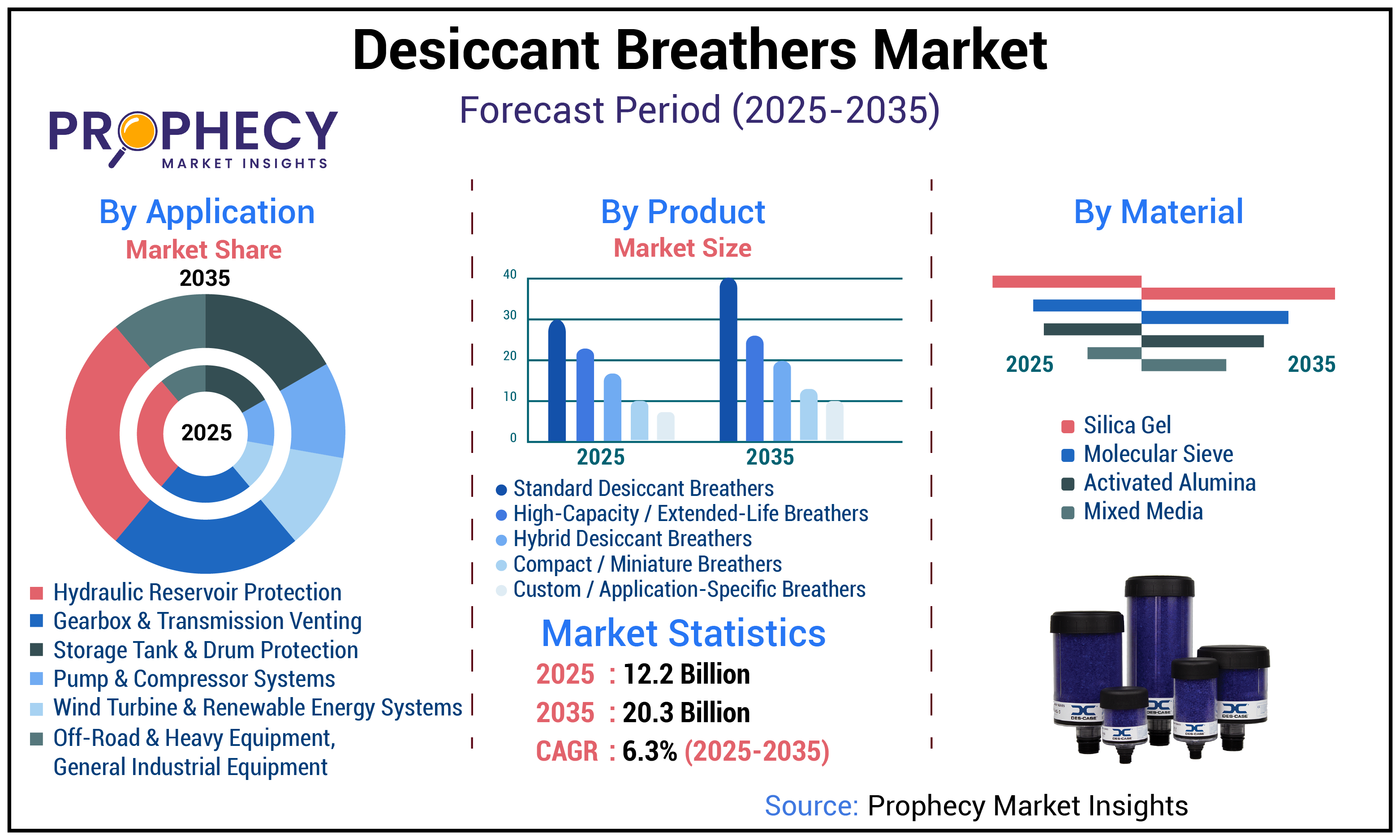
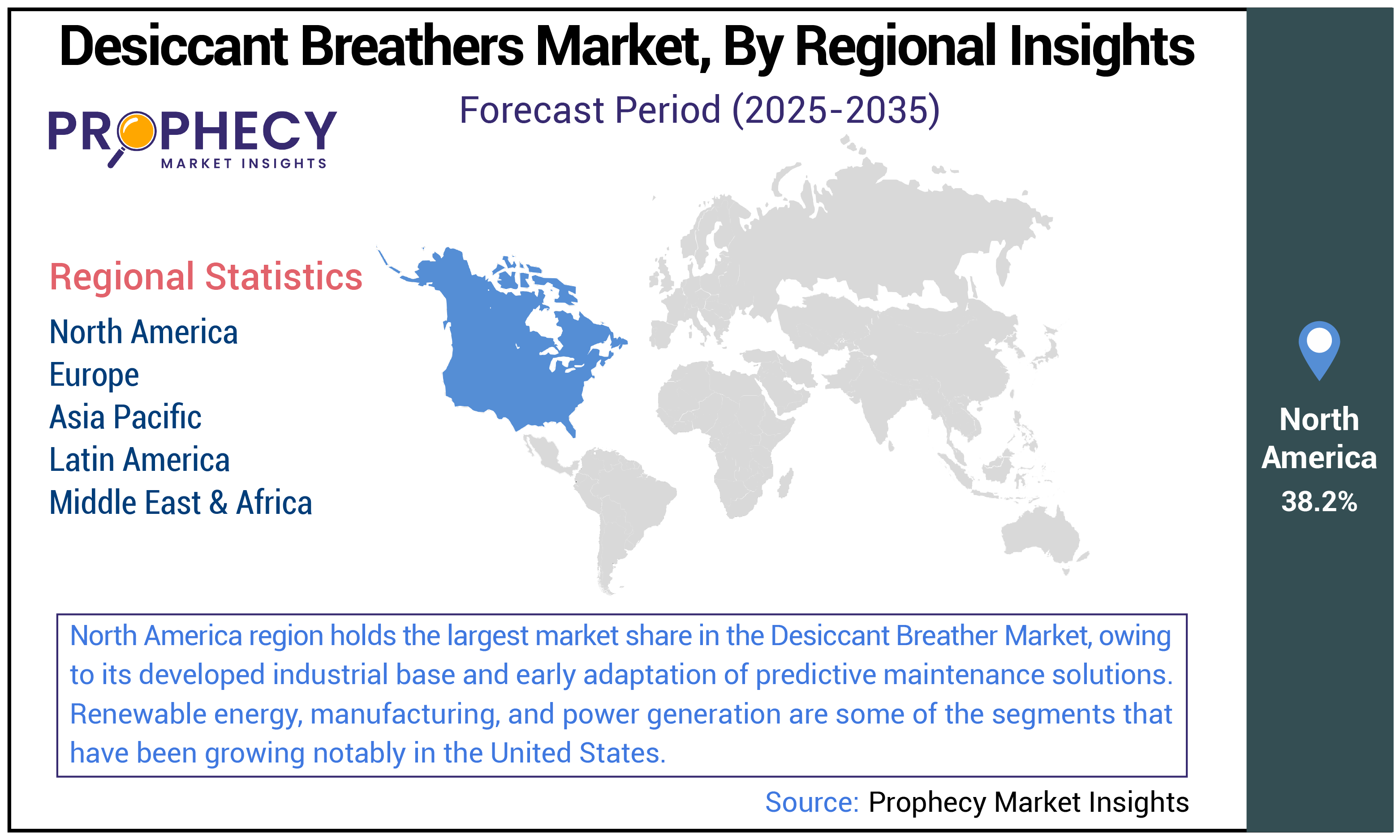
- North America has the largest regional share in the desiccant breathers market, with almost 38.2%.
- The second-largest and fastest-growing area is Europe, by accounting for 26.9%.
- By product type, standard desiccant breathers probably have the most market share among others.
- On the account of material, silica gels are the most widely used desiccant breathers in the market.
Global Desiccant Breathers Market By Drivers & Restraints
Drivers and Restraints:
|
Drivers |
Restraints |
Opportunities & Trends |
|
|
|
Key Drivers:
Technological Innovation Accelerating Desiccant Breather Performance
Smarter, faster, and more environmentally-friendly solutions are driving growth in the desiccant breather industry through technological advances. Inventions such as nanostructured desiccants- which have much larger surface areas- can more quickly absorb moisture and therefore better protect against humidity. Smart, sensor-installed breathers can now be used to monitor breathers in real-time and enable predictive maintenance reducing unplanned downtime. Not only are these developments improving operational efficiency, but also increasing reliability and making systems cost-effective especially in challenging applications such as oil & gas and heavy industry.
- For instance, a 2023 experimental study published in Energy Reports compared silica gel desiccant wheels with lithium chloride molecular sieve 5A, which showed a notable performance improvement over traditional silica gel-only design. The composite desiccant wheel (silica gel + lithium chloride + 5A) showed a 14 % higher regeneration rate and an 85.5 % higher adsorption rate than pure silica gel wheel. This research demonstrates the substantial improvement in moisture adsorption and recovery efficiency provided by state-of-the-art composite desiccant formulations that minimize refresh cycles, improve humidity management, and improve reliability in the most demanding industrial dehumidification applications.
Restraints:
High Production Costs Limit Desiccant Breather Adoption
Expensive production cost has become one of the limiting factors to the use of desiccant breathers - particularly those with superior materials and intelligent functions. High costs of raw material, research and developments, and production processes make high-end breathers unattainable to cost-conscious enterprises. This economic threshold is the reason why small businesses tend to postpone purchases or consider less efficient but cheaper versions.
- For Instance, on international supplier websites such as Alibaba and Made-in-China, simple desiccant breathers are advertised at around USD 2-4 per item, whereas more advanced or personalized varieties have a price range of around USD 10-30 each. High cost difference, sometimes in excess of 200 percent, makes it hard to justify large operations from investing in advanced options, although reliability advantages may be obvious.
- Counterbalance Statements: In future, it is possible that production cost of desiccant breathers will decrease as scale of production increases, efficiencies in supply chains, and material technologies evolve. Further uptake of automation, reusability, and mass purchases could help make high-performance breathers cheaper and accessible to even small-sized industries.
Opportunities & Trends:
Product Customization & Scalable Solutions Drive Market Flexibility
Industrial consumers now appreciate desiccant breathers that can be customized to their respective units- be it media, housing and or capacity. Flexibility in terms of the custom and scalable solutions enables the equipment ready to serve any specific environmental, chemical, or operational needs. This ability allows the businesses to incorporate breathers that maximize deliveries and minimizes wastes, be they niche applications or massive systems. Consequently, scalable and customizable solutions are unlocking new opportunities in a wide range of industries.
- For instance, Drytech Inc uses rapid prototyping (such as stereolithography) to mass produce custom desiccant breather systems, designing custom housings and formulations based on customer needs and testing of these designs. Such custom-made solutions are subjected to environmental testing: humidity, thermal, altitude to check fit and functionality then full production commencement.
Global Desiccant Breathers Market By Segmentations & Regional Insights
Product type, material, size, application, end user and region are the divisions of the desiccant breathers market.
By Product Type:
Standard desiccant breathers, hybrid desiccant breathers, high-capacity / extended-life breathers, compact / miniature breathers, custom / application-specific breathers, are product type on which desiccant breathers market is segmented. Standard desiccant breathers are the most commonly used as they are inexpensive, easy to find, and applicable to most industrial systems including basic fluid systems and general machinery.
High-capacity / extended-life breathers are second most dominant, and are used where high volumes or large scaled processes require maximum longevity and replacing breather bottles is expensive.
By Material:
Based on the material, the desiccant breathers market is divided into silica gel, molecular sieve, activated alumina, and mixed media. Silica gel is the most dominant in desiccant breathers market share as it is always been the choice material, with its high rate of adsorption, economical, and versatile application (such as, in packaging and the protection of machinery). Molecular sieve takes the second position with high-performance use, particularly in instances where low humidity or selectivity is of key importance such as for pharmaceuticals and electronics industry.
- For instance, in electronics shipping tests, done by IMPAK Corporation, a 28 g packet of molecular sieve desiccant reduced relative humidity inside sealed packages to below 30 percent within 2 days. That is over 50% reduction, ensuring that sensitive elements such as the printed circuit boards are not affected by the moisture related corrosion even during cargo transportation across different climates
By Size:
Small-capacity breathers, medium-capacity breathers, large-capacity breathers, are size of the desiccant breathers market. Small-capacity breathers (less than 50 gallons, low flow) are by far the most prevalent as they can be used in most standard fluid reservoirs and smaller systems, and as they are generally also less expensive and thus more affordable to a broader range of industries.
The medium-capacity breathers (50-500 gallons, moderate flow) are the second most commonly used. They are ideal for mid-sized industrial applications that require a balance between system capacity and operational efficiency. These types of breathers serves for longer time than smaller capacity ones and can be used in the event reliability and time between maintenance is a priority in a plant with a moderate-sized hydraulic system or storage tank.
By Application:
On the application, desiccant breathers market is categorized into hydraulic reservoir protection, gearbox & transmission venting, storage tank & drum protection, pump & compressor systems, wind turbine & renewable energy systems, off-road & heavy equipment, general industrial equipment, and others. Hydraulic reservoir are the most dominant in desiccant breathers market share when it comes to application as they this industrial machinery are found in most industries and business hence, protecting them from moisture is essential for maintenance and reliability.
Gearbox & transmission venting are the second most dominant in desiccant breathers market share as is a key area of concern in most aspects of engineering especially in applications such as manufacturing and locomotion functions where high levels of lubricant degrading are experienced, therefore, using breathers helps a great deal.
- For instance, a foundry in Nebraska put desiccant breathers on their hydraulic reservoirs to reduce moist and dirt contaminants in the hydraulic fluids. Only 3 months later, silicon particulates had significantly decreased due to oil analysis, and the system was first able to reach its target ISO cleanliness standards of 17/15/13, which were impossible to attain with the use of expensive water-absorbing filters
By End User:
Manufacturing & processing plants, power generation, oil & gas and petrochemical, mining & construction, agriculture equipment, aerospace & defense systems, transportation & rail, and others are end user of the desiccant breathers market. Manufacturing & processing plants occupy the leading position in desiccant breathers market share as these have heavy use of hydraulic systems, gearboxes and storage tanks thus they experience the highest demand of breathers.
Second-most dominant are power generation as this application greatly depends on systems filled with fluids, generators, and turbines; moisture control is critical to overall uptime and life.
Regional Insights:
Geographically, the desiccant breathers market is studied across North America, Europe, Asia Pacific, Latin America, and the Middle East & Africa.
North America: This region holds the largest market share in the desiccant breather market, owing to its developed industrial base and early adaptation of predictive maintenance solutions. Renewable energy, manufacturing, and power generation are some of the segments that have been growing notably in the United States in particular and that demand moisture control solutions with high performance in order to increase the life and the efficiency of the equipment.
North America has weaknesses in the form of supply chain logistics and rising cost of raw materials. Such problems may affect the market growth as they can affect the market prices and production schedules.
- U.S. Desiccant Breathers Market Insights:
North America is headed by the United States due to the large investments made in infrastructure development and renewable energy projects. An case in point would be the growth of wind and solar energy installations, which has boosted the popularity of desiccant breathers that help to prevent moisture penetration into sensitive equipment such as transformers and gearboxes.
Europe: This region takes second place in the world, with Germany and the U.K. leading the way. The focus on environmentally friendly manufacturing processes and regulatory regimes in the region has spawned the production of desiccant breathers in several industries including automotive and pharmaceuticals.
The desiccant breathers market is threatened by economic uncertainties, such as variable energy prices and changes in regulations. These influences can alter investment choices and costs of production to manufacturers and end users alike.
- Germany Desiccant Breathers Market Insights:
Germany is the European leader in the use of desiccant breathers, due to its strongly developed industrial base as well as its dedication towards innovation. German manufacturers have been credited with the innovation of high performance breathers that are used in demanding industries such as automobile industries and precision engineering industries.
Asia Pacific: This is the most rapidly expanding market in the desiccant breather market and this is due to the breakneck industrialization and infrastructure development in countries such as China and India. Increasing emphasis being made on the maintenance and equipment reliability has generated demand in the region in terms of moisture control solutions across different sectors.
Even though the region has future perspectives of growth, it is also challenged by the lack of consistency in regulatory ability as well as different levels of technological development within the individual countries. Such differences have the potential of affecting the consistency in which markets grow and the standardization of products.
- China Desiccant Breathers Market Insights:
The largest market in the Asia Pacific is China, however, the country stands out as a result of its vast manufacturing industry and substantial investments in forms of infrastructure. The need to modernize its industrial apparatus and adopt the new technologies of maintenance has promoted the demand of desiccant breathers to prevent the machine breakdowns caused by moisture factors.
Desiccant Breathers Market Report Scope:
|
Attribute |
Details |
|
Market Size 2025 |
USD 12.2 Billion |
|
Projected Market Size 2035 |
USD 20.3 Billion |
|
CAGR Growth Rate |
6.3% (2025-2035) |
|
Base year for estimation |
2024 |
|
Forecast period |
2025 – 2035 |
|
Market representation |
Revenue in USD Billion & CAGR from 2025 to 2035 |
|
Regional scope |
North America - U.S. and Canada Europe – Germany, U.K., France, Russia, Italy, Spain, Netherlands, and Rest of Europe Asia Pacific – China, India, Japan, Australia, Indonesia, Malaysia, South Korea, and Rest of Asia-Pacific Latin America - Brazil, Mexico, Argentina, and Rest of Latin America Middle East & Africa – GCC, Israel, South Africa, and Rest of Middle East & Africa |
|
Company Landscape |
Market Share Analysis of Companies Heat Map Analysis Company Overview, Product Types Overview Financial Information, Key Highlights Business Strategies Overview SWOT Analysis |
|
Report coverage |
Revenue forecast, company share, competitive landscape, growth factors, and trends |
|
Value Added Data Infosets |
Besides fundamental market insights such as the size of the market, growth rate, segmentation, regional study, and key players, our reports carry value-added data sets such as trade flow (import-export) analysis, production and consumption overview, price trend evaluation, supply and value chain mapping, and raw material availability. Moreover, we provide strategic tools as PESTLE and Porter’s Five Forces analysis, examination of the regulatory landscape, as well as monitoring of technology and innovation thereby providing a comprehensive overview which facilitates sensible and anticipatory decision-making. |
Segmentation:
By Product Type:
- Standard Desiccant Breathers
- Hybrid Desiccant Breathers
- High-Capacity / Extended-Life Breathers
- Compact / Miniature Breathers
- Custom / Application-Specific Breathers
By Material:
- Silica Gel
- Molecular Sieve
- Activated Alumina
- Mixed Media
By Size:
- Small-Capacity Breathers ( <50 gallons / low flow)
- Medium-Capacity Breathers (50–500 gallons / moderate flow)
- Large-Capacity Breathers (Industrial >500 gallons / high flow)
By Application:
- Hydraulic Reservoir Protection
- Gearbox & Transmission Venting
- Storage Tank & Drum Protection
- Pump & Compressor Systems
- Wind Turbine & Renewable Energy Systems
- Off-Road & Heavy Equipment, General Industrial Equipment
- Others
By End User:
- Manufacturing & Processing Plants
- Power Generation
- Oil, Gas and Petrochemical
- Mining & Construction
- Agriculture Equipment
- Aerospace & Defense Systems, Transportation & Rail
- Others
By Region:
- North America
- U.S.
- Canada
- Europe
- Germany
- U.K.
- France
- Russia
- Italy
- Spain
- Netherlands
- Rest of Europe
- Asia Pacific
- China
- India
- Japan
- Australia
- Indonesia
- Malaysia
- South Korea
- Rest of Asia Pacific
- Latin America
- Brazil
- Mexico
- Argentina
- Rest of Latin America
- Middle East & Africa
- GCC
- Israel
- South Africa
- Rest of Middle East & Africa
Global Desiccant Breathers Market By Competitive Landscape & Key Players
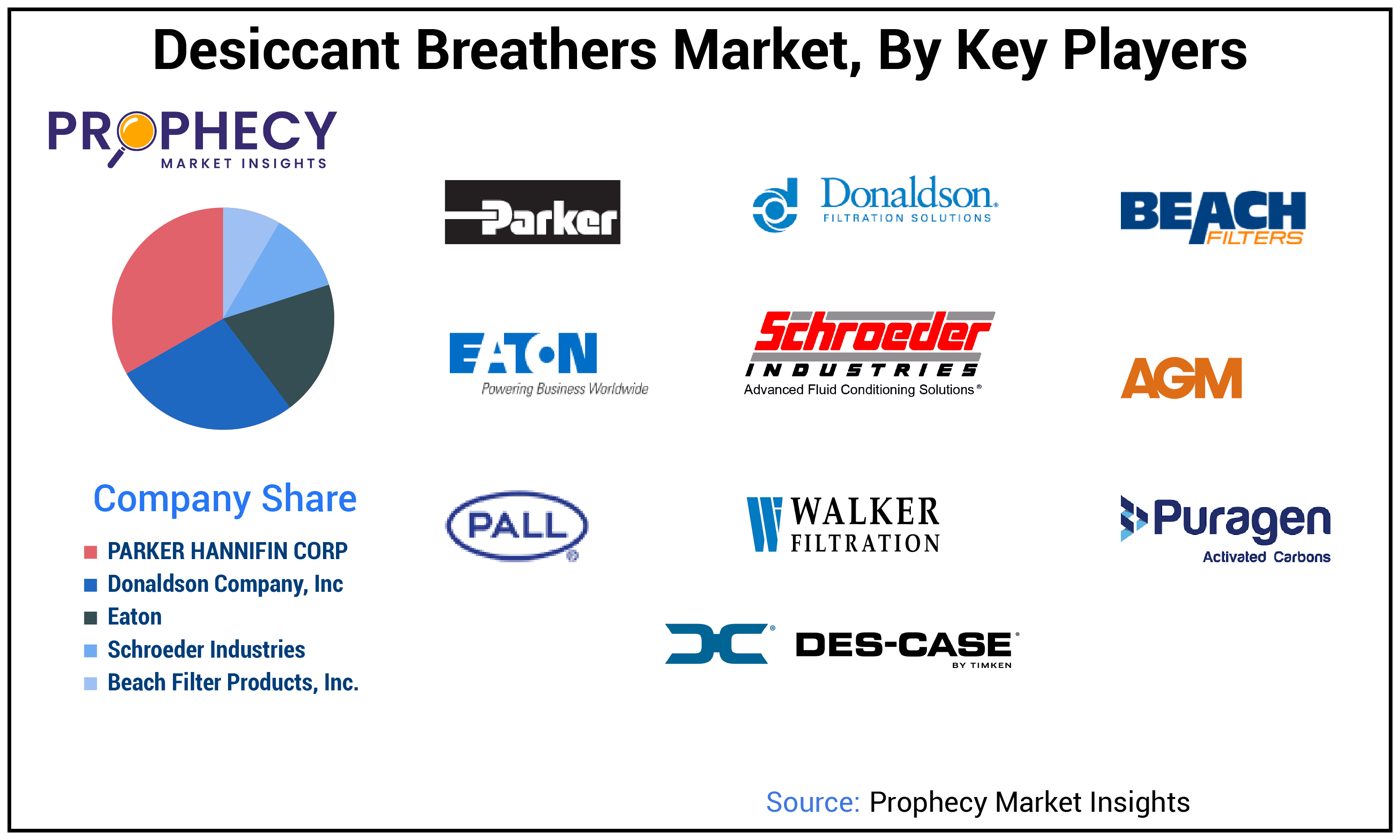
Innovation and product differentiation are two foreseeable ways that companies can use to expand in the desiccant breather market. It is possible to attract a broader industrial base by offering smart breathers, custom solutions, and eco-friendly materials. Target marketing and availability of distribution channels can also ensure accessibility. The key players operating in the desiccant breathers market include, Donaldson Company, Inc, Pall Corporation, Schroeder Industries, and others.
Desiccant Breathers Market Companies:
- PARKER HANNIFIN CORP
- Donaldson Company, Inc
- Eaton
- Schroeder Industries
- Beach Filter Products, Inc.
- Descase
- Pall Corporation
- C.C.JENSEN A/S
- Drytech Inc.
- AGM Container Controls.
- PURAGEN ACTIVATED CARBONS
- Walker Filtration
- Filtration Group GmbH
- Sorbchem India Pvt Ltd.
- Bossmanfilter
View an Additional List of Companies in the Desiccant Breathers Market
Global Desiccant Breathers Market By Recent News
- In April 2025, Zeozorb, LLC announced its commitment to delivering precision and consistency in moisture control with its line of desiccant breathers engineered for critical applications across fluid power, mining and marine offshore, power transformers, storage tanks, and wind energy systems. High-quality molecular sieves and precise quality control, including adsorption rates, particle integrity, and seal performance testing, ensure that Zeozorb products will perform in austere environments and meet, or exceed, aerospace requirements.
- In September 2024, Dodge Industrial has launched its new OPTIFY Breather, an intelligent desiccant breather that can be connected to any OPTIFY IoT platform. It provides real-time-data about breather life, saturation rate, temperature, and so on, as it is equipped with advanced sensors, enabling users to view breather status remotely, increase the life of the gearbox, and enhance the process of maintenance. High-capacity silica gel and fine polyester filtration (down to 3 microns) prevent moisture and particulate contamination and allow proactive maintenance and maximization of uptime.
Analyst View:
The desiccant breather market shows significant growth potential as industries seek to protect critical electrical and mechanical equipment from moisture damage. Rising reliability requirements for power equipment further fuel this market expansion. There is growing concern about moisture and oxygen ingress, which is driving the increased usage of new breather technologies across industry and renewable energy processes. Constant development of new and maintenance-free smart breathers in the market is possible to increase the competitiveness of the market and its sustainability in terms of infrastructure performance in the long run.
Analysis of Sources:
Primary Sources:
- In-depth interviews
- Company-specific data
- Surveys and questionnaires
- Focus group discussions (FGDs)
- Others
Secondary Sources:
- U.S. Department of Energy
- International Journal for Research in Applied Science & Engineering Technology (IJRASET)
- ResearchGate
- IET Digital Library
- Others
More Related Reports
Renewable Naphtha Market
Standard Modular Hydropower Market
Renewable Energy Storage Market
Renewable Methanol Market
North America Renewable Energy Storage Market
Global Desiccant Breathers Market By Company Profile
|
Company Name |
Product Portfolio |
|
PARKER HANNIFIN CORP |
Molecular sieve desiccant breather, Polyester & silica gel desiccant breather, and Others |
|
Donaldson Company, Inc |
Thermally reactive advanced protection breathers, thermally reactive self-regenerating tank breather, and Others |
|
Eaton |
Desiccant breather for helicopter gearboxes, desiccant breather for hydraulic systems, and Others |
|
Schroeder Industries |
Silica gel desiccant breather, Bi-directional airflow silica gel based desiccant breather, and Others |
|
Beach Filter Products, Inc. |
Disposable hygroscopic breathers, Extreme duty breathers, and Others |
Global Desiccant Breathers Market By Highlights
FAQs
Desiccant breathers market size was valued at USD 12.2 Billion in 2025 and is expected to reach USD 20.3 Billion by 2035 growing at a CAGR of 6.3%.
Product type, material, size, application, end user, and region are the segmentation for the desiccant breathers market.
Improvements in manufacturing operations, especially in energy and utilities, growing applications in vacuum pumps, heavy equipment, and storage systems and so on are some of the desiccant breathers market growth drivers.
North America, Asia Pacific, Europe, Latin America, and the Middle East & Africa. North America is expected to dominate the desiccant breathers market.
The utilization of Generative Al and technological innovations has not only revolutionized product type development but has also facilitated the creation of precise formulations, customized blends, and improved delivery systems in the desiccant breathers market. As a result, the entire industries are witnessing a significant reduction in time-to-market and a substantial increase in product type efficacy. Such transformations have undoubtedly paved the way for the accelerated growth of the market.
The key players operating the desiccant breathers market include PARKER HANNIFIN CORP, Donaldson Company, Inc, Eaton, Schroeder Industries, Beach Filter Products, Inc., Descase, Pall Corporation, C.C.JENSEN A/S, Drytech Inc., AGM Container Controls., PURAGEN ACTIVATED CARBONS, Walker Filtration, Filtration Group GmbH, Sorbchem India Pvt Ltd., and Bossmanfilter.