Global AntiAging Device Market By Overview
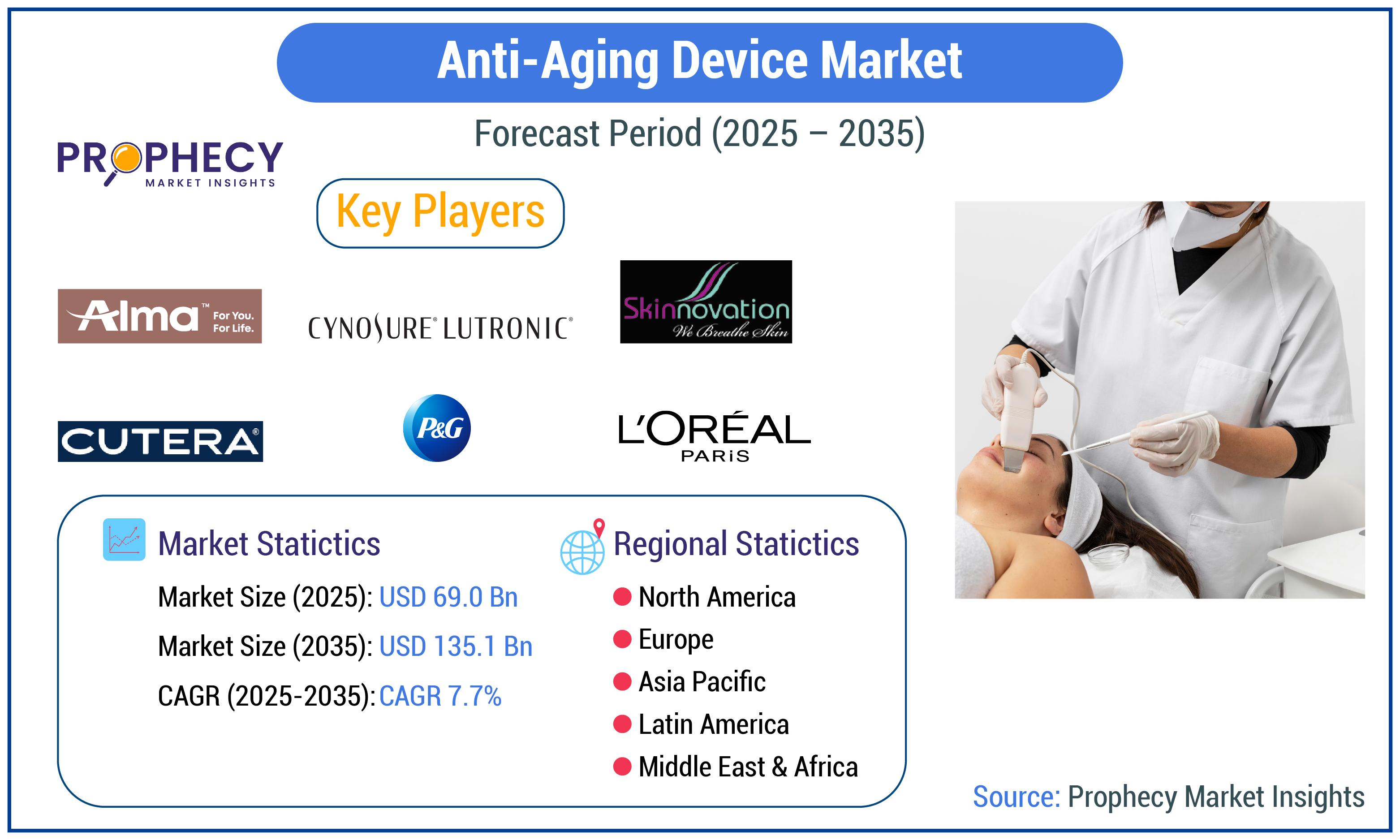
- The anti-aging device market size is expected to expand at a valuation of USD 135.1 Billion by 2035.
- In 2024, the valuation of the market reached USD 66.2 Billion.
- The market is projected to grow at a CAGR of 7.7% during the forecast period.
Anti-aging devices refer to technologies and goods that are advertised as reducing, preventing, or reversing the indications of aging. This technology frequently targets skin-related issues including drooping and wrinkles. Anti-aging devices offer various advantages, such as reducing wrinkles, improving skin elasticity, brightening the complexion, enhancing hydration, improving skin texture, reducing scars and dark spots, and promoting collagen production, further slowing down the visible signs of aging.
The rising aging population, growing consumer awareness about skincare and anti-aging treatments, rising demand for minimally invasive and at-home anti-aging devices, and increasing research and development by companies to come up with effective anti-aging solutions, are factors fostering the anti-aging device market growth.
Furthermore, the advancements in artificial intelligence and smart technologies, along with several technological advancements including laser therapy, radiofrequency, and ultrasound, and the rising demand for environmentally friendly and sustainable beauty technologies are also contributing in the target market’s expansion.
Impact of Generative AI on Anti-Aging Device Market:
With the help of advanced research and development, optimized device performance, and individualized skincare solutions, generative AI is transforming the anti-aging device market. AI-powered skin analysis improves efficacy by personalizing treatments. Through cost savings, improved consumer involvement through virtual consultations, and accelerated innovation in non-invasive technologies, it propels market expansion and increases access to cutting-edge anti-aging treatments.
Global AntiAging Device Market By Drivers & Restraints
Key Drivers:
Market is Witnessing High Growth Due to the Rising Aging Population Globally
The rising aging population drives the anti-aging device market growth as people seek to combat or delay the signs of aging, and there is an increasing demand for products and services that address age-related concerns. Additionally, the increased awareness about the signs of aging and the benefits of preventative measures, increasing consciousness of physical appearance among consumers, and development of new anti-aging devices further contribute to market diversification.
- For instance, in October 2024, according to the data published by WHO, by 2030, 1 in 6 people in the world will be aged 60 years or over. At this time the share of the population aged 60 years and over will increase from 1 billion in 2020 to 1.4 billion. By 2050, the world’s population of people aged 60 years and older will double (2.1 billion). The number of persons aged 80 years or older is expected to triple between 2020 and 2050 to reach 426 million.
Rising Demand for Minimally Invasive Anti-Aging Devices is Propelling the Market Growth
The anti-aging device market is expanding due to the growing demand for minimally invasive anti-aging products, which provide safer, painless, and faster recovery options. Technologies including ultrasound, radiofrequency, and laser therapy draw patients looking for efficient non-surgical therapies. Growing awareness, hectic schedules, and a predilection for at-home and clinic-based solutions all contribute to adoption, which broadens the market's scope and spurs innovation.
Market is Propelling due to the Increasing Awareness of Skincare Globally
The anti-aging device market is driven by the growing consumer awareness of skincare, which encourages them to use cutting-edge products for healthy and youthful skin. In order to avoid the indications of aging, informed customers look for non-invasive therapies, such as radiofrequency devices, microcurrents, and LED therapy. Demand is increased by influencer marketing, dermatological research, and social media. This change encourages consistent use of anti-aging technology for long-term skincare benefits, increases innovation, and broadens market reach.
Restraints:
Market Growth may be Hindered Owing to Lack of Proper Regulatory Approvals of Anti-Aging Devices
The lack of appropriate regulatory clearances for many anti-aging devices raises safety concerns and results in inconsistent efficacy. Misleading statements and inconsistent device quality can erode consumer trust and hinder anti-aging device market expansion. Innovation and worldwide adoption are also hampered by the lack of defined guidelines.
- Counterbalance Statements: Safety and efficacy can be improved via more robust regulatory frameworks, clinical validation, and industry-standard certifications. Increasing marketing openness and educating consumers about scientifically supported technology helps foster trust, which will guarantee legitimacy and steady market growth.
Opportunities & Trends:
Integrating Artificial Intelligence with Anti-Aging Devices Unlocks Growth Opportunities in the Upcoming Years
The surging integration of AI with anti-aging technologies, which allows for automated adjustments for best outcomes, real-time skin analysis, and customized treatments, is expected to boost market growth during the forecast period. AI boosts the research and development of novel solutions while increasing device efficiency and safety. Additionally, data-driven insights and virtual consultations driven by AI increase consumer involvement, further augmenting the effectiveness and accessibility of cutting-edge anti-aging solutions.
- For instance, in July 2023, according to an article published by ResearchGate GmbH, multi-dimensional data obtained in the course of aging-related research are difficult to analyze. However, with the use of artificial intelligence (AI), datasets at the molecular, genetic, and biophysical information levels become more insightful and help strengthen skin resilience. AI-driven technologies thus contribute to advances in skin aging research, including method development and data acquisition, evaluation, and interpretation.
Global AntiAging Device Market By Segmentations & Regional Insights
The anti-aging device market is segmented into device type, target area, distribution channel, and region.
By Device Type
According to device type, the market is bifurcated into stand-alone devices and direct-to-consumer devices. The stand-alone devices holds the largest anti-aging device market share. This dominance is driven by technological advancements, consumer demand for convenient home treatments, and the increasing affordability of these devices.
The direct-to-consumers devices segment is growing in the target market. The increased consumer awareness, rising disposable incomes, and its convenience and accessibility is burgeoning the segment’s expansion.
By Target Area:
Based on target area, the market is categorized into skin treatment, eye treatment, hair treatment, and others. The skin treatment is the target area, which is dominating the market. The growth of the segment is driven by the high consumer demand due to several skin aging concerns, innovations in skin treatment technologies, and the rise in popularity of at-home beauty treatments.
Hair treatment is the target area which is the fastest growing segment in the anti-aging device market. The growth is driven by the increasing prevalence of hair-related issues, and technological advancements making hair treatment more accessible.
By Distribution Channel:
Based on distribution channel, the market is catalogued into supermarkets and hypermarkets, e-commerce, retail pharmacies, and others. The supermarkets and hypermarkets segment is attributed to rule over the market due to its wide product availability, customer preferences, and competitive pricing. Additionally, it is a convenient option for the consumers, thereby further driving the segment’s growth.
E-commerce is the fastest growing segment of the target market due to its convenience, wider product selection, and competitive pricing.
Regional Insights:
Geographically, the market is studied across North America, Europe, Asia Pacific, Latin America, and the Middle East & Africa.
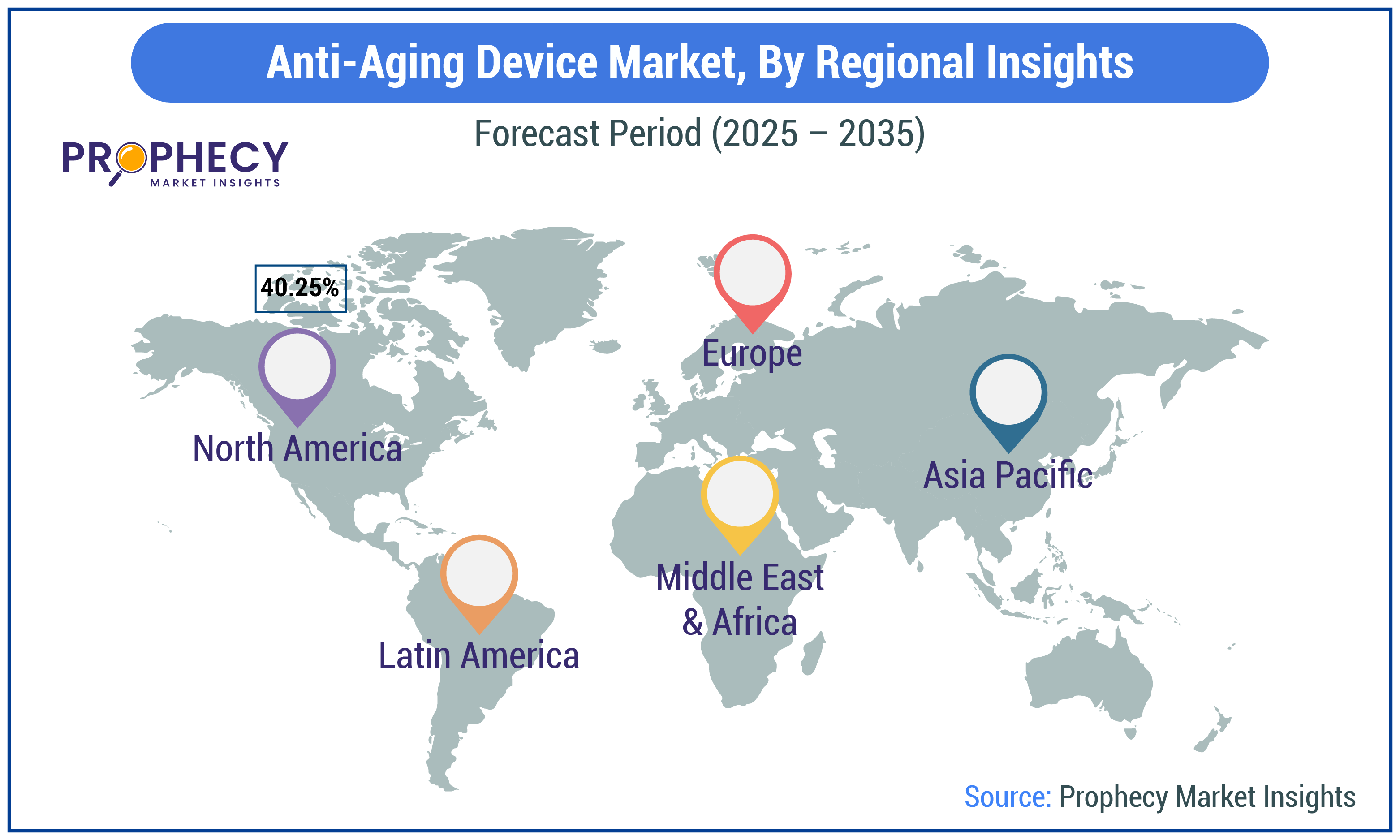
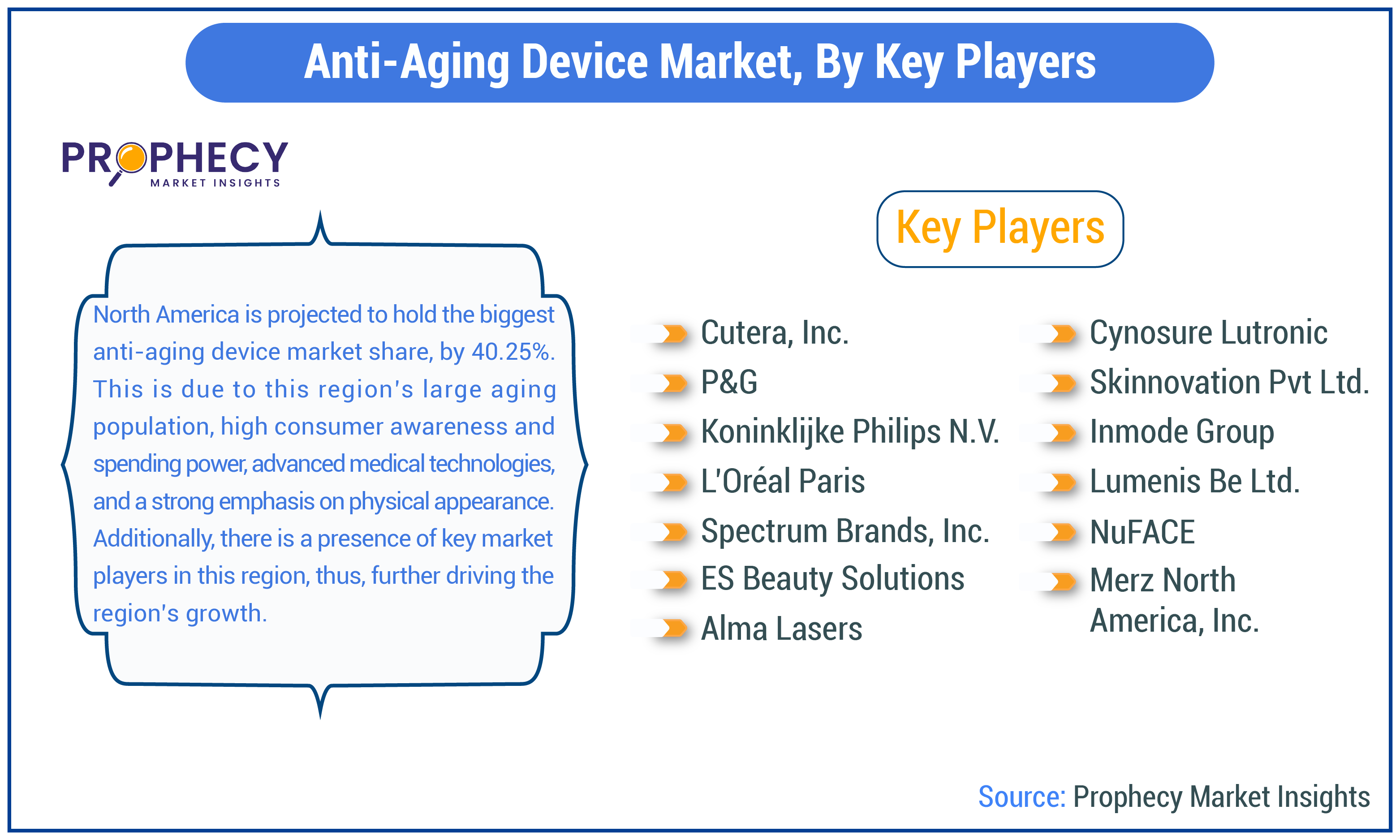
North America: North America is projected to hold the biggest anti-aging device market share, by 40.25%. This is due to this region’s large aging population, high consumer awareness and spending power, advanced medical technologies, and a strong emphasis on physical appearance. Additionally, there is a presence of key market players in this region, thus, further driving the region’s growth.
- U.S. Anti-Aging Device Market Insights:
The U.S. anti-aging device market is the leading market among all the other countries in North America. This is due to its large population, high consumer spending power, and advanced healthcare infrastructure, leading to strong demand for both non-invasive cosmetic treatments and anti-aging skincare products. In addition to this, the geriatric population of this country is also expanding thereby, further causing the anti-aging device market expansion in the country.
Europe: Europe is the region, which is anticipated to grow with the highest CAGR during the forecast period. The growth of the region is driven by the rising aging population, rising self-consciousness about aging, increasing preference for natural and organic products, advanced research and quality standards, and increased interest in health and beauty regimens.
- France Anti-Aging Device Market Insights:
The anti-aging device market of France is experiencing rapid growth in the recent years, during the forecast period. This is due to the high awareness and demand of these devices among the French consumers, significant investments in research and developments, leading to technological innovations, and an influence of beauty culture among the consumers of this country.
Asia Pacific: This region is experiencing a subsequent amount of growth in the recent years. The large and geriatric population, rising disposable incomes, increasing awareness of anti-aging solutions, and the influence of beauty trends, such as, K-beauty and J-beauty, is boosting the region’s growth in the market.
- China Anti-Aging Device Market Insights:
The Chinese anti-aging device market is growing in a considerable amount, in the recent years, compared to other Asia Pacific nations. This growth is driven by a growing elderly population, increasing consumer awareness of beauty therapies, and the development of medical tourism, in this country. Additionally, new beauty trends also influences the country’s anti-aging device market.
Anti-Aging Device Market Report Scope:
|
Attribute |
Details |
|
Market Size 2025 |
USD 69 Billion |
|
Projected Market Size 2035 |
USD 135.1 Billion |
|
CAGR Growth Rate |
7.7% (2025-2035) |
|
Base year for estimation |
2024 |
|
Forecast period |
2025 – 2035 |
|
Market representation |
Revenue in USD Billion & CAGR from 2025 to 2035 |
|
Regional scope |
North America - U.S. and Canada Europe – Germany, U.K., France, Russia, Italy, Spain, Netherlands, and Rest of Europe Asia Pacific – China, India, Japan, Australia, Indonesia, Malaysia, South Korea, and Rest of Asia-Pacific Latin America - Brazil, Mexico, Argentina, and Rest of Latin America Middle East & Africa – GCC, Israel, South Africa, and Rest of Middle East & Africa |
|
Report coverage |
Revenue forecast, company share, competitive landscape, growth factors, and trends |
Segmentation:
By Device Type:
- Stand-Alone Devices
- Direct-to-Consumer Devices
By Target Area:
- Skin Treatment
- Eye Treatment
- Hair Treatment
- Others
By Route of Administration:
- Topical
- Local Ocular
- Systemic
By Distribution Channel:
- Supermarket and Hypermarkets
- E-Commerce
- Retail Pharmacies
- Others
By Region:
- North America
- U.S.
- Canada
- Europe
- Germany
- U.K.
- France
- Russia
- Italy
- Spain
- Netherlands
- Rest of Europe
- Asia Pacific
- China
- India
- Japan
- Australia
- Indonesia
- Malaysia
- South Korea
- Rest of Asia Pacific
- Latin America
- Brazil
- Mexico
- Argentina
- Rest of Latin America
- Middle East & Africa
- GCC
- Israel
- South Africa
- Rest of Middle East & Africa
Global AntiAging Device Market By Competitive Landscape & Key Players
The key players operating in the market include, Cutera, Inc., P&G, Koninklijke Philips N.V., L’Oréal Paris, Spectrum Brands, Inc., ES Beauty Solutions, and others. These key players are adopting strategies, such as, understanding the target audience, building trust through consistent messaging, leveraging social media and content market, and adopting new technologies, to maintain competitive edge in the market.
Anti-Aging Device Market Companies:
- Cutera, Inc.
- P&G
- Koninklijke Philips N.V.
- L’Oréal Paris
- Spectrum Brands, Inc.
- ES Beauty Solutions
- Alma Lasers
- Cynosure Lutronic
- Skinnovation Pvt Ltd.
- Inmode Group
- Lumenis Be Ltd.
- Merz North America, Inc.
- NuFACE
View an Additional List of Companies in the Anti-Aging Device Market
Global AntiAging Device Market By Recent News
- In February 2025, SharkNinja Inc., launched Shark CryoGlow, its first consumer solution in the skincare category, was launched in the U.S. Shark CryoGlow was a MedSpa-inspired under-eye cooling + LED anti-aging & acne clearing mask combining high-energy LEDs, deep-penetrating infrared, and under-eye cooling all available with the touch of a button. Developed with dermatologists, backed by clinical testing, and FDA-cleared to offer consumers an at home solution for its skincare needs.
- In January 2025, L’Oréal launched a new device called the Cell BioPrint, designed to give people a detailed breakdown of the skin quality of the people in five minutes. The French cosmetics company had long operated at the intersection of beauty, science, and technology. This device helped in determining the quality and age of the skin. It was also geared towards understanding the skin’s longevity, to reverse aging.
- In September 2024, a revolutionary device, Wonder Face was introduced at Dr Rickson's Dermatherapie Clinic, which was a promising approach to toning facial muscles and reverse aging. This device offered an exciting method for toning facial muscles and combating the effects of aging. Wonder Face was a revolutionary non-surgical approach for excellent Facial Muscle Toning to reverse the aging process.
- In August 2024, Purple Pompa announced the launch of its innovative skincare line dedicated to “Age Balance”. This novel approach harmonized natural aging with skin rejuvenation, offering a refreshing alternative to traditional anti-aging products. This helped in maintaining healthy, radiant skin at every stage of life and it helps in supporting the skin’s natural processes, and enhances its resilience.
- In June 2023, the aging care brand EFFECTIM, developed a new beauty device, “EFFECTIM Bright Beauty Lifting Activator,” and a new beauty serum, “EFFECTIM Bright Lifting Serum (quasi-drug), which are based on based on Shiseido’s most advanced dermatological research. The device uses STEM4 Multi Force technology in Lift Mode and SPOT5 Root Shooting Pulses in Bright Mode, providing a 6-minute daily skin care routine for busy users.
Analyst View:
The anti-aging device market is expanding due to a number of factors, including the aging population, rising consumer awareness of skincare and anti-aging treatments, growing demand for at-home and minimally invasive anti-aging devices, and increased company research and development to create efficient anti-aging solutions. Additionally, the development of smart technologies and artificial intelligence, technological innovations such as laser therapy, radiofrequency, and ultrasound, and the growing demand for sustainable and eco-friendly beauty products are all driving the target market's growth.
More Related Reports
Antithrombin Market
Lubricant Antioxidants Market
Anti-Idiopathic Pulmonary Fibrosis Drugs Market
Stuttering Device Market
Drug Device Combination Products Market
Global AntiAging Device Market By Company Profile
|
Company Name |
Cutera, Inc. |
|
Headquarter |
Brisbane, California, U.S. |
|
CEO |
Mr. Taylor Harris |
|
Employee Count (2024) |
430 Employees |
Global AntiAging Device Market By Highlights
FAQs
Anti-aging device market size has reached a valuation of USD 69 Billion 2025 and is expected to be valued at USD 135.1 Billion 2035 growing at a CAGR of 7.7%.
Device type, target area, distribution channel, and region are the segmentation for the target market.
North America, Asia Pacific, Europe, Latin America, and the Middle East & Africa. North America is expected to dominate the market.
The key players operating in the anti-aging device market include Cutera, Inc., P&G, Koninklijke Philips N.V., Skinnovation Pvt Ltd., L’Oréal Paris, ES Beauty Solutions, Alma Lasers, Cynosure Lutronic, Inmode Group, Lumenis Be Ltd., Merz North America, Inc., and NuFACE.