Global Acai Berry Market By Overview
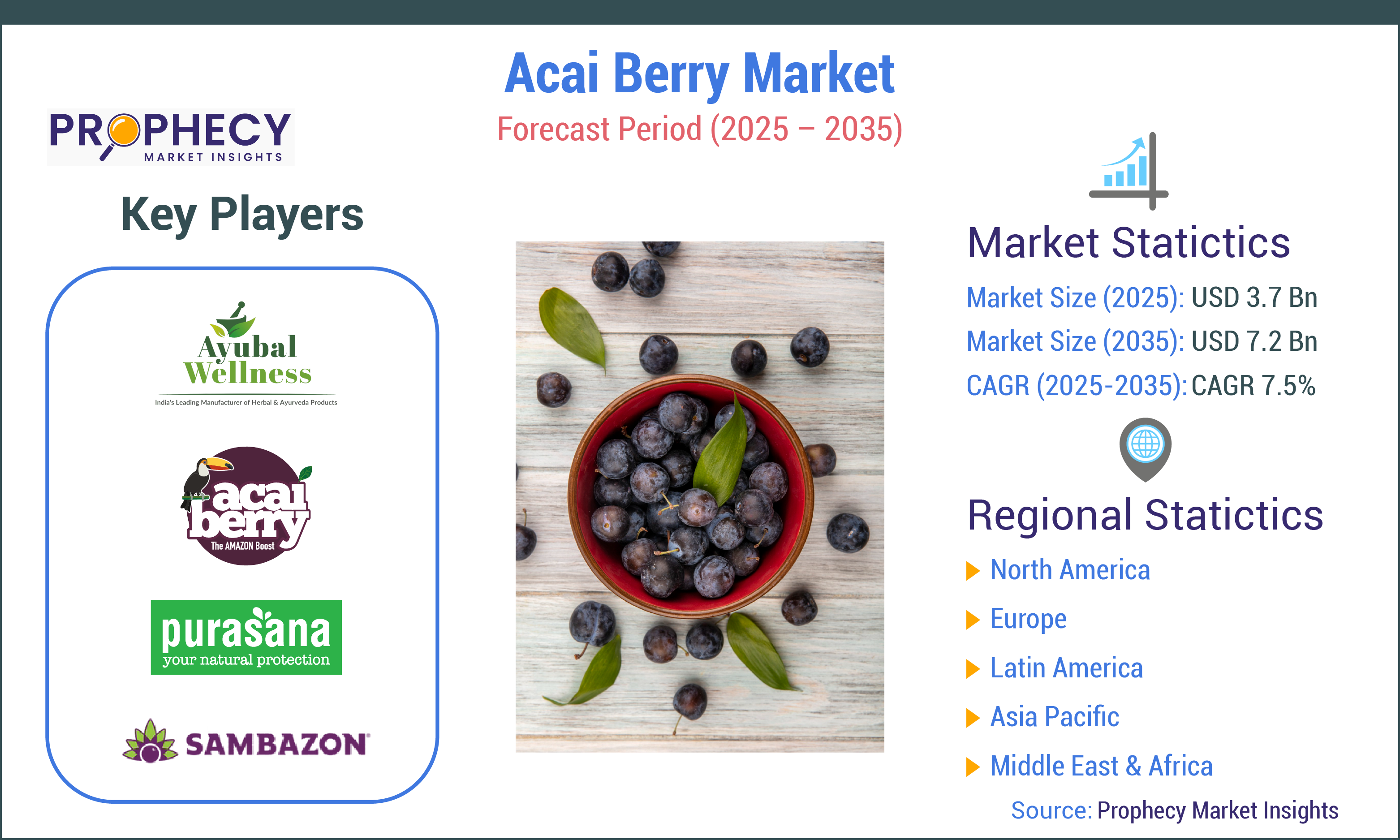
- Acai berry market size is predicted to progress at a rate of USD 7.2 Billion, by 2035.
- The valuation of the market was accounted for USD 3.5 Billion in 2024.
- Acai berry market is mounting at a CAGR 7.5%.
Acai berry is a small, dark purple fruit that grows on the acai palm tree, which is native to the rainforests of Central and South America, particularly the Amazon Basin. The berry is about the size of a grape and has a single large seed of the fruit, with the remaining pulp being highly prized for its nutritional and medicinal properties. It is rich in antioxidants, especially anthocyanins, which give the berry its deep purple color and help combat oxidative stress in the body. Acai also contains fiber, healthy fats, vitamins A, C, and E, and various plant compounds to support heart health, brain function, and anti-inflammatory processes. It is often consumed in acai bowls, smoothies, energy bars, and dietary supplements, which recognized as superfood in recent years.
Rising disposable income, rising demand for superfoods, natural health Product Forms, increases the demand for acai berry, rise in consumption of functional food, and growth in beverage sector, is anticipated to drive acai berry market growth. Increasing awareness of preventive healthcare, expansion of vegan, plant-based diets, and rising e-commerce, health retail platforms, is expected to pitch acai berry market growth.
Diversify product offerings, such as ready-to-eat snacks, protein bars, cereals, energy drinks, and growing demand in emerging markets, can significantly drive acai berry market growth. Development of sustainable, organic supply chains, innovation in delivery forms, such as capsules, tables, gummies, and partnerships with fitness, wellness brands, is projected to boost acai berry market growth.
Recession Risk and Tarriff Analysis on Acai Berry Market:
- The acai berry market is exposed to economic downturns due to its positioning as a premium health Product Form. During a recession, consumers often cut back on optional spending, including superfoods and organic wellness items, which could lead to a decline in demand for acai-based product. Product such as acai smoothies, supplements, or beauty items may be viewed as non-essential, especially in price-sensitive markets.
- Tariffs can significantly impact the cost structure and global trade of acai Product Forms, especially since acai is predominantly grown in Brazil and exported globally in various forms. Import duties, food safety regulations, and customs fees can increase retail prices in major consumer markets such as the U.S., Europe, and Asia.
Impact of Generative AI on Acai Berry Market:
- AI is transforming the acai berry market by enhancing product innovation, marketing, and supply chain optimization. Brands are using AI-driven tools to analyze consumer trends, enabling them to develop targeted product such as acai-infused supplements, functional beverages, and skincare.
- AI algorithms support personalized marketing campaigns, generating tailored content for social media and e-commerce that resonates with health-conscious audiences. AI-powered chatbots and virtual assistants improve customer engagement, offering nutrition tips or Product Form recommendations.
Global Acai Berry Market By Drivers & Restraints
Key Drivers:
Rising Disposable Income Predicted to Boost Acai Berry Market Growth
As consumers earn more, are increasingly willing to spend on premium, health-focused Product Forms that support wellness, longevity, and active lifestyles. Acai berries, recognized as a superfood rich in antioxidants, fiber, and essential nutrients, are often recognized as high-value Product Forms in the food, supplement, and cosmetic industries. In developing regions in which middle-class populations are rapidly expanding, rising income levels are changing dietary preferences. Consumers are shifting from traditional fasteners to functional and organic foods, including acai-based juices, smoothie packs, and supplements. This trend enables more people to explore preventive health and fitness regimes, often powered by natural superfoods such as acai. As a result, rising disposable income expands the consumer base and also encourages Product Form diversification, is expected to boost acai berry market growth.
- For instance, according to article published by Euromonitor is privately owned & trademarked, in November 2024, this article states that, global disposable income rise by 3.4% in 2023, driven by growth in Asia Pacific and North America. By 2040, disposable income growth is projected by 2.6% with emerging and developing regions leading the expansion. In Asia Pacific, real growth of 49.8% in consumer spending over 2023-2040, which is higher than North America. Developed Asian nations such as Japan and South Korea are expected to drive a significant increase in spending, though still covering behind China. In 2023, the global wealthy population expanded by 6.4%, driven by an addition of 2.4 billion individuals, mainly from the U.S., Germany, the U.K. and France.
Restraints:
Market Hindered by Limited Shelf Life and Supply Chain Complexity
Acai berries are highly perishable, losing nutritional value within 24 hours of harvest. This makes fresh acai exports nearly impossible and increases reliance on frozen or powdered forms, which require sophisticated cold chain logistics. Maintaining quality during transport involves specialized cold-chain logistics, which adds significant cost and infrastructure demands. These challenges can lead to supply instability, increased prices, and limited accessibility in distant markets.
- Counterbalance Statements: the industry has adopted innovative processing technologies such as freeze-drying, spray drying, and vacuum sealing, which significantly extend the shelf life of acai by preserving its nutritional value. Improvements in cold-chain logistics including temperature-controlled shipping, advanced packaging, and regional processing hubs have enabled a more reliable and efficient supply network
Opportunities & Trends:
Rapid Expansion of Online Grocery Shopping Platform Fuels Marget Expansion
As digital commerce becomes a conventional shopping channel, consumers are increasingly turning to e-commerce and mobile apps to purchase health and wellness Product Forms, including superfoods such as acai. Online platforms allow brands to showcase a wider variety of acai Product Forms, such as frozen pulp, powders, juices, and supplements without the shelf space limitations of traditional retail. This is especially beneficial for niche or premium product such as acai, which have limited exposure in physical stores.
Online retailers often provide detailed product descriptions, health benefit information, and customer reviews, helping educate consumers and influence purchasing decisions. As consumer reliance on digital shopping continues growing, particularly after the pandemic, the online grocery ecosystem offers a powerful channel for scaling the acai berry, contributing to boost acai berry market share.
- For Instance, according to the data published by GWI, 59% of grocery shoppers prefer online shopping. U.S. online grocery purchase is growing at 23% from 2020, where 89% of shopper are reaching for privet-label Product Forms to stretch their grocery budgets. 35% of online grocery shopper are in high-income category. 61% are kids, and 47% of parents that have kids aged 3-11, prefer to quick, easy, and stress-free grocery solutions. 59% are married, and 67% of urban areas lived people prefer online grocery shopping. 35% of food shoppers in APAC regularly use coupons, showing that price incentives are a key factor in driving repeat purchases.
Global Acai Berry Market By Segmentations & Regional Insights
The acai berry market is segmented into product form, claim, application, distribution channel, and region.
By Product Form:
Based on Product Form, the market is divided into pulp, dried, frozen, powder, juice, extract and other. Pulp is most superior segment in the market, as it is most commonly used in smoothies, acai bowls, beverages, and functional foods. It retains most of the fruit’s original taste and nutrients, making it highly popular emerging markets, in which acai bowls are a staple in health-focused diets, is projected to fuel segment’s development in acai berry market size.
Dried acai is fastest growing segment in the market, including powders and capsules. It is widely used in nutraceuticals, supplements, and energy bars due to its longer shelf life, convenience in transport, and high concentration of antioxidants. The growing trend of on-the-go nutrition and dietary supplements supports this segment’s steady growth in acai berry market share.
By Claims:
By claims market is segmented into, organic, non-GMO, gluten-free, and dairy-free. Organic is most superior segment in the market, driven by increasing consumer awareness about clean eating, natural ingredients, and the perceived health benefits of organically grown products. Açaí berries are often marketed as a superfood, and consumers who seek out these products typically prefer organic options that are free from synthetic pesticides, herbicides, and fertilizers, is estimated to impel segment’s expansion in acai berry market share.
By Application:
By application, acai berry market is divided into, food & beverage, nutritional supplements, cosmetics & personal care, pharmaceuticals, and others. Food & beverage segment holds the largest acai berry market share. Acai is widely used in smoothies, juices, energy bowls, yogurt, snack bars, and functional beverages. Its rich antioxidant content and superfood status have made it especially popular among health-conscious consumers and in fitness-related diets. The global rise in demand for plant-based and clean-label foods, is predicted to compel growth of segment in acai berry market growth.
Nutritional supplements is second leading segment in the market. Acai berry is included in a range of dietary supplements for its supposed benefits in immune support, weight management, anti-aging, and cardiovascular health. It is commonly available in capsule, powder, and gummy forms, appealing to consumers focused on preventive healthcare and natural wellness solutions, resulting to boost segment’s extension in acai berry market size.
By Distribution Channel:
Under distribution channel, the market is categorized into hypermarkets & supermarkets, convenience stores, online retails, specialty health stores, and others. Hypermarkets & supermarkets are the leading distribution channel for acai berry globally. These large-format retail stores offer wider Product Form variety, visibility, and in-store promotions, making them the go-to option for consumers looking for acai-based foods such as frozen pulp, juices, smoothie packs, and snack bars. Their ability to offer competitive pricing and trusted brands has made them the leading sales channel, is estimated to impel acai berry market share in given segment.
Regional Insights:
Geographically, the market is studied across North America, Europe, Asia Pacific, Latin America, and the Middle East & Africa.
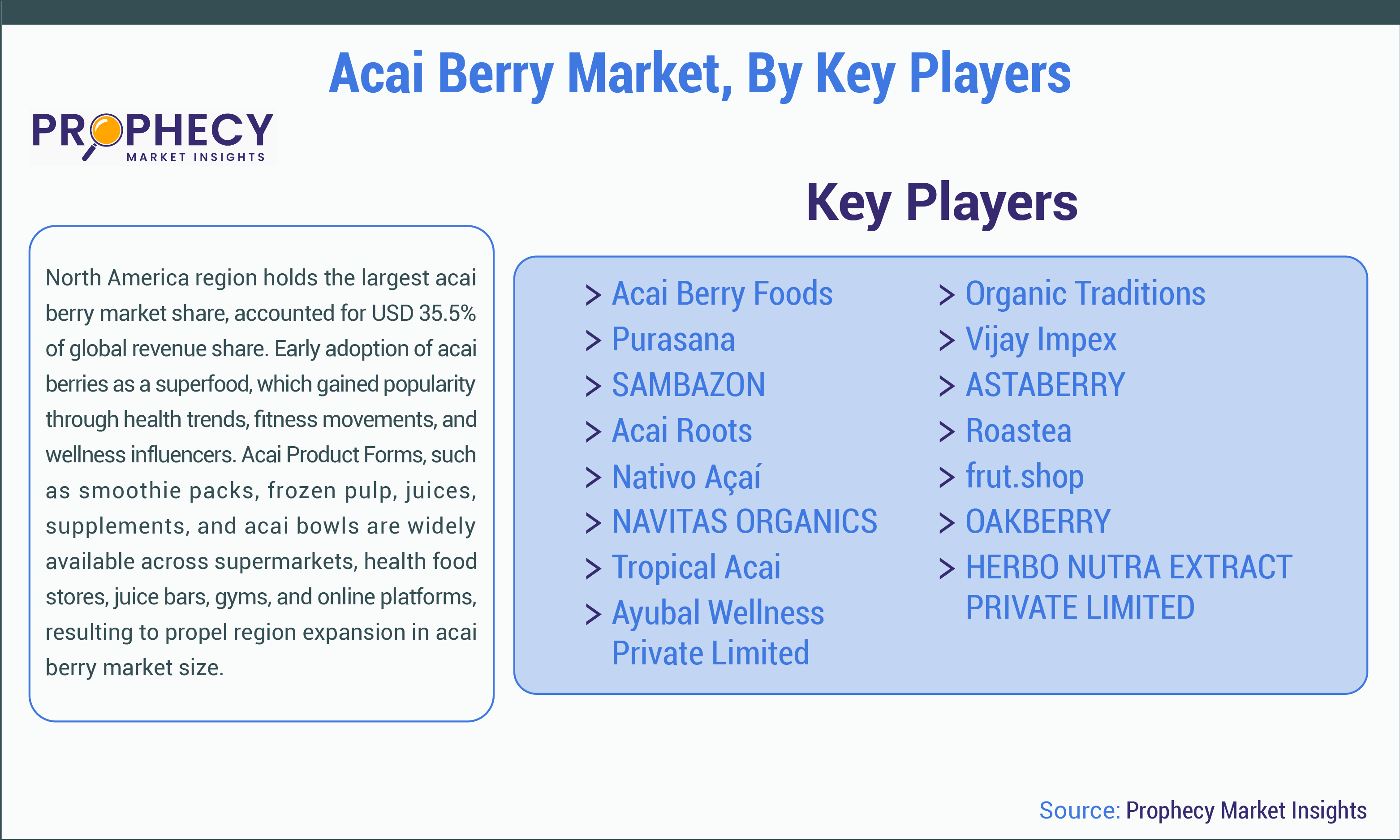
North America: This region holds the largest acai berry market share, accounted for USD 35.5% of global revenue share. Early adoption of acai berries as a superfood, which gained popularity through health trends, fitness movements, and wellness influencers. Acai Product Forms, such as smoothie packs, frozen pulp, juices, supplements, and acai bowls are widely available across supermarkets, health food stores, juice bars, gyms, and online platforms, resulting to propel region expansion in acai berry market size.
- U.S. Acai Berry Market Insights:
The U.S. is the largest and most dominant country in the North America market, driven by several factors, including early adoption of acai as a superfood and a well-established culture of health consciousness. The U.S. market benefits from a vast network of health-focused retailers, supermarkets, cafes, and juice bars that widely offer acai-based Product Forms such as smoothies, frozen pulp, powders, and dietary supplements. Consumer demand is fueled by growing awareness of the berry’s rich antioxidant content and potential health benefits, such as anti-aging and immune support, predicted to boost acai berry market size.
Europe: This is the second-largest market for acai berry. The increasing popularity of veganism, plant-based diets, and clean-label foods has contributed to the rising demand for antioxidant-rich superfoods such as acai. European consumers are highly ingredient-conscious, often preferring Product Forms that are organic, sustainably sourced, and fair-trade certified, is anticipated to boost acai berry market share.
- Germany Acai Berry Market Insights:
Germany is the leading country in the Europe for target market. The country has a well-developed retail network including specialty health stores, organic supermarkets, and online platforms, which facilitate broad access to acai Product Forms. Germany’s stringent food safety and quality standards encourage manufacturers to maintain high Product Form quality, boosting consumer trust, is estimated to impel acai berry market share.
Asia Pacific: This region is emerging as a rapidly growing market for acai berry, driven by rising health awareness, increasing disposable incomes, and the expanding influence of Western wellness trends. Countries such as India, China, Japan, South Korea, and Australia are witnessing a surge in demand for superfoods, including acai, as consumers become more focused on preventive healthcare, nutrition, and fitness, contributing to fuel acai berry market growth.
- China Acai Berry Market Insights:
China is the dominant country in the Asia-Pacific region's market. Rising disposable incomes, a burgeoning middle class, and increasing lifestyle diseases have led consumers to seek natural and functional foods such as acai. The growing fitness culture, interest in superfoods, and demand for immune-boosting supplements, is assessed to compel acai berry market size.

Acai Berry Market Report Scope:
|
Attribute |
Details |
|
Market Size 2025 |
USD 3.7 Billion |
|
Projected Market Size 2035 |
USD 7.2 Billion |
|
CAGR Growth Rate |
7.5% (2025-2035) |
|
Base year for estimation |
2024 |
|
Forecast period |
2025 – 2035 |
|
Market representation |
Revenue in USD Billion & CAGR from 2025 to 2035 |
|
Regional scope |
North America - U.S. and Canada Europe – Germany, U.K., France, Russia, Italy, Spain, Netherlands, and Rest of Europe Asia Pacific – China, India, Japan, Australia, Indonesia, Malaysia, South Korea, and Rest of Asia-Pacific Latin America - Brazil, Mexico, Argentina, and Rest of Latin America Middle East & Africa – GCC, Israel, South Africa, and Rest of Middle East & Africa |
|
Report coverage |
Revenue forecast, company share, competitive landscape, growth factors, and trends |
Segmentation:
By Product Form:
- Pulp
- Dried
- Frozen
- Powder
- Juice
- Extract
- Others
By Claims:
- Organic
- Non-GMO
- Gluten-free
- Dairy-free
By Application:
- Food & Beverage
- Nutritional Supplements
- Cosmetics & Personal Care
- Pharmaceuticals
- Others
By Distribution Channel:
- Hypermarkets & Supermarkets
- Convenience Stores
- Online Retails
- Specialty Health Stores
- Others
By Region:
- North America
- U.S.
- Canada
- Europe
- Germany
- U.K.
- France
- Russia
- Italy
- Spain
- Netherlands
- Rest of Europe
- Asia Pacific
- China
- India
- Japan
- Australia
- Indonesia
- Malaysia
- South Korea
- Rest of Asia Pacific
- Latin America
- Brazil
- Mexico
- Argentina
- Rest of Latin America
- Middle East & Africa
- GCC
- Israel
- South Africa
- Rest of Middle East & Africa
Global Acai Berry Market By Competitive Landscape & Key Players
The main key players operating in the acai berry market are, Ayubal Wellness Private Limited, Acai Berry Foods, Purasana, and others. These companies are constantly innovating, expanding their Product Form portfolios, and optimizing Product Formion processes to meet the evolving demands of consumers, through their collaboration or partnerships. Companies are investing in research and development (R&D) to introduce innovative form of Product Forms, resulting to propel acai berry market growth.
Acai Berry Market Companies:
- Ayubal Wellness Private Limited
- Acai Berry Foods
- Purasana
- SAMBAZON
- Acai Roots
- Nativo Açaí
- NAVITAS ORGANICS
- HERBO NUTRA EXTRACT PRIVATE LIMITED
- Tropical Acai
- Organic Traditions
- Vijay Impex
- ASTABERRY
- Roastea
- frut.shop
- OAKBERRY
View an Additional List of Companies in the Acai Berry Market
Global Acai Berry Market By Recent News
- In April 2025, OAKBERRY launched its new Signature Bowl menyu, featured with six lusciously layered açaí bowls. The Signature Bowl was available at OAKBERRY acai shop nationally for the consumers those looked to remix, revamp, and refresh their açaí experience. Signature Bowl includes variets of menus, such as Matcha Bowl, Golden Almonds Bowl, Fruity Bowl, Tiger Bowl, Original Bowl, and Crunchy Bowl, which aimed to give consumers to build their perfect bite.
- In February 2023, Ivia Beaute Pvt, Ltd. with its flagship brand Astaberry, launched its new range of Acai Berry Bio Hyaluronate Product Forms. This Product Form had variety of ranges packed with the goodness of Acai Berry and Bakuchiol. Infused with Acai berry and Bakuchiol, the Product Forms are known to be vegan and eco-friendly. Acai berry is loaded with antioxidants, minerals, and vitamins to boost collagen Product Formion and fight free radicals.
- In November 2022, Tropical Acai launched organic shelf-stable liquid acai pulp, known as Acai Bowl in a Bag. The company offered unique, delicious, healthy Product Form to market, with aimed to provide best quality Acai to the market.
- In October 2021, Red Bull India launched the new Purpule Edition with refreshing and unique taste of Acai Berry, made it perfect on-the-go drink to vitalize body and mind. The Red Bull Purple Edition is priced at USD 1.35 for 250 ml and is available nationally across retail outlets.
Analyst View:
The acai berry market driven by rising disposable income, changing consumer preferences, increased demand for nutritious supplements. Rising demand for superfoods, expansion of online grocery shopping, increases the demand for acai berry, rise in consumption of functional food, and growth in beverage sector, is anticipated to drive acai berry market growth.
More Related Reports
Cheese Powder Market
Frozen Bakery Products Market
Frozen Pizza Market
Frozen Fruits and Nuts Market
Fruit Pulp Market
Global Acai Berry Market By Company Profile
|
Company Name |
Acai Berry Foods |
|
Headquarter |
London, England |
|
CEO |
Marcus Carmo |
|
Employee Count |
78 Employees |
Global Acai Berry Market By Highlights
FAQs
Acai berry market size was valued at USD 3.7 Billion in 2025 and is expected to reach USD 7.2 Billion by 2035 growing at a CAGR of 7.5%.
Product form, claims, application, distribution channel, and region are the segmentation for the target market.
North America, Asia Pacific, Europe, Latin America, and the Middle East & Africa. North America is expected to dominate the market.
The key players operating in the acai berry market include Ayubal Wellness Private Limited, Acai Berry Foods, Purasana, SAMBAZON, Acai Roots, Nativo Açaí, NAVITAS ORGANICS, HERBO NUTRA EXTRACT PRIVATE LIMITED, Tropical Acai, Organic Traditions, Vijay Impex, ASTABERRY, Roastea, frut.shop, and OAKBERRY.